
AI Business
Welcome to the 💲Offer Fundamentals | AI Business Playbook, where we embark on a transformative journey to unlock the true potential of your business offers.
Start ReadingWe're kicking off a brand new series this week, diving deep into the 'O' of BATON - Offer.
Business: what value are we going to provide and to who?
Audience: how will we let them know about the value we have?
Tribe: how do we get permission to offer our value to prospects?
Offer: how do we package up our value and sell it to customers?
Network: how do we scale what works into a business?
This is where the rubber meets the road, folks. We're talking about actually making some money. Exciting, right?
Let’s get started:
Introducing Offer
value into revenue
problem-solving all the way down
mapping your funnel
You might be wondering, "Kyle, why the hell are we only talking about making money now? Isn't that the whole point of a business?"
Fair question! Here's the deal: online trust is hard to come by. Like, really hard.
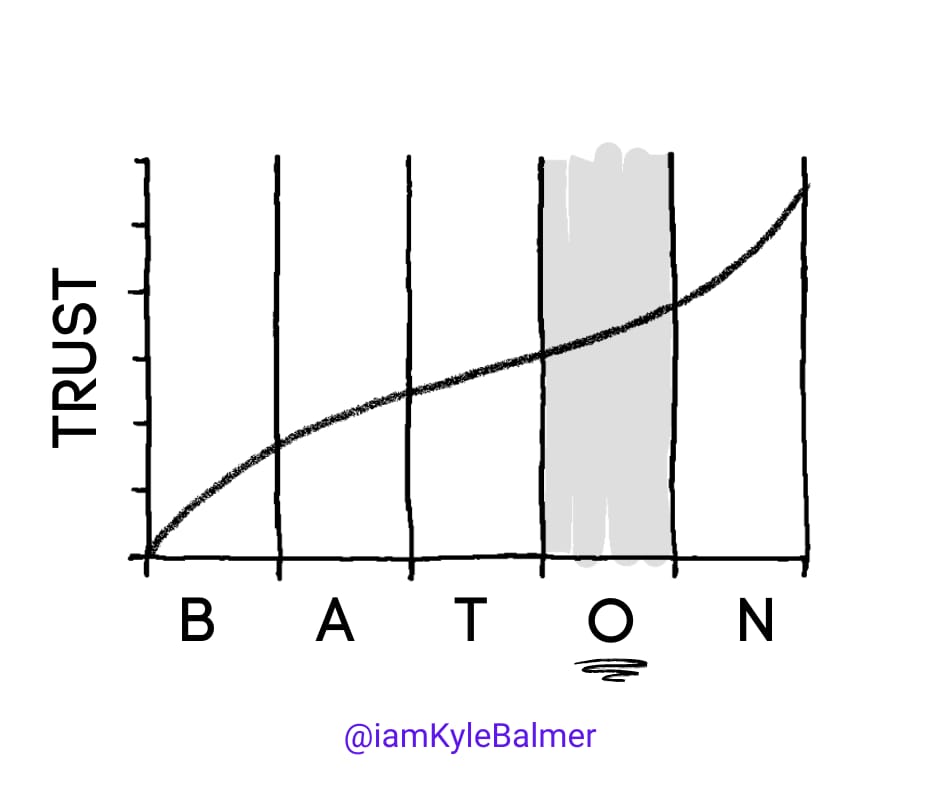
The BATON system is built to overcome this trust barrier. Let's recap:
B - Business: We figured out what value we're providing to the market.
A - Audience: We got that value out into the world via audience building.
T - Tribe: We converted that audience into a tribe of people who actually want to hear more from us.
And now, finally, we're ready to build an offer and make some sales.
By doing it this way, we're overcoming the MAIN problem entrepreneurs face - building something that no one wants! This, more than anything, is what sinks new businesses (and existing ones too!).
Instead of jumping straight to selling, we've been focused on creating value by solving problems. It's been our through-line through the entire BATON process:
1. What problem do our potential customers have?
2. We use content marketing to discuss and help with these problems.
3. We build a tribe to continue this relationship and build trust.
4. Now, we create products and services to close the deal.
It's the same customer problems all the way through - just different levels of assistance.
Let's use a personal trainer as an example. If you're helping people lose weight, you could just say "eat less, move more." That's correct, and if people just did that, they'd lose weight.
But people don't - the multi-billion dollar weight loss industry is proof of this. They need additional help, in the form of products and services, to get them to their desired result.
That's what Offer is all about: building out the products and services we'll be selling to help people solve their problems and reach their outcomes.
Before we dive into creating offers, we need to have a map of where we're going. This is our funnel.
A sales funnel is essentially the journey a customer takes from first becoming aware of your brand to making a purchase (and hopefully, repeat purchases). It typically looks something like this:
1. Low-cost entry offer: $10-20, easily consumable digital product
2. Core offer: Around $100-500, more comprehensive digital product
3. Premium offer: $1000+, high-value digital product or service or hybrid
4. Top-tier service: $10,000+, done-for-you service
Of course, these price points will depend entirely on your niche and what costs are usual in your industry. The main point is that there should be an escalation from one stage to the next.
Let's use a prompt to generate our funnel:
You are an AI assistant specialising in business strategy and sales funnel creation. Your task is to help the user develop a customised sales funnel for their business based on the BATON framework. Follow these steps:

1. Ask the user to provide the following information:
   a. A brief description of their business and the main problem they solve for customers
   b. Their target audience and any specific characteristics of this audience
   c. The typical price range for products/services in their niche (low-end to high-end)
   d. Any existing products or services they offer

2. Based on the information provided, create a customised sales funnel with four main levels. Focus on customer problems. Try to incorporate their existing products and services and offer amendments to fit their existing offers into the funnel:

   a. Low-cost entry offer:
      - Suggest a product or service priced between $10-$50
      - This should be easily consumable and provide quick value
      - Example formats: ebook, short video course, template pack, etc.

   b. Core offer:
      - Suggest a product or service priced between $100-$500
      - This should be more comprehensive and solve a significant problem
      - Example formats: in-depth course, software tool, group coaching program, etc.

   c. Premium offer:
      - Suggest a high-value product or service priced $1000+
      - This could be a digital product, service, or hybrid
      - Example formats: high-end course, 1-on-1 coaching, done-with-you service, etc.

   d. Top-tier service:
      - Suggest a premium, done-for-you service priced $10,000+
      - This should be the highest level of personalised service or results
      - Example formats: done-for-you implementation, high-touch consulting, etc.

3. For each level of the funnel, provide:
   - A catchy name for the offer
   - A brief description of what it includes
   - The main problem it solves or result it provides
   - Why it's valuable to the customer
   - How it leads to the next level of the funnel

4. Suggest 2-3 potential upsells or cross-sells that could be added between the main funnel levels.

5. Conclude with 2-3 tips on how to ensure smooth transitions between funnel levels and maintain trust throughout the customer journey.

Present your response in a clear, easy-to-follow format with appropriate headings and bullet points. Encourage the user to adapt and refine the funnel based on their specific business needs and customer feedback.
Over the rest of this Playbook, we'll be fleshing out this funnel, talking about how to build and launch each element, and then finally how to tie it all together.
Specifically here's what's coming up:
1. Outlining our funnel (that's today!)
2. Starting with a service
3. Launch methods to ensure success
4. Creating digital products
5. Upsells, escalations, and tying everything together
By the end of this week, you'll have a clear roadmap for creating and launching your offers, and you'll understand how to guide customers through your value ladder.
Remember, we're not just selling stuff here. We're providing solutions to real problems, solutions that our audience has already shown interest in through our previous BATON steps.
This isn't about pushing products - it's about delivering value in a way that also sustains and grows your business. Do this and you’ll do well.
Premium subscribers, I'll see you tomorrow when we dive into starting with a service - often the quickest way to start generating revenue.
If you're not a premium subscriber yet, what are you waiting for? Don't miss out on the full Offer-building blueprint! FYI we’ve revamped Premium so it’s even more valuable - it’s getting a bit silly to be honest! Details here.
You are currently on the free plan or trial.
The email you just read is Part 1 of a 5-part series.
Every week I write an AI Business and Entrepreneurship series to help you:
Start a business using AI
Grow your existing business using AI
Up-skill and use AI for your career progression
But, when you upgrade, you don’t just get the premium email newsletter…
You also get : AI business courses, private community, video playbooks, expert talks and instant access to 40+ AI Business Playbooks.
(Price increase after 200 members).
If you feel this is not for you — Unsubscribe here.
Keep prompting,
Kyle
We're continuing our deep dive into the 'O' of BATON - Offer.
Yesterday, we mapped out our sales funnel. Today, we're going to talk about why we're not going to build it... yet.
Confused? Don't worry, it'll all make sense soon. I hope anyway!

Let’s get started:
Starting with Service: The Counterintuitive First Step
why not rush into digital products?
the power of starting with service
crafting your service offer
Digital products are the bomb. They are the holy grail of online business. Assets that you build once and sell forever, automatically, in your sleep.
That is entirely doable. It’s not just online guru BS.
But - we’re not deploying digital products in our Offer just yet.
"Hold up, Kyle," I hear you say. "Yesterday you told us about this beautiful funnel with digital products at the start. Now you're saying we shouldn't build those first? What gives?"
I get it. It seems counterintuitive. But there's a method to this madness, I promise.
Here's the deal: our final funnel is a map guiding our final destination. But we won't build it in that order. Why? Because during the planning stages, our full offer funnel is theoretical. We need to build it with respect to what our customers actually want. And to do that, we need their input.
If we rush off and build our first digital products, we're building blind. We could spend weeks or months compiling a course or writing an ebook, but we're doing that with reference only to ourselves.
In fact this is what most people do. And if you’ve ever had a failed product it’s probably what you did too.
Instead, we need to be talking to and working with customers first and foremost.
And this means, in the early days, starting with a service.
We start by offering a basic, MVP (Minimum Viable Product, or service in this case…) version of our service.
This lets us truly nail our customer problems and our solutions because we're talking to them daily, weekly, or monthly about what they need.
We start with the highest value part of our offer - our premium service. Why?
Because if we can't solve their problem using this, then we can't solve their problems using stripped-down product versions either. If you can’t solve their problem when you are giving it your all then you can’t help them. Sound brutal - but it’s true. Do yourself (and your customers) a favour and don’t pursue the idea if you can’t pull it off.
Instead by deploying our service first we give ourselves (and customers) the best chance of resolving their initial problem. Which is how we drive value and which is what businesses exist to do.
Then, sneak preview, we'll bundle all of our learnings from our service into products. And we'll make the service we are now building the premium upsell after the products. We back into our funnel. We’ll cover that later in this Playbook.
Right now, the key is working out what that service offer looks like. There are two basic components - the customer problem and our solution.
Problems we’ve discussed. And you should have honed in on during the Audience and Tribe parts of building your business. If you do not know your customers’ problem go back and start again - do NOT try to sell them anything.
Let's say our customer problem is having excess body weight. They want to shift it, cut down, and lose weight. Our solution could come in a huge range of options - group coaching, 1:1 meal plans, personal chef, an on-demand video course. The options are limitless.
They fall, however, along a couple of axes:
1. The range of delivery: Is it 1:1, small group, or one-to-many?
2. The format of delivery: In-person, written, audio, video, etc.
3. Your input as provider: Is it Done For You, Done With You, or Do It Yourself (customer does the work)?
Let's use this prompt to generate some service ideas based on your customer problems:
You are an AI assistant specialising in business strategy and service development. Your task is to help the user generate a variety of service (no products) ideas based on their customer's primary problem. Use the following context and framework to guide your response:

Context:
When developing a new business offer, it's often best to start with a service rather than a digital product. This allows for direct interaction with customers, immediate feedback, and the ability to refine the offer based on real-world needs. Services can vary along three main axes:

1. Range of delivery: 1:1, small group, or one-to-many
2. Format of delivery: In-person, written, audio, video, etc.
3. Level of provider input: Done For You, Done With You, or Do It Yourself

Instructions:
1. Ask the user to provide the following information:
   - A clear, concise statement of their customer's primary problem

2. Based on the provided problem, generate 15 diverse service ideas. For each idea, include:
   - A catchy name for the service
   - A brief description (1-2 sentences)
   - The range of delivery (1:1, small group, or one-to-many)
   - The format of delivery (in-person, written, audio, video, etc.)
   - The level of provider input (Done For You, Done With You, or Do It Yourself)

3. Ensure that your ideas cover a wide range of possibilities across all three axes.

4. After presenting the ideas, remind the user to:
   - Remove any ideas they personally don't want to pursue
   - Consider which ideas might be most appealing to their target audience
   - Remember that the final choice will be made based on customer interest, not personal preference alone

5. Conclude with a brief explanation of why starting with a service can be beneficial:
   - Immediate customer feedback
   - Ability to iterate quickly
   - Opportunity to build deep understanding of customer needs
   - Potential to create case studies and testimonials
   - Generate revenue while developing future product offerings

Present your response in a clear, easy-to-follow format with appropriate headings and bullet points. Encourage the user to view these ideas as starting points that can be refined based on customer interactions and feedback.
This prompt will take a customer problem and turn it in 15 potential service ideas.
Feed in one customer problem only for best results. Clarity matters. If your customers have various problems re-run the prompt for each.
From the generated ideas, go ahead and remove all the ones you DON'T want to do. They're off the table.
You should still be left with many options. How to choose?
Here’s the crucial part: You don't. Your customers will. We'll cover the launch method in the next Part.
Starting with a service offer allows us to:
Get immediate feedback from real customers
Iterate quickly based on what's working and what isn't
Build a deep understanding of our customers' needs
Create case studies and testimonials for future marketing
Generate revenue while we're building our product suite
It's like getting paid to do market research whilst we develop the digital product versions of our Offer. Not a bad deal, right?
In the next Part we're going to dive into how to actually launch this service offer. We'll talk about the cohort launch method - a powerful way to validate your offer and start bringing in revenue quickly.
Remember, the goal here isn't to build the perfect offer right out of the gate. It's to start serving customers, learning from them, and refining our offer based on real-world feedback. It's about building something people actually want, not just what we think they want.
If you're not a premium subscriber yet, what are you waiting for? Don't miss out on the full Offer-building blueprint! And when you upgrade you’ll instantly unlock 40+ AI Business Playbooks and the Private Community Area. Learn more here.
Keep prompting,
Kyle
In the last Part we came up with some ideas for our service. Today, we're going to figure out which one to run with and how to launch it.
And we’re finally going to bank some cash - horray!
Let’s get started:
Zero Risk Launch Method
validating your ideas before spending a penny
gathering detailed feedback
the pre-sale process
nailing the delivery
repeat to refine
Remember those service ideas we came up with in the last Part? The ones based on solving problems for your customers, just in different modalities?
Now we’re going to launch and start generating revenue. But…which idea?
We rejected the ones WE didn't want to do as our first pass. No use if you aren't enthusiastic. That’s a start but likely you’ll have lots left.
Now we're going to find out which of the other ideas we should run with. And we're going to do it in the smartest way possible - by asking our audience and tribe.
Quick aside: If you haven't got an Audience and Tribe in place, I would highly recommend looping back to those playbooks and working those out first. They will make launching services and products much, much easier and save you from making expensive (cost and time) mistakes. It’s a relatively small time/cost investment.
By having an Audience and Tribe, we can simply ask which of our services (and later products) they want. This makes launching infinitely easier, as we'll shortly see.
Here's what we're going to do with our service ideas:
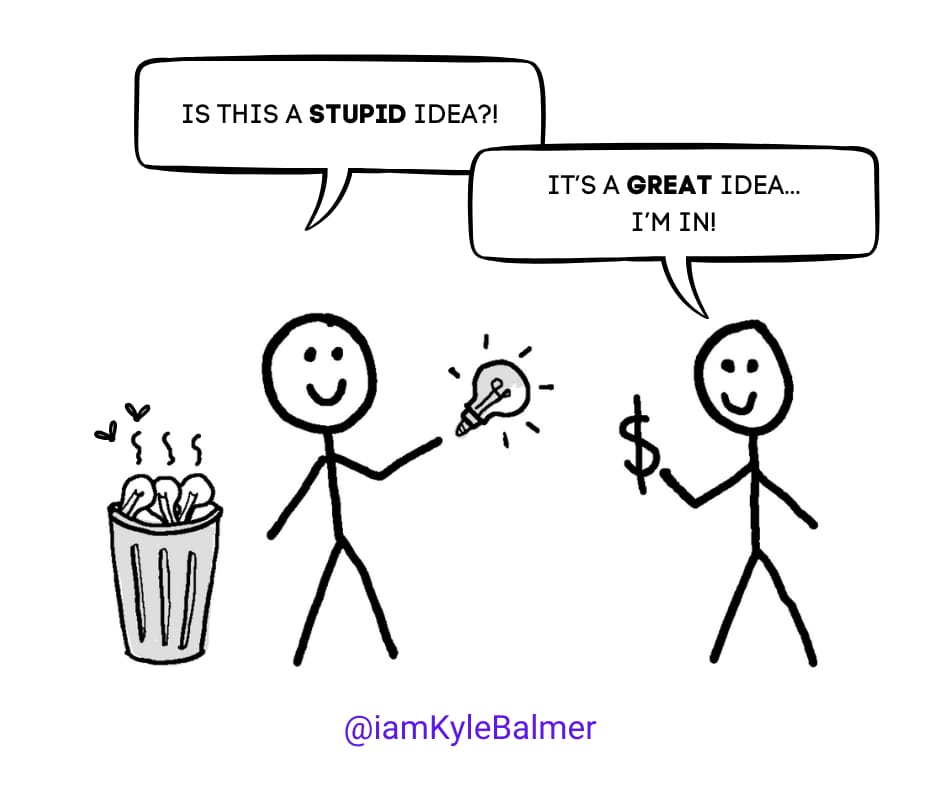
For our Audience, we'll put out a tweet saying, "I'm thinking of launching XYZ. Is this a stupid idea or something you'd be interested in?" If you're more video-oriented (Instagram or TikTok for example), do the same basic message in a short video - "Here's what I'm thinking, roughly what it'll look like. Are you interested?"
We do the same with our Tribe - we put ideas into our emails with a poll asking for feedback.
If enough people say they're interested, we progress. If not, we go back to our list of service ideas and try another.
We keep doing this until we get a definite "yes please!!" from our audience and tribe. You'll know when it happens - you're looking for a disproportionate YES! Anything less, a lukewarm response, isn't worth pursuing.
We still don't launch though! I know, I know! But it’s worth it!
We will first send out a survey and collect information about what people are interested in. Here's a basic prompt to help you create that survey:
You are an AI assistant specialising in market research and customer discovery. Your task is to help the user create a survey to gather crucial information from potential customers before launching a new service. Use the following context and framework to guide your response:

Context:
Before launching a new service, it's essential to understand exactly what potential customers want and expect. This survey will serve as a market research tool to refine the service offering and ensure it meets customer needs.

Instructions:
1. Ask the user to provide the following information:
   - A clear, concise statement of their customer's primary problem
   - A brief description of the proposed service solution

2. Based on the provided information, generate a list of 10-15 survey questions. The questions should cover the following areas:

   a. Problem validation:
      - Confirm the existence and severity of the problem
      - Understand how the problem impacts the customer's life or business

   b. Current solutions:
      - Explore what solutions (if any) the customer is currently using
      - Identify pain points with existing solutions

   c. Service specifics:
      - Gauge interest in specific features or aspects of the proposed service
      - Determine preferred delivery methods (e.g., 1:1, group, online, in-person)
      - Assess desired frequency or duration of the service

   d. Pricing and value:
      - Understand the customer's budget for solving this problem
      - Explore what aspects of the service they value most

   e. Objections and concerns:
      - Identify potential objections or hesitations about using the service
      - Understand what might prevent them from purchasing

   f. Desired outcomes:
      - Clarify what success looks like for the customer
      - Determine how they would measure the effectiveness of the service

3. Include a mix of question types:
   - Multiple choice
   - Rating scales
   - Open-ended questions for more detailed feedback

4. After presenting the survey questions, provide brief guidance on:
   - How to distribute the survey (e.g., email to your list, social media polls)
   - Recommended sample size for
Put the survey together in Google Forms as a basic tool or feel free to use a premium tool like Typeform.
Once we've collected this information, we're ready for the launch. We can feed information from our survey back into another prompt to come up with our launch offer:
You are an AI assistant specialising in service design and marketing. Your task is to help the user create a tailored service offer based on survey responses from potential customers. Use the following context and framework to guide your response:

Context:
The user has conducted a survey to gather insights about their potential customers' needs, preferences, and pain points regarding a specific problem and proposed service solution. Now, they need to create a service offer that aligns with the most common and significant customer requirements.

Instructions:
1. Ask the user to provide the following information:
   - A brief summary of the survey responses, highlighting the most common themes and preferences
   - The proposed service idea (as it stood before the survey)

2. Based on the provided information, create a tailored service offer that addresses the main overlapping requirements consistently mentioned in the survey. Include:

   a. Service Overview:
      - A catchy name for the service
      - A concise (2-3 sentence) description of what the service offers
      - The primary problem it solves for customers

   b. Key Features:
      - List 3-5 main features or components of the service
      - Explain how each feature addresses a specific customer need or preference identified in the survey

   c. Delivery Method:
      - Specify how the service will be delivered (e.g., 1:1 coaching, group sessions, online course, etc.)
      - Explain why this delivery method was chosen based on survey responses

   d. Duration and Frequency:
      - Outline the length of the service (e.g., 6-week program, ongoing monthly service)
      - Specify the frequency of interactions or deliverables

   e. Pricing Structure:
      - Suggest a pricing model that aligns with the survey responses about budget and perceived value
      - Explain the rationale behind the pricing

   f. Unique Selling Proposition:
      - Craft a statement that distinguishes this service from potential competitors
      - Base this on the specific needs and preferences expressed in the survey

3. Create marketing materials for the service:

   a. Email Pitch:
      - Subject line
      - Opening hook
      - 3-4 paragraphs describing the service, its benefits, and why it's perfect for the recipient
      - Clear call-to-action

   b. Social Media Pitch:
      - A short (280 character) Twitter-style pitch
      - A longer (1-2 paragraph) Facebook/LinkedIn-style post
      - 3-5 hashtags to use with the social media posts

4. Provide suggestions for:
   - Any bonuses or add-ons that could increase the value of the offer
   - Potential upsells or cross-sells based on secondary needs identified in the survey
   - Ideas for a satisfaction guarantee or risk reversal to address any common objections

5. Conclude with brief guidance on:
   - How to test this offer with a small group before a full launch
   - The importance of continuing to gather feedback and iterate on the service

Present your response in a clear, easy-to-follow format with appropriate headings and bullet points. Encourage the user to adapt and refine the offer based on their unique understanding of their audience and business goals.
For example I fed in 200+ survey responses I currently have about an AI Expert community. The prompt took all of that information and crafted an offer package for me.
Here’s the pitch email as an example:
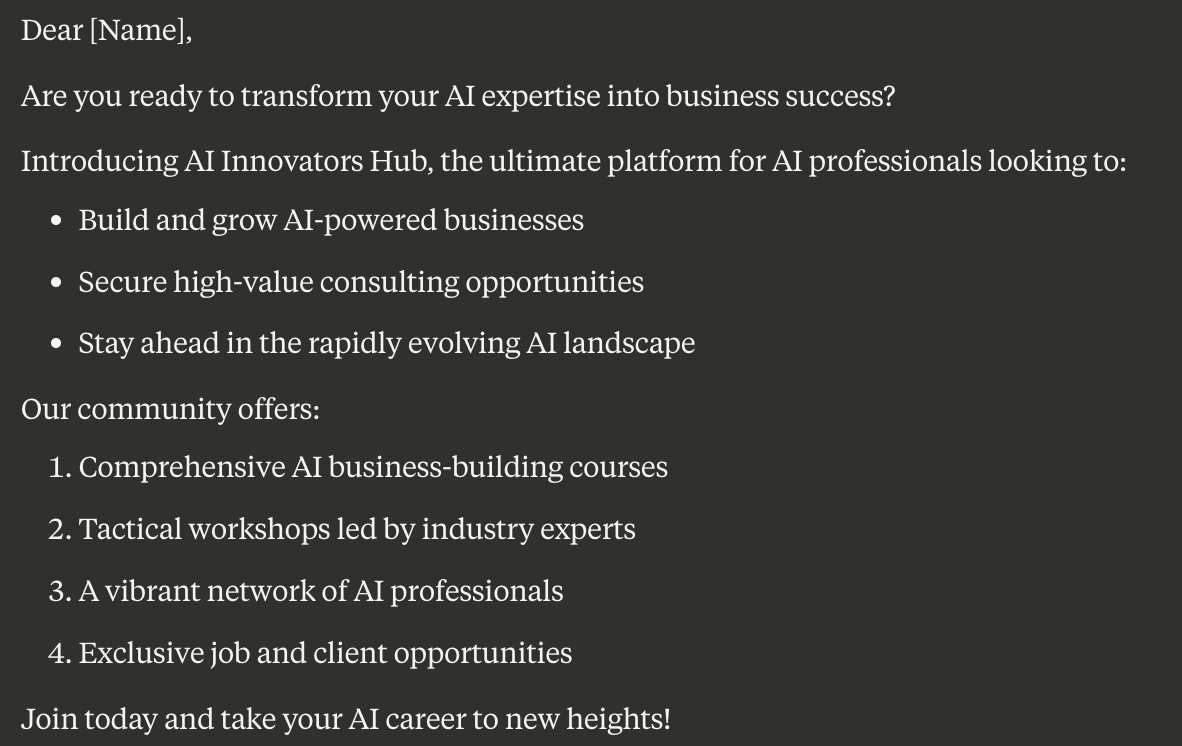
Run your potential customers’ survey answers through the prompt to generate a similar summary of the service you should be providing them.
Now take this back to your list and audience for a pre-sale. Set up a basic page. If you have a website, great! Do a sales page and hook it to Stripe. If you don't, use Gumroad, Carrd, Topmate or a similar tool to set up a basic sales page + checkout.
Topmate is great if you are doing 1:1 services as it allows you to take calendar bookings. Caard and Gumroad are solid for non “time-specific” sales.
Then go for the pre-sale.
Set limits on capacity. If it's a 1:1 service, the limits will be lower than if group-based or one-to-many. But still restrict capacity for i) your sanity and ii) to keep quality of delivery high. It's tempting to want to fill your calendar (if getting paid!) but be careful not to overcommit.
Make your first sale lower cost than it will be later. Our goal right now is feedback - we want the first customers through the door and to achieve the goal for them. We'll make money later!
Right now, charge enough to make sure they are committed to the result (don't give it away free - they won't value it!!). Pricing depends on niche and value to them, so it's hard to give a price, but very likely order of magnitude is not 10s and not 1000s - it'll be 100s.
Now you are going to absolutely nail the delivery. You will overdeliver, in fact.
If you find that they haven't reached their goal by the end of the service, then you will keep going until they do. And then we'll build that extra mile into the product and service moving forward.
Importantly, we use this first pass to learn. What do they need to solve their problem? What supplemental resources? What additional assistance? What blockages do they all seem to hit? What additional content or education do they need from you? We use the first delivery to suss all this out. We are getting paid to build with them.
Also, make sure to collect testimonials and reviews. I personally use Senja, but use whatever works best for you.
Once you've finished with the first batch, do it again! Increase the price, layer in the social proof you have achieved from first customers. Repeat, learn more, continue to refine.
The more repetitions you do, the more you'll learn about how to solve your customer's problem. And it's this hard-won knowledge that we'll be baking into our products in the next Part.
Next up we're going to talk about how to take all this learning and package it into a digital product. We're moving down our funnel, folks, and it's going to be exciting.
Remember, the goal here isn't just to make sales (although that's nice). It's to deeply understand your customers' needs and how to meet them. That's the key to building a sustainable, successful business.
If you're not a premium subscriber yet, what are you waiting for? Don't miss out on the full Offer-building blueprint! And when you upgrade you’ll instantly unlock 40+ AI Business Playbooks and the Private Community Area. Learn more here.
Keep prompting,
Kyle
We're still deep in the 'O' of BATON - Offer.
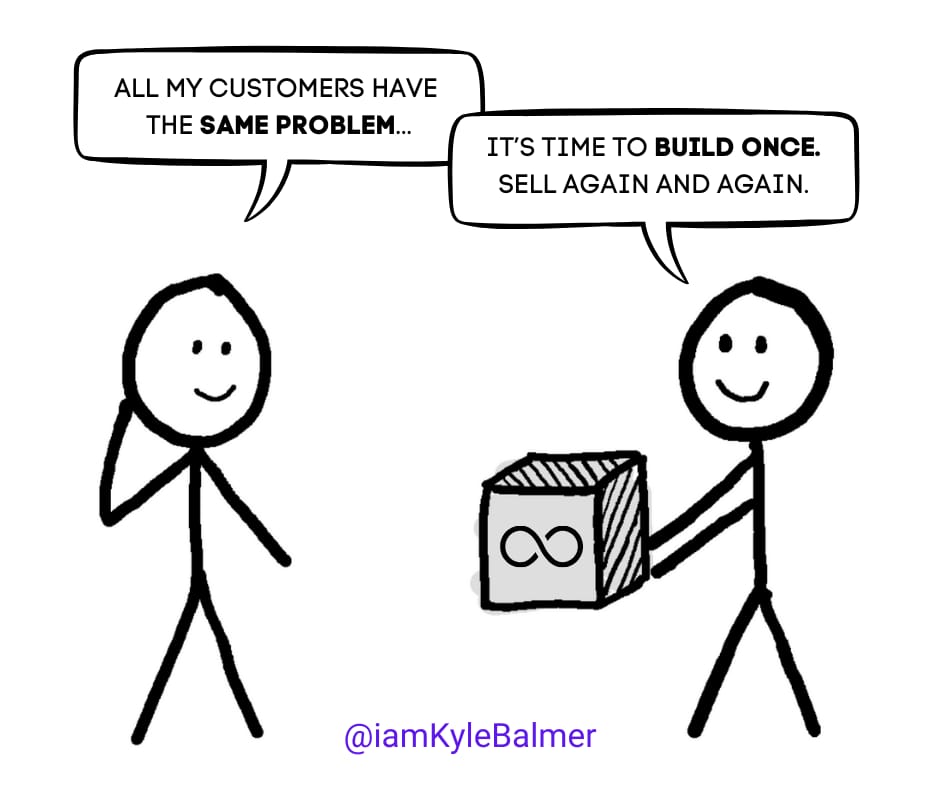
Yesterday, we talked about launching and refining your service. Today, we're going to take those learnings and finally turn them into a scalable digital product.
Let’s get started:
From Service to Digital Product
identifying customer problems
generating product ideas
launching your digital product
building and hosting
The beauty of starting with a service is the face-time you get with customers. It's like a goldmine of insights just waiting to be tapped. After providing enough service, you'll start to see themes pop up again and again.
Here's what you need to do:
Note down the main problems your customers have.
Keep track of how often each problem comes up.
Pro tip: If you provide your service online, you've got a secret weapon. Export all the transcripts from your service calls and run them through an AI to extract patterns. Here's a simple prompt to do just that:
Analyze the following service call transcripts. Identify the main customer problems mentioned, list them in order of frequency, and provide a brief summary of each problem.

[Paste your transcripts here]
Use a large context window model for a request like this to ensure you can load all the transcripts in.
If you're not doing online calls, no worries. Just keep note of each customer and their main problem. As you continue, you'll see patterns emerge naturally.
Now that we've got our list of customer problems, it's time to turn them into product ideas. And guess what? I've got a prompt for that too:
You are a product development expert. Based on the following list of customer problems, generate digital product ideas that address these issues. For each problem, create three product versions:

1. Lead Magnet (free, quick-win product)
2. Core Offer (main paid product)
3. Premium Offer (high-end, comprehensive solution)

For each product idea, provide:
- A catchy name
- A brief description (2-3 sentences)
- Key features or components
- How it specifically addresses the customer problem
- Potential pricing strategy

Customer Problems:
[List your identified customer problems here]

Ensure that each product idea logically builds upon the previous one, creating a clear value ladder for customers. Consider various formats such as ebooks, video courses, software tools, templates, or coaching programs. Be creative and focus on providing tangible value at each level.
This prompt is designed to give you lead magnet, core, and premium versions of a product for each idea.
Load up all of your customer problems to generate multiple potentials here.
Remember how we launched our service? We're going to use the same method here:
Ask if people would be interested first! Ask about the core product specifically.
Build a tripwire (low-cost entry product) and launch it for feedback.
Once you've achieved interest, build the full product.
As with our initial service launch the beauty of this approach is that you're validating at every step. No more building products in a vacuum and hoping people will buy! It doesn’t work!
Now, I can't tell you exactly how to build your product because, well, I don't know what it is! But I can give you a prompt to help you figure out the build steps:
You are a digital product creation specialist. For the following product idea, provide a detailed step-by-step guide on how to build and launch it. Consider the following aspects:

1. Content Creation:
   - Outline the main topics or modules
   - Suggest resources or research needed
   - Estimate time required for content development

2. Product Format:
   - Recommend the best format(s) for delivery (e.g., PDF, video, interactive website)
   - Suggest tools or software needed for creation

3. Production Process:
   - Break down the production into manageable tasks
   - Provide a timeline for each phase of development

4. Testing and Quality Assurance:
   - Suggest methods for testing the product
   - Recommend ways to gather initial feedback

5. Launch Preparation:
   - Outline steps for setting up the sales page or platform
   - Suggest marketing materials needed (e.g., email sequences, social media posts)

6. Post-Launch:
   - Provide ideas for gathering customer feedback
   - Suggest methods for ongoing improvement and updates

Product Idea:
[Paste your product idea here, including its name, description, and key features]

Please provide a comprehensive guide that a non-technical person could follow to create and launch this digital product. Include any relevant tools, resources, or best practices that would be helpful in the process.
Pull in ONE product idea from the previous step and copy/paste it into this prompt. This will give you a step by step of how to build out your product. I’ve also written specific Playbooks on different formats.
As for hosting, let's keep it simple. Gumroad is a great option for digital products. It allows you to set up a paywall easily, and you can even use it for your lead magnets.
Here's how you might structure it:
- Lead magnet as the free version (remember what we covered about lead magnets in the previous Playbook)
- Core product as a paid version
- Premium product as an upsell
My recommendation? Start with a bunch of core products first, then add premium versions later. But you've got a sketch of what that looks like from the prompt above, so you're all set to go when the time comes.
In the next and final Part of this series, we're going to look at pulling all of this together. We'll talk about how to streamline your offer funnel, from lead magnets all the way up to your premium products and services.
Remember, the goal here isn't just to create a random bunch of products. It's to create a seamless journey for your customers, solving their problems at every step of the way.
Keep prompting,
Kyle
We've reached the final day of our deep dive into the 'O' of BATON - Offer.
Today, we're tying it all together. We're going to see how everything we've learned in BATON connects to create a comprehensive business funnel.
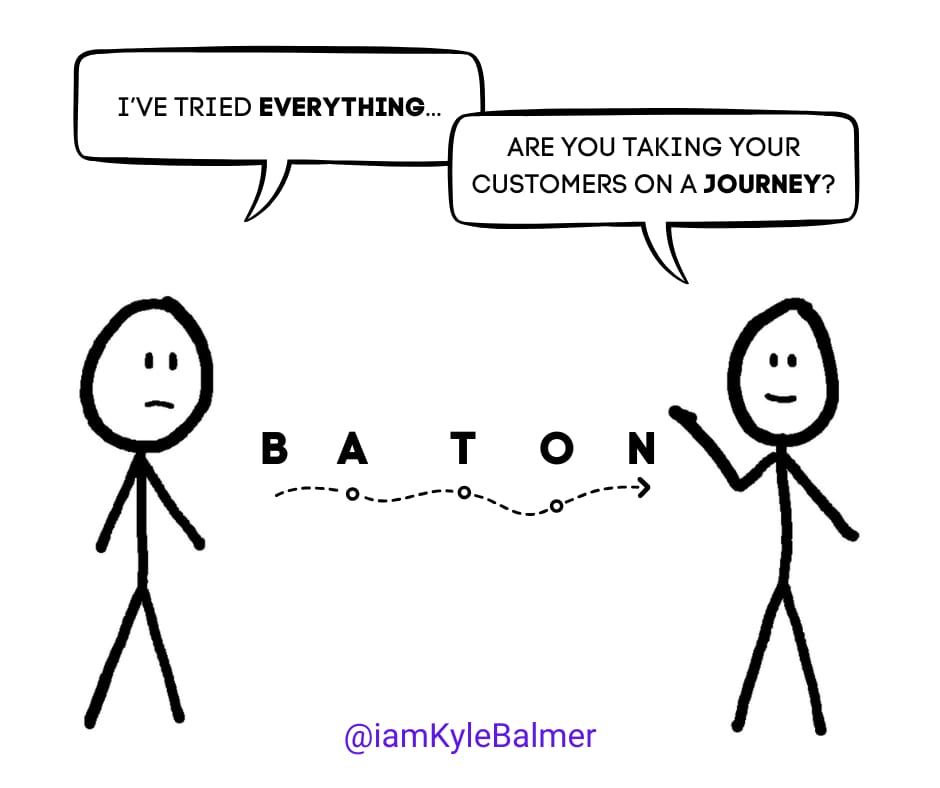
Let’s get started:
Tying it All Together
revisiting the funnel
creating your complete funnel
tying it all together
master checklist
Let's start by revisiting our funnel. Remember, this isn't just about offers - it's about the entire BATON process. Specifically:
Business: Identifying customer problems
Audience: Creating content (from wide, surface-level to detailed) to address their problems
Tribe: Lead magnets and email list building off the back of content
Offer: Core product, premium product, service
This funnel takes your customer on a journey from first encountering your brand to becoming a high-value client.
Let's look at an example using weight loss as the customer problem:
Business: Identifying that customers struggle with sustainable weight loss
Audience: Creating content on nutrition, exercise, and lifestyle changes
Tribe: Offering a free "7-Day Meal Plan" lead magnet to build an email list
Offer:
Lead Magnet: 7-Day Meal Plan
Core Product: 30-Day Weight Loss Program
Premium Product: 90-Day Body Transformation Course
Service: 1-on-1 Personalised Coaching
Now it's your turn. Let's use this prompt to piece together your complete funnel:
You are an AI assistant specialising in business strategy and funnel creation. Your task is to help the user create a complete business funnel based on the BATON framework. Follow these steps:

1. Ask the user to provide the following information:
   a. The main customer problem they're addressing
   b. Their most popular content pieces
   c. Their lead magnet
   d. Their core product offer
   e. Their premium product offer
   f. Their service offering

2. Based on the provided information, create a comprehensive funnel chart that includes:

   a. Business:
      - The identified customer problem

   b. Audience:
      - List the content pieces, organised from broad to specific

   c. Tribe:
      - The lead magnet and how it connects to the email list

   d. Offer:
      - Lead Magnet
      - Core Product Offer
      - Premium Product Offer
      - Service Offering

3. For each component of the funnel, provide a brief description of its purpose and how it leads to the next stage.

Present your response in a clear, easy-to-follow format, using a combination of text and a visual representation of the funnel if possible. Encourage the user to view this as a living document that can be refined over time based on customer feedback and business results.
If you’ve been running all your previous work in the same chat then you can feed everything in automatically.
Remember, for the Offer component, we build backwards. We start with the service, then build out products based on feedback. Then we make our service offer our most expensive offer moving forward. We shift it’s position in the running order.
Now that we have our complete funnel, let's tie the components together. The connections will depend on the components of your funnel.
I’ve recommended certain tools like beehiiv and Gumroad but chances are you are using different platforms. Because of this we need an integration plan that matches your tech stack.
We'll use another prompt to help with this:
You are an AI assistant specialising in marketing technology and funnel optimisation. Your task is to help the user integrate the various components of their business funnel. Follow these steps:

1. Ask the user to provide the following information for each component of their funnel:
   a. The specific tool or platform they're using (e.g., ConvertKit for email, Teachable for courses)
   b. If they haven't chosen a tool, ask them to specify their requirements

2. For each component, provide recommendations:
   a. If the user has a tool, confirm if it's suitable or suggest alternatives if necessary
   b. If the user hasn't chosen a tool, recommend 2-3 options based on their needs

3. Create an integration map that shows how each component connects to the others. For each connection, specify:
   a. If there's a native integration available
   b. If an API connection is possible
   c. If a third-party tool like Zapier is needed
   d. If a manual process is required

4. For each connection, provide step-by-step instructions on how to set it up, or link to relevant documentation.

5. Suggest automation opportunities, such as:
   a. Automatically adding lead magnet subscribers to a specific email sequence
   b. Triggering upsell offers based on product purchases
   c. Segmenting the email list based on user behaviour or purchases

6. Identify any potential gaps in the funnel where leads might be lost, and suggest solutions.

Present your response in a clear, easy-to-follow format, using a combination of text and a visual representation of the integrated funnel if possible. Encourage the user to start with the most critical integrations first and gradually build out the full system over time.
This prompt will help you identify the platforms for each component and suggest ways to connect them, whether through native integrations, APIs, Zapier, or manual links.
If you don’t yet have a platform in mind it’ll also provide some recommendations. It’s basically an integrations expert.
I know what you're thinking: "Kyle, this is a lot of work!" And you're right. We're looking at the complete business here! But now you have the map and the steps to deploy it all.
One last prompt! To help you get started, here's a prompt to generate a master checklist:
You are an AI assistant specialising in project management and business operations. Your task is to create a comprehensive checklist for deploying a complete business funnel based on the BATON framework. Follow these steps:

1. Create a master checklist that covers the deployment of all funnel components:
   a. Business (problem identification)
   b. Audience (content creation)
   c. Tribe (lead magnet and email list)
   d. Offer (products and services)
   e. Integration and automation

2. Break down each major task into subtasks that can be completed in approximately 30-minute chunks.

3. For each task, include:
   a. A clear, actionable description
   b. Estimated time to complete
   c. Any prerequisites or dependencies
   d. Tools or resources needed

4. Organise the checklist in a logical order of operations, considering dependencies between tasks.

5. Include checkpoints for testing and quality assurance throughout the process.

6. Add tasks for setting up analytics and tracking to measure the funnel's performance.

7. Include reminders for ongoing tasks, such as content creation and email list maintenance.

8. Suggest points where the user should pause and gather feedback before proceeding.

9. Include tasks for documenting processes and creating standard operating procedures (SOPs).

10. Conclude with a section on next steps and continuous improvement.

Present your response as a detailed, structured checklist that the user can easily follow and check off items as they complete them. Include an estimated total time for deployment and a suggestion to spread the work out over a realistic timeframe based on the user's available time and resources.

Encourage the user to customise the checklist based on their specific needs and to use it as a living document that evolves with their business.
This checklist will break down the process into manageable 30-minute chunks. Rome wasn't built in a day, and neither is a successful online business.
Why is it always Rome…? No city was built in a day. I digress!
With this roadmap, you're well on your way. We’ll build that Rome together.
We've covered a lot of ground in this Offer playbook. We've talked about:
Understanding the importance of building trust before selling
Starting with a service to deeply understand customer needs
Creating digital products based on real customer feedback
Building a complete funnel from lead magnets to premium services
Remember, this isn't a linear process. It's iterative. You'll constantly be refining and improving based on customer feedback and results. Don’t just blindly follow your masterplan if something ain’t working!
The key is genuinely just to start. As you gain momentum, you can add more components and refine your existing ones. But don’t try to get fancy before you are already underway. Planning is procrastination.
This concludes our Offer playbook, but we're not done with BATON yet. Next week, we'll be diving into the final component: Network. We'll talk about how to scale what works and build a sustainable, growing business.
Keep prompting,
Kyle
Welcome to the 💲Offer Fundamentals | AI Business Playbook, where we embark on a transformative journey to unlock the true potential of your business offers. This playbook is meticulously designed to guide you through each pivotal step in the BATON framework, focusing on how to package and sell your value effectively. You'll discover not just how to create an offer, but how to build trust, attract the right audience, and ultimately drive revenue by solving real customer problems. By the end of this playbook, you'll have a comprehensive understanding of how to turn your insights into compelling offers that resonate with your market.
This playbook is designed for entrepreneurs, business owners, and marketing professionals who are eager to enhance their offer strategies. If you're feeling overwhelmed by the complexities of creating a compelling sales funnel or struggling to connect with your target audience, this playbook is perfect for you. Whether you're just starting out or looking to refine your existing offers, you'll find actionable insights and practical steps that address your unique challenges and aspirations for business growth.
No prior experience is necessary! This playbook is designed to guide you step-by-step, making it accessible for anyone, regardless of their background.
The playbook is structured to be flexible. You can progress at your own pace, but we recommend setting aside a few hours each week to fully engage with the material.
Absolutely! Even established businesses can benefit from revisiting and refining their offer strategies to stay competitive and relevant.
While some sections may reference specific tools, most concepts can be applied using basic business practices. We provide suggestions and alternatives for various tech stacks.
Yes, the principles covered in this playbook are versatile and can be tailored to suit various industries and business models.