
AI Business
Welcome to the '👋 Writing a Welcome Sequence | AI Business Playbook', your ultimate guide to crafting a compelling welcome email sequence that transforms your audience into loyal customers.
Start ReadingThis is one of the most powerful assets you can have for your business and it’s key for turning audience members into customers.
This week we’ll cover:
Part 1: Why you need a Welcome Sequence
Part 2: The important Email 1
Part 3: Busting beliefs with Emails 2-5
Part 4: Switching to the sell Email 6
Part 5: Closing with Email 7-10 and beyond
Let’s get started:
Why you need a Welcome Sequence
What even is a welcome sequence?
Know, like and trust → Sale
10 emails, 5:5
Go hunt for great welcome sequences
I’ve talked a lot about how important it is to get an audience member’s email and not rely purely on social media.
Getting an email ensures that we can continue to communicate with them and move them to becoming a customer. There are a number of ways to get the email - lead forms, lead magnets, newsletter sign up, free giveaway etc.
I’ve discussed those in other Playbooks so won’t cover it all again. What we’re interested in is what happens the moment you get that email.
Do you just wait until you have something to sell them and blast them an email? No!
In fact we want to hold back the selling as much as possible. If someone has just trusted you by giving them your email and you immediately hammer them with your offers you won’t make the sale. In fact you’ll end up in the spam folder, you silly goose.
Instead we ease people in with a welcome sequence.
A well constructed email sequences becomes an incredibly powerful sales tool to drive revenue on autopilot. That’s what we are building this week.
A welcome sequence is a series of emails that is sent to all new people on your email list. Regardless of when they sign up they get sent the emails in sequence.
So if Joe signs up on Monday he’ll get email 1 on Monday, email 2 on Tuesday and so on.
If Joyce signs up Wednesday she gets email 1 on Wednesday, email 2 on Thursday and so on.
Everyone is on their own timer.
Practicality wise I recommend using beehiiv (referral link with discount) for all your email newsletter and marketing needs. But there are many other tools that can delver email campaigns like welcome sequences.
What do we say in these emails? How many emails do we send? When do we send them? What’s too many emails?
We’ll answer all of this across the week.
Here’s an outline though:
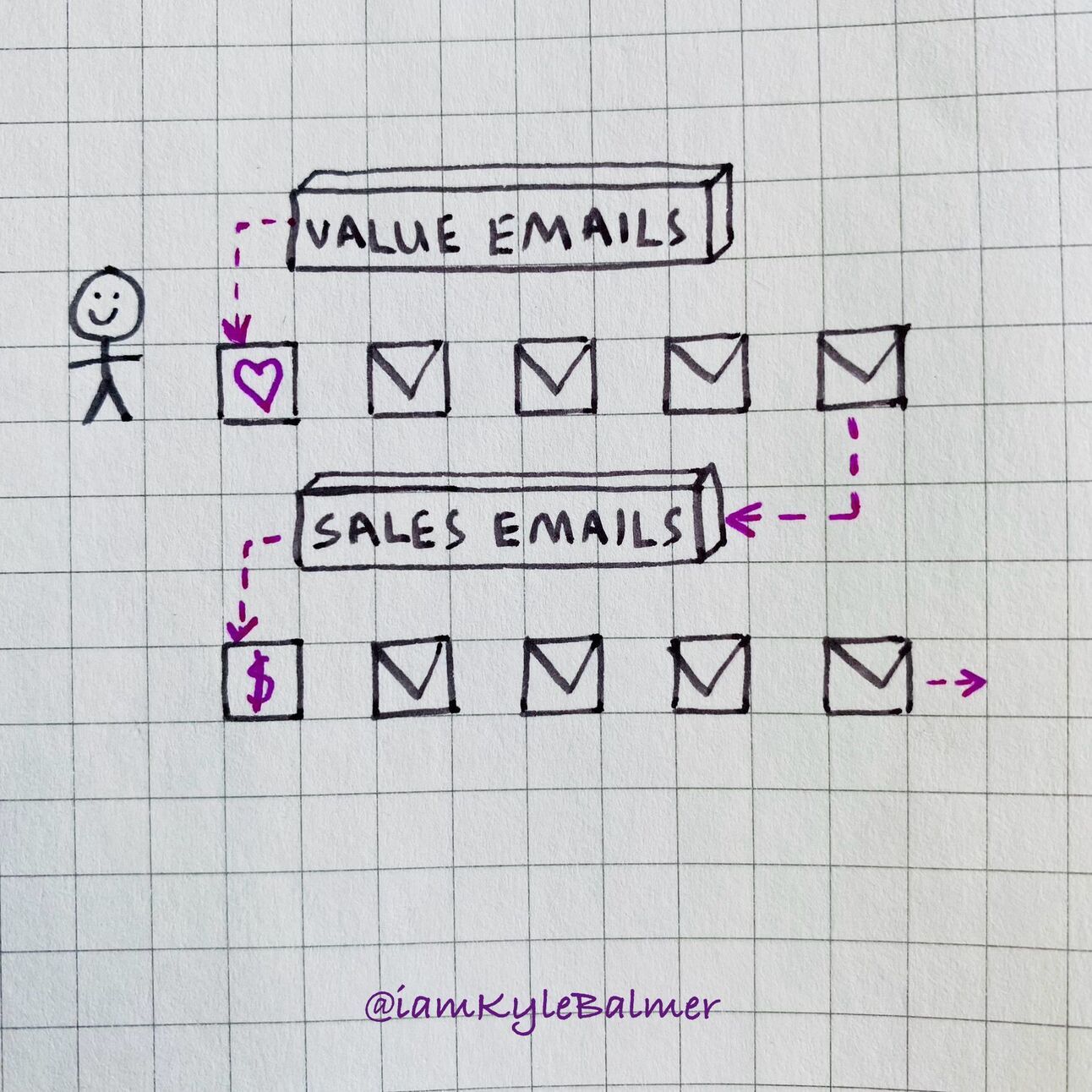
10 emails total, delivered daily
First 5 are value emails
No sale, just value
Free gifts and unexpected generosity
Each email knocks down a false belief or limitation
Objective is be known, liked and trusted
Second 5 shift to sale
Focus is on your sales funnel’s first sale
Selling with their permission
Outlining offer and going into details in each email
Is this the only way to structure a welcome sequence?
Absolutely not. There are many ways.
But it’s a solid starting point for a business that does not yet have a welcome sequence in place. And from there you can tweak and optimise as required.
One caveat here - if your first sale is low cost (<$50) you can likely shorten the sequence. If it’s higher (>$500) ticket you’ll want to extend the sequence. I’ll discuss this as we talk about the sales emails in Parts 4 and 5.
After your welcome sequence you can also segue into your main marketing campaign emails. We just use the welcome sequence up front to ease people in, build goodwill and move them them to a first purchase.
Think of your first and sixth emails a tentpoles.
Email 1 is the first value email. Followed by 4 more emails to lock the value in .
Email 6 is the first sales email. Followed by 4 more to outline benefits, deal with objections and close the sale.
If these emails don’t hold up then all the subsequent ones don’t matter. For this reason take extra time drafting these tentpoles emails. We’ll give them special attention in this Playbook by giving them a whole Part focusing just on them.
Here’s a super powerful exercise.
Think of the last purchase you made online. Not from Amazon but from an individual creator or maybe a piece of software.
Go back to your emails and look for the first emails they sent you.
For example I just purchased Justin Moore’s new book on pre-release.
I can trace back in my email inbox and find the first emails he sent me:

These become valuable for me to review. Because I know they worked - because I made a purchase. Therefore there’s something valuable to be gleaned from looking back at Justin’s first emails to me.
On quick inspection I love that his first email is “what do you need from me?”. He literally asks what he can do to help.
Going back through welcome emails from creators you respect is a great way to start gleaning insights into what they are doing to get you to (one day) purchase.
Now that you know what a welcome sequence is this becomes an extremely powerful exercise - go inbox diving for treasure!
Then starting tomorrow we’ll kick off with Part 2 : The important Email 1
Keep prompting,
Kyle
Today we begin to structure out our welcome sequence starting with, unsurprisingly, email 1.
Don’t worry too much about perfecting this email yet. We’ll pass through all 10 emails over the week and then go back and make sure everything works well together.
Let’s get started:
The important Email 1
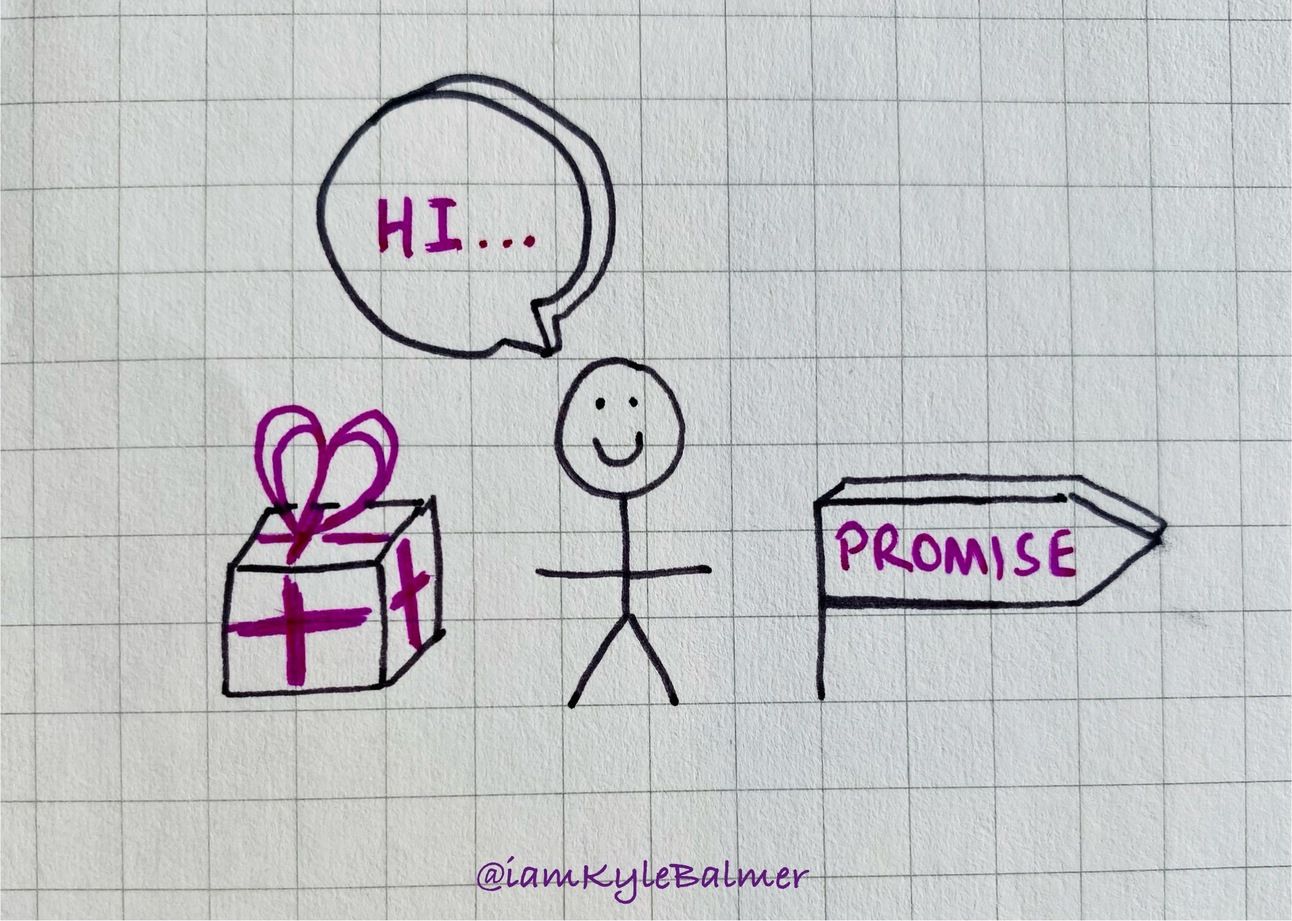
getting personal
immediate gift
promise of what’s to come
The first email needs to be the best in the sequence.
If you lose people they won’t open the rest of your welcome series. Which means no matter how good those emails are they won’t be seen.
So we need to nail Email 1!
We have one primary objective: getting readers to open the next email. Once they’ve done this they’ll get more and more used to opening your emails and (hopefully) eagerly expecting them!
We’ll do so by:
getting personal
immediate gift
promise of what’s to come
First up you need to accelerate the know-like-trust sequence as quickly as possible.
We do this by introducing ourselves as a fellow human being.
I recommend going personal in the first email - telling them who you are and why you are happy to have them here with you.
Include a photo (or better yet video) of yourself to show people that you are a person. The welcome email immediately becomes a personal welcome rather than just another company email campaign.
Specifically let’s use this prompt to get started:
Act as a copywriter
Help me write a personal introduction that gets customers to know, like and trust me quickly
Collect the following information from me first:
1. Name + company name
2. Why I started the company and its mission.
3. how I'm going to help the reader
4. where I came from and how I got to where I am

Use this information to compose an introduction that:
1. warmly welcomes them
2. outlines how I'm going to help them
This will help generate a basic introduction for you:
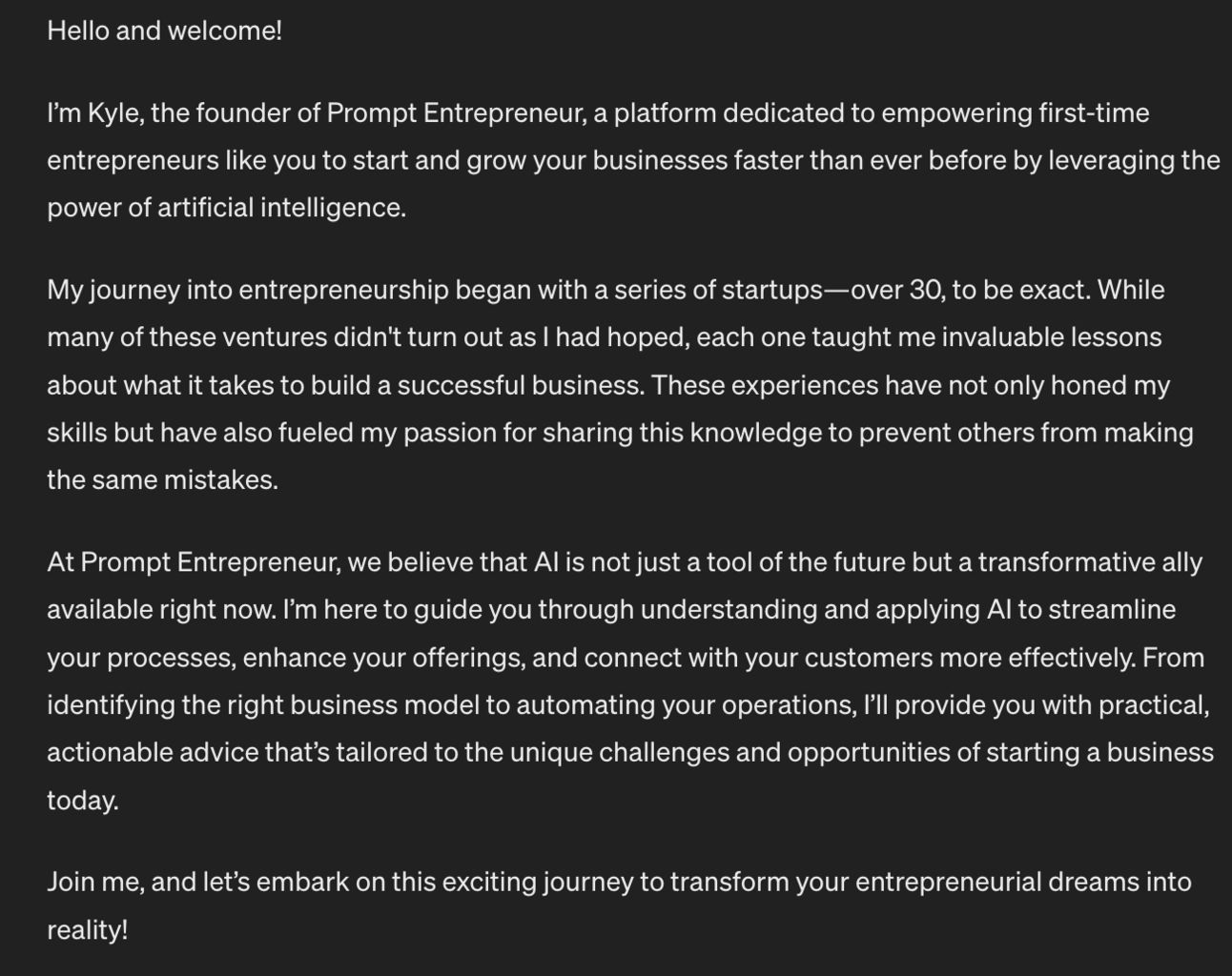
Make sure to rewrite in your voice! Remember this is one of the most important emails you’ll ever write.
Add in lots of personal details to remind people you are a person talking to them, another person.
We are next going to immediately “bribe” our audience! A soft bribe!
We’re going to give them a gift. Not one that they were expecting. And we expect nothing in return. Instead we’re giving them this gift to overdeliver.
I personally give people a link to my 10 Steps Course in my first welcome email. It’s an immediate drop of value that makes them pay attention.
Find something similar that you can give them out of the blue in your first email.
Importantly it should not be too long or hard to consume. Don’t give them a 200 page eBook!
They’re just getting to know you. The last thing they want is homework.
I recently got one email that sent me a 130 page book. Then followed up with this:
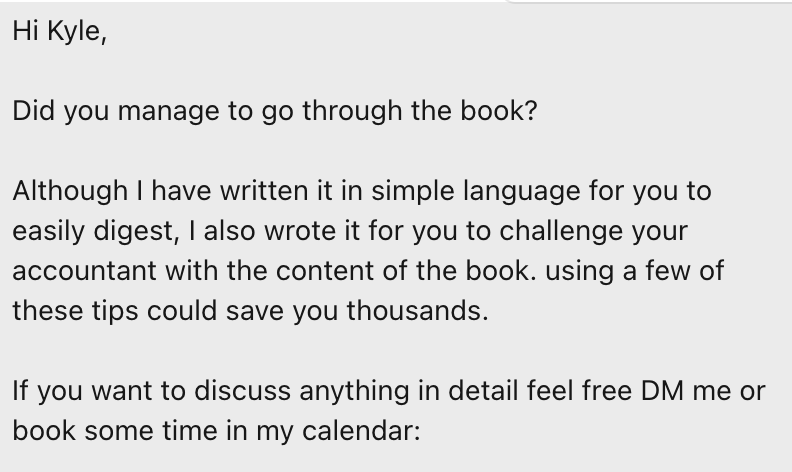
Good lord don’t do this.
Give them a quick punch of value - something they can quickly consume and immediately understand the value of.
Here’s a quick prompt to use after the previous one:
Act as a marketing strategist
After the email introduction I want to provide my readers with something extremely valuable as a free gift.

The free gift should be:
-fast for me to create (<2 hours)
-easy for the recipient to consume
-immediately recognisable as valuable

Give me 5 suggestions
This will give you some ideas to start with:
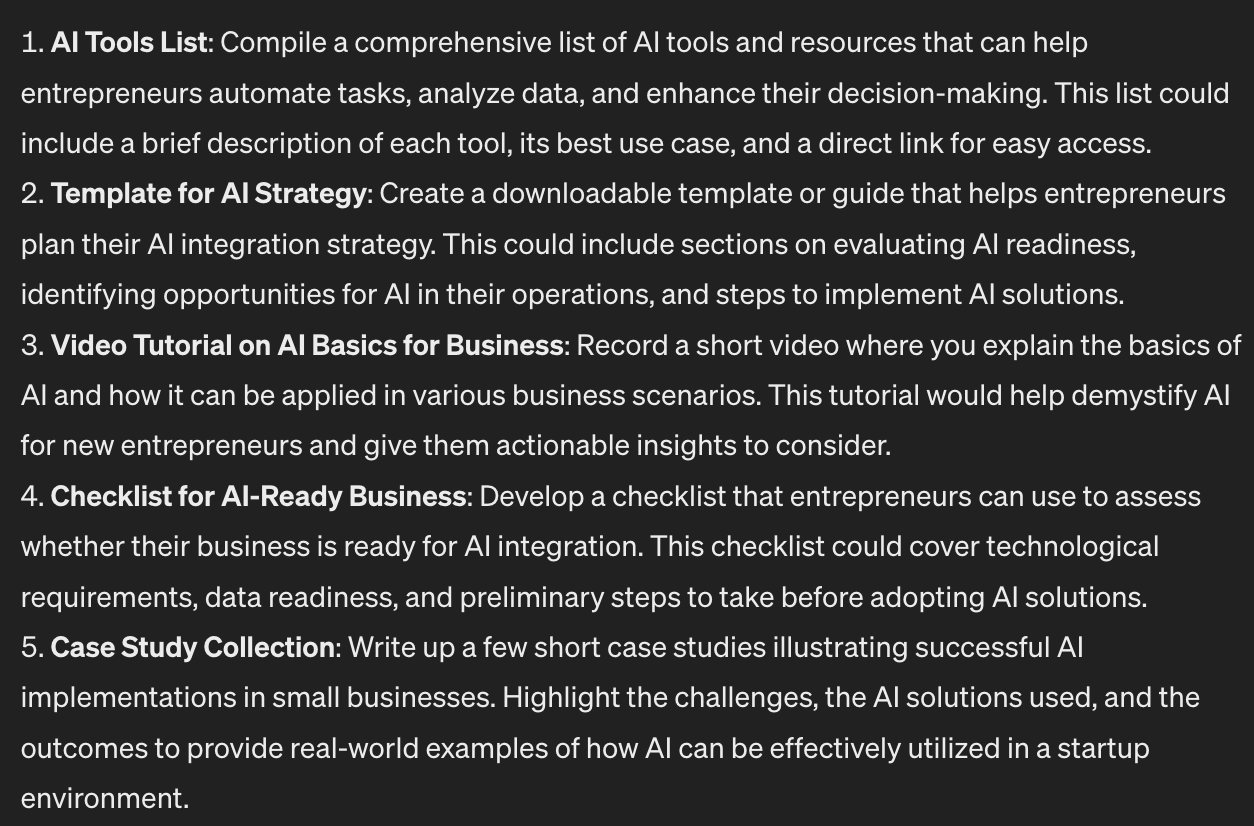
By giving them a freebie we are immediately giving them massive value just for signing up.
We are also using the psychological concept of reciprocation. It’s a powerful mental tool.
Basically if someone gives you something that opens up a mental loop. The only way to close that loop is to respond in kind by giving them something. This a powerful sales hook for later.
Once we’ve dropped our first free gift we’re then going to roll this into the next 4 emails with the…
Now that you’ve given them their gift the trap is baited!
We follow this up with a reason for them to continue to open your welcome emails: more value.
This could come in then form of more free gifts if you have a sequence of freebies that makes sense. Or it could be the emails themselves. We decide this in the next Part where we build out emails 4-5.
Either way it’s important in this email, Email 1, to tell readers that there is more coming.
We don’t need to explicitly list out the upcoming freebies (although this is an option). Instead a simple “If you find this useful you will love what I’m sending you over the next few days. Keep your eyes peeled so you don’t miss those emails.”
We’re using fear of loss here to get the open. They’ve been promised something. And to claim the value they need only to open the next email. By not opening those emails they will not receive what they (psychologically) now believe they are owed.
They’ll open those next emails - believe me!
In the next Part we’ll work out exactly what those value bombs are going to be.
For now though we are done with Email 1. We’ve used it to quickly provide a free gift and told them to expect more. This will be enough to get the next emails opened which is when we’re really going to start delivering value.
Keep prompting,
Kyle
Now we move into the bulk of the value delivery with emails 2-5.
That doesn’t mean we are only providing pure value. We’re a business so we are preparing to sell - we’re using these four emails to lay down the groundwork.
Let’s get started:
Busting Beliefs with Emails 2-5
How long is a piece of string?
1 belief busted per email
Continue to gift
Single line sale
Transitioning to the sale
After Email 1 we’re going to continue our charm crusade.
We’ll use the next 4 emails to keep dropping value bombs and then transition into the second phase (the sale) in emails 6-10.
Why 4 emails? Well. It actually doesn’t need to be. It really depends on how big your first sale is.
If someone has just signed up for your email list and your first sale is $10 I’d say use 1 email to welcome them and give them a gift and then the second email moves immediately to the sale.
$10 is small enough to be an impulse purchase. It still needs to be super valuable (don’t shortchange yourself by selling crap!) but it doesn’t need 10 emails to get someone to a $10 sale.
If, conversely, your first sale is $1000 then you’ll probably need more than 10 emails. Scale your sequence up accordingly.
Not sure how many emails you’ll need? Find others in your niche who have similar priced product and see how many emails they send for that - generally they’ll have dialled in on that length of sequence over time.
We’re using 10 emails (5 value, 5 sale) as a happy medium. This will let you sell a product or service from $50-500 which will cover most eventualities.
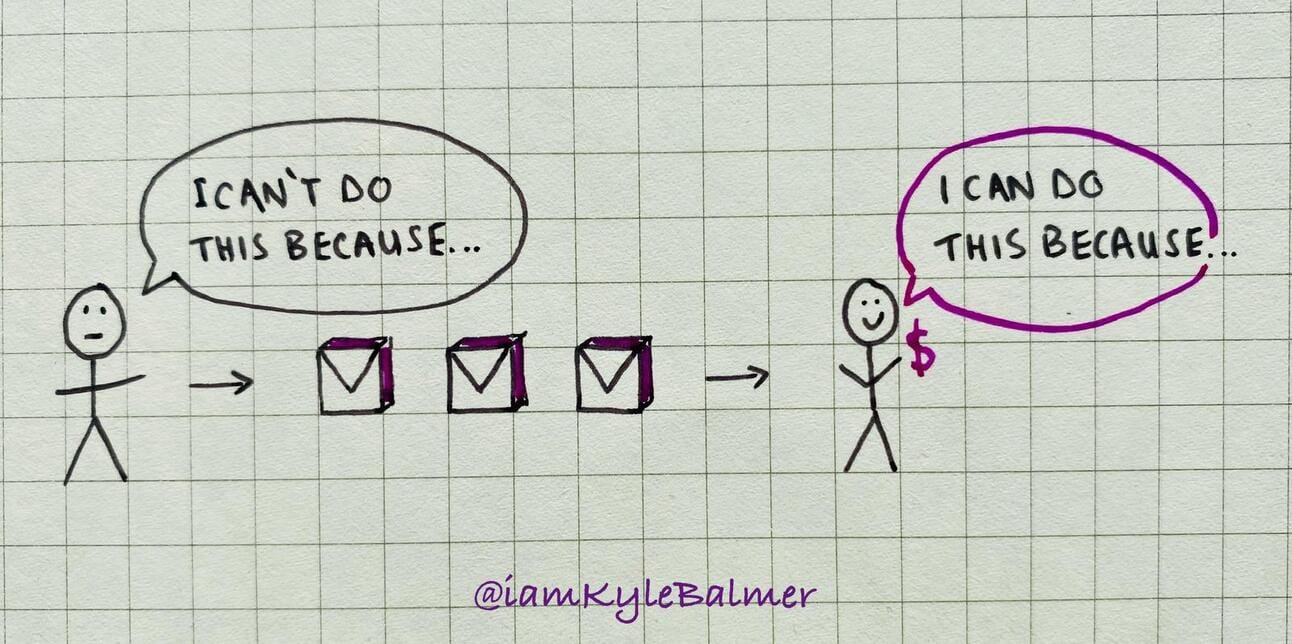
We are going to continue to deliver value over the next 4 emails. Overdeliver if possible.
This means very valuable, helpful emails. And more free gifts. Our aim is to overwhelm with goodwill.
One option here is simply to find your top 4 blog articles, videos, newsletters, lead magnets or any other known popular asset. Then deliver these one at a time as a “best-of” sequence.
This is a decent start but let’s get a bit more sophisticated.
We want to use each email to bust a false belief. Which each false belief we knock down we get closer to a sale.
For example in my world of AI entrepreneurship false beliefs might include:
I can’t use AI because I’m not technically savvy
I can’t start a business now because the economy is in the toilet
starting a business using AI is expensive and I can’t afford it
These are all false beliefs that I’ve run into in my time writing, teaching and consulting. And they are all false beliefs I know I can disprove.
Once I’ve done so I can help people move out of the way of themselves. We really are our own worst enemy at times!
Start by thinking about what your customers’ false beliefs are. Use your experience here but here’s a ChatGPT prompt to get you thinking:
Act as a market researcher
My niche is [niche details]
My ideal customer is [avatar details]

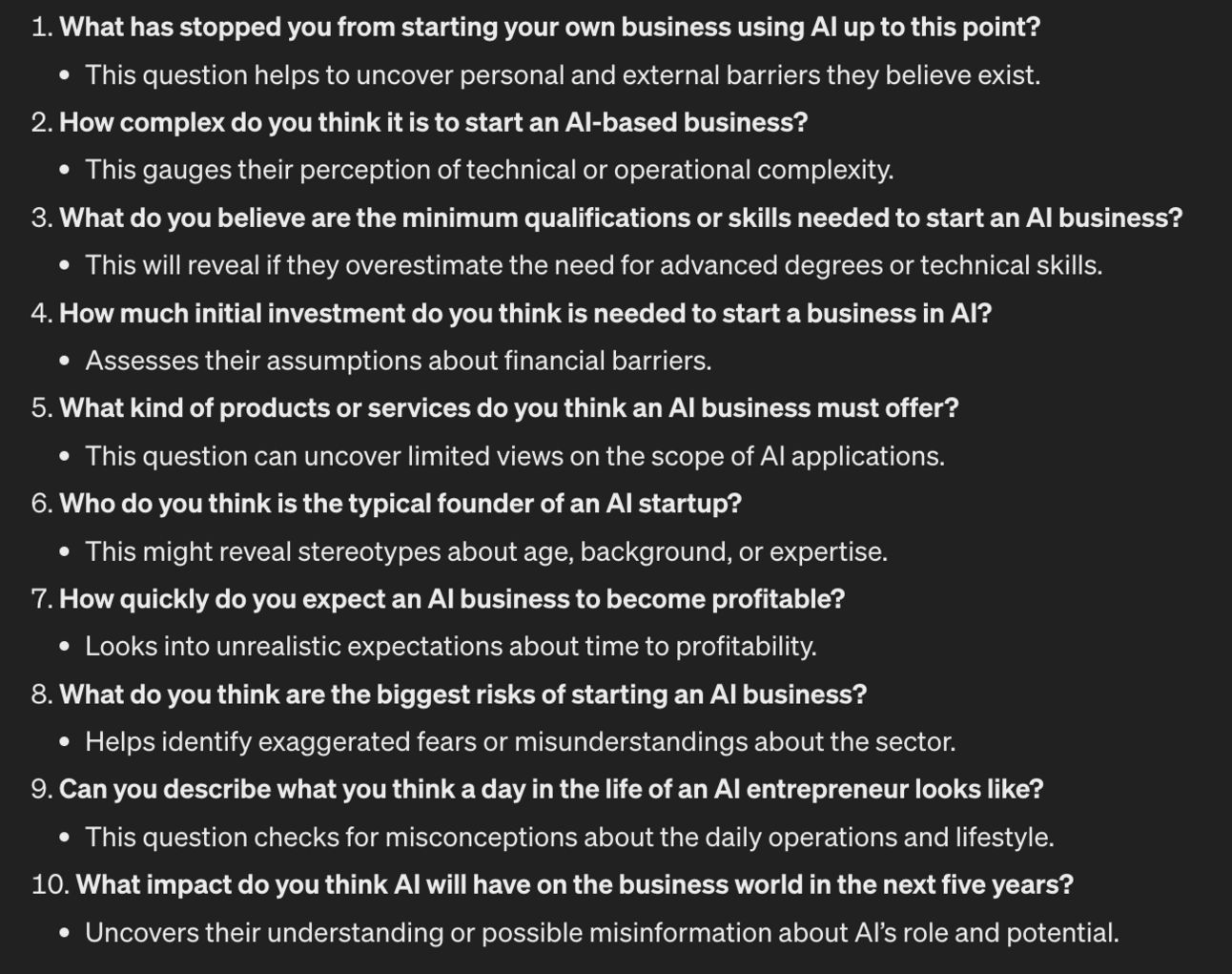
First, give me 10 questions I can ask to subtly elicit their false beliefs about the topic.

Second, give me 10 examples of what their false beliefs could be.
As an example I’ve plugged in:
My niche is AI entrepreneurship
My ideal customer is people who have always wanted to start their first business but have not taken the plunge
This gives me two main outputs. First the questions I can use to poll my audience to gauge false beliefs:
and second some examples of false beliefs:
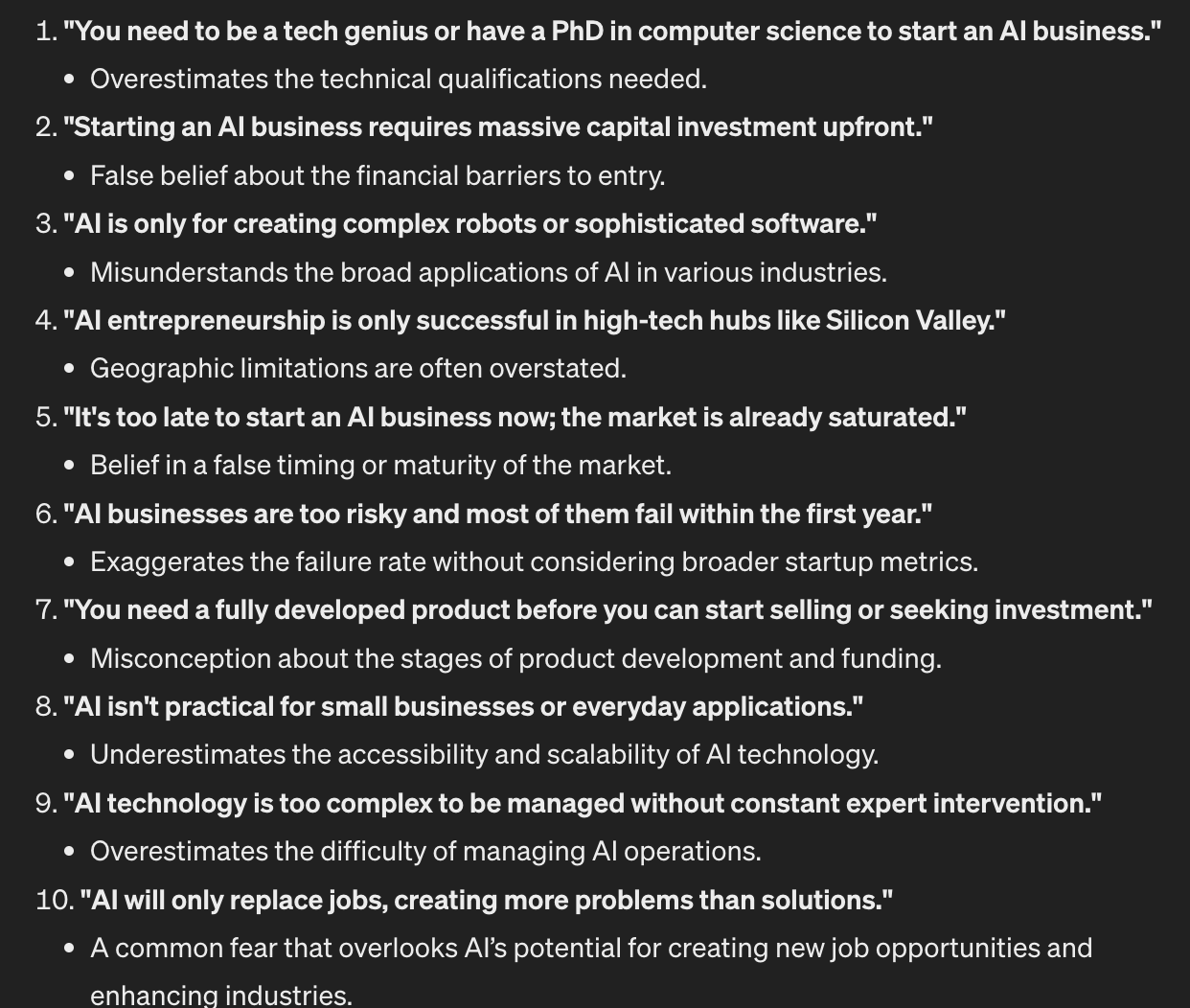
Ideally use the questions to start asking your audience. See what they respond to. If in doubt though use the list ChatGPT generated for you. As always though data from actual customers (rather than ChatGPT!) will give you better answers.
We want to hone in on the 4 most prevalent and dangerous false beliefs.
And then use our 4 emails to knock these down.
Identify them manually (keep talking to your audience and customers and this will become clearer) or use a prompt like this:
Bust these false beliefs:
[list out false beliefs]

and for each suggest a tool/resource I can give audience members to help them shake their false belief.
Here’s one example from above - “AI is too complex”:
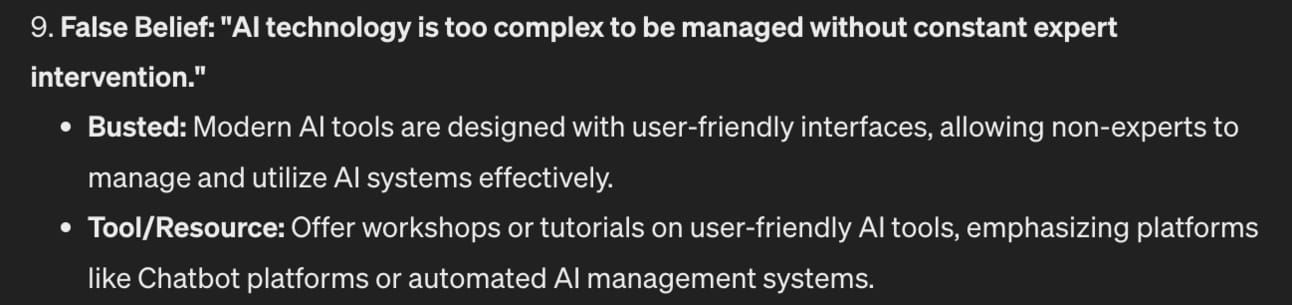
This would lead me to write an email where I specifically talk about how using AI tools like ChatGPT is actually very simple. I bust the belief.
If you can use Whatsapp you can use ChatGPT - that would be my hook. I’d then expand and show how modern AIs are basically chat tools. I’d give a handful of examples and grab some screenshots of the tools to show the simplicity of use.
I’d then back that all up with a quick 1 page PDF “ChatGPT Quickstart Guide” to cement the value.
I’d do this for each of the beliefs I want to bust. One email. One belief. One belief bust. One free gift.
Whilst these first emails are very heavy on the value we do not want to hide the fact we’re going to sell.
In fact we want to make this clear upfront to set expectations.
I do this in two ways.
First up, in each of the value emails I’ll have a line or two that mention the sale and gives a link. Something like “if you find this valuable you’ll love my [product name] that I’ll be introducing later. If you want to know more here’s a page with info: [link]”
Second, in the last value email (email 5) I’ll explicitly say I’m going to transition to telling them about a product or service in the next email.
I don’t apologise. In fact I say “now that you’ve learned more about me and what I do I’m pretty sure you’ll love to hear about [product]. With your permission in the next few emails I’m going to tell you more.”
I will also (this is optional) tell subscribers that if they aren’t interested it’s time for them to unsubscribe. I then put a large Unsubscribe button in to make it easy for them.
It looks exactly like this:
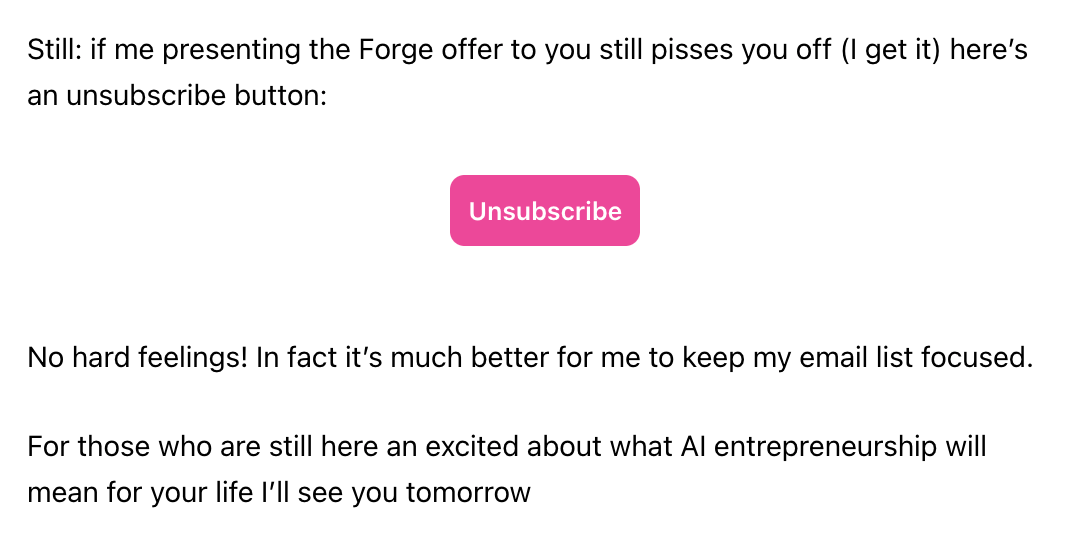
As I say this is optional. And depends on whether it fits with your brand!
This is basically me saying to people in my free list that if they aren’t happy for me to talk about this stuff I’d rather they leave. They don’t want to be there. So I don’t want them to be there. So I politely show them the door.
Funny thing about this is …as soon as someone on the fence is shown the door they are much more likely to want to stay.
The emails with explicit “please unsubscribe” buttons have, you guessed it, the lowest unsubscribe rates.
We humans are weird huh? 😝
However you decide to do it make sure that your readers are ready for the sale. Which we’ll be cracking into in the next Part.
Keep prompting,
Kyle
In Email 5 you set the scene so your audience knows the sale is coming. Now we start in Email 6 with the big reveal.
Let’s get started:
Switching to the sell Email 6
Shut the doors
Goal = get the click
Keep it wide, follow up with details
No pricing
Before you get into your sale again reiterate that you want people to leave.
Huh?
I start my main sales email with a reminder I’m going to sell to the reader. And a request that anyone who isn’t happy with that leaves.
The reason for this is that:
i) anyone annoyed isn’t going to buy from you anyway (no upside) and
ii) they might report as spam (downside)
We’ll remove the downside whilst losing no upside.
The third (really interesting) reason is that as soon as we tell them “this isn’t for you” they are more likely to stay and read the sale!
Because of all this I start my big sale with a request that those who aren’t interested please leave. I then give them a big “unsubscribe” button right there.
Believe me - you aren’t losing anything if they go. They were never going to be customers.
The purpose of your sales emails is not to sell.
It’s to get people to click to go to your sales page.
The sales page’s job is to make the sale. The sales emails’ job is just to get people to the sales page. Read that again - it’s important!
For now we just want to get a click. We have (in the current sequence) 5 emails to get people to click to the sales page. Most people won’t do it on the first email. They’ll miss it. Or don’t have time to go to the page right now. Or the email just doesn’t grab them.
That’s fine. It’s why we have a handful of sales emails to get the click.
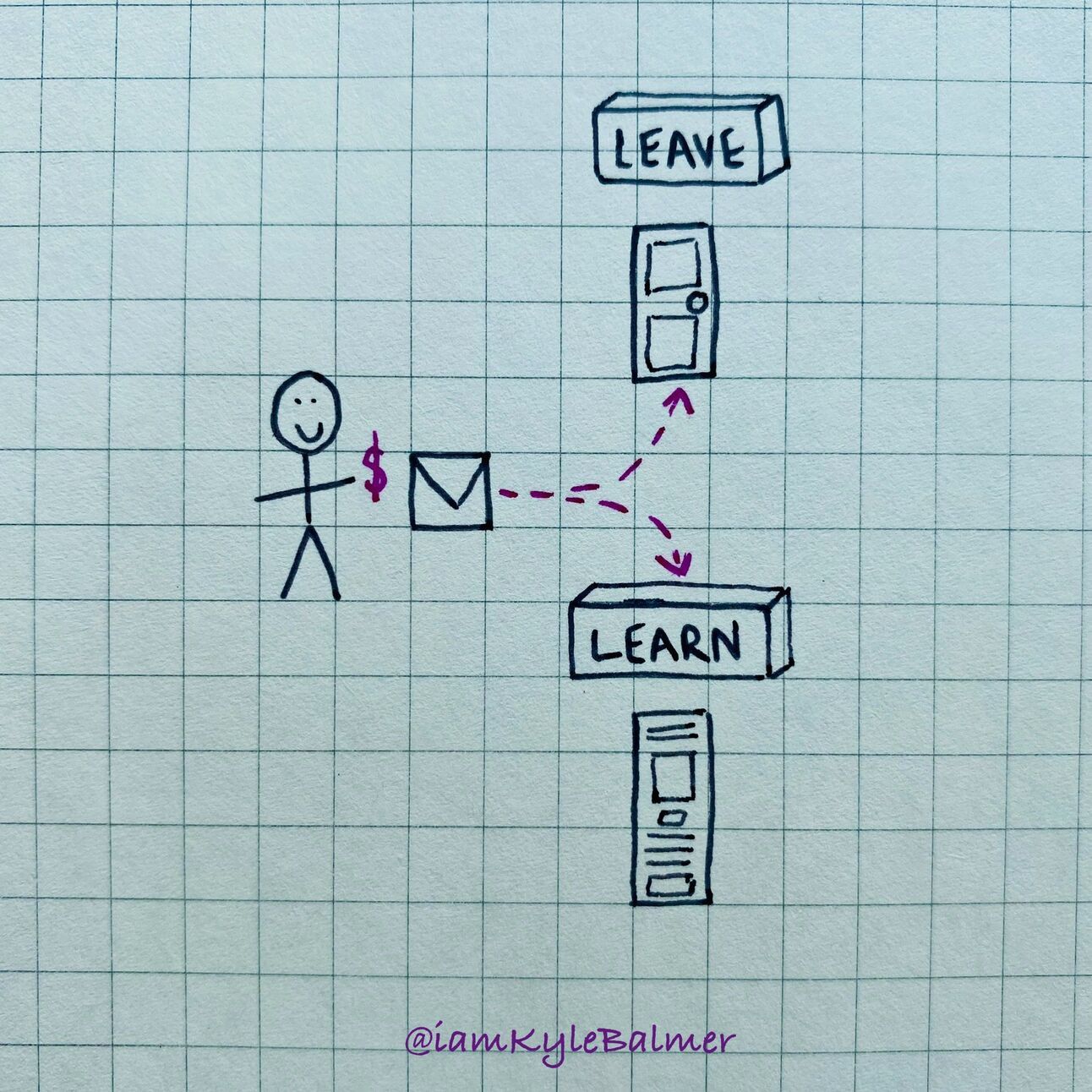
With this first email we are making an introduction.
We aren’t going deep. We aren’t pushing a sale. We are just showing them the valuable product or service we have to offer them.
Email 6 (our first sales email) therefore is a broad introduction - a survey of what our offer is.
In tomorrow’s Part we’ll get into the remaining emails - right now we are just making a first sales impression.
The best way to do this is to connect this first email directly to your sales email.
Use this prompt alongside your sales page:
Act as a marketing copywriter

Analyse this sales page and draft a sales email.

The objective of the email is purely to get someone to click to the sales page

Provide a survey of the offer, focusing on features and associated benefit.

Do not mention pricing. Do not go into too much detail.

Sales page copy begins:
[copy/paste sales page copy]
Copy and paste in the copy from the sales page below the prompt to generate a draft of a sales email:
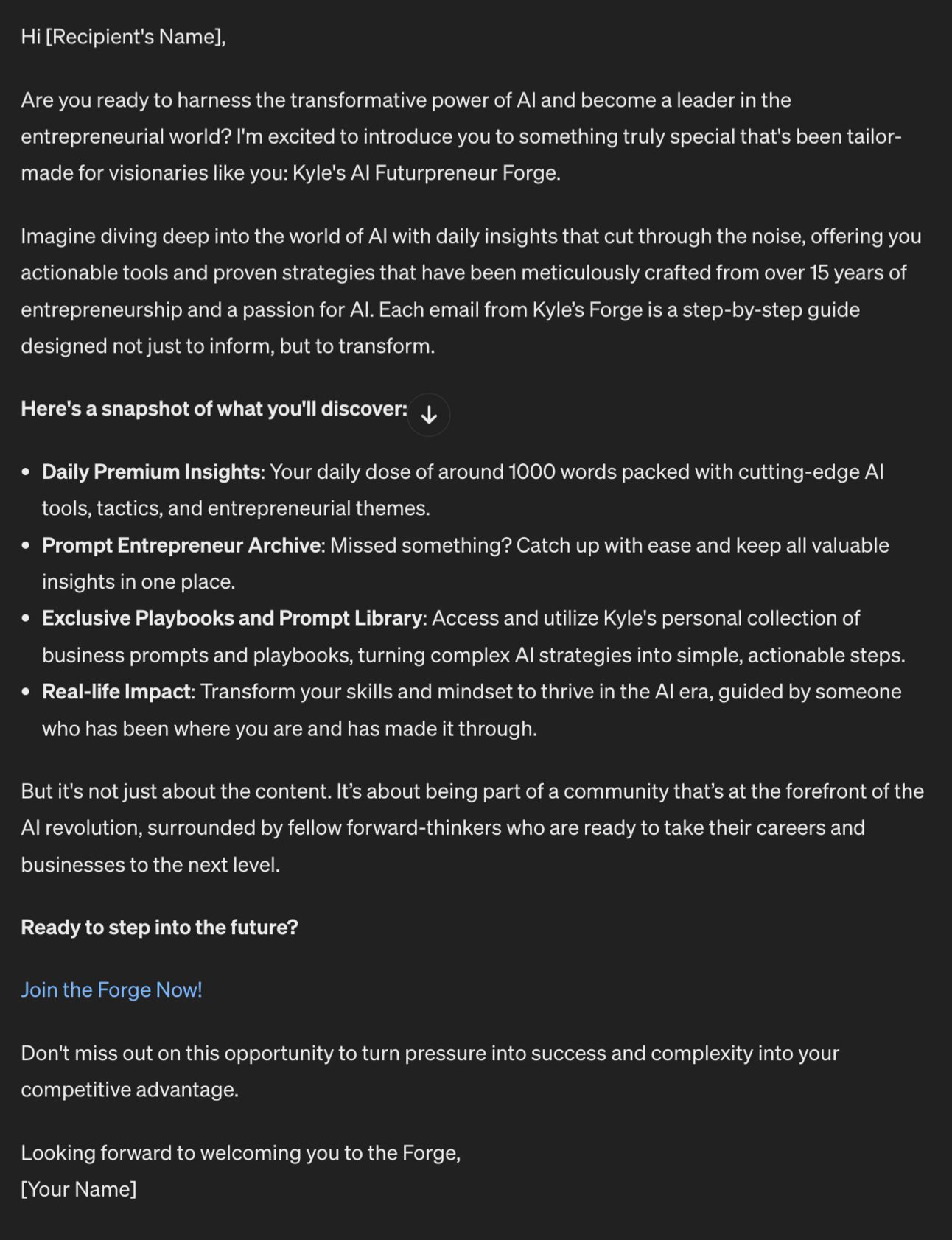
Make sure to rewrite in your personal style. Borrow language from your sales page as much as possible. We want to create congruency between your email and page so that there isn’t a huge tonal shift when people arrive on the page.
First up don’t mention pricing.
We want to get people to the page and walk them through the offer before hitting them with the pricing. This is the job of the sales page - to walk them up to the pricing. So we don’t want to jump the gun at the email with the pricing.
Also, if you change the pricing on your sales page you’ll need to go back through all your sales emails and make changes. Believe me - this gets very annoying very quickly!
Second, make sure not to hide the link to the sales page. The name of the game here is to reduce friction. Don’t make people hunt for the sales link! Easy buttons and visible links are useful here. And include it more than once if it’s a longer email.
Third, don’t apologise for the sale. This includes explicitly apologising (don’t do that!) but also feeling apologetic and allowing that to seep into your tone.
You need to be confident of the value of what you are selling. If you are not they won’t be confident to buy.
And if you aren’t confident in what you are selling? Then…why are you selling it? Serious question.
You life will be a lot simpler if what you sell is truly valuable. If it isn’t - make it so. Go and develop the product until you are confident it is valuable.
If you are selling someone else’s product and you can’t make it more valuable? Stop selling it! Go make something truly valuable and sell that instead.
In the next Part I’m going to move onto the remaining sales emails and how we knock down objections.
Keep prompting,
Kyle
We now wrap up our Welcome Sequence with emails 7-10.
This is all about objection handling and showcasing the benefits of our offer.
I’ll then touch on where you go after the first 10 emails are in play.
Let’s get started:
Closing with Email 7-10 and beyond
Predict customer objections
OFB - Objections → Features → Benefits
Building upon your first 10 Welcome emails
In our value emails we identified 4 major false beliefs that our customers hold and used each email to bust them in turn.
We are going to follow a similar pattern in our sales emails - this time with objection handling.
Smart marketers anticipate objections and skillfully overcome them
— Katelyn Bourgoin 🧠 (@KateBour)
12:46 PM • Apr 25, 2024
We’ll first identify objections to our offer. We’ll provide counters to each of these objections. And flip the objection into a reason why they should buy - making it a benefit instead.
We’ll cover one objection in each one of our emails, just like we did with false beliefs.

First we need to identify potential objections to our offer.
As always real feedback from customers is best here. So make sure to ask people!
Here’s how we can get the process started with AI though. Use this prompt:
Act as a marketing copywriter

Review the sales page I will provide and extract 4 objections

[copy/paste sales page copy]
ChatGPT will run through the copy and pull out potential objections customers might have. For my Forge page it gave me:
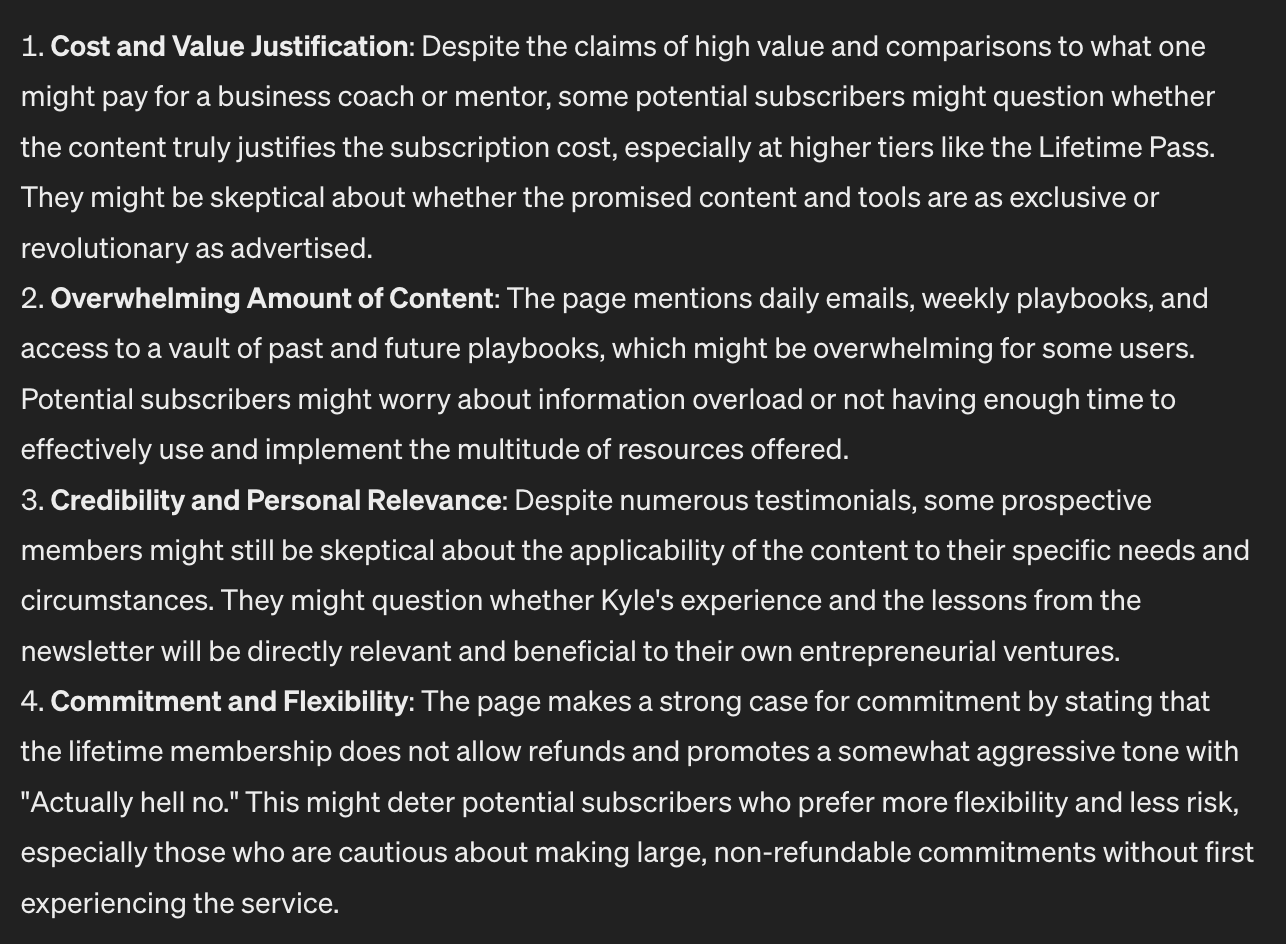
All solid objections! These are all things a potential buyer could very well be thinking on my sales page.
Let’s get to work on these.
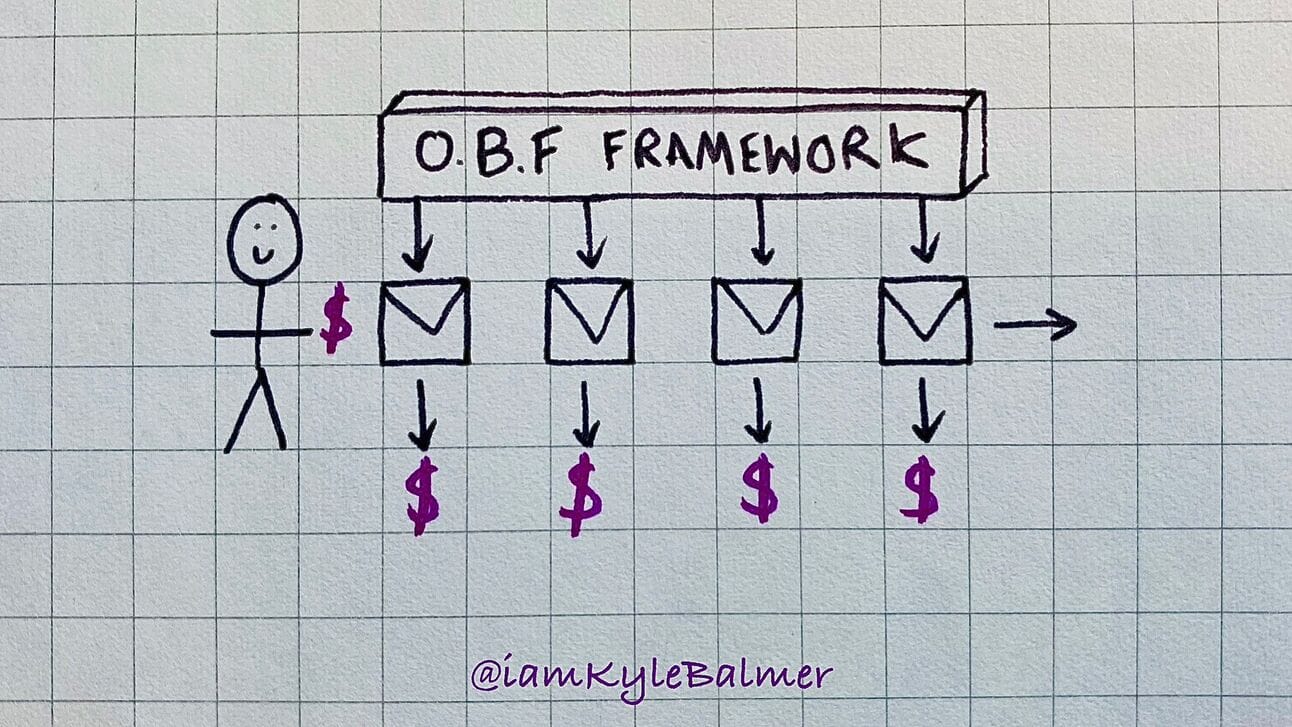
I use something I call the OFB framework to begin my objection handling.
Basically for each Objection I’ll find a Feature of my offer than deals with the objection. I’ll then use the Feature to flip the Objection into a Benefit instead.
Objection → Feature → Benefit (OFB)
We then use the language of benefits to preemptively deal with the objection in our emails.
Below the prior prompt output use this:
Now refute these objections with reference to features of the offer

Then convert the objection and offer feature into a benefit for the customer

Provide Objection, Objection, Feature, Benefit in a table.
ChatGPT will process everything into a table for you:
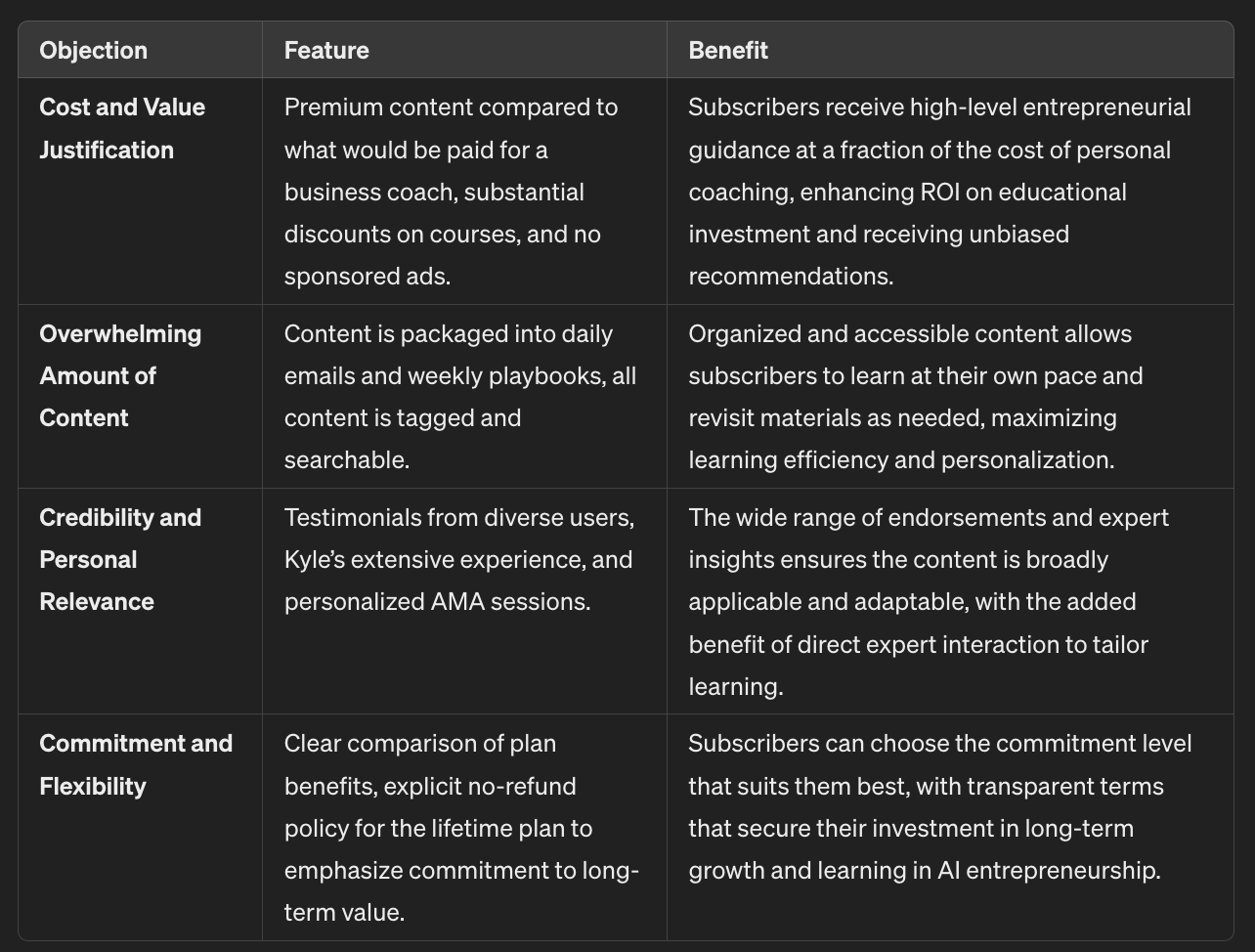
These are the outlines for our 4 objection handling emails.
I now recommend writing 4 emails that:
address the objection head on
point out why the objection is false
show instead that they are in safe hands
One email for one objection.
As always write yourself in your own tone if you can. Here’s a prompt to help you with the first draft though:
Act as a sales email copywriter

Draft an email for the [first] objection

Acknowledge the objection with a personal story
Use features from the sales page to show why this time it's different
Show the benefits of moving past the initial objection
This outputted the following sales email:
Subject: Unlock True Value in Your Entrepreneurial Journey – Here’s How!

Hi [Recipient's Name],

I completely understand if you’re looking at the price tag on the Forge membership and wondering, “Is it truly worth it?” I’ve been in your shoes more than once, questioning whether another subscription could genuinely offer something new and impactful. But let me share a personal story that changed how I view investments like these.

Years ago, I found myself signing up for courses and memberships, one after another, always ending up somewhat dissatisfied. The change came when I realized that the true value lies not just in the content itself but in how it’s crafted and delivered. That’s when I designed the Forge.

The Forge isn’t just another newsletter or a run-of-the-mill business coaching service. Here’s why it’s different:
- **No Sponsored Ads:** Every recommendation is based on real results and personal use, not paid endorsements. This means you get unfiltered, genuine advice that’s truly best-in-class.
- **Comparable to Business Coaching:** You might pay thousands for a business coach, but in the Forge, you receive distilled knowledge from 15+ years of hands-on experience for a fraction of the cost. And it’s all accessible on your schedule.
- **Premium Discounts on Courses:** Regular subscriptions might offer content, but how often do they give you steep discounts on transformative courses? As part of the Forge, you get 50% off premium courses that could very well change the course of your entrepreneurial journey.

Moving past this initial hesitation can open doors to an experience packed with tangible, actionable insights. Imagine saving hours of time and significant amounts of money while still receiving the kind of dedicated support and high-caliber strategies that usually come from high-cost consultants.

If you’re ready to give it a try and see just how much value you can extract from your subscription, click here [Insert Link] to join us. Remember, it’s more than just an investment in a service; it’s an investment in transforming your skills and business in the age of AI.

Looking forward to welcoming you to the Forge.

Warm regards,

Kyle Balmer
Founder, Kyle's AI Futurpreneur Forge

P.S. Still unsure? Drop me an email personally, and let’s talk about your goals and how the Forge can help you meet them.
More than enough to get started. Your job is to run this for all the objections and prepare the emails in your own language.
You’ve now got in place a basic 10 email welcome sequence - 5 value, 5 sale.
This doesn’t mean you have to stop here.
You can extend your welcome sequence pretty much indefinitely. Basically sending out emails until you secure that first sale.
What I’d recommend after this first sale is to return to value emails. Think of this as a process of refilling the well.
I’d also reduce the frequency of the emails moving forward. This depends on what else you are sending them to be honest. But generally you’d want to cool off a little after the initial salvo.
Instead you go back to value and reduce frequency and let goodwill build up again before returning to a sale.
When you return to the sale ideally it’s a new sale. Why’s that? Because they didn’t buy what you had to offer this time. Chances are they won’t again unless their circumstances have changed and/or your offer adjusts.
Having a new offer gives you a much cleaner slate when cycling back to sales again.
Now, there are certainly people who would disagree with me here. Someone like Tai Lopez for example doesn’t decrease frequency. He also continues to talk about the same offers. Basically until you damn well buy!
This is certainly a valid alternative. It depends on you, your offer, your market and how many leads you are able to bring into your funnel.
Ultimately, at this point it’s really up to you. You have the basic 10 step welcome sequence and can now build upon that as you see fit. It’s much easier to see the way forward once we’ve started!
Keep prompting,
Kyle
Welcome to the '👋 Writing a Welcome Sequence | AI Business Playbook', your ultimate guide to crafting a compelling welcome email sequence that transforms your audience into loyal customers. This playbook dives deep into the art and science of email marketing, empowering you with the strategies and insights needed to create a sequence that not only builds trust but also drives sales. With a well-structured welcome sequence, you can automate your marketing efforts while establishing a meaningful connection with your audience, setting the stage for long-term success. Throughout this playbook, you'll discover how to effectively engage your new subscribers, guide them through a journey of value, and gradually lead them towards making that vital first purchase. By the end of this week, you will be equipped with the tools to create a powerful welcome sequence that works for you, even when you’re not actively selling.
This playbook is designed for small business owners, marketers, and entrepreneurs who are looking to enhance their email marketing strategy. If you struggle with converting your email list into paying customers or feel overwhelmed by the prospect of crafting effective email campaigns, this playbook is perfect for you. Whether you're just starting out or looking to refine an existing strategy, you’ll find the insights and practical tips necessary to create a welcome sequence that resonates with your audience, addresses their pain points, and drives engagement and sales.
A welcome sequence is a series of automated emails sent to new subscribers that introduce your brand, provide value, and guide them towards making a purchase.
With the guidance provided in this playbook, you can start implementing your welcome sequence within a week.
No prior experience is necessary! This playbook is designed to cater to all skill levels, providing step-by-step instructions.
You can use various email marketing platforms like Beehiiv, Mailchimp, or ConvertKit, all of which support automated email sequences.
Absolutely! The strategies outlined in this playbook serve as a foundation that you can customize to align with your unique brand voice and audience.