
AI Building
Welcome to '💰 Starting an Online Business using AI | Blueprint,' your essential guide to launching a successful online business in 2024.
Start ReadingPast the first exciting week of NY resolutions and into the proper work.
This week I want to outline how I would start a business right now in 2024.
This is what’s working right now.
I’ll cover a high level approach over the week to give you an outline.
This is how I’m helping people (including my significant other!) start businesses right now. It’s a strong blueprint.
The basic idea here is:
identify a market need that you can satisfy
produce a high value free giveaway to confirm the market
collect email addresses and nurture via a newsletter
formulate and sell a service offer to your newsletter readers
convert your learnings from serving clients to create your first digital product
This basic shape works across all niches and platforms and is built on first providing value, gaining trust, getting to know your customers and then and only then cementing your product.
Heads up that if this week’s emails are valuable I’ll be running a set of live accelerators over 6 weeks, deep diving and helping you action the lessons.
There’s a waitlist opening up here: Join the waitlist.
This week’s emails will be covering:
Part 1: Discover your profitable business niche
Part 2: Captivate the market with your lead magnet
Part 3: Effortless email list growth
Part 4: Deep dive into customer needs
Part 5: Save the world with your creations
First up we’ll lock down your profitable business niche.
First up it’s worth mentioning that I’ve covered this topic multiple times before in other Prompt Playbooks.
Nevertheless this is the first vital step in launching a business - you need to have a clear business idea that:
is based on your skills and abilities rather than desire
is something you enjoy enough to work on sustainably
has an existing market of buyers
Miss any one of these and your business is doomed.
I’ve written a prompt to guide you through this process and generate a handful of business ideas.
Act as a business coach

I am starting a new business and need to refine ideas and my niche

First query me on: What are you skills and abilities? Include professional and personal, formal qualifications and informal skills. What do people come to you for assistance with?

Based on the answers to these questions compile a list of at last 20 potential business niches.

Present the list in a table and ask me to provide, in preference order, my top 5.

Take my top 5 business niches and run a market analysis - analyse the market sizing, competitiveness and capital requirements.

Based on this rank the business niches from most attractive to least attractive.

Collect my top choice and give me 5 variants of that business, focused on different approaches, subniches, submarkets.
This prompt will run you through a process to help brainstorm business niches for you.
It’ll start by collecting up your skills, generate a long list of potentials, have you sort them by preference and then run a market analysis on each.
It’ll then finalise the process with a list of 5 variants. Here’s the final outcome for me:
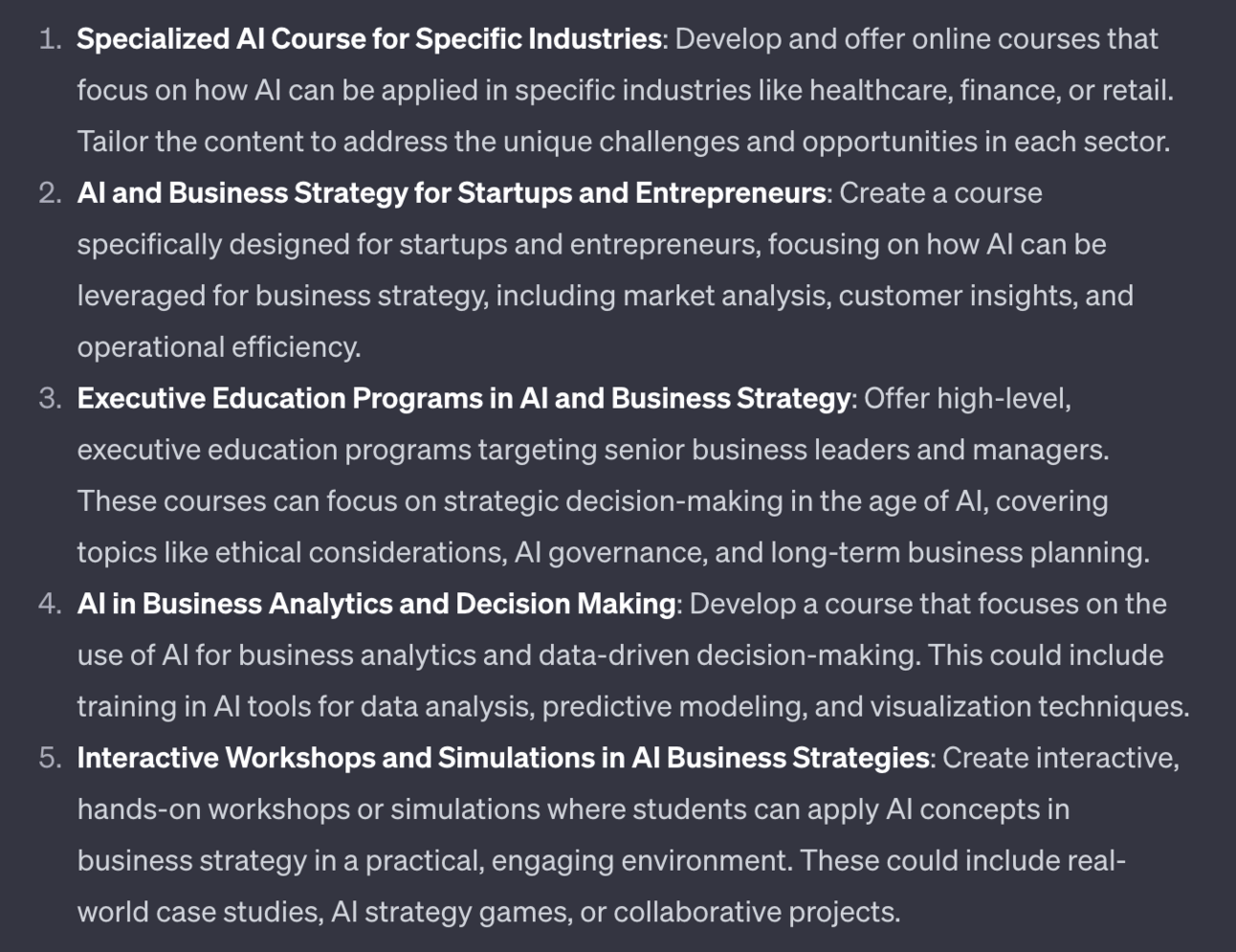
By the end of this process the business niches generated should be non-generic.
The purpose of the prompt is to go through a multistep, multi-input process that ends in a sub-niche rather than a wide general niche.
Choose one that looks interesting to you. Don’t agonise this step because all ideas inevitably change once you launch anyway!
In this Premium Prompt we’re going to take the 5 shortlisted ideas and run them through an additional step.
We’ll take it a step further by giving ChatGPT our constraints:
Which of these 5 ideas would be optimal with these additional constraints:
low/no capital, desire to enter market fast, building project alongside 9-5 job.
Add your specific constraints here. The more personal to your situation the better.
ChatGPT will then re-analyse the business ideas with this new lens - what makes most sense for you based on your situation.
This is another powerful way to ensure that this brainstorm isn’t generic but instead powerfully relevant.
Sweet that’s the first big step out of the way.
We’ll keep it similarly high level this week - we want to build out the basic shape of a 2024 business rather than get stuck in the weeds.
With this week’s overview we’ll then be in an amazing place to launch a business in 2024.
Also I’m putting together a set of weekly live Accelerators covering these topics and helping you action the lessons. Waitlist is open.
A reminder of what we’ll be covering this week:
Part 1: Discover your profitable business niche
Part 2: Captivate the market with your lead magnet
Part 3: Effortless email list growth
Part 4: Deep dive into customer needs
Part 5: Save the world with your creations
Until then, keep PROMPTING!
Kyle
With a business idea in hand it’s time to go to market.
Already?
Yup- we go to market ASAP so that we know whether or not there even is a market!
I’m covering the top-level here but this is a big task! If you want more details I’ll be running a live accelerator in a few weeks on this exact topic. Waitlist here.
Once you have a business niche in mind we need to test whether there is a market for it or not.
This, more than anything else, is what sinks new businesses.
Competition we can work around. Product development we can work out as we go. Sales channels we can decide later.
But if there is no market then the business is dead in the water.
Before we leap in and start building we need to know whether a market exists. And the only proper way to know is to build something called an MVP - a minimum viability product.
We want to create the most basic form of value that our business offers and see if people want it.
For example, taking an idea from the last Part let’s say my business idea is:
Specialised AI Course for Specific Industries: Develop and offer online courses that focus on how AI can be applied in specific industries like healthcare, finance, or retail. Tailor the content to address the unique challenges and opportunities in each sector.
I could run off and and develop the courses, build a website, hire a training team and run advertising to gain clients.
But there’s a risk that I do all of that and find that my market doesn’t care. They don’t want the value I’m offering. Disaster!
Instead we need to build a minimal version of this value and test it out with the market.
Specifically we are going to create a “lead magnet”.
A lead magnet literally acts as a magnet for leads (emails).
You’ve seen them before, even if you don’t know the name.
Any time you need to give an email to receive a free ebook: lead magnet.
Email for a checklist? Lead magnet.
Email for a Notion document? Lead magnet.
Here’s a prompt:
Act as a marketing consultant for my business

Based on the business idea I will provide at the end of this prompt

Generate 5 lead magnet ideas with brief descriptions. They should be text based, easy to consume, easy to create.

Ask me which I prefer then generate the full text of the lead magnet.

Create a hook title for the lead magnet and a brief description I can use in social media to encourage downloads. No emojis, no hashtags.

My business idea is [copy/paste business idea]
This will generate a list of potential lead magnets for you:
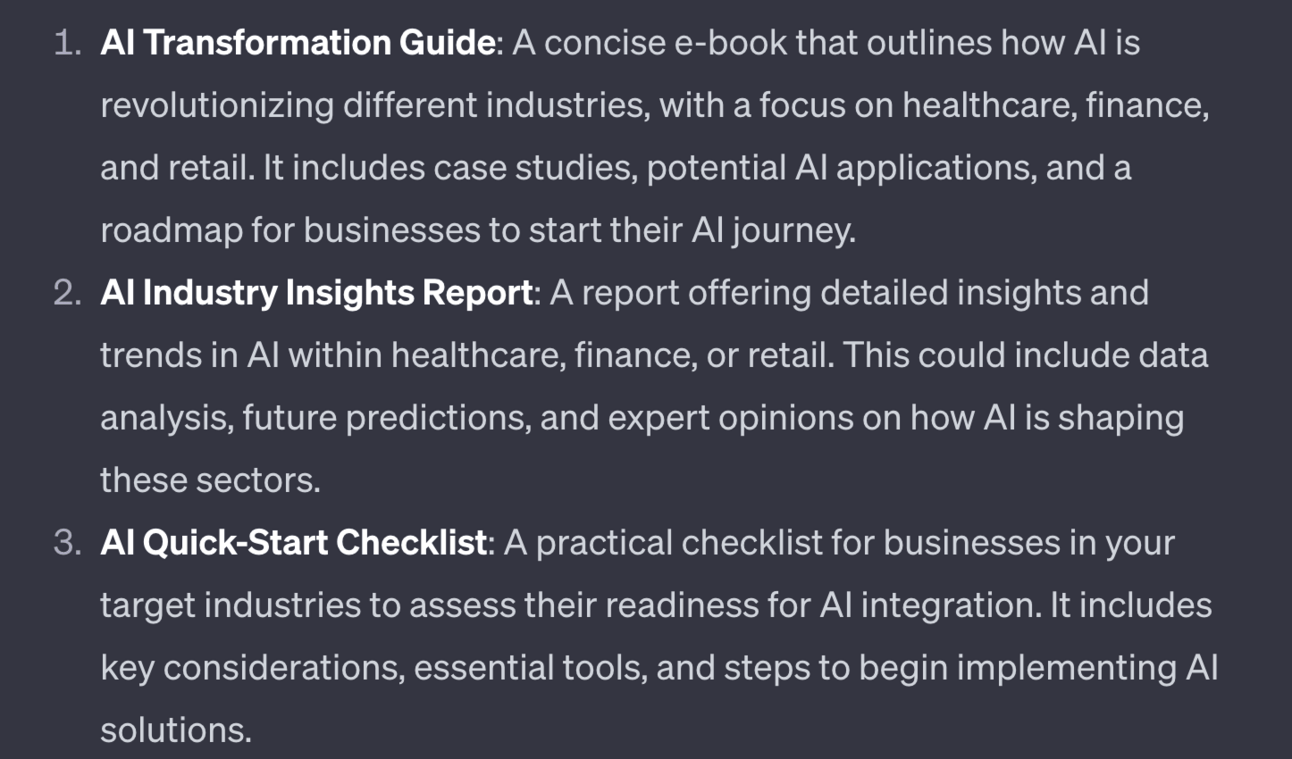
Go ahead and tell ChatGPT which to produce and it’ll spin out the full text. Here’s the start of an output:
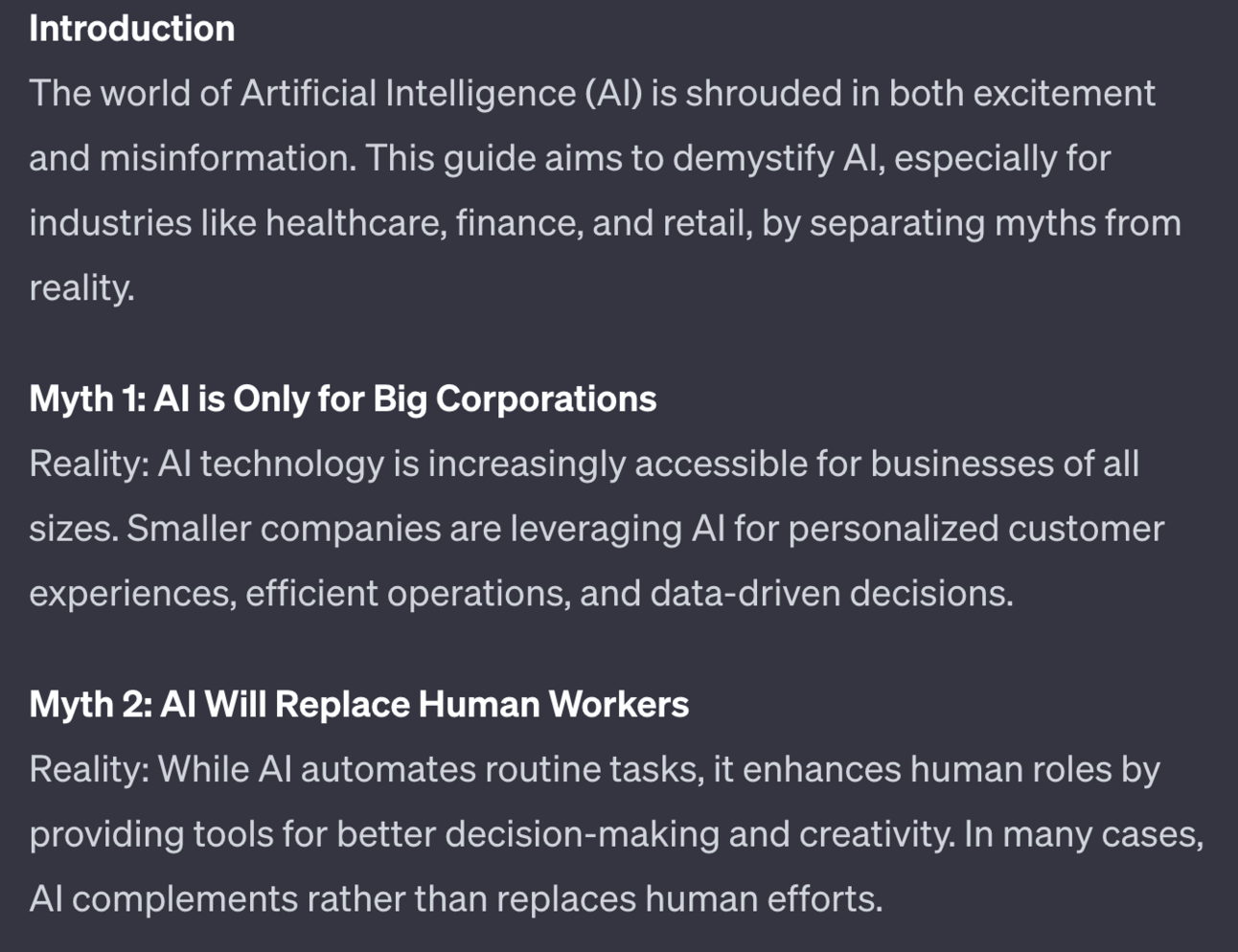
Need more detail? Fill in the gaps manually (recommended) or ask ChatGPT to flesh out the text. Either is faster than writing manually from scratch.
Once you have valuable content keep it simple. We don’t need to turn this into a beautiful, fully designed report.
Instead I recommend getting the text into Notion and then creating a public link. Here is an example of one of mine, simply set in a Notion document:
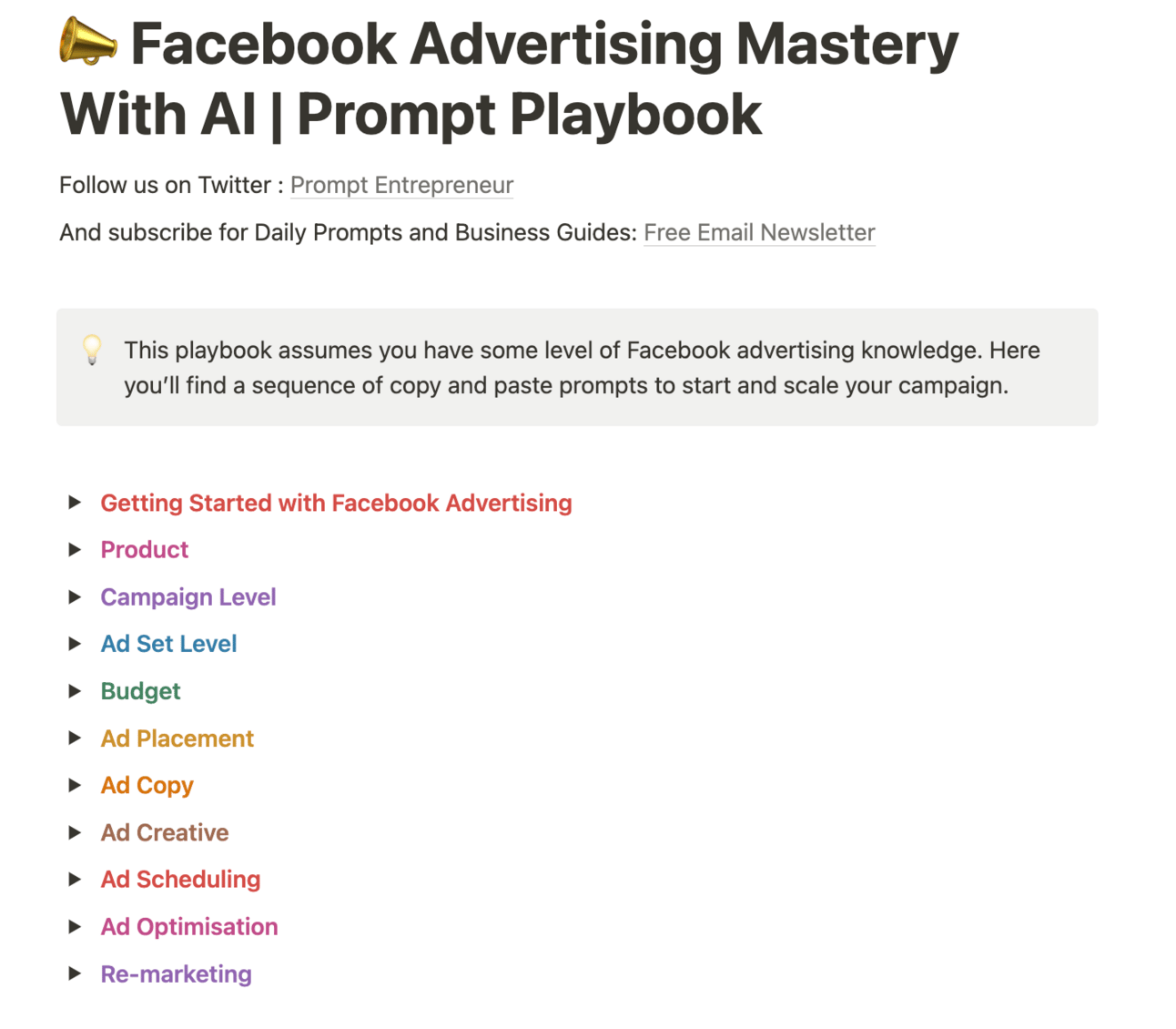
Live link here: Example lead magnet.
Next step is distribution and (crucially) knowing how many people have downloaded your lead magnet. That tells us how popular it is.
The simplest way is to post onto social media asking people to DM you to get sent the link.
This lets you gauge interest. It’s a manual process but more than sufficient to see if people are interested.
Don’t have an audience? I can help there. When I run accelerators I take my students’ lead magnets live to my audiences.
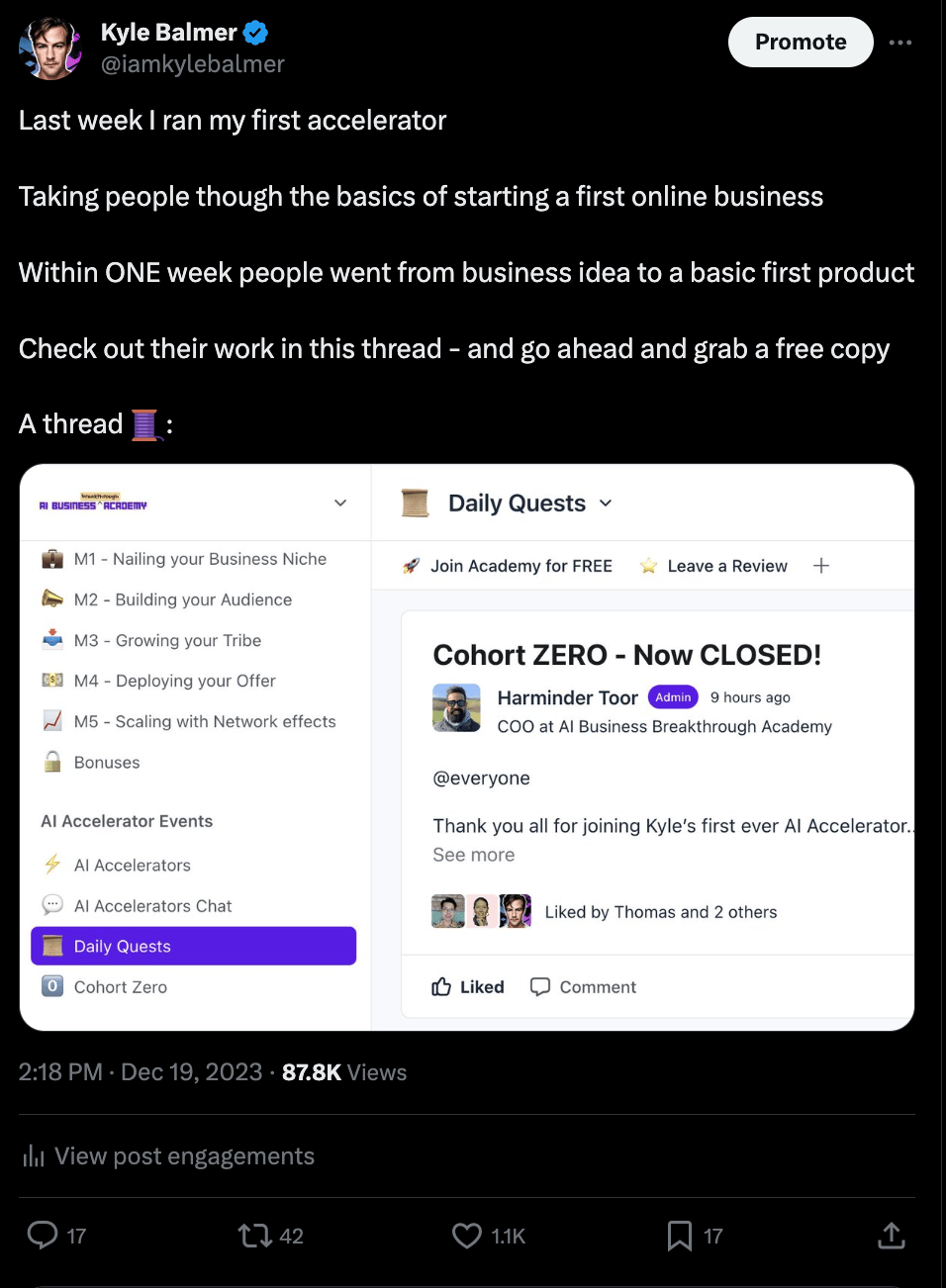
This tweet for example had 5 student’s lead magnets attached as a thread. 87,800 views on the thread and a decent chunk of traffic sent through to download their lead magnets.
Another alternative (if you don’t have an audience yet) is to run advertising. Putting $10 behind some ads to test a market is a very low cost compared to investing in a business and realising there’s no market!
The above method is great for testing the waters.
But I also want to give you a quick look at my tech stack for making it i) automated and ii) easy to launch lots of lead magnets.
Launching lots of lead magnets is particularly important because frankly we don’t know which will hit. We need to keep nudging the market to see what resonates.
For a more automated backend I use:
Notion
Gumroad
Hypefury/Tweethunter/Typefully
Lead magnets are created in Notion. You can also use Word or Google Docs to make a nice PDF but personally I like the design and ease of sharing that comes with Notion. It’s also free.
I use Gumroad to give away my lead magnets and collect email addresses. Gumroad takes a cut of your sales but because lead magnets are free it means Gumroad is free.
I create a product, set the price to $0 and then make the contents of the product the link to the Notion document. Simple as that.
This means to access my Notion document someone has to first give me their email address in Gumroad. It creates an easy “opt in” mechanism.
Finally I use Hypefury/Tweethunter/Typefully to run DM giveaways on X. Either of the three platforms will do the job - I suggest trying their free trials and seeing what works best for you. My personal preference is Tweethunter.
Here’s an example of a DM giveaway tweet:
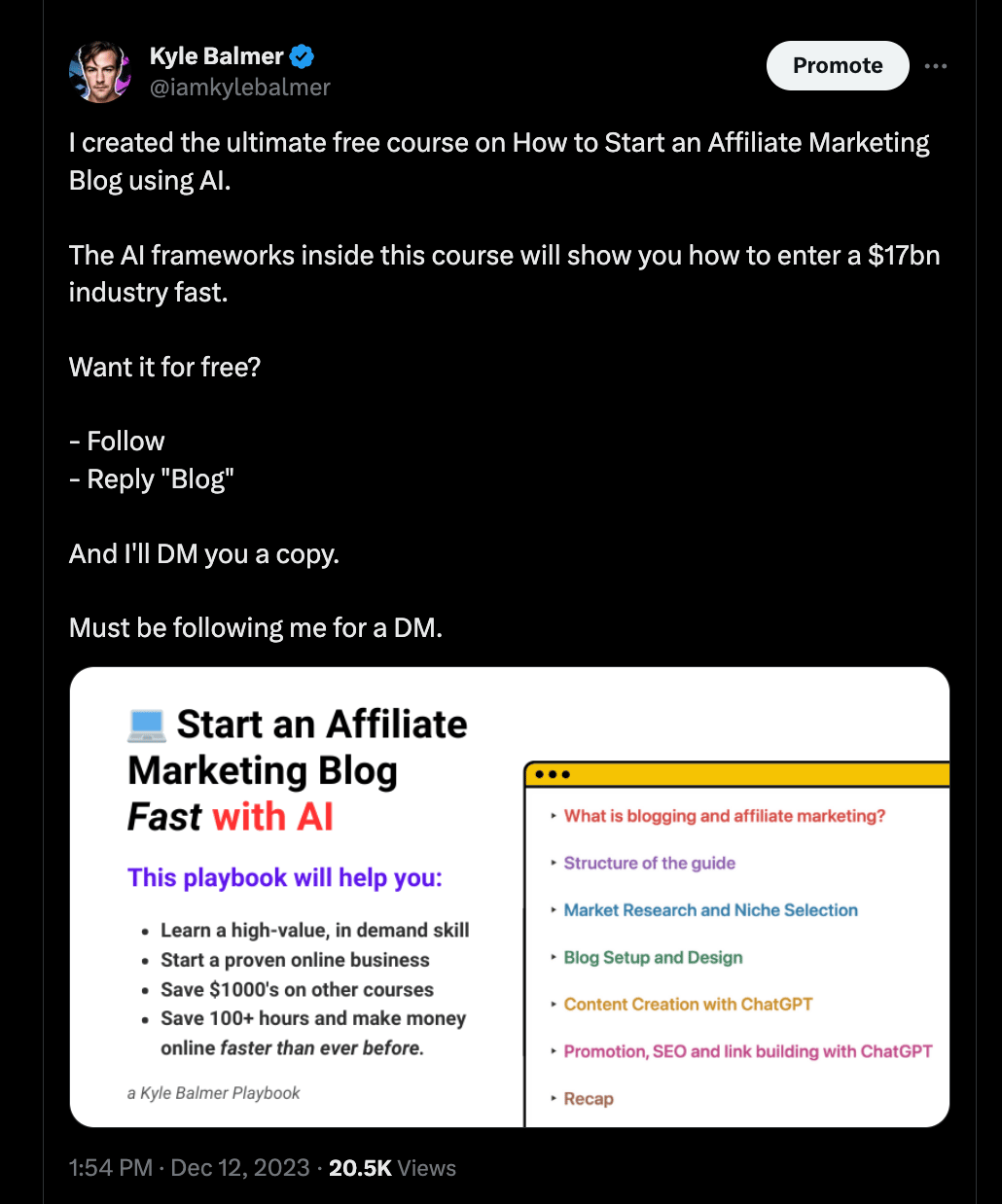
That has 20,000 views and 363 people asking for the lead magnet.
Hypefury/Tweethunter/Typefully will automatically send a DM to anyone who asks for the lead magnet. That DM thanks them and gives them the Gumroad (not the Notion) link so they can claim their lead magnet.
That means 363 new X followers (they need to follow to receive my DM) and up to 363 new email subscribers.
I run one of these a day generally for strong X and newsletter growth.
If there’s interest I can shoot a full video tutorial and add it to the community. Just say in Chat and I’ll film it all.
Today’s issue gives you the core foundation for not only testing your market but also driving newsletter subscriptions.
I’ll also be running 6 weeks of Accelerators on this starting soon. Waitlist here.
In tomorrow’s issue we’ll go more into the newsletter. What it looks like, what its function is and how to grow one for free (or even whilst making cash).
A reminder of what we’ll be covering this week:
Part 1: Discover your profitable business niche
Part 2: Captivate the market with your lead magnet
Part 3: Effortless email list growth
Part 4: Deep dive into customer needs
Part 5: Save the world with your creations
Until then, keep PROMPTING!
Kyle
We looked at how we start to collect emails in the last Part by using a lead magnet.
Now we are looking at how we use these emails to start growing our business.
Right now newsletters are the hawtness.
Newsletters give you something that social media does not: control of your own list.
With social media like X or Instagram an algorithm change or (worse!) account shut down can wipe your business out.
It’s imperative that you get your audience’s direct contact details. In today’s day and age that’s an email address.
And once you have that email address we need to keep the prospect warm. We can’t just ignore them until we are ready to sell them something.
Instead we need to reward their trust by providing value. A newsletter is an amazing way to do this, building trust and moving people towards making a purchase from you.
Here’s my newsletter (the one you are reading!) over the last 12 months:
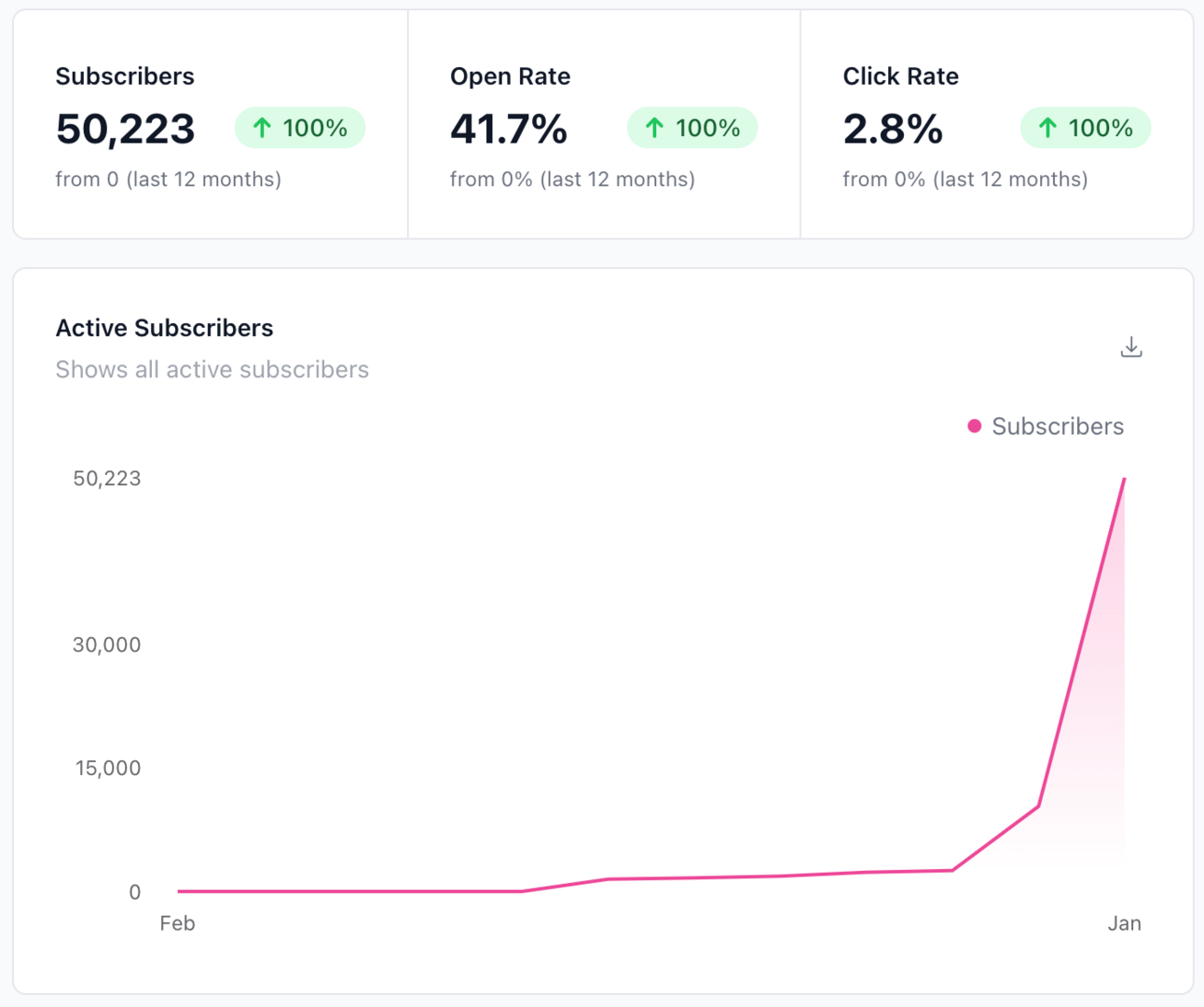
Launch was mid-year, around July where you can see the horizontal line slightly nudge up. Then months of grind and slow growth.
Followed by working out the “secret sauce” that I’m now teaching you this week. You can probably spot where that realisation was made!
In this issue I’ll outline the model.
First things first though you need a solid newsletter.
I’ve written a whole Prompt Playbook on this elsewhere which goes into depth. I’ll also be running an Accelerator on the topic in a few week’s time - waitlist here.
Today though here’s a prompt to get you started:
My business is [copy/paste business idea]

Customers signed up for the following lead magnet: [lead magnet description]

Based on this work backwards to generate an avatar of my customer along with their specific problems and questions.

Next generate ideas for a weekly newsletter that I could send them that would solve their problems and answer their questions.
If we run this prompt with the business idea from the previous Part and the following. lead magnet :
AI Myths vs. Reality PDF: A document that dispels common myths about AI in business, especially in your targeted industries. It provides factual information and clears up misconceptions, helping businesses understand what AI can and cannot do.
then we get the following outputs:
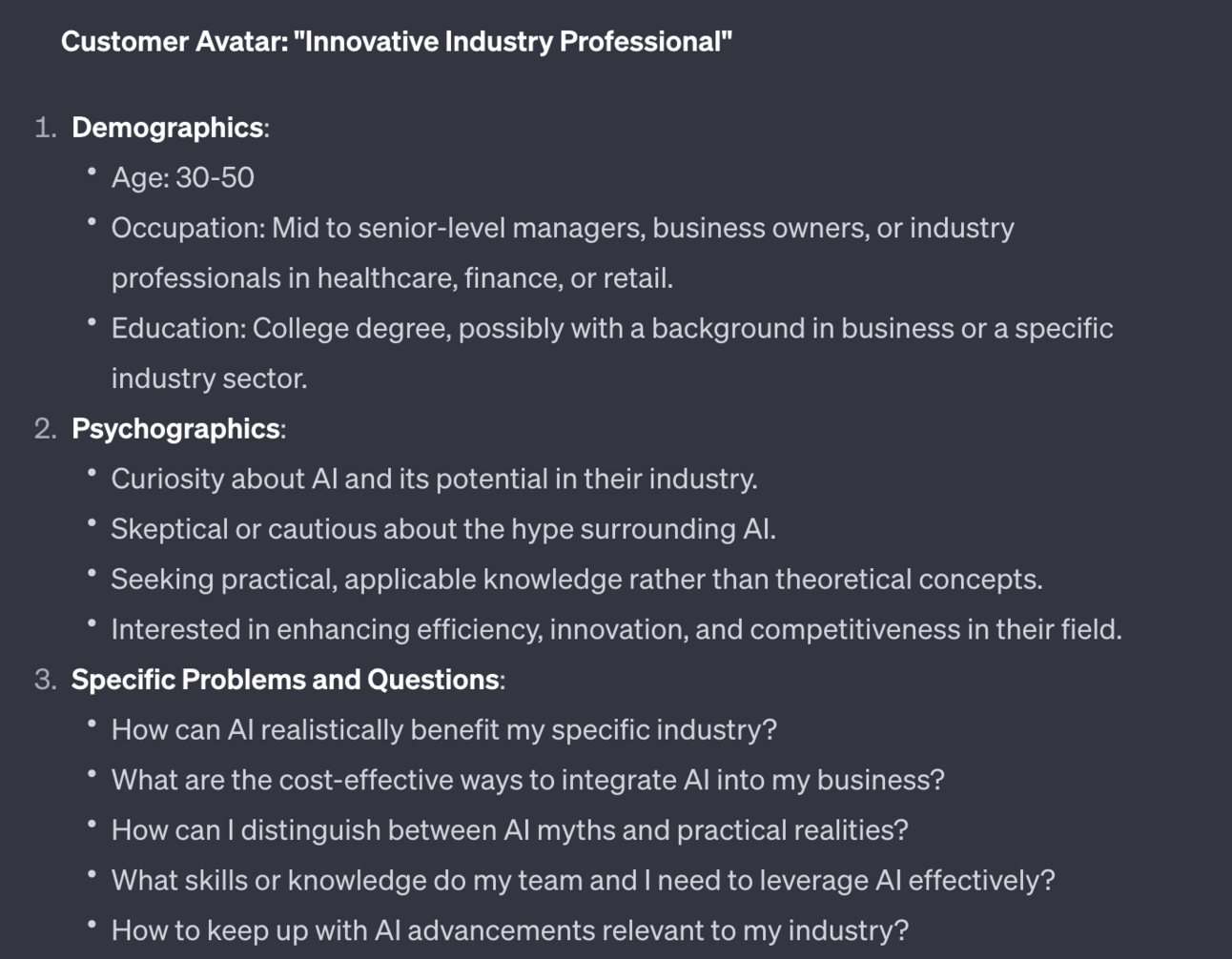
First up ChatGPT works backwards to generate an avatar.
Question here - shouldn’t we have worked out the avatar first?
No - we are basing our avatar on which lead magnet actually worked! Once we have a strong reaction to a particular lead magnet then we know we’ve hit upon something. We let the market lead us rather than assume we know better than the market.
This avatar is obviously a starting point. You’ll need to actually talk to your audience and customers (via polls, surveys and interviews) to get the full picture.
The prompt also uses this basic avatar to generate some newsletter ideas:
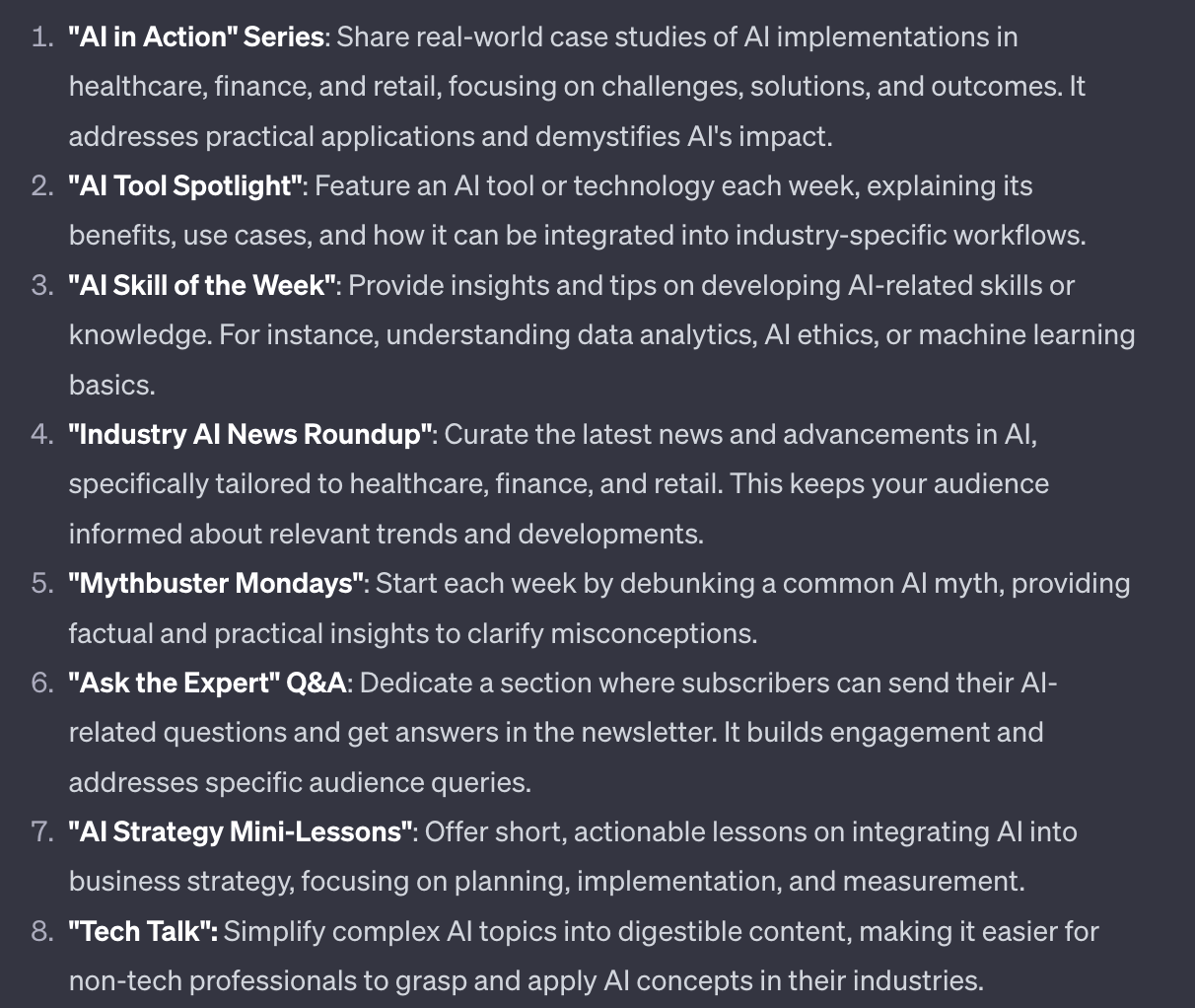
Anyone of these could be its own newsletter. Or sections within a newsletter. Again the actual content of the newsletter is beyond this single email.
I want to instead give you the rest of the setup so you understand how a newsletter fits in context.
Our newsletter is ultimately our sales platform - for whatever service or product you will be creating (in the next 2 Parts).
My newsletter goes to 50,000 people.
40% open each day.
That’s 5 issues a week x 50,000 people x 40%
For 100,000 weekly impressions.
That attention can be monetised. Either by sponsorship, affiliate links, guest articles or your own products and services.
Personally I recommend focusing on your own products and services.
Each issue I’ll add Call to Actions (CTAs) - you’ll notice them at the bottom of the email in particular. Go ahead and check I’ll wait here!
Your newsletter will do the same thing - you provide valuable information in the newsletter itself. This makes it a valuable resource and builds trust and authority. You then pepper the newsletter with CTAs and focus on building your audience so that enough people are clicking through and making purchases.
That’s the basic engine we’re building here. And using a newsletter rather than social media because you control access to the audience rather than the social media platform.
How do we get rocket growth like the chart above?
2 main tactics.
The first I covered yesterday - the DM giveway Notion document behind a Gumroad email gate. Make sure that those emails go into your newsletter. Nice and easy. That allows me to add ~200-300 emails per day.
The second tactic is adverts. Specifically self liquidating adverts.
Right now I run advertising and pay $0.80 to gain a subscriber from the US or UK.
But for each subscriber I gain through advertising I make $1.20 or more.
So I actually make money whilst growing my newsletter list.
Huh, what?
The mechanism here is that when someone signs up for my email newsletter they get shown this screen:
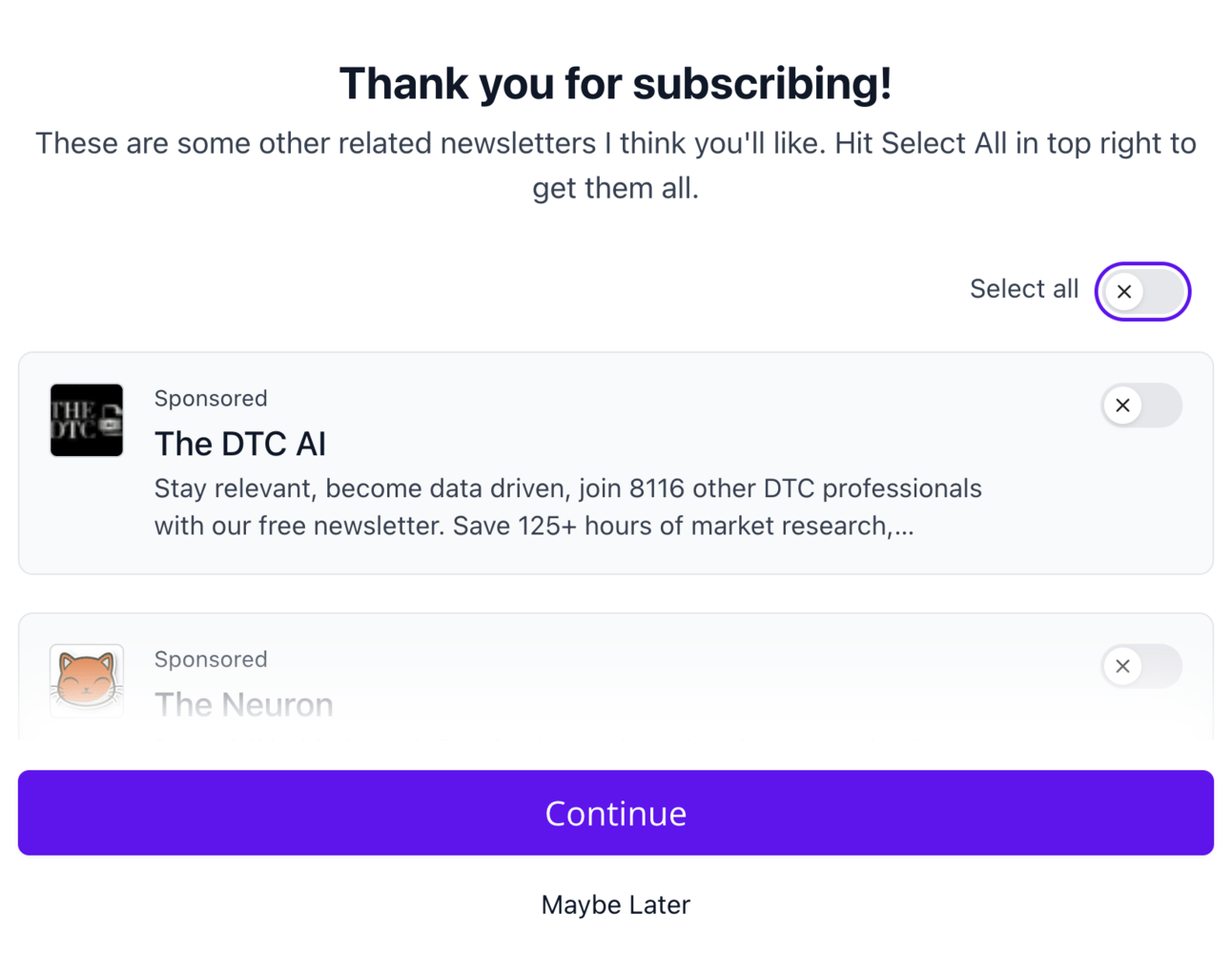
This screen gives them the option to sign up for additional newsletters that I recommend.
Each newsletter they sign up for pays me around $1-3 per qualifying subscriber.
You can see how this is going now eh?
As long as I keep my cost per subscriber low enough and the recommendations pay higher than that amount I make profit whilst building my email list.
Very very powerful.
I personally use (and highly recommend) beehiiv, which comes with built in monetisation tools like this.
Alternatively you can use Sparkloop which works independently of your email sending platform.
Here’s a quick recap of everything covered as it’s a lot today:
Build a newsletter based off the success of your lead magnet, focusing on providing regular value to your subscribers and future customers
Use beehiiv as your newsletter platform
Use the newsletter to sell your products and services via CTAs
Grow your newsletter for “free” using advertising that costs you less than the revenue generated by Boosts.
Sounds simple but there are obviously lots of complexities involved! I’ll talk more about this in the Accelerator as it’s a big topic! Waitlist here.
The key to the strategy above is obviously getting low cost Cost Per Acquisition (CPA) on getting newsletter subscribers.
I run at a $0.80 cost per subscriber in the UK and US which is very cheap.
I’ve had a number of people try to sell me services and when I say “sure, can you beat $0.8?” they’ve all said no!
For adverts I personally find this works:
Meta ads (Facebook and IG) over X, LinkedIn, Youtube.
X leads to lots of volume but low quality.
LinkedIn is high quality but expensive.
Meta is goldilocks zone of quality and cost.
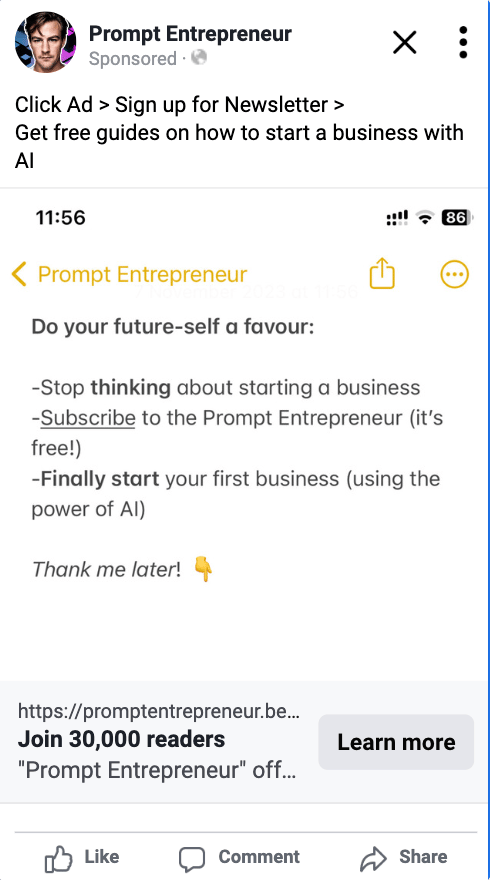
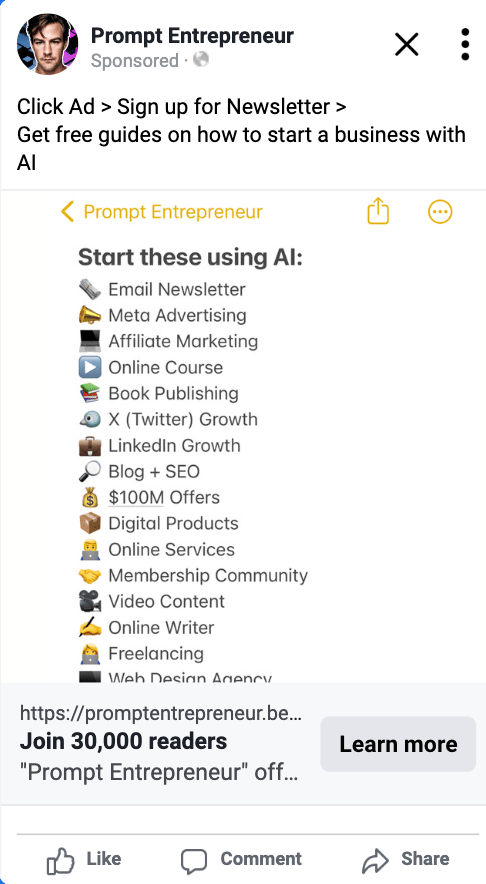
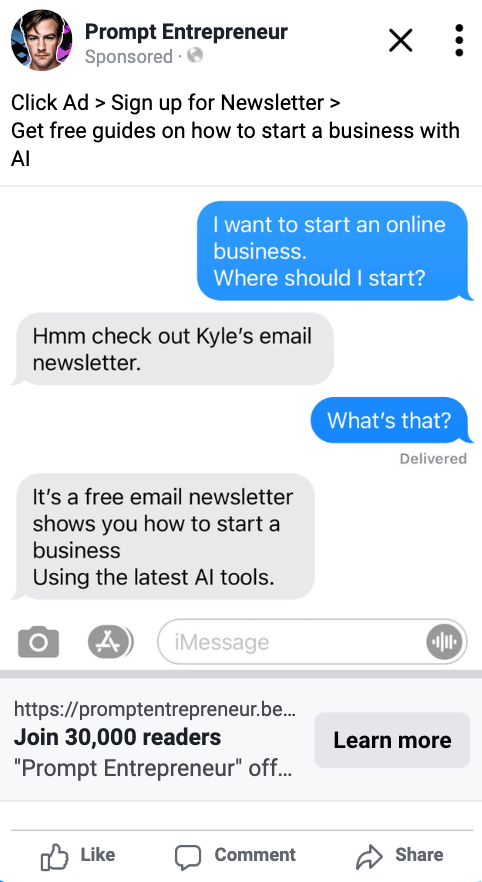
Single photo creative, focusing on pattern breaks
Images of text on Apple Note, mock up SMS exchange for example
Straight to beehiiv landing page, no lead magnet
I tested more complex versions like free guides, email courses, video course etc. but the simplest straight to subscribe option works the best.
Wide targeting, allowing Meta’s algorithm to do its work
Set geography to countries where other newsletters will pay you for Boosts. Tends to be USA and Europe.
Set basic interest like “entrepreneurship”, “sport”, “technology”. Very high level.
Let the algorithm do the rest of the work.
Here are three creatives that work best for me. I suggest you copy them! Go nuts!
Lots covered today.
But a newsletter is its own topic - make sure to check out my Prompt Playbook on Amazon for a full overview.
Or alternatively join us on the 6 weeks live Accelerators starting soon. Waitlist here.
A reminder of what we’ll be covering this week:
Part 1: Discover your profitable business niche
Part 2: Captivate the market with your lead magnet
Part 3: Effortless email list growth
Part 4: Deep dive into customer needs
Part 5: Save the world with your creations
Until then, keep PROMPTING!
Kyle
Next up in the Blueprint we are going to start learning exactly what our customers want.
More importantly though we’re going to do this whilst getting paid.
Before running off and building a product we need to work out what exactly our customers want.
The best way to do this is to launch a service offer first.
Why?
This put us face to face with customers and increases the rate at which we learn about them.
We get immediate access to their challenges and problem.
We can generate revenue whilst doing so, allowing us to bankroll our business moving forward.
The alternative is pushing ahead and building a product that nobody wants, launching in and being confused that noone is buying it. We don’t want that!
Let’s use a prompt to help us work out a service offer.
Act as a markting consultant

My business niche is: [copy paste business idea]

I successfully generate attention using this lead magnet: [lead magnet description]

And my customer avatar is [copy/paste avatar]

Based on these parameters suggest 5 simple service offerings I could offer.

Focus on service offers that can be sold in 1 hour blocks, provide immense value and allow me to consult and find out my customer's problems and challenges.
I inputted information from the previous parts- specifically the specialized AI Course for Specific Industries business idea, the Myths lead magnet and the middle to senior management level customer avatar.
This lead to the following list of service idea suggestions:
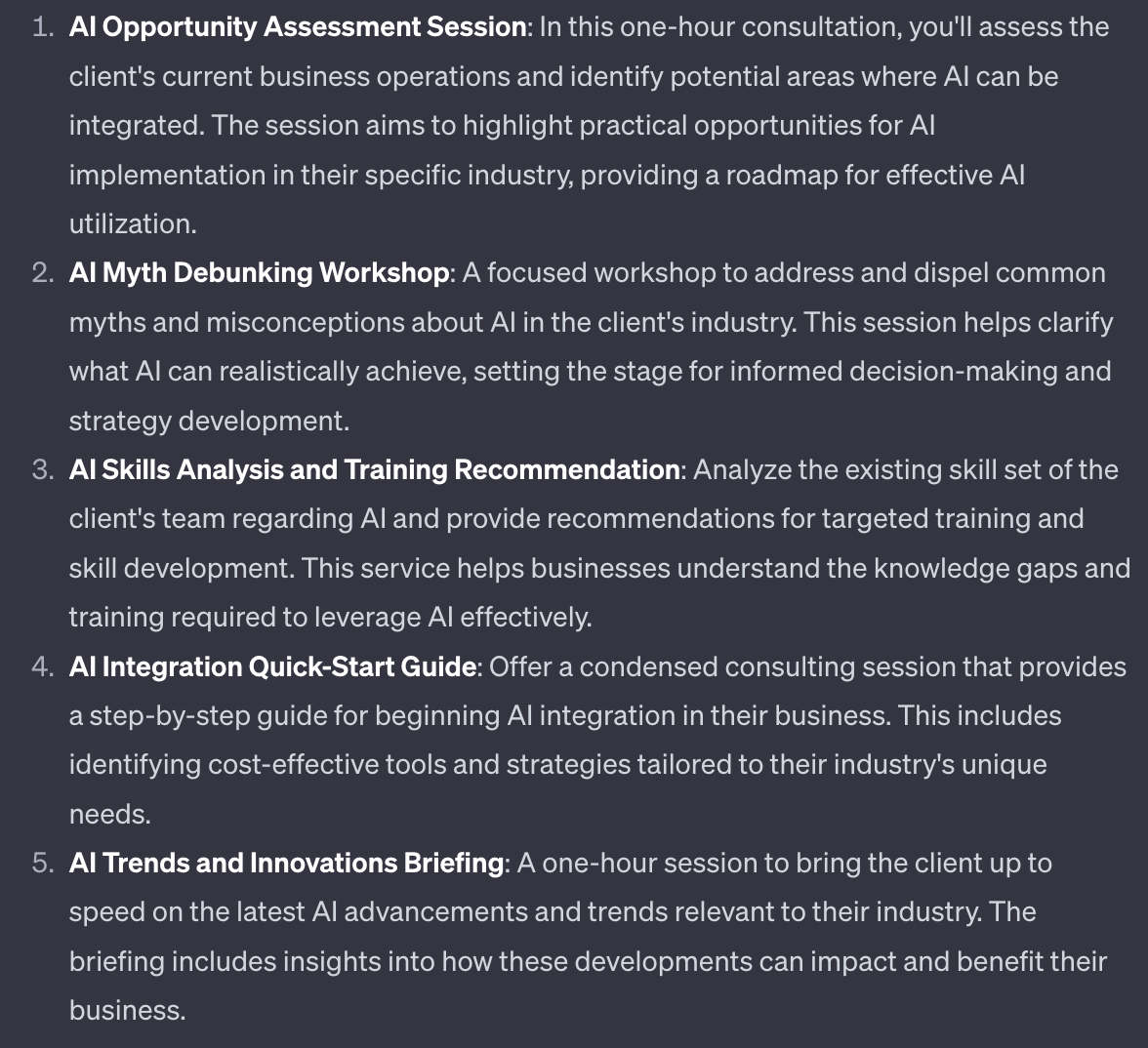
Remember that these are ideas that are tuned to be attractive to the audience and newsletter subscribers you are already talking to.
Which to go with? I don’t know!
But you know who does? Your audience!
Poll you audience and newsletter subscribers - literally ask them which of these are the most attractive to them. Follow their lead rather than assume what they want.
Price your service at $100/hour.
And increase the rate every 10 clients.
What about the backend of taking bookings? Keep it simple - personally I recommend Topmate (affil link). They take a cut of your booking but make the whole booking, scheduling and taking payment process painless.
Doing it manually with emails and invoicing is also doable but honestly using a tool like Topmate makes it a lot simpler. Calendly is also an option but you’ll be paying a monthly fee whether or not you make bookings - Topmate on the other hand will take a % of your revenue instead.
With the service offering your goal is not making money. That’s a nice side benefit!
Your goal is to spend as much time with your customers as possible.
Find out what their burning problems are.
Find out what annoys them, makes their lives miserable.
These are what we’ll be focusing on in the next Part where we build digital product.
I’ll talk more about building out a service offer (and then scaling it as a premium offer) in the Accelerator as it’s a big topic! Waitlist here.
We can accelerate learning and revenues by creating service bundles.
We structure this so that one hour service is our entry level and the main service is over a series of hours.
Here’s a prompt to use below the main prompt:
I want to pursue option [option number]

Provide a structure where the first hour is an introduction and soft sales pitch

Give me a 3 hour follow on package

And a 10 hour follow on package

The 1 hour should lead into the 3 hour
The 3 hour should lead into the 10 hour

Outline what each package is and the benefits for the customer
Give me suggested sales hooks from one to the next
Plug in the name or the number of the service offer idea you are pursuing.
The output will be a detailed game plan for your packages. Here’s the output of the first (of three) package:
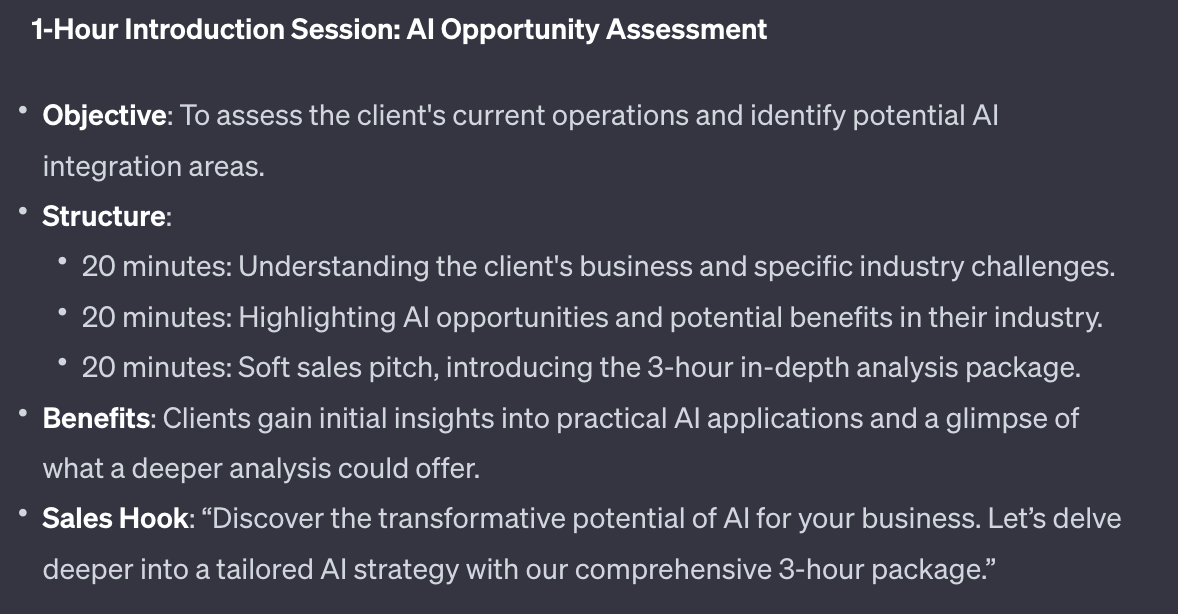
Each package will run on from the last one, allowing you to escalate customers.
Importantly the first hour session becomes your entry point rather than your main offer. It’s an introduction where you can help clients to identify their problems and then move them into a sale.
Each escalation means more revenue and (importantly) a deeper relationship with the client.
In the next Part we’re going to take all the learnings we acquire from our service offer and formulate them into a digital product that sells on autopilot.
Remember that all this (and more…so much more) will be covered in our series of live accelerators.
Join us on the 6 weeks of live Accelerators starting soon. Waitlist here.
A reminder of what we’ll be covering this week:
Part 1: Discover your profitable business niche
Part 2: Captivate the market with your lead magnet
Part 3: Effortless email list growth
Part 4: Deep dive into customer needs
Part 5: Save the world with your creations
Until then, keep PROMPTING!
Kyle
The final step in the Blueprint is to formalise our audience, newsletter and service work into a digital product.
This is the good stuff.
What online business is all about.
It’s the waking up to this sort of thing:
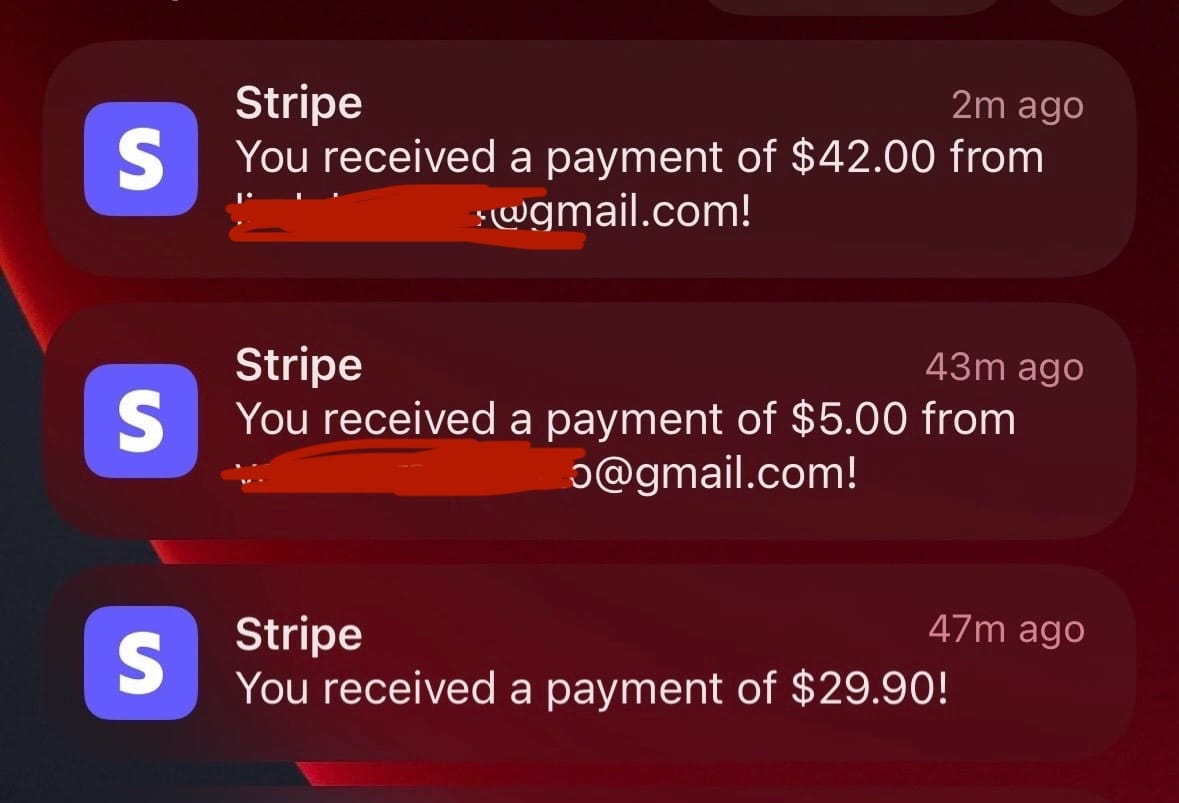
Once you have a digital product in place you get as close to the dream of “passive income” as possible.
There’s been a lot of ground work (we covered this in the last four Parts) but that now pays off when you develop and launch digital products.
We’ll look at how in this Part.
Our products need to solve customer problems.
How do we know what our customers’ problems are?
That’s precisely why we started with running a 1:1 service offer in the last Part!
By spending time talking to and working with clients you’ll start to see patterns.
Clients in the space will all have similar problems. The more you work with clients the more apparent the patterns will become.
You can supplement this with polls. With both you audience (for example on X) and tribe (in newsletter) you can run polls asking what their biggest problems are.
This feedback is not as valuable as listening to service clients but it’s a great supplement.
Over time you need to collate and write down the top problems that your customers deal with. Ideally you can narrow it down to a single problem - but having a handful of problems is also fine!
Once you’ve got the customer’s core problem on lock we can formalise a product. Here’s a prompt:
Act as a product designer

My business is [copy/paste business niche]

I offer the following service: [copy/paste service description]

I have identified my customers primary problems as:
[list out customer problems]

First delve one layer deeper on these problems to suggest the root core problem linking these problems.

Next suggest 5 product ideas that I can offer to customers to solve this problem

The products should be digital, hands-off once completed, require no/low capital to develop, require no specialised team or skills to develop.
I’ve run this prompt along with the previous business niche and service offer from the last Part.
For the customer problems I’ve used:
not knowing if AI is a fad
technical inexperience
worried other companies are deploying AI and they are not
First the prompt analyses the problem areas I provided and suggests a root cause:
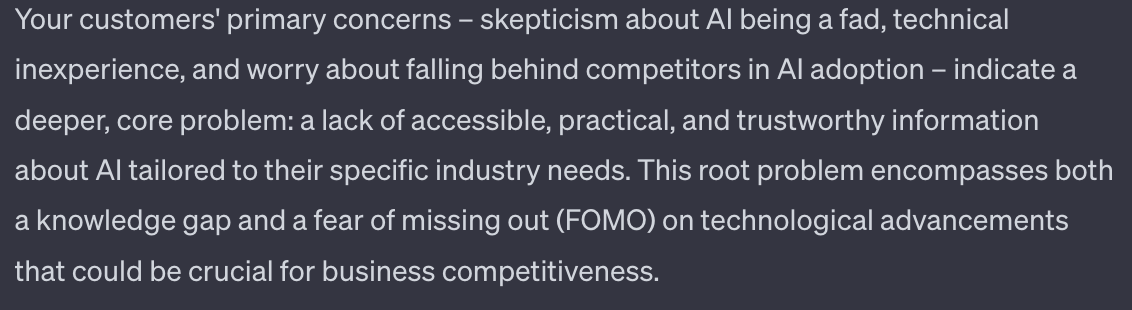
In this case ChatGPT has identified the core problem as FOMO.
This is a genuine concern for middle managers, which was the target avatar from previous Parts.
They don’t want to look like idiots for missing the boat when competitors and colleagues are suddenly deploying AI and they are not. They want to cover their arses basically by keeping up to date!
ChatGPT will also generate a handful of product ideas for us:
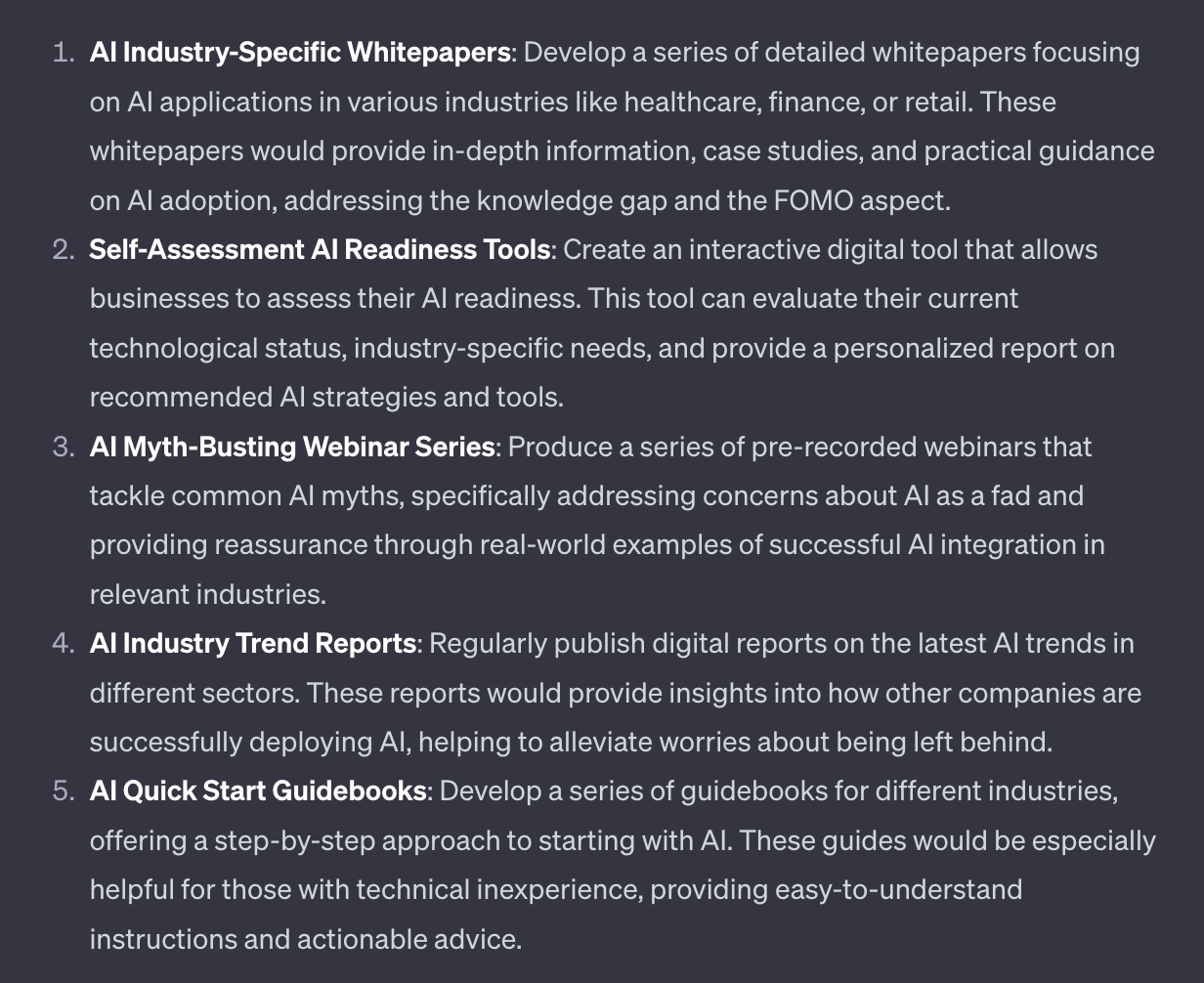
All solid ideas.
How do we know which to go with?
You know the answer to this by now! We ask them.
Run polls to your audience and newsletter subscribers. Ask your current customers. Find what they want and run with that.
The product creation process will depend on which idea you run with - the production of a webinar series is very different to a set of guidebooks.
Publishing will also depend on what the product is. For example a video course is published on an LMS (learning management platform) whereas a guidebook might be published on Amazon.
I’ve covered most of these various ideas elsewhere in Prompt Playbooks. Right now you just need to work out what the product will be.
I’ll talk more about building out digital products (in any format) in the Accelerator as it’s a big topic! Waitlist here.
A more advanced tactic is to build in multiple formats.
Once you’ve identified the customer’s main problems you hit them from multiple angles.
You create a whitepaper, guidebook, video course, email course, community, mastermind, webinar series etc. all about the same problem.
Why?
First up everyone has different preferences. You might like audio whilst I prefer to learn from text. We are all different.
Second, we can escalate the same customers through different variants. They may start with the eBook but then buy the (more expensive, more hands-on) video course.
Here’s a prompt to hit the same problem from multiple angles. Use this below the previous output:
Expand this to 10 product ideas

Then sequence them into a funnel from lowest cost/time investment to highest

Provide indicative pricing for each
This will expand the product idea range and then sequence them into an escalation funnel for you:
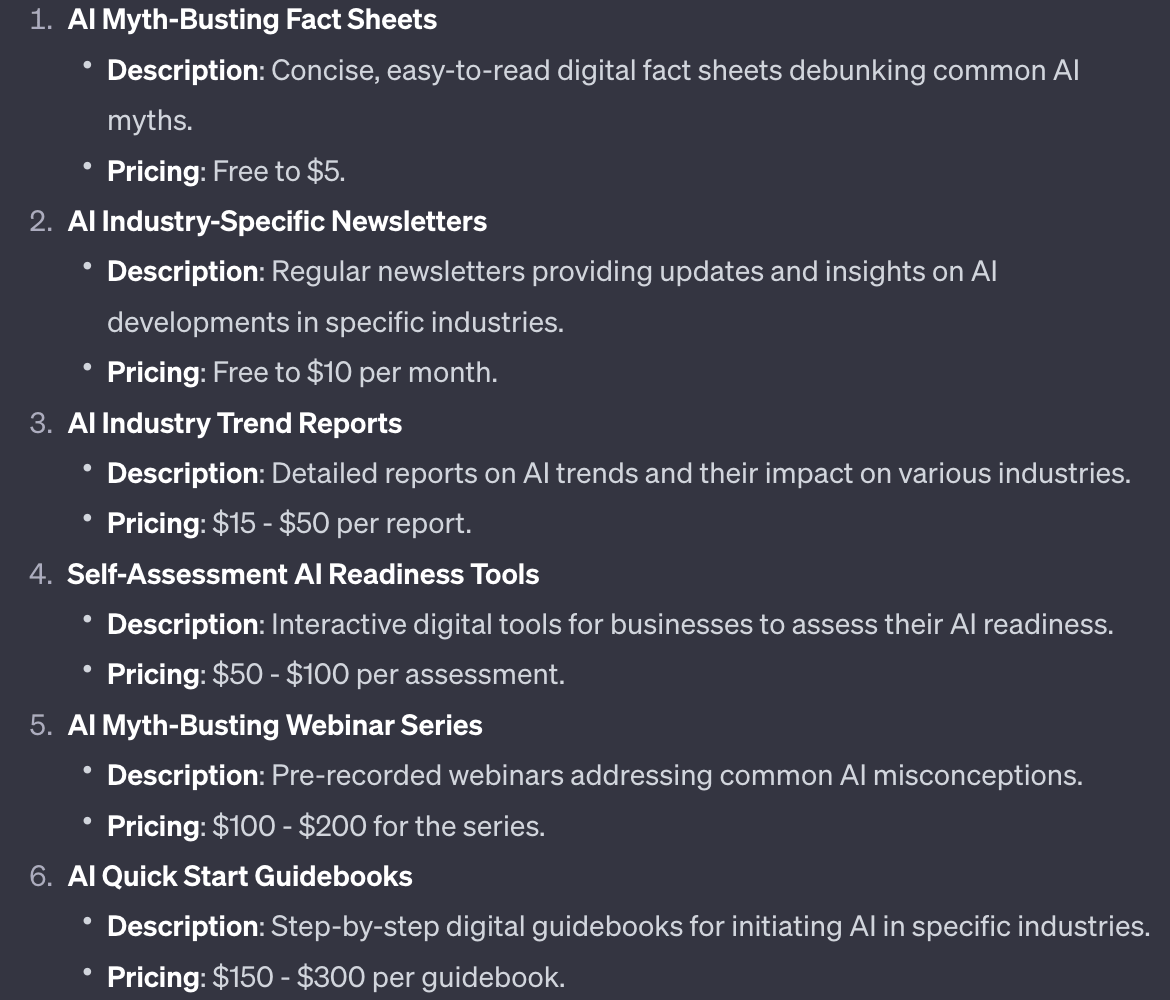
As always confirm these with customer discussions before deploying.
Then deploy from front to back, continually adding new offers and escalating customers.
Over this week I’ve given you the Blueprint for a successful business in 2024.
Business niche → Lead Magnet → Newsletter → 1:1 Service → Digital Product
This basic flow is my focus for 2024 - helping people deploy this basic model, launch their first business and escape the 9 to 5.
Want to join us on the 6 weeks of live Accelerators starting soon? Free waitlist here.
Here’s what we covered this week:
Part 1: Discover your profitable business niche
Part 2: Captivate the market with your lead magnet
Part 3: Effortless email list growth
Part 4: Deep dive into customer needs
Part 5: Save the world with your creations
Until then, keep PROMPTING!
Kyle
Welcome to '💰 Starting an Online Business using AI | Blueprint,' your essential guide to launching a successful online business in 2024. This playbook provides a step-by-step framework that harnesses the power of AI to identify market needs, engage potential customers, and create valuable digital products. With actionable insights and proven strategies, you'll transform your entrepreneurial vision into a thriving reality, freeing yourself from the constraints of traditional 9-to-5 employment.
This playbook is designed for aspiring entrepreneurs, freelancers, and small business owners who are eager to leverage AI for their online ventures. If you're feeling overwhelmed by the complexities of starting a business or unsure about how to stand out in a crowded market, this blueprint is perfect for you. It provides clear, actionable steps to help you navigate the business landscape with confidence, making your entrepreneurial dreams achievable and sustainable.
No prior experience is necessary! This playbook is designed for beginners and provides clear guidance through each step.
You can expect to spend a few hours each week on the exercises and implementation, with flexibility to accommodate your schedule.
This playbook is designed to help you build your business alongside your 9-to-5 job, with strategies that fit into your existing commitments.
Absolutely! The principles outlined in this playbook are adaptable to various niches and industries.
While the playbook itself is comprehensive, you may choose to invest in tools or services that enhance your business, but these are optional.