AI Business
Are you ready to break free from the constraints of traditional business models and start your entrepreneurial journey without breaking the bank?
Start ReadingLast week I asked readers and viewers what exactly is stopping them from starting a business.
The number one reason that came up again and again was MONEY.
We all sort of assume we need:
great business idea
a team
and cash
To start a business.
That’s fairly traditional.
And wrong.
The age of the bootstrapped solopreneur is well and truly here. It’s just that traditional conceptions about business haven’t caught up yet!
This week I’m going to show you step by step how to start a business with zero cash.
Here’s a video intro on the topic.
@iamkylebalmer Replying to @Yentino you do not need money to start a business. In fact having too much cash is a hinderence! #entrepreneur #business #own... See more
This week we’ll cover:
Part 1: Best time to Start
Part 2: Low Cost Business Ideas
Part 3: Earn Immediately Whilst Validating
Part 4: Grow Without Investment
Part 5: Raising Money with Proven ROI
Let’s get started:
You know I’m going to talk about trees here right?
The best time to plant a tree was 20 years ago. The second best time is now.
It’s a good saying. And it’s true! But I’m not just gong to leave it at that.
Because that dude didn’t have AI.
AI has changed the game. For once starting 20 years ago may not be the best time!
There are two forces at play here - positive and negative, the carrot and the stick. Both caused by AI. Both equally important for your future.
Just last week The Guardian newspaper here in the UK published a think tank report about the impact of AI:
Now, that 8m number is the worst case. That’s about 22% of the entire UK work force, roughly 1 in 4 workers. Of course the newspaper focused on that scary figure. Got to get that click!
But even if worst the case scenario isn’t realised what’s for certain is that AI is coming like a freight train for certain jobs and entire industries.
And a lot of us are standing around on the train tracks, Airpod Pros stuck firmly in ears, humming along to Taylor Swift.
Yes, AI will make new jobs. Yes, people will retrain. Yes the global economy will (probably) keep on chugging.
Humans are great at finding a way to botch our way through it. We’ve been doing it for Millenia. I’m fairly certain we’ll manage to do so again.
But that doesn’t mean that individuals are insulated. This is the risk.
Sure humanity as whole will probably be fine if not better in the long run.
But that doesn’t make it any easier for individuals who are about to, in the technical parlance, have their shit rocked.
These individuals are going to have a rough time of it. In the same way the cart drivers, the hand weavers, the British miners and all the other industries that have been automated and supplanted have.
New jobs were made yes. But not fast enough for the people who got hit by the freight trains of the car, loom or Maggie Thatcher. Toot toot.
Welp that’s the end of the issue have a lovely week! Bye!
Nah, I wouldn’t do that to you.
The fact that you are here, reading about AI entrepreneurship of all things, means that you will be ready for what’s about to happen.
In fact more than that you are in a position to thrive.
The problem with having a single job, a 9-5, is the instability. If you have ONE source of income and that one source of income gets removed what happens?
This is why we don’t make one legged stools.
Instead, if we have multiple sources of income all ticking away for us we put ourselves in a more stable position. Much like three legged stool or, if I may be so bold, a four (!) legged chair.
Come what may with AI (and we don’t know what’s coming exactly) having flexibility gives us optionality. We will be able to flex.
Having a business or side income to replace or supplement our job puts us in this stronger position.
And thankfully, it’s also never been easier to start a business.
Because of AI.
When I started my first online business I had to:
create the product
design the brand
write the copy
build the website
integrate the eCom
structure ad campaigns
handle customer service
deal with shipping/inventory
do the bookkeeping and accounting
etc. etc.
I had to do all of this because I had no cash. It was my first business. It was hard to raise cash (no track record) and I didn’t have my own cash to invest.
I couldn’t hire for these skills with no money.
So I had to learn them myself. It’s the solo founders dilemma: you need either a team or cash or preferably both.
AI has changed that. I now have in my pocket an expert on all of the above.
For some tasks I will use AI to directly do the work. For others I’ll use AI as a assistant to give me step by steps.
Either way I’m able to supplement any of my shortcomings with AI. Which in turn allows a founder to plan, design, build, launch, market and fulfil faster and more efficiently than ever before.
You, as a solo founder, are no longer alone. AI has lowered the barriers to entry for starting a business if you know how to use it correctly. And it’s my job at Prompt Entrepreneur (and the new AI Futurepreneur Forge) to teach people how to use it for business.
Oooh but the economy is bad. It’s the wrong time. Interest rates are blah blah blah. VCs in San Francisco are saying such and such.
Stop it.
For one, it’s outside of your control. Are you going to wait ten years until the conditions are just right? Hint: they never are. I personally left uni in 2007 just as we entered the worst recession since the Wall Street Crash. Shit happens.
Two, there are plenty of good reasons why starting a business in a recession is a GOOD idea. Here’s a video so I don’t have to rehash this again!
@iamkylebalmer Replying to @Timothy you shouldnt start a business during a bad economy? I think there are good reasons for entrepreneurs to start during ... See more
As someone in the comments pointed out we’v been in on/off recession for 10-15 years! Worrying about the economy is just an excuse.
Over the next 4 Parts I’m going to show you how to start a business with no cash.
And why in fact have no cash is going to make your business way stronger in the long term.
The trick is to know what sort of business idea to pursue and how to manage its rollout. There are a very specific set of steps that will allow you to start with zero and build from there. I’ll walk you through step by step the process I’ve used on countless businesses (countable actually - 30+!) and taught to others.
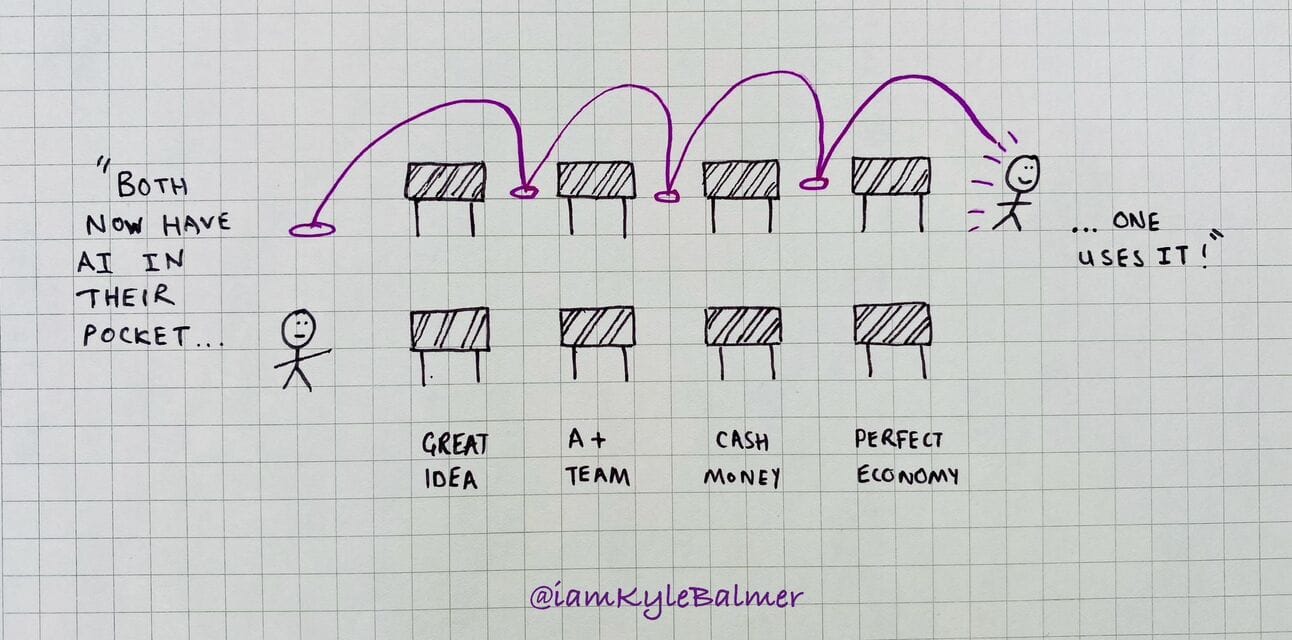
A reminder of what we’ll be covering :
Part 1: Best time to start
Part 2: Low Cost Business Ideas
Part 3: Earn Immediately Whilst Validating
Part 4: Grow Without Investment
Part 5: Raising Money with Proven ROI
Keep prompting,
Kyle
Welcome to the first Futurpreneur Forge issue - our newly revamped Premium only newsletter.
If you are on the free newsletter heads up this is the last Tuesday issue you’ll receive - we’re sending this last one to make sure everyone knows about the change. From now it’ll just be Monday and Saturday.
If you are joining us it’s $49/year this week only.
For those who are joining us in the Forge welcome! Thank you to the hundreds who have joined us so far. We’re so excited!
There are going to be a lot of changes moving forward making these issues much more valuable and actionable for you. Think: graphics, videos, screen-shares, checklists, more prompts etc.
This shift allows me to double down on making these guides absolutely kick-ass. I’ll be regularly polling you find out what you want more of and less of so I can better refine it for you specifically.
Right, let’s continue this week’s guide on a subject near and dear to my heart -starting a business with no cash!
This week we’ll cover:
Part 1: Best time to Start
Part 2: Low Cost Business Ideas
Part 3: Earn Immediately Whilst Validating
Part 4: Grow Without Investment
Part 5: Raising Money with Proven ROI
Let’s get started:
Low Cost Business Ideas
Your idea should be a combination of something you are skilled at (good enough to compete), something you enjoy (willingness to work on it) and there exists a market for it.
The initial idea should require no capital, no team and be digital not physical.
Service first ideally. This puts you in contact with customers immediately which provides immediate revenue and more importantly learning. Freelance if you need to. Then shift to a productised service then to a product once the value to the customer is known.
When starting a first business it’s important to choose an idea that is as low cost as possible.
Why? Because if/when it doesn’t work we are ready to go again.
Too many people plough their savings into starting a business - think of the guy who starts the restaurants of his dreams using 10 years of hard earned savings. Only for it to not work.
That’s a situation we want to avoid.
Because, and here’s the hard truth, most first business ideas will not work.
And if they do work then it’ll be because they’ve been pivoted and adapted to make them work. Often what you end up with is very different to the initial idea! And that’s fine.
Because of all this we want our first business to be low cost so we can i) start with nothing, ii) adapt easily if needed and iii) go again if the first idea doesn’t work out.
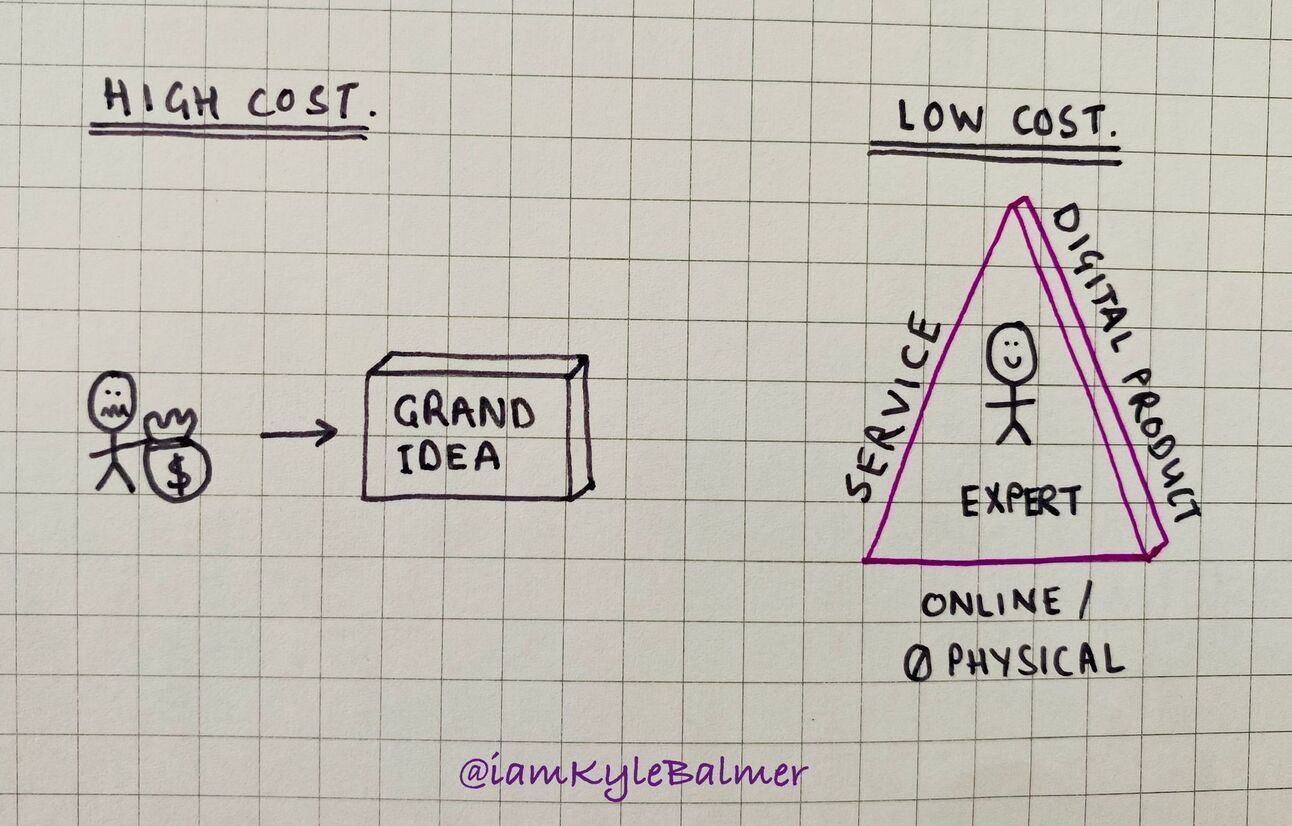
For first businesses I recommend:
a service to start
converting into digital products over time
online/digital delivery
nothing physical
expertise based
The basic play here to to find an area of your own expertise where you can provide massive value to customers.
You start by packaging this expertise up into a service that you yourself deliver.
By doing so you get in contact with and learn from customers (more on this in Part 3) whilst earning money.
You then convert the service into digital products. Digital products become your bread and butter and early offers. Your service offer becomes your premium offer.
Here’s a prompt that’ll pull all this together for you:
Act as a business strategist

Help me define a business idea.

It should require no capital, no team and be digital not physical.

My expertise are: [list out skills]

First give me a list of business ideas and ask me to select. Then outline that idea in full. It will be a service business that I later build into a productised service and digital products.
If I plug in “teaching, writing, entrepreneurship, ai” as skills the prompt will first output some basic ideas:
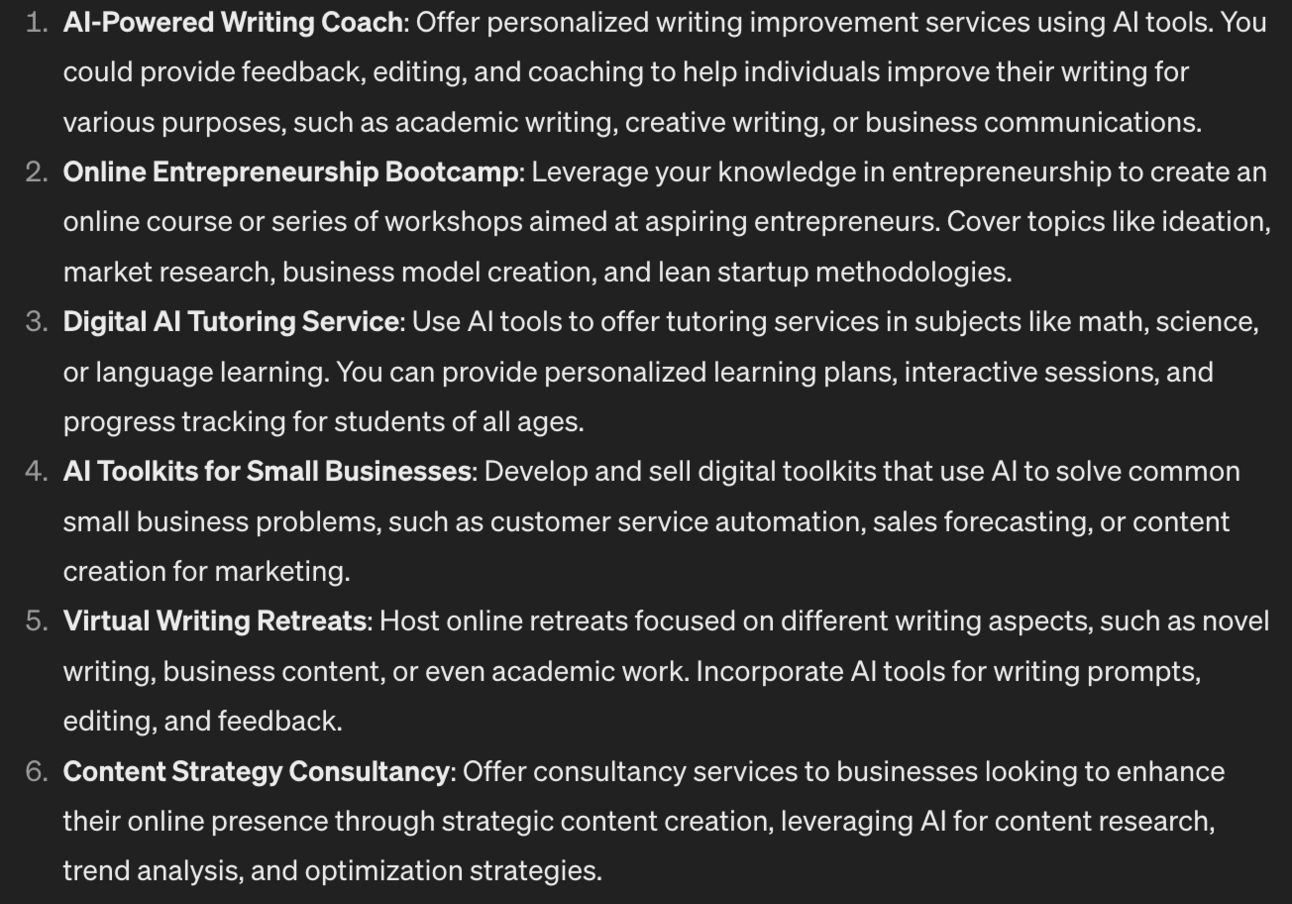
I can then specify which it should outline in detail. For example I like the idea of 2.
This will cause ChatGPT to outline the idea according to the limitations we’ve discussed. It’ll be designed for zero cost, no team, digital not physical and starting with a service.
ChatGPT will take the basic idea and flesh it out using the framework instructions I’ve provided.
For example it’ll design first the basic service offering:
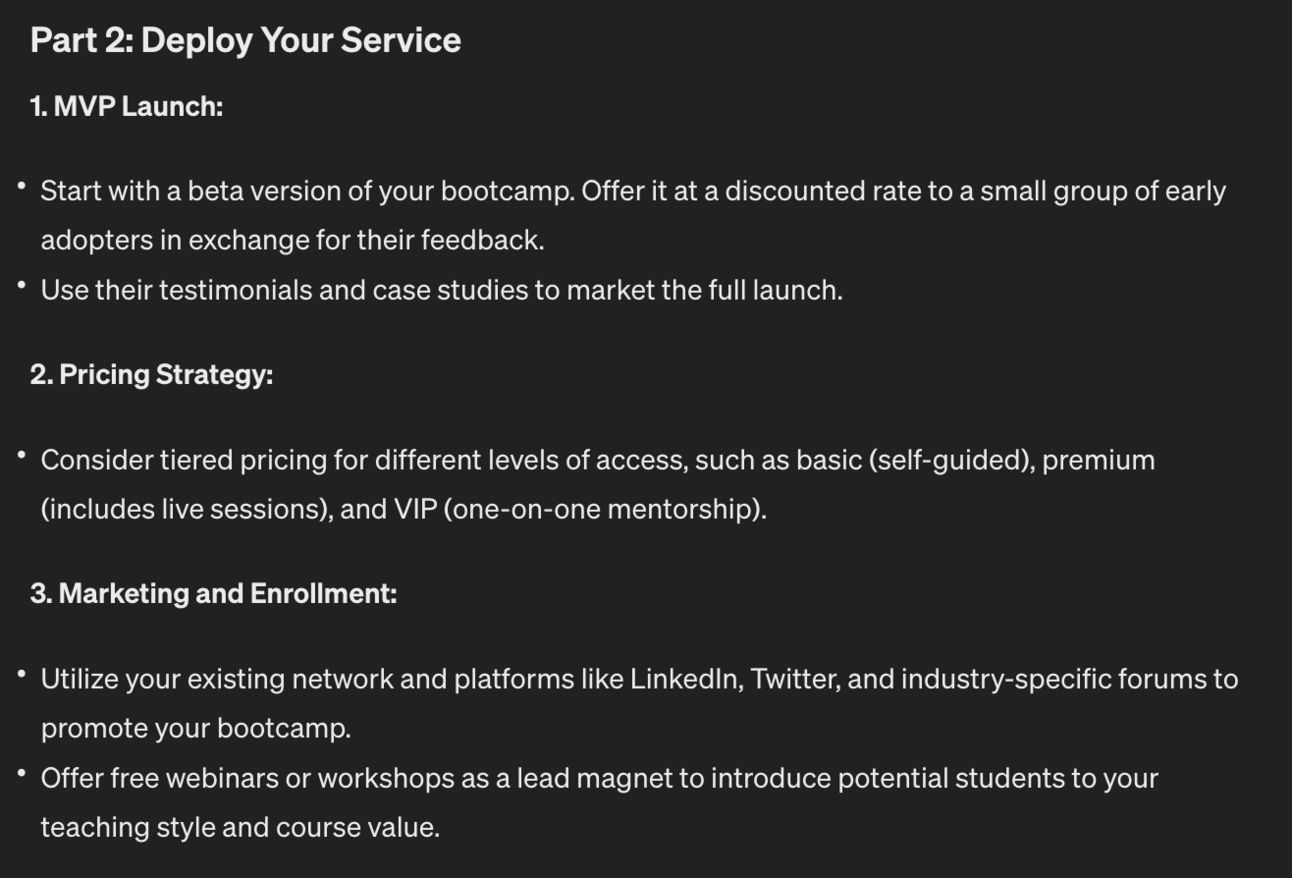
before later delving into how you’ll upgrade the business into products:
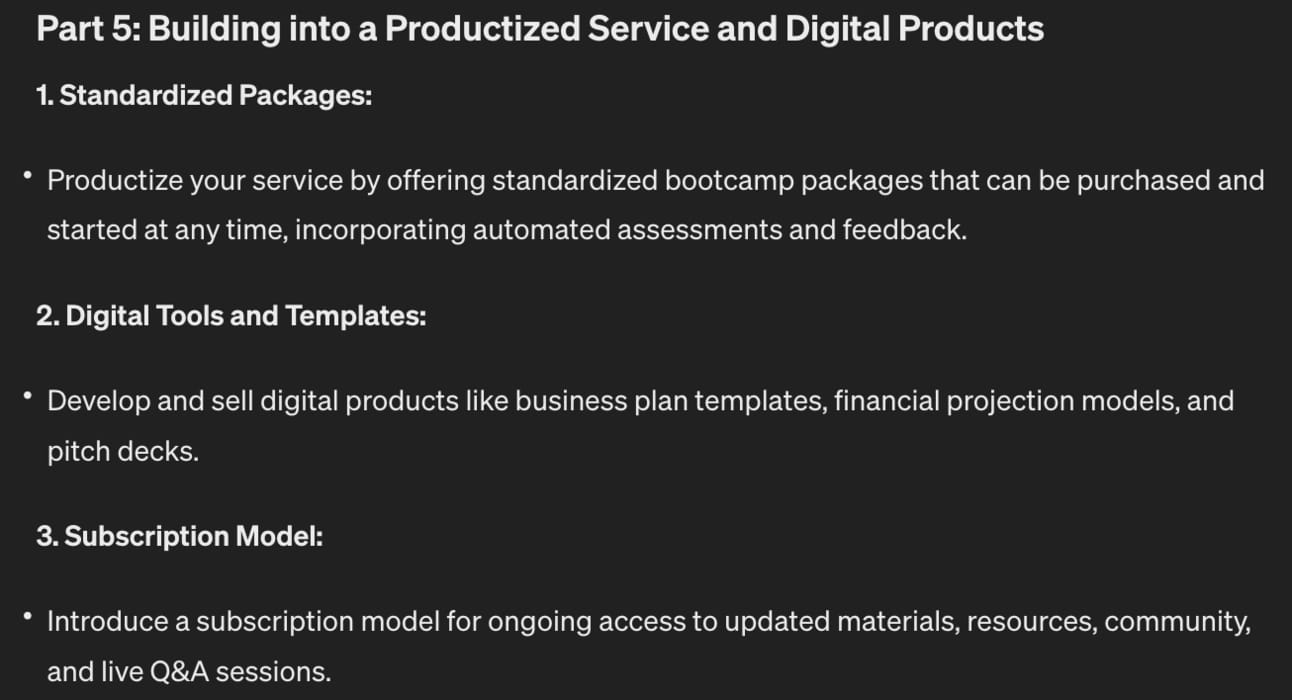
Again the purpose here is to start with a service and then from there build digital products.
We do this because by working with people 1 to 1 or in small groups we get an idea of what their exact problems and challenges are. This in turn let’s us refine our offer based on what they are saying, not on what we think. Simple but extremely important.
Now that we have a basic idea in place in the next Part I’ll cover how we launch to both earn and learn.
A reminder of what we’ll be covering :
Part 1: Best time to start
Part 2: Low Cost Business Ideas
Part 3: Earn Immediately Whilst Validating
Part 4: Grow Without Investment
Part 5: Raising Money with Proven ROI
Keep prompting,
Kyle
Let’s continue building our no money required business.
We’re now focusing on working out what exactly out customers want.
Most business owners totally ignore this. Which is ultimately why most businesses eat the dust.
Instead we’re going to start learning about our market whilst getting paid to do so.
Let’s get started:
Earning While Validating
Engage in continuous small launches to generate immediate revenue and, more importantly, invaluable customer insights.
Utilize lean platforms like Gumroad for initial sales, avoiding distractions from non-essential infrastructure.
Reward early adopters with attractive pricing and free upgrades, continuously increasing prices with each iteration.
Once you have your basic idea locked in place go ahead and start.
You will never have the perfect idea when you start. Because a starting idea exists purely in your head - there’s no reference to the people who actually matter: your customers.
Like a tree falling in the woods where no one is there to hear your idea itself has no value without reference to your customers.
Only your market and the customers therein can actually judge whether your idea is good or not.
This means there’s no print polishing your beautiful business idea. There’s no additional value in more planning. That’s just procrastination.
Instead we need to get out into the market ASAP so that the market can tell us whether our idea is good or not.
This means launching before we are “ready”.
Thankfully it also means launching before we have the ability to spend lots of money! A fast launch means limited time and resources which helps saves us from our worse excesses of overspending.
The name of the game is instead to have lots of small mini launches.
Using each launch to both earn AND learn.
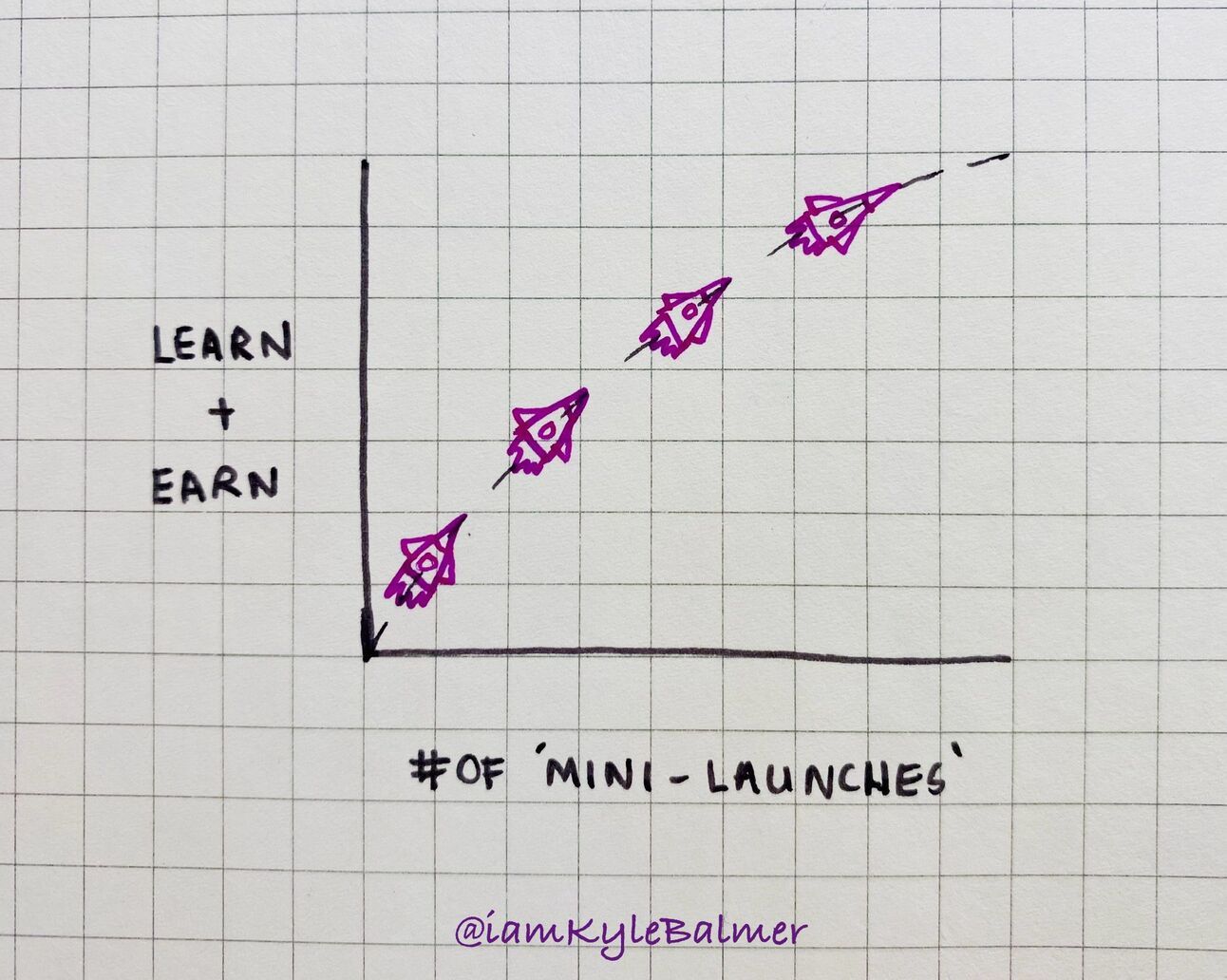
The basic play is to build something called a minimum viability product MVP. Or in this case a service.
Let’s imagine your expertise is helping doctors reenter the workforce after maternity leave.
The general way people start a business is backwards.
They’ll think I need to help these people. Oh I know I’ll write and publish a book to get the word out. Or I’ll rent a space to provide coaching and counselling services. Or I’ll build an app that will help these doctors.
Too much. Too soon.
And too expensive.
We need to first confirm that there’s actually a market demand. And that requires getting into the market and helping people first.
A minimum viability version of the same value would be something like offering low cost one to one coaching to a local doctors’ WhatsApp group.
The cost to you is spending some time providing the sessions. And maybe some time prepping a one pager on what the sessions include.
That’s it. No additional cost. No additional time sunk.
And this is sufficient to see whether people actually want what you have to sell. Early on this information is more important than anything else.
That information validates the idea. Or, equally important, invalidates it. If no one is interested then maybe there’s no market. It’s much better to find this out before spending lots of money building an app or renting a space.
Let’s use a prompt to help work out our basic service offer. Use this below your work from the previous Part.
Act as a business strategist and service designer

Review my basic business plan

Structure a 30 minute to 1 hour session that encapsulates the value I provide, one on one for a client

Provide an example session breakdown

Provide a one pager description of the service
ChatGPT will create two assets for you.
The first is an example of what your service will look like:
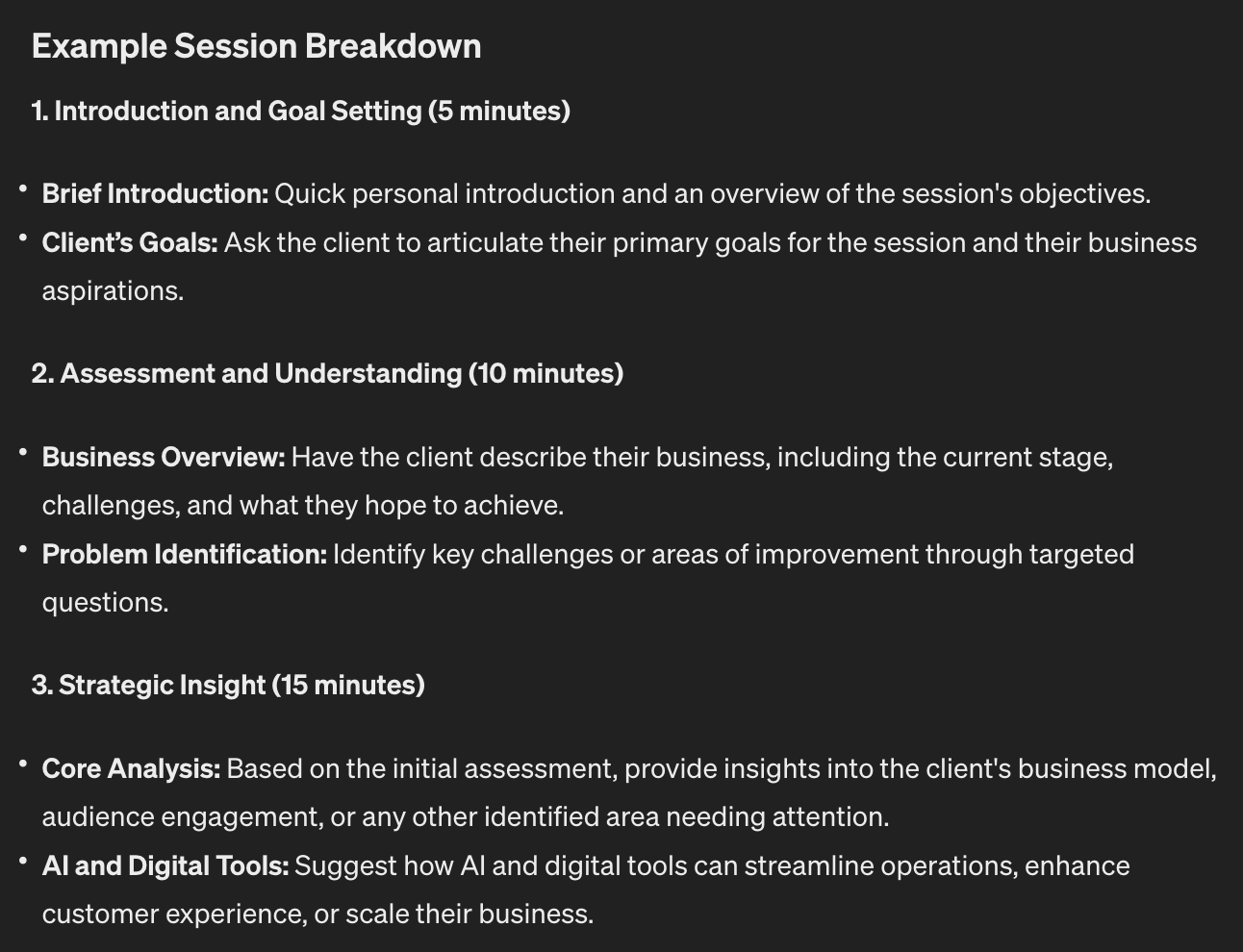
The second is a one pager to help you get the word out. Here’s the beginning of my example one pager:
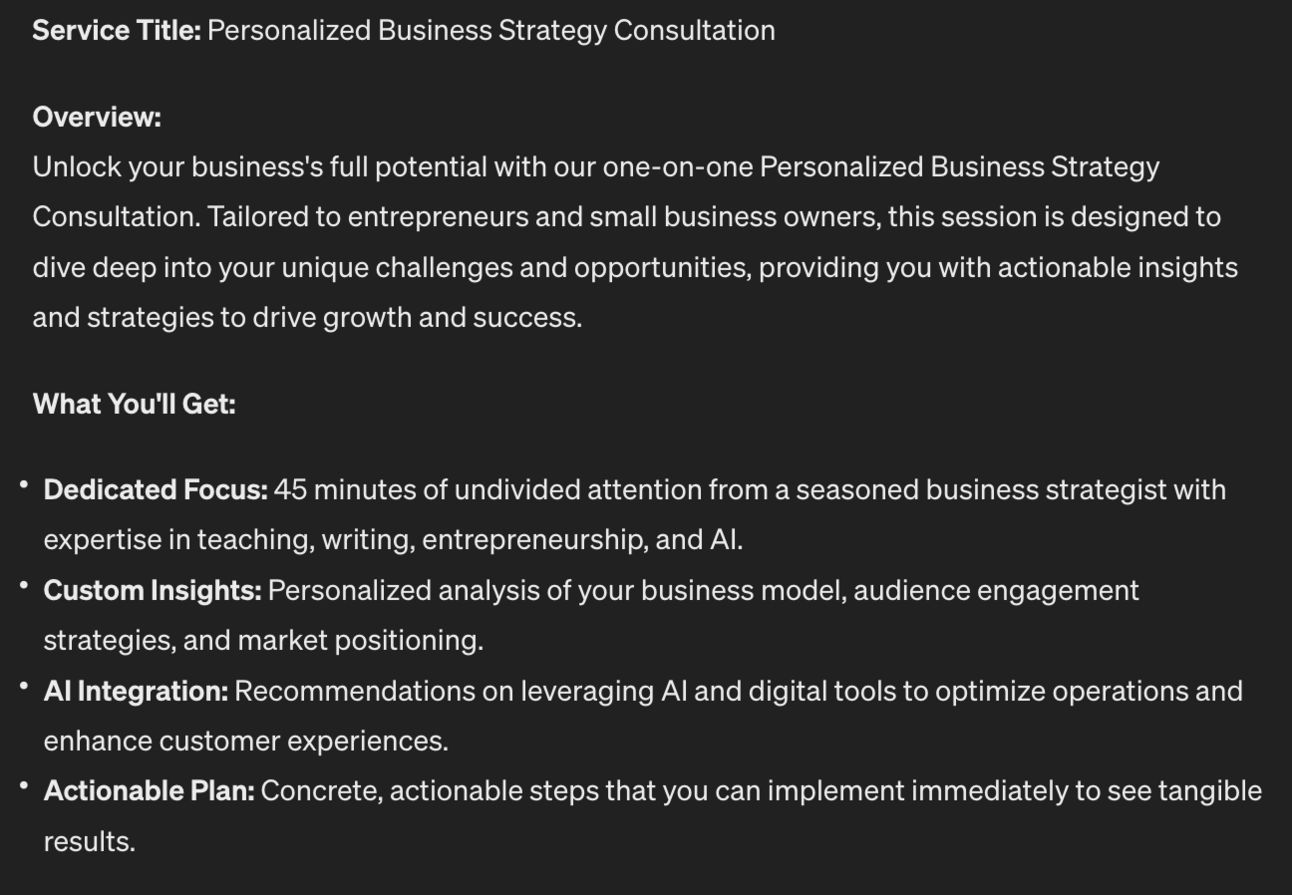
Publicise your session details to any existing channels you have. Or even email prospective customers individually. You don’t need many to start.
Use a basic tool like Topmate or Calendly to take bookings. Keep it super simple and lean rather than investing time in building out an infrastructure.
Don’t worry about build complex lead generation systems or anything like that yet. All that comes later when we scale. Right now keep it manual.
The purpose of these sessions is not necessarily to make bank. It’s to learn.
But don’t do the sessions for free!
You can and should charge because that’s the only way you’ll get proper feedback. Free changes the dynamic and the information not get isn’t as valuable.
Getting paid is also important if it’s the first time you (as a new business owner) have made cash. That first dollar/pound is important psychologically - it makes it feel real.
From your sessions what you are looking for is to start to pull together the common questions and challenges your customers have.
Guess what? There aren’t very many.
For the doctors returning to work for example you might discover it’s imposter syndrome, confidence and worries about falling behind on training.
For AI entrepreneurship I find it’s confidence, lack of an idea, believing money is needed and not knowing first steps.
Whatever your area of expertise as soon as you have talked to 10, 20, 30 customers you will see the same challenges appearing again and again.
This is the most vital part of the process. You need to note those challenges down as they’ll become the key to your digital products.
And you can do this whilst I) not spending money and ii) earning some cash from providing your basic service.
In the next Part we’ll take all these challenges and construct your full funnel.
Right now just get out there and collect information!
A reminder of what we are covering :
Part 1: Best time to start
Part 2: Low Cost Business Ideas
Part 3: Earn Immediately Whilst Validating
Part 4: Grow Without Investment
Part 5: Raising Money with Proven ROI
Keep prompting,
Kyle
You’ve launched your stripped down minimum viability service, got a handful of customers and - most importantly - learned from them what their main problems and challenges are.
Now we have real intelligence with which to grow.
Before we do it’s useful to know what our actual growth targets are.
Lots of people grow for the sake of it. Or they aim at some guru touted number like $10,000/month.
It’s much better (and healthier) to actually know the figures you need to reach.
Let’s get started:
Grow without investment
Work out your own personal financial goals for i) replacing your 9-5 ii) living your dream life.
Sketch out growth plan and financial goals for each stage. Connect to your personal goals to start. Calculate sales required at each level of growth.
Price in this growth from the start. Work out your reinvestment % and build that that into your growth plan.
Don’t grow for the sake of it.
Instead work out your actual personal income goals.
You should have a figure for:
replacing your 9-5
Living your dream
Replacing your 9-5 is relatively simple because you’ll already know your current take home pay. Use that + all the other benefits you get from your job (health insurance, pension etc) all added up to work out the replacement figure.
Use two principals here - conservatism and simplicity.
For conservatism let’s say your salary is $40,000 and you aren’t really sure about the additional benefits value. If so just double the salary to $80,000 as your figure. Go higher than you think is necessary.
For simplicity don’t agonise this process. You don’t need 6 interlinking spreadsheets for this to get the exact amount to a dollar or pound amount. A nice round 10,000 is fine.
Using both of these principals let’s say your current take home with benefits is somewhere around £34,000-£37,500. Easy, your replacement target is £40,000.
For living your dream life we need more variables.
I’ve built a calculator that will walk you through the process.
Act as an entrepreneurial coach who is helping a first time business founder to work out how much they need to earn in order to live the lifestyle they want

Walk through this process with me one at a time. Ask the questions for each step, await my answers and then move to the next step:
-Define your ideal lifestyle. What does quality of life look like for you? Consider aspects like hobbies, travel, housing, possessions, experiences, family time, how many children, etc. Guide me through this process to gather information on what the ideal lifestyle looks like.
-Research cost of living. Ask me where I want to live. Look up average prices for housing, food, utilities, transportation in your desired city or town. Factor in costs of your lifestyle. List annual costs. Make a detailed list of estimated costs for your lifestyle. Include necessities and discretionary spending. Generate an estimated cost of living.
-Identify goal costs. Determine one-time and ongoing costs for major goals like buying a home, starting a business, having kids, dream vacations.
-Calculate annual amount needed. Add up all annual costs and goal amounts needed. This is your baseline yearly income requirement.
-Factor in taxes. Use the amount required and the location's tax bracket to provide a tax estimate. Adjust the annual total by subtracting estimated taxes to get your pre-tax income target.
-Add savings buffer. Ask me to decide on a savings percentage (e.g. 10-20% of income) and add this to get total needed pre-tax income.
-Provide a final result of how much is needed per year in a tabular format with the costs that make up this required total.
Obviously this is not financial advice - these are thinking tools to get you started working out the actual income you need from the business.
It’ll be rough but it’s better than just saying $10,000 a month!
Now that we know the end goal we can apply the business plan.
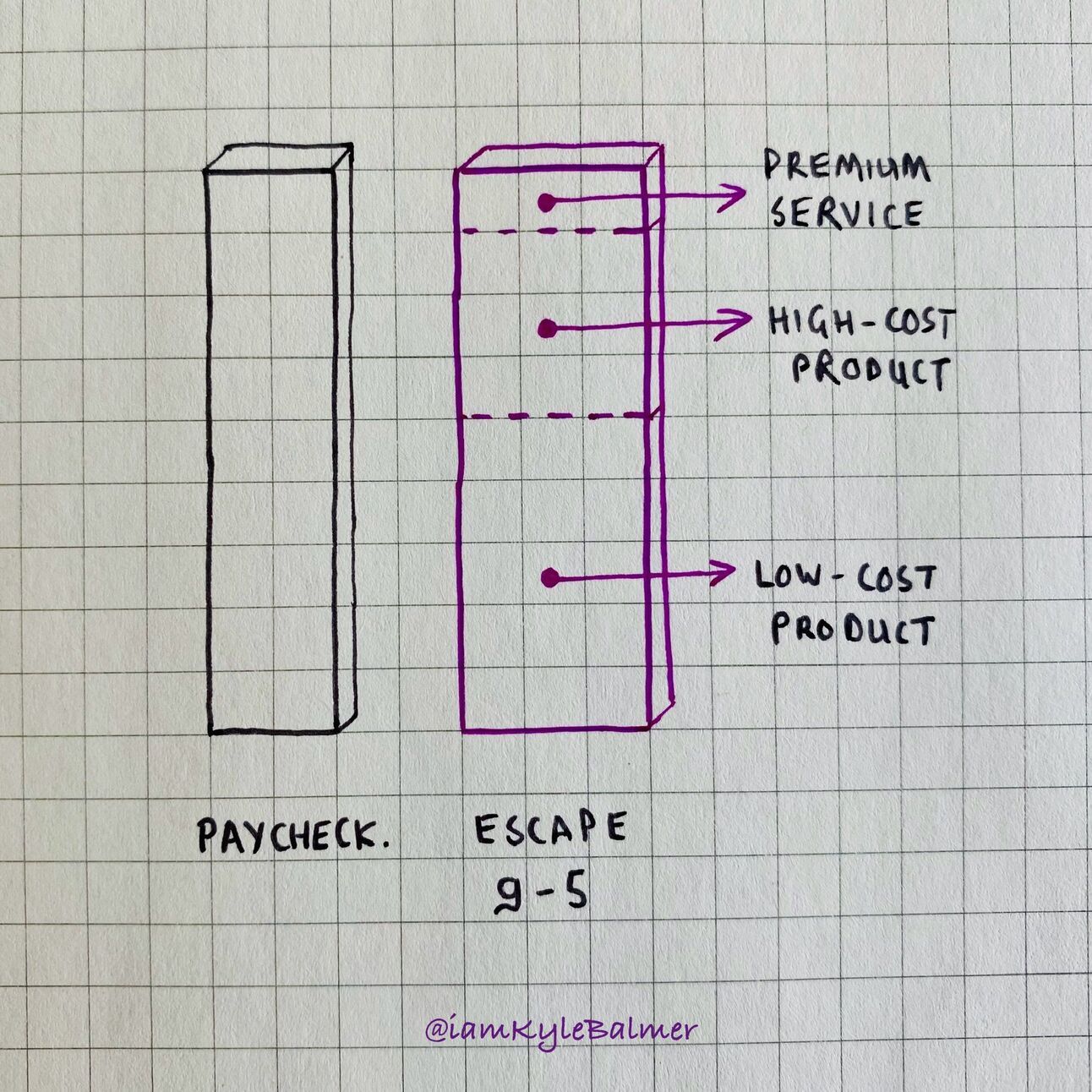
My recommendation is the following value stack:
low cost digital product
High cost digital product
Service offer
That service that you constructed and launched previously? That’s going to become your premium offer - the thing you charge the most for.
Why? Because your time will become more and more expensive as the business grows.
My hourly rate used to be around £50 ($60).
It’s now £1000 ($1250) for the hour, a 20x increase in a year or so.
This happens naturally as your expertise, audience and business grows.
And it’s also because the other parts of your business will be making money which means any time not spent on them is an opportunity cost.
To structure your business the three main challenges or problems that your customers have and structure them into products.
They have a problem, you help them solve it with your expertise. Using first low cost then higher cost products and services depending on how much assistance they need to reach their goal.
Let’s say that your expertise is teaching kids to skateboard. Your customer here is the parent (because kids don’t have money) who want their children to learn to skateboard.
Through your manually delivered service you realise that the main challenges are;
teaching the children confidence
Learning to ollie (jumping on a skateboard)
Safety and how to fall properly to avoid injury
You see these topics come up again and again with all the customers you work with.
Now you turn these into products.
The low cost products for could be:
Audio course on child confidence for parents
Short video course on ollie technique
Short pdf booklet on safety
You’d match the format (video, audio, text) to the problem at hand. And you’d like have a handful of low cost products per problem.
The purpose of these lower cost products is to get people on their journey with you. They should be easily consumed and immediately actionable. Being too long and complex here is actually a hindrance!
Your higher cost products is where we have the detail. This is where people who need additional assistance will come next.
Think video courses, workshops, full books etc. More detail, more value, more chance of the customer reaching their goal. And higher price.
The third layer is your service, at its new higher price point. It could be a reworked version of the current service or something new. Whatever serves the customer best.
Let’s use another prompt to pull all this together:
Act as a business planning strategist

Design a business model using the following instructions and parameters

The business has a funnel consisting of low cost products, high cost products and premium service

Assume >$100, $300-500 and $1000 price points

For every 100 low cost product I sell assume I sell 10 high cost and 1 service package.

Assume 80% profit margin on sales, immediate 20% reinvestment and 25% tax on the remaining profits.

Assume the rest comes out as personal income

I have three levels of personal income goals

Escaping the 9-5 - [amount]

Dream life - [amount]

Calculate the sales mix required to hit the personal income goals. Give me both annual, monthly and daily sales targets

Also assume for every 100 people who see my offer I’ll make a low cost sale. Use this to work out rough traffic requirements

Provide me the daily, monthly, annual reinvestment totals too.
Remember to plug in your income targets.
You’ll need GPT4 (paid) for this to run the numbers properly. Alternatively use Microsoft Copilot which gives you GPT4 for free. If reading this later this won’t be an issue.
This prompt will take your income goals and smush it together (that’s the technical term) with the basic business structure to come up with an idea of what level of sales you’ll need.
Here’s an example output for escaping the 9-5:
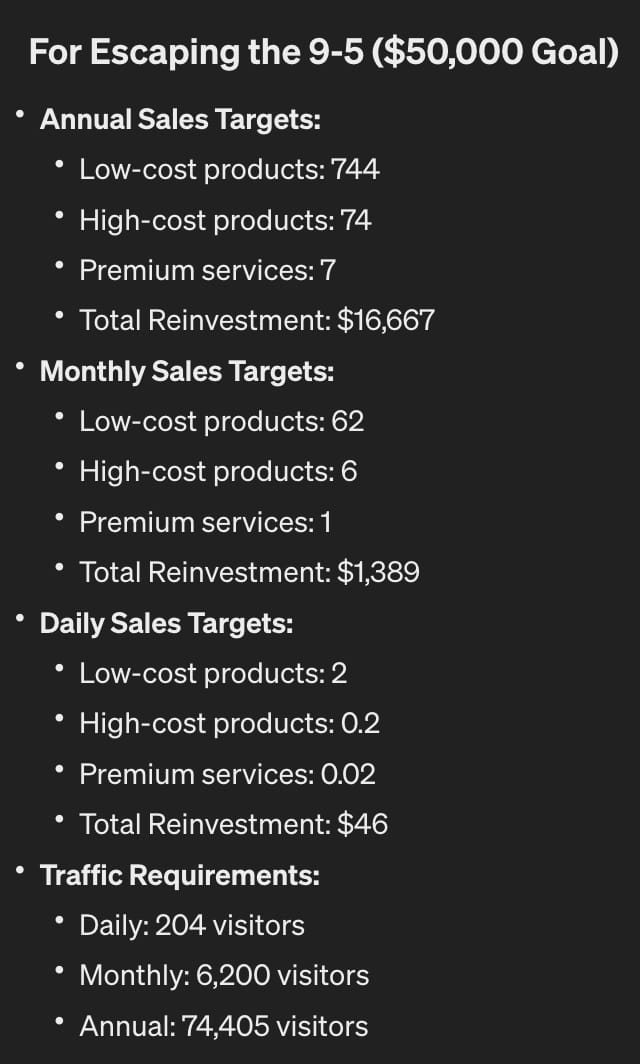
Chances are you’ll think two things simultaneously.
Huh. The requirements to escape the 9-5 are not that high. High sure but not undoable. At all.
The requirements for dream life are actually high and I’ll never get there.
That tends to be the reaction here! But it depends on your entirely and what income requirements you put in.
Interestingly though the first section of getting to 9-5 replacement is probably the toughest because it’s where you are learning the most. You as a person will have to change. Entrepreneurship is the best form of personal development out there!
You’ll also notice I added in 20% reinvestment. Feel free to tweak this (and any parameter in the prompts, as always).
This is how we scale without needing funding. I’ve built it directly into the model so that you both get paid and have cash to reinvest.
This model, whilst rough, gives you the basic plan of attack you’ll need to get started.
It will 100% change over time. Plans always do. But it’s enough to get started with and (most importantly) not spend months trying to work this all out.
A reminder of what we are covering :
Part 1: Best time to start
Part 2: Low Cost Business Ideas
Part 3: Earn Immediately Whilst Validating
Part 4: Grow Without Investment
Part 5: Raising Money with Proven ROI
Keep prompting,
Kyle
Once your business is chugging away making sales you might think you’re done.
Honestly, you could be! Maybe you are on the way to breaking out of your job or you’ve already made it. And that’s enough for you.
If so fantastic - you’ve made it!
If you do want to build more (and this is honestly personal!) then you may find the rate of progress to be too slow.
Maybe you’ve done the maths with your rate of growth and realised it’ll take 10 years to get to the dream goal. And that’s too long for you.
If that’s the case then the simplest way to push progress faster is investment.
Let’s get started:
Raising Money with Proven ROI
Determine the business's return on investment (ROI) by quantifying how each dollar invested translates into revenue.
calculate capital requirements
Identify optimal funding sources based on capital requirements
Investment is a bit of a bad word in the creator and solo-preneur communities because we want to be self reliant.
But an influx of cash can move us forward much faster. And depending on the funding source we may not even need to give any of the business away.
The key to this is ROI: return on investment.
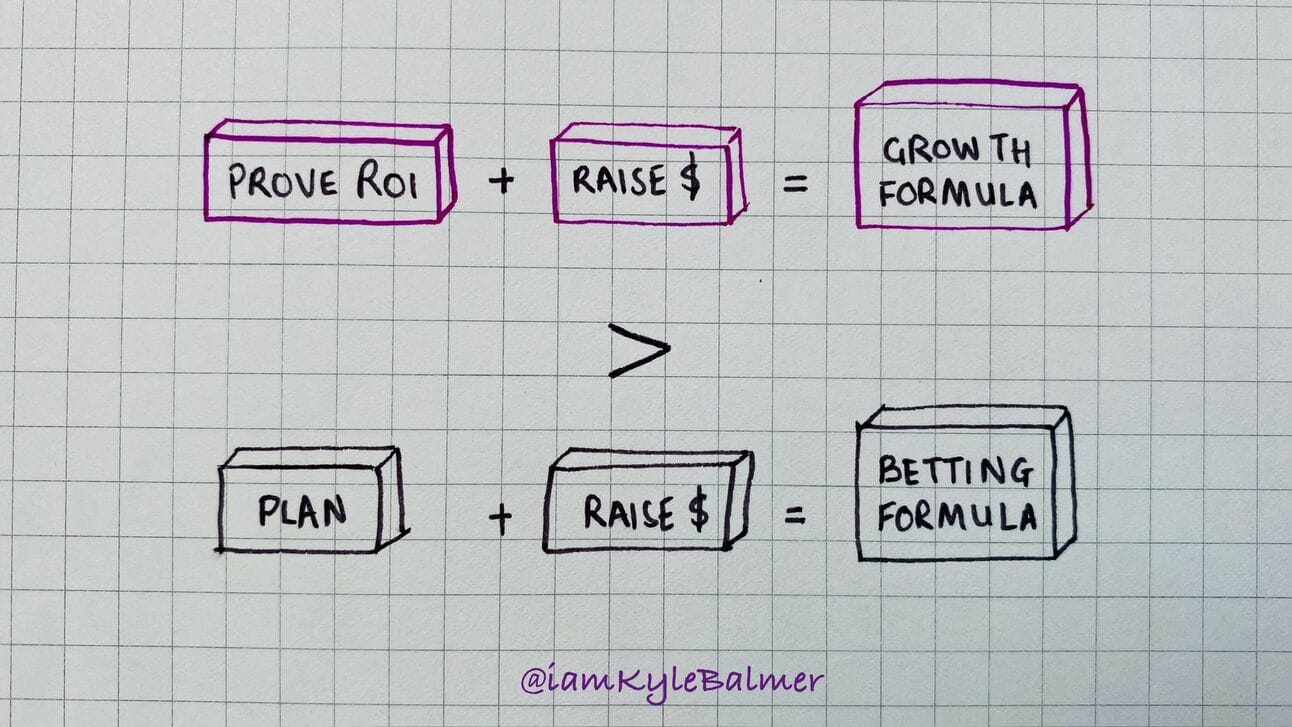
A lot of companies out there raising money are speculative bets.
They have a plan, a team and a dream. But no revenue.
You on the other hand started lean and built something that is cash flowing.
And, if you followed the path of using digital products, chances are your profit margins are insane.
In the online world of digital products we’re used to 80-90% margins.
These would be seen as criminal in the “real” world.
Armed with existing revenues and large profit margins your business is very attractive for investment. You have locked in ROI.
The key metric we want to work out is your ROI.
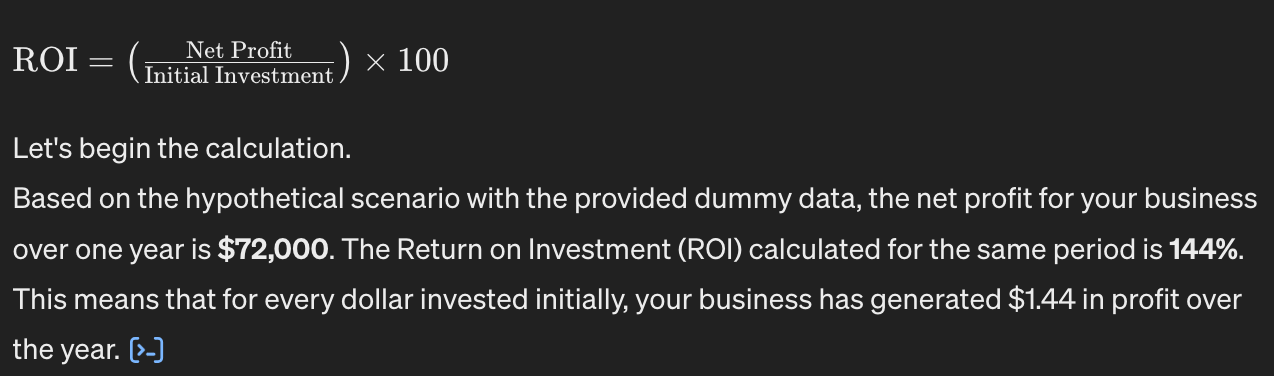
Put (very!) simply this how many dollars you make for each dollar put in.
If I put in $1 and make $10 my ROI is 900% or 9x.
It’s the net profit / the initial investment.
$10-$1 or $9 is my net profit.
$1 is my initial investment. $9/$1 = 9.
The maths is simple. The complicated part is gathering up all the information required.
We can use ChatGPT to guide us through the process thankfully.
Do this below your business plan and income requirement calculations from the last Parts.
Help me calculate the ROI of my business.

I have a range of products and services as follows:
[products + services and their pricing]

Ask me all the questions required to work out my ROI.
If required after each of my answers ask clarifying questions
ChatGPT will act as a consultant asking you the required questions and will ask for details:
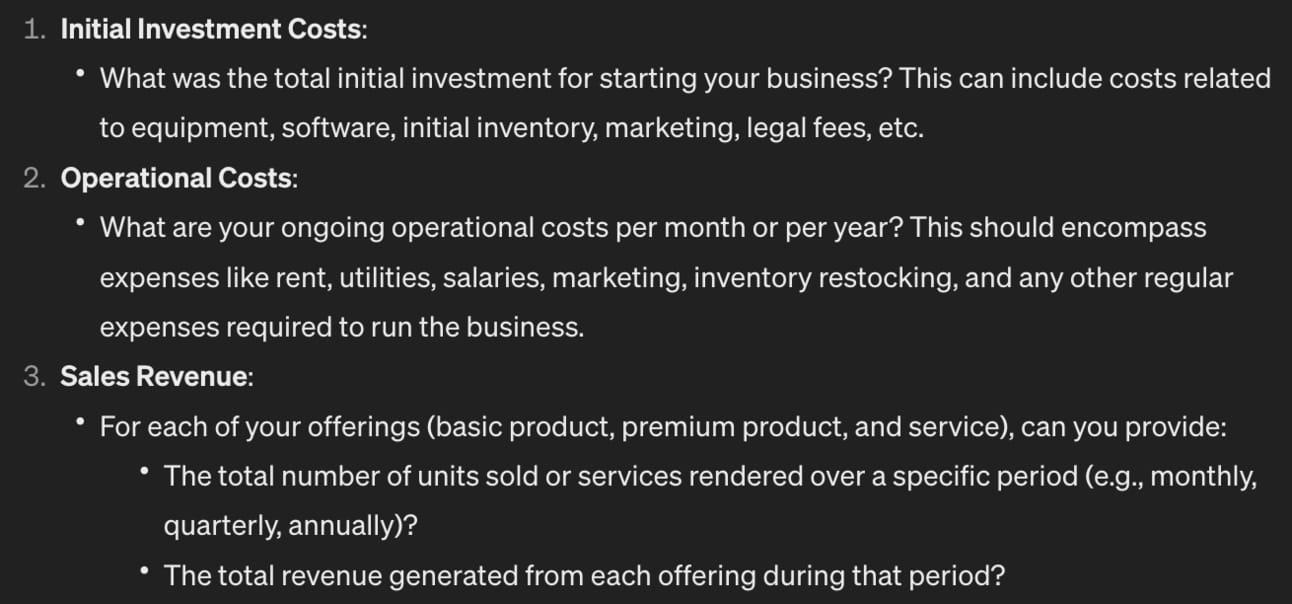
Once you’ve fed in the information it requires (and answered any supplementary questions) ChatGPT will run the numbers for you:
We’ll now push this a step further by feeding our income calculations and business plan back in.
We know our rough ROI. And we know the current level of our business and where we need to get to in order to generate the income we want.
So we can use ChatGPT to work everything out for us. Use this prompt:
Based on the above business details, personal income goals and ROI

work out the capital required to grow the company to the required personal income.
ChatGPT will now do some WORK for you. Here’s the first part:
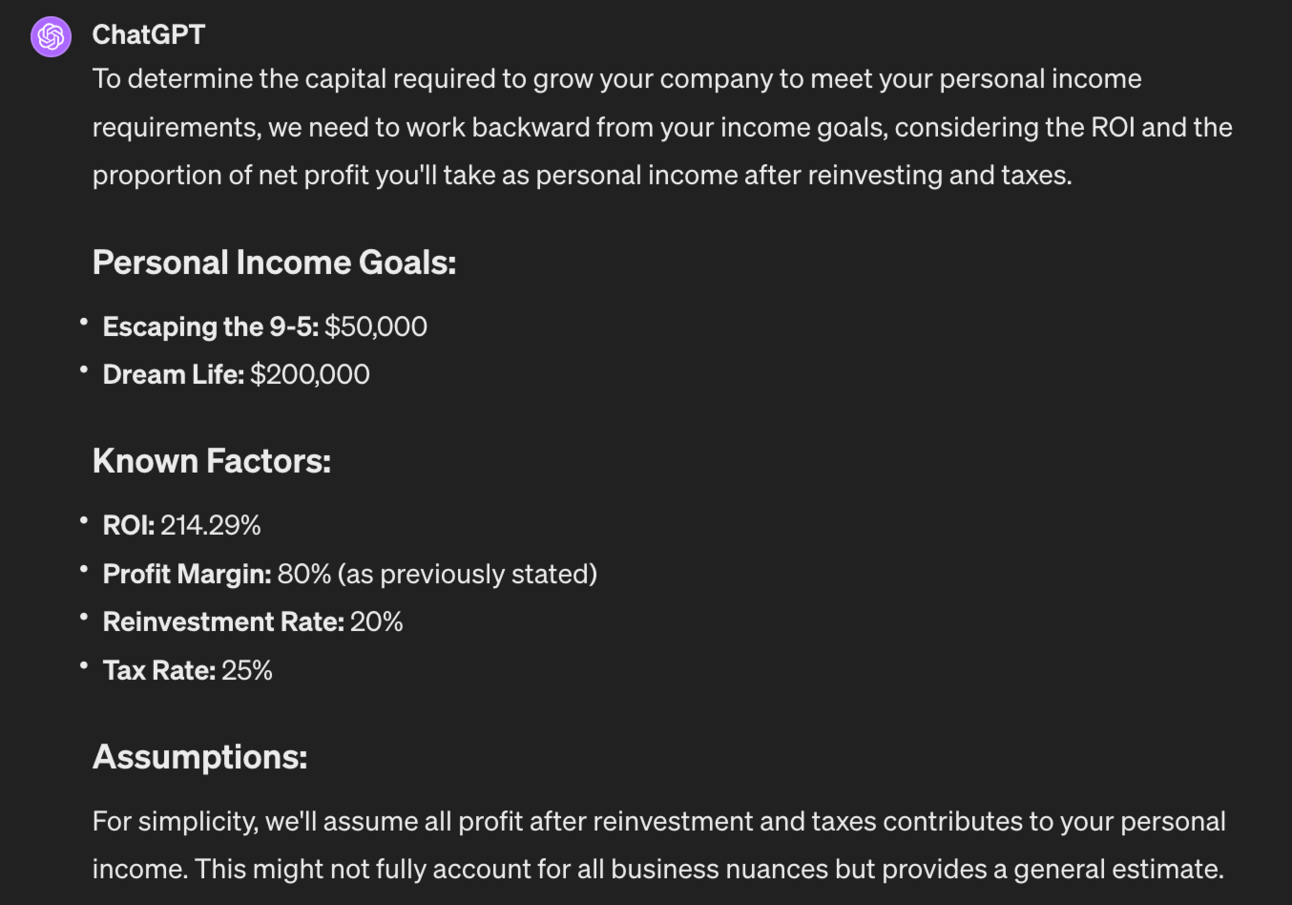
It’ll outline all the parts of the calculation it knows. This is great if you need to adjust any variables later.
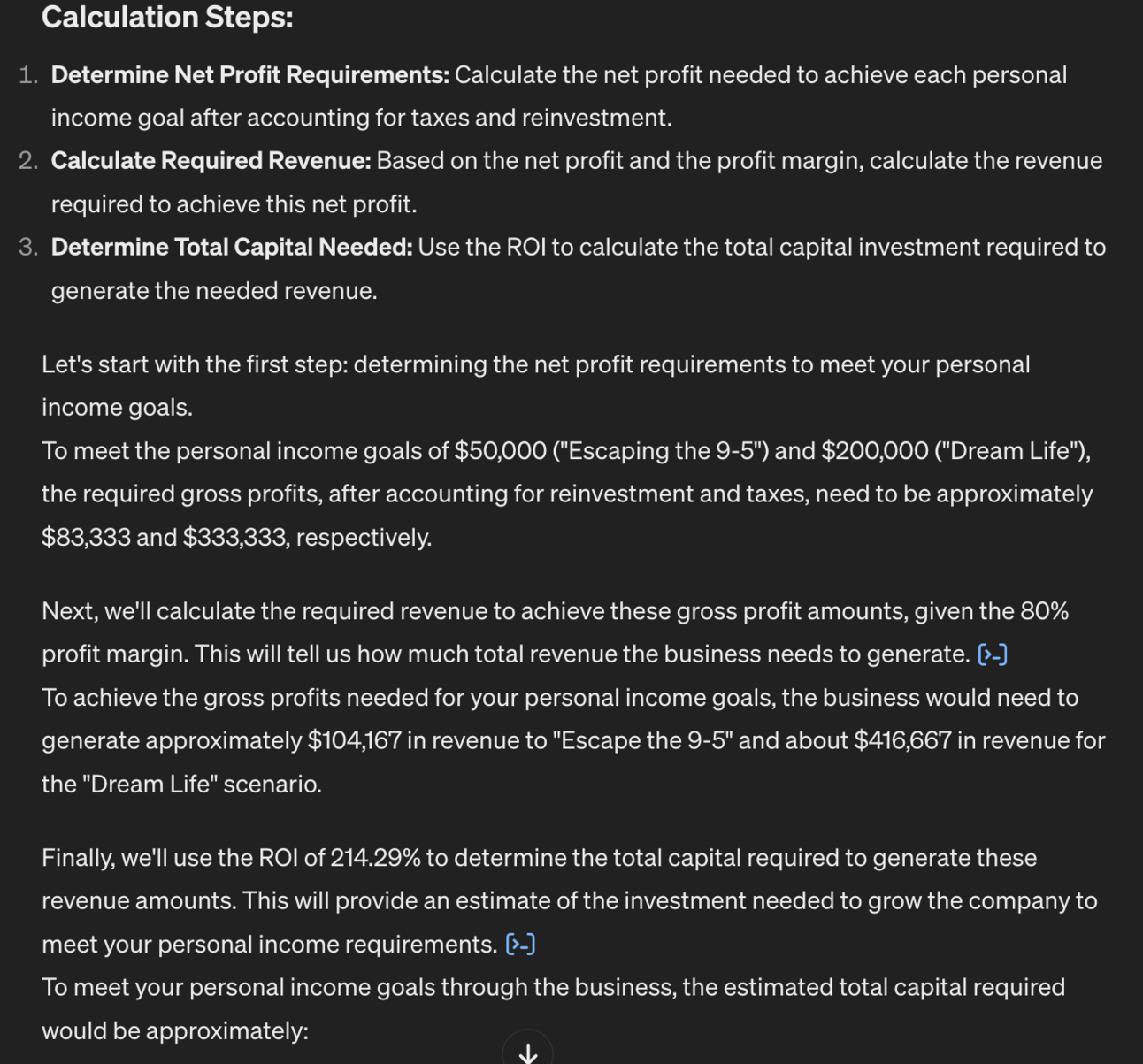
Next it’ll work the maths for you:
Finally it’ll pull everything together like so:
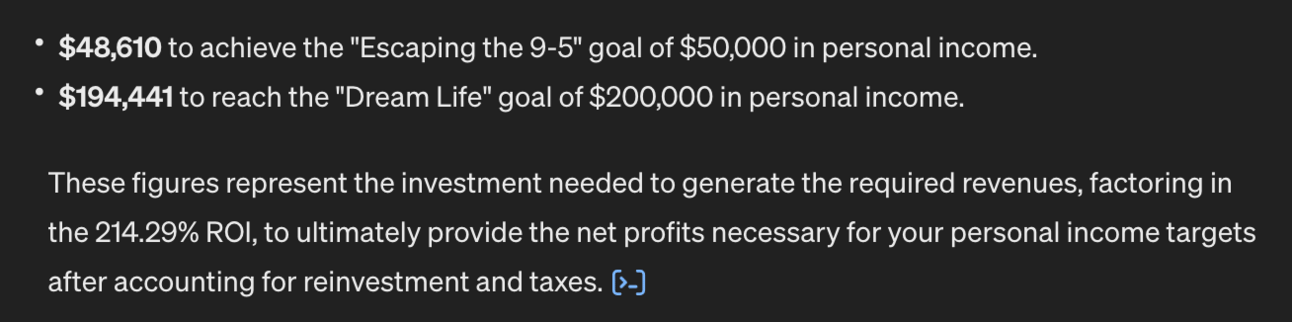
If you are confused because the income generated is similar to the capital required this is a quirk of the maths here.
That’s after all the costs, taxes etc. That’s take home income for you.
And importantly that’s one year. That investment will make that the annual income each year thereafter.
If I ask ChatGPT to take those numbers 5 years forward:
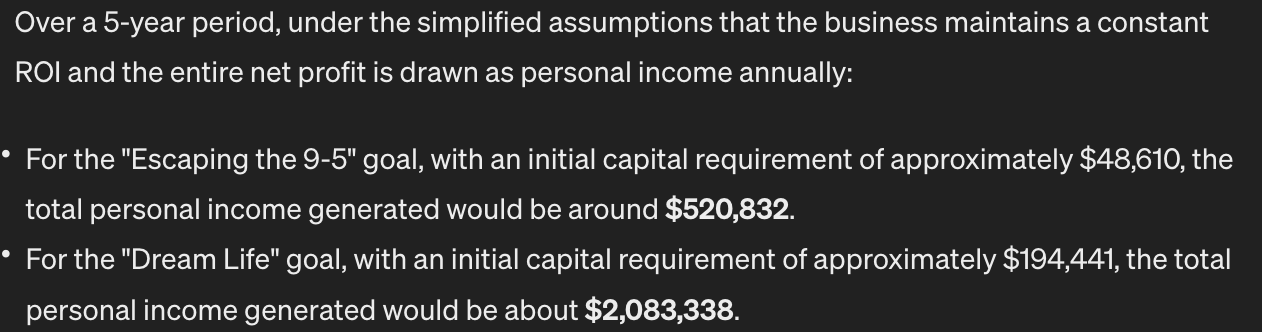
And that’s assuming things don’t grow and accelerate. Which, once you’ve got momentum, they tend to. Same investment put in but it keeps returning income year on year.
Once you have this all in ChatGPT let’s use our final prompt:
Based on this capital requirements work out the best possible sources of funding for me
I am based in [location]
The sector is [niche]
Based on your capital requirements, location and sector ChatGPT will generate some alternative for you. Here are some of the more interesting ones when using UK based and AI education as the niche:
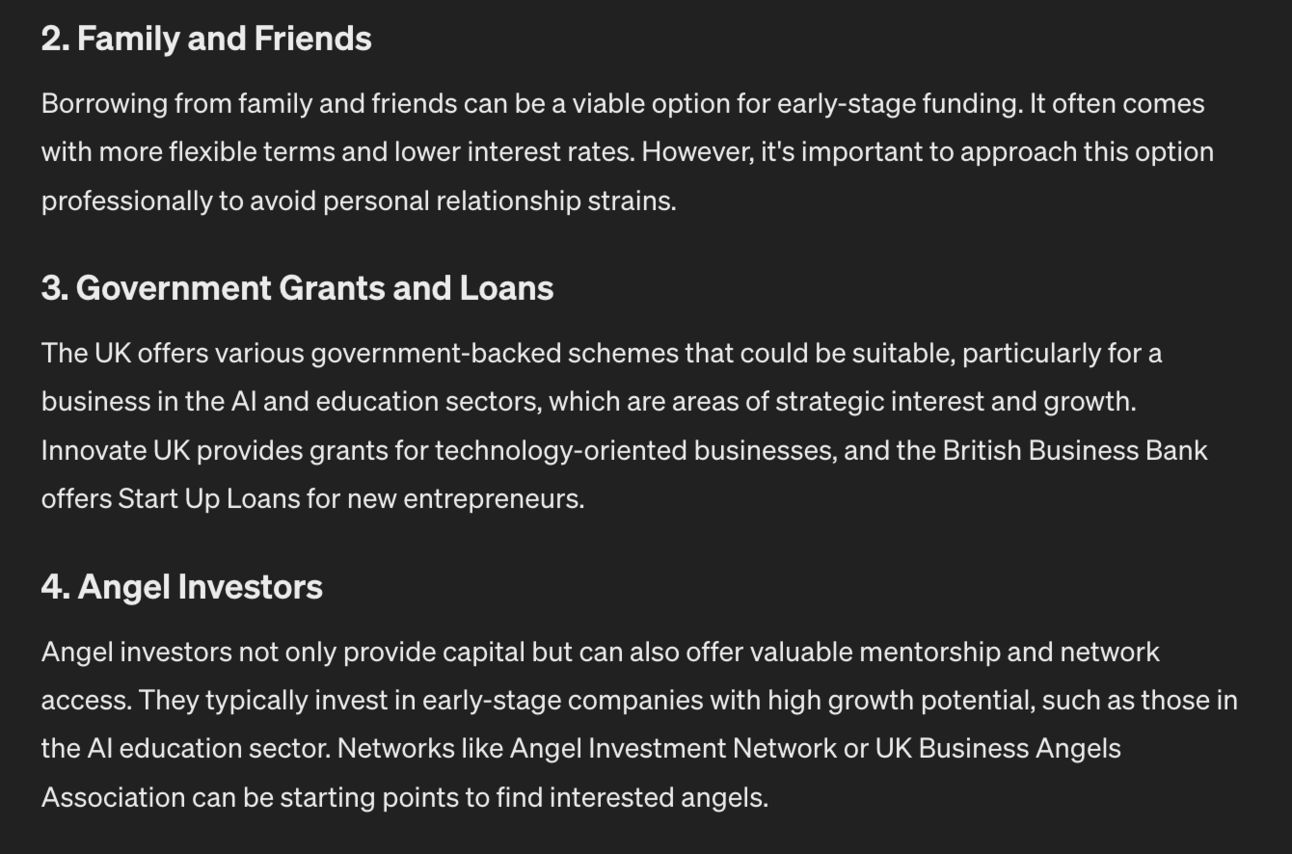
Now obviously this is a very high-level treatment of the subject.
There will be a LOT more due diligence involved. But the prompts above get you moving in the right direction about what exactly is even possible.
Big week!
We’ve walked through why starting a business right now is the best play.
But we’ve been looking at this through the lens of having no/low cash to start with.
Based on that we generated low cost business ideas and I’ve shown you how to earn whilst working out if the idea is a goer or not.
We then transitioned into how we grow the business through bootstrapped reinvestment before finally touching on how we can use a proven ROI to go and raise capital.
Following this process you can go from having no cash to build the business to having multiple investors trying to bite your hand off to get involved with your ROI.
A reminder of what we covered :
Part 1: Best time to start
Part 2: Low Cost Business Ideas
Part 3: Earn Immediately Whilst Validating
Part 4: Grow Without Investment
Part 5: Raising Money with Proven ROI
Keep prompting,
Kyle
Are you ready to break free from the constraints of traditional business models and start your entrepreneurial journey without breaking the bank? The '💸 Starting a Business with no Money | Playbook' is your ultimate guide to launching a successful business from scratch. This playbook will walk you through the essential steps to leverage AI and innovative strategies, allowing you to build a thriving business with zero cash upfront. With actionable insights and expert advice, you'll discover how to turn your ideas into reality, regardless of your financial situation.
This playbook is designed for aspiring entrepreneurs who are eager to start a business but feel held back by financial limitations. If you have a great idea but lack funding, or if you're currently in a 9-5 job and seeking a flexible side hustle, this guide is perfect for you. It addresses the common fears and misconceptions about starting a business without money, empowering you with the knowledge to take action and succeed.
No prior experience is necessary. This playbook is designed for beginners and will guide you through each step with clear instructions.
Results vary, but many users begin to see progress within weeks by implementing the strategies outlined in the playbook.
The playbook includes exercises to help you brainstorm and validate your business ideas, ensuring you find something that resonates with you.
Absolutely! This playbook is tailored for those looking to start a side business while working full-time.
You will need access to the internet and a willingness to learn and take action. The playbook provides all necessary tools and resources.