
AI Business
Welcome to '🔻 Sales Funnels 101 | AI Business Playbook', your essential guide to mastering the art of sales funnels!
Start ReadingThis week we’ll be dealing with one of the most important topics for an online business - nay, any business.
This is such a core concept that I’m genuinely surprised I haven’t covered it before.
I was casting around for an idea for the week (as I do every week!!), chatting to my business partner. He went back through all the past Playbooks (40+ now…wow) and found a massive gap.
Sales funnels!
Knowing your sales funnel is hyper important for any business. And … I just haven’t discussed it in a Playbook! I feel remiss!
This week we remedy my mistake.
Over the week we’ll cover:
Part 1: Why you need a sales funnel
Part 2: The common thread
Part 3: Lead Magnet to Tripwire
Part 4: Core offer and Upsales
Part 5: Premium offer
Why you need a sales funnel
what is a sales funnel
my basic funnel
prompt to extract competitor’s funnels
trust building
A sales funnel is a marketing model that describes the journey potential customers take from first becoming aware of a product or service to making a purchase and beyond.
It’s the spine of any business.
The funnel is divided into stages that guide prospects through a structured process.
Here’s the sales funnel I personally use:

Audience: The broadest stage where potential customers are attracted through various marketing efforts such as social media, content marketing, and advertising. The goal is to create awareness and build a large, engaged audience. (My audience channels are Tiktok, LinkedIn and Twitter)
Lead Magnet: At this stage, valuable free resources (e.g., e-books, webinars, free trials) are offered to the audience in exchange for their contact information. This converts the audience into leads by capturing their interest and details. (I use past Playbooks here)
Tripwire: A low-cost immediate offer is made to the leads to encourage them to make a small initial purchase. The tripwire offer is designed to be an irresistible deal that requires minimal financial commitment, helping to convert leads into paying customers quickly. (Mine is $20)
Core Offer: Leads who have made a tripwire purchase are then presented with an initial, often lower-cost product or service designed to convert them into regular paying customers. This stage aims to validate their interest and establish a purchasing relationship. (Mine is $69/year)
Upsell: After the core offer purchase, customers are presented with additional offers that complement the core product or service. These upsell offers are designed to increase the overall value of the purchase by encouraging customers to buy more or upgrade their purchase. (Mine is $197)
Premium Offer: Existing customers are offered higher-value products or services, such as premium memberships, advanced training, or personalised services. The goal is to upsell and deepen the customer relationship, increasing their lifetime value.
That’s mine. Once you know the basics you’ll start seeing them everywhere and will be able to learn best practices. To expedite use this prompt:
Uncover and present [creator/company]'s sales funnel
With special reference to audience, lead magnets, tripwire offer, core sale, upsale(s) and premium offer
Get pricing
If I do this with Dickie Bush for example I get a report on his funnel. Here’s an extract:
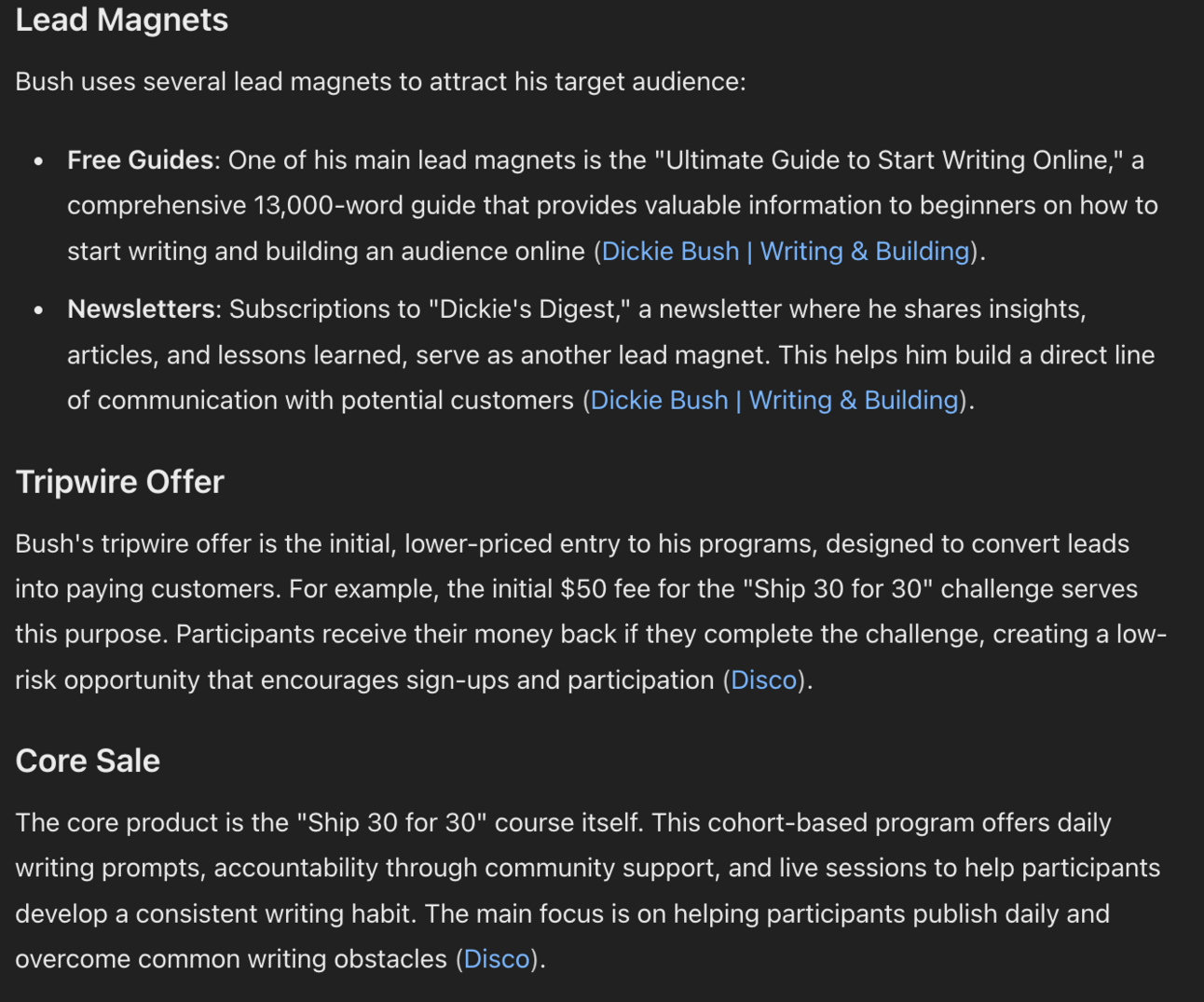
This is gold dust intel. Run the process on some competitors and see what you can dig up. The more you do the better able you’ll be see the hidden mechanisms people use.
You might look at all of this and think “why do I need all these step? Why can’t I just sell my product?”
The short answer is trust. Or, lack of it!
Trust on the internet is low. That’s for good reasons. There are lots of fakers out there.
Because of this when we do business online we need to build trust bit by bit. Our funnel is the marketing mechanism we use to do so.
At each stage of the funnel we are asking for a little bit more trust:
we start asking for a like or follow
next we ask for an email
then a small low cost item at $10 or so
followed by higher priced core items and premium offers
Each step asks for a little more trust.
And once they give it to us we make sure they know they made the right decision.
At each stage we will sell to less people. But the price increases as we move people down the funnel, building trust and escalating sales.
The alternative is running advertising straight to our product. This sometimes works - in eCom for instance. But if your business is - for example - executive coaching then running an advert to show a complete stranger your $5000 coaching package is not going to work.
Over this week I’ll show you how to work out your sales funnel. This requires working out the common thread between your offers and then sequencing offers to carry prospects along the funnel. That’ll be in Part 2.
Then I’ll talk specifically about how to create, host and connect the core elements of a funnel:
lead magnet
tripwire offer
core offer
upsale
premium offer
I’ll talk about how we move people along from step to step to dramatically increase your average customer lifetime value.
This works whether you sell products, services or a mix.
We’ll dive in in much more detail in the next Part.
Keep prompting,
Kyle
This week we’re constructing a sales funnel. Regardless of your business having a proper funnel in place will radically upgrade your revenue potential.
Instead of just slapping together whatever products we have on hand we’re going to start by working out exactly how to get people through our funnel.
We’re focusing on the common thread that ties it all together.
Let’s get started:
The common thread
solve problems
solve the same problem at different levels
knowing your customers’ problems
mapping problems to a sales funnel
Business provide value to customers by solving problems.
Sometimes this is obvious - like a coach or consultant. They are specifically tasked with helping customers to solve problems and move towards a better life.
Sometimes this is less obvious - luxury fashion for example. Here the problem the customer has is needed to fit in (or stand out!) by possessing certain items. The item itself is less important than the problem of “belonging” that it solves.
Either way the business provides values by identifying and solving the problems its customers have.
The bigger the problem the more the business can charge.
The more people that have that problem the greater the customer base.
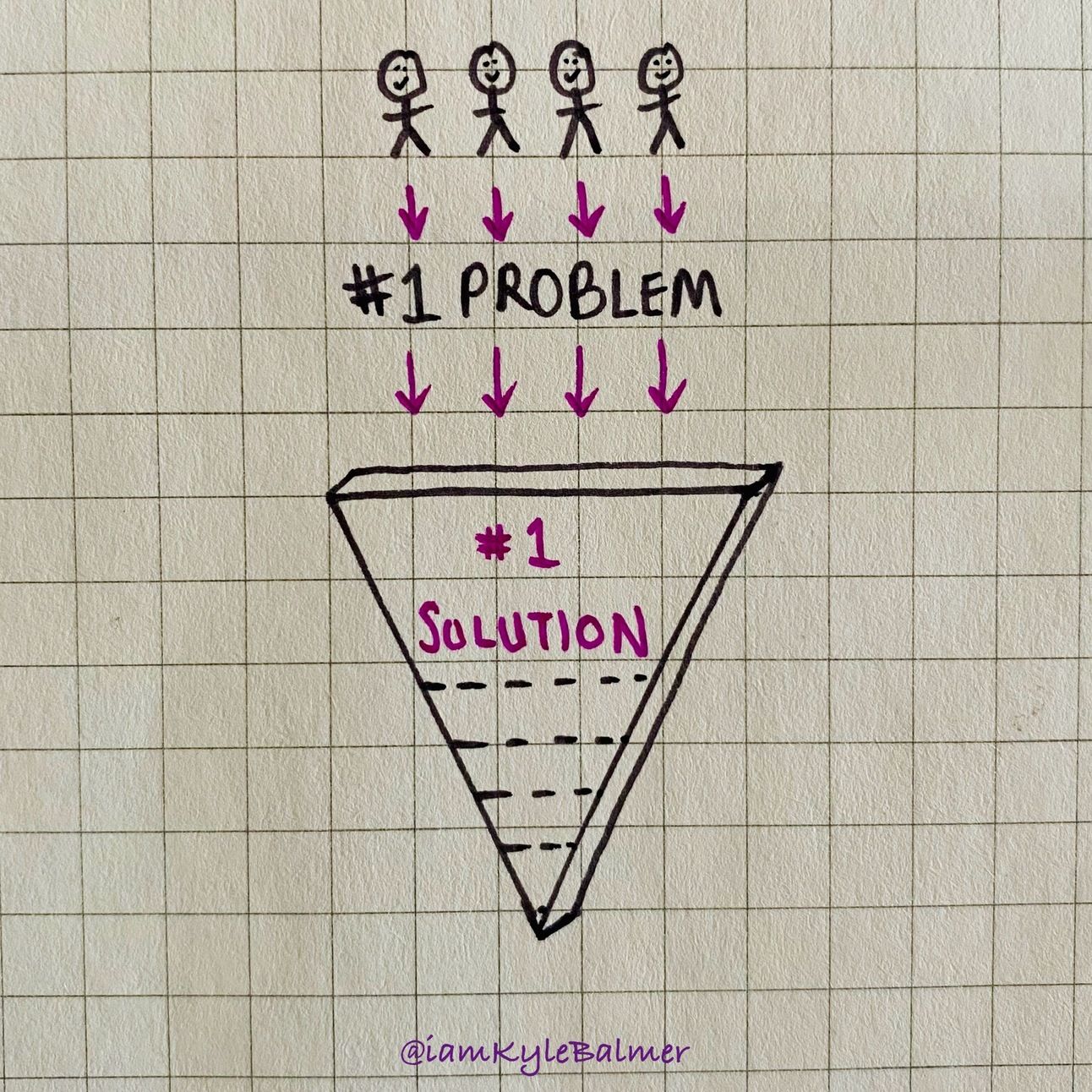
Before you start building your sales funnel you therefore need to know the core problem that you are helping your customer to solve.
Let’s use a questioning prompt here:
Help me identify my customer's true problem
I run a business in the [topic] niche
Ask me about my customer's common difficulties. Collect my answer and suggest a deeper level of motivation. Provide several options and suggestions. Again ask for feedback and repeat 3 times.

When we settle on a root problem relay it back to me in a short succinct problem statement followed by an in-depth explanation.
I ran this process of the niche of “teaching AI to businesses” an received the following:

Ultimately only your customers can reveal their true problems. But this is a good place to start.
We can get deeper into the truth by:
asking our customer via surveys, polls and interviews
seeing what content and marketing messages they respond to
what they purchase
This is all iterative. The more time you spend in the space serving your customer the more you’ll learn about what problems they are facing and (ultimately) how to help them.
Once we have an idea of the core problems our customer face we can map out our funnel.
Importantly our funnel solves the same problem, just at different levels of details and implementation.
This is super important. Read it again. It’s the same problem we are solving.
The customer’s problem becomes the common thread we hold to.
Let’s use a second prompt under the first:
Act as a marketing manager
Construct a sales funnel that solves my customer's primary problem
Each stage of the funnel will solve the problem in more detail and providing more hands-on help and implementation

My niche is [topic]
My target audience is [provide details]

The stages of the funnel are:
Audience generation
Lead magnet
Tripwire offer
Core offer
Upsale
Premium

For each provide a handful of options
This will take your customer problem and construct a funnel for you. The prompt is set up to give options for each element in the funnel.
If you already have certain elements (ie. you already have a core product) then specify this in the prompt. This will shape the rest of the funnel around extant elements.
Be careful with this though as your existing products may not actually be the best fit for your funnel! It’s tempting to try to squish together products we’ve already created into a funnel but that funnel may end up being an inefficient Frankenstein.
One concern is that by giving solutions to our customers early in the funnel we’ll solve their problem and never be able to sell anything to them.
For example if I give away a free checklist then why would anyone buy my course later?
Some people will indeed be able to use your free and low cost content to “work it all out” themselves.
These people are in the minority. We’re talking 1-5% of people.
And guess what: these are the people who were going to work it out for themselves anyway! They have more time than money. They weren’t your customers and never will be.
The vast majority of people will want more from you. If they found your free checklist useful then they are more likely to take you up on your next offer. You’ve built trust already and become the obvious choice for the next step.
At each stage even when they make progress they’ll realise there’s more to do. More to solve. More need for your particular expertise and solutions.
And as such they’ll keep moving down the sales funnel.
You do not have to know exactly what elements will go in your sales funnel.
You’ll always be testing and tweaking the exact best mix.
The main thing right now is to know the general “directionality” of the funnel - ie. the customer problem that the funnel solves - as well as a rough order of the elements.
We’ll be covering each element of the funnel in the rest of the Parts, starting at the beginning and moving further along each time.
Generally you’ll want to crack each element before moving to the next. Once you nail the lead magnet for example you know you’ll have a steady flow of customers for your tripwire and onto core offer.
But if you haven’t sorted the lead magnet then the later elements don’t matter!
As such we’ll cover each in turn in the order of deployment over the next three Parts.
Keep prompting,
Kyle
Let’s talk about the powerful 1-2 punch of a lead magnet followed by a tripwire offer.
Successfully deployed this will reduce your customer acquisition cost to $0 which, you don’t need me to tell you, will set you up pretty well!
Let’s get started:
Lead magnet to tripwire
what’s a lead magnet?
use lead magnet to test customer problems
designing a powerful lead magnet
combining with a tripwire
The first step in our sales funnel is to bring people from our Audience into our Tribe.
We usually do this by capturing their email address. By doing so we now have permission to talk to them. It’s the first sign that they are genuinely interested in what we have to offer.
We capture this email using something called a lead magnet. It’s exactly what is sounds like - magnet to attract leads.
I’ve written a whole Playbook on lead magnets - you can find it here: Lead Magnets Prompt Playbook.
We’ll cover the basics in this Part, especially how lead magnets and tripwires relate to the wider sales funnel structure.
First of all this is where we carry our audience through to the beginning of our sales process.
However which way we are building an audience we need to make the next step (the lead magnet) make sense.
This is the case whether we are using:
organic content (ie. social media, blog articles)
paid advertising
or any other way to get in front of people
You need the lead magnet to be congruent (wow word!) with the content.
For example I’ll use my own content and lead magnet. My content on social media talks about the usage of AI in business. How-tos, FAQs, AI news, tools etc.
My lead magnets are more in-depth guides about how to deploy AI in business. Lead magnets are generally in the format of a checklist, short video, a mini eBook, a trial of a software, a chemistry call or some other “taster” format.
There’s a consistency. I don’t do funny videos about cats and then expect people to download my AI guides. That’s not going to fly.
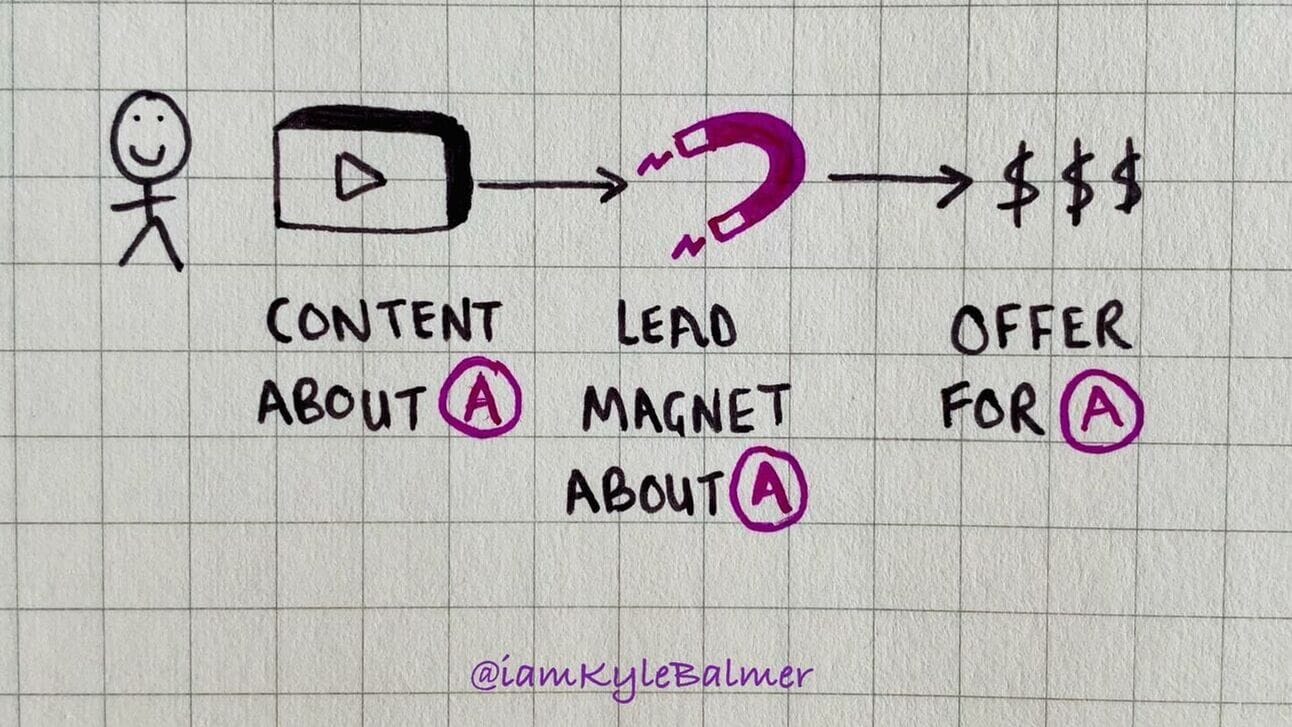
That consistency comes from focusing on my customer’s problems.
For example one problem my customers have is “what business should I start?”
I’ll have content about this, giving frameworks, breaking down business ideas, talking about what makes a good business or a bad business. Then I’ll present a lead magnet that addresses these topics in a lot more detail.
Importantly these are also topics I address later in my products. For example I have a mini-course called the Niche Navigator which is presented to people who have these problem.
Lead magnets are fantastic for genuinely working out what problems your customers actually have.
We can hypothesise for days about what we think their problems are. But ultimately we need to put offers in front of people and see what they react to.
That’s the ultimate tell. Anything else is guess work.
For this reason I recommend making lots of lead magnets.
Personally I have about 40 lead magnets. And each is pushed to different platforms, with different creatives, which means the total number of lead magnet variations is closer to 200!
This allow me to see what people actually want. No more guess work.
In my case for example I’ve had some super powerful lead magnets:
organic lead magnet - one talking about how to run AI workshops for business led to 900+ requests for the lead magnet - that’s 900 new leads in my sales funnel
paid lead magnet - one offering an “AI Business Blueprint” has decimated all other paid lead magnet offers I run, allowing me to acquire a lead for $0.19.
I only know this from testing. Putting out a range of offers, solving a range of customer problems. And seeing which of them resonate best.
This tells me that these are topics that audience member are really into. And thus I need to focus my sales funnel here.
Once you know this you can start to lock the best performing lead magnets in place and optimise on them.
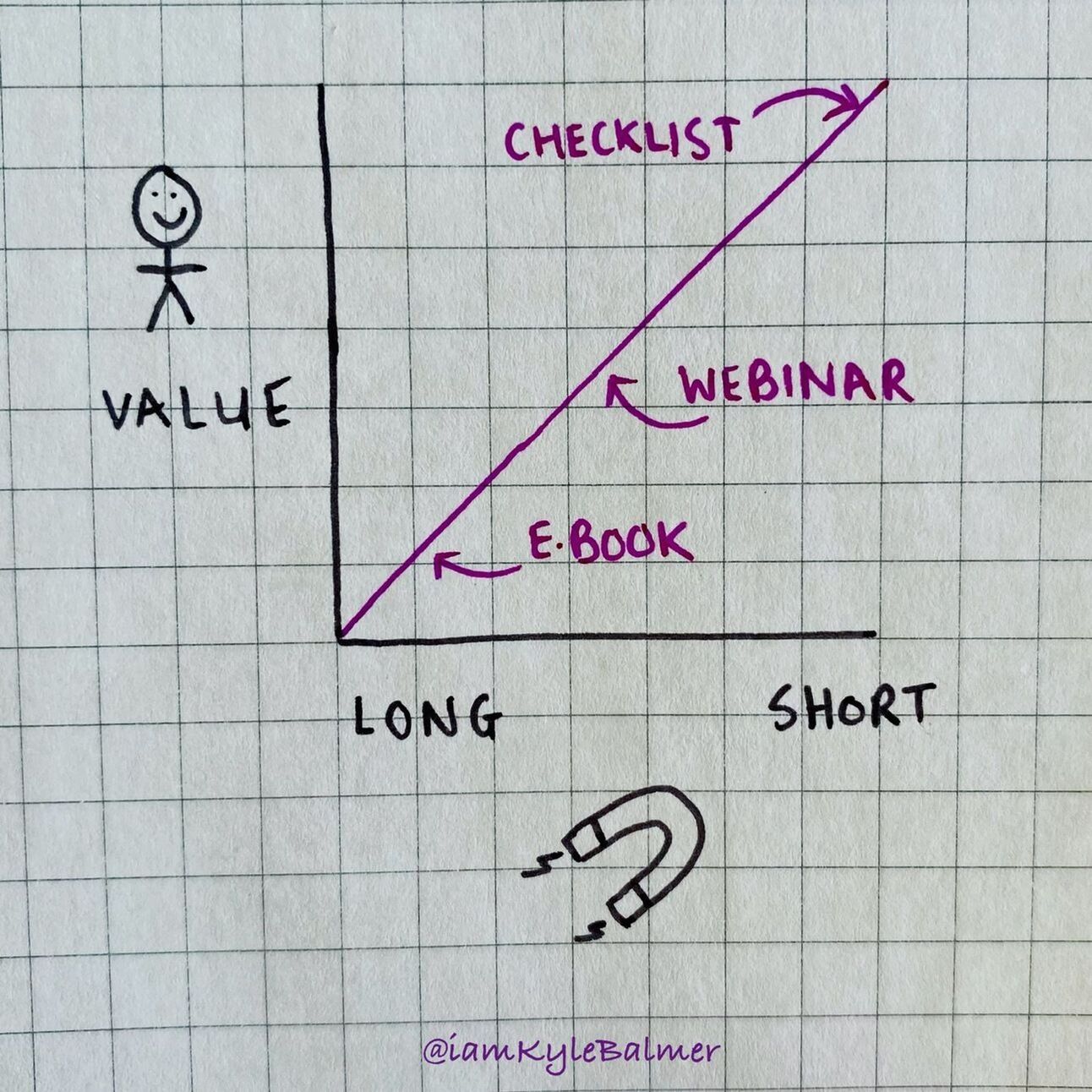
Lead magnets should be:
fast for you to produce
fast for people to consume
high value density
designed to answer questions whilst opening up more
Don’t write a whole eBook as your lead magnet. That’s a mistake I see happen again and again! Don’t do it!
It takes too long for you to produce - thus reducing the volume you can test.
It takes too long for people to consume - most will download it and forget it immediately. I’m sure you’ve done the same.
eBooks are also low density of value:time required.
Instead think of formats like resource lists, checklists, templates, swipe files and other high value but fast to create/consume items.
Let’s use a prompt to give us some ideas:
Act as a marketing funnel expert

My business is in the [topic] niche
My audience members are [audience details]
Their common problems are [list common problems]

Generate 10 lead magnet ideas addressing the range of problems.
As design guidelines the lead magnets should be:
-fast for me to produce
-fast for my audience to consume
-high value density
-designed to answer questions whilst opening up more

For example resource lists, checklists, templates, swipe files and other high value but fast to create/consume items.
I’d also recommend looking at what other people in your niche use as lead magnets. Spend enough time on their socials and blog and you’ll see them. Basically anything asking for your email in exchange for something is a lead magnet.
This is a more advanced technique but it works hand in hand with lead magnets.
A tripwire is an immediate sale after someone signs up for your lead magnet.
They’ve given you their email and so you know they are interested in what you have to say.
Hitting them with an immediate next step (a sale) allows the most eager to immediately buy in.
I personally have a $20 sale that occurs after every lead I capture. It’s basically the “thank you” page - once someone gets a lead magnet they are sent to a page outlining the $20 offer.
Does everyone buy this? Absolutely not. But some do - about 1-2%.
What this means is that you can make revenue whilst collecting leads. This is especially powerful if you are paying for advertising.
Personally I pay $0.19 for an email lead. 100 leads costs me $19. But if 1% of those 100 people buys my $20 tripwire guess what? I’m cost neutral.
The tripwire immediately liquidates the cost of the advertising and you’ve acquired 100 leads for free.
What should the tripwire be? It should be an intermediary between your lead magnet and your Core offer (which we’ll discuss in the next Part). Right now just think about immediate “upgrade” offers on your lead magnet.
For example if you lead magnet is a particular lead magnet for a particular task your customers do then your tripwire could be a package of multiple checklists they’d also find useful.
We’ll get a better idea of intermediary offers once we’ve locked in our core product - which we’ll do in the next part.
Keep prompting,
Kyle
Into the heart of the matter - working out your core offer!
This is where you actually start to generate significant revenue. It’s the first proper sale.
Let’s get started:
Core offers and upsales
keep following the thread
core offer prompt using the value equation
how to price your funnel elements
taking people fro m lead to customer
adding upsales
I’m going to sound like a broken record here. So be it!
To work out the transition from lead magnet to our core offer we need to come back to the common thread that runs through our sales funnel.
That thread is determined by the core problems we are solving for our customers.
Our core products needs to be the main vehicle through which we solve this problem.
If our customers’ problem is losing weight then our:
content marketing might be about weight loss motivation
lead magnet is a basic nutrition checklist about the items you need to immediately throw out of your kitchen
core offer is a full nutrition plan and guidance on how to use it
Our core offer is something that requires a considerable investment from our customers - in both time and money.
It’s something they’ll take the time to consume. And are willing to spend a non-insignificant amount of money on to acquire.
But ultimately we are solving the same problem - just in more depth, with more guidance, more material and more motivation than the lead magnet that captured their attention.
You may already have your core offer. It tends to be the product or service that most businesses start with.
Generally most businesses already have a core offer already and need to add a lead magnet beforehand and a premium offer afterwards.
If this is the case for you then make sure there’s a through-line. Don’t just jam your core offer into the sales funnel because you’ve already made it. That’s a false economy.
If starting from a clean slate let’s use this prompt to ideate core offer ideas:
Help me generate core offer ideas.
We'll use Alex Hormozi's value equation.
My niche is [topic]
My customers are [customer description]
Their main problems are [problems]

Ask me a series of questions to guide me through the value equation - one for each element

Wait for my inputs

Then based on inputs give me 5 core offer ideas
This uses Alex Hormozi’s value equation, which I’m a fan of. Here’s a diagram of the basic model:
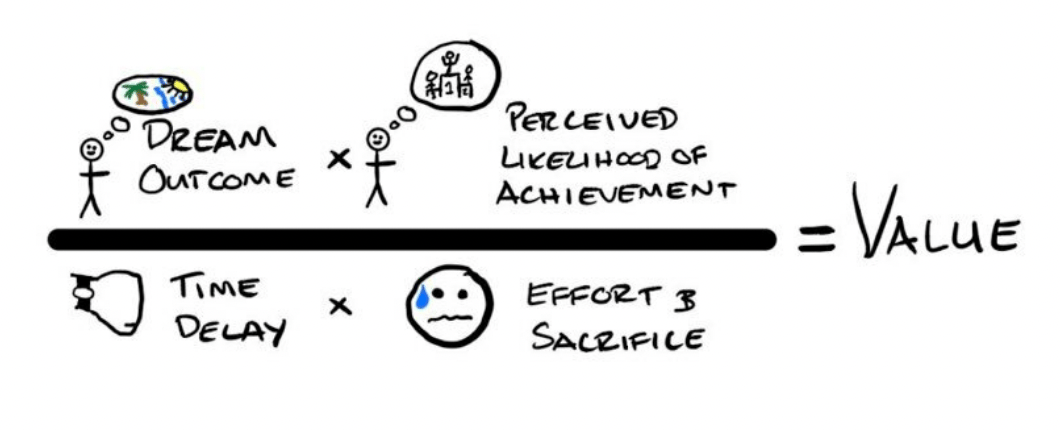
You don’t need to know the model to use the prompt - just work through the questions it ask you and it’ll spit out potential core products.
Importantly make sure that the customer problems you input are the common thread of your sales funnel.
The pricing at the various parts of your sales funnel will depend entirely on your niche, how strong your brand is and how much value you can demonstrate.
That said there are common “set points” that are used in online business a lot. Because…they work.
These are useful to get an idea of relative pricing in your sales funnel (and thus to work out how to price your core offer).
In general:
lead magnet - free
tripwire offer - $10-20
core offer $50-200
upsell offer $200-500
premium offer $1000+
So when designing your core offer thing about something coming in at the low hundred range. Again, depending on your niche and what’s common!
How do we actually achieve our core offer sales in our sale funnel? What’s the mechanism?
Because, ultimately, our customers don’t know there’s a sales funnel. They don’t know there’s a next step until we tell them! How could they?
The way we do this is email marketing. Remember that we used a lead magnet to capture their email - we now deliver emails to tell them about the next steps.
This doesn’t mean we just spam them with emails about our core offer. They’ll quickly unsubscribe.
Instead deliver value and then talk about your core sale. That value comes in the form of content - and, you guessed it, it should be content that helps solve their core problems!
I’ve written extensively on writing a welcome series (with sales) in this Playbook: Welcome Series Email Marketing Playbook.
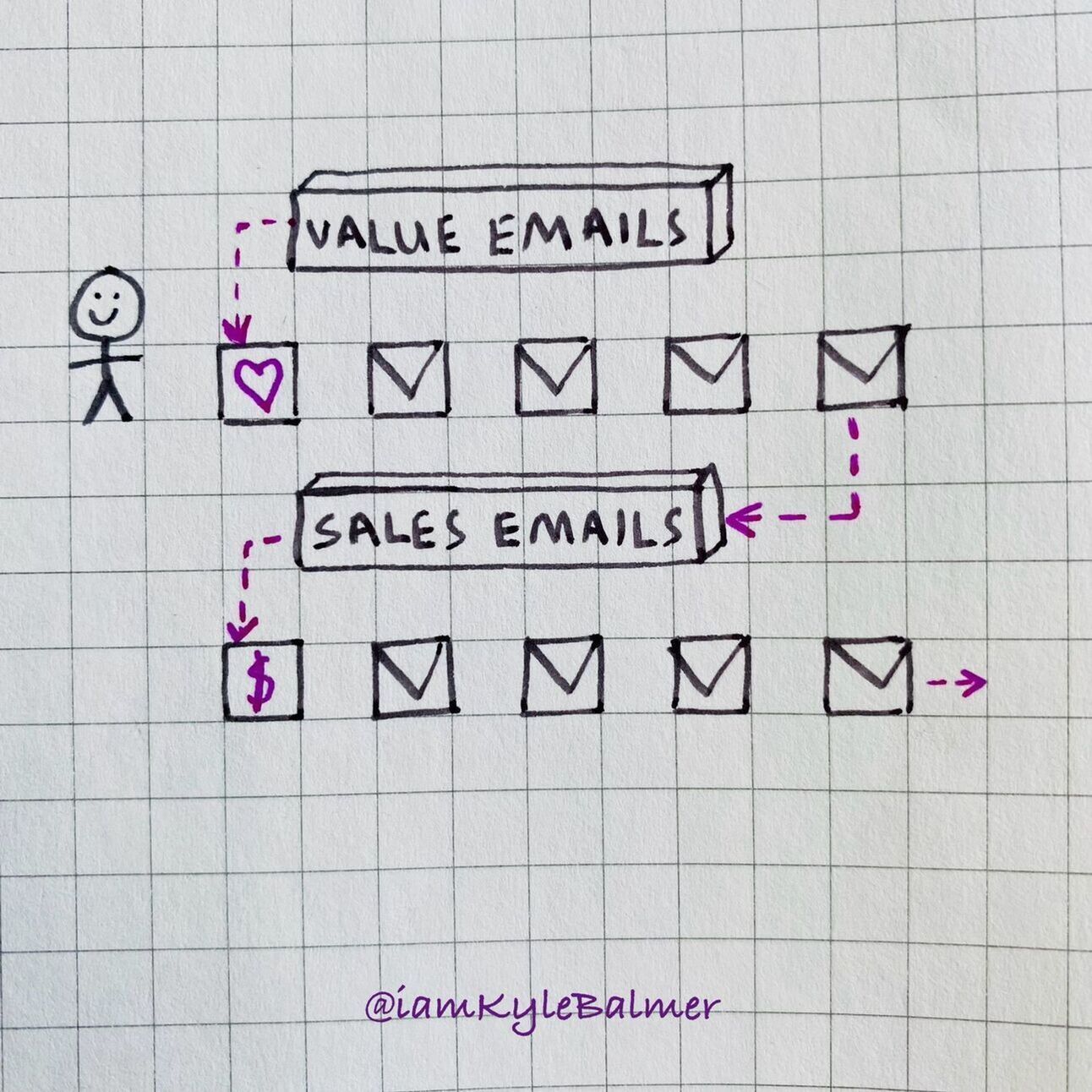
The basic recommendation I’d make is:
find 5 top problems that your core product solves
write 5 welcome emails that are pure value, giving basic advice on how to solve these problems
follow these with 5 sales emails talking about your core offer
I use beehiiv to deliver my welcome and sales emails but there are lots of other email marketing tools out there. I use beehiiv personally because I also have an email newsletter.
When is the best time to sell to someone?
The moment just after they’ve purchased from you!
There’s a phenomenon in sales and marketing called the “hot streak”.
Basically once someone has already opened their wallet and made a purchase they are likely to keep buying.
Once someone has decided to buy a car for $40,000 they are more likely to also want the leather seats for $3,000.
They aren’t thinking about the fact that the seats are $3,000. They are thinking “eh I’m spending $40,000 so what’s another $3,000”.
Your upsale can either be an offer bump that makes your core offer better somehow. Generally by making the outcome easier, faster or more certain for the purchasers. For example you’ve sold them a $200 course and for an extra $30 they can get the printed book version sent to them.
Or it could be a full upgrade to a new, better product or service. A halfway point between your core offer and the premium offer. A great example here is if you sell someone a video course for $200 and offer a $250 upsale to get some 1:1 time with you.
Speaking of premium - we’ll cover that in the next Part!
Keep prompting,
Kyle
Our tripwire should have got us close to breakeven. And our core offer takes us into profit. It’s looking good, chugging along.
Where we really crank it up though is with our premium offer. This is where the true power of the sales funnel comes into play.
Let’s get started:
Premium Offer
Profit multiplier
Product → Service
DIY → DWY → DFY
The premium offer is where we can really make bank.
The reason for this is the customer trust we’ve built throughout the funnel.
Leads have come into our system, made purchases from us and (if you’ve delivered!) been happy with each of those purchases.
This builds up trust in us and our offers. And it’s a seamless process because they start with low cost, low time investment items and move up from there.
As this process continues you’ll have more and more people who are ready for your premium offer.
Premium offers are generally in the thousands of dollars rather than the tens and hundred of dollars we’ve been working at before.
We can only make sales at this level because of all the trust we’ve built up. If we’d have tried to go straight to a $2,000 sale with cold traffic there’s no way in hell we’d pull it off.
This part of the funnel is therefore where all the prior work come into play and we pull in real profits.
Generally I recommend your tripwire, core and upsales are all digital products.
They should be something you can sell with zero marginal cost. Selling one or selling a thousand of them should cost you the same.
This is not the case with physical products. The more you sell the more inventory, warehousing, shipping, customer service and returns cost you have. Selling 10,000 hats costs a lot more than selling 10 hats.
With digital goods this is not the case. Bar some minimal hosting costs the cost of selling 10,000 units is the same as selling 10.
What about services?
Services require time to deliver and time is cost. There’s always a cap to how much of a service you can provide - a capacity that is determined by your team size and systems.
Again digital products don’t have that limitation. There’s no time component to selling digital products. It’s instantaneous and automated.
Digital products are therefore perfect at the lower ends of your sales funnel - tripwire, core and upsells.
At the premium level though we can look at reduced scalability.
We can introduce physical goods and services. Because the higher pricing gives us the leeway to still profit and scale.
Personally I hate physical products as a business (I’ve tried a few and no thanks!) So my personal recommendation is to add service offerings in as your premium level! I’ll focus on services here but if you are comfortable with physical products then all power to you!
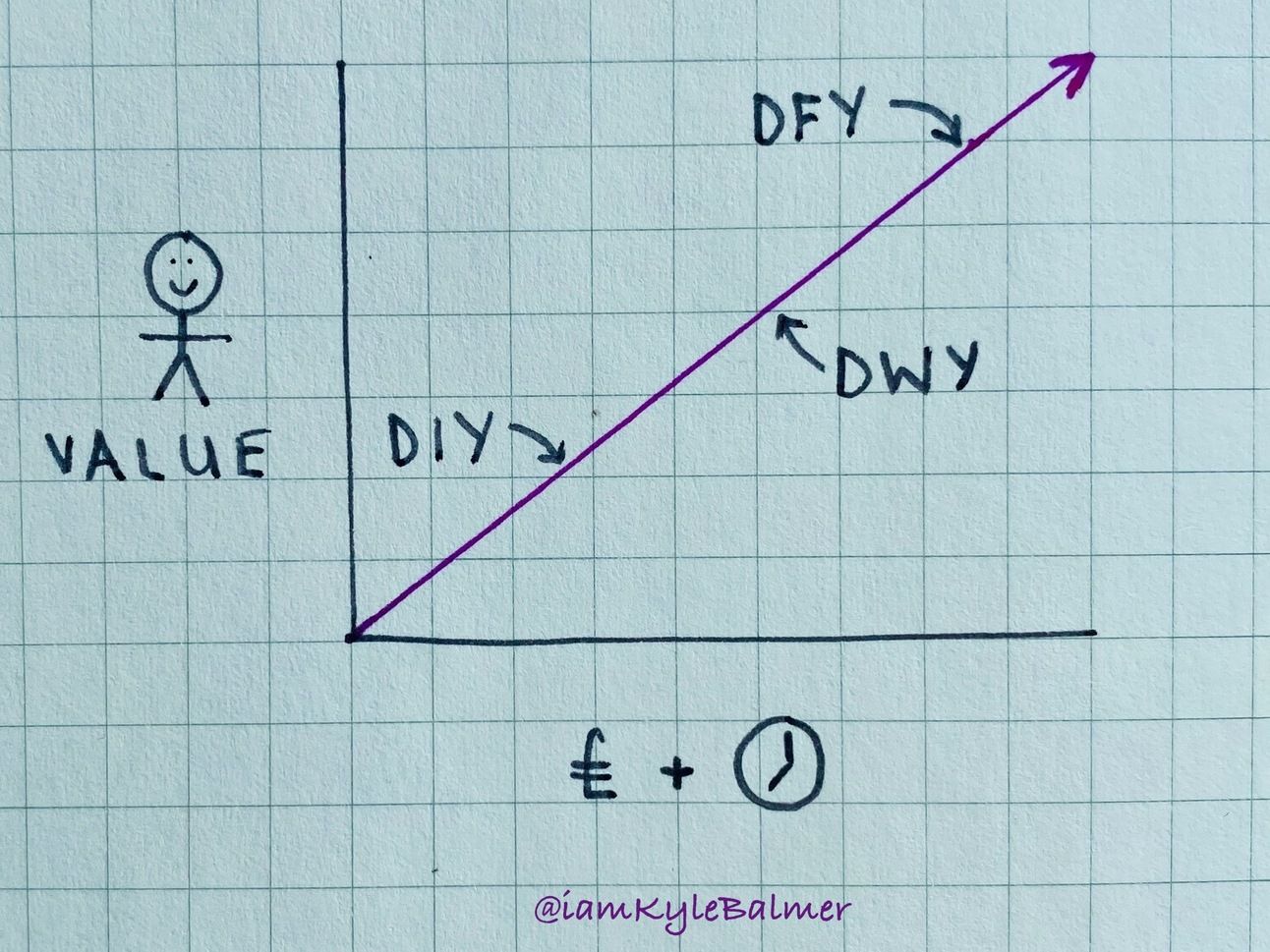
Generally as we move customers down a funnel we move from:
Do it yourself (DIY)
Done with you (DWY)
Done for you (DFY)
Do it yourself is giving people a course, an eBook or some sort of resource which allows them to use your information to answer their problems.
Done with you in a bit more hands on. For example running workshops or a cohort where you walk people through how to solve their problems. It could also be coaching, mentoring or other hands-on services.
Done for you is literally taking the problem off their plate and sorting it out for them. They hire you and your team of experts to get it done.
For example let’s say you help small businesses with their Facebook adverts.
The customer problem is wanting to generate more sales using Facebook adverts but not having the technical know-how or skills to get it done. They’ve tried with Facebook ads before and lost money each time. They want to finally crack it.
Here’s a full funnel:
Content on how to get started with Facebook adverts in your business.
Lead magnet with the common mistakes businesses make when making their first Facebook advertising campaign.
The tripwire is a “Set up your first successful campaign” set of videos for $20.
The core offer is a “How to run 10x ROI Facebook Ads for your business” course for $200.
The upsell is a $50 library of all your most successful ad creatives and copy for them to swipe.
The DWY premium offer is a 30 day cohort where you take a group through setting up their first campaigns, done live with a group of 20 at a cost of $1000 each ($20,000 revenue)
The DFY premium offer is taking on their Facebook ads as an agency, charging them 10% of spend with a minimum ad spend of $10,000/month (netting you $1000/month or $12k p.a. per client).
Notice the same problem is solved at each stage.
We just provide more and more additional help as we proceed - culminating in a high ticket agency offer.
Let’s work this out for your business using a prompt:
Help me generate premium offer ideas for my sales funnel.

My niche is [topic]
My audience is [describe audience]
Their core problem is [customer problem]

My lead magnet is [lead magnet details]
My tripwire offer is [tripwire details, including price]
My core offer is [tripwire details, including price]

Detail a range of premium offers
Suggest 3x DIY offers
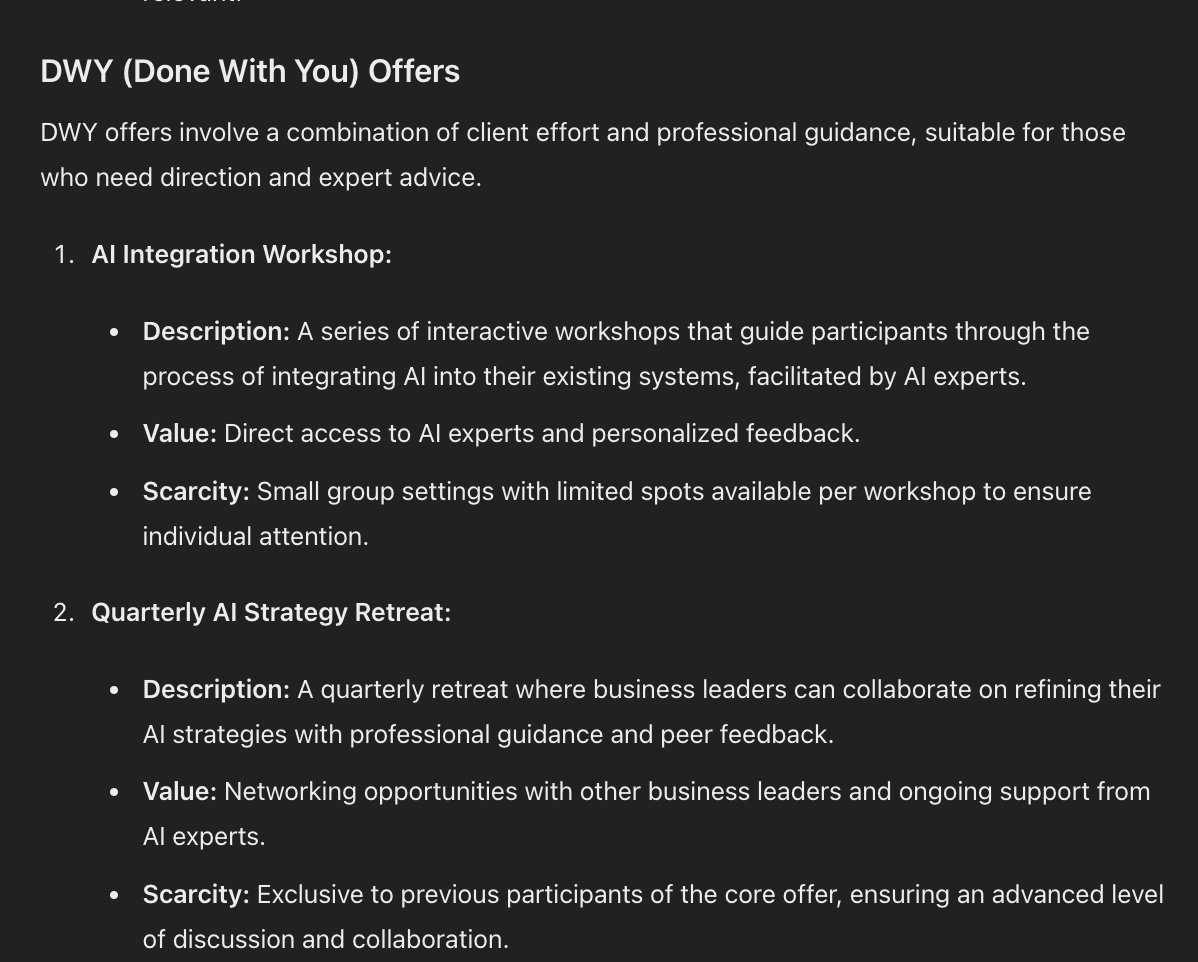
3 x DWY (done with you) offers
3 x DFY (done for you) offers

Which increase in scarcity and price
This prompt will help you come up with ideas to plug into your funnel as premium offers.
For example I use the niche of helping business leaders to integrate AI, fed it some funnel details and got these DWY suggestions:
As well as these (even more premium) DFY suggestions:
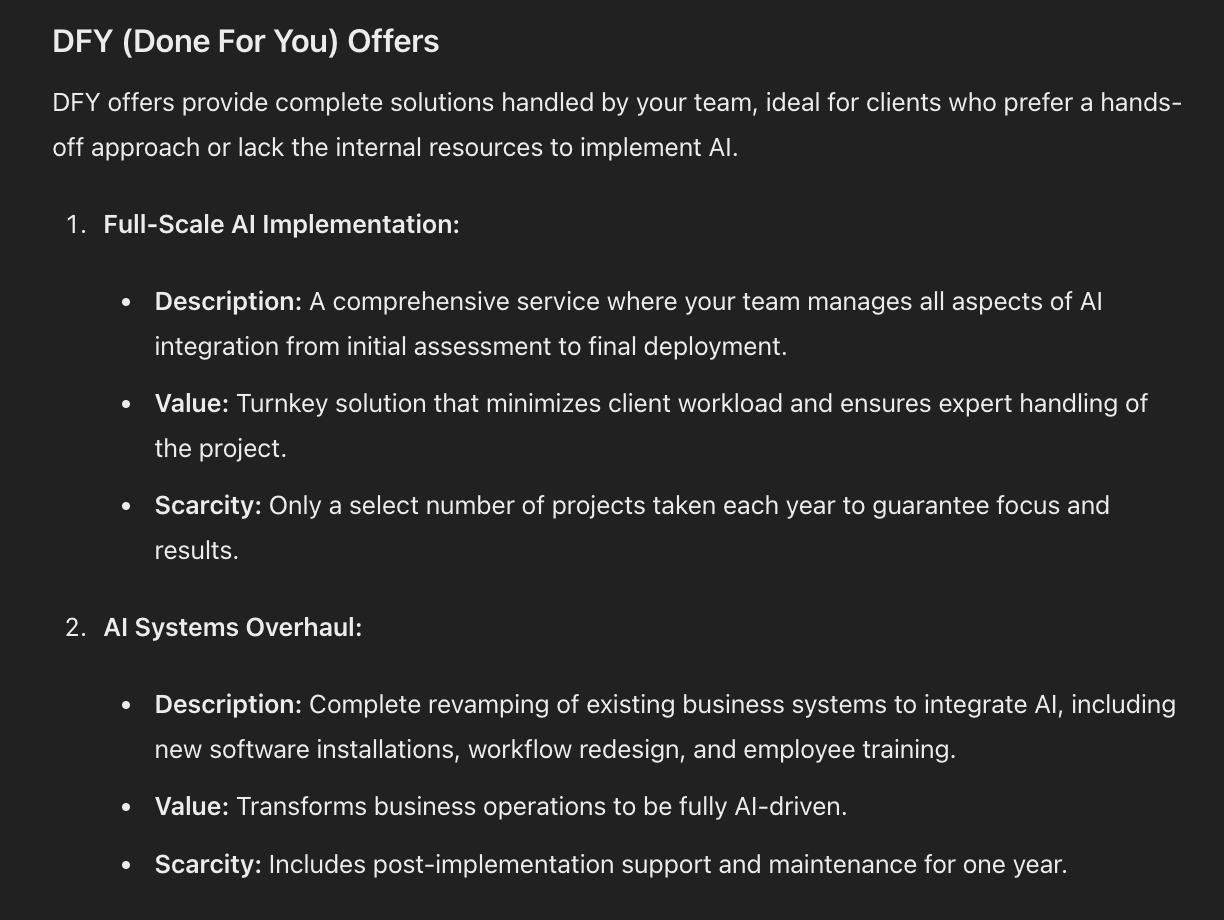
Not sure how to launch these sort of high tickets items? Check my Playbook on cohort launches - the methodology is applicable to any high ticket launch.
We’ve covered, soup to nuts, how one ideates and begins to build out a sales funnel.
Use these prompts (and your own knowledge of the industry you operate in) to sketch out your funnel before plunging in and building willy-nilly.
Knowing the overall structure of your sales funnels tells you the structure of your business and what you need to be building next. It’s the skeleton around which you hand everything else.
Time now to get building!
Keep prompting,
Kyle
Welcome to '🔻 Sales Funnels 101 | AI Business Playbook', your essential guide to mastering the art of sales funnels! In this playbook, we delve into the fundamental concepts that underpin successful online businesses. Whether you're an entrepreneur just starting out or a seasoned business owner looking to refine your strategies, this playbook offers actionable insights and proven techniques to enhance your sales process. Unlock the secrets of effective sales funnels and transform your customer journey from mere awareness to loyal brand advocates, boosting your revenue and growth in the process.
This playbook is designed for entrepreneurs, small business owners, and marketing professionals who are looking to enhance their online sales strategies. If you're struggling to convert leads into paying customers or find it challenging to build trust with your audience, this playbook is perfect for you. It addresses common pain points such as low conversion rates, ineffective marketing tactics, and the need for scalable business models, providing you with step-by-step guidance to overcome these obstacles and achieve your business goals.
No prior knowledge is required! This playbook is designed to guide you from the basics to advanced strategies, making it suitable for all levels.
You can progress at your own pace, but dedicating a few hours each week to read the content and implement the strategies will yield the best results.
Absolutely! The concepts and strategies outlined in this playbook apply to both products and services, helping you optimize your sales funnel regardless of your business type.
Yes! Each section includes actionable prompts and examples to help you apply the concepts effectively in your own business.
Yes, the principles of sales funnels are universal and can be adapted to fit any industry, making this playbook relevant for a wide range of businesses.