
AI Knowledge
Turn AI into a practical day-to-day productivity system.
Start ReadingThis week we’re turning to productivity, the close runner up of our last vote.
I’ll be covering how to use AI to become more productive in your business and general life
We’ll cover this not only on the daily tactical basis but on a wider annual strategic level.
We’ll be covering:
Part 1: First rule of productivity
Part 2: Productive goal setting
Part 3: Breaking down the year
Part 4: Crushing the daily grind
Part 5: 1% better
By chaining all these prompts together you’ll have a powerful AI productivity system to up your game 10 fold.
Prefer to watch?
The temptation this week is to give you lots of cool systems built in Notion, Coda, Airtable and all hooked together with Zapier.
I love that stuff and I bet a whole bunch of you do too. I get it!
Instead though we’re going to be focusing not on “doing productivity” but actually being productive! Shocking!
It’s super easy to fall for all the productivity porn around bullet journals, second brains and PKMs.
Only to then spend more time working on your “system” than actually - you know - doing the productive work you are meant to be doing!
In this issue we’ll use AI to starting working out what productivity is for us.
This will be different to everyone so we’ll use an AI coaching prompt to help us define what productivity.
The first rule of productivity is we need to align our actions with our values.
There’s no point in doing tasks that aren’t aligned with the life we actually want for ourselves.
We need to work out, in order:
Value → Goals → Projects → Tasks
This will be the basic flow of this week.
Let’s go ahead with the first component using this coaching prompt:
Act as a personal coach

Ask in sequence each of the following questions.

-What is most important to you in life?
-Which of your core beliefs about have you never broken?
-What does success look like to you?
-What parts of yourself do you actively dislike?
-What are your standards for how you would like to ideally work?
-How do you like the quality of your work to be judged?
-What are the proudest moments of your life?

For each question ask 2 x supplementary Why questions to elucidate the truth behind my answers.

One question at a time, get my answer, then the next question.

Balance personal and professional

Then use the results to generate a list of 10 life value areas (ie. money, family, health, fame as examples - be creative) ordered by their importance to me.
ChatGPT will run you through a series of coaching questions.
Take your time with them. The more you put into this process the more powerful the end results.
At the end of my questioning I received:
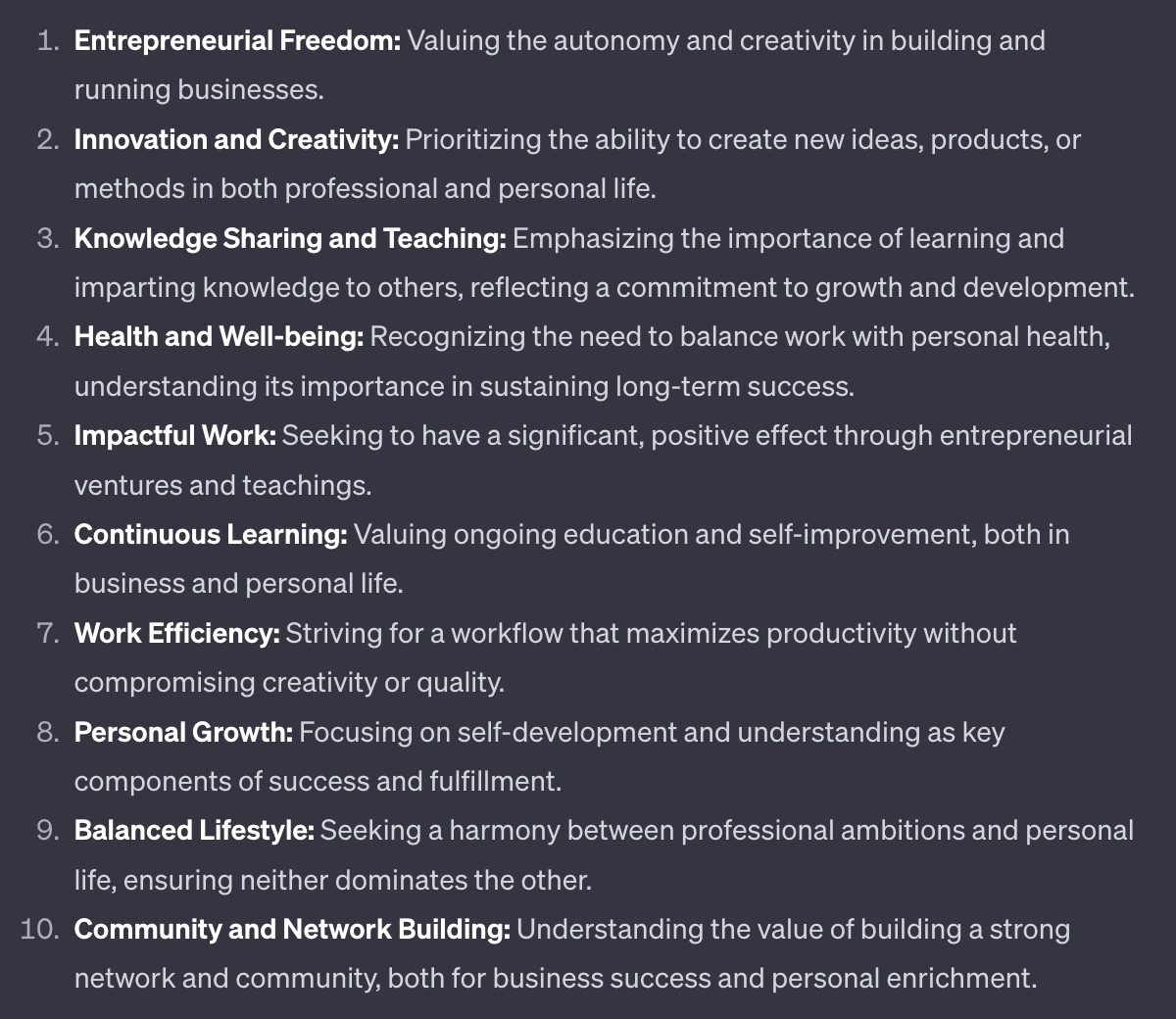
Yours will (hopefully!) be different to mine. We’re all unique.
Of course if anything seems wrong in your answer you can adjust it. ChatGPT isn’t infallible! But this coaching process should help to elucidate some foundational values.
We’re going to be using these values in the next Part to start goal setting.
We’ll extend the above work by using a ranking system.
Here’s the additional prompt:
Take the list of value areas above and provide a percentage importance weighting for each based on my original answers

The sum of all percentages should add up to 100%

Base your weighting on the frequency and strength of related language used in my original answers
This will go back to your original answers and analyse your use of language in order to gauge how important each value is:
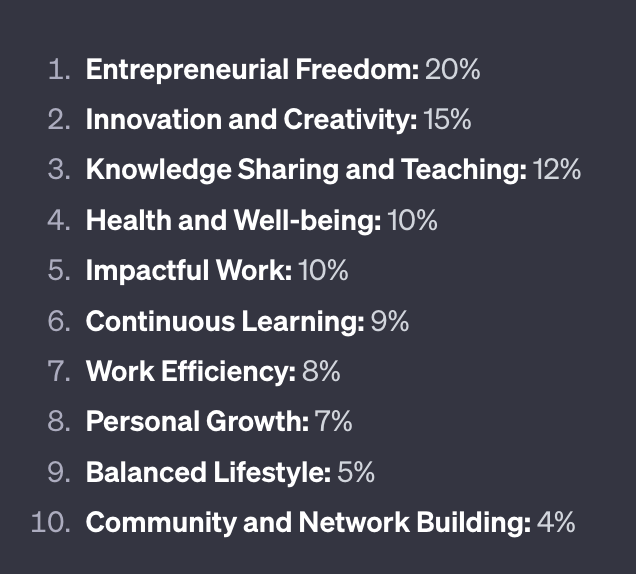
This is a first pass to get a rough ordering. Feel free to nudge up and down. Or even to redo the weightings!
Again the more detailed your first answers the better the results will be. This is especially the case here because we have asked for a linguistic analysis.
The reason we’re doing weightings will be clearer in the next Part when we begin goal setting. Adding these weightings will help us to further refine the process by emphasising the most important and de-emphasising the lesser values.
First step done - we have a nice set of personal values generated by our AI coach.
Next up we’re going to align our goals to these values and then begin working down to annual, quarterly, weekly and daily tasks.
A reminder of what we’ll be covering this week:
Part 1: How to be more productive
Part 2: Productive goal setting
Part 3: Breaking down the year
Part 4: Crushing the daily grind
Part 5: 1% better
Until then, keep PROMPTING!
Kyle
In the last Part we started off by working out what is actually important to us.
Today we start to convert what we value into specific goals.
Remember our basic flow?:
Value → Goals → Projects → Tasks
Today we’re covering Goals.
Prefer to watch?
Let’s get cracking with a prompt that we’ll use below our previous work:
Act as a goal setting coach

Review my list of values and for each ask me for 3 goals that I want to achieve in the following year.

Ask about one value area at a time, collect the 3 goals, make suggestions according to SMART framework, confirm my goals then move to next value area.

Then generate a table with all the areas, goals and SMART details in columns.
This prompt will walk you through a coaching process where you need to think about your own goals.
ChatGPT will elicit answers and then make suggestions to make the goal SMART (ie. Specific, Measurable, Achievable, Relevant and Time-bound):
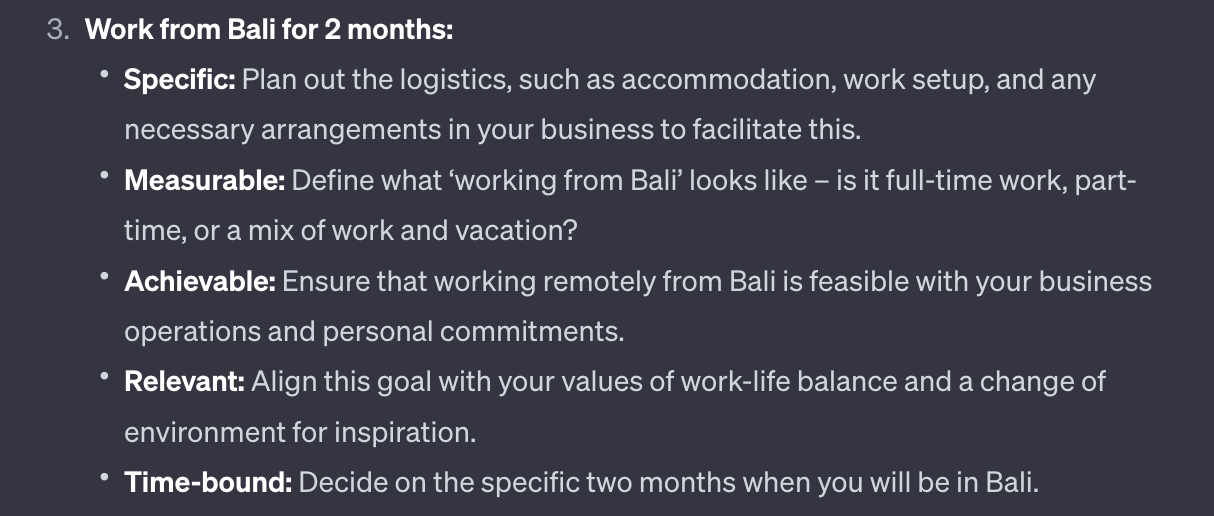
It’ll work through each of your value areas going from most to least important.
It will then generate a table of all the goals:
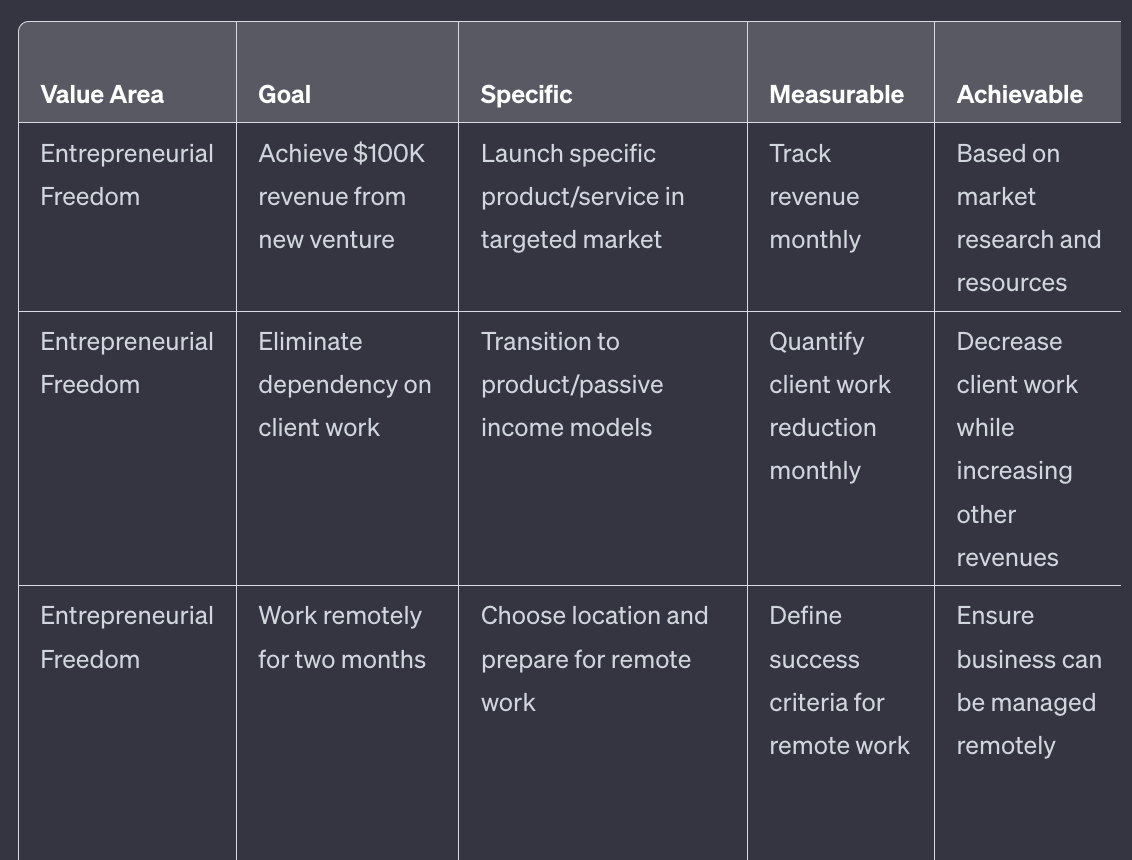
It’s best to copy/paste this out to Google Sheets or a similar spreadsheet tool as it’s hard to see it all in ChatGPT!
Once you have all the areas of your life and the annual goals set against them we want to manually edit.
Anything look out of place in that table? Edit it or straight up delete it. No problem. These are your goals, not ChatGPTs!
It’s easier to do this once you have it all in a table in front of you.
Keep a hold of this big ol’ table as we’re going to be using it tomorrow as the basis of an annual, quarterly and weekly project plans.

The basic prompt above will treat all areas of life as equal.
But yesterday we weighted our values.
We can also weight our goals.
For instance if health is more important than money for you this coming year we need that to be reflected in your goal planning.
We don’t want to dedicate the same amount of time and energy to both.
Here’s an updated prompt:
Act as a goal setting coach

Review my list of values and for each ask me for goals  that I want to achieve in the following year.

My values are weighted, not all are equally important.

Assign a number of goals to each value area according to its importance.

Ask about one value area at a time, make suggestions according to SMART framework, confirm my goals and THEN move to next value area.

Then generate a table with all the areas, goals and SMART details in columns. Make sure that the goals are distributed in a way that matches my value distribution.
As a reminder in yesterday’s example we had:
Entrepreneurial Freedom: 20%
Innovation and Creativity: 15%
Knowledge Sharing and Teaching: 12%
Health and Well-being: 10%
Impactful Work: 10%
Continuous Learning: 9%
Work Efficiency: 8%
Personal Growth: 7%
Balanced Lifestyle: 5%
Community and Network Building: 4%
As the distribution of values.
The prompt with this list will return the following:
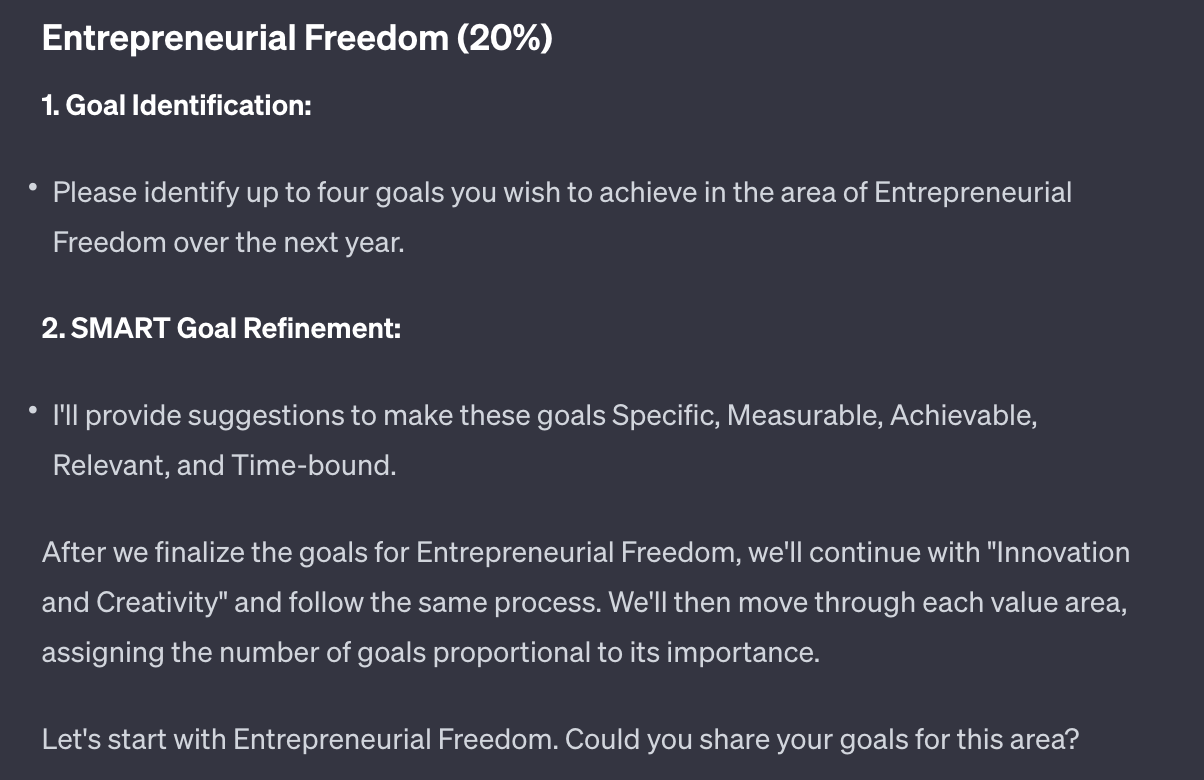
Notice we are asked for 4 goals, not 3. Our weightings have adjusted the balance of goals set for each area, allowing us to adjust focus.
The lowest priority will have one goal only for the year. The focus is reduced.
Continue the process as above and ChatGPT will generate a full table.
We’ll use this table in the next Part tomorrow.
Tomorrow we’re going to convert your large annual goals into specific quarterly and weekly projects. We’ll get granular with your goals!
Part 1: How to be more productive
Part 2: Productive goal setting
Part 3: Breaking down the year
Part 4: Crushing the daily grind
Part 5: 1% better
Until then, keep PROMPTING!
Kyle
In the last Part we converted our values into annual goals.
Annual goals are a good start but most people will leave their annual goals until the end of the year and then either:
Try to sprint them out in the last few months of the year or
Forget about them
Instead we need BIG annual goals to be split up into smaller components.
Remember our basic flow?:
Value → Goals → Projects → Tasks
We’re converting each major annual goal into a project and carving each project into smaller, actionable, steps.
Prefer to watch:
Let’s get started:
Use this prompt below your others from the work so far:
Act as a goal setting coach

Analyse my annual goals

Break each goal into quarterly, monthly and weekly actions so that by the end of the year each goal is complete.

The weekly actions should match add up to equal the monthly action. The weekly actions will be a mix of continuous actions done all year and progressive actions that change over the year.
The monthly actions should add up to match the quarterly action.

Provide a 12 month plan for each annual goal.
This will break your larger goal into smaller chunks - subgoals to be performed across the year.
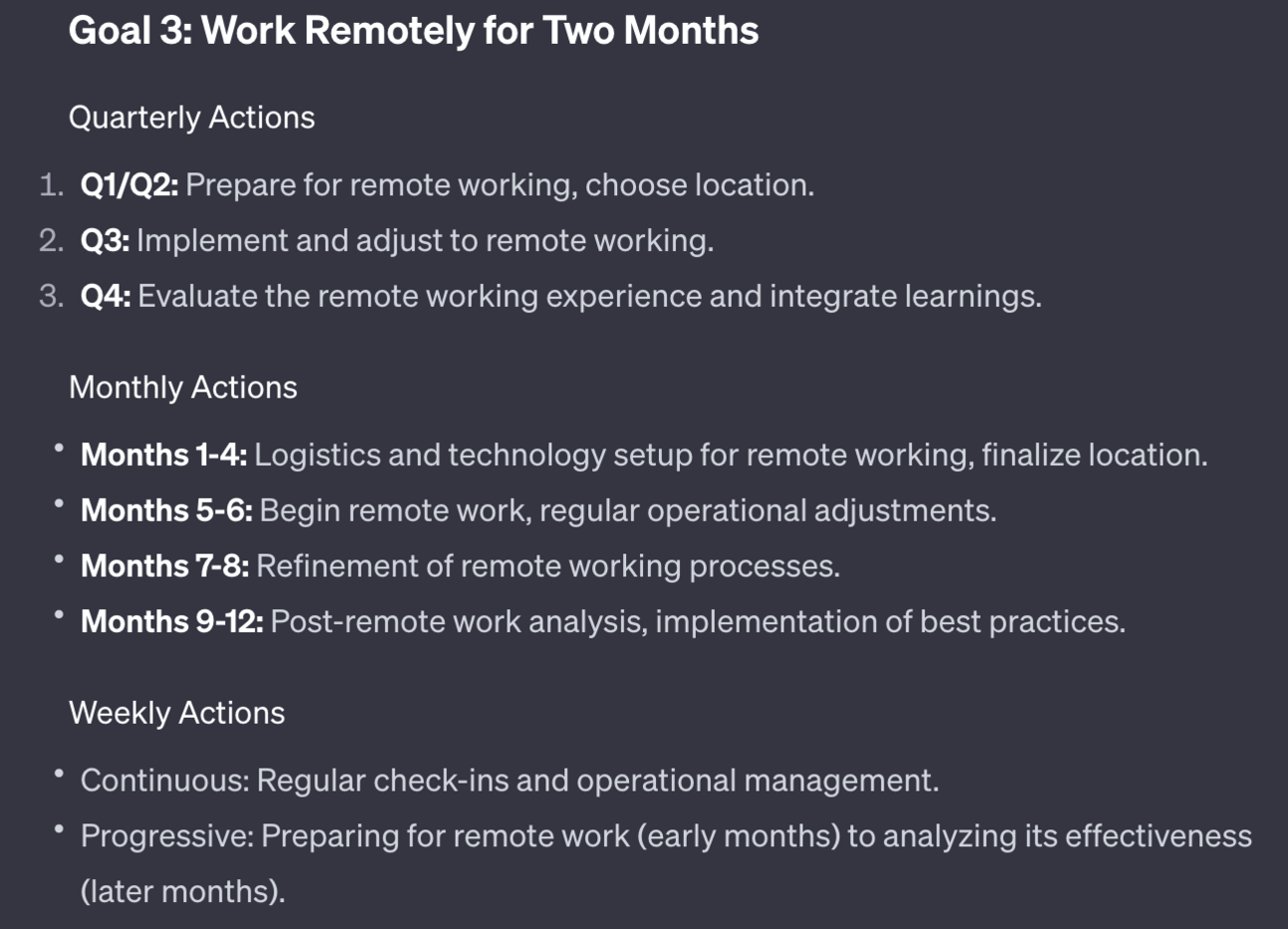
As always give it amendments. For example in the output above it assumes I want to live abroad for 2 moths during Q3. But maybe I want to move that forward to April. I’d have to tell ChatGPT this extra context so that it can adjust accordingly.
Do this will all of your goals until you are happy with the basic shape.
Then use this follow up prompt
Give me a calendar with all goals on a weekly basis for 52 weeks

Use format
Week 1 (Month 1 1-7)
Goal 1 subgoals
Goal 2 subgoals
Goal 3 subgoals
etc.

Week 2 (Month 1 8-14)
Goal 1 subgoals
etc.

Starting January 2024
This will now take all your previous work and generate an extremely detailed 52 week plan.
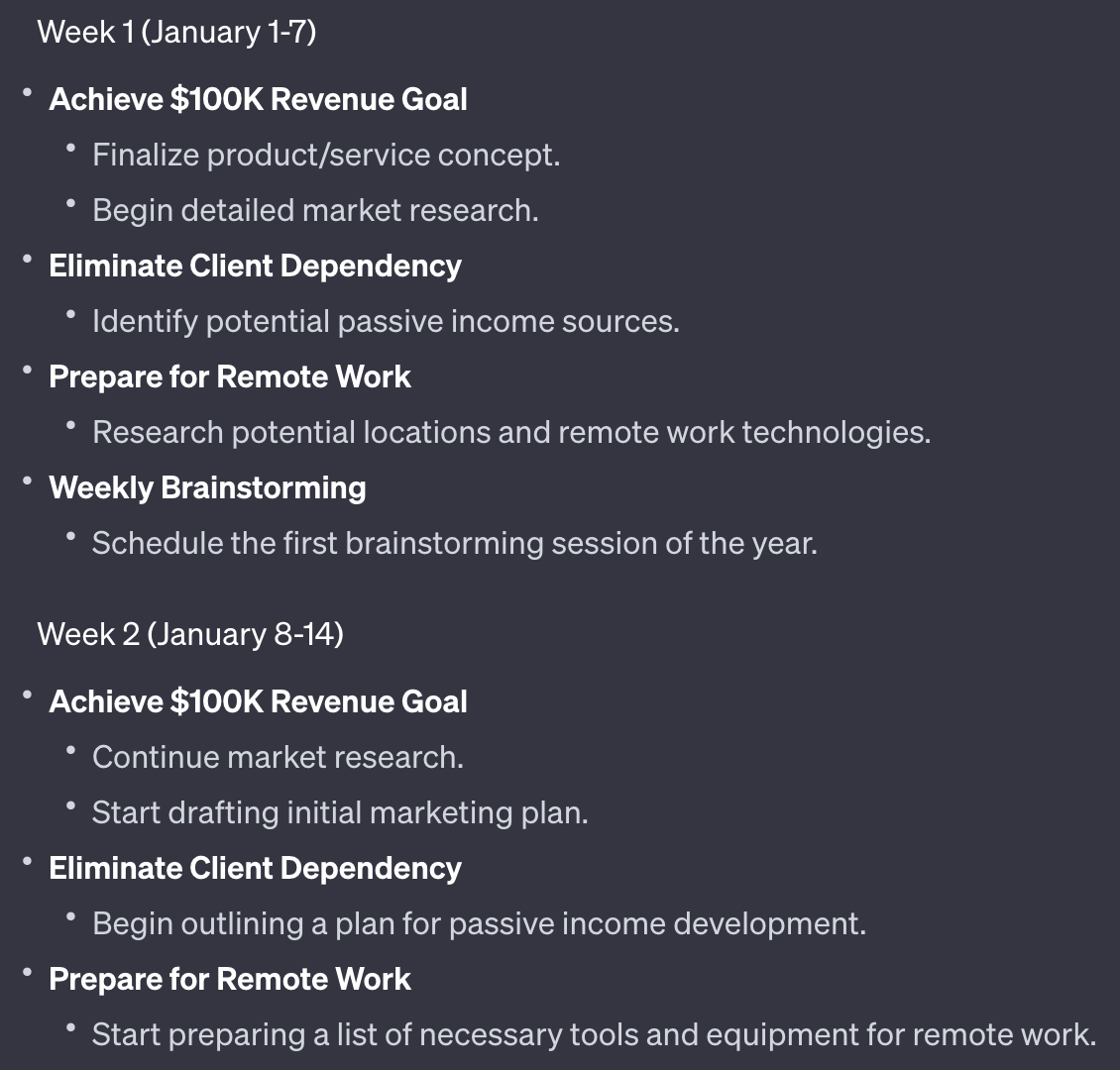
Each time the prompt stops use “continue, referring to above 12 month plan” to generate more weeks.

To make your goals even more actionable we need to add Key Performance Indicators (KPIs).
To paraphase Peter Drucker “what gets measured gets done”.
To assign KPIs to our goals we need 2 measures: where we are now and where we want to be.
Here’s a prompt that’ll add KPIs to our existing goals:
Act as a KPI expert

For each of the goals I want to set a KPI

Make suggestions and confirm which KPI I wish to use for each goal

Then for each goal and ask for i) my target and ii) where I am now

Then break the goal KPIs down month by month over the year and return in a tabular format
ChatGPT will come up with some suggested KPIs. Use these, suggest your own or ask for more.
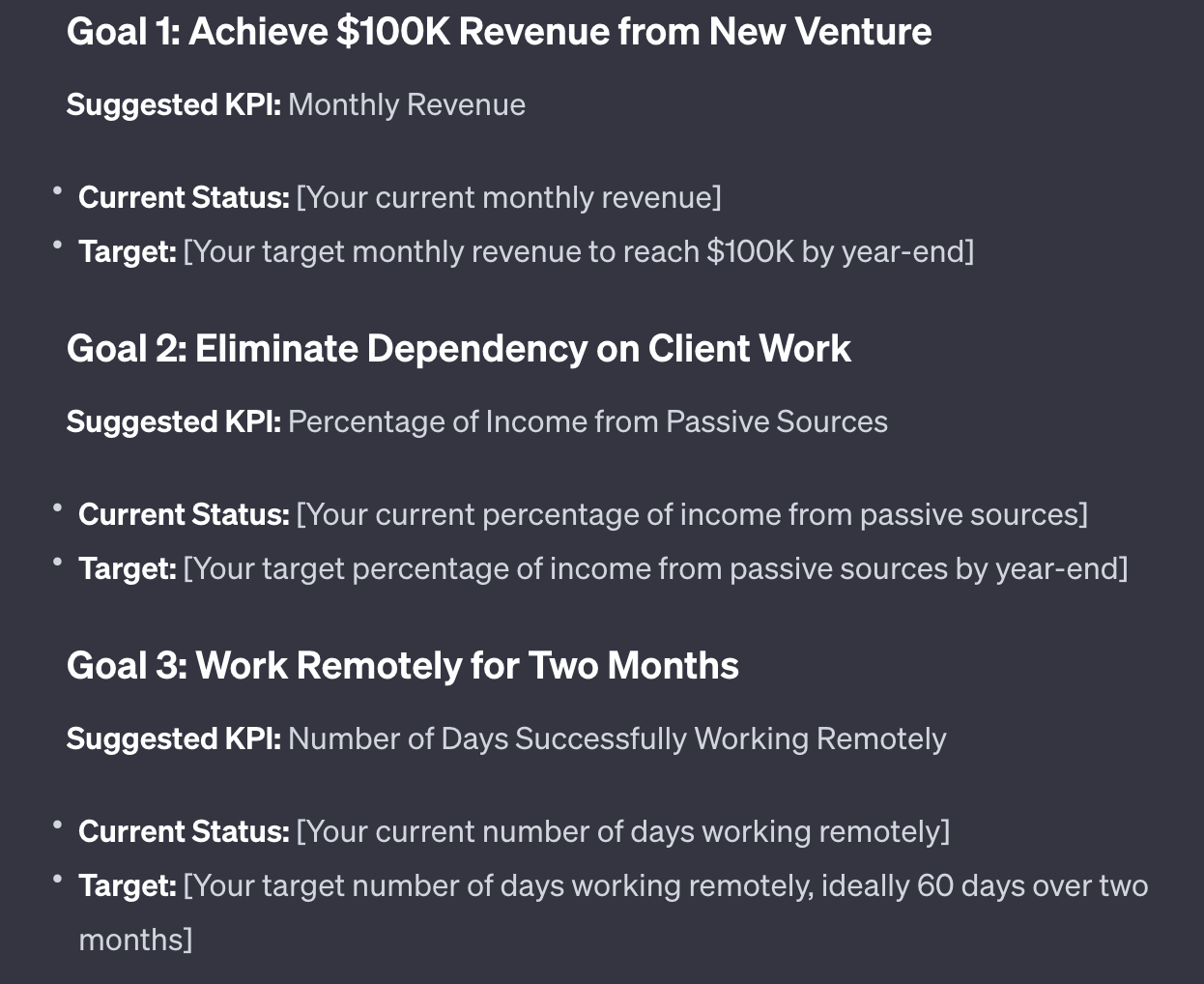
Then give ChatGPT your starting and goal points.
ChatGPT will then generate KPI goals for you to aim for each month:
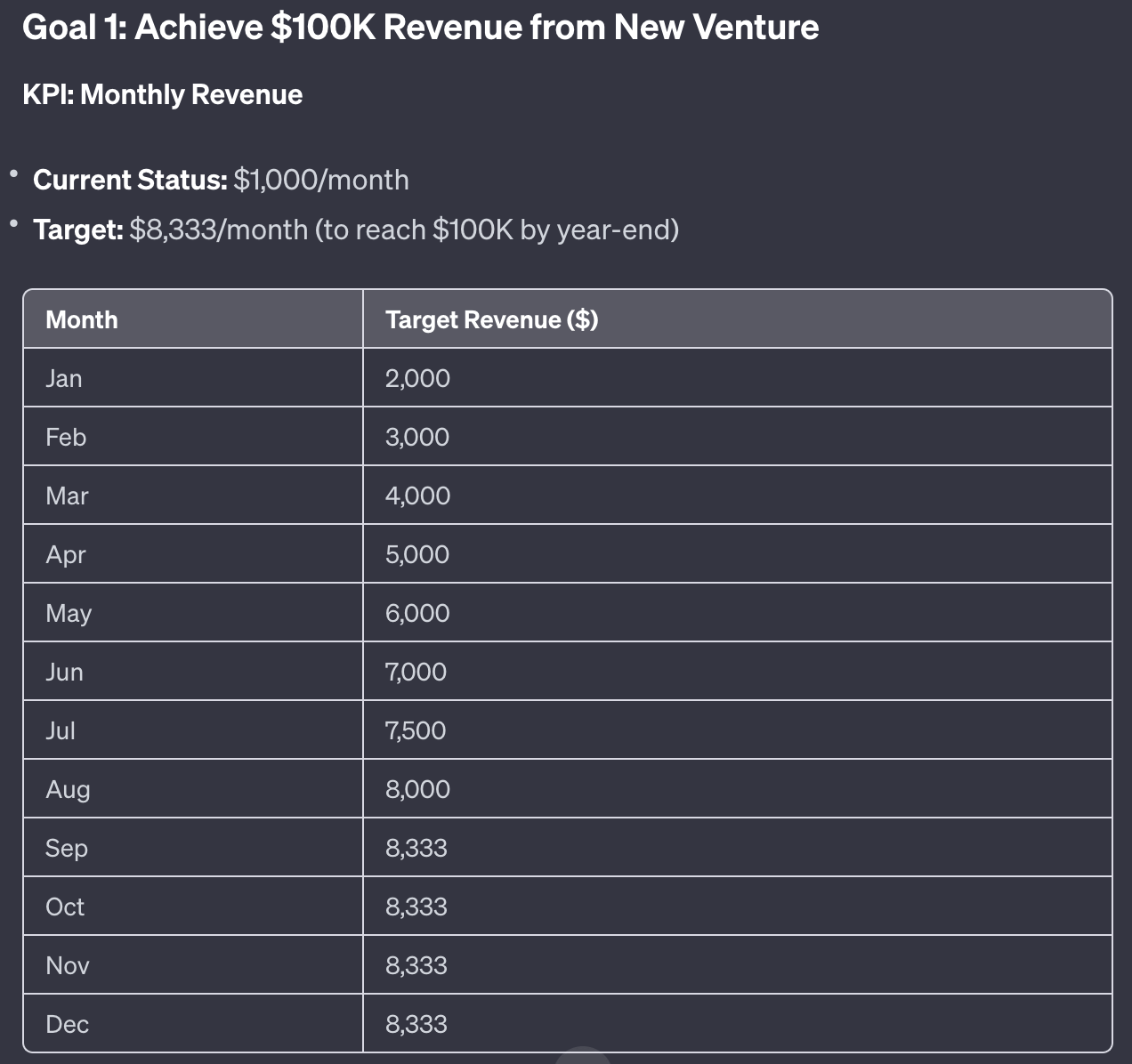
Adjust as required and then get these badboys up on your wall! Print our your KPIs or use a whiteboard so you can keep on target and accountable to yourself.
Tomorrow we’re going to put the pedal to the metal and start the daily work.
We’ll change our goals and tasks into actual “here’s what you need to do on a daily basis” tasks.
Part 1: How to be more productive
Part 2: Productive goal setting
Part 3: Breaking down the year
Part 4: Crushing the daily grind
Part 5: 1% better
Until then, keep PROMPTING!
Kyle
Now we’re into the nitty gritty of personal productivity - your daily tasks.
Remember our basic flow?:
Value → Goals → Projects → Tasks
Now we’re at the end. We’ve cascaded our values into goals into big projects and now we’re tackling tasks.
Prefer to watch:
Let’s get started:
We’re going to use the work that we did in the last Part (our quarterly and weekly plans) and use these each week to plan our our week day by day, hour by hour.
Act as a scheduling assistant.

I wake at [time]
I eat at [all meals + times]
I sleep at [z]

My priorities this week are:  [copy/paste week pan]

For each priority ask me how much time I want to dedicate to the task then break down the tasks into slots over the week.

I also have these locked in commitments: [picking up kids from school, lunchtime gym classes etc.]

This week I have these additional todos: [xmas shopping, getting a handyman to come fix the boiler etc.]

Prepare a weekly dayparting plan for me. Tabular format.

Place work + locked in commitments + todos into the schedule. Break tasks up.
Provide all the required details. Here’s an example filled in:
Act as a scheduling assistant.

I wake at 8
I eat at 830,12,5
I sleep at 11

My priorities this week are:
Finalize product/service concept
Identify passive income sources
Research remote work locations
Schedule first brainstorming session

For each priority ask me how much time I want to dedicate to the task then break down the tasks into slots over the week.

I also have these locked in commitments: gym at 10, write newsletter

This week I have these additional todos: xmas shopping, call handyman, entrepreneurs dinner at 8 thursday
Ask me the time required for these commitments and todos

Prepare a weekly dayparting plan for me. Tabular format.

Place work + locked in commitments + todos into the schedule. Break tasks up.
ChatGPT will take all this information and quiz you for extra details like so:
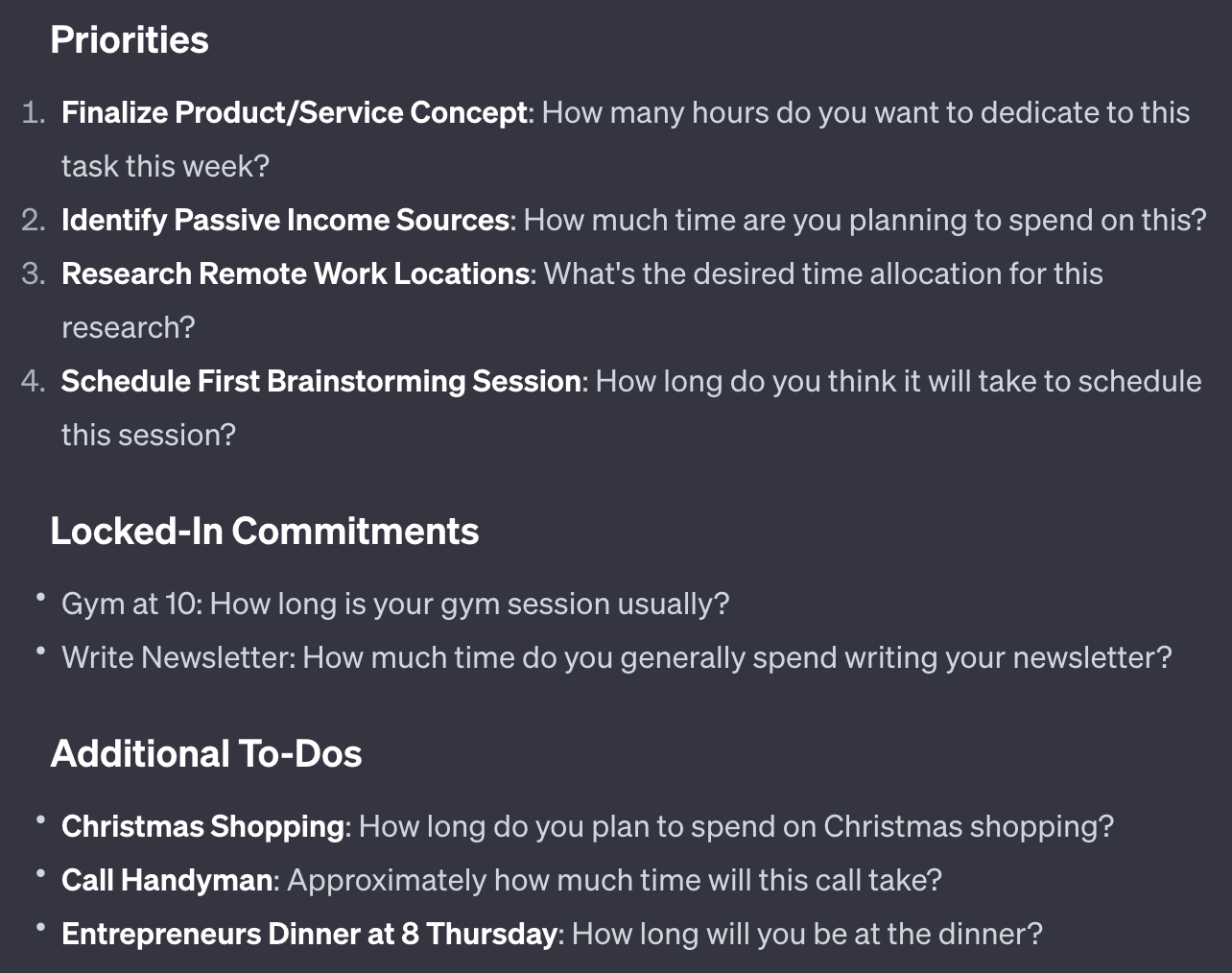
I went ahead and answered like this. No need to write out in full:
priorities
4 hours
2 hours
3 hours
1 hour

gym = 1 hour
newsletter = 2 hours

xmas shopping = 4 hours
handyman = 30 mins
entrepreneurs dinner = all evening
ChatGPT will take that additional input at put together your weekly plan:
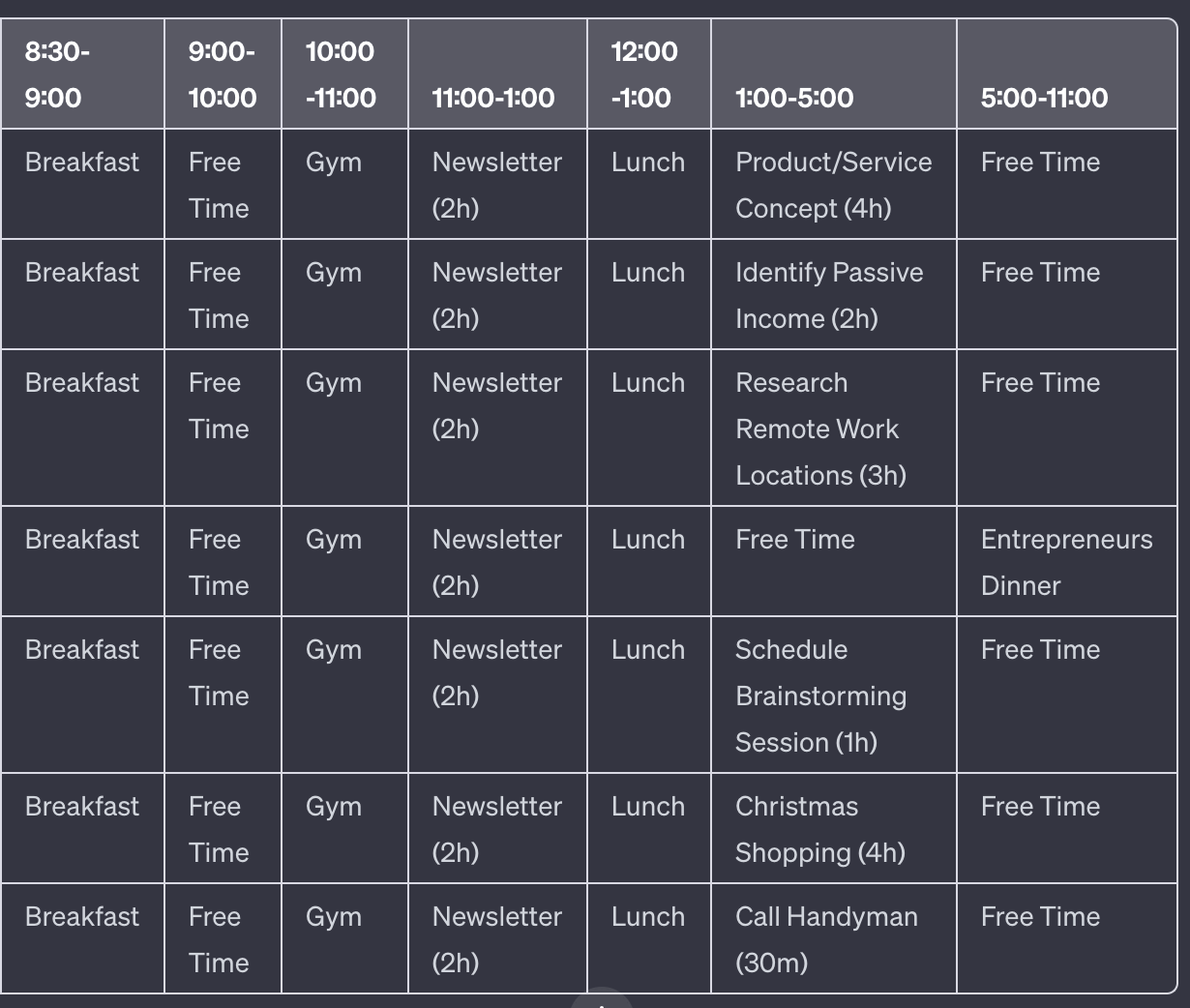
This current plan has quite a lot of free time. But when you dump in your to do list (or at least the part you can realistically manage!) then ChatGPT will sort everything out and give it a place.
Use this day parting schedule to form up your productive week, focusing primarily on projects that drive you goals. All aligned with your values. Pretty cool huh?

Once you’ve got your week planned using ChatGPT let’s take it a step further with this premium coaching prompt:
Analyse this weekly schedule and suggest ways to make my day more productive in terms of work, health, leisure. For the example schedule above ChatGPT made 7 suggestions about how to make my life more productive and healthy. Here are the first two:
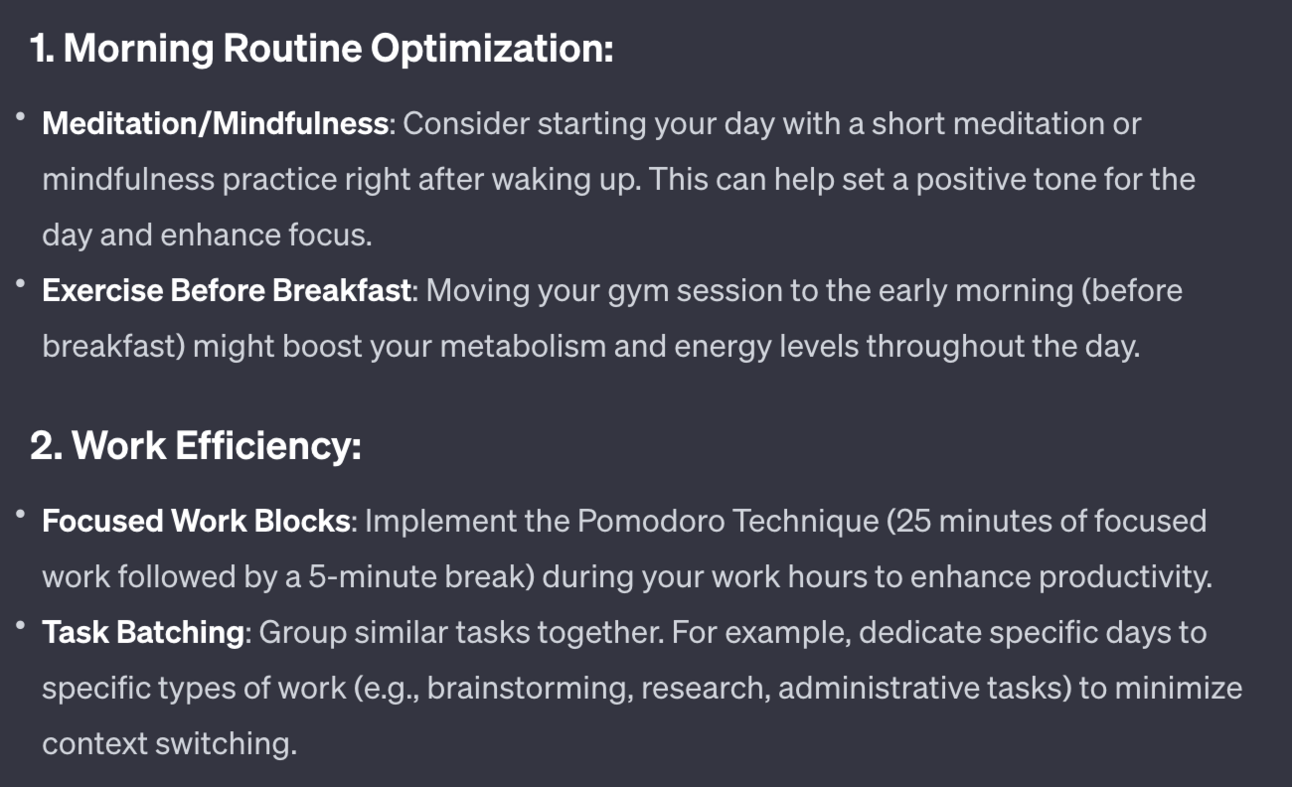
I can then go a little further and tell ChatGPT which ones to implement. For instance I apply the meditation and exercise before breakfast suggestions to get the following:
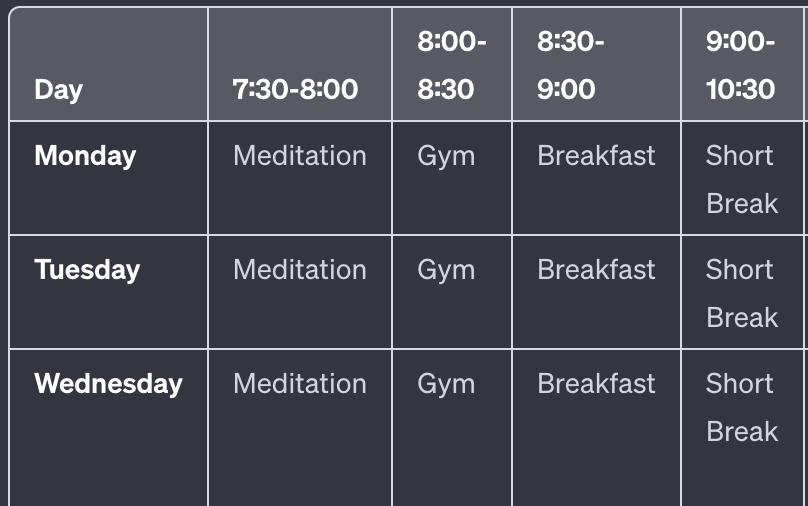
Use the added suggestions to optimise your perfect week. But don’t try adding them ALL at the same time! Drip them in over the weeks as you become more productive.
We’ve now covered the meat our productivity system - tomorrow we’ll be covering how we optimise our productivity week over week and keep things flexible.
Part 1: How to be more productive
Part 2: Productive goal setting
Part 3: Breaking down the year
Part 4: Crushing the daily grind
Part 5: 1% better
Until then, keep PROMPTING!
Kyle
If you’ve been following along this week you’ll now have a weekly plan.
Each week you can generate a new weekly plan using the exact same prompts - just updated to include your pressing to-dos.
As we progress through the year though we’ll want to make sure that are schedule actually matches reality.
Expectation ≠ Reality.

There’s no sense having a beautiful “perfect” schedule if we keep going off-piste. We’ll end up just dumping the schedule!
Let’s make sure that our schedule is aligned with reality. And use this to optimise.
Prefer to watch?
Let’s get started:
First up we need to keep track of how we actually spend our time.
You can do this “properly” using an app like RescueTime.
Or you can just jot down notes each day of what you are doing hour to hour.
How detailed you go really depends on how detailed a person you are! Both will work.
Collect at least a week’s worth of data and then use this prompt:
Compare my planned schedule structure to my actual time usage.

Use the actual time usage to adjust the planned schedule structure to make it more realistic.

Output the new structure in a table similar to the planned schedule structure.

Planned schedule:
[copy/paste planned schedule]

Actual time usage:
[copy/paste actual time usage]
Use this prompt along with your previously generated “perfect” schedule and your record actual time usage.
For actual time usage I inserted:
Actual Time Usage:
Wake up at 7:30 AM instead of 8:00 AM.
Breakfast at 9:30 AM instead of 8:30 AM.
Gym starts at 12:00 noon.
Newsletter writing split into two blocks: 10:00-11:00 AM and 1:00-3:00 PM.
Difficulty finishing the main work block by 5:00 PM, more realistically ends at 6:00 PM.
You can add in short hand notes no problem and ChatGPT will work out the details.
ChatGPT will merge your perfect schedule and the actualities of your life to create a refreshed new schedule. Here’s a snippet (ChatGPT can’t display the full width without scrolling):
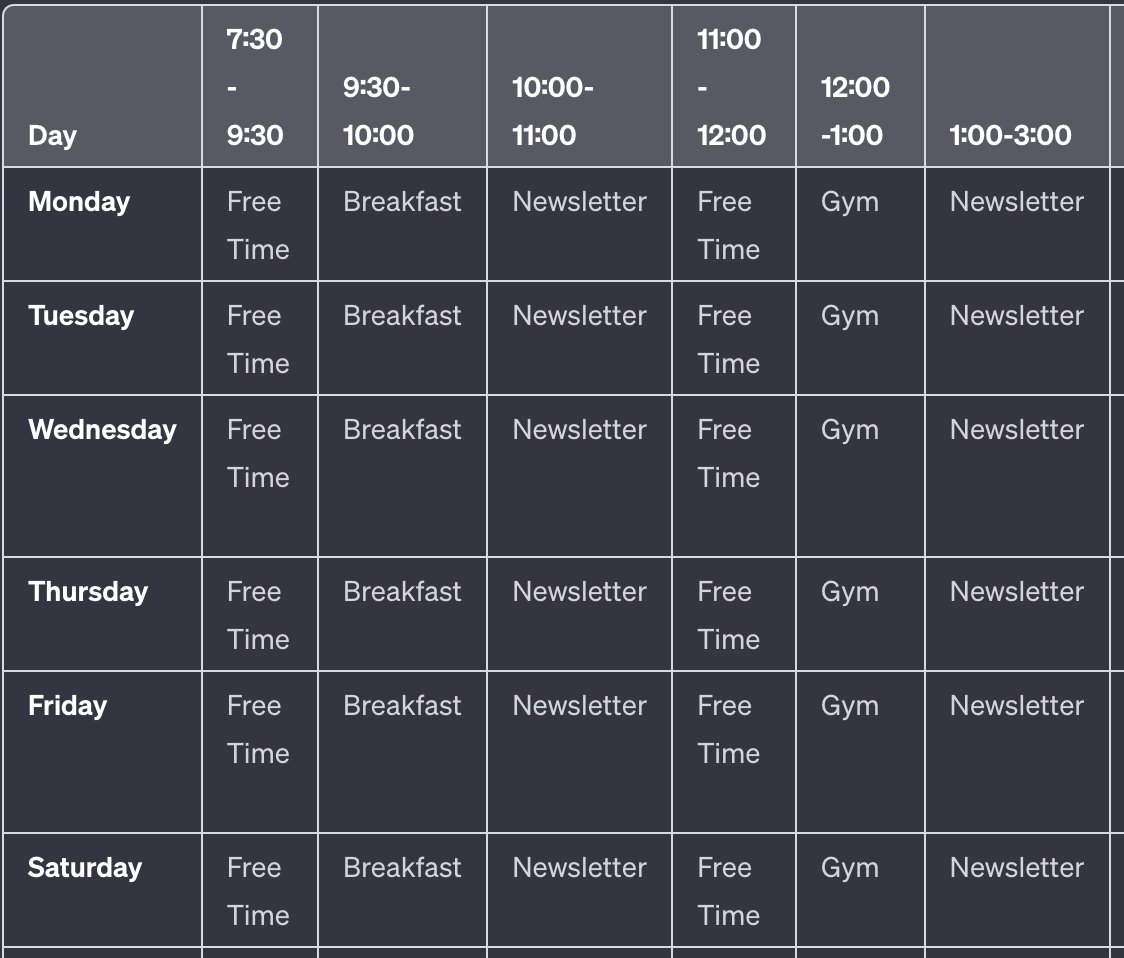
Now, when we move into the next week we use this slightly adjusted version of yesterday’s prompt:
Act as a scheduling assistant.

Here is my basic weekly Updated Schedule Based on Actual Time Usage. Adapt it with the following details.

My priorities this week are:  [copy/paste week plan]

For each priority ask me how much time I want to dedicate to the task then break down the tasks into slots over the week.

I also have these locked in commitments: [picking up kids from school, lunchtime gym classes etc.]

This week I have these additional todos: [xmas shopping, getting a handyman to come fix the boiler etc.]

Prepare a weekly day parting plan for me. Tabular format.

Place work + locked in commitments + todos into the schedule. Break tasks up if required.
This will rerun the process from the last Part, helping you to structure your week by asking for priorities, commitments and to-dos.
But it will build on the “realistic” schedule we just created. Here’s the output I got after running it again with my emendations:

We can run this optimisation process every week or just every once in a while when we feel that that our schedule is becoming unrealistic.
By doing so we can continuously improve our productivity bit by bit, getting a little better each week.

This is built on a practice I personally do every week.
I find it easy to forget what worked and what didn’t each week. It’s often easy to be so busy that you forget to reflect. And too often this leads to autopilot.
Here’s a nice prompt to run each week to kick you out of that mode:
Act as a personal productivity coach

Ask me the following:
1. 3 wins of the week
2. 3 things I can do better next week

Use this to suggest ways to improve my schedule next week
This prompt will first of all offer some general suggestions:
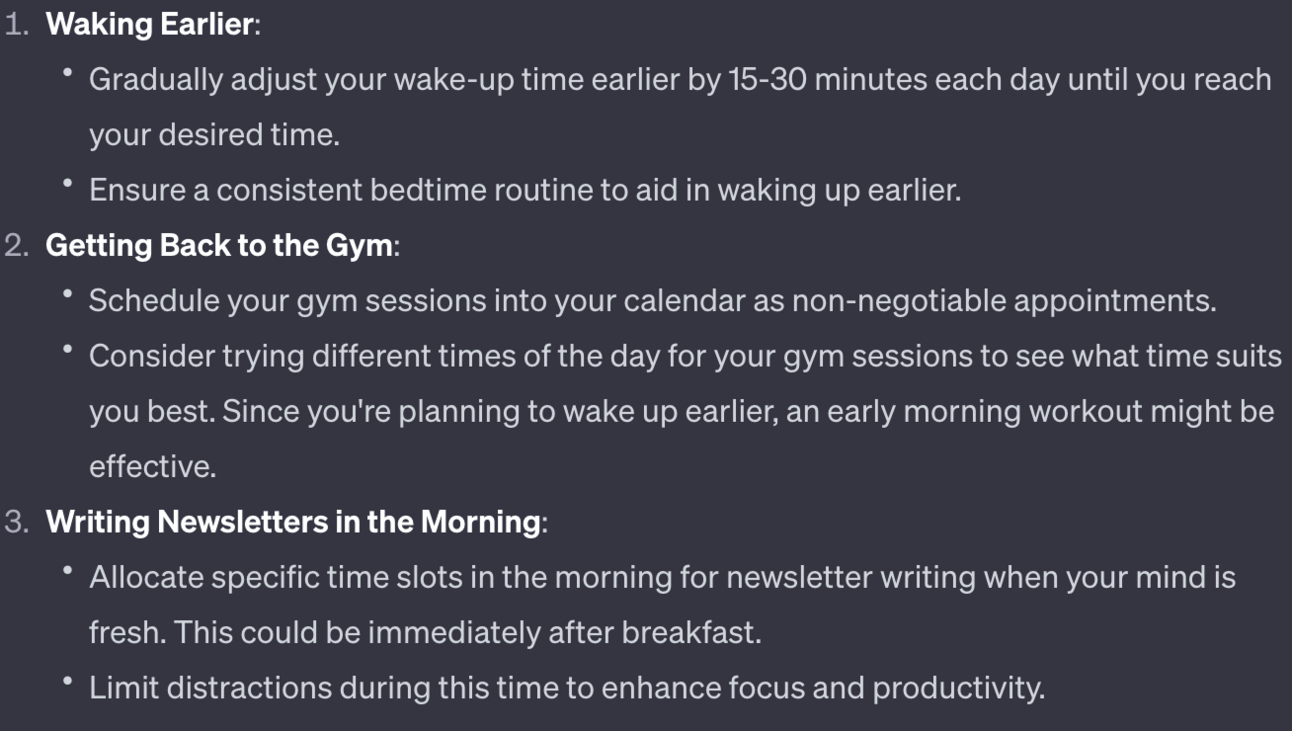
and will then feed these directly into your schedule:
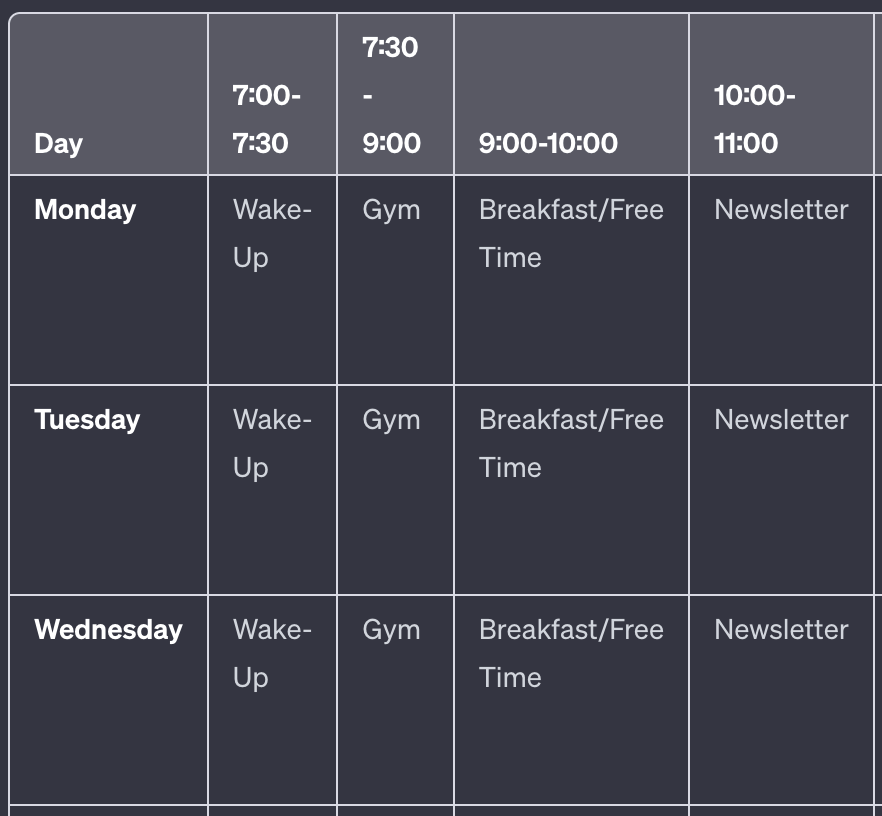
That’s the end of the week! You now have a set of prompts for getting your 2024 goals aligned with your values and making sure you smash next year out of the park.
If one of your goals in 2024 is finally starting a business keep tuned as I’ll have some announcements around New Years for you.
Part 1: How to be more productive
Part 2: Productive goal setting
Part 3: Breaking down the year
Part 4: Crushing the daily grind
Part 5: 1% better
Until then, keep PROMPTING!
Kyle
Unlock your full potential with our comprehensive playbook, 📊 Personal Productivity with AI. This guide isn’t just about doing more; it’s about being more effective in both your professional and personal life. By leveraging the power of AI, you'll learn to align your actions with your core values, set meaningful goals, and streamline your daily tasks for maximum efficiency. Whether you're a busy entrepreneur, a corporate professional, or anyone looking to enhance their productivity, this playbook is designed to help you achieve transformative results in a structured and sustainable way.
This playbook is designed for professionals and entrepreneurs who are struggling to balance their workload with personal aspirations. If you find yourself overwhelmed with tasks and unsure of how to prioritize your goals, this guide will provide you with the tools and strategies to reclaim your time and focus on what truly matters. Whether you’re looking to enhance your business efficiency or simply improve your daily routine, this playbook will equip you with actionable insights to boost your overall productivity.
No prior experience with AI is necessary. This playbook is designed to be accessible to everyone, providing simple prompts and practical applications.
While the time commitment varies, you can expect to spend a few hours each week to see substantial improvements. The playbook provides a structured approach to make the most of your time.
Absolutely! The strategies outlined in the playbook are designed to enhance productivity in all areas of life, helping you align your personal values with professional goals.
The playbook includes techniques to optimize your time and create a realistic schedule that fits into your busy life.
Yes! The methods discussed are especially beneficial for remote workers looking to improve their productivity and maintain a healthy work-life balance.