
AI playbook
Unlock the potential of your business with the '🔺 Maslow's Hierarchy | AI Business Playbook'.
Start ReadingI’m off on holiday in Montenegro for a couple of weeks.
I use holidays as a way to get some space and reset. To look at what’s working and what needs more focus.
This is especially important in entrepreneurship because it’s very easy to hyper-fixate on only the business and let other areas of your life - health, relationships, personal growth - stagnate.
This week we’re looking at how we can rebalance.
Specifically we’ll be using Maslow’s hierarchy of needs.
We’ll cover:
Part 1: Health foundations
Part 2: No more money worries
Part 3: Important Relationships
Part 4: Earned Confidence
Part 5: What do you want to be?
Let’s get started:
Health Foundations
what is Maslow’s hierarchy?
AI speeds everything up
without health nothing else matters
building a health plan
Before we kick off on a whole week of using Maslow’ hierarchy let’s quickly summarise what it is!
Maslow's Hierarchy of Needs is a psychological theory proposed by Abraham Maslow in 1943. It suggests that human needs can be organised into a hierarchy, often depicted as a pyramid. From bottom to top, these needs are:
Physiological: Basic survival needs like food, water, sleep
Safety: Security, stability, freedom from fear
Love/Belonging: Relationships, friendship, intimacy
Esteem: Self-respect, recognition, status
Self-actualisation: Realising one's full potential
The theory posits that we must satisfy lower-level needs before progressing to higher ones. It's a simple yet powerful framework for understanding human motivation and well-being. It doesn’t have much empirical backing but it’s a nice mental model!
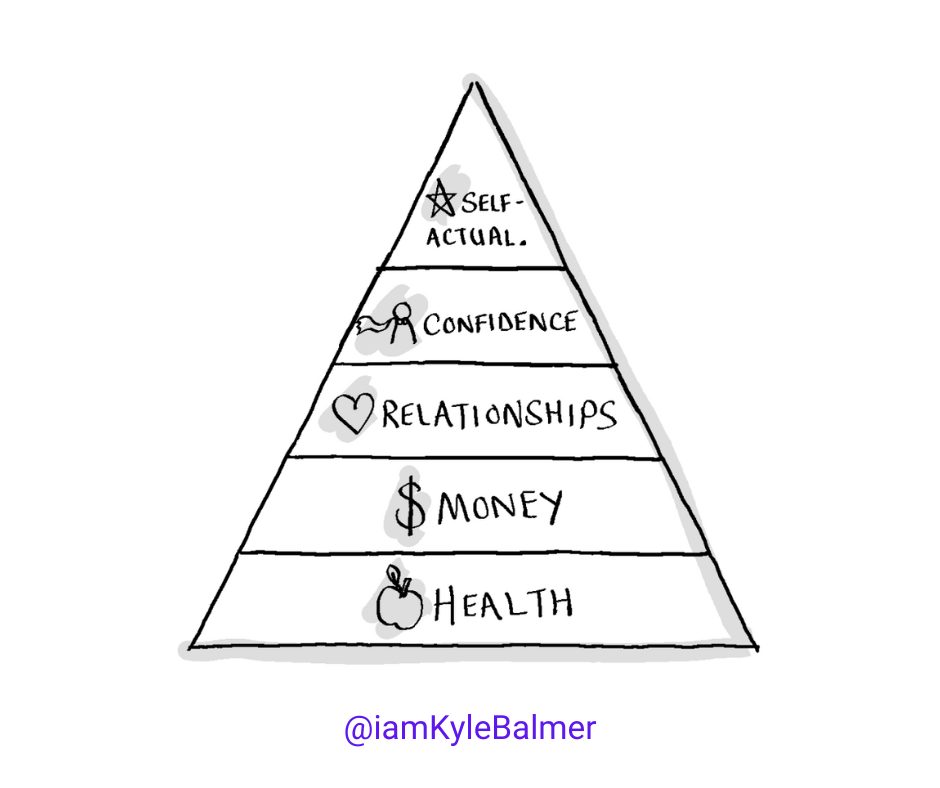
For the sake of this week we’re going to simplify the pyramid to:
Health
Money
Relationships
Confidence
Self-actualisation
Each day we’ll tackle one of these topics. Starting today with Health.
Right now change is accelerating at an unprecedented pace. Faster than I can ever remember. All because of AI.
As always change brings both opportunities and challenges. Challenges include:
Information overload: We're bombarded with data, making it hard to focus on what truly matters.
Constant connectivity: The line between work and personal life is blurring.
Automation anxiety: Fears about job security in the face of AI advancements.
These factors can lead to stress, burnout, and a sense of disconnection from our core needs. Thanks AI!
We’re going to focus on Maslow's Hierarchy to provide a crucial anchor in these turbulent times. By focusing on the fundamentals, we’ll build a stronger foundation to deal with whatever comes at us.
On the more positive side - as AI takes over more routine tasks, uniquely human qualities become more valuable! This has always been my “bet” when it comes to AI. Automate the mundane. Lean into the human.
Automate the mundane. Lean into the human.
Self-actualisation - which sits right at the top of Maslow's Hierarchy - involves creativity, problem-solving, and emotional intelligence. These are areas where humans still beat AI. So there is hope!
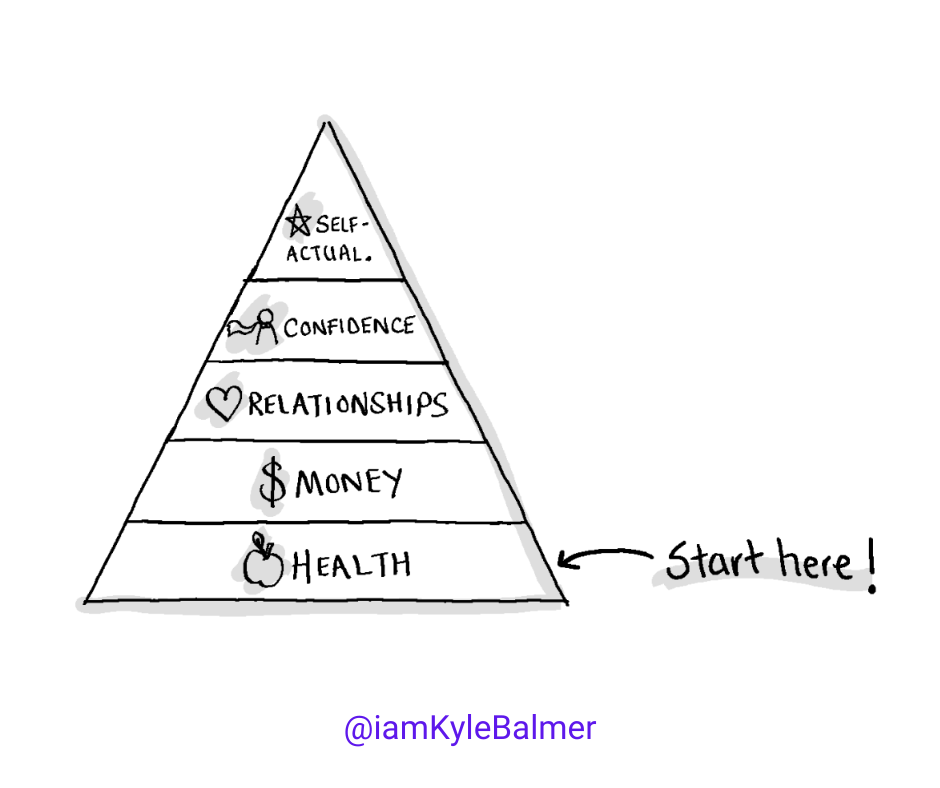
Health forms the base of Maslow's Hierarchy, and for good reason. Without our health, everything else crumbles.
I learned this lesson the hard way. A couple years back, I caught Covid, which then developed into pneumonia. I went from running two marathons that year to being winded by a set of stairs. It was…horrendous!
I'd been so focused on growing my business that I'd neglected my health. I didn’t carve out space for rest but instead kept pushing and pushing. Letting my immune system crash out basically.
The result? Months of illness, lost productivity, and a stark reminder of what really matters.
This experience taught me that health isn't just about avoiding illness. It's the foundation that allows us to do everything else. Lose it and everything else basically becomes impossible.
In our world of AI and entrepreneurship where we're constantly pushed to be more productive, it's easy to sacrifice sleep, exercise, or healthy eating in the name of #hustle. But this is a false economy.
Here's a prompt to help you create a personalised health plan using ChatGPT:
You are a highly knowledgeable health and wellness expert.
First, interview me about my current health status, goals, and available time. Ask me questions one at a time and wait for my response before proceeding.

Based on this information, create a comprehensive health, fitness, and nutrition plan.

Start with overall health recommendations, then provide an exercise/fitness routine, and finally a nutrition plan to support these goals.

Confirm the plan with me and then use follow up questions to make general recommendations more specific.

Then prepare an annual and monthly overview and weekly schedule.
ChatGPT will first interview you on your current health, fitness and nutrition. From there it’ll prepare a full plan with annual, monthly and weekly breakdowns.
As always the more information you put in the more detail you’ll get out. So take your time answering the questions.
Once you are happy you can use a follow up prompt like:
Prepare tabular scheduleTo get an easy to use schedule:
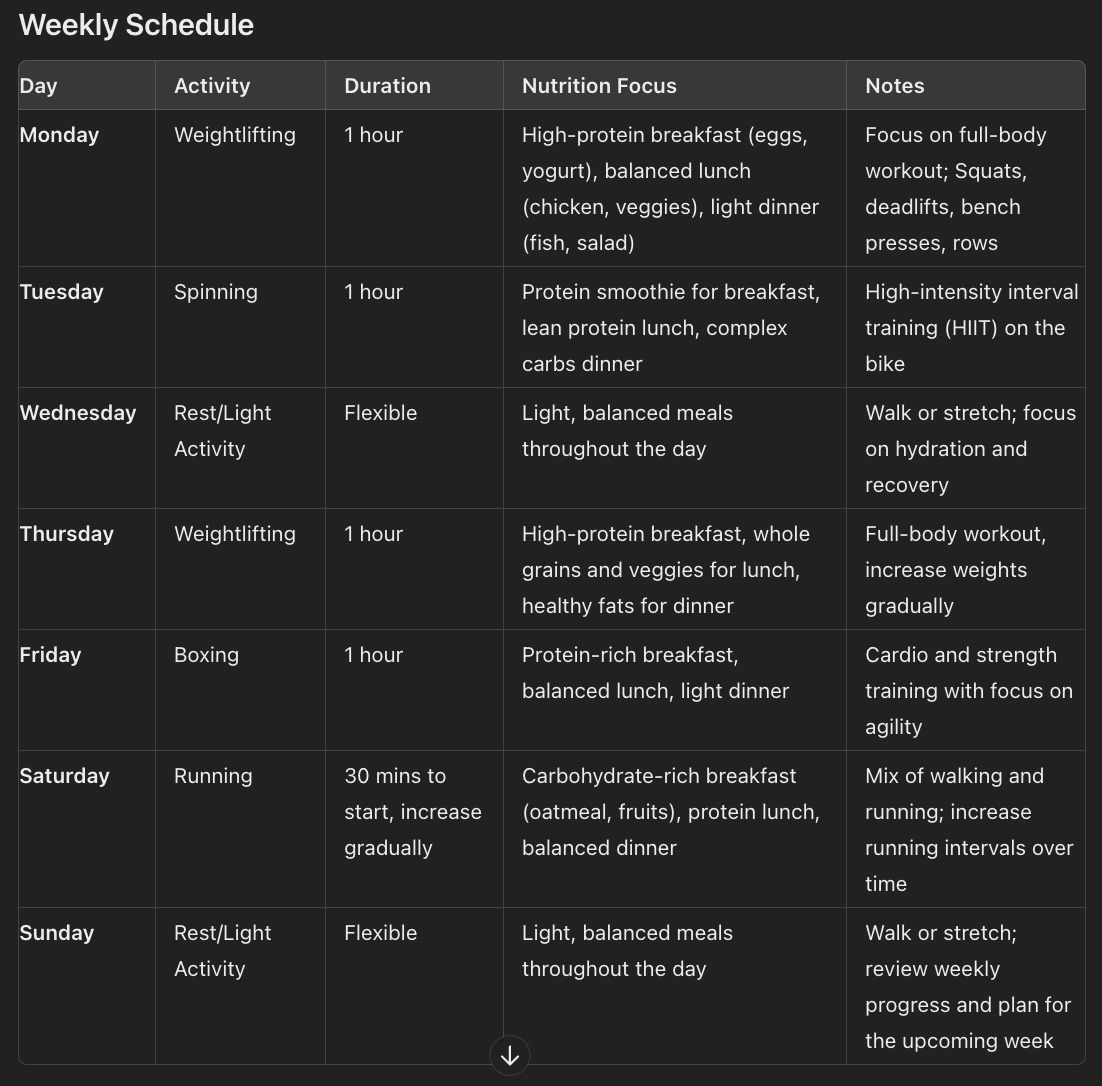
If you are goal orientated you can also feed this in during the interview. Just make sure to mention targets - for instance if you want to run a marathon or lift a certain weight. ChatGPT will add in progression over the monthly/annual schedule.
Over the rest of this week we’ll be moving up Maslow’s hierarchy. Honestly though the work we covered today is going to be the most impactful. Without your health in place the rest is moot.
If you are young you probably think this stuff is unimportant. For real though if you nail these basics early in your life you’ll be thanking your younger self later!
This week we’ll move onto to:
locking down your income and removing money worries
carving out time for your important relationships
building confidence in what you do
knowing what you’re here for and getting it done
Premium subs, see you in the next Part.
Keep prompting,
Kyle
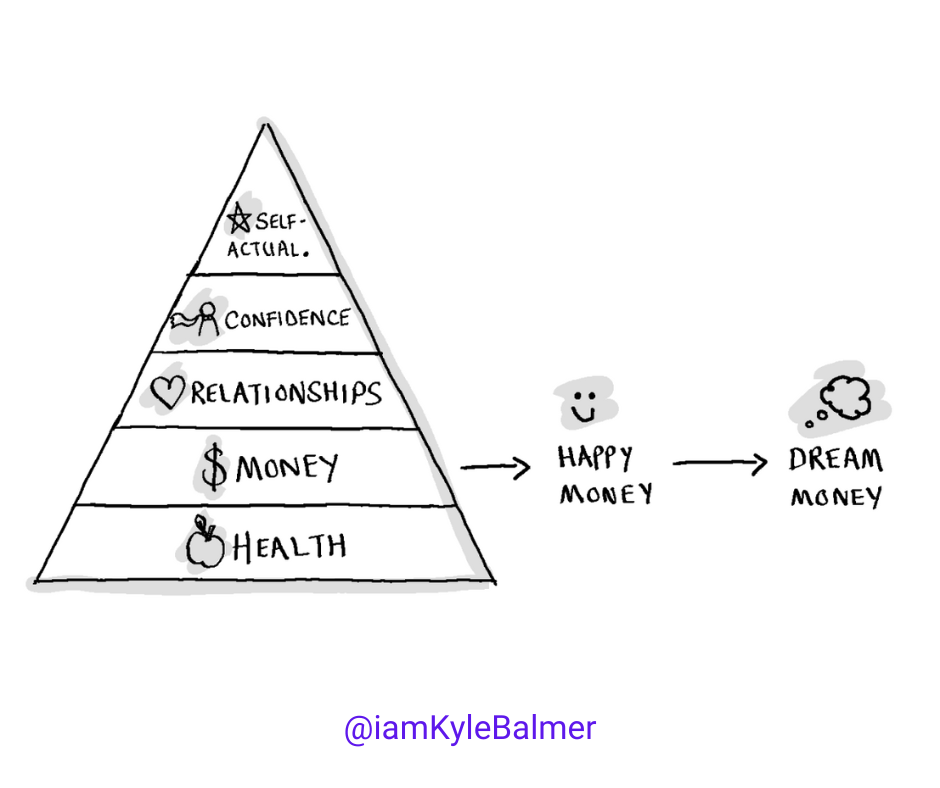
In this Part we’ll move to the next level of Maslow’s hierarchy of needs - security. Specifically: income.
Let’s get started:
Health Foundations
lack of money is a stressor
baseline income
dream income
income vehicles
This one is pretty raw for me.
I’ve been building Prompt Entrepreneur for the last year. And for the majority of that time my income has been severely low - basically living on credit cards until the business “hit”.
Thankfully this paid off and we’re now secure.
After the 6-figure launch we had a few weeks ago I cleared out my debt.
I shot a video about it the same day:
@iamkylebalmer I just paid off my debts after a 6 figure launch. BUT the last year has basically been living on credit cards whilst i build up this new b... See more
Living with money challenges is a stressor. It’s always there, in the background. And increasingly it’s affecting more and more people globally.
In Maslow’s hierarchy right above physiological needs (health, shelter - basically staying alive) are safety needs.
Safety needs include employment, property, money, job stability etc. I’m going to simplify this to “income” for ease.
Before we can dream big (we’ll get to this don’t worry!), we need to understand our baseline. What does it actually cost to keep ourselves afloat? This requires a thorough audit of our finances.
Boring yes. And maybe painful. But AI can make it much quicker and easier.
Many of us shy away from this step because it can be uncomfortable. This is one of my personal weaknesses too - I totally understand.
Here’s a first prompt to get a baseline figure:
You are a skilled financial advisor.

Conduct a comprehensive audit of my financial needs for basic survival.

Ask me detailed questions about my spending, budget, income, and country of residence (for tax calculations).

Cover all essential areas including housing, food, utilities, transportation, healthcare, debt repayments, and basic personal needs.

Ask one question at a time and wait for my response before proceeding.

After gathering this information, provide a summary of my monthly and annual financial requirements for comfortable survival. Account for tax using country of residence.
This’ll run through a set of questions and help you work out your minimum for base comfort. Keep hold of this - we’ll use it shortly.
Once we know our survival baseline let’s move onto what’ll take us from surviving to thriving.
Lots of people when asked how much they need just make up a number.
They’ll either pluck a number from their head like “$1 million”. Or they’ll repeat some internet guru figure like $10,000/month.
Instead let’s actually work it out properly. Here are two methods.
i) The "Double the Average" Approach: Studies have shown that happiness tends to increase with income up to a certain point, after which additional income has diminishing returns. This point is often around double the average income of your city or region.
Obviously this depends on where you live! Thankfully this is an easy request:
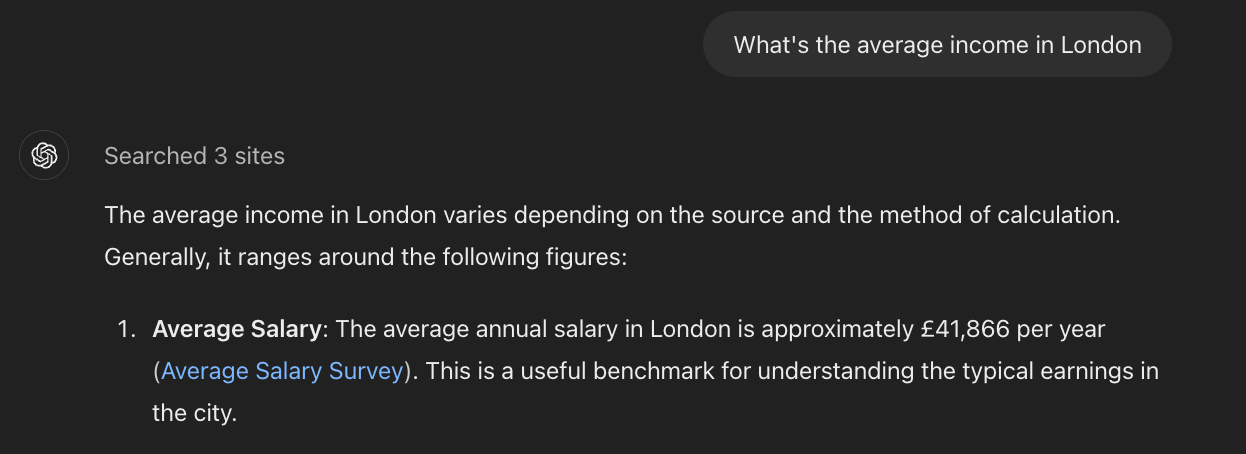
So if the average in my city (London) is £41,866 then ~£84,000 (~$110,000) is an optimal “happiness” income.
Grab the average figure for your location and double it to find your local optimum.
This approach provides a useful benchmark, but it's important to remember that everyone’s needs and desires are different. For that we can employ the next method.
ii) The Dreamline Approach: This involves envisioning your ideal lifestyle and then calculating the income required to support it. It's more personalised but requires more detailed thinking about what truly matters to you.
We’ll use a prompt:
You are a financial planning expert specialising in lifestyle design.

Help me calculate the income I need to support my dream lifestyle.

First, ask me detailed questions about my ideal life, including my location, housing, family/children, travel, hobbies, personal development, and any other important aspects.

Then, based on my responses, estimate the annual income required to support this lifestyle.

Consider factors like taxes, savings, and potential lifestyle inflation. Ask one question at a time and wait for my response before proceeding
This will run a detailed audit of what your dream lifestyle will actually require.
When I get people to run this they are usually surprised by how little is needed.
Unless you have a hankering for private jets and Bugattis a lot of dreams are more affordable than we might assume. We just tend not to actually sit down and work out the cost. Hell, if you really want a Bugatti you can lease one via a business for less than you’d expect. The main thing is that you capture this cost in your dream income so we at least know what we need.
Once you have your target incomes, it's time to explore ways to get there.
Depending on what the figure is there will be different method to get there.
Career advancement, saving and investment may be enough, depending on your industry and the average salaries. This is (probably!) the safest lowest risk route.
If you need to get to a higher figure you’ll likely need to look at entrepreneurship. This could be supplementing your 9-5 with freelancing or contractor work. Or it could be starting up a business yourself.
Thankfully it’s now easier than ever to start a business thanks to AI. It’s dramatically reduced start up costs thanks to having expertise at your finger tips that would have previously cost you a lot of money!
Let’s use a final prompt to start thinking about the best ways to get to our goals:
You are a financial advisor helping me look at income generation options

I need [baseline] income to survive
And my goal income is [dreamline figure]

My current income is [income] which I make via [explain where income comes from]

I have skills in [list as many skills as possible]

Based on this provide me with ideas to
I) hit baseline income
II) hit dream income
Remember, the best approach often combines multiple methods and aligns with your skills, interests, and values.
This prompt will get you started with thinking about how to reach that dream income. Obviously the real route will be more complex but having ideas for the first step remains valuable.
In the next Part we’ll add in yet another layer - relationships.
Keep prompting,
Kyle
Moving onto the next level of Maslow’s hierarchy : relationships.
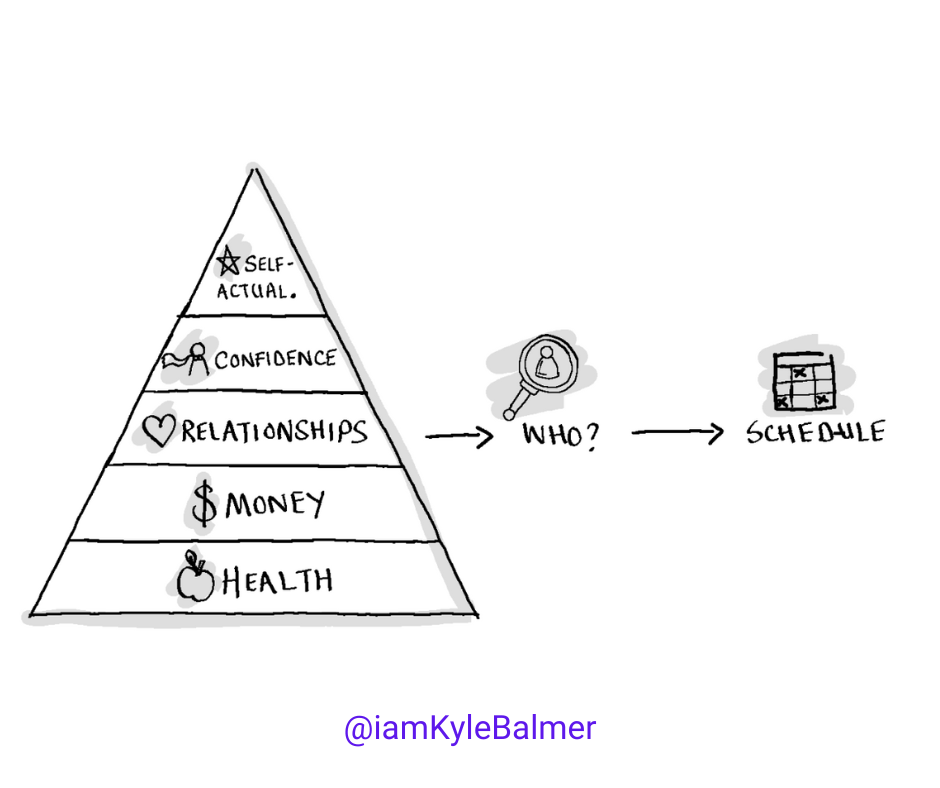
Let’s get started:
Important Relationships
don’t forget why we do what we do
intentionality is key
work out your most important relationships
plan in time to see people
As we climb Maslow's hierarchy, we reach a level that's often overlooked in the world of entrepreneurship: relationships.
Unless you are Scrooge McDuck we look after ourselves and strive for financial security not just for our own sake, but to protect and care for those we love.
This could be family, friends, or even our wider community. Basically anyone we decide to spend our (limited) time with.
I was recently at an entrepreneurship dinner where this topic came up. One attendee shared how he was so focused on making money to secure his family's future that he wasn't actually spending time with them. He was missing the forest for the trees, so to speak. It's a common trap many of us fall into - working so hard for our loved ones that we forget to actually be with them.
This is where intentionality comes in. We need to be deliberate about carving out time for our relationships. Whether it's for our parents, siblings, children, friends, or partners, we need to consciously make space in our busy lives for connection.
Before going any further I recommend checking this video:
This applies not just to parents but to anyone you care for and want to spend more time with.
The concept of intentionality in relationships is powerful. It's about actively choosing to prioritise the people who matter most to us, rather than letting work and other obligations constantly take precedence.
But how do we do this in practice? It starts with identifying who's most important to us and then deliberately scheduling time for them. Let's use AI to help us with this process.
You are a compassionate relationship coach. Help me identify and prioritise the key relationships in my life. Ask me questions about my family, friends, and community connections. Guide me to reflect on who I want to spend more time with and why. After our discussion, provide a summarised list of my most important relationships, categorised by type (e.g., family, close friends, mentors). Ask one question at a time and wait for my response before proceedingThis is another coaching prompt. We’re using them a lot this week! Because this week is about reflection and (thankfully) AI has infinite patience to listen to us!
This prompt will help create a list of those most important to us.
It may also reveal some relationships that are less important to you than you thought. These may be relationships that you want to minimise rather than maximise in the future. This too is a valuable insight.
Now that we've identified our key relationships, let's use AI to help us schedule quality time:
You are a skilled time management and relationship coach. Based on the list of key relationships I provide, help me create a plan to carve out quality time for each person or group. Ask me about my current schedule, work commitments, and any challenges I face in making time for relationships. Then, suggest specific strategies for scheduling regular, meaningful interactions with each person or group on my list. Include ideas for activities or ways to make our time together more intentional and meaningful. Remind me to actually book these times in my calendar. Ask one question at a time and wait for my response before proceeding.Use this directly below the results of the first prompt to “feed in” your list.
This will again run your through a process of questions. The end result will be a very specific action plan of exactly how to protect and build the relationships identified as important.
Remember though that the goal here isn't to turn our relationships into another task on our to-do list. Relationships are not a tick-box task. This all seems quite clinical! I get that.
All that we’re doing here is giving ourselves a broad plan and some nudges. We want this to lead to realisations like: “oh I really want to spend more time with old friend from university. I’ll reach out and organise a get-away for a long weekend”
Go and enjoy that long weekend. Work will wait.
Keep prompting,
Kyle
Climbing up Maslow's hierarchy, we've reached the Esteem level. Today, we're zeroing in on a crucial aspect of this: confidence.
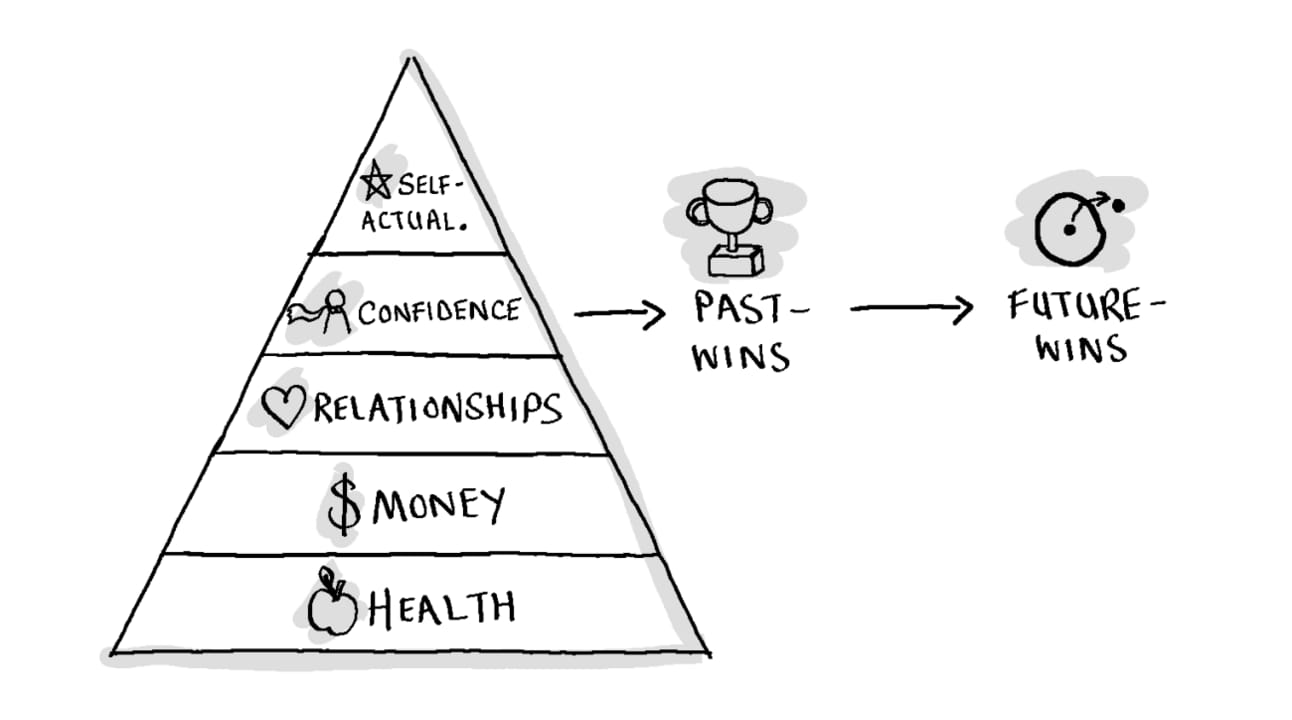
Let’s get started:
Earned Confidence
what is confidence?
base foundation of confidence
how to build confidence
repeat the cycle
Confidence is the cornerstone of esteem, this level of Maslow’s hierarchy. Confidence serves as the bridge between our abilities and our sense of self-worth.
This isn’t about bravado or arrogance, but rather a quiet assurance in our capabilities. We’re not talking Dunning-Kruger levels of (stupid) over-confidence.
Instead, valid confidence is born from a cycle of planning, execution, and reflection.
Crudely:
We set out to do a thing.
We do the thing.
And then know we’ve done the thing well.
Lack of confidence stems from either not doing the thing (procrastination) or doing the thing well and not giving ourself credit (imposter syndrome).
Overconfidence comes from doing the thing poorly and thinking we’re an absolute champ.
Confidence, in its purest form, is the ability to say "I can handle this" in the face of new challenges, not because we're certain of success, but because we trust in our capacity to learn, adapt, and persevere. We’ve done stuff out of our wheelhouse before and, most of the time, it went pretty well.
For entrepreneurs, especially those just starting out, confidence can be elusive. We often downplay our achievements or doubt our abilities. But here's the thing: confidence is a skill, and like any skill, it can be developed.
First up let's use AI to help recognise past achievements and build a baseline of confidence:
You are a supportive and insightful professional coach.

Help me recognise and appreciate my achievements and skills. Ask me questions about my professional and personal accomplishments, overcome challenges, and acquired skills.

After our discussion, provide a concise summary of my key achievements and capabilities. Frame these as powerful, factual statements that I can use to boost confidence. Ask one question at a time and wait for my response before proceeding.
I’d recommend keeping a copy of the end result saved somewhere. Or, really powerfully, you could print them out.
Having an external reminder of your capabilities can be very useful. Especially when you are feeling a severe lack of confidence. If mantras and the like help you then you can also use the output of the prompt in this way.
Let’s now build on this base foundation.
Confidence isn't static. It grows when we push ourselves out of our comfort zone, realise we’re okay, and then establish a new norm. It's an incremental process.
The first time we do anything it’s scary. Our brains are programmed in that way. We don’t want to risk our ego. We don’t want to make mistakes. We don’t want to look stupid. So doing something new is always hard.
But at the same time our brains are really good at acclimatising. Do something enough times and you’ll get used to it fast. And that expands your boundaries and confidence.
This brings us to our next prompt:
You are a strategic goal-setting coach with expertise in personal development.

Help me define three significant achievements to focus on this year that will push me out of my comfort zone and build my confidence. They can be personal or professional goals.

Ask about my current skills, areas I want to improve, and my long-term aspirations.

Then, for each achievement, break it down into small, manageable steps. The goal is to make each step feel as effortless as possible while still pushing my boundaries.

After our discussion, provide a summary of my three main goals and the step-by-step plan to achieve each. Ask one question at a time and wait for my response before proceeding.
Run this prompt exercise to come up with 3 big scary goals to focus on. They can be personal or professional - building confidence in one area generally leads to confidence in others so don’t sweat the “best” goals here.
I’ve also set the prompt up so that it makes each challenge achievable. Instead of “run a marathon” this will generate a set of steps starting with “walk/run 1000 ft” or something equally achievable to get started. We incrementally push limits.
Remember, this is a all an ongoing process. There’s no sudden witch from “not confident” to “confident”. It’s all degrees.
Because of this it’s useful to run this exercise repeatedly. Set a reminder to run the first prompt (assessing your achievements) next year. You’ll by then have new achievements to add to your list. And an ever better sense of self-esteem and confidence.
Confidence isn't about never failing; it's about knowing you can handle whatever comes your way. Hell, if you’ve read my work you’ll know I think failure is great. Failure is the only way to learn anything! It happens - and it’s a good thing.
Confidence is instead about trusting in your ability to learn, adapt, and overcome. It’s the “I’ve got this” feeling when facing a new challenge.
And that attitude? That can be learned. You got this.
Keep prompting,
Kyle
Unlock the potential of your business with the '🔺 Maslow's Hierarchy | AI Business Playbook'. This playbook is crafted to guide entrepreneurs and business leaders through the essential layers of personal and professional growth using the timeless framework of Maslow's Hierarchy of Needs. Dive into actionable strategies that elevate your health, financial security, relationships, and self-confidence, all while leveraging the transformative power of AI. Experience a holistic approach that not only enhances your business acumen but enriches your life as a whole.
This playbook is designed for ambitious entrepreneurs and business leaders who often find themselves overwhelmed by the demands of their work. If you struggle with maintaining balance in your life, particularly in areas like health, finances, or relationships, this playbook is perfect for you. It addresses the common challenges of burnout, anxiety from rapid changes in technology, and the quest for personal fulfillment in an increasingly competitive landscape.
No, this playbook provides a comprehensive introduction to Maslow's Hierarchy of Needs and its application in business.
You can engage with the playbook at your own pace, but we recommend dedicating time each day to fully absorb and implement the strategies.
While aimed at entrepreneurs, the principles of this playbook can benefit anyone looking to improve their personal and professional growth.
Yes, it focuses on essential areas like health, financial management, and relationship building that are crucial for overcoming common business challenges.
Each section includes actionable prompts and exercises to help you integrate the concepts into your daily routine and decision-making.