
AI Building
Are you ready to transform your social media launch strategy into a powerhouse of engagement and revenue?
Start ReadingFancy a peek behind the curtain of a quarter-million-dollar launch?
Right now, I'm knee-deep in prep for a massive launch coming this January. The target is $250,000. Now, we've had a couple of decent runs this year, each bringing in around $100,000.
Buuuut let's be honest - they were about as organised as a lucky dip at the village fête. Scrappy doesn't even begin to cover it! Minimal systems and basically doing everything manually.
For this big January push, we've decided to get serious.
We've brought in the big guns - a launch expert by the name of Virgil Brewster. (And between you and me, I'm half expecting him to start quoting Dante's Inferno at any moment. "Abandon hope all ye who enter here" feels oddly appropriate when staring down the barrel of a major product launch! Just messing - Virgil is the man with the plan!)
This launch is going to be consuming the last quarter of the year for me. And here's the kicker - I'm doing it all publicly. That's right, I'm pulling back the curtain and showing you exactly how we're preparing for this quarter-million launch. I’m going to cherry pick the most interesting (and actionable) stuff and write it up for you.
Why am I sharing all this? Well, my hope is that this journey will be valuable for you and your own offer launches.
Think about it - you're getting access (through me) to a top launch coach, filtered through my experiences and combined with AI wizardry. Whether you're planning your first launch or your fifty-first, I'm hoping you'll be able to take these learnings and absolutely smash it.
One of our first big tasks has been to prep all the social media content for the next 90+ days. The idea? To be everything, everywhere, all at once. (And no, we're not talking about the mind-bending film, though launching sometimes feels just as chaotic!)
This week, we're focusing on how to create and coordinate your social media for a product or service launch - with AI as your trusty sidekick. Let's face it, sitting staring at a blank Google Doc for your social media creation is about as fun as watching paint dry. The blinking cursor. The glaring white page. It's enough to make even the most seasoned entrepreneur break out in a cold sweat. And writing out 90 days (!) of content up front? Yikes!
Fear not! We're going to harness the power of AI to turn that blank page into a goldmine of engaging content. No more writer's block, no more staring contests with your computer screen. Just a steady stream of posts that will have your audience hanging on your every word as roll up to launch time.
Let’s get started:
Humble Brag Content
Introduction to the four pillars of launch content
Mastering the art of the humble brag
Crafting humble brag content with AI assistance
Before we dive deep into our first content type, let's quickly introduce the four pillars of our launch content strategy:
Humble Brag: Showcasing successes without sounding boastful
Behind the Scenes: Giving your audience a peek into your process
Social Proof: Leveraging testimonials and case studies
Hype: Building anticipation and excitement
We'll cover each of these in depth over the next four parts, with a final part on how to tie it all together into a cohesive 90-day strategy. Today, we're focusing on the art of the humble brag.
Humble bragging. It's a bit of an oxymoron, isn't it?
Bigging myself up doesn’t come easily. I mean, I’m British… we're more comfortable queueing politely or apologising for things that aren't our fault than tooting our own horns. But in the world of product launches, a bit of strategic boasting is essential.
The key word here is 'humble'. We're not just shouting our successes from the rooftops; we're weaving them into relatable stories that inspire rather than intimidate.
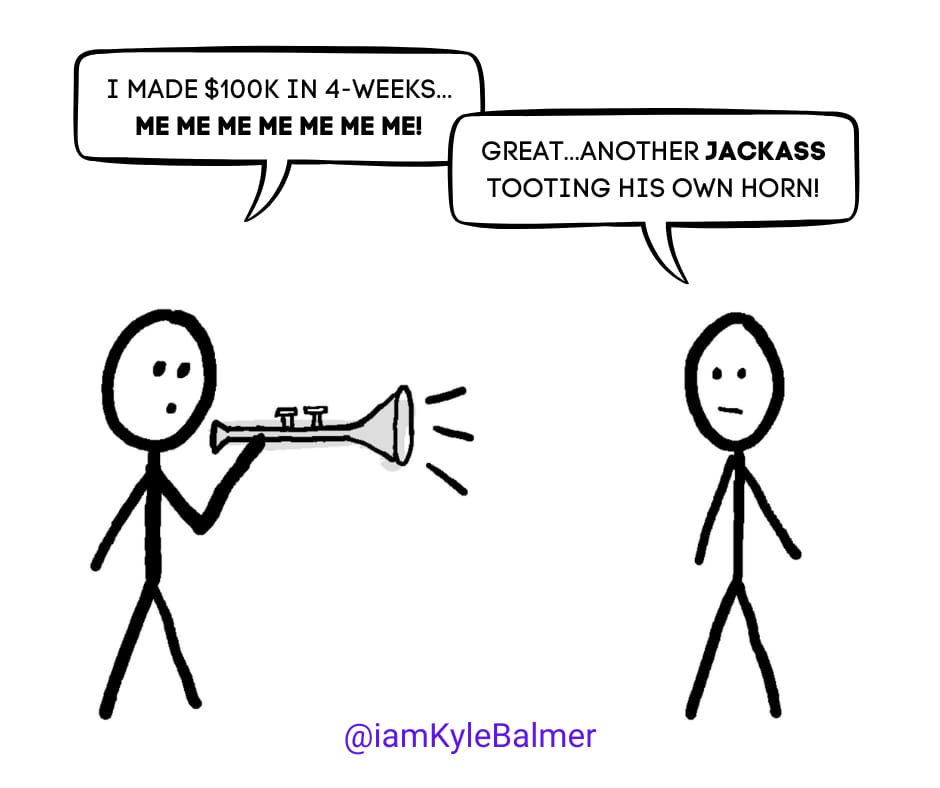
Remember how I started this newsletter? I mentioned our previous £100k launches, but I also pointed out that they were scrappy and chaotic. That is a humble brag in action. It's not just "look at all this money/fame/success" - it's layered with humbleness.
The goal isn't to say "Hey, I'm amazing and I'm doing so well." It's to say "Hey, I've had some amazing results, and you can too." It's not about results because of me, it's about results despite me!
Some of my most popular TikTok videos follow this format. I'll start by saying I get paid $1,500-$4,000 per hour for workshops. This is true, and it's a great hook that makes people stop and listen.
But then I'll explain that this isn't because I'm special. It's because there's massive demand, and I just happened to stumble onto it!
I'll go further and say that I'm not even the best person for this - I'm introverted, don't like being on stage, have a lisp, can’t even pronounce my own RISEN framework without it sounding like WISEN etc. etc.
But despite all of this, I get paid £4,000 for an hour of my time on stage. That's the essence of a humble brag.
The art is in tooting your own horn without sounding like a jackass. And importantly, showing people why they can have similar successes (because they can!).
Now, let's get practical. How can we use AI to help craft these humble brags? Here's a prompt I've developed to help generate humble brag content:
You are an AI assistant helping to create humble brag content for a product launch. Please interview me about my offer and business using the following structure:

1. Ask about successes, plaudits, fame, awards, money generated, etc.
2. Inquire about natural limitations - what held me back before, what was life like before the successes, what factors were against me, etc.
3. Combine this information into 5 humble brag narratives - write out or outline these for me.
4. Generate social media posts from these narratives in 4 formats: short text, long text, short video script, long video script. Create 5 narratives for a total of 20 posts. Do not include hashtags or emojis.

Please maintain a conversational tone throughout. Focus on inspiring others by showing that if I can achieve these results despite limitations, they can too.
When you run this prompt, you'll get a solid foundation for your humble brag content. But remember, these are just starting points. Don't just schedule these up as is! They're drafts that you’ll use to build from.
To really make these posts shine, you'll want to refine them further. One effective way to do this is to provide examples of your own social media posts or video transcripts to the AI. This helps the AI understand and mimic your unique voice and style. I’ve written a handful of Playbooks on doing this for further reference but the basic is simply to upload previous written samples (or video transcripts) and instruct the AI to replicate the tone of voice.
For now, focus on getting your basic humble brag narratives worked out and some samples created. We'll dive into the nitty-gritty of content volume (for 90 days!) and scheduling in Part 5 when we talk about pulling everything together.
In our next Part, we'll delve into the world of behind-the-scenes content. Get ready to pull back the curtain and give your audience a peek into your process!
Keep Prompting,
Kyle
In this Part we’re covering the second content pillar of our launch: behind the scenes.
Remember I mentioned I'd be sharing the nitty-gritty details of our quarter-million-pound launch? Well, guess what? You're looking at it right now!
This very newsletter is a prime example of behind-the-scenes content. I'm quite literally giving you a peek behind the curtain as we speak.
And it doesn't stop here - I'm doing the same thing across my social media channels. I'm recording what I'm working on, asking questions, seeking help, and even working out problems live.
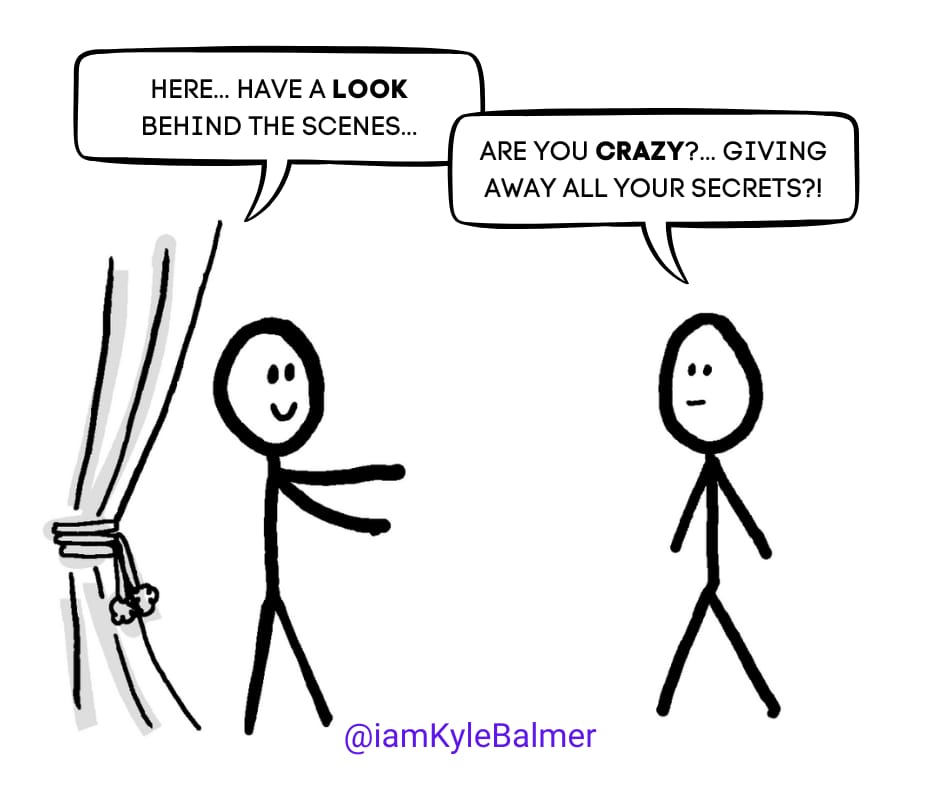
Why am I doing this? Well, that's exactly what we're going to dive into today. Welcome to Part 2 of our Launch Social Media Strategy series, where we're focusing on the power of behind-the-scenes content.
Let’s get started:
Behind the Scenes Content
What is behind-the-scenes content?
The power of building in public
Co-opting your audience into the creation process
Risks and how to mitigate them
Examples of behind-the-scenes content for launches
Behind-the-scenes content is exactly what it sounds like - it's giving your audience a glimpse into what's happening behind the curtain.
Some people use the term “opening the kimono”. But I find it a bit gross. And who wants to see me in a silk kimono anyway? Maybe don’t answer that…
Behind the scenes content is showing the process, the struggles, the victories, and even the mundane day-to-day tasks that go into creating your product or service. Hell, sometime the mundane posts are the most engaging because they remind people that you are, you know, a person.
This type of content is particularly powerful if you run a personal brand (and let's face it, in today's world, you should!). People love to see what's happening behind the scenes, especially when it comes to someone they follow and admire.
You might have heard me talk about "building in public" before. Well, this is it in action. Building in public is essentially creating your product or service out in the open, sharing your progress, setbacks, and victories with your audience as they happen.
It's a powerful strategy because it does several things:
It creates transparency and builds trust with your audience. Ultimately launches are about trust so the more you build the better.
It generates interest and anticipation for your launch.
It allows you to get real-time feedback from potential customers.
It creates a sense of investment from your audience in your product.
Here's a hard truth: you can't just say "Hey, I'm launching!" 150 times over the next few months. I’ve seen companies do this. They put out a daily sales message just talking about how great their launch will be. Snooze. That's about as exciting as watching paint dry.
Instead we need to fill the airwaves with related, interesting content. The key word here is related - when selling you don’t sell sell sell in every damn post. You talk around the sale as well, fill in the gaps, build trust, anticipation and excitement. And then when you do sell (we’ll get to this) the groundwork has already been laid.
By sharing your journey, you're constantly reminding people about your upcoming launch without being repetitive or salesy. You're creating a narrative that people want to follow, and more importantly, want to be a part of.
One of the most powerful aspects of behind-the-scenes content is that it allows you to co-opt your audience into the creation process. This is a bit more subtle but deployed well it’s wonderful. Here's how it works:
You declare what you're building.
You build it openly, sharing your progress.
People contribute their ideas and feedback.
You incorporate their feedback into your product.
You tell people how you've incorporated their ideas.
OK sounds basic right? But this process is incredibly powerful. Not only are you getting valuable feedback from future customers, but you're also making them feel part of the process. It becomes "their" product in a way.
They wanted it, you created it, and now they can access it by buying! You’ve already planted seeds of ownership - they want to own it because they were part of its creation.
I used this technique for my last two 6 figure launches this year - basically asking people if they wanted it, having them help shape it and then simply stating, “OK what you wanted is ready, here’s how to buy it”. Simple? Yup. Effective? God damn right it is.
Now, I know what some of you might be thinking: "But Kyle, aren't I giving away too much by showing people what I’m up to? Won't people just take my ideas and not buy later? Can’t they just piece it together from my public activity??"
Here's the truth: people don't act on information alone. We’re just too damn lazy.
I could give away unlimited information, and most people still wouldn't use it. Why? Because information by itself lacks two crucial elements:
The emotional hook to start taking action.
The accountability and detailed steps to make it actionable.
These elements come from the product itself. So don't worry about giving away too much. Focus on being as helpful and transparent as possible.
Some people still don’t believe me when I tell them to bare all and give away information. My rejoinder to this is always to point out that Harvard and MIT put out their course material for free online. Lectures, handouts, homework and even the exams (you need to pay to take the exam but it’s low cost compared to enrolling normally).
Technically anyone can get themselves a computer science degree from MIT using that material.
Does anyone do it? Hell no! Without the push of enrolling, having peers, structured terms, lectures and teachers no one acts on this information.
The information isn’t enough by itself. Your product is the key that will get them their desired result.
So, what kind of behind-the-scenes content can you create for your launch? Here are some ideas along with examples where relevant:
Share what you're working on today.
My big task today
Work out a proper CRM for launch
We’ve run last two launches (~$200,000) without a CRM
But January going for a BIG launch so expecting much more volume
So it’s time for a CRM
Right now looking at
Basic @trello system
@FolkHQ
@HubSpot— Kyle Balmer (@iamkylebalmer)
10:00 AM • Sep 26, 2024
Discuss a current block or challenge you're facing.
Starting to say no more
I’m refreshing the application procedure for the AI workshop kit
So that it’s far stricter and lots more NOs
Why? I want people to act.
— Kyle Balmer (@iamkylebalmer)
11:46 AM • Sep 24, 2024
Show the tools you're using in your process.
Nearly done with new sales flow for AI workshop kit
The stack
@HeyFormHQ to @zapier to @FolkHQVery lightweight. Loving it so far
— Kyle Balmer (@iamkylebalmer)
2:38 PM • Sep 26, 2024
Run a poll on what features to add to your product.
Enhancing the AI Workshop Kit. Which would you prefer?
• How to secure speaking gigs as an AI expert (and get paid well)
• Strategies for selling AI workshops to entire organisationsBasically speaking to multiple companies OR one at a time
— Kyle Balmer (@iamkylebalmer)
11:00 AM • Sep 30, 2024
Ask your audience about their biggest problems related to your offer.
On a scale of 1-10, how confident are you in your ability to monetise AI knowledge in your industry?
If you're below an 8, what's your biggest roadblock?
Share your number and main challenge.
I'm developing something that could be a game-changer.
— Kyle Balmer (@iamkylebalmer)
7:00 PM • Sep 26, 2024
And a few more:
Share a time lapse of your work process.
Do a livestream of yourself working (Gary Vee does this)
Do a Q&A session about your launch preparations.
Share early drafts or prototypes and ask for feedback.
Document team meetings or brainstorming sessions.
Share personal reflections on the launch process - your fears, excitements, etc.
Your imagination is the limit really. What we’re going to do though is use an AI prompt to inspire use and give us some potentials.
Do you need to write them all now? Well, no…it’s sort of hard to know what we’ll be doing everyday of the launch! But there are some elements you can pre-prepare and others you can at least have a list of handy to check daily for inspiration.
Now, let's get practical. Here's a prompt you can use with AI to generate ideas for behind-the-scenes content:
You are an AI assistant helping to create behind-the-scenes content for a product launch.

Please interview me about my offer and launch process using the following structure:

1. Ask about the product or service I'm launching - what is it, who is it for, what problem does it solve?
2. Inquire about my creation process - what tools am I using, what steps am I taking, what challenges am I facing?
3. Ask about my launch timeline and key milestones.
4. Based on this information, generate 20 ideas for behind-the-scenes content. Include a mix of:
   - Daily updates
   - Process revelations
   - Challenges and how I'm overcoming them
   - Sneak peeks of the product/service
   - Polls or questions for the audience
   - Personal reflections on the launch process

For each idea, provide a brief description and suggest the best format (text post, image, video, poll, etc.).
Remember, these are just starting points! And obviously the behind the scenes will change as you move through the launch process. So use them as inspiration, but always add your personal touch. Your audience follows you for your unique perspective, so make sure that shines through in your content.
Related Playbooks: AI Writing Workflow, Audience Fundamentals, Expert Guide Marketing, Building AI Assistants using Claude Projects, AI Assistants using ChatGPT, Q&A Content Marketing, Live Video 101, Content Marketing Machine…
Upgrade Today and get them ALL.
Premium readers find them all in the Playbook Vault.
Keep Prompting,
Kyle
I've got a confession to make. For years, I've been guilty of a cardinal sin in the world of online business: not collecting enough social proof.
A couple of years ago, I had over 30,000 students on Udemy, but only a handful of reviews. Oops. It's like I was sitting on a goldmine of social proof, but forgot to bring a shovel!
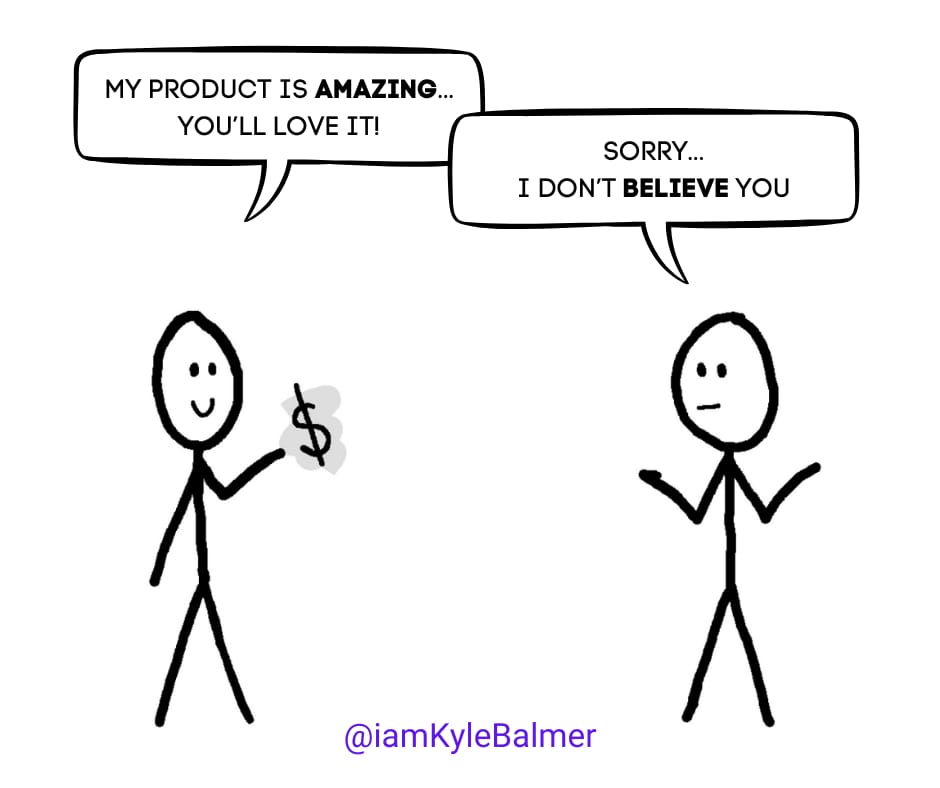
Thankfully, our launch coach has given us a kick up the backside, and we've been on the offensive recently. We're not just collecting testimonials - we're publishing them too. Because, as it turns out, having testimonials and using them are two very different things!
This experience has been a real eye-opener, and it's exactly what we're going to dive into today. Welcome to Part 3 of our Launch Social Media Strategy series, where we're focusing on the power of social proof and testimonials.
Prefer to listen? Here’s an interview podcast about today’s topic:
Let's get started:
Social Proof and Testimonials
The purpose and power of social proof
Different levels of social proof
Strategies for collecting testimonials
Incentivising customers to provide feedback
Using AI to generate social proof content
Here's the thing: I can tell you until the cows come home how brilliant my offer is.
But of course I would - I made it! It's like asking a parent if their child is clever. You're not exactly going to get an unbiased opinion, are you?
This is a limitation all marketers have. What we say doesn’t matter that much!
This is where social proof comes in. Social proof is what OTHER people say and think about us and our offers. It's infinitely more compelling than any amount of self-promotion. It's the difference between saying "Trust me, I'm great!" and "Don't take my word for it, listen to what these happy customers have to say."
Social proof comes in many flavours, each with its own level of depth and impact. Let's break (some!) them down:
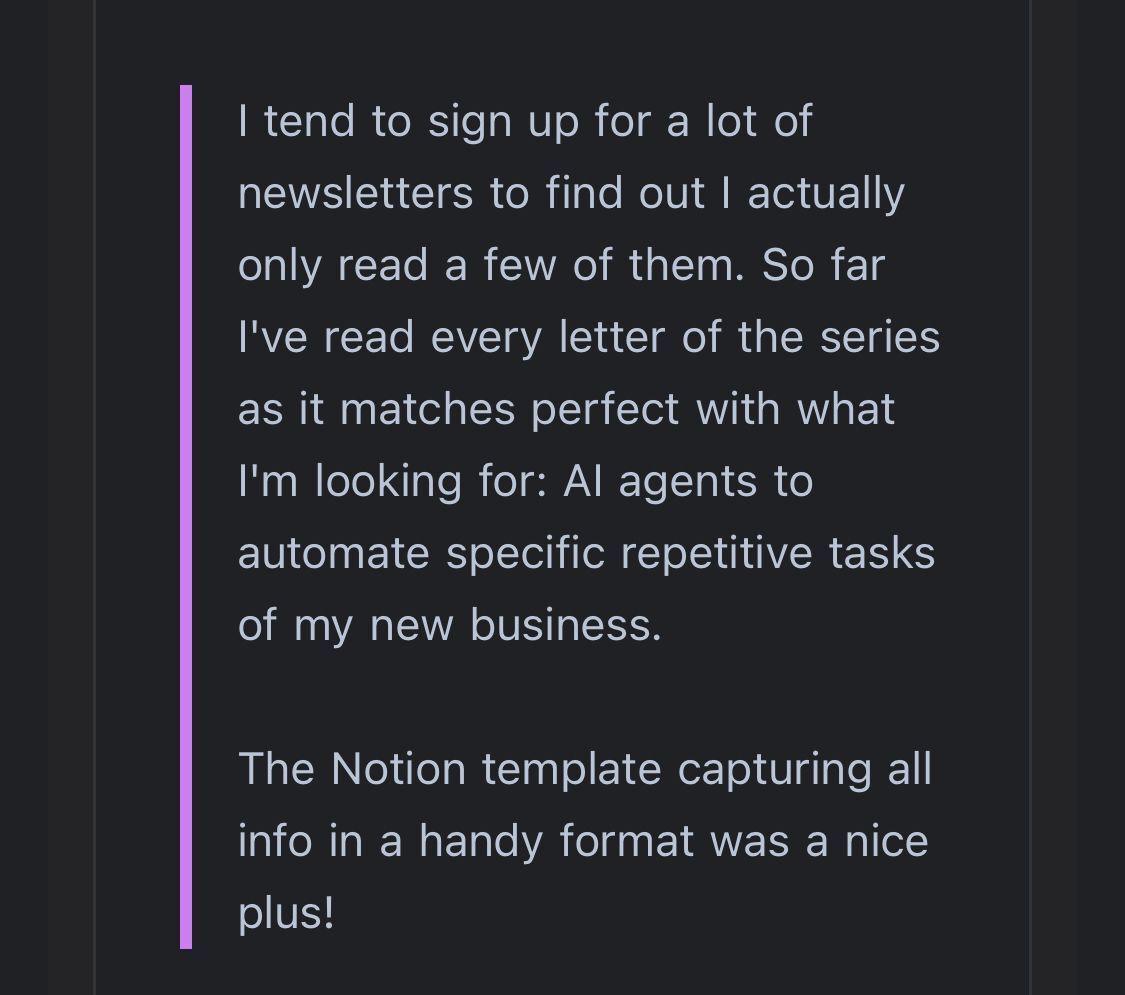
1. Unintentional Proof: This is when people spontaneously email or message to say, "Hey, I love your stuff!" It's genuine and unsolicited. Here’s a recent example I got:
2. Quick Reviews/Feedback: Short, snappy comments or ratings. Think star ratings on Amazon, Gumroad, Shopify or whatever your eCommerce platform.
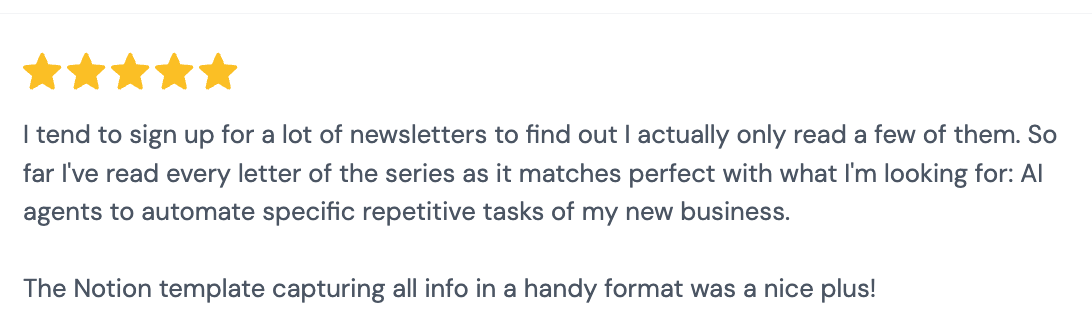
3. Testimonials: More detailed feedback, usually a paragraph or two, highlighting specific benefits or results.
4. Video Testimonials: Like written testimonials, but with the added authenticity of seeing and hearing the customer.
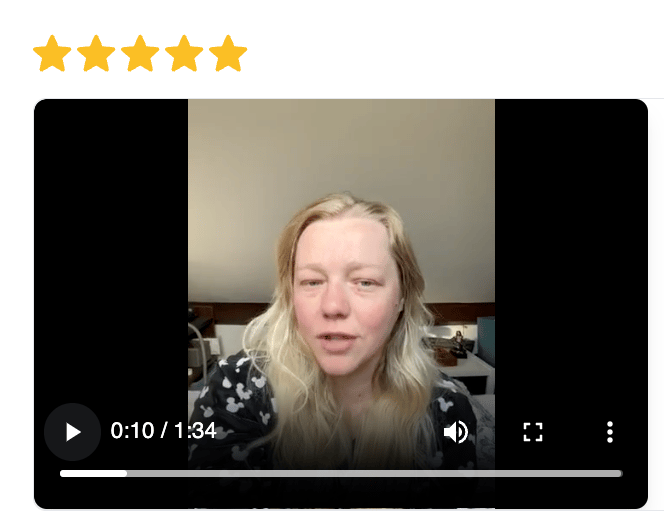
Thank you Gemma!
5. Interviews: In-depth discussions with satisfied customers, diving into their experience with your product or service.
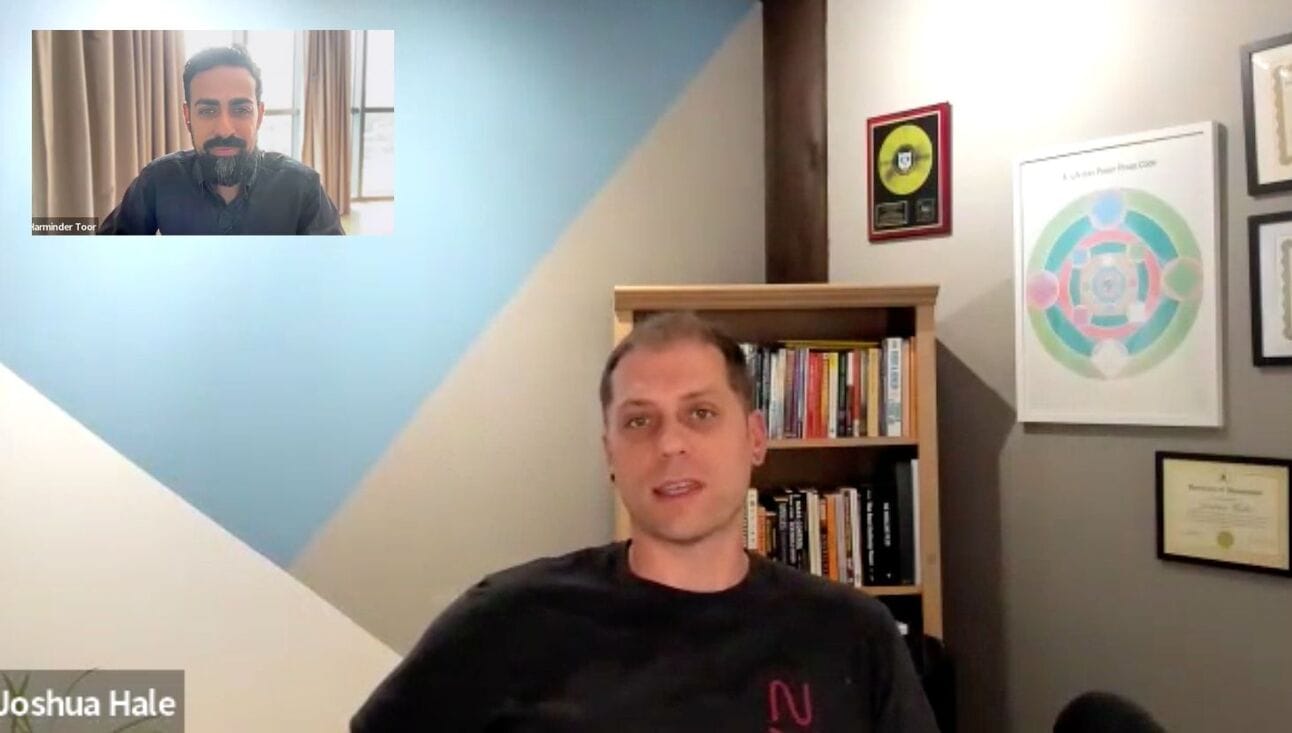
Thank you Joshua (AI Workshop Kit record holder)
6. Case Studies: Detailed examinations of how your offer helped a specific customer achieve their goals.
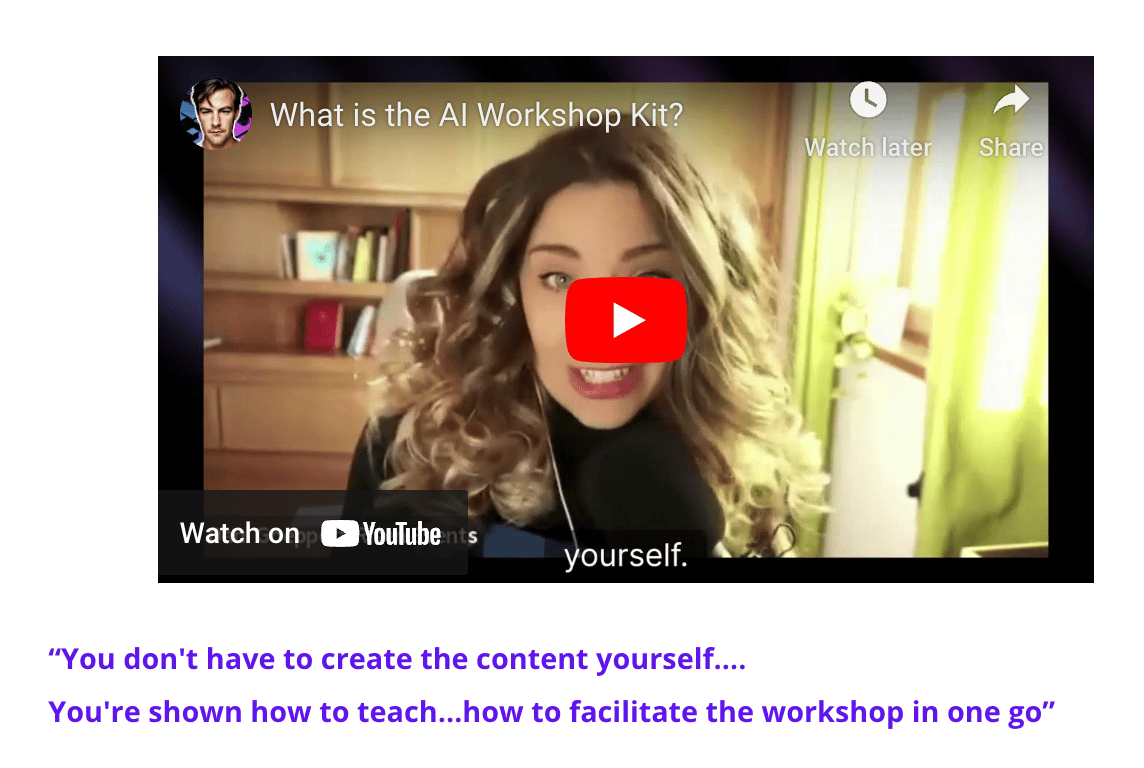
Thank you Dani, about to run the AI Growth Summit!
As we move down this list, the social proof becomes increasingly in-depth and powerful. However, it also requires more work both from the customer and from you to compile.
(If you want to dive deeper into this topic, I've written a whole playbook on it here)
Here's the good news: happy customers generally want to help. They're often more than willing to sing your praises!
The bad news? It's work for them. People forget, people add it to their to-do list, and... it doesn't get done. It's not that they don't want to - life just gets in the way.
So, how do we overcome this? We incentivise.
For basic reviews, we use a tool called Senja, which has a brilliant feature - a roulette wheel. When someone leaves a review, they get to spin a wheel and win free Playbooks. Everyone wins something, and it's massively increased the number of reviews we get.
(By the way, you too can win a prize if you leave a testimonial, give it a try here).
For bigger asks like interviews or case studies, offer something more substantial. For example, a 1:1 consultation or a high-value freebie. These types of social proof are extremely valuable for you, so it's worth offering a compelling incentive.
Here's a pro tip: If your customers have their own businesses, offer them a backlink. When you post their testimonial or case study, make sure to tag them or include their website details. It's a win-win - they get promotion, and you get social proof.
Thanks to this recent push, we've managed to collect a whole bunch of testimonials in just a week or so. You can see the range of types here (scroll towards the bottom of the page).
Also check out https://senja.io/p/aibusinessbreakthrough/h-vtDZ which is our Senja “wall”. This gives you a wide understanding of all the different types. Notice also I’m slipping this in as a bit of a humble brag? It’s a callback, I swear! 😛
Now, let's get practical. Here's a prompt you can use with AI to brainstorm ways to collect testimonials and create social proof content:
You are an AI assistant helping to create a social proof strategy for a product launch. Please interview me about my offer and current social proof situation using the following structure:

1. Ask about my product or service - what is it, who is it for, what problem does it solve?

2. Inquire about my current social proof - do I have any testimonials, reviews, or case studies? If so, how many and what type?

3. Ask about my social media presence and other marketing channels.

Based on this information:

1. Suggest 5 strategies for collecting more testimonials, tailored to my specific offer and audience.

2. Generate 15 ideas for social media posts showcasing social proof. Include a mix of:

   - Posts featuring short quotes from testimonials

   - Ideas for visualising data from reviews (e.g., star ratings, success metrics)

   - Concepts for before-and-after posts

   - Ideas for showcasing case studies

   - Suggestions for user-generated content campaigns

For each idea, provide a brief description and suggest the best format (text post, image, video, carousel, etc.)
Once you have your basic types of social proof decided upon you need to get serious about collecting it. Set targets. Hit them. It’s a constant process.
Here are some “easy” places to add your collection link though. This is the closest you’ll get to automating collection. Remember, the key is to catch customers when they're feeling warm and fuzzy about your product or service. Here are some prime locations:
In Your Newsletter: After providing value in your newsletter, add a quick call-to-action for feedback. Something like, "Enjoyed this newsletter? We'd love to hear your thoughts!"
Thank You Emails: Right after a purchase, customers are often at their peak excitement. Include a testimonial request in your order confirmation or thank you emails.
Social Media Bios: Add a link to your testimonial collection page in your social media bios. Platforms like Instagram allow a single link, so consider using a tool like Linktree to include multiple links, one of which can be for testimonials.
Members Area: If you have a course or membership site, add a prominent button or link asking for feedback. This catches users right after they've engaged with your content.
Post-Interaction Emails: Send a follow-up email a week or two after a customer support interaction or coaching call, asking how they found the experience.
Product Usage Milestones: If your product allows for tracking usage, send a testimonial request when users hit certain milestones. For example, after they've completed a course or used your software for 30 days.
Social Media Posts: Occasionally create posts specifically asking for feedback. Remember to remind people of the incentives. Hell, lead with them!
Receipts and Invoices: If you send physical products, include a small note with the packing slip asking for feedback. For digital products, add a link in the invoice email.
The key is to strike while the iron is hot. Any time a customer is likely feeling positive about their interaction with your brand is an opportunity to request a testimonial. Just remember to keep it light, make it easy, and always be appreciative of their time and effort. It’s a volume game.
In our next part, we'll explore the part that comes least naturally to me: hype!
Related Playbooks: AI Writing Workflow, Audience Fundamentals, Expert Guide Marketing, Building AI Assistants using Claude Projects, AI Assistants using ChatGPT, Q&A Content Marketing, Live Video 101, Content Marketing Machine…
Upgrade Today and get them ALL.
Premium readers find them all in the Playbook Vault.
Keep Prompting,
Kyle
I've got a confession to make: building hype doesn't come easily to me.
Maybe it's the Brit in me, but I've always been more of a "build it, release it, and hope people want it" kind of chap.
My approach has been rather matter-of-fact: if you like it, awesome; if not, no worries.
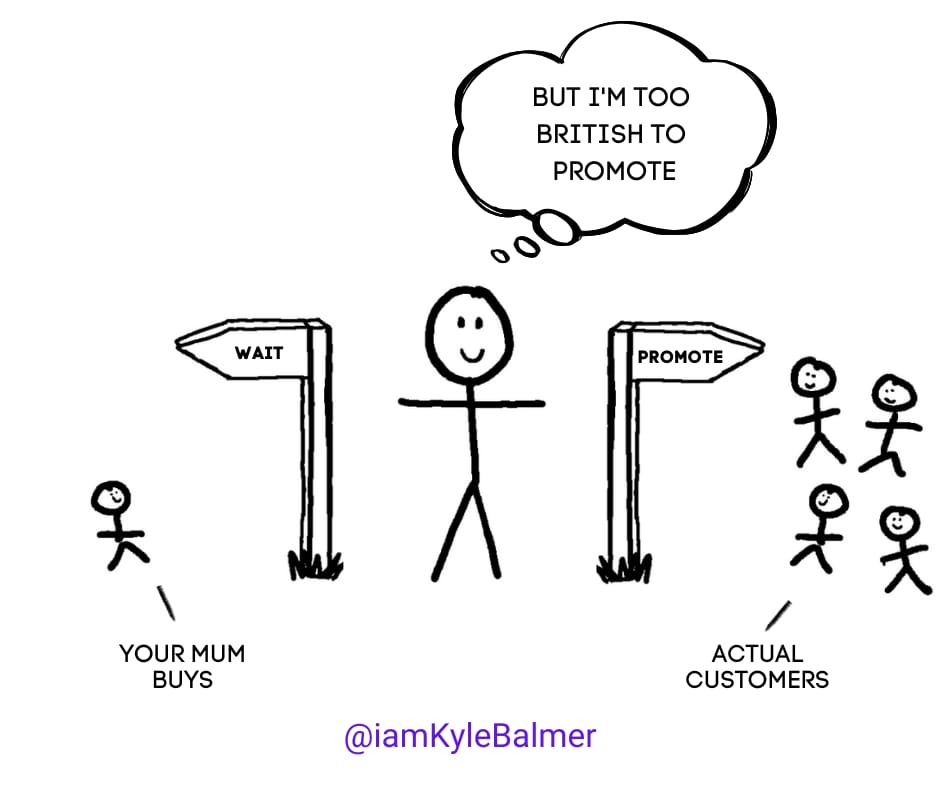
Unfortunately, in today's busy world, that approach is about as effective as a chocolate teapot. Going hard on the Britishness today eh?
I've learned (the hard way) that you have to be the greatest supporter of your launch offer. If you're not a cheerleader for your own product, no one else will be. No one is ever going to care more than you.
Today, we're diving into the art of building hype - the final piece of our launch content puzzle.
Prefer to listen?:
Let's get started:
What is hype content?
Overcoming reluctance to self-promote
The importance of believing in your offer
Creating genuine hype from a place of service
The role of time pressure in building anticipation
Strategies for different stages of your launch
Using AI to generate hype content
Hype content is all about creating anticipation and excitement for your upcoming launch. It's the build-up, the teaser trailers, the "coming soon" posts that get your audience on the edge of their seats, eagerly awaiting what you're about to unveil.
For some of you this is easy. Some are natural hypemen. Hypepersons? Hypers? You know what I mean!
But if you're anything like me, the idea of hyping up your own product might make you feel a bit... uncomfortable. It took some serious reframing for me to get over this hurdle. Here's how I personally did it:
Believe in Your Offer: If you don't believe in what you're selling, you shouldn't be selling it. Full stop. If you're not 100% confident in your offer, improve it until you are. Don’t sell crap, simple.
Focus on the Impact: Does your product or service genuinely help people? If so, it's your duty to tell people about it. I know my offers are life-changing, and that AI is probably the most important skill set to acquire in business (and potentially life) right now.
Reframe It as an act of Service: If you believe in your offer and know there’s a positive impact then you're not in the business of hyping to push bad offers. You're hyping in order to cut through the noise and provide people with something genuinely valuable.
Once I made this mental shift, producing hype content became much easier. I'm not just selling; I'm serving. Smart eh? It took me a loooooong time to get there so hopefully the above makes the process a little less painful for you!
Let me give you an example. When talking about the AI Workshop Kit I often start my TikTok videos with a statement about income potential. Something like, "I make $1,500 to $4,000/hour. It used to take me a month to make that - sometimes longer!"
Here’s an example with 30k views that helped drive sales:
@iamkylebalmer Gauging interest : would you be interested in teaching AI to businesses? I run workshops and give talks but don’t have capacity to meet d... See more
Now, that's one hell of a hook. But here's the thing: it's all true, and it aligns with my mission.
I'm telling people about my offer because they can do the same (and they do!) and change their lives (and they have!). The hype is in that first sentence, but it comes from a place of service, not sales.
A quick but important note: don't make stuff up. Don't lie. Don't overhype with fluff. It's not only dishonest and gross, but people will smell the BS and lose trust in you. And if they do trust your inflated claims, you'll end up with terrible returns and complaints when you inevitably fail to deliver. It ain’t worth it.
If you feel this is a genuine block for you, I wrote an entire playbook tackling this subject — Authentic Selling!
Simply telling people about something great isn't enough. There’s a second component to consider.
We need to create pressure, like a kettle building up steam. This is why launches are so effective - there's a build-up of anticipation, and then boom! The launch happens.
Right now, I have three people a day organically applying for my AI workshop kit. But I tell them to wait until the upcoming January 2025 launch. Why? Because we're building pressure, building steam.
Your hype content needs to shift as you move towards launch:
Early Stage: You're teasing, dropping hints, intriguing people.
Middle Stage: You start revealing exciting details about the opportunity.
Final Week: You're in full hype mode. The intensity ratchets up to 11.
Timing matters. A lot.
Now, let's get practical. Here's a prompt you can use with AI to generate ideas for hype content:
You are an AI assistant helping to create hype content for a product launch. Please interview me about my offer using the following structure:

1. Ask about my product or service - what is it, who is it for, what problem does it solve? What are the core customer problems.
2. Inquire about the expected results or benefits for customers.
3. Ask about any previous success stories or testimonials.

Based on this information, generate 15 example hype posts:
- 5 for the early stage of the launch (teasing and hinting)
- 5 for the middle stage (revealing exciting details)
- 5 for the final week (full hype mode)

For each post, provide:
- A catchy headline or opening line
- The main body of the post (2-3 sentences)
- A call to action
- Suggested format (text post, image idea, video concept, etc.)
- No emojis or hashtags

Focus on creating genuine excitement based on the real value of the offer, without resorting to hype or exaggeration.
We've now covered all four types of launch content: humble brag, behind the scenes, social proof, and hype. In each Part, we've explored the content type and created some sample posts.
In our final Part, we'll pull it all together.
We'll talk volume, schedule, ratios of different post types, and start mass-producing the content we need for a successful launch. Everything from the last 4 Parts is about to be combined into a cohesive, powerful launch strategy!
Related Playbooks: AI Writing Workflow, Audience Fundamentals, Expert Guide Marketing, Building AI Assistants using Claude Projects, AI Assistants using ChatGPT, Q&A Content Marketing, Live Video 101, Content Marketing Machine, Authentic Selling…
Upgrade Today and get them ALL.
Premium readers find them all in the Playbook Vault.
Keep Prompting,
Kyle
We've reached the final stretch of our launch strategy series. Over the past four Parts, we’ve looked at the four pillars of launch content: humble brags, behind-the-scenes glimpses, social proof, and hype-building.
But it’s all a bit disparate right now. Thank you for bearing with me until we can pull it together into a cohesive, powerful launch strategy.
We're going to talk about structure, timing, volume, and how to blend all these elements.
Prefer to listen?:
Let's get started:
The Master Plan
The three phases of a launch strategy
Content ratios for each phase
Volume and frequency of posts
The master prompt for content generation
Scheduling and automation tips
Maintaining authenticity at scale
When it comes to structuring a launch, I like to think in terms of three distinct phases: Prepare, Build Up, and Explosion. Each phase typically lasts about 30 days, giving us a 90-day launch runway. Of course, this can be condensed or expanded based on your niche and offer - generally, the more expensive the offer, the longer the runway.
Let's break down each phase:
Prepare (Days 1-30): This is where you're setting the stage. You're building your offer and systems for the launch, and you're bringing your audience along for the ride.
Build Up (Days 31-60): Now you're starting to generate excitement. You're showcasing what you've built and proving its value.
Explosion (Days 61-90): This is where you go all out. You're in full hype mode, pushing towards the big launch day.
While all four types of content (Behind the Scenes, Humble Brag, Social Proof, and Hype) should be present throughout the launch, their ratios shift as we move through the phases.
Here’s an example schedule if you are posting 1/day:
Phase
Posts per Week
Behind the Scenes
Humble Brag
Social Proof
Hype
Prep
7
3
2
1
1
Build Up
7
2
2
2
1
Explode
7
1
2
2
2
This breakdown ensures you're hitting each content type consistently throughout your launch, while shifting the focus as you move through the phases. In the Prepare phase, you're heavy on Behind the Scenes content. As you move into Build Up, you balance out with more Social Proof. Finally, in the Explosion phase, you ramp up the Hype while maintaining a mix of other content types.
Remember, this is a starting point. More content is (pretty much always!) better when it comes to launches.
As you get more comfortable with the process and if your schedule allows, you can gradually increase to 2 or 3 posts per day, adjusting the ratios accordingly. But build up! Don’t just start at 3 a day and burn out.
Now that we've covered the structure and ratios, it's time to actually generate your content. Here's a comprehensive prompt that builds on all we've discussed in the previous parts.
Use this alongside the prompts from our earlier sessions on humble brag, behind the scenes, social proof, and hype content. Use it underneath so that it pulls in all the previous context.
Note, for best results focus on ONE platform and ONE phase at a time.
You are an AI assistant helping to create a comprehensive social media content plan for a product launch. Please gather the following information:

1. Which social media platform are we focusing on? (Choose one at a time)
2. Which phase of the launch are we planning for? (Prepare, Build Up, or Explosion)

We will be creating 7 posts per week (1 per day) for each 30-day phase. Generate a content plan following these guidelines:

For the Prepare phase (Days 1-30):
- 3 Behind the Scenes posts per week
- 2 Humble Brag posts per week
- 1 Social Proof post per week
- 1 Hype post per week

For the Build Up phase (Days 31-60):
- 2 Behind the Scenes posts per week
- 2 Humble Brag posts per week
- 2 Social Proof posts per week
- 1 Hype post per week

For the Explosion phase (Days 61-90):
- 1 Behind the Scenes post per week
- 2 Humble Brag posts per week
- 2 Social Proof posts per week
- 2 Hype posts per week

For each post, provide:
1. The type of content (Behind the Scenes, Humble Brag, Social Proof, or Hype)
2. A brief description of the post's content
3. Sample post.

Ensure the content flows logically, building anticipation towards the launch.Once you've generated your content plan, it's time to schedule and automate. The exact process will depend on your chosen platform, but here are some general guidelines:
Twitter: Use a tool like Typefully or Buffer to schedule your tweets in advance.
Instagram: Later or Hootsuite are great for planning your grid and scheduling posts.
LinkedIn: LinkedIn's native scheduling tool or Hootsuite work well for professional content. I personally use Typefully (because it is what I use for Twitter/X as well).
Facebook: Facebook's Creator Studio or Buffer can handle your Facebook page posts.
The key is to load everything up front as your spine - this is the core of your content strategy. Think of it as creating a solid skeleton for your launch.
Feel free to add more content as you go along, especially behind-the-scenes posts as things change day to day. But the main thing is to have this solid core in place so you can "set it and forget it," knowing there's a minimum amount of content going out consistently.
Now, I know what you're thinking. "Kyle, this sounds like a lot of content. How do I keep it authentic and not just mass produce crap?"
Here's the thing: this process gets you 80% of the way there. It creates a solid foundation and ensures you're consistently putting out content. But that final 20%? That's where your personal touch comes in. You still need to do the work!
Take the AI-generated content as a starting point. Then, inject your personality, add current events or developments, and tailor it to what's happening in real-time with your launch.
We've covered a lot of ground over these five parts. Let's recap the key points:
Part 1: Humble Brag Content - We learned how to showcase our achievements without coming across as boastful. The key is to focus on the journey and the lessons learned, not just the end result.
Part 2: Behind the Scenes Content - We explored how to give our audience a peek behind the curtain, building trust and engagement by showing the process behind our product or service.
Part 3: Social Proof and Testimonials - We discussed the power of letting others sing our praises, and how to effectively collect and showcase testimonials and case studies.
Part 4: Building Hype - We delved into the art of creating anticipation and excitement for our launch, focusing on how to build genuine hype from a place of service.
Part 5: Pulling It All Together - And finally, we've learned how to combine all these elements into a cohesive, powerful launch strategy.
As you kickoff your own launch journey, keep these strategies in mind, but don't be afraid to adapt them to your unique voice and audience. After all, that's what will truly set your launch apart.
Here's to your spectacular launch! If you need any assistance with your launch don’t hesitate to reach out. I can help or refer you on to launch experts.
Related Playbooks: AI Writing Workflow, Audience Fundamentals, Expert Guide Marketing, Building AI Assistants using Claude Projects, AI Assistants using ChatGPT, Q&A Content Marketing, Live Video 101, Content Marketing Machine, Authentic Selling…
Upgrade Today and get them ALL.
Premium readers find them all in the Playbook Vault.
Keep Prompting,
Kyle
Are you ready to transform your social media launch strategy into a powerhouse of engagement and revenue? The '🚀 Launch Social Media Strategy | AI Business Playbook' is your ultimate guide to mastering the art of launching successful products and services through social media. In this playbook, you'll get an insider’s view of a quarter-million-dollar launch, complete with actionable insights and practical AI tools that make content creation a breeze. Say goodbye to writer's block and hello to a steady stream of engaging posts that captivate your audience and drive results.
This playbook is designed for entrepreneurs, marketers, and business owners who are eager to enhance their social media presence and drive successful product launches. If you often feel overwhelmed by the prospect of creating consistent and engaging content, or if past launches have felt disorganized and chaotic, this playbook will provide you with the structure and strategies you need to succeed. Whether you're launching your first product or your fiftieth, this guide will empower you to turn your aspirations into reality with confidence and clarity.
No prior experience is necessary! This playbook is designed for all skill levels, from beginners to seasoned marketers.
The time commitment varies, but you can start seeing results by dedicating just a few hours per week to planning and executing your content.
Absolutely! We provide easy-to-follow guidance on how to leverage AI tools for content creation, making it accessible for everyone.
Yes! The strategies outlined in this playbook can be adapted to fit any social media platform you choose to use.
The principles in this playbook are versatile and can be tailored to any niche, ensuring you can effectively reach your target audience.