
AI Business
Work through practical ways to build an AI business.
Start ReadingA few months back, Tai Lopez's team slid into my DMs.
Yeah, the “here I am in my garage guy”

They wanted me to create an AI automation course. Proper big opportunity - talking about flying me to LA to film it, the works. I was genuinely tempted.
Then I actually checked what Tai was saying about AI.
You’ve probably seen the sort of messaging plastered all over social media: "Automatic income!" "Print money with faceless videos!" "Trading bots that beat the market!" Normally being sold by a 20 year old from his Dubai apartment balcony. It was that vibe.
Look, I respect the hustle. Tai Lopez is a master salesman. He’s the best at what he does. But Christ, the promises were mental.
They just weren’t aligned with what I teach. So I declined.
But here's the mad bit - there IS serious money being made in AI. Last year alone, I pulled in £300-400K+ teaching people about this stuff. Starting from ZERO.
And my workshop students charge £1000 an hour and sign implementation deals off the back of it. Heck, I’ve been paid $4000 for one hour of my time giving a talk.
There is a huge amount of demand for AI knowledge and implementation right now. And companies are willing to pay top dollar.
BUT the money isn't lying on the floor waiting to be picked up like the 19 year old on TikTok tells you. You won’t be a millionaire with ChatGPT next week. Sorry!
This Playbook about the reality behind the AI gold rush, and how to actually get a piece of it. It’s all based on how I personally make (good) money and techniques I’ve taught others.
And it all, boringly(!), is first based in solid business principles!
Let’s get started:
Why AI hype merchants are selling dreams, not systems
Where the real money actually is (hint: it's boring)
Three legitimate ways to build an AI business
Why your existing knowledge is your unfair advantage
Every few years, we get a new "revolution" that's supposedly going to make everyone rich overnight.
Remember when everyone was going to get wealthy flipping houses? Then it was dropshipping. Then crypto. Then NFTs. Now it's AI.
If they worked we’d all be sitting on the beach with our Maitais by now. But here we are.
The pattern's always identical. New technology emerges. Early adopters see genuine success. Then hype merchants arrive promising anyone can replicate those results with their "secret system."
I get pitched these systems constantly now. "Kyle, want to see my AI YouTube automation that's making £50K a month?". My DMs are an absolute trainwreck (which is why I don’t check or respond to DMs often - sorry!)
The current crop of AI hustles falls into predictable categories:
Automated YouTube channels. ChatGPT writes scripts, AI generates visuals, text-to-speech does the voiceover. Upload and profit, apparently.
AI trading bots. Because the same ChatGPT that thinks there are three Rs in "strawberry" is definitely going to outperform Goldman Sachs.
Faceless social empires. AI creates all your content while you sip cocktails in Bali. Dominate LinkedIn and Twitter overnight with automated posting, responses and more.
Dropshipping with AI sauce. Now the robots will find products AND write descriptions. I actually got approached by a multi billion-dollar Chinese company wanting me to promote their "sourcing AI" - even though I don't dropship and told them it's not my thing. "Doesn't matter," they said. Yikes. More on that story in the next Part.
Here's what they don't tell you:
AI content is aggressively mediocre. Still. YouTube's algorithm rewards engagement, not automation. Your AI-generated "10 Amazing Space Facts" competes with MrBeast's latest million-pound production. Good luck with that…
Yes, the content and quality will get better. BUT that brings us to the next point.
Everyone has access to the same tools. Your "secret ChatGPT prompts" aren't secret. They're probably identical to what thousands of others are using. So what happens when everyone is flooding YouTube, social media and Google with the same AI generated content (even if the quality is high)? We get oversupply and a collapse in price/value. Microeconomics FTW.
You need something more. We need to combine AI (which is increasingly universally accessible) with something special that we bring to the mix.
Here's what's actually happening while everyone chases automation fantasies:
Businesses are desperate for AI help. Every company knows they need to "do something" with AI. Most have no clue what. They'll pay serious money for someone who can bridge that gap.
My students prove this weekly. They're charging £1000+ per hour for AI workshops. Not because they're technical geniuses - because they understand business problems and can explain how AI solves them.
In fact being a technical genius is a hinderance - our job is instead to bridge the gap to “normal” businesses and show them what they should be focusing on. And being too deep in the sauce gets in the way of this - as soon as we start mentioning back propagation and gradient descent to executives their eyes (rightfully) glaze over.
Our job instead is to guide individuals and businesses into this new world of AI. We take on the role of Virgil in the Inferno if we want to be fancy.
This comes in a few different flavours.
The first (my focus!) is on building authority online and content about what AI is, what it is for and what is it not for. I personally focus on the newsletter and TikTok to do so. But there are multiple channels available for this. The best is where people from your industry hang out.
We’ll be covering this and other ways to profit over this Playbook.
The biggest opportunity isn't in the AI itself - it's in combining AI with knowledge you already have.
I harp on about this a lot. Sorry! But it’s important.
There’s enough generic guff out there about AI. What we need are specifics.
You know your industry's problems. You understand what keeps people awake at 3am. You've seen the repetitive tasks that drain hours of expensive time.
That knowledge + AI skills = genuine business opportunity.
This is the core of what separates our efforts from hyped up “make passive income from home in 2 hours a week from your beachfront property” nonsense.
We're covering three legitimate paths to AI income:
Building Authority - Becoming the go-to AI expert in your field through content and speaking
Building Solutions - Creating tools and automations that solve actual business problems
Teaching Implementation - Running workshops and consulting that help businesses adopt AI effectively
Each works because it creates genuine value. Not because it exploits some technological loophole.
Are these the only ways? Absolutely not. But they are three ways I’ve personally made money and worked with others who are making money. So In know they work and the pathways to get them up and running.
The opportunities are real. But they require real work. I’ll outline the process but it’s still up to you to put in the effort - if that sounds like too much I’d say skip this Playbook.
Next we'll dig into why AI doesn't change the fundamentals of business. The same principles that built successful companies before ChatGPT still apply. We'll use these to evaluate which AI opportunities are worth pursuing and which are just shiny distractions.
I'll also tell you about that billion-dollar dropshipping company and why I walked away from more money than I used to make in a month - for a 60-second video…
Yeah…still hurts!
Keep Prompting,
Kyle
A couple of weeks after turning down Tai Lopez, another offer landed in my inbox.
This time from a multibillion-dollar Chinese product sourcing company.
I won’t blow them up here but you can probably guess who. Your first guess is the right guess. 😅
They wanted me to mention their "AI sourcing tool" on my TikTok.
Cool, I said, I’ll have a look. I poked around and it was sorta cool. But I don’t personally source physical product from China. It’s just not my business.
I told them so.
Just follow the script, they said. Don't worry that.
£5,000 for a 60-second video.
Five grand. More than I used to make in a month at my old job. Lordy.
Again, I walked away. Even when it hurt. Especially when it hurt.
Because your business - AI or not - needs to be value based first. Always.
Let’s get started:
Preserve value at all costs
Josh Kaufman's 5 parts of every business (spoiler: AI doesn't change them)
How AI enhances these fundamentals rather than replacing them
The framework for evaluating any AI opportunity
That £5,000 would've been the easiest money I'd ever made. Literally reading a script for 60 seconds.
But your reputation is your business. Once you start promoting stuff you don't understand or use, you're not building a business anymore. You're just renting out your credibility until it's worthless.
The AI space is full of this. People with audiences getting paid to promote tools they've never touched, courses they've never taken, systems they've never implemented.
Short-term cash, long-term disaster.
My value to my audience is clear: I help entrepreneurs and businesses understand AI practically. I test tools myself. I implement systems in real businesses. I communicate what actually works versus what's just hype.
When I haven’t tried something myself I say “haven’t used it”.
When I don’t know how something works I say “I don’t know”.
That's my business - translating AI capabilities into business language that people can actually use…Promoting some random dropshipping tool destroys that value instantly.
The same applies to whatever business you are building (with or without the assistance of AI). Value comes first.
Josh Kaufman nailed it in The Personal MBA. Every business - whether it's selling widgets or AI consulting - is built on five fundamental parts:
1. Value Creation - You solve a real problem for real people
2. Marketing - You get attention from people who have that problem
3. Sales - You convert interested people into paying customers
4. Value Delivery - You actually solve their problem as promised
5. Finance - You make enough money from doing so to keep going
That's sorta it. That's business. Has been for centuries.
I’ve got an MBA from a top ten US business school and Josh Kaufman’s breakdown captures it better than my 2 years and $100,000 ever did!
And here’s the thing: AI doesn't change this formula. It just gives us new tools to execute it better.
The excitement around AI has led people to think it changes everything about business. It doesn't.
What AI changes is HOW we do business, not WHAT business is.
Value Creation gets faster. AI helps you build solutions quicker, test ideas faster, and iterate based on feedback more efficiently. You can use Cursor to spin up an MVP in hours not months and Lovable to make a webpage in minutes not weeks.
Marketing becomes more targeted. AI can help personalise content, analyse what resonates, and reach the right people more effectively. Same marketing but each individual can suddenly do a lot more - great news if you are a one person band.
Sales gets more sophisticated. AI can handle initial qualifying, provide instant responses, and help you understand customer needs better.
Value Delivery scales easier. AI can automate routine tasks, provide 24/7 support, and maintain quality at higher volumes. All the boring day to day stuff that just has to get done to keep the doors open? AI can take a bunch of that off your plate.
Finance becomes clearer. AI makes everything cheaper. Much cheaper. Which allows you to operate at high margins, which keeps the business sustainable.
But notice what hasn't changed: you still need to create genuine value. You still need to solve real problems. You still need paying customers. All of that hard work boring stuff stays! The core business stuff remains the same.
The businesses winning with AI aren't the ones chasing automated passive income. They're the ones using AI to do these five fundamentals better than their competition. They are augmenting their currently successful business models and ratcheting them up a level.
So if you are sitting analysing a potential business to start you first need to ask “would this work without AI?”.
If yes then it’ll work with AI. Just…even better.
If no then you may be able to patch over the cracks with AI. But it’s smoke and mirrors. Far better to work out something genuinely valuable (in the eyes of your customers, not you!) first. Also much cheaper!
Before jumping into any AI venture, run it through these questions:
Does this create genuine value? Not "does this use cool technology," but "does this solve a problem people actually have and will pay to fix?"
Can I explain the problem clearly? If you can't articulate exactly what problem you're solving, you don't have a business - you have a solution looking for a problem. And you actually need to make sure these are problems that customers have articulated. Not fantasies!
Do I understand this space? Your industry knowledge is your unfair advantage. AI tools are commoditised. Your understanding of specific business problems isn't. This will be a running theme in this Playbook and all my writing.
Is AI actually necessary here? Sometimes the best solution is the simplest one. Don't use AI just because you can. Lots of current batch AI tools would work perfectly fine (better even!) with standard automations. No AI needed.
Can I deliver this reliably? Building a business requires consistency. If your AI solution works 80% of the time, that's not good enough for paying customers. AI’s stochastic nature (fancy word for random, non deterministic) means that this is not always the case. How important is this for your particular use case.
Will this still be valuable in two years? Don't build on shifting sand. Focus on solving problems that will persist, not chasing temporary AI trends. We can’t predict where AI will be - apart from saying “it’ll be better than it is now!” - so the better route is to build something valuable without AI, with today’s AI and with tomorrow’s AI. Something that as AI gets better so does your solution. That begins in the fundamentals discussed above.
The dropshipping company probably thought they were being smart. Get someone with an audience to promote their tool. Doesn't matter if they understand it - just get the word out.
That's technology-first thinking. Start with the cool AI tool, then find someone to market it.
Value-first thinking is different. Start with the problem. Understand who has it and how much it costs them. Then figure out the best way to solve it - which might involve AI, or might not.
Don’t sell AI, sell solutions.
The three legitimate AI business opportunities I'm covering next in this Playbook all follow this pattern:
Building Authority - Solves the problem of individuals/ businesses not understanding how AI applies to their industry. You become the “go-to” person in their industry by building a audience.
Building Solutions - Solves specific operational problems using AI as one tool among many. You identify problems in your industry that AI can help with and build solutions.
Teaching Implementation - Solves the problem of teams not knowing how to use AI effectively. You go into organisations and run workshops, consultations etc. to help them overcome these barriers.
Each starts with a real business problem. AI is just one tool in the solution.
The money hers is in helping others navigate AI using knowledge you already have. Your biggest advantage isn't learning new AI techniques - it's applying AI to problems you already understand.
Are these the only ways to make money with AI? Absolutely not. It’s a general purpose technology - we haven’t scratched the surface of possibilities yet.
But! These are three ways I know work. And have helped other people (hundreds now) get to work for themselves.
Before you get carried away with your next AI venture, use this prompt to stress-test it:
You are a business consultant specialising in evaluating new ventures using proven business fundamentals. Interview me about my AI business idea and help me determine if it's built on solid foundations.

Ask me questions one at a time about:
1. The specific problem I'm solving (who has it, how much it costs them)
2. How I currently know this problem exists (my experience/background)
3. How people solve this problem today (non-AI solutions)
4. Why those current solutions aren't good enough
5. How my AI approach would be better
6. Whether I can deliver this reliably and consistently

After gathering this information, provide:
- An honest assessment of whether the underlying problem is valuable enough to build a business around
- Whether the non-AI version of this solution would be valuable (if yes, the AI version likely is too)
- Red flags or gaps in my thinking
- A clear recommendation: green light, yellow light (needs work), or red light (pivot away)

Focus on business fundamentals, not technical feasibility. Be brutally honest about whether this solves a real problem people will pay for.
Run your business idea through this. If the non-AI version of your solution sounds valuable, you're onto something. If it doesn't, adding AI won't save it.
After reading this Part you can complete this analysis yourself. You know what to look out for. But this prompt can assist in highlighting potential blind spots. Always helpful!
Next we'll dive into the first legitimate AI opportunity: building authority in your field. This isn't about becoming an AI influencer (gross!) - it's about becoming the go-to expert on how AI applies to your specific industry.
Keep Prompting,
Kyle
I came out of a spinning class today with a new teacher. At the end I was chatting to the teacher and she asked what I did.
I had to gulp and say “well, I’m kinda a TikToker”.
At my age! Goodness! Ha!
But it’s true. I’ve driven £300,000+ of revenue in the last year because of TikTok… Even if I don’t like it I’m a professional TikToker! (I guess I need to get over myself and just accept that).
Before I was always behind the scenes. Planning, strategy, automations, systems. For other people. For other brands.
But when I decided to step out from behind the scenes and get in front of a camera everything changed.
Not because I'm some natural at short-form video. The opposite, actually. I'm awkward on camera, stumble over words, have a lisp, and hate the editing process.
It doesn’t matter.
The hard stuff nobody else wants to do? Like getting their mug on camera. That's exactly where the opportunity lies.
Now I've got 250k+ followers, a newsletter read by 50,000+ entrepreneurs, and a solid six-figure revenue streams. Within a year. All because I showed up daily on one platform and did the work everyone else was avoiding.
Let’s get started:
Why building authority is your most powerful long-term strategy
How distribution beats everything else in an AI-saturated world
The simple formula that actually works (spoiler: it's not a hack)
Your step-by-step plan to become the AI expert in your niche
Authority is the ultimate force multiplier in business. When people know you as the AI expert in your field, everything becomes easier.
We’re not talking here about becoming a general influencer. Hell, I’m not good enough looking for that!
Instead we’re talking about becoming an authority. Someone who is known in a specific industry for talking about a certain topic.
This is arguably more profitable than being a generic influencer. You can make good money with a few thousand followers in your industry as an authority rather than requiring the millions of generic followers that an influencer needs.
And the world is smaller than you think. I started to get recognised in the streets of London at around 50,000 followers. That’s hardly celebrity status - but apparently enough to occasionally be recognised in a big city. Madness!
Now imagine that within your specific industry? It’s a very powerful position to be in. Being known means:
Trust happens faster. Instead of cold pitching prospects, they come to you already convinced you know what you're talking about. You have built in social proof. It’s shallow but true - having x0,000 followers automatically elevates your status.
Doors open automatically. Speaking opportunities, partnership offers, consulting gigs - they start flowing without you having to chase them down. People will jump into your inbox and DMs saying “hey I saw your video on such and such can you come and talk at my event” on a regular basis.
Revenue becomes easier. You can monetise through sponsorships, affiliate deals, and direct audience payments while also launching your own products with built-in distribution. The last is underrated - this is using your audience to drive your business. Rather than the audience being your business. Super important distinction.
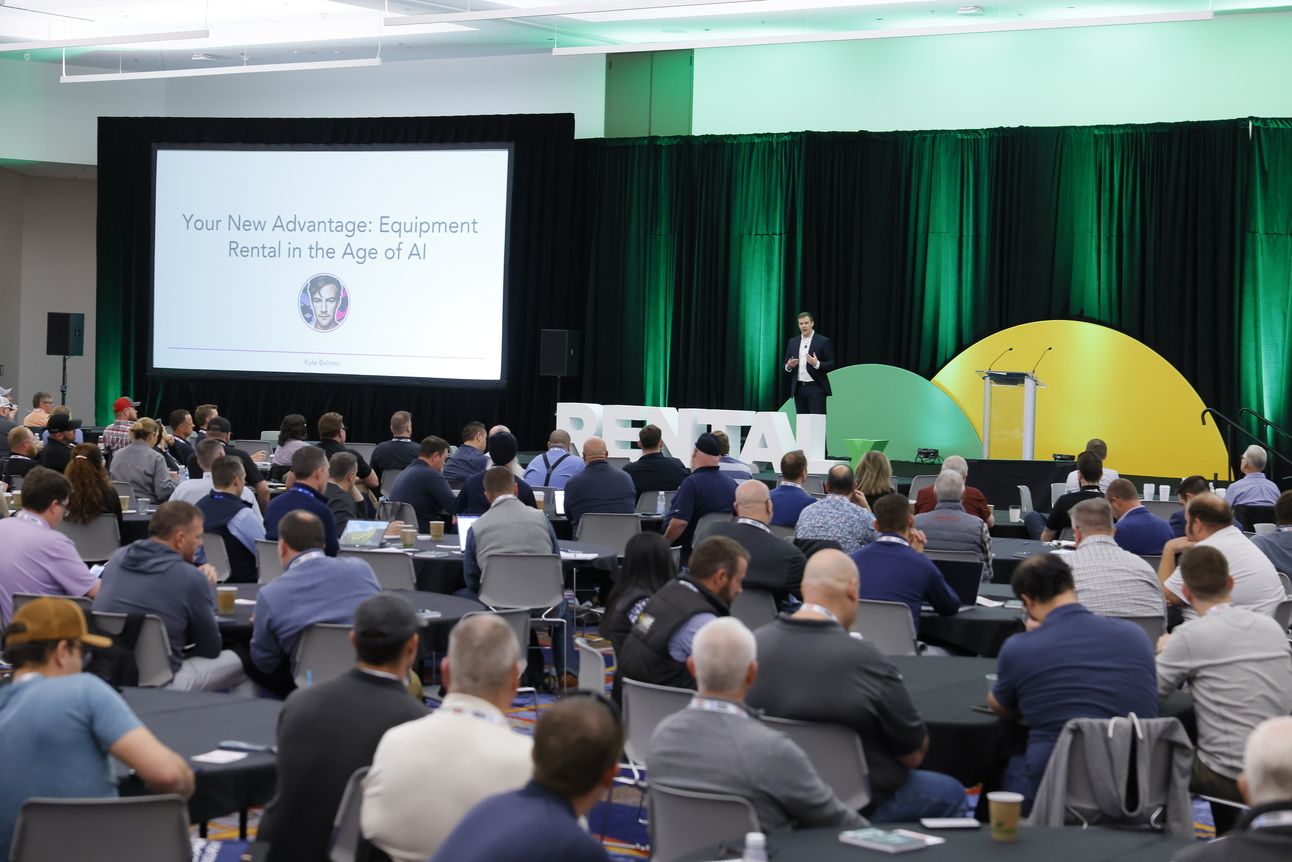
Pricing increases dramatically. When you're the recognised expert, you can charge premium rates because people understand your value before they even speak to you. I charge $4000/hour to give a talk which (frankly) seems mental.
Look at someone like Pieter Levels. He built (initially for fun) a flight simulator game in three hours using AI. Within days, it had 89,000 players and generated significant revenue. Luck? Hardly.
Levels spent the last decade building an audience that trusts his work. When he launches something - anything - they show up. That's the power of authority. And that is what you need to start building ASAP.
Here's what most people don't see coming: AI means that building will get easier, but being heard will get harder.
AI is democratising creation. Soon, anyone will be able to spin up an MVP in hours, not months. That means more competition, more noise, more products fighting for attention.
Ditto with content. As more content production can be automated (even if it is “AI slop”!) the airwaves will fill up. You’re going to have to shout louder and louder to be heard.
In a world where everyone can build, distribution becomes everything. The difference between a successful launch and a failed one won't be the quality of your product - it'll be whether anyone knows you exist.
Building an audience basically isn't optional anymore. It's survival. And the best time to start this if you haven’t is today.
I tested every growth hack, secret strategy, and algorithm trick the gurus sell.
It’s all junk.
Here's what actually moved the needle:
Consistency + Volume = Authority
That's it. No secret sauce. No hidden hashtags. No magic posting times.
Just showing up every single day and creating valuable content. One piece at a time. For months.
The hard truth? Most people quit after two weeks because they don't see immediate results. They're looking for the shortcut that doesn't exist. 🤷♂️
I posted every day for six months before things started clicking. Not because I'm naturally good at this - because I was willing to do the work that felt impossible at the start. And I’m stubborn…mainly stubborn.
And one day one video just…worked. I’m literally wearing my jacket because I was going out of the door and thought “ugh I have to do my stupid video”. Sat down, shot the thing. Went to meet friends at the pub.
Checked TikTok later than evening.
The video was at 500,000 views…
Damn…kinda cool! Maybe there’s something to this whole TikTok thing.
Woke the next morning. 1.5M views.
Wha…
And it kept rolling, all the way to 3.5M or so by the end of the week.
After that? I was off to the races.
BUT that came after months of plugging away with little to nothing in terms of results. And it’ll probably happen to you too. Sorry!
I run an AI Authority Accelerator where I give students 4 week of content and scripts to produce. Primarily to get them into the creative habit. Out of the 100 students I had 5 or so who pop off within the 30 days and get their first 100s of thousands of views (and 10,000 followers).
Great for them! Amazing work! But the key thing is that everyone just chug along and stick to the programme until the algo Gods decide it’s their turn. Consistency and volume beats all.
OK what about the nitty gritty?
You want to carve out space as the AI person in your specific industry. Not "AI expert" - that's too broad. "The AI expert for engineering firms." "The AI educator for charities." "The AI consultant for accountants."
You want to be THE person in your industry. So when someone mentions AI in the context of your industry you are the first person who comes to mind.
Every industry needs someone who can bridge the gap between AI capabilities and their specific business problems. Someone who speaks both languages - tech and business.
That someone could be you. A lot of industries do not have that person yet.
As highlighted before pick the industry you already understand. Don't try to learn a new sector while also learning AI content creation. Use your existing knowledge as your unfair advantage.
I know, I know. "But Kyle, I hate being on camera."
Join the club. Most of us do.
But here's why short-form video wins:
Authenticity beats polish. People don't want perfect production - they want real expertise from real humans. Your awkwardness is actually an asset. AND you’ll get better at speaking about your topic area by simply putting in the repetitions. It’s the ultimate public speaking practice!
Speed of creation. No editing, no fancy graphics, no complex setup. Record, post, move on. Boom, boom, boom. You can create more content faster. More rolls of the dice.
Platform preference. People consume technology content through video now. Books are boring (even though they're valuable). Don’t agree?? Don’t like that? Me neither. BUT…you and I can't fight this trend alone. It’s simply how most people consume information.
Low barrier to entry. Anyone can start. No expensive equipment or technical skills required. No faffing with gear and setups - that’s procrastination. Just point and shoot.
Short-form video lets you cut your teeth without the overwhelm of long-form content production. As someone who is just getting into long form (after a year of short form) believe me it’s a different ball game. Much more complicated and requires resources. Stick to short form to start.
Everything you create should follow this pattern: take AI news, tools, or techniques and filter them through your industry lens.
AI news through your industry lens: "New ChatGPT update: what this means for law firms"
AI tools through your industry lens: "I tested 5 AI writing tools for marketing agencies - here's what actually works"
AI techniques through your industry lens: "How to use prompt engineering for better client presentations"
Notice the pattern? You're not creating generic AI content. You're creating industry-specific AI content that nobody else is making.
Your audience doesn't care about AI in general. They care about how AI applies to their specific problems.
FYI my AI Authority Accelerator gives you 20+ content “types” to practice. I won’t outline them all here because it’s overwhelming. Start basic and layer in complexity as and when you feel ready.
The main thing is, repeat after me, volume and consistency. Just keep plugging away at the highest volume you can sustain.
98% of the people reading this will think “Yes! This sounds great and I will definitely do this. Let me just add that to my To-Do list and I’ll swing back to it in a week or so when I’m ready”.
Do you think they’ll do it?
Nah!
The key is starting before you feel ready. Your first videos will be terrible. Mine were. Everyone's are. Hell, go back and look at your favourite creator’s first video - chances are it’ll be terrible. Unless they deleted all their old stuff the cowards!
Here’s the thing. The person who posts terrible videos consistently will beat the person planning perfect content that never gets published.
Because the person posting will get better. Every video is a practice opportunity. A chance to get feedback. To see what works and what doesn’t. And also, as a nice bonus(!), a chance to pop off and get that first “viral” video.
Speaking of getting started - I run a 4-week AI Authority Accelerator that covers exactly this process. How to carve out your niche, create consistent content, and build authority in your specific industry.
It’s a 4 week day by day Accelerator rather than simply giving you the complete plan now. That’s because the name of this game is building a creative habit. Putting in the consistent work over several weeks. Rather than spaffing out 10 videos today and not doing any more for 8 months.
But you don't need to wait for an Accelerator to begin. Pick your niche today. Create your first video tomorrow. Post it even if it's rubbish.
I've also got free playbooks covering content creation and audience building - check those out if you want to dive deeper into the specifics.
But if you need extra structure and support then absolutely check out the AI Authority Accelerator and see if it makes sense for where you are right now.
In the next Part we'll explore the second legitimate AI opportunity: building actual solutions that businesses need. This is where your technical skills (even basic ones) meet real business problems to create tangible value.
Keep Prompting,
Kyle
"We need an AI agent to revolutionise our customer service!"
This was the opening line from a VP I talked to last month. Big company, serious budget, ready to throw money at the AI problem.
He’d heard about agents and thought (rightly!) that they sound pretty damn great.
But ten minutes into the conversation, I realised what they actually needed was a simple automation that checked their database and sent templated responses based on inquiry type.
No machine learning required. No complex reasoning. Definitely no "agent."
Something that honestly they could (and should!) have been doing years ago.
But agents sound sexier than basic "if this, then that" logic, don't they?
This is the trap a lot of businesses are falling into right now: over-engineering simple problems because AI marketing has convinced them everything needs to be cutting-edge.
Today we're talking about building solutions that actually work - not slick impressive all singing all dancing agent demos that break in production.
Let’s get started:
The automation spectrum: from simple rules to AI agents
Why most "AI agents" are actually just smart automations (and why that's fine)
How to match the right solution to the right problem
Your industry knowledge is your secret weapon for finding valuable problems
Before we talk technology, let's talk money. Crass eh? But important.
Say you find a task that takes someone 10 hours per week. At £50/hour, that's £500 weekly, £26,000 annually.
Per person.
Scale that across a team of 10? You're looking at £260,000 in annual labour costs for one repetitive task. Clean quarter million in savings. Every year from now on…
What do you think a business will pay for that? Decent money right.
This is why businesses pay serious money for automation solutions. Not because the technology is impressive - because the problem is expensive.
Solve an expensive problem and you can charge a good price.
When most people talk about "automation," they're actually describing three different things:
Traditional Automations - Pure "if this, then that" logic. No AI involved. Example: "When form submitted, create CRM record and send welcome email." We’ve been doing this sort of stuff since computers have been around.
AI Automations - Traditional automation with AI steps mixed in. Example: "When support ticket arrives, AI categorises it, then routes to appropriate team with AI-generated summary."
AI Agents - Systems that can plan, reason, and adapt their approach. Example: "Given a goal like 'increase customer satisfaction,' figure out what actions to take and execute them."
Here's the reality check: 90% of what businesses call "AI agents" are actually AI automations, the second definition here. They aren’t true agents.
And that's perfectly fine - they're often the best solution!
Type
Complexity
Reliability
Cost
Best For
Traditional
Low
Very High
Low
Predictable, rule-based tasks
AI Automation
Medium
High
Medium
Tasks needing some interpretation
AI Agent
High
Variable
High
Complex, multi-step problem solving
Here’s a video with me chatting about this too:
The key to building solutions that actually work?
We don’t start with the technology. We start with the (all together now!) business problem!
We don’t sell AI. We sell solutions.
And we start the simplest approach that could solve the problem.
Traditional Automation Examples:
Automatically creating invoices when projects complete
Moving leads through sales pipelines based on actions
Generating weekly reports from database queries
Scheduling social media posts
AI Automation Examples:
Customer service responses that understand intent and provide personalised answers
Content moderation that identifies problematic posts for human review
Lead scoring that analyses emails and website behaviour to prioritise prospects
Document processing that extracts key information and routes for approval
AI Agent Examples:
Research assistants that can gather information from multiple sources and synthesise insights
Project managers that can allocate resources and adjust timelines based on changing conditions
Personal assistants that can book travel, manage calendars, and handle complex multi-step requests
Notice the progression? Each level handles more complexity and ambiguity, but also introduces more potential failure points!
If a problem can be solved with a lower level, less complicate automation always do so. Do not add complexity for the sake of it. Even if you can charge a client more! It’s a disservice to over-engineer a solution.
Here's where most people go wrong: they see AI capabilities and immediately want to use them everywhere.
Customer inquiry about store hours? "Let's build an AI agent that understands natural language and can handle complex conversations!"
Or... you could just put your opening hours on the website and set up an auto-responder… that’ll get the job done. Probably better!
The sexiest solution isn't always the best solution. If traditional automation solves 80% of the problem reliably, start there. Add AI only when simple rules genuinely can't handle the task.
But what problems should you actually be solving? Let’s hop into that.
Remember what we covered in Parts 2 and 3? Your existing industry knowledge is your unfair advantage.
If you're in marketing, you know agencies spend hours creating client reports. If you're in operations, you've seen procurement teams drowning in vendor comparisons. If you're in sales, you understand how much time goes into lead qualification.
That intimate knowledge of business pain points is worth more than any technical certification.
So when starting to build and sell automations to businesses we start here. Within our industry, where we have a huge competitive advantage compared to generic automation providers.
Before building anything, map out the problem on paper:
Define the exact problem: "Sales team spends 15 hours weekly qualifying leads from website forms". If you can’t define the problem simply it’s probably not a problem.
Break down current process: "Receive form → Research company → Check budget fit → Score lead → Assign to rep"
Identify decision points: Which steps are pure rules? Which need human judgment?
Choose your approach: Can this be solved with simple logic, or do you need AI for interpretation, creativity and to deal with complexity?
Once you’ve worked out a basic problem let’s run it through a prompt to see what sort of solution is apt.
Here’s a quick interview prompt to get your expertise into an AI:
You are a business automation consultant helping me design the right solution for a specific problem. Interview me about my business problem and recommend whether it needs traditional automation, AI automation, or a full AI agent.

Ask me about:
1. The exact problem and current manual process
2. How often this happens and time spent per instance
3. What decisions or interpretations are needed
4. How much variability exists in the inputs/outputs
5. What level of accuracy is required

Then provide three solution approaches:
- Traditional automation (simple rules-based)
- AI automation (rules + AI where needed)
- AI agent (full reasoning and planning)

For each approach, include:
- What it would look like
- Pros and cons
- Estimated complexity to build
- Reliability expectations

Recommend which approach to start with and why. Focus on solving the problem as simply as possible while being genuinely helpful.
This forces you to think through the business logic before getting caught up in technical possibilities. We need a sense check to save us from ourselves!
Remember the CEO who wanted an AI agent? After mapping out their actual problem, we built a simple automation using their existing tools. Took two weeks instead of six months, cost 80% less, and worked reliably from day one.
They paid happily because we solved their expensive problem efficiently. The technology choice was invisible to them - they just cared about the outcome.
That's what businesses actually buy: solutions to expensive problems, delivered reliably.
Identifying profitable problems is far far (far) more important than the solutions you work on. I highly recommend spending more time on the problem and how you communicate and package it up than the actual first draft automation!
If you want to dive deeper into finding, building, packaging and marketing AI automations my 2-week AI Automation Accelerator with @brandNat takes you from problem identification to sellable product.
In the next Part we'll cover the final legitimate AI opportunity: teaching businesses how to implement AI effectively. This is where your knowledge from Parts 3 and 4 combines - you know how to talk about AI and you can build solutions.
We'll explore how to turn this expertise into high-value training and consulting that businesses desperately need. Like…all of them.
Keep Prompting,
Kyle
I once gave some AI workshops to a London based charity.
"We had one of the Big Four come in last month to talk about AI," the director told me after my workshop. "Spent two hours explaining gradient descent and neural networks. Half the room fell asleep, the other half looked terrified."
"What did you think of today?" I asked.
"Finally, someone who speaks human. Our team actually understands what they can actually do with AI now."
Businesses don't need AI experts.
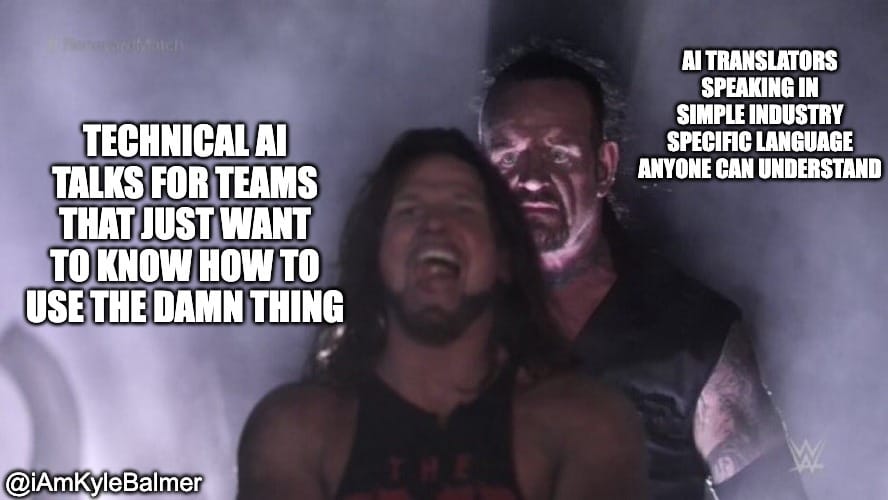
They need AI translators.
People who can bridge the gap between what's possible and what's practical for their specific world.
In this Playbook we've covered building authority, creating solutions, and now we're talking about the third legitimate opportunity (and the one I think is most exciting): teaching businesses to actually use AI effectively.
Let’s get started:
Why businesses desperately need AI education (but not the kind you'd expect)
How to start teaching for free and scale to $4000++/hour workshops
The surprising simplicity of what businesses actually need to learn
Your industry knowledge makes you a better trainer than generic consultants
Here's what happened over the past year: every business got the memo that they need to "do something with AI." Most have no clue what that something should be. Just…get to it! AI time!
The result? Massive demand for AI education. But not the technical kind - the practical kind.
There’s a pattern:
First some guy from the IT department does a session. Bless, he’s not the best communicator and doesn’t understand why everyone doesn’t seem to be “getting it”. Staff leave thinking AI probably isn’t for them.
Then a consultant or advisory company is brought in. They do an amazing, glitzy demo on AI and all it’s advances. We learn about the history of AI, why generative AI is different, how it works and are given a menu of different textual, visual, audio and other uses for AI. So wow! Such technology! Staff feel overwhelmed. Maybe they aren’t smart enough for all this?
Finally someone like myself (or one of my students) comes in. OK, here’s what AI is and how to think about it, here’s how to access it and we’ll run a couple of exercises suited to how you’ll be using it. And here are some experiments to play around with afterwards and some next steps. Got it? Cool. Staff members leave genuinely excited about what AI can do and start to mess around on a day to day basis.
The differences comes in talking the language of staff members. Breaking everything down to what actually matters to them. Do they need to know how the internet works to use it? Absolutely not - same with AI.
I started doing free workshops for charities because I genuinely wanted to help, and teaching forced me to learn faster. Word spread. Larger organisations started asking me to train their teams.
Now I (and my students) charge £1500-£4000++ per hour for workshops. Not because we're AI PhDs, but because we can explain AI without jargon to people who need to actually use it.
This might surprise you, but most AI training requests are simpler than you'd ever imagine.
We're embedded in the AI world. You’re reading this guide so I know you are!
We think about prompt engineering, fine-tuning, RAG systems. We keep up to date with the new models (well, we try to! Ha!).
We assume businesses need the advanced stuff.
They don't.
They need basics. Sometimes it's as simple as "how do I download the correct ChatGPT app and not fall for scams?" For real this is a biggy - getting people to download the correct OpenAI ChatGPT app on their phone…
Yeah: basic level!
Once all staff have been given a basic introduction sure we can go deeper.
For example we can do department-specific training:
Marketing teams learning to create better content
HR understanding how to screen applications more efficiently
Finance discovering how to automate routine analysis
Operations seeing how to streamline repetitive processes
etc.
And you can go into these different departments and give these after everyone has that base level foundation.
Here’s why you can do all this. And you can…
Generic AI consultants speak in technical terms. They talk about "large language models" and "training datasets."
You speak the language of your industry. You know the metaphors that make sense. You understand the actual problems people face daily. You can tell stories that relate.
The dudes in flash suits at McKinsey cannot. They are too embedded in the world of consulting. You can talk to your industry far better than they ever could because you live in it!
If you're training marketing teams, you don't talk about "token limits" - you talk about "getting better brief responses from your AI assistant." If you're with finance people, you don't explain "neural networks" - you show them how to automate expense categorisation. They don’t care how it works, only what they can do with it.
This is why I'm often brought in despite the IT department's preferences. Awkward! Teams need someone who can explain without intimidating.
The breakthrough insight for most workshop attendees? AI is fundamentally about communication.
This is the ONE big learning outcome I want for my attendees. Honestly. It’s that simple.
I show them that if they can use WhatsApp they can use ChatGPT and pretty much any AI.
I also show them how it’s their writing and speaking ability that matters.
Sure, it’s wrapped up in fancy language like “prompt engineering” but it’s at its core just communication. Here’s a related video:
Once people understand this, the fear disappears. Suddenly they're asking better questions: "How do I give this thing better instructions?" "What kind of tasks is it actually good at?"
That's when real learning happens. it becomes an actual constructive conversation about their work and what AI can do for them.
Want to break into AI training? Start with free workshops.
I began with local charities. Low pressure, genuine desire to help, and the perfect place to refine your material. You'll quickly learn what resonates and what confuses people.
Document everything:
Take photos of engaged audiences
Collect written testimonials
Record feedback about what worked best
Note common questions and objections
This becomes your credibility package for paid workshops. You then “rank up” and start to charge increasing amounts. My first paid workshop was around £100/hour only!
The progression looks like this:
Free workshops: Build credibility, refine material, get testimonials
$500-1000: Local businesses, business groups, small teams, proving your value
$1500-2500: Mid-size companies, department-wide training
$3000-4000: Large organisations, conferences
Seems like a lot of cash for you personally right?
I thought this too until I reframed.
So I gave a talk once to 400++ people. Probably 500 but let’s keep the numbers easy.
It was a one hour talk, 400 people, $4000. That’s $10 per attendee.
Huh. Wait. That’s CHEAP!
Sure as an individual I still walk away with $4000 for an hour. Fantastic. Very happy. But the client got $10/hour/attendee training. Very cost effective. Everyone wins.
Once you reframe like this you realise how it’s possible to charge so much. It’s because you are delivering even more value.
The beautiful thing about AI training? It opens doors to everything else.
After a successful workshop, you become the go-to AI person for that organisation. They'll ask about:
Ongoing consulting on AI strategy
Custom automation projects (hello, Part 4)
Executive briefings for leadership
Department-specific implementation help
One workshop can turn into months of work if you deliver genuine value. Basically you are getting a foot in the door and showing them you know what you talk about. You are just getting paid at the same time.
If you want to start running workshops but don't want to build everything from scratch, I license my complete AI Workshop Kit. All the materials, slides, and frameworks I use plus training on how to customise materials and find clients. The whole shebang!
We've covered the reality behind the AI gold rush and three legitimate paths to profit:
Part 1 exposed the hype machine and why most AI "opportunities" are repackaged get-rich-quick schemes.
Part 2 reminded us that business fundamentals haven't changed - AI enhances how we create value, but doesn't eliminate the need for solving real problems.
Part 3 showed how building authority in your niche creates multiple revenue streams and positions you as the go-to AI expert in your field.
Part 4 explored building actual solutions - from simple automations to AI-powered systems that solve expensive business problems.
Part 5 revealed how teaching businesses to use AI practically can command premium rates while opening doors to consulting and implementation work.
The thread connecting all three opportunities? Your existing industry knowledge combined with practical AI understanding creates genuine value that businesses will pay for.
Start with Authority (Part 3) if you enjoy creating content and have patience for long-term building. This also creates a great foundation for everything else. With distribution you can launch other ventures more easily.
Jump to Solutions (Part 4) if you're more technically inclined and want immediate revenue from solving specific problems.
Begin with Training (Part 5) if you're comfortable presenting and want to leverage your existing industry connections quickly.
The beauty? These paths reinforce each other. Authority gets you training opportunities. Training reveals solution needs. Solutions provide case studies for more authority. It all works hand in hand - yay!
The AI gold rush is happening. And there is money to be made. Lots of it.
But it's not in the automated empires the flashy marketing guys promise. It’s still not easy.
It's in being the bridge between AI capabilities and business reality. It's in solving actual problems for actual people with budgets. It's in making this transformative technology accessible to the businesses that need it most.
Boring, profitable work!
Keep Prompting,
Kyle
Unlock the secrets to monetizing artificial intelligence with our comprehensive playbook, 💲How to actually make money with AI. This guide dives deep into the reality of the AI gold rush, equipping you with practical strategies that have generated significant income for countless individuals and businesses. Gone are the days of empty promises and get-rich-quick schemes; this playbook is rooted in solid business principles that guarantee real results. Immerse yourself in actionable insights that will transform your understanding of AI and how to leverage it for financial gain.
This playbook is designed for entrepreneurs, business consultants, and professionals in various industries looking to harness the power of AI for financial success. If you're overwhelmed by the hype surrounding AI and unsure how to navigate the landscape, this resource is perfect for you. You'll discover how to turn your existing skills and industry knowledge into a lucrative AI consulting practice, bridging the gap between technical AI concepts and practical business applications.
No prior AI knowledge is necessary! This playbook is structured to guide you from the basics to advanced strategies, making it accessible for everyone.
While the time commitment varies based on your pace, many readers report seeing initial results within a few weeks of applying the strategies outlined in the playbook.
Absolutely! The focus is on practical application rather than technical expertise, empowering you to leverage AI effectively in your business.
Yes! The strategies in this playbook are designed to be flexible, allowing you to implement them alongside your current commitments.
Unlike other courses that promise quick fixes, this playbook is grounded in real-world business principles and focuses on actionable steps to create sustainable income.