AI Authority
Welcome to the 👐 Hands-Free Content Machine, your ultimate guide to transforming the way you create content.
Start ReadingYesterday, I did something that blew my own mind. I created a complete 2,000-word sales page—from scratch—in just over an hour while sitting in the garden in Cyprus enjoying the sunshine.
And here's the kicker: I challenged myself not to type a single word. Not one keystroke. I wanted to see just how far I could get by simply vibing with AI through conversation.
The inspiration? Pure necessity. The Mediterranean sun was so bright I could barely see my screen. Oh poor me! 😅
Typing and constantly correcting myself was becoming frustrating. So I thought, "Why not just use voice input instead?" Little did I know this constraint would lead to a breakthrough. Father of necessity and all that.
For context, this kind of work typically takes my team days (sometimes weeks) to produce. In fact, I told my business partner I'd "get started" on the sales page, expecting it to take at least a day or two.
When I delivered a complete first draft just an hour later, their reaction was one of pure shock. And if you're hiring a professional copywriter? You're looking at thousands of pounds and a multi-week timeline. No longer.
But there I was, lounging in my garden chair, speaking my thoughts aloud, and watching as a comprehensive, persuasive sales page materialised before my eyes.
No typing whatsoever. No staring at a blank page. No endless revision cycles with a team. Just me, talking through my ideas as if I were explaining them to a colleague.
And it doesn't just work for sales pages—this approach can revolutionise how you create any substantial content: case studies, white papers, landing pages, product descriptions, email sequences, you name it.
Let's get started:
Why traditional content creation is painfully inefficient
The "AI interview" approach that changes everything
How speaking unlocks ideas typing can't reach
A 7-step framework anyone can follow
Expanding beyond sales pages to all content creation
What started with expediency (couldn’t see sh*t) became a personal challenge.
I started with a simple question: how much of the content creation process could I do without ever touching a keyboard? Could I create professional-quality, high-converting copy just by speaking?
This wasn't a totally random challenge. I've long suspected that many of us (myself included) get in our own way when writing. We overthink, we self-edit too early, we get stuck in perfectionism loops. Speaking bypasses many of these mental blocks.
So I set the parameters: create a complete sales page for a real product launch without typing a single word. Everything had to be done through voice or AI interaction.
The results surprised even me—and I've been doing this AI stuff for quite a while now.
I had one of those “oh wow ok this changes everything” moments that are becoming increasingly rare. We have so many “breakthroughs” in AI that we become inured. But this was a legit holy crap moment.
For instance I was initially struggling with exactly what story would grab attention at the top of the page. By speaking it through—stuttering, backtracking, thinking aloud, absolutely making a mess of it—I was able to discover the narrative I was looking for.
The AI then extracted the essence of my rambling, removing all the roundabout talk and distilling it into a clean, powerful story hook.
If you've ever created (or paid for!) a sales page, you know the drill:
You start with a blank document and that familiar sense of dread. Where do I even begin? You type a few sentences, delete them, try again. The first draft takes days of concentrated effort.
Then come the revisions. Is it persuasive enough? Does it cover all the objections? Is the tone right? Does it have enough social proof? The edit cycles seem endless.
If you're working with a team or a copywriter, add in multiple rounds of feedback, conflicting opinions, and that all-too-familiar feeling that something's still missing.
All told, you're looking at a process that might take weeks and cost thousands—and that's if you're efficient! I know some entrepreneurs who haven’t started yet because they’ve hit this roadblock.
What if instead of writing, you could just talk? What if instead of staring at a blank page, you were answering insightful questions about your product or service? What if instead of endless revision cycles, you could see patterns and gaps immediately and fill them on the spot?
Here's the biggy: The bottleneck in content creation isn't usually knowledge or expertise—it's extraction and organisation.
You know this stuff inside and out. You know your customers' problems. You know why your solution works. But getting all that knowledge out of your head and onto the page is hard.
Here's the process I used to force that knowledge out of your head:
Start with a trusted framework: I began with a proven sales page structure. You can ask AI for a framework, reference a specific expert's approach, or even upload examples of what's worked for you before.
The interview setup: I had the AI analyse the framework and prepare a series of targeted questions it would need to fill in the details. It came back with about 15 questions covering everything from my product features to customer pain points and objections.
Speak your expertise: Here’s the magic bit. I simply went through each question, speaking my answers naturally. Some responses came easily, others I worked through by thinking aloud. The key is that speaking removes many of the barriers writing creates—it's more natural, more fluid, and often more authentic.
Compile and identify gaps: Once I'd answered the questions, the AI compiled everything into a first draft and immediately identified areas that needed more detail or clarity.
Add credibility with data: I noticed the draft was persuasive but could use more concrete evidence. I used AI research tools to find relevant statistics and case studies that supported my claims.
Identify supporting materials: The AI helped me identify what images, testimonials, graphs, or videos would strengthen specific sections of the page.
Final assembly: The completed text was ready to be formatted into a proper sales page on our website. The whole process took about an hour of active work on my part.
This hands-free approach is revolutionary for several reasons:
It bypasses writer's block completely. Speaking is natural—most of us can talk about our businesses for hours. There's no blinking cursor, no blank page anxiety. We are yappers and this lets us yap.
It's a form of "rubber duck debugging" for your messaging. The act of explaining something out loud often clarifies your own thinking in ways that silent reflection doesn't. It’s used in programming a lot when you don’t have a coding partner.

Also referenced in the Matrix Resurrections
It creates a dialogue rather than a monologue. The AI asks follow-up questions, spots inconsistencies, and helps you build a more complete picture.
It separates content creation from formatting and design. You focus purely on the message first, then handle the presentation later. No self editing on the fly!
It dramatically improves the experience of creating content. Working outside in the sunshine rather than hunched over a keyboard made the whole process enjoyable. By the end, I was literally hopping around excitedly at how liberating this approach felt. Work doesn't have to feel like work! (And yes I know I’m meant to be on holiday…)
While I'm using a sales page as the example, this approach works for virtually any substantial content creation task:
Case studies: Tell the story of your client's transformation conversationally, then let AI structure it into a compelling narrative.
Video scripts: Outline your thoughts verbally, then refine them into a tight script without staring at a blank page.
Email sequences: Describe your customer journey and key messages verbally, then let AI shape them into a cohesive sequence.
White papers and reports: Share your research and insights conversationally, then have them transformed into a professional document.
Website copy: Talk through your brand story, services, and unique value proposition, then see them transformed into compelling website sections.
The applications are endless here. I’ll use my sales page as a concrete example in this Playbook but you can apply this to whatever substantial, structured content you need to produce.
Hell, you could probably make a dent in a PhD using the same method…
In Part 2, we'll dive deeper into the "co-working with AI" aspect of this process. I'll show you exactly how to set up the perfect framework and conduct an effective AI interview.
You'll learn how to tap into the power of "rubber duck thinking"—where simply explaining something out loud helps you clarify your own ideas and discover insights you didn't know you had.
Quack.
Keep Prompting,
Kyle
Over the years, I've worked with various mentors and coaches who also happen to be high-end business consultants. One thing that always struck me was their fees—£1,000+ per day to essentially ask questions and listen.
Their "secret sauce"? They don't tell clients anything they don't already know. They simply ask the right questions, listen intently, and then repeat back what they heard but in a more structured, lucid way.
Now we have that same capability in our pocket. The AI isn't writing your sales page or case study for you—it's extracting, organizing, and polishing what's already in your head. It's being your personal consultant, asking you the right questions at the right time, without the £1,000/day price tag.
Today, I'm pulling back the curtain on exactly how this co-working relationship functions. How to set up the framework, conduct the AI interview, and use "rubber duck thinking" to produce your best work ever—all without typing a single word.
Let's get started:
Why traditional writing processes fail most entrepreneurs
Setting up the perfect interview framework
The voice recording tools to use (and which to avoid)
How to leverage "rubber duck thinking" for breakthrough insights
Turning rambling thoughts into compelling content
When I told you in Part 1 about creating that sales page while lounging in the garden in Cyprus, I may have made it sound a bit too magical. Let me be clear: AI isn't doing the hard thinking for you.
You're still the expert on your business, your products, and your customers. That’s all you baby.
What AI does brilliantly is play the role of the perfect interviewer—asking probing questions, spotting gaps in your thinking, helping you articulate your thoughts more clearly, and then organising everything into a coherent structure.
Think of it as having a world-class consultant or copywriter at your disposal 24/7, but one who:
Never charges by the hour
Never gets tired of your rambling
Never judges your half-baked ideas
Never forgets what you said 10 minutes ago
Never imposes their own agenda(!)
That's pretty powerful, right? But to make this partnership work, you need to set it up correctly!
The first step in our hands-free content creation process is establishing a solid framework. Without this, you're just talking aimlessly, and no amount of AI magic will transform rambling thoughts into compelling content.
While I'm using a sales page as our concrete example throughout this series, remember that this approach works for virtually any content type—case studies, white papers, email sequences, video scripts, etc. etc. you name it. The framework will change, but the process remains the same. So…just think about how you want to use this and you’ll be solid.
There are three main ways to establish your framework:
The simplest approach is to say something like:
"I need to create a sales page for [your product]. Can you provide a proven sales page framework with the main sections I should cover?"The AI will typically respond with a solid structure like:
Attention-grabbing headline
Emotional hook or story
Problem statement
Solution introduction
Features and benefits
Social proof/testimonials
Objection handling
Pricing and offer details
Call to action
Risk reversal (guarantee)
This approach works well if you're new to the content type you're creating.
The above is totally fine but (by its very nature) a bit generic.
If you prefer a particular expert's methodology, you can directly reference it:
"I want to use Russell Brunson's 'Perfect Webinar' framework to structure this sales page. Can you outline the key components of that framework and prepare questions for each section?"This approach leverages established wisdom in your industry while making it easy to follow a specific style or methodology.
If there’s a well known framework your AI will have that information.
My favourite approach is to provide examples of content that you admire or that has worked well for you in the past:
"I'm going to share a sales page that converted extremely well for a similar product. Please analyse its structure and create a framework based on the patterns you observe."You can then paste in the text of a sales page, case study, or email sequence that you want to emulate. Depending on the AI model you're using and whether it has internet access, you'll typically need to copy and paste the actual content rather than just providing a URL.
This is great if you want to, ahem, borrow from a known company’s sales page. Chances are they spent a lot of time and money building that. You’re going to piggyback by extracting the structure and aligning it to your product.
Once you have your framework, the next step is turning it into an interview protocol. This is where the consultant approach really shines.
You simply ask:
"Based on this framework, what questions would you need to ask me to gather all the necessary information to create a compelling [content type]?"The beauty of this approach is that you're not speaking differently to the AI than you would to a human expert. What makes it powerful is that you're essentially talking to an infinitely patient, infinitely attentive listener who can extract the core meaning from even your most rambling responses.
Unlike a human consultant who might get bored, lose focus, or impose their own ideas, the AI cuts through all the excess verbiage and babbling to distill the essence of what you're trying to communicate—often better than you could do yourself! It's like having a conversation with someone who's laser-focused on understanding you.
When I tried this for my sales page, the AI came back with about 15 questions spanning everything from the core problem my offer solved to specific objections customers might have.
One set of questions the AI threw at me that led to a genuine breakthrough was:

Here’s how my response looks:
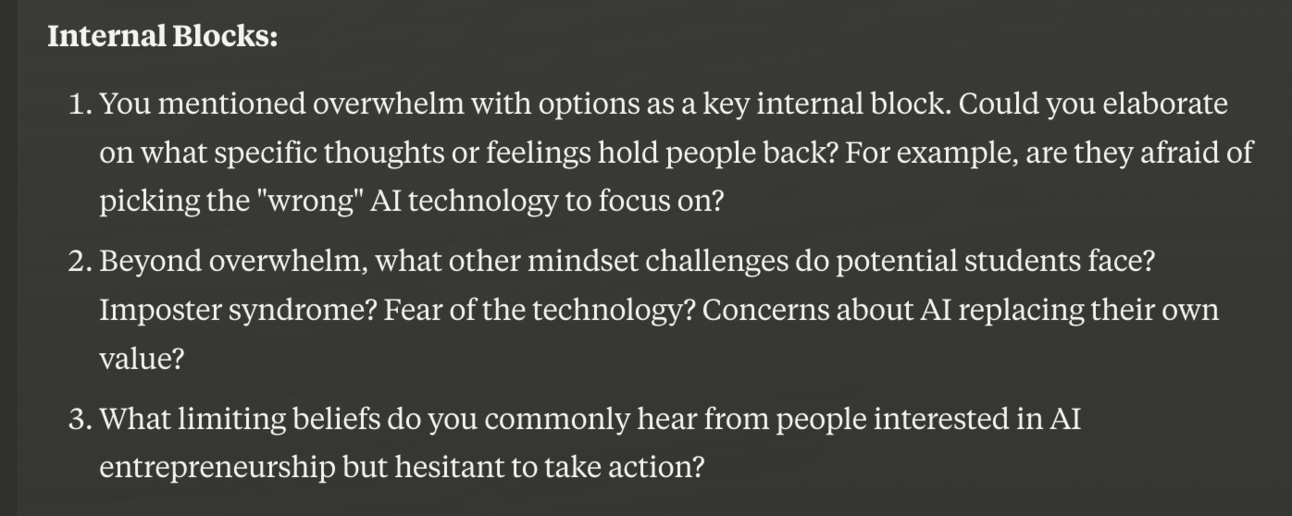
Absolute rambling mess! Literally making it up as I went along.
But that’s fine! I could answer these conversationally, one by one, without the pressure of crafting "perfect" written responses. Just talking, as if I were explaining my offer to a friend or colleague.
Off the back of this question I ended up addressing impostor syndrome—specifically, the feeling many potential customers have that they "don't know enough about AI" to succeed with my program. I might never have directly addressed this barrier had the AI not specifically asked about internal blocks.
For this method to work smoothly, you need the right voice input tools. I've experimented with several approaches, and here are my recommendations:
Both ChatGPT and Claude have built-in voice-to-text features that work brilliantly for this purpose. I recommend using these standard voice input features rather than the advanced conversational modes for several reasons:
They allow for longer, uninterrupted speaking time (5+ minutes without cutting you off)
You can take natural pauses to gather your thoughts
You have full control over when the AI processes your input
You can see what was transcribed before the AI responds
On mobile, you'll find the microphone icon right in the input field. On desktop, you may need to enable your browser's speech-to-text functionality.
A heads-up on one limitation: With particularly long recordings (typically over 5 minutes), the recording might suddenly stop. Don't panic! Just note the question number you were on and resume recording from there. When this happens to me, I simply say "Continuing from question 7..." and pick up where I left off. The AI has no problem connecting these segmented responses.
ChatGPT Advanced Voice mode is amazing but less ideal for this specific content creation approach because:
They tend to interrupt your flow of thought
They often process shorter chunks of speech
They don't always give you a chance to review what was transcribed
You have less control over the pace and rhythm of the conversation
Save these for more casual brainstorming or quick Q&A sessions. For our purposes we just want to talk and the AI to listen.
The secret sauce here powerful lies in what programmers call "rubber duck debugging"—explaining problems to an inanimate object (traditionally a rubber duck) to find solutions. The act of explaining often reveals insights that silent contemplation doesn't.
You’ve probably notice this happen before when explaining a problem to a friend. Simply by talking about what the problem is you gain clarity - and often see the solution before your friend even responds.
This is exactly what happened with the story hook for my sales page. I was struggling to find the right narrative angle, so I just started talking through different possibilities, backtracking and contradicting myself along the way. Through this verbal exploration, I found the perfect story hook—something I might have spent hours trying to craft if I'd been staring at a blank page.
After you've answered all the interview questions, simply ask the AI to compile everything
We’ve covered a lot so here’s a basic flow laid out with the exact prompts you can use:
Step
Prompt
Establish Framework
"I need to create a [content type] for [your product/service]. Can you provide a proven framework based on [expert's name]'s approach with the main sections I should cover?"
Generate Questions
"Based on this framework, what questions would you need to ask me to gather all the necessary information to create a compelling [content type]?"
Answer Questions
Use voice input to answer each question in turn, speaking naturally
Compile Draft
"Based on all my answers to your questions, please compile a first draft of the [content type] following the framework we discussed."
Identify Gaps
"What sections of this draft need more detail or clarification to make the [content type] more compelling?"
Fill Gaps
Use voice input to provide additional information for the identified gaps
Finalize Draft
"Please update the draft with this additional information and refine the overall flow and coherence."
This sequence will guide you through the entire hands-free content creation process. You can adapt these prompts to suit your specific needs, but the basic flow remains basically the same.
In Part 3, we'll look at how to take your rough draft and transform it into a polished, persuasive final product. I'll show you how to:
Use AI to punch holes in your own argument (and then fix them)
Add credibility with data and research
Identify the perfect supporting visuals and social proof
Test different versions against each other
Prepare the final document for deployment
Keep Prompting,
Kyle
During a workout last week I refined my entire sales page using just my voice - no keyboard required.
By the time I finished my cardio session (a bit breathlessly, I might add..it’s been a couple years since my last marathon), I'd completely overhauled the value prop, added new sections addressing objections, and refined the call to action.
This is the beauty of the hands-free content approach: it transforms "dead time" into productive time and removes the friction that keeps us from creating high-quality content.
In Parts 1 and 2, we covered the basics of hands-free content creation and the co-working relationship with AI. Today, we'll start to refine your rough draft into a polished piece.
The Rundown is the most trusted AI newsletter in the world, with 1,000,000+ readers and exclusive interviews with AI leaders like Mark Zuckerberg, Demis Hassibis, Mustafa Suleyman, and more.
Their expert research team spends all day learning what’s new in AI and talking with industry experts, then distills the most important developments into one free email every morning.
Plus, complete the quiz after signing up and they’ll recommend the best AI tools, guides, and courses – tailored to your needs.
Let's get started:
The essential human-in-the-loop review
Testing your content against common objections
The iterative refinement process
Collaborative editing techniques
Preparing for final enhancements
Before we let AI evaluate our content, there's an essential step: the human review.
This "human-in-the-loop" approach remains a crucial part of the AI skill set - it’s amateur to skip this and rely too much on the AI! Don’t do it.
In the case of our sales page, you remain the expert who knows your product, service, and audience better than any AI ever could. Without your guidance, you'll end up with generic ChatGPT slop.
The simplest and most “natural” way to do this is to read through your draft and give feedback on the fly:
"This introduction paragraph feels a bit wordy. Let's tighten it up by removing..."
"I like the point about X, but we need to expand on it with..."
"This section doesn't flow well from the previous one. Let's add a transition that connects..."
This works fine but tends to focus in on the small issues rather than larger (more important!) requirements.
Let’s look at how we can systematise this a bit better.
First up we can have AI do a critical pass of the work. Duh!
You can either use the same AI or port your content to a second AI for a fresh perspective - experiment with both approaches.
The challenge here is that AI tends to be agreeable and may simply praise your work rather than finding flaws. We need to specifically prompt it to be critical:
Please critically evaluate this draft WITHOUT PRAISE OR POLITENESS. I need you to be honest. Identify weak arguments, missing information, logical inconsistencies, sections that need strengthening, and objections someone might have after reading this. Don't hold back - finding flaws now will help me improve the final version.

Equally do not point out flaws for the sake of it.
Ideally use a Reasoning or more advanced model for this.
For my sales page, this analysis revealed three critical issues:
The story wasn't adequately tied to the offer - they felt disconnected
I hadn't established my credibility for teaching the subject
The pricing section was completely missing (as I was initially building it for a waitlist so this was very true!)
The beauty of this approach is that once these issues are identified, you can immediately address them—again, hands-free. Simply speak your thoughts on how to resolve each issue, and the AI will implement the changes.
Once we have the most glaring problems resolved we can get stuck in ourselves. We’re going to start to provide specific feedback of increasing granularity.
The key is to work from large-scale issues down to the details - don't get lost in sentence-level edits when the entire structure needs reworking. Here's the hierarchy I follow:
Begin with the big picture. Is the information in the right order? Are there logical gaps in the flow?
No? Then ask for large structural refinements. For example:
I think the overall structure needs adjustment. Let's move the section about [topic] before the section on [other topic], and then add a new section about [missing element].Generally to make sure the AI knows what section I’m talking about I’ll read the header or the first sentence.
Once the overall structure is solid, focus on improving specific sections. Ie:
The section on [topic] needs improvement. Here are my thoughts on how to make it stronger...Then speak freely about what you want to change in that section, often thinking through options aloud. You can even talk around the subject until you’ve found the answer yourself! The AI cuts through your verbal exploration bit and implements the essence of what you're trying to communicate. Super useful if you are verbose like me!
Only after the structure and sections are solid should you focus on fine-tuning individual sentences and word choices:
In the third paragraph, the sentence starting with 'Furthermore' is too wordy. Let's make it more direct and impactful.or 🤣 ":
Goodness me don't use the word "delve" - everyone will know you are ChatGPT! Don't miss the forest for the trees - handle the big issues first, then work your way down to the details. If you start changing individual word choices right off the bat it’s going to take a while to get through the edit!
Importantly, you can repeat this entire process multiple times. With each cycle, you'll notice the issues becoming fewer and less significant. When you find yourself making only minor tweaks at the sentence level, that's your signal that the content is ready for the next phase of enhancement. This is the iterative process: until it’s no longer required.
Beyond the basic refinement process, here are some powerful techniques to enhance your collaboration with AI. These are a bit more grab-bag but hopefully helpful.
Getting the tone right is crucial for connecting with your audience:
The tone of this draft is too [formal/casual/technical]. Please revise it to be more [conversational/authoritative/accessible] while maintaining the key messages.Pro tip: AI can actually analyse your speaking patterns from your voice inputs and emulate your natural tone in the written content. Extremely cool. For a sales page, this conversational authenticity can be incredibly valuable. For other content types like case studies or white papers, you might want a more formal tone.
You can also upload writing samples you'd like to emulate, whether they're your own previous work or examples from others in your industry.
If a section is too complex or jargon-ey:
This explanation of [concept] is too complicated. Please rewrite it as if explaining to a smart 12-year-old while preserving the key information.For trimming bloated content:
This draft is too lengthy. Please condense it while preserving all key points and maintaining the flow. Cut unnecessary examples, redundant phrases, and overly wordy explanations.This approach helps you trim excess verbiage without losing valuable content. You can direct the AI to focus on specific sections that feel particularly bloated or ask for an overall tightening of the entire piece.
FYI: most AIs are rubbish at word counts so don’t both with instructions like “cut it to 200 words”. It won’t work and you’ll get annoyed. It’s a common error early users of AI make and then complain AI is rubbish. 🤣
At this stage, you've refined your core content through human review, critical appraisal, and iterative improvement. Your draft should now have:
Clear, logical structure
Consistent tone and voice
Compelling arguments and explanations
Natural flow between sections
No obvious gaps or weaknesses
But we're not quite finished. In Part 4, we'll explore how to add credibility to your content through data, research, and supporting elements. We'll leverage AI Deep Research to find the perfect statistics, case studies, and expert quotes to strengthen your arguments.
And yes, all hands free.
Keep Prompting,
Kyle
For instance, a sales page filled with hype but no substance makes me skeptical.
So for my sales page, I decided to scatter supporting facts and figures throughout to increase conversion rates.
Obviously using AI research capabilities to find exactly what I needed!
Let's get started:
Why evidence transforms good content into great content
Leveraging specialized AI research tools
Finding and integrating compelling data
Identifying supporting visuals and materials
Strengthening social proof
Validating credibility
In Part 3, we refined our basic content structure and flow. Now we're going to add an additional layer to step it up.
This step is optional depending on your content type, but it's particularly valuable for:
Sales pages (to back up claims and reduce skepticism)
White papers and case studies (to establish authority)
Blog posts and articles (to increase trustworthiness)
Presentations and pitch decks (to convince stakeholders)
Video scripts (to add credibility to verbal claims)
Not every piece of content needs this level of evidence, however. For instance, personal stories, creative writing, routine updates, or internal communications might not require extensive research. So consider this step optional.
The first step is finding every assertion in your content that would benefit from supporting evidence.
Basically what in your sales page or document is going to raise eyebrows??

Here's the prompt I use:
Please identify all claims, assertions, or statements in this draft that would be strengthened by supporting data, statistics, case studies, or expert quotes. This creates a clear shopping list of places where you need to add credibility through evidence. Good first step.
And yes…we are 100% going to look for evidence that supports our conclusions. Cheeky? Yes. But we’re not doing balanced academic research here. If you DO need more balanced arguments specify this in the research step.
So we could go off and find our own supporting evidence.
This is where having access to the right AI research capabilities becomes crucial. At the time of writing, I recommend:
ChatGPT Deep Research
DeepSeek (R1) - particularly strong for in-depth reasoning and research, and it's free to use (horray!)
The key is to use models with strong research skills, ideally more than one since they'll often find different information from various sources. You can combine all their findings.
Whatever the best research tools are when you're reading this, use those. This space is evolving rapidly, but the approach remains consistent.
For each claim that needs support, craft a focused research prompt. Here's a generic template you can adapt to any topic:
Find credible information about [your specific topic], including data points, case studies, expert opinions, and industry examples. Focus particularly on [specific aspect you need]. Include sources for all information provided.The key to effective research prompts is specificity:
Particular industries or contexts
The type of information you need (statistics, case studies, examples, quotes)
Credible source requirements (academic, industry reports, news articles)
Note: you can also ask the models to go and find support data for ALL the points you need to make but be aware that it’ll find less info per point. Experiment to your own needs here.
When using specialised research tools like ChatGPT's deep research capability or DeepSeek's R1 model, you'll often get extensive results. Here's how to bring it all together:
Copy all the research from your research tool back to your primary chat (this is one step where you will need to use your keyboard)
Use this prompt with the pasted research:
Using the research copied below, please distill the 5-7 most compelling and relevant pieces of evidence that match my shopping list of claims needing support. For each data point, provide:The specific claim from my shopping list this evidence supports
*The statistic or finding itself
*The source
*A suggestion for how to incorporate it naturally into my content
Finally, integrate the evidence:
Please integrate these statistics and evidence points into my draft. Ensure they flow naturally within the existing text and include appropriate attributions.For my sales page, this process allowed me to transform general statements like "AI automation helps businesses operate more efficiently" into specific, credible claims like "Businesses implementing AI automation solutions report an average 35% reduction in process time and 28% decrease in operational costs (Harvard Business Review, 2024)." and even provide a link to the research for the very analytic!
That's the difference between making a claim and proving it.
And
Content is rarely just data and statistics. Visual elements like charts, graphs, infographics, and images can dramatically enhance credibility and engagement.
While AI can't create most of these elements for you (yet), it can identify exactly what supporting materials would strengthen your content.
Try this prompt:
What supporting materials (images, graphics, charts, videos) would enhance this content? For each suggestion, please specify:

*What the element should show/contain
*Where it should be placed in the content
*Why it would be valuable to include
For my sales page, this analysis suggested:
A comparison chart visualising efficiency gains before and after automation
Specific places where client testimonials would address potential objections
Areas where process diagrams would clarify complex concepts
Suggestions for before/after scenarios that would demonstrate transformation
While you'll need to create or gather these materials separately, having a list of targets to create makes the process much more efficient.
Perhaps the most powerful form of evidence is social proof—testimonials, case studies, and examples from others who have experienced what you're describing. I’ve written whole Playbooks on this elsewhere - it’s super important. But let’s cover some additional help here.
If you already have testimonials or case studies, you can ask the AI to identify the optimal places to include them:
Here are testimonials from previous clients. Please suggest the best places to integrate them into my content to address potential objections and strengthen key claimsUse this alongside a copy/paste or page full of your prior testimonials and reviews and the AI will pick those that’ll back your arguments up.
If you don't have testimonials yet, the AI can help you identify what kinds would be most valuable:
Based on this content, what specific types of testimonials or case studies would be most effective in building credibility? For each suggestion, explain what kind of client/result would be ideal and what specific concern it would address.This analysis can guide your customer feedback process, helping you gather testimonials that directly address the specific objections or concerns potential customers might have.
OK one final piece! Once you've integrated all your evidence and supporting materials, it's time for a final credibility check:
Please evaluate this content from a skeptical reader's perspective. Are there any remaining claims that lack sufficient evidence? Are any statistics or quotes used in misleading ways? Is the evidence balanced and fairly presented? What else could be added to make this content even more credible and convincing?
This helps identify any remaining weaknesses before you finalise your content.
Remember, this is also an excellent time for a human review. Show your content to another person (shock horror!); a colleague, friend, or even potential customers. Consider posting parts of it on social media to gather feedback as you "build in public."
In Part 5, we'll explore how to prepare your content for deployment and discover how this approach applies to various content types beyond sales pages.
Keep Prompting,
Kyle
I was recently chatting with a friend who runs an agency. He knows he should be creating more content—more case studies, more emails, more articles.
He understands all the benefits of content marketing for the long term.
But at the end of a full day of client work, sitting down to write is the last thing he wants to do. It just never becomes a priority.
When I explained the hands-free content approach we've been exploring in this series, he was skeptical but willing to try. Two days later, he texted me: "This s*** works. Written more today than past year.”
This is why I've been so excited to share this approach with you. It's not just about creating a sales page (though that's a great place to start)—it's about removing the friction from ALL your content creation.
In this final part of our series, we'll cover how to publish your content and how to adapt this approach to various content types beyond sales pages.
Let's get started:
Publishing your content for various platforms
Expanding beyond sales pages to other content types
Building a sustainable content creation habit
Your action plan to get started today
Once you've refined your content and enhanced it with credibility elements, it's time to prepare it for publication. The specific steps will obviously depend depending on where and how you're publishing, but the process remains similar.
First, ask the AI to format your content appropriately for its destination:
Please format this content for [destination platform]. Include appropriate formatting tags, section breaks, and any platform-specific elements.For example, if you're preparing content for your website:
Please format this for WordPress, including appropriate H2 and H3 headings, bulleted lists, and suggested places for call-to-action buttons.Or for other uses:
Please convert this content to Markdown format for publishing on GitHub. Just give it the specific format you need and your AI should be able to do the heavy lifting.
For any supporting materials you identified in Part 4 (charts, graphics, etc.), you can create detailed specifications:
For each of the supporting materials we identified, please create a detailed specification that I can give to a designer, including:

*Exact purpose of the visual
*Key data or information to include
*Suggested format and style
*How it integrates with the surrounding content
These specifications serve as a design spec for your designer or for yourself if you're creating the materials.
OK we’ve got our first project done. What it was. For me : a sales page. For you probably something else.
Let's quickly recap the core process we've covered in this series:
Start with a framework or structure for your content type
Have the AI generate interview questions based on this framework
Answer these questions conversationally using voice input
Let the AI compile your answers into a structured draft
Refine the content (from big-picture structure to sentence-level details)
Add credibility with research and supporting elements (if needed)
Format for final publication
Sounds like a lot. But compared to doing this manually? Woo-wee it’s fast.
This process works for virtually any content type. Here's how to adapt it for different formats:
Content Type
Framework Example
Example Interview Questions
Case Studies
Problem → Solution → Results
• What specific problem was the client facing?
• What unique challenges made this situation difficult?
• What solution did you implement?
• What measurable results did the client achieve?
Email Sequences
Goal → Problem → Solution → CTA
• What's the specific goal of this email?
• What problem are you addressing?
• What action should the reader take?
• What objection might prevent them from acting?
Video Scripts
Hook → Problem → Solution → Call to Action
• What attention-grabbing statement will hook viewers?
• What problem resonates most with your audience?
• How does your solution work in simple terms?
• What should viewers do next?
Blog Articles
Introduction → Key Points → Supporting Evidence → Conclusion
• What's the main point readers should understand?
• What are 3-5 sub-points that support this?
• What evidence supports each point?
• What action should readers take after reading?
Social Media
Hook → Value → CTA
• What will stop someone from scrolling?
• What one valuable insight can you share?
• What's the next step for interested readers?
Presentations
Problem → Solution → Proof → Implementation
• What problem are you solving for the audience?
• What's your proposed solution?
• What evidence proves it works?
• How can the audience implement it?
And so on and so on….
Remember: this method works particularly for any content where you are getting your expertise out of your head and into a content form of some type. It’s co-creation!
Over the past five parts, we've explored a transformative approach to content creation:
In Part 1, we introduced the concept of hands-free content creation and how it freed me to create a sales page while relaxing in the garden. (Where I still am right now, writing this)
In Part 2, we explored setting up the perfect co-working relationship with AI and the power of the interview approach.
In Part 3, we covered the critical refinement process, from structure to sentence-level polishing.
In Part 4, we discussed enhancing content with credibility through research and supporting materials.
And now in Part 5, we've looked at publication and expanded applications for various content types.
The goal has been to show you that creating high-quality content doesn't have to be painful or time-consuming. This method should make it so frictionless that it becomes, dare I say it, fun.
Keep Prompting,
Kyle
Welcome to the 👐 Hands-Free Content Machine, your ultimate guide to transforming the way you create content. Imagine crafting a compelling sales page or engaging blog post without ever typing a word. This playbook reveals a revolutionary approach that leverages AI and voice input, empowering you to overcome common writing obstacles like perfectionism and writer's block. Whether you're a busy entrepreneur or a content creator, you'll discover how to produce high-quality, persuasive content effortlessly while enjoying the process. In this playbook, you'll explore a proven 7-step framework that not only accelerates your content creation but also enhances your creativity. Say goodbye to the frustration of staring at a blank page and hello to a new era of content generation where speaking your ideas becomes the key to unlocking your potential. Get ready to redefine your content strategy and make writing a breeze!
This playbook is designed for entrepreneurs, marketers, and content creators who struggle with traditional writing methods and often feel overwhelmed by the content creation process. If you find yourself stuck in perfectionism, lacking time, or simply dreading the thought of writing, this playbook offers a solution that will transform your approach to content. By embracing the hands-free content creation method, you will regain control and confidence in your ability to produce compelling content quickly and efficiently. This playbook is perfect for those looking to leverage AI tools to enhance their productivity while maintaining high standards of quality.
No special tools are required! You only need a device with voice input capabilities and access to AI tools.
You can start seeing results within just a few hours of implementing the techniques outlined in this playbook.
Absolutely! Whether you're creating sales pages, blog posts, emails, or social media content, this method can be adapted to fit your needs.
No worries! The playbook includes step-by-step instructions that are easy to follow, even for those who may not be familiar with technology.
Yes! This method can be applied by individuals or teams, making it a great collaborative tool for content creation.