
AI Authority
Are you ready to capitalize on the booming AI consulting market?
Start Reading2025 is the year companies start getting real ROI from AI. Not faffing with toys, experimenting or testing - but actually seeing returns.
This means there is an opportunity for AI consulting.
And the numbers show that big consulting businesses know it…
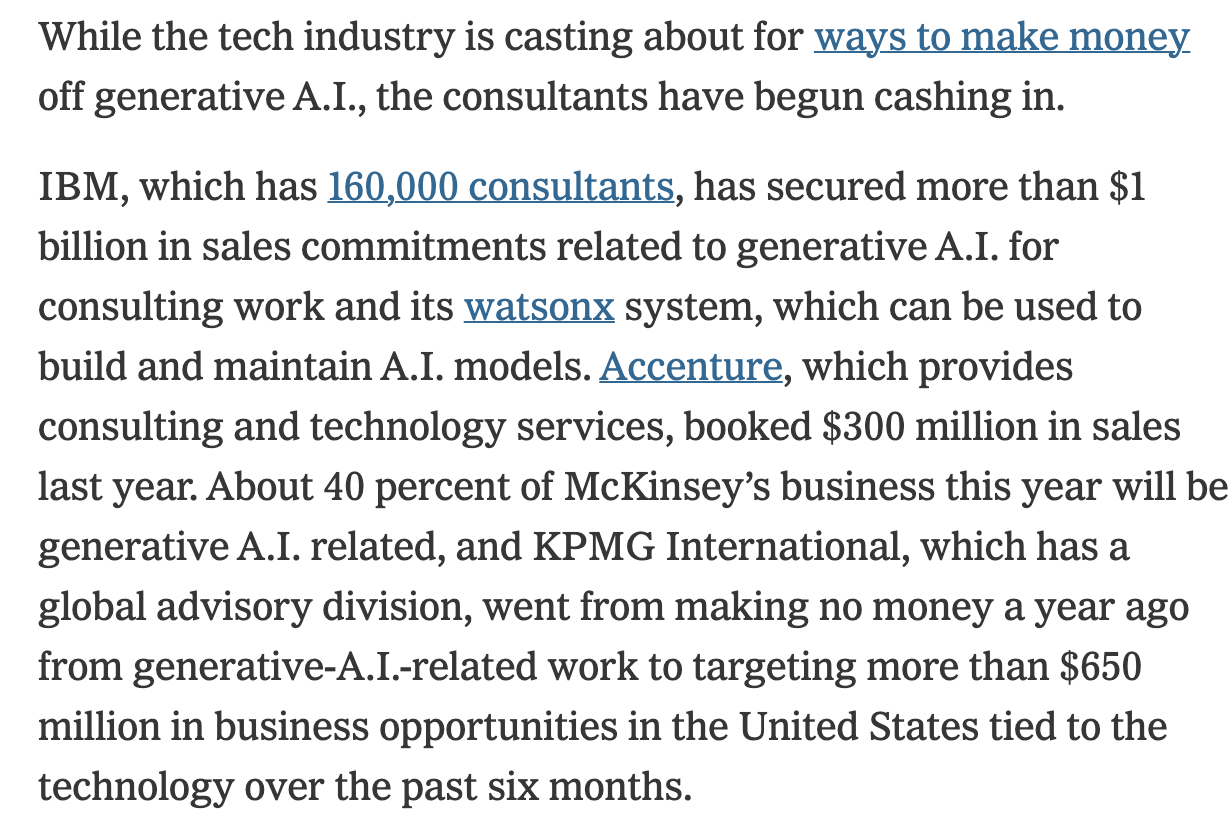
Look at what's happening: Boston Consulting Group now makes a fifth of their revenue from AI work - from zero just two years ago. McKinsey? 40% of their business this year will be AI-related. IBM's locked in over $1 billion in AI consulting commitments. And KPMG? They went from making nothing from AI last year to targeting $650 million in opportunities.
This playbook isn't about competing with these giants. (I mean, if you want to by all means go for it!).
But for the rest of us this instead about getting your first steps right in a massive market where there's room for everyone. As a consultant, I charge $500-1000 per hour depending on the client, and these initial consultations often lead to ongoing retainers and implementation work. It’s lucrative and (dare I say) easy work.
You don't need to beat McKinsey to do extremely well.
Let's get started:
Why 2025 is the crucial year for AI consulting
How to position yourself in this growing market
The "sell first, build later" approach to getting started
Why industry expertise trumps AI knowledge
Getting past the two main blockers fast
Every business on earth is trying to figure out what to do about AI. Some will get it right and thrive. Others will get it wrong and struggle. The difference? Often it's having the right guidance at the right time.
This isn't just another tech trend. It's not NFTs (remember those? No?). It's not blockchain, a cool technology searching for a problem to solve. It's technology that everyday people are already using, both personally and professionally.
Grandparents are using ChatGPT. Believe me, they were not using Web3. 😅
The market is ready, the need is real, and 2025 is when it all comes together.
Now, I can hear the objections forming:
"But Kyle, I don't know enough about AI..." "How would I even find clients?"
These are the two main blockers I hear all the time. And guess what? We're going to solve both this week. That's our game plan - get you that first client, delivered consultation, and growth in confidence.
Here's something crucial I've learned from helping over 150 people move into AI consulting: success doesn't come from being an AI PhD. It comes from being able to translate AI's importance to businesses in YOUR field.
Think about it. If you're in marketing, you know exactly what keeps CMOs up at night. If you're in HR, you understand the real challenges of talent acquisition and management. If you're in operations, you know where the bottlenecks are.
You, unlike many, are i) using AI and ii) in an industry. You can combine these two facts. You know better than most what industry problems AI can solve. And which it cannot. That’s gold. You can save companies a lot of time and energy (and mistakes!).
Your job is not being the smartest AI expert on earth. Your job is translating and interpreting why AI is so important to people in your industry. And helping them navigate their way in.
I made somewhere over $300,000 last year (with a brand new business) using a simple philosophy: sell first, build later. This isn't about being unprepared - it's about being prepared at the right time, for the right client, with the right solution.
By going out to the market first before building anything you can:
test there’s a market in the first place!
ask what the market actually wants
build based on that need rather than what you think they need
For consulting in particular here’s the basic flow we’ll follow this week:
We pitch consultations first
Land the client
Work out their specific problems
Prepare targeted solutions
Deliver value
Get testimonials
Repeat and grow
Notice we secure the client first then work out how we are going to help them. I’ll go into more detail later in the Playbook but the basic premise here is "Just in Time" learning versus "Just in Case" learning.
The old school approach is to learn everything about AI just in case you need it. That's slow, inefficient, and frankly, paralysing. You’d go off and get certifications, degrees, PhDs.
And still be an unhelpful consultant! Ha!
Instead, we're going to learn what we need, when we need it, for specific clients with specific problems.
Here's our "cheat code": We're going to do all the work before we step into the room. Then just deliver the value. More details later!
Tomorrow, we're diving into outreach. But here's the twist - we're starting with zero friction. I'm going to show you how to get your first consulting clients without the usual barriers.
So you can literally get into a room with them next week. Sounds a bit mad but it’ll work.
No lengthy pitch decks, no complex proposals. None of that. We need to reduce the time from “hmm I want to consult about AI” to “ok I’ve just legitimately helped a company” as much as humanly possible.
Here’s a quick rundown:"
Part 2 - Zero-Friction Outreach: How to land your first consulting clients using a proven approach that removes all barriers to entry.
Part 3 - Just-in-Time Preparation: Once you've got that first meeting booked, I'll show you exactly how to prepare. No more getting ready "just in case" - we prepare with purpose.
Part 4 - The Consultation Playbook: A step-by-step guide to running your first consultation, including what to do when you don't know the answer (it happens to all of us!).
Part 5 - Building the Flywheel: How to turn that first consultation into a thriving practice, including getting testimonials, referrals, and making the transition to paid work.
This playbook is laser-focused on that crucial first step - getting started. We're not trying to build a consulting empire overnight. We're focused on getting you that first win, that first piece of evidence that you can do this.
Keep Prompting,
Kyle
Here’s the sad truth: most people never start anything worthwhile.
They get stuck in preparation mode, reading more books taking more courses, endlessly tweaking, planning, refining offerings, polishing LinkedIn profiles... and never actually doing the darn thing.
It happens again and again in business. Too much chat, not enough doing.
We're doing something different.
We're going to use a strategy that's helped dozens of my students land their first consulting clients within a week.
It's not fancy. It's not sophisticated. Fancy and sophisticated just slow things down.
But it works because it removes every possible barrier to getting it done.
Let's get started:
Why start with zero-friction outreach
The power of short, free sessions
Finding your first targets
Crafting messages that get responses
Taking action TODAY
In Mario 64 there’s a level with an ice slide.
Once you’re on the slide there’s no stopping. You just keep sliding - it’s ice, more or less frictionless.
We want to make our own ice slide.

Here's our strategy: We're going to offer short (15-30 minute) free consultations to charities and non-profits.
"But Kyle, why free? And why charities?"
Simple. We're removing every possible reason for someone to say no:
Short time commitment? Check.
No financial investment? Check.
Plus, by working with non-profits, you're not devaluing your time - you're doing pro bono work. I’m not asking you to work for free - I’m asking you to donate your time to a good cause.
I’m going to use charities/non-profits primarily here. But it can be any group you care about - local community group, church, government body…whatever is important to you!
Why do this at all? Because right now the only objective we have is to get you in the room giving your first AI consultation. We do not care about anything else. Nothing else matters.
This is because once you’ve got started you can build momentum. You’ll get social proof in the form of past client testimonials. You’ll be able to write up a case study. You’ll get referrals for more work (including paid). And, perhaps most importantly, you’ll build your own confidence that you can consult in AI.
We’ll cover all this later in the Playbook - don’t sweat it now.
We’ll basically get the flywheel up and running and parlay first (free, charitable) consultation up to paid …and then go from there. Your charity work might even lead directly to paid opportunities. Many (many!) non-profit executives have connections in the corporate world. When you demonstrate value in a pro bono context, paid work often follows naturally.
But first: step one!
There are three ways to approach this, depending on your industry and expertise:
Direct Industry Alignment This is gold if you can find it - charities doing work directly in your field. For example if you're in:
Engineering → Organisations running engineering projects in developing countries
Education → Non-profits focused on STEM education
Healthcare → Medical charities and research foundations
Obviously there won’t always be groups directly connected to what you do - it’ll depend entirely on your industry!
Functional Alignment Charities have business functions. You may be able to transfer your industry experience to assist them. If you're in:
Marketing → Help with their marketing operations
Finance → Support their financial teams
HR → Assist with their people operations
You’ll bring what you know about AI from your industry to their specific function.
General AI Support Sometimes there is no direct industry overlap. That’s fine - go broader and just find a charity. Don’t let the lack of direct overlap stop you. Focus on universal challenges like:
Document processing
Email management
Content creation
Data analysis
ALL organisations need to deal with this sort of stuff. And you can show them how AI can assist.
Here's a prompt to help you find targets based on your chosen path:
You are an AI assistant helping find initial consulting opportunities in the charity/non-profit sector. Your task is to help identify potential organisations for offering free 15-30 minute AI consulting sessions.

There are three possible approaches to finding targets:
1. Direct Industry Match: Finding charities working directly in the consultant's industry (e.g., engineering consultant → engineering education charities)
2. Functional Match: Finding charities that need help with specific business functions (e.g., marketing consultant → charities' marketing operations)
3. General AI Support: Helping any suitable charity with universal AI challenges like document processing, email management, etc.

Please ask the user for:
1. Their industry/professional background
2. Their location
3. Any specific skills or expertise they want to highlight

Then provide:
1. 5 specific organisations for each approach, with:
   - Organisation name
   - Brief description of work
   - Why they're a good fit
   - Name/title of potential contact person

2. 3 specific methods to find more similar organisations, including:
   - Relevant directories
   - Search strategies
   - Professional networks

3. Exact search strings to use on:
   - Google
   - LinkedIn
   - Charity databases
This’ll get you started but obviously supplement with other techniques as and when needed.
You are looking for 10 potential outreach targets. We want 10 to increase our chance of a hit. Once you have 10 you are going to hit them up with a brief outreach message.
This does not need to be complex.
Why? You’re offering something free (no financial commitment), short (low time commitment) and high value.
Hi [Name],

I've spent [X] years working in [industry/function] and I'm reaching out to local non-profits to offer free pro-bono 15-minute AI consults this month.

If your organisation is currently working out how to use AI I'd be happy to help out.

Would you be interested?

Best,
[Your name]
Sprinkle in details about what they do and any background that’s relevant here. Done stuff with them before? Even better. Add that.
And…that’s it. For real.
Your next steps:
Run the target-finding prompt
Find ~10 organisations
Send them a quick message
No fancy website needed. No detailed consulting packages. No pitch deck. Just get in front of someone who could benefit from your expertise.
In the next Part, we'll cover what happens after someone says yes. How to prepare, what to know, and how to deliver real value in that first consultation.
The beautiful thing about this zero-friction approach? You may even have your first "yes" before starting the next Part. It’s fast. That means you can apply what you learn immediately.
Keep Prompting,
Kyle
Now you’re cursing my name - why did Kyle make me do this?? I’ve no idea what I’m doing.
Good. Don't worry. We're now going to prepare in a focused way, gathering exactly what we need to help this specific client. Nothing more, nothing less.
Then we’re going to nail our first consult.
Let's get started:
Just in Time vs Just in Case preparation
The five key questions to ask
Turning responses into a consultation plan
Time-boxing your session effectively
Being ready for common scenarios
Just in Time (JIT) revolutionised manufacturing at Toyota back in the 1970s. Instead of stockpiling parts just in case they might be needed, they got exactly what they needed, when they needed it. The result? Less waste, better efficiency, higher quality.
We're taking this principle and applying it to consulting.
Most wannabe consultants and experts prepare "Just in Case" - stockpiling knowledge about AI, preparing for every possible question, trying to become an expert before their first client.
They don’t want there to be the slightest chance they are caught on the back-foot. It’s rooted in fear.
It’s also backwards.
Instead, we prepare "Just in Time" - learning exactly what we need for each specific client. When a client books a session about AI in their marketing department, that's what we dive into. Not AI in accounting, not AI in operations - just what this client needs.
It's faster, more focused, and frankly, more effective. Just like Toyota didn't need a warehouse full of parts, you don't need encyclopaedic knowledge of AI to help your first client. Honestly, AI is moving so fast that trying to amass the knowledge is pointless anyway - everything is out of date so fast!
OK sounds good but how do we practically do this?
Once someone's agreed to a consultation, send them a brief email asking:
"Are you currently using any AI in your organisation?" This tells you their starting point and knowledge level. The answer may be “no”!
"What problems or challenges have you encountered with AI so far?" Even if they haven't used AI, they might have concerns or failed attempts.
"Which AI tools or capabilities are you most interested in exploring?" This shows where their enthusiasm lies - crucial for engagement.
"What tools or software does your team currently use regularly?" Understanding their tech stack helps you make relevant recommendations.
"What are your main concerns or reservations about implementing AI?" This lets you address fears and blockers upfront.
Keep it casual - this isn't an interrogation! A simple "To help me prepare for our chat, could you briefly let me know..." works well.
Once we’ve got responses from the client we’ll plug them into this prompt:
You are an AI consultation planner helping prepare for AI strategy sessions with organisations. Your task is to create a detailed consultation plan based on client responses.

Input needed:
1. Consultation duration: [15 or 30 minutes]
2. Client's current AI usage: [their response]
3. Problems/challenges encountered: [their response]
4. AI tools/capabilities interested in: [their response]
5. Current tech stack: [their response]
6. Main concerns about AI: [their response]

Create a consultation plan including:

1. Time Allocation
Break down the session into specific segments, e.g.:
- Introduction/rapport building
- Discussion of current state
- Exploration of opportunities
- Addressing concerns
- Next steps and wrap-up
Specify exact minutes for each segment.

2. Key Discussion Points
For each time segment:
- Main topics to cover
- Specific questions to ask
- Points to emphasise
- Examples to share
- Transitions between segments

3. Likely Questions from Client
Based on their responses, predict:
- Technical questions they might ask
- Implementation questions
- Cost/resource questions
- Risk-related questions
Provide concise answers for each.

4. Red Flags to Watch For
- Signs they might need additional expertise
- Indicators of misaligned expectations
- Technical misconceptions to address
- Scope creep warnings

5. Specific Recommendations
Based on their current state and interests:
- 3 immediate action items
- 2 tools/solutions to consider
- 1 low-risk starting point

6. Preparation Checklist
- Required knowledge to review
- Case studies/examples to have ready
- Technical concepts to brush up on
- Industry-specific considerations

7. Follow-up Plan
- Items to note for follow-up
- Resources to share after
- Next steps to propose

Additional Guidelines:
- Keep recommendations practical and achievable
- Focus on value delivery within time constraint
- Include specific transition phrases
- Note areas where you might need to be flexible

Format the output as a clear, structured consultation roadmap that can be easily referenced during the session.
Let’s see this in action with some example responses from a client:
We're using ChatGPT a bit for donor thank you emails - one of our volunteers showed us.
Emails need lots of editing to sound like us, and we're unsure about data privacy.
Interested in exploring AI for grant writing and newsletters.
Using Mailchimp, Excel, and Microsoft Office.
Main concerns are making mistakes with donor communications and costs - we're on a tight budget.

Thanks,
Sarah
City Soup Kitchen
and here’s the complete plan generated by our preparation prompt: Consult preparation.
The result is a full schedule for the meeting as well as things you should prep. The prompt will also generate likely questions you’ll be asked during the consultation too as well as give you answers. It’s basically a brief to make sure you can go into the consult confidently and knowing how to help them.
Sometimes they won't respond to your questions.
Two options here.
First is rescheduling and saying that you need their response. Emphasise it’s a short consultation and that you need to make sure their time is used wisely - hence the questions.
If they still won’t do answer then you have a choice to drop the consult (they aren’t paying so there’s no financial obligation) or, if you feel confident enough, go ahead and run the consult on the fly.
If this is the case you’ll simply start with "Before we dive in, I'd love to understand where you're at with AI currently. Would you mind sharing..."
Then ask the same five questions. Just means you'll be doing more listening in the first part of the consultation. They’ll get less value but at this point that’s sort of on them for not responding. It is what it is.
Tomorrow, we're covering the consultation itself. How to run it smoothly, read the room, and deliver real value in a short time frame.
For now though just get their responses and run the prompts above so that you are ready to enter that room. The beauty of our Just in Time approach is that you're preparing exactly what you need, when you need it. No more, no less.
Keep Prompting,
Kyle
The consultation is tomorrow. You've got their responses. You've made your plan. Now it's time to deliver.
How do we actually go in and provide massive value as a consultant?
Let's get started:
Stick to the script (mostly)
The art of listening while leading
Handling questions you can't answer
Making the most of 15-30 minutes
Setting up next steps
Here's the reality of short consultations: 80% will follow your prepared plan. You know their problems, you've crafted solutions, you've anticipated questions. This is your safety net.
You are in control here because we’ve already elicited their problems/questions and we’ve prepared. It’s sort of like going into an exam where you have been given the answer key in advance.
It might feel like cheating but remember your only goal is to provide value to the client. If you specifically prepared for that (and only that!) who cares? Certainly not the client.
But that other 20%? That uncertainty? That's actually where the magic happens. That's where you discover what they really need, not just what they think they need. We’ll get to how to cover that shortly.
First up you need to display i) authority (you know what you are talking about) whilst ii) being likeable.
It’s a complicated balance. But if you nail that first impression you’ll be set. Here’s how I personally do this.
I’ll begin by introducing what you'll be working on together based on their responses: "Based on what you shared about [specific challenge], I thought we could focus on X and Y today. Does that work for you?"
This does four things simultaneously:
You’ve taken control
Shows you've listened
Sets clear expectations
Gets their buy-in
Then stick to your plan. You've only got 15-30 minutes - this isn't the time for long detours.
We’ve kept it short specifically for this reason. So that we can control the consultation and keep it on track. And leave them wanting more.
If we scheduled in 60 minutes then there’s far more chance they’ll throw curveballs at you that you can’t (yet) deal with. Instead we want short, sharp and value packed.
In 15-30 minutes, you need to:
Build rapport (quickly)
Confirm their situation
Deliver value
Set next steps (if viable)
This is why we prepared. This is why we got their responses beforehand. No time wasted figuring out their problems - we're jumping straight to solutions.
Sometimes clients will take the conversation in unexpected directions. That's fine - but manage it:
"That's a really interesting point about [their topic]. Given our time constraint today, should we stick with [original focus] or would you prefer to explore this?"
Let them choose. Either way, you're showing respect while maintaining control of the session.
Just because you have a game plan doesn’t mean you ignore them. We have to be able to adapt based on what they are saying. The plan is our safety net. We can come back to it whenever we need to but don’t be afraid to follow their cues.
Yes, follow your plan. But watch for these signals:
Strong emotional responses to certain topics
Repeated mentions of specific problems
Push-back on suggested solutions
Signs of confusion or overwhelm
These are gold. They tell you what really matters to them. These are what we as consultants can learn from. And they are also (later) the points that you will sell off. These will be the emotional hooks you’ll leverage when selling consultation packages. So keep an eye out for them - write them down, watch for patterns across different clients.
Another concern during consultations is handling questions you cannot answer. It happens. Part of the job I'm afraid!
Do not let this stop you from starting! You can’t know everything. Plenty of very valuable experts don’t know everything. And they know they don’t know everything!
Sometimes you won’t know an answer because it's something very specific to their business or their systems and there's no way as an outsider you can know the full answer.
I’ve had this a number of times. For example one Swiss/India based organisation I was consulting with had complicated cross-border workflows across 3 different teams, 2 locations and 4 databases. The client began to explain all this and very quickly I stopped them. It was not something we could solve in 30 minutes - it would require too much knowledge of their systems, how everything ties together, who is in charge of what part etc. etc.
At this point you can go with "That's a great question. It touches on some complex technical aspects that I'd need to look into more deeply. Rather than give you a half-baked answer, let me research that and get back to you with proper information."
You can either offer to go off and look into it for them (if viable) or with them (ie. additional consultations). This is a good segue into paid consultation.
Sometimes the reason you can’t answer a question is simply because it is outside of your knowledge. I get this with Video AI for example - it’s just not something I’ve worked with or know enough about. And that’s fine!
I’d go with response like: "That's outside my core expertise, but I know someone who'd be perfect to answer this. I'll check with them after our call and get back to you."
This shows professionalism while maintaining credibility. And maintains you as a valuable consultant because you have access to a valuable network. Always follow up as promised!
Do not try to just BS your way out! It's tempting but it's much more credible (and powerful) to say "not sure but I can find out".
I can’t overemphasise this enough.
Most organisations are just getting started with AI. What seems basic to you might be revolutionary to them.
The more you go into companies the more you’ll see this. And the more you’ll realise what an opportunity AI consulting is!
If they're excited about using ChatGPT for email drafts, don't jump to showing them how to build custom GPTs. Meet them where they are for now. Sometimes that’ll be helping them get a non-fake version of ChatGPT on their phone - for real!
Always end with:
Clear summary of what was discussed
Specific next steps
Request for feedback/testimonial
Even if the consultation went off in unexpected directions, bring it back to concrete actions they can take.
Next in the Playbook we're covering how to turn that first consultation into a thriving (paid!) practice. We'll talk about getting testimonials, handling referrals, and making the transition to paid work.
Keep Prompting,
Kyle
You've done it. First consultation complete. Now what? Time to turn this into a real business.
Most people start with this stuff. That’s the wrong way to do it. Get the consults done first (at least one!) then worry about scaling it up.
Let's get started:
Securing that crucial first testimonial
The power of social proof
Moving from free to paid work
Building your client base
Next steps in your consulting journey
Right after your consultation, while everything's fresh, ask for that testimonial. Send a simple email:
"Thanks for your time today. If you found our session valuable, would you mind providing a brief testimonial about your experience? Happy to draft something for you to edit if that's easier."
That last line is crucial. Make it easy for them to say yes.
Or, if you are comfortable and did the consult in person, straight up ask if they’ll do a video testimonial. Get your phone out and record it. Worth its weight in gold if you can get it.
If you do want a more streamlined way to collect testimonials you can use a tool like Senja but honestly just an email or text is great. Some of my most powerful testimonials are literal text messages, screen-shotted. It’s raw and authentic.
I’ve written an entire Playbook on social proof if need more background.
Along with the testimonial, you want to collect everything that shows your impact. Ask for permission to use their logo, grab photos if you met in person, document the specific problems you helped solve. Even small wins like time saved matter. This isn't just marketing material - it's proof you can do this.
The charity or non-profit you helped likely has two types of connections you care about. First, they know other non-profits - perfect for more free consultations. You can continue to get more done to i) build your confidence and ii) get more social proof.
Second, and more interesting, they have business connections - potential paid work.
Think about it. The executive director of that charity probably knows business owners. Very often heads of charities came from corporate world. They tend to be heavy hitters.
Or if you didn’t work with the leader directly then maybe your contact has links. For example the marketing manager likely has a network of professionals. These connections are your bridge to paid work.
Ask specifically: "Do you know anyone else who might benefit from this kind of AI guidance?"
When they mention a business connection, be clear: "Just so you know, pro bono work is for charities only. For businesses, I charge my standard rate."
You've just made the transition to paid work sound natural and professional. Does it matter if you’ve never actually charged for this? And maybe don’t even have a standard rate yet? Nope! As soon as you’ve done your first paid consult you will - we just need to get over this first hump.
The Three-Step Referral Process
Alongside directly asking for referrals from charity to paid work you should be widening out your own outreach. Previously we did outreach to charities and non-profits. Now that we’ve done a few (free) consults we’ll go ahead and talk to companies about paid consultations.
When you feel ready, start transitioning to paid work through your nonprofit connections, focusing on small businesses first. This lets you test different price points and build confidence with paying clients.
Generally this works well, start with smaller businesses with lower rates and work your way up.
Initial clients will likely be small, and that's fine. Less pressure, more learning opportunity. The key is not to get stuck here though. Smaller clients and smaller budgets are actually the hardest work…
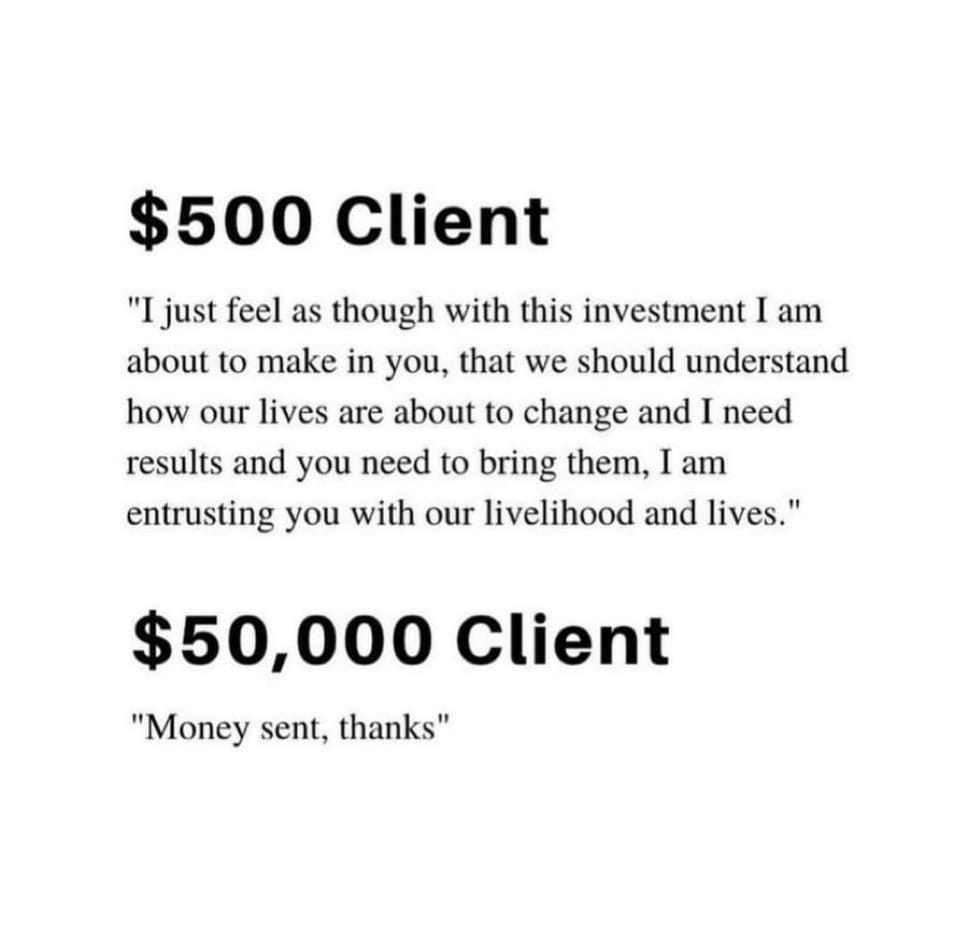
The key here is your confidence. If you are confident enough to go to a large company go for it! You probably have the exact same chance of landing a high end client as a low end client - just at 10x the cost. But if you need to work up and build your confidence, social proof and working knowledge by all means do. Just don’t get stuck here!!
Oof pricing. How much to charge? How long is a piece of string?
Honestly this will depend on your industry, your location and your confidence.
Me giving any concrete number is probably a disservice here. With that said I’d start around $200/hour and go from there.
You can also start to layer in other services and ways to hire you.
A one-hour consultation might start at $500, with half-day workshops at $2000. For implementation work, charge by the project rather than the hour - this is where the real money lies. (Not wanting to do the implementation yourself? Partner with someone who can do that part and split the revenue).
Remember, you can always increase prices. It's much harder to decrease them. So start where you are comfortable and each time bump it up.
I found with workshops in particular I started at $500 and kept bumping it up until I met resistance. It’s currently at $4000/hour. Do the same with your consults.
Success with paid clients opens doors. You can increase prices, expand services, build products, create workshops, or write content. But that's for later.
Right now, focus on the basics: getting that testimonial, asking for referrals, and making the transition to paid work. Everything else builds from there.
This Playbook was about getting started - your first consultation, first testimonial, first paid client. Let's recap the journey:
Stage
What You Do
Key Output
First Contact
Reach out to charities/nonprofits offering 15-30 min free consultation
First meeting booked
Pre-Consultation
Send 5 key questions about their AI usage and needs
Understanding of client needs
Preparation
Use responses to create focused consultation plan
Structured session plan (using prompt)
First Consultation
Deliver value in short timeframe, mostly following plan
Real consulting experience, confidence
Follow Up
Request testimonial and referrals
Social proof + new leads via referrals
Growth
Repeat with mix of free (charities) and paid (business) clients
Building portfolio
Full Transition
Move to primarily paid work with businesses
Sustainable flow of revenue
There's more to learn about systematic outreach, consulting packages, AI workshops, and scaling your practice. But you don't need any of that yet! You've got what you need to start. The rest comes later.
Keep Prompting,
Kyle
Are you ready to capitalize on the booming AI consulting market? The playbook '🧠 First Steps in AI Consulting' is your guide to navigating this transformative industry, designed to help you achieve real ROI from AI initiatives by 2025. This comprehensive resource breaks down the essential steps to start your consulting journey, from securing your first client to scaling your practice. With practical insights and actionable strategies, you’ll learn how to leverage your industry knowledge to provide valuable AI solutions, positioning yourself as a trusted advisor in a rapidly evolving market.
This playbook is designed for aspiring consultants, industry professionals, and entrepreneurs who recognize the urgency of integrating AI into their business strategies. If you're feeling overwhelmed by the complexity of AI or unsure about how to approach potential clients, this resource will demystify the process and provide you with a clear path forward. Whether you're from marketing, HR, or operations, you'll find actionable insights tailored to your specific challenges and aspirations, empowering you to take the first steps in this lucrative field.
No, you don’t need to be an AI expert. This playbook emphasizes leveraging your existing industry knowledge to effectively communicate the value of AI.
You can expect to invest a few hours to read through the content and start implementing the strategies, with ongoing practice as you gain clients.
This playbook is specifically designed for beginners, guiding you through the essential steps to successfully launch your consulting practice.
The playbook provides a zero-friction outreach strategy that will help you connect with potential clients quickly and effectively.
While any industry can benefit from AI, this playbook encourages you to leverage your existing expertise, making it easier to identify opportunities within your current field.