AI Knowledge
Welcome to the 🐉Entrepreneurial Resilience Playbook, your ultimate guide to navigating the tumultuous journey of entrepreneurship.
Start ReadingYet it causes so many of you to bounce off and not achieve your goals.
Because of this we’re going to tackle the issue head on.
We’ll cover:
Part 1: I get knocked down, but I get up again
Part 2: Fail fast, fail often
Part 3: Mental tweaks
Part 4: Antifragility
Part 5: It’s dangerous to go alone
Want to advertise here? Get started here.
Let’s get started:
This took me a while. And was pretty painful!
But here’s a roll-call of my businesses.
bulk buying sweets and selling at school (pocket money)
selling pirated games (first cease and desist)
chipping Playstations (bricked a console, had to buy a replacement)
event promotion (rubbish at it)
film production (failed)
property data product (failed)
dropshipping (failed)
real estate investing ebook (failed)
Chinese language learning posts (failed, pivoted)
Chinese language learning digital posters (succeeded, automatic, low cash but something)
FBA business (failed)
niche blog like How to get Taller .com (lol)
language learning T-shirts (failed)
language learning reference cards (failed)
habit tracking app where trees grew over time with habits (built, failed)
30 Days of Doing (failed)
Building Businesses Online (failed)
International Sourcing Platform (failed)
Out of the Box Business websites (failed)
Happy Knit Club (knitting kits, failed)
Email Sponsorship .com (revenue but shutted)
purchased an estate agency (failed)
Crushed Content newsletter (pivoted to Prompt Entrepreneur)
B Street Digital (digital agency, run for years, paid bills, shut down client work early 2023 to pivot to Prompt Entrepreneur)
Prompt Entrepreneur (ongoing)
Honestly there are more - but I got tired of going through old website domain lists!
I also, as anyone who knows me will attest to, have a terrible chronological memory!
You get the idea though.
Lots and lots. And lots. Of failures.
And a tiny handful of successes.
This is the norm. It’s just most entrepreneurs don’t talk about it out loud.
Here’s my favourite @levelsio tweet:
🍰 Only 4 out of 70+ projects I ever did made money and grew
📉 >95% of everything I ever did failed
📈 My hit rate is only about ~5%
🚀 So...ship more
— @levelsio (@levelsio)
11:53 AM • Nov 7, 2021
Talk to any entrepreneur and they’ll have a similar list.
The problem is that what most aspiring entrepreneurs see are the successes.
Basically survivorship bias - the only people you see left standing (and who have a big enough platform to be heard) are those who made it.
Just remember that their “overnight success” is generally years and years of complete disasters.

https://eduardklein.com/life/how-to-be-entrepreneur/
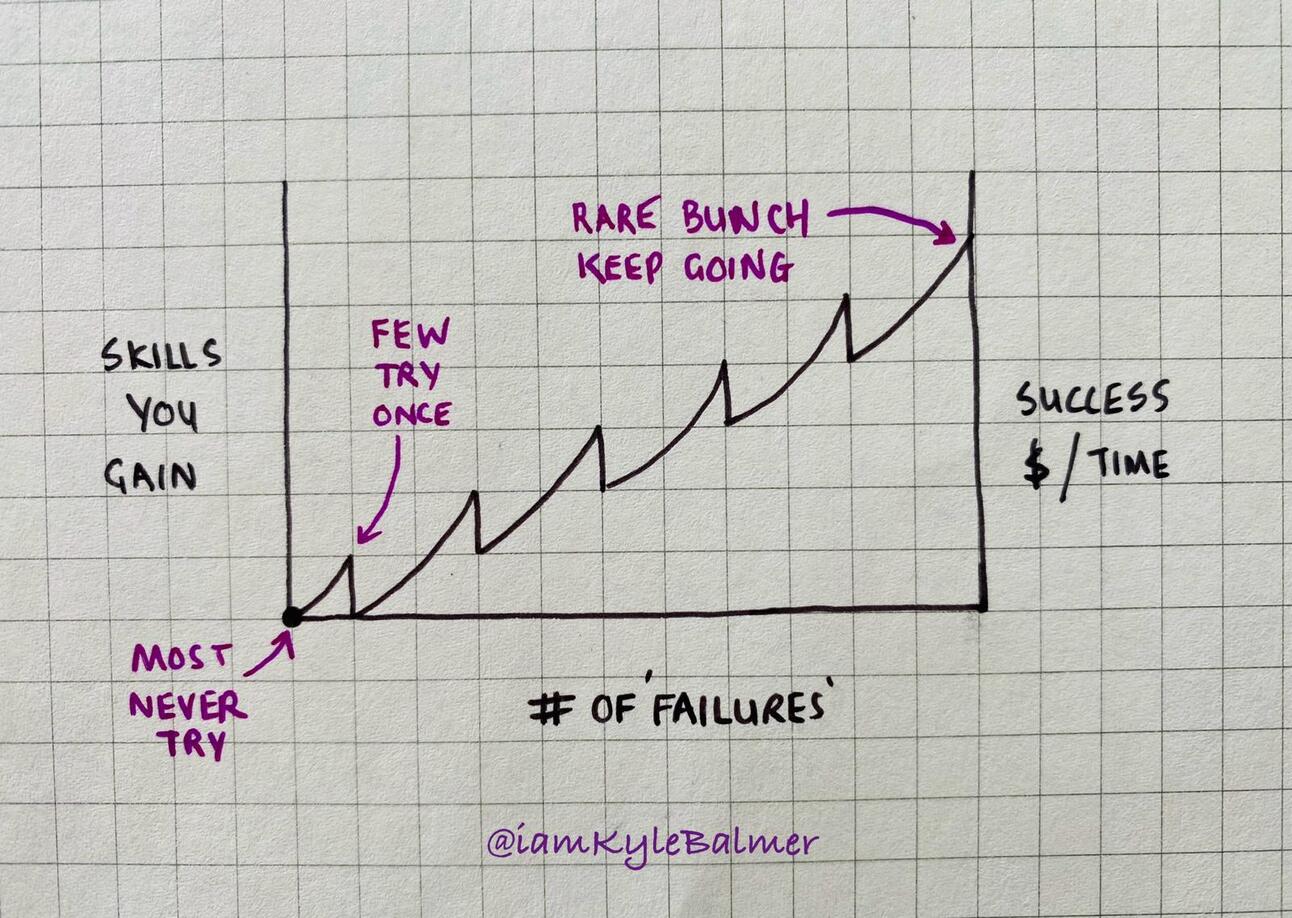
Here’s a question - how many businesses have you tried to launch?
Zero? One? Two? Three? Four?
If so - it’s not enough.
You need volume.
Most (nay, all?) early businesses will flop.
And why wouldn’t they? You’ve not done it before!
Learning to do a backflip. Do you expect to land it first time? No.
Learning Spanish. Expect that first time ordering empenadas to go smoothly? No
But with business we for some reason have the expectation that the first idea, the first implementation, the first time is going to work. Nonsense.
Instead we, as entrepreneurs, need to keep stepping up to bat. It’s about gaining the skill of building a business as well as building the business.
Does that mean to learn, learn, learn first? Nope. Knowledge without action doesn’t build skill.
It means we need to build our first businesses as learning projects. We can hope but don’t expect them to hit immediately.
And we make sure that if they fail the failure doesn’t end our entrepreneurial dreams. We make sure that the failure is fast, small, cheap and doesn’t mentally hurt us. This will be what we’re covering this week.
If you are starting your first business (or simply a new idea to add to an ongoing concern) let’s use this prompt with your idea:
Act as a business strategist

My business idea is [provide details, as much information as possible]

Assume I have limited time, zero capital/assets. Use the lean methodology

Give me the first 5 steps of deploying this idea, each building upon the last and only being deployed once the previous has shown the business idea to be valid.
For each step provide a description and precise, actionable definition of success/failure
I’ll run this prompt with “selling custom jewellery”. It gives me 5 steps.
The first for example is :
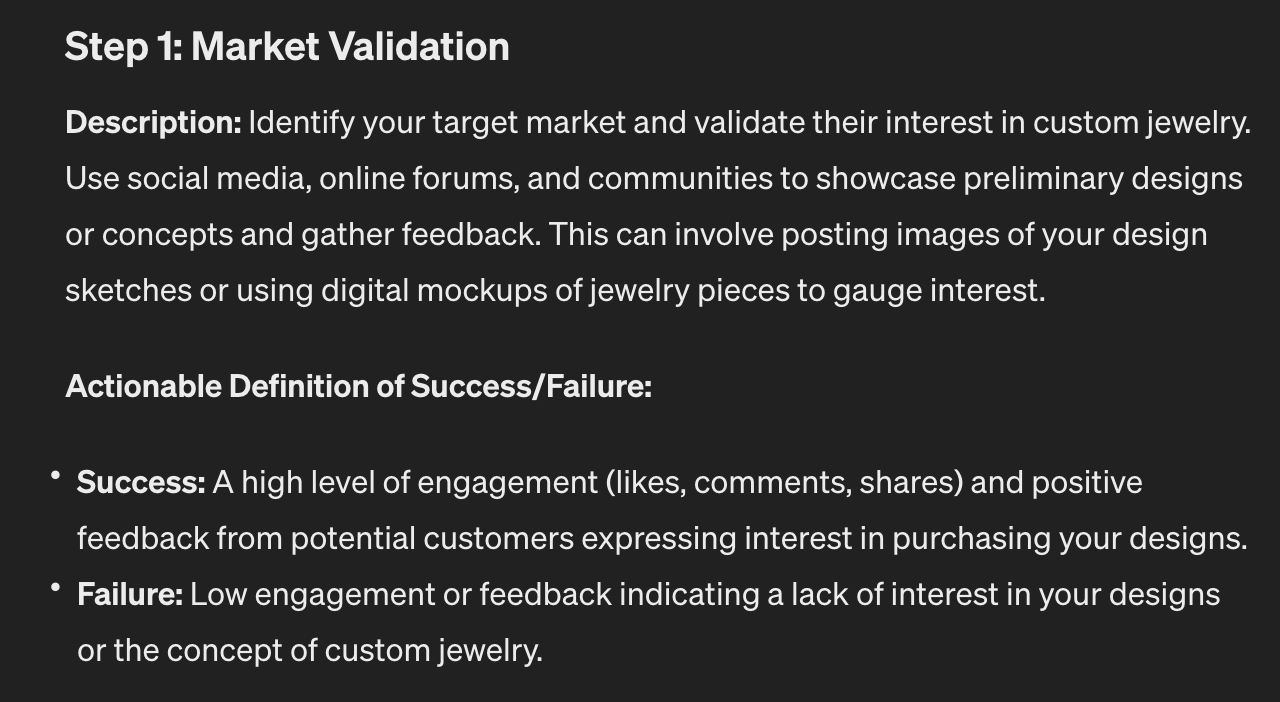
Notice that this step requires no cash and very little time.
And there’s a distinct success/failure metric.
This allows us to test our business idea without going all in, spending money, building a team, designing a logo and all the other silly things people do when starting a business.
It’s this sort of focus on the trappings of a business (logo, business cards, business plan, fundraising, renting an office etc.) that makes business failure catastrophic.
Instead if we build step by step, testing and validating as we go we can keep each “failure” small and controllable.
We’ll get into more details about this in the next Part.
For now run the prompt with your business idea to get a set of sensible deployment steps.
The more detailed your step by step plan is the more you derisk testing your business idea.
Here’s an extended prompt that will more finely tune your plan.
Act as a business strategist

I'm exploring a business idea centred around [specify business idea].

I have limited time and no starting capital, I'm looking to employ the lean startup methodology to bring this idea to life.

Create a step-by-step guide that is practical, actionable, and based on validating the business concept before further investment of time and resources.

Each step should include:

-A clear action item that leverages digital tools, creativity, and personal networks without financial expenditure.
-Specific methods for identifying and understanding my target audience to ensure my idea meets a real market need.
-Measurable milestones for success/failure, such as specific numbers of user interactions, feedback scores, or prototype validations, to ensure objective assessment.
-A feedback mechanism to learn from each step and inform the next, emphasizing an iterative approach for continuous improvement.
-Considerations for resource efficiency and potential scalability of the business model.

Outline the first 5 steps in deploying my idea, where each step builds upon the insights gained from the previous one and only progresses once the idea's viability has been confirmed.
This will generate a much more detailed step by step guide. Here’s the first step for the same “custom jewellery” business idea:
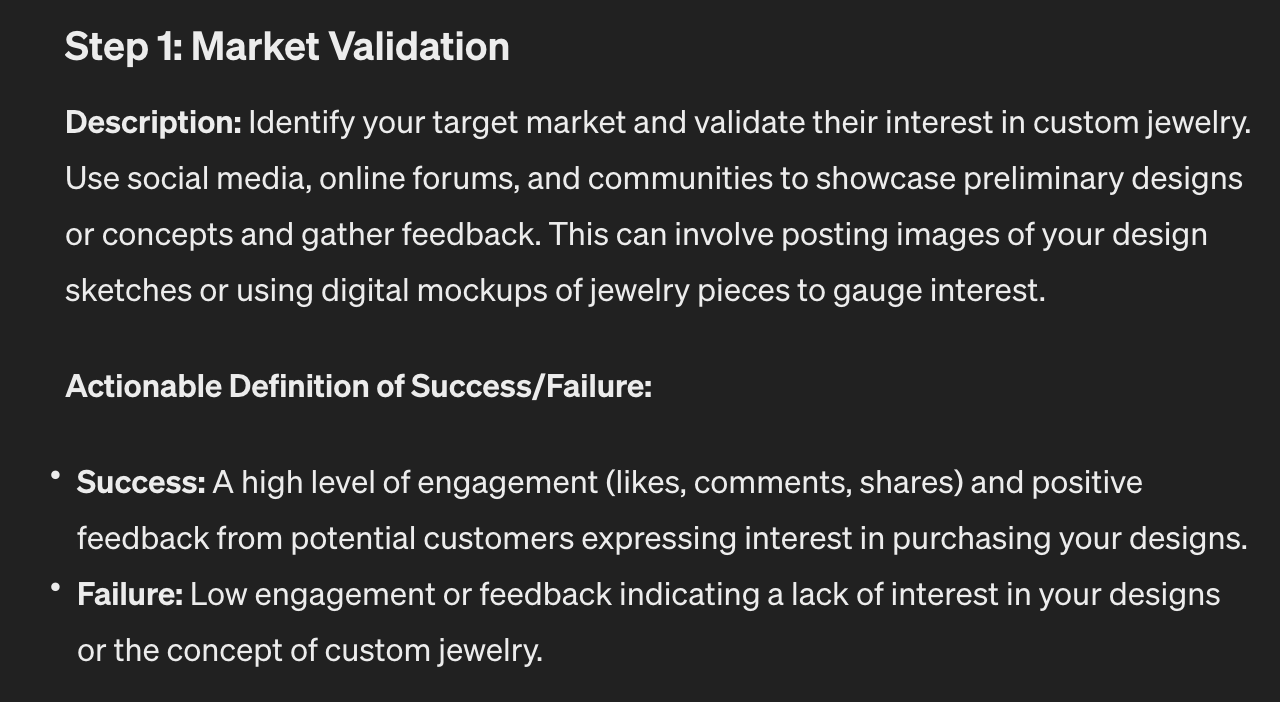
It’ll continue with this deeper level of detail for all 5 steps. Use this rather than the free prompt as we move forward.
Over the rest of this Playbook we’ll look at how best to make sure your learning curve is smooth.
And importantly how to keep plugging away until you get the success you deserve.
A reminder of what we’ll be covering :
Part 1: The upside of downfalls
Part 2: Fail fast, fail often
Part 3: Mental tweaks
Part 4: Antifragility
Part 5: It’s dangerous to go alone
Keep prompting,
Kyle
And the key to failure is to make each failure small.
There are two ways to do this. The wrong way and the right way.
The wrong way to fail is how most businesses operate.
They spend time and money:
preparing the perfect plan
building the perfect team
getting an kick-ass logo designed
All before actually, you know, opening the doors to customers.
What generally happens is a flop.
At no point did the business bother asking what the customer actually wanted. Or, better, asking them to make a purchase.
Instead the business followed the Hollywood Blockbuster model of “build it, do a big launch and hope for the best.” And if it doesn’t immediately work then throw cash at advertising.
This is a dangerous, flashy way to launch a business. And often leads to a glorious wreckage.
One huge failure. Game over.
It’s also how most, if not all, businesses launch.
The right way is to avoid one big failure by having as many small failures as possible. As quickly as possible. Fail fast, fail often.
Sounds weird but hear me out.
We only learn through failures and mistakes. We cannot, by definition, learn from a complete success. There’s no learning moment there.
We need to fail in order to learn.
But: we need each of those failures to be survivable.
The regular (bad!) model allows all our failure to coalesce in one big launch moment. It’s all of nothing.
The better model is to make lots of plays, make a lot of mistakes and small failures, learn from each failure and improve.
This model is called “lean startup”, a term popularised by Eric Ries in his book of the same name. I’m calling it “leaRn startup” to hammer home the point.
The basic idea is:
start with a hypothesis
come up with a test
validate by launching
In the realm of business for example this means constantly launching new products, services and content to see what customers actually resonate with.
We don’t use market research. We don’t make “educated” guesses. We don’t just hope for the best.
We build and launch. And see if the customer responds.
And the only response we care about is them opening their wallet and paying.
Nothing else matters for our tests.
I actually won a lean startup competition when I lived in New York. This is where I learned the power of this methodology.
It was a 2 day hackathon where we came up with a product and got the basics built. We then were judged by a group of successful entrepreneurs and a winner announced.
There were some seriously impressive startups being created that weekend. Really cool ideas. Multi-million sized projects. Amazing teams.
But we won.
Not because our idea was better. Not because the projected market was larger. Not because out team was more impressive.
We won because we got members of the public to give us cash.
We got total strangers to pay us for this product that didn’t exist yet, with the promise that we’d get it to them if/when it’s ready.
Anyone can say “that’s a great sounding product.” People say nice things (white lies!) all the time. Especially if you are talking to people who like you.
But what people say doesn’t matter. It’s what they pay for that is the only real proof.
In practical terms what does this mean?
It means you need to launch your product/service immediately.
Not in a few months. Now.
And you use the success of this launch to gauge the next steps.
If people bite your hand off for it you know you are onto something.
If there’s no interest then the idea needs tweaking. In lean startup it’s called a “pivot”.
We can do fast launches by building something called a “minimum viability product” or MVP.
Basically this is something that captures the value of your business in its most essential form.
AirBnb is a famous example here. It began literally as one air mattress on the floor of an apartment in SF. People rented it instead of a hotel during conference season.
Groupon’s MVP was hitting up an email list of 500 people working out of an office building selling them pizza. Then calling up the local pizza joint and bulk buying 2-for-1 pizzas and pocketing the difference.
The purpose of the MVP is purely to prove that there is a market demand for what your business intends to sell.
You do not wait until you have an office, team, fancy logo and letterhead to sell. You sell immediately and see if anyone gives a damn.
If no then this is a tiny low cost failure. Instead of wasting months and thousands of dollars you have your answer immediately.
So let’s build an MVP for your business:
Act as a lean startup consultant

My business idea is [detail your business]
My ideal customer is [customer details]
The primary problem I solve for my customers is [problem]

Suggest 5 potential MVPs I could design and deploy

The MVP is to confirm market demand.
Each MVP idea should be fast (<1 day) to deploy, cost less than $100 and have a success/failure condition.
Fill in as many details about your business as possible. As always, more specificity is best.
ChatGPT will generate some MVP examples. Here’s one of five:
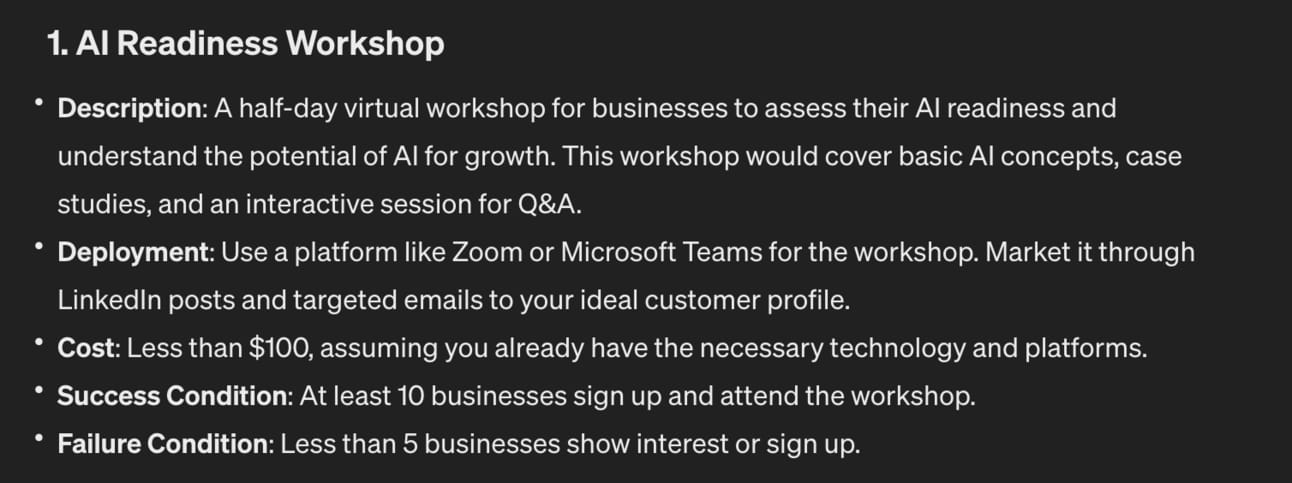
Importantly there are Success/Failure conditions. Use these as jumping off points to set your own. Remember, the purpose here to validate where there is a market or not.
The MVP should be super simple to deploy. Not something that’ll take a month to prepare.
And remember - you can always kill it before having to fulfil!
In the example above it’s a workshop that we get sign ups for. You’d set a date, create a zoom invite link and publish the event to your channels. If you don’t have channels in place you’d run an advert.
If you get the 10 sign ups (success condition) great - run the workshop.
If you get less than 5 signups (failure condition) - kill the workshop.
The goal here is not running a workshop.
The goal here is to gauge customer demand!
One MVP does not a business plan make.
Instead you need a set of experiments, all giving you more and more information about customer demand.
Here’s a prompt to set this up for you.
Act as a lean startup consultant

My business idea is [detail your business]
My ideal customer is [customer details]
The primary problem I solve for my customers is [problem]

Suggest 5 potential MVPs I could design and deploy

The MVP is to confirm market demand.
Each MVP idea should be fast (<1 day) to deploy, cost less than $100 and have a success/failure condition.

Each MVP should be sequential, following on from the last, from smallest to largest commitment to create and deploy. Each should only be deployed if the previous success condition is met.

Provide the 5 MVPs and a basic flowchart decision tree.
This will sequence the MVPs like so:
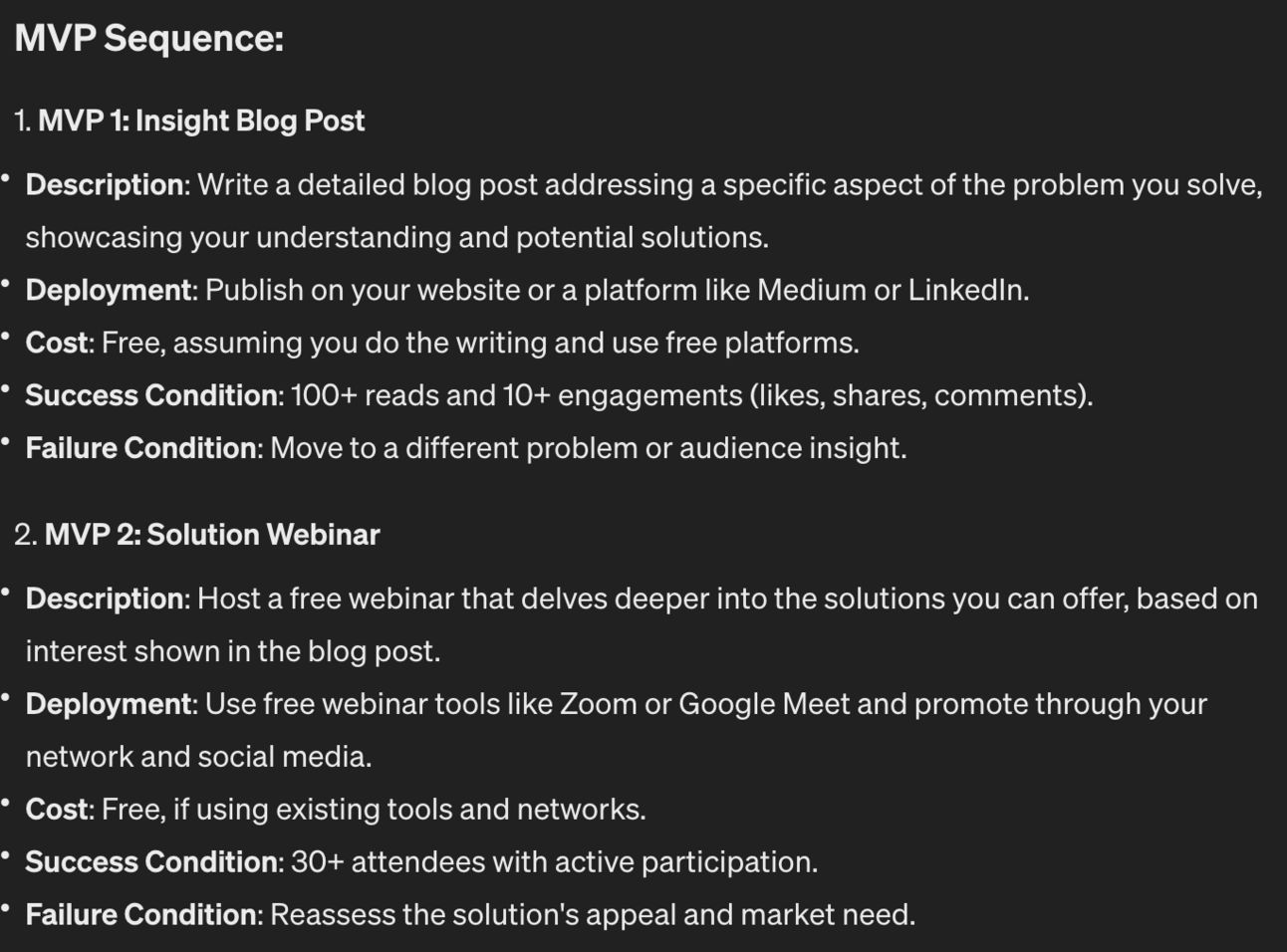
These are the first 2 (of 5).
As well as a decision tree:
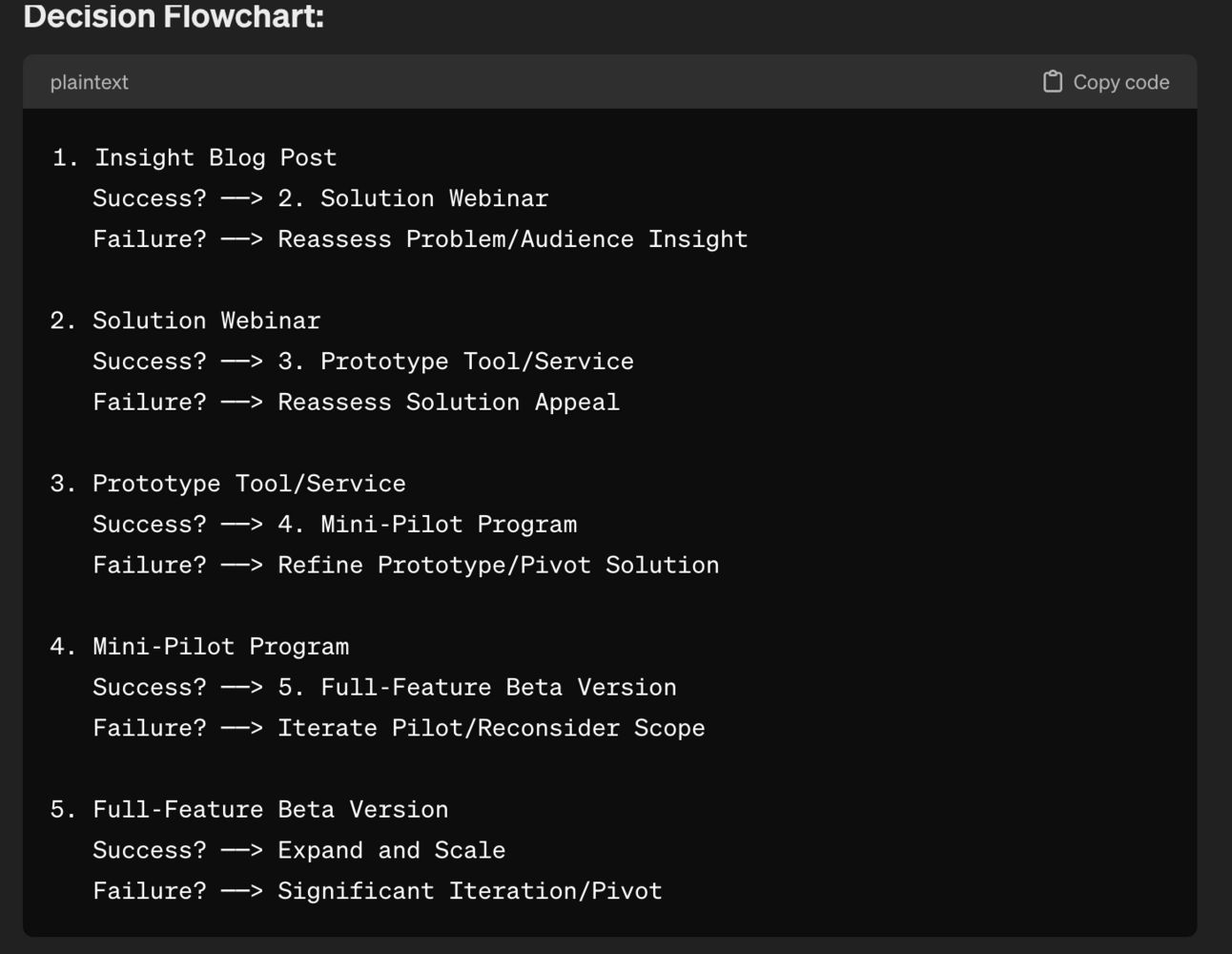
Deploy each test one by one, each time growing in confidence that the business idea is strong.
You’ll get massive learnings about your customers by following this process of incremental building.
We want to fail.
That’s how we learn.
We just failure fast and fail often. Rather than saving it all up for one cataclysm.
This takes a lot of mental rewiring. We’ll cover that in the next Part.
A reminder of what we’ll be covering :
Part 1: The upside of downfalls
Part 2: Fail fast, fail often
Part 3: Mental tweaks
Part 4: Antifragility
Part 5: It’s dangerous to go alone
Keep prompting,
Kyle
Over the last two Parts I’ve talked about how failure is part of the process.
We need to fail to progress. It’s part of learning and thus unavoidable.
However, this doesn’t make failure feel any better.
It still sucks!
In this Part I want to talk a little about how you prep yourself for the knocks and blows you’ll take as an entrepreneur.
Let’s get started:
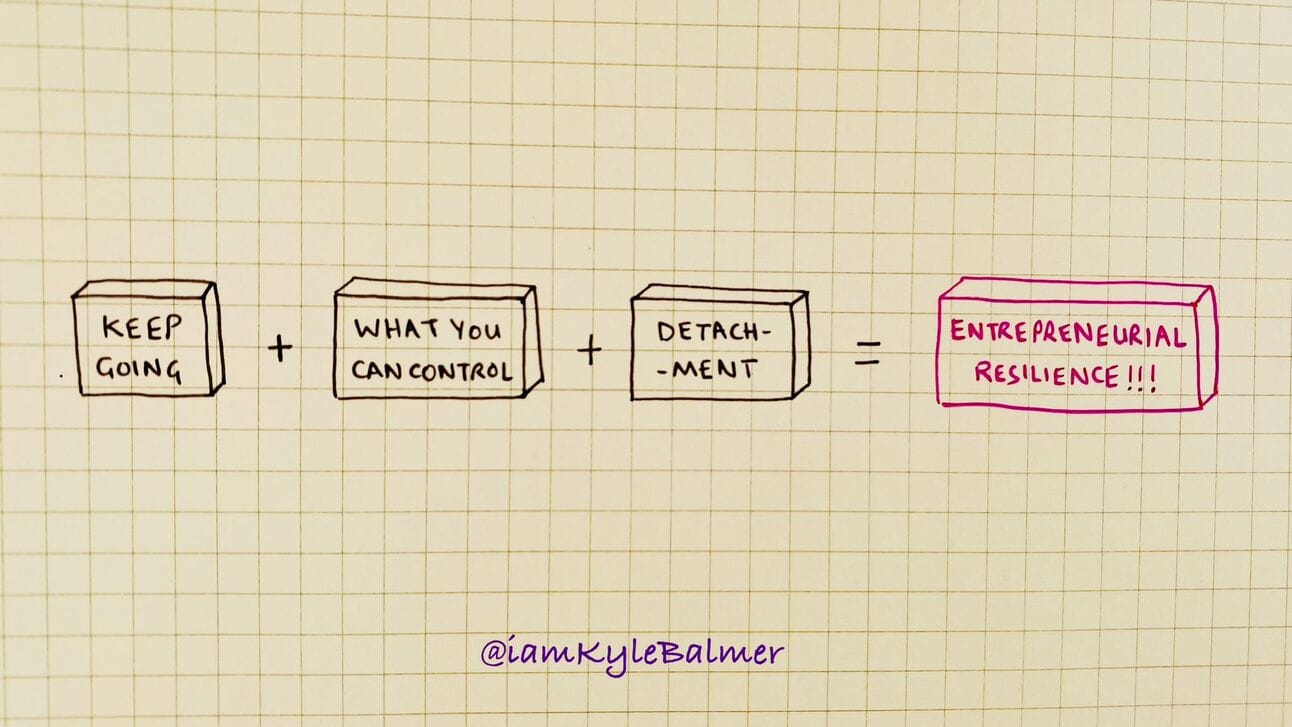
Let’s cover a few mental adjustments you can make that’ll help you weather failures better. More failures mean more learning. But only if you keep pushing ahead after a failure! We can’t let a blow knock us down and out for good.
We’ll look at:
Stoicism and control
You are not your idea
Stoicism is an ancient philosophy that has seen a comeback in recent times.
The basic lesson of Stoicism is to not worry about what you cannot control. You train your mind simply not to react.
The other day I flew to Switzerland to deliver a training.
I was set to be on stage at 1:30PM.
My flight was half an hour late. Not ideal.
I rushed off the plane in Geneva and slammed immediately into the mother of all queues:

The electronic passport gates were all offline and everyone was being funnelled through 2 (very slow!) passport control officials.
I was going to be late. Very late.
Years ago I would have panicked. Got worked up and upset. Thought the world was ending.
But…this situation wasn’t under my control.
The flight was late: sure. There was a queue: sure.
Those were the facts of the situation. I had zero control over those.
What I did have control over was how I decided to react.
I used my time in the queue to:
inform the company of my ETA
rework the presentation to scoop out 30 minutes
work out that I could record those 30 minutes later and send over after the presentation
Panicking about the delay would have got me nowhere. It’s out of control. And I would have turned up to speak in a bad frame of mind.
But reacting to the delay and working out next steps? - that’s valuable.
Same with all business.
If something is out of your control - stop sweating it.
The fix here: focus purely on what you can control. You next steps. Your plan. How you react to crises. How you move through difficulties. This is all controllable.
You will hit challenges in business. Lots of them. Stuff will fail. And you need to roll with it.
This is a skill that can be learned. Look into Stoicism. Look into mindfulness. These will guide you.
And expose yourself more to risk and failure in order to practice. Remember to keep those failures small and manageable as we discussed in the last Part.
You are not your idea.
If your business idea fails this does not mean that you are a failure.
A lot of us get so into our business idea and how great it is that we begin to identify with it.
Absolutely you need to be excited about it. Hell, if you aren’t then you won’t be able to convince anyone else to be!
But you need to make sure you don’t dump your ego into your idea. The risk of doing so is that if your business idea fails (and it probably will - look at all my failed ideas) then it’s easy to see yourself as a failure.
But your idea is not you. It’s just something you’ve created. And the first passes will be crap.
The best way to avoid over-identifying is simply to have lots of ideas. Then you can’t pour your body and soul into only one of them. You have other ideas ready to go if this particular business doesn’t work, or doesn’t work how you expected it to.
A side issue here is the fact that your business ideas aren’t worth much. First time entrepreneurs in particular tend to massively overvalue their ideas. The idea itself is worthless - it’s only the execution that matters.
It’s possible to go too far with embracing failure.
Whilst the lean methodology we looked at is extremely powerful we need to be aware of our psychology of failure.
There are risks of going too far.
The lean startup method is all about running experiments and learning from failures.
But one thing I’ve seen happening is some people get stuck in “learning”.
They constantly iterate and tweak. They hide behind iteration instead of sticking on something and just going for it.
It can therefore become a form of procrastination or analysis paralysis.
What’s the fix then? Goals and targets.
You have to mix the tactic of lean startup’s learning through iterative failure with wider strategic goals.
Ideally with a business partner, coach/mentor or community to keep you on track.
If you know you are an over-planner or over-analyser make sure you don’t fall into this trap. Get some external accountability to act as a counterbalance.
These mental reframes can help you put iterative failures for learning into practice without getting overwhelmed.
Next up we’ll look at how failures, challenges and stressors aren’t only things to overcome but things that can actively make us stronger.
A reminder of what we’ll be covering :
Part 1: The upside of downfalls
Part 2: Fail fast, fail often
Part 3: Mental tweaks
Part 4: Antifragility
Part 5: It’s dangerous to go alone
Keep prompting,
Kyle
His ideas are powerful for entrepreneurs but hidden somewhat amongst his dense books.
I recommend his books by the way but do understand they can be HEAVY!
We’ll cover the basics in this Part.
Let’s get started:
Antifragility is a rich concept that is hard to encapsulate in a newsletter.
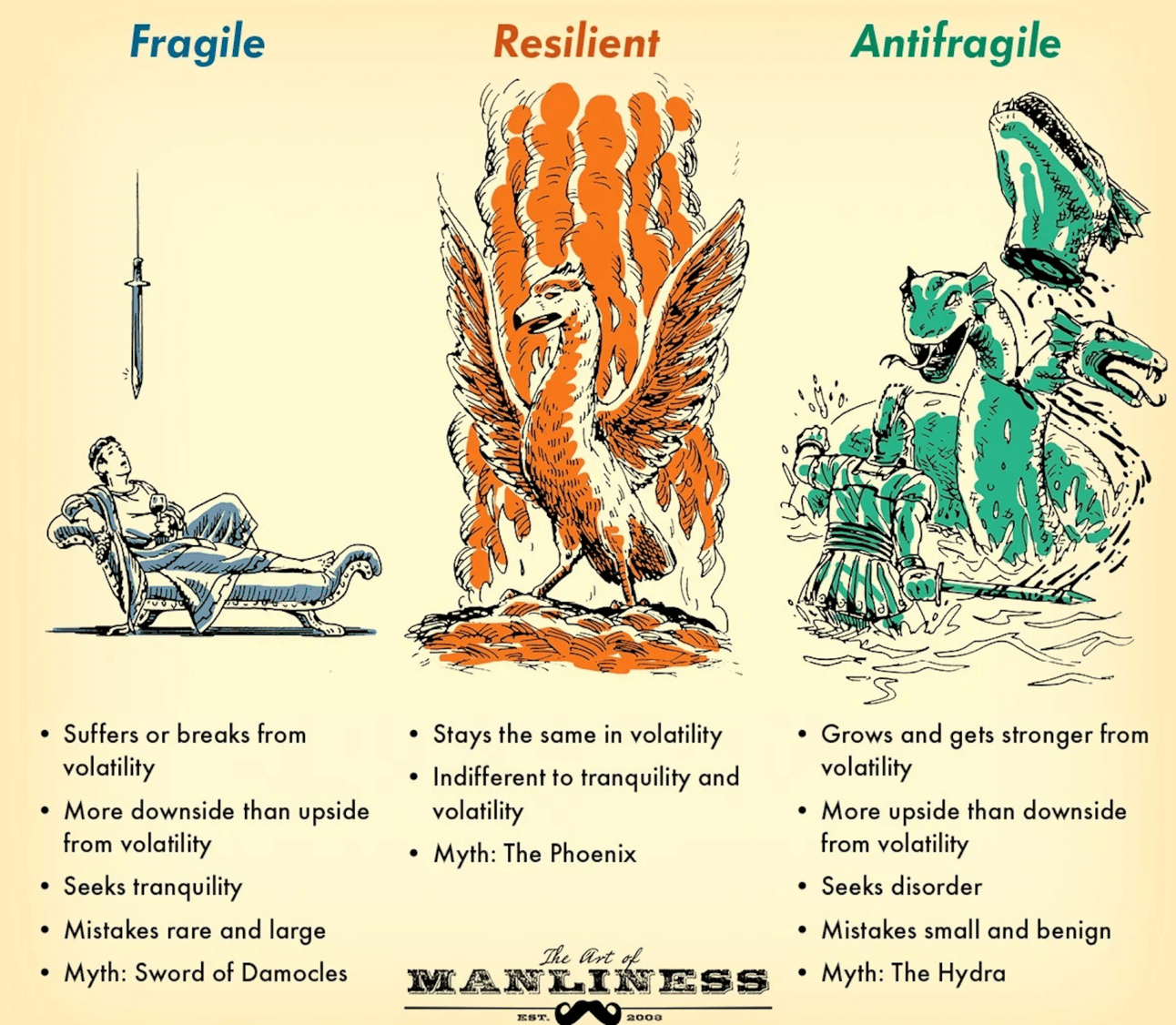
I’m going to cheat a bit and use this great infographic:
Most people know about fragile and resilient systems.
Scaffolding is a great example here.
In the West we tend to use steel scaffolding poles. They are strong, rigid, hard to break.
In the East though, especially in typhoon prone regions like Hong Kong, they use bamboo scaffolding.
If you’ve not seen it before it’s really quite amazing:
The reason for this is that steel scaffolding snaps in a typhoon. It’s strong until it’s not. And when it is overwhelmed it breaks. It’s Fragile.
Bamboo scaffolding on the other hand flexes in the wind. It may not be as absolutely strong as steel but it can weather stresses. It ignores the strong winds by moving with the stresses. It rolls with the punches. It’s Resilient.
Antifragile on the other hand doesn’t just weather the stress.
It gets stronger.
The more stress the stronger it gets.
This is something new. And exciting.
Weightlifting is an amazing example here - you build muscle by actively putting it under stress repeatedly.
We need to do this with our entrepreneurial career too.
We don’t want to just be resilient. We want to go beyond and actively stronger the more stressors we experience.
We’ve talked about how already. Stressors in entrepreneurship come from failure.
Again this is the same in weightlifting. If we lift very light weights again and again and never really push ourselves we don’t get stronger.
We get stronger when we take ourselves to (or close to) failure. Training weights is basically a process of going to failure, backing off, going again, backing off, going again…all with sufficient rest to allow us to return stronger each time.
We do the same with business. We need to seek the hard stuff, the chaos and the volatility. And within that area we create and build.
When we fail, we learn.
And we make sure that we can bounce back from each failure stronger. We learn and apply that learning.
We become antifragile
Artificial intelligence is the ultimate stress test for humanity.
It’s putting skills, jobs, industries and potential the whole of capitalism under stress.
Here is someone much smarter than me discussing this:
Around the 2 min mark, Harari says that this is the first time in human history that we have no idea what the world will look like in 20 years.
I agree.
I studied history at Oxford and whilst nowhere near Harari’s level of comprehension (obviously!) I know enough about historiography to know that this time it’s different. This is new.
For those who are antifragile though, change and volatility is a good thing. The antifragile gets stronger amongst chaos.
We are right now looking at immense opportunity. If you are ready to grab it.
What about the practicalities of how to become antifragile in business?
There are many ways so I’ll just highlight a few here:
Diversification
Personal Brand
Barbell strat (Premium)
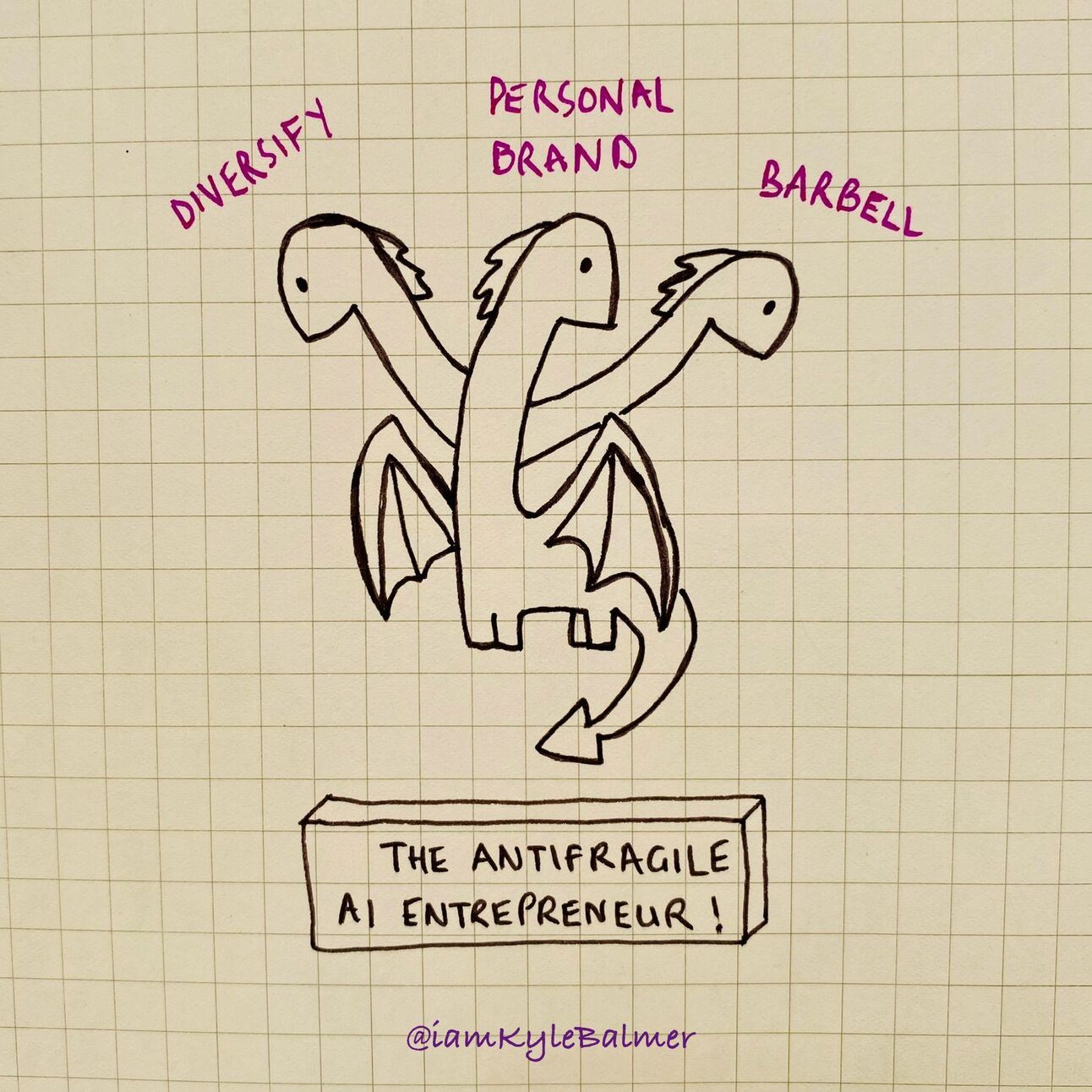
Do not rely on one single stream of income. We do not know which income streams will remain relevant. So we need to have a range of income streams live in case one gets destroyed.
In my videos I often get great wits saying “haha lol can’t wait for AI to take your job”. I respond -”fair. But I have many jobs for this exact reason”.
Right now I have 6-8 revenue streams in action within Prompt Entrepreneur alone.
Because of this I know that if one gets knocked out (and I’m sure they will) I have others up and running. I’ve been caught out before when a single source of work suddenly dried up. It isn’t pleasant.
And AI will make this more of an issue. A new AI tool might drop tomorrow that suddenly wipes out a function. At the time of writing this for example a software engineering AI called Devin just dropped.
Just last week I’ve had conversations with software developers who were singing the “AI isn’t good enough to take my job” hymn.
Devin seems to have changed their tune - suddenly I’m seeing a lot more software developers calling for regulation and slow down on AI. This tells me that Devin is good…and they are worried.
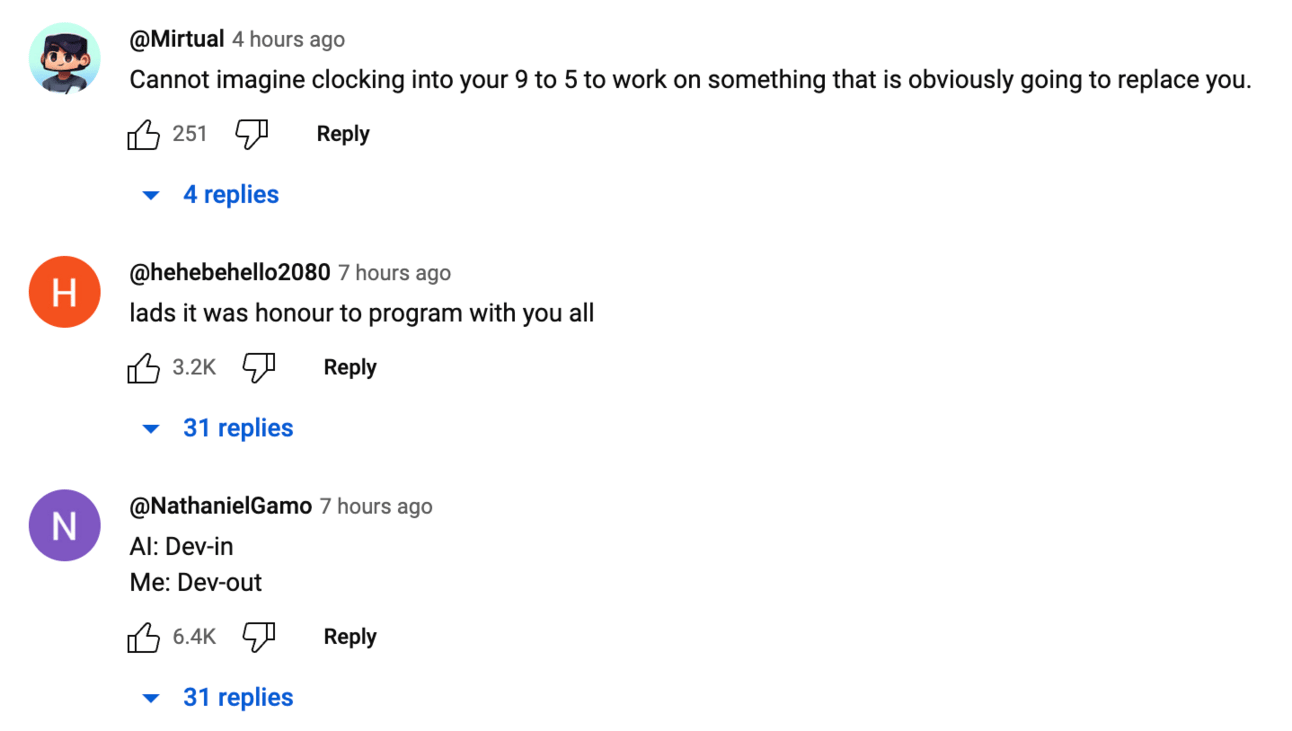
This can (and will) happen at any time. Meaning that relying on one source of income is now extremely fragile.
This applies if you have a job.
And if you have a business with a single primary revenue source.
I know I go on about this one a lot but it’s important.
You are unique.
Your particular blend of character, background and skills is unique.
Even if one of your ventures fails and you need to move to another you act as a continuity. If people like you and the stuff you do then you are less fragile.
In fact your failures become part of your story. People love underdogs!
Building in public or simply talking about your business publicly helps make you antifragile by strengthening your personal brand.
Being known is a super power. And this will be even more the case as bland faceless AI takes hold of most interactions.
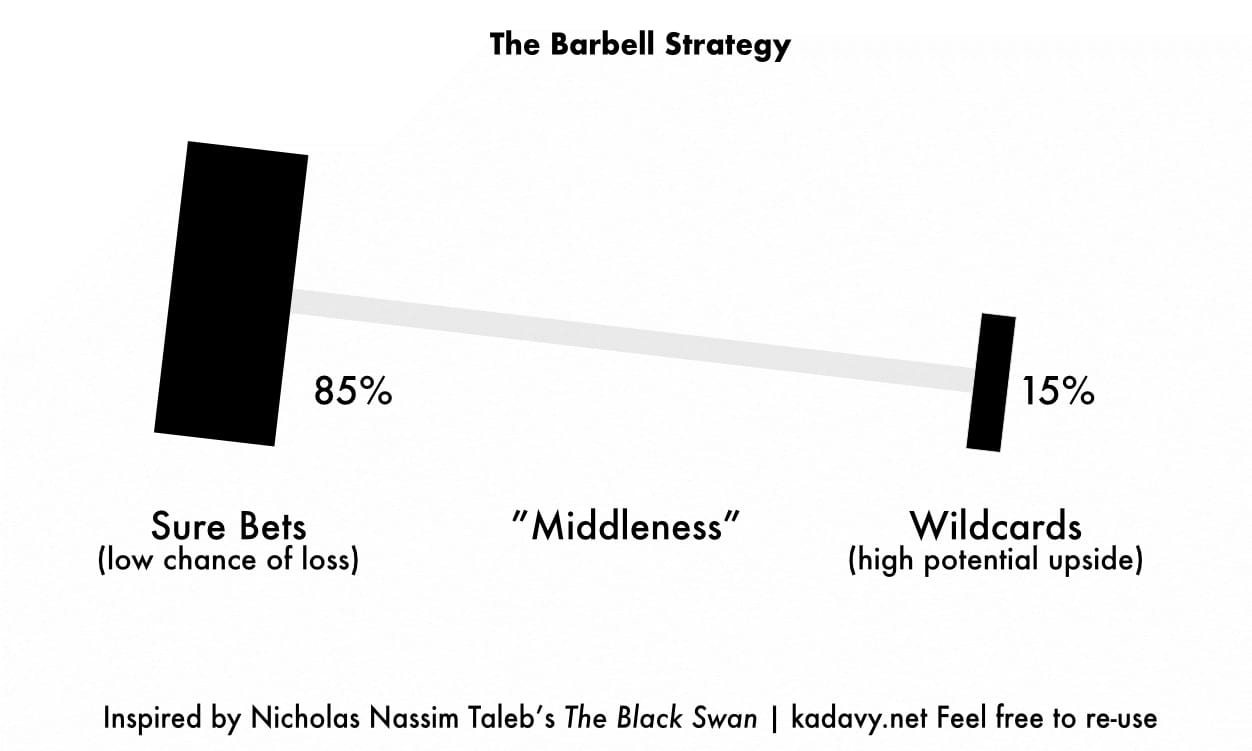
The barbell strategy is another idea from Taleb.
The idea of deploying a barbell strategy is to avoid the middle.
The middle is where dreams and aspirations go to die.
Instead make the majority of your income/investment is a safe bet.
If you have a 9-5 job keep it. For now!
If you have steady client work that doesn’t excite you but pays well, keep it.
If you have these sort of low risk, low upside income streams you have a stable base. This gives you breathing room.
The rest of your work should be wild-ass big bets. Moonshots. Things people will laugh at you for trying.
These will (mostly) fail. And that’s fine! We only need one to kick off for us to do wildly well.
In my case my digital agency B Street Digital has always dripped in regular income. It pays the mortgage and bills.
Which in turn allowed myself and business partner to make big bets on other projects with high upside. Prompt Entrepreneur is one of these - one that worked. Very well.
It’s important that you don’t immediately go all in only on the big bet. If you do so without large savings or external funding you’ve put yourself on a clock. The big bet has to work or else you lose the house. Oopsie.
This leads to you making decisions from a place of fear and scarcity. And you’ll make bad decisions in this place.
Instead keep your safe bets running to pay the bill and take big swings on the side until one big bet pays off.
Antifragility is a topic that we could go into a lot more depth on.
This Part has acted as a primer but I recommend you look into it more - perhaps even reading Taleb’s book if you want to go deep.
A reminder of what we’ll be covering :
Part 1: The upside of downfalls
Part 2: Fail fast, fail often
Part 3: Mental tweaks
Part 4: Antifragility
Part 5: It’s dangerous to go alone
Keep prompting,
Kyle
It’s almost time to head out on your entrepreneurial adventure.
Let’s get started:
Over the last few Parts we’ve talked about how important failure is in business.
Without failure there is zero learning.
So it’s necessary for us, as entrepreneurs, to get used to and become antifragile in the face of failures.
You might be feeling pretty confident right now. And that’s amazing!
However, when things get really bad it’s hard to see the way forward.
When you are struggling to get customers, have bills mounting up and are second guessing everything you do…
Is this really a good idea? Maybe I should have listened to those who said it was a bad idea? This is a terrible idea!
These times happen. Of course they do. And they are hard even for the most antifragile of us! They suck.
Let’s look at some additional mechanisms outside of ourselves that can keep us on the path.
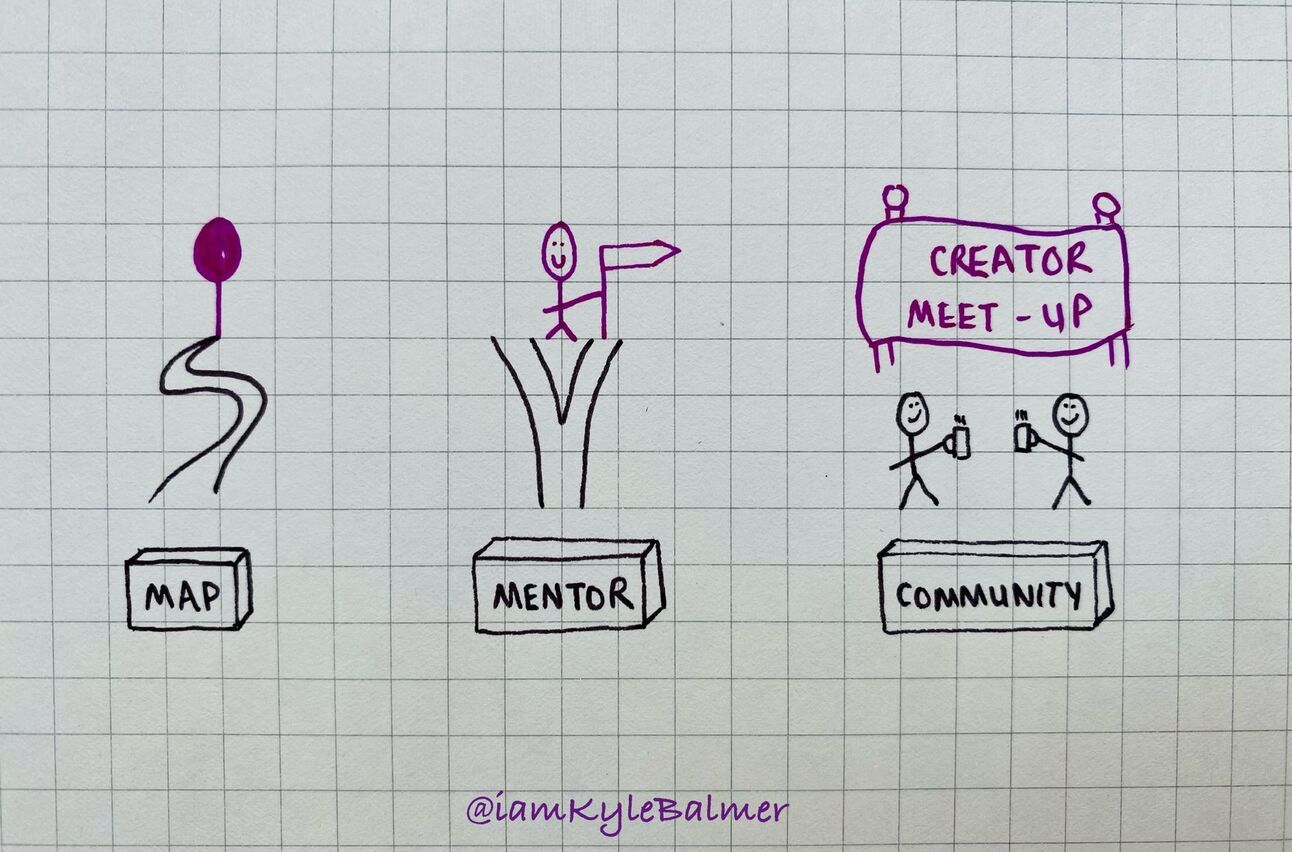
First up: know where you are heading!
It’s really useful to have a map of the territory you are about to venture into.
This is the primary reason why books and courses are so powerful. The best ones give you an exact step by step guide of how to proceed.
Having this pathway helps you stay focused.
I (obviously!) recommend my own AI Business Breakthrough Academy as the pathway for AI entrepreneurship.
But, here’s the kicker, it doesn’t really matter which path you take.
The key is that you follow it to the end. Because by doing so you will learn.
Remember that your first business probably won’t be a hit. And that’s fine. It’s learning. It’s practice.
By following one course all the way through you get a structured plan of learning - much like as if you were doing a course at university, just a lot more practical!
Don’t jump from one course to the next. You’ll learn nothing. Instead work all the way through one - extract all the knowledge you can.
If you build a successful business via the course: fantastic. If not go again with a new business, new pathway and this time apply what you learned from the first course as well.
Your knowledge will start to accrete very quickly and you’ll be able to start skipping through the stuff you know and only pluck out the new gems.
Second, look into getting a mentor.
Importantly a mentor is different from a coach. A coach won’t necessarily have experience in your niche. And their main job is to get you to come to realisations yourself - it’s not about them telling you what to do but instead you working it out.
A mentor is someone who has done what you want to do and can help you along the way. They tend to be more directive - you should try doing this this and this - rather than you finding your own way through discussion.
Obviously all of this depends on the personality and teaching style of the mentor but this mentor/coach distinction is generally valid.
There will be two main types of mentors out there - those who advertise themselves as mentors and those who do not. Both are valid. With the later though you’ll have to directly approach them and ask.
The main advantage of a mentor is that they’ll help you shorten the path to success. They’ll be able to see activities and behaviours and say “ok stop that” or “that looks promising”.
You are basically tapping into their years of judgement, accrued by making lots of their own mistakes in the past! This lets you skip forward in your own journey.
Expect to pay for a mentor. They are generally busy people. Whilst many of them will want to help more budding entrepreneurs they just don’t have the capacity. So they’ll realistically need to be remunerated for their time and years of experience.
During writing I saw Justin dropped this post. Very relevant:
$1,000/hr for sponsorship coaching?!
What a joke.
$1,000/hr for sponsorship coaching?!
What a steal!— Justin Moore | Sponsorship Coach (@justinmooretfam)
4:15 AM • Mar 14, 2024
$1000 an hour is a steal if you consider the years of experience Justin has and how much time, money and agony that single hour could save.
Third, find a community.
This is a group of people you can turn to for assistance, to share victories and defeats and the journey itself.
They come in many formats.
Personally I am part of:
Whatsapp/Discord groups
private entrepreneur dinners in London
my own meet-up
my own Circle community
the Twitter/X AI community at large
All these communities are useful for different things - sparking ideas, discussing plans, seeing what people are up to in the space etc.
My recommendation is you find and join as many communities as you can and then stick to the ones you enjoy using.
It’s trick to quantify - some will just have a vibe that matches what you need. They’ll have the right mix of value/chat, the right focus, the right level of members etc. You’ll enjoy being there. That’s the kicker.
Importantly in any community make sure you are giving more than you take. If you are in there selling you’ll i) get booted and if not ii) won’t be liked by the members! Instead focus on giving and helping.
Fourth, don’t work alone.
Think about partnering up or finding a co-founder.
This a BIG decision. Maybe even bigger than your choice of romantic partner because you’ll probably spend more time with your business partner!
Because of this my recommendation is don’t jump straight in. Instead do some projects with potential business partners.
This is another great reason why starting multiple businesses, one after another, is useful. You can team up with someone for a particular venture and see how it goes. You learn together, you build together.
Having a partner is super powerful because it means you aren’t responsible to only yourself. Being an entrepreneur can be pretty lonely. And having that one other person to talk to, work through ideas and build with makes it a lot more bearable.
If it takes off and looks like a goer then formalise the partnership. At that time you need to sit down and have a frank discussion about roles/responsibilities and split. 50/50 is the “default” but that means you didn’t think about it - generally it’ll be something other than 50/50.
Look for someone who compliments rather than overlaps with you. It’s tempting to find someone who is like you - chances are you’ll really get on with them! But that’s not what makes sense for the businesses.
If you are creative, find an operator.
If you are great at sales and marketing find someone who can deliver the backend.
You should combine to make a larger whole rather than double up on certain skills.
Last word on partnerships: be very wary of partnering with a friend or, worse, someone you are in a relationship with.
What you like about them as a friend/partner will be very different to what you need in a business partner.
That doesn’t mean it can’t work. Only that you need to really think about it beforehand and have some serious conversations.
Over this Playbook we’ve looked at the skill of becoming an entrepreneur and how we hone that skill through repeated failures in order to learn.
A reminder of what we covered:
Part 1: The upside of downfalls
Part 2: Fail fast, fail often
Part 3: Mental tweaks
Part 4: Antifragility
Part 5: It’s dangerous to go alone
Hopefully by the end of this Playbook you are in a position to make yourself a better entrepreneur.
By not worrying about failures and instead seeing them as a learning opportunity and also making ourselves antifragile to stress we become more powerful.
Keep prompting,
Kyle
Welcome to the 🐉Entrepreneurial Resilience Playbook, your ultimate guide to navigating the tumultuous journey of entrepreneurship. This playbook is designed to empower aspiring and established entrepreneurs alike by providing actionable insights and strategies to cultivate resilience in the face of failure. With a focus on learning from setbacks and building antifragility, you'll discover how to transform challenges into stepping stones towards success. Dive deep into real-life experiences and practical exercises that will equip you to tackle your entrepreneurial dreams head-on and emerge stronger than ever before.
This playbook is crafted for ambitious entrepreneurs, both new and experienced, who are eager to learn from their mistakes and thrive in the competitive business landscape. If you've ever felt overwhelmed by setbacks, questioned your path, or struggled to gain traction with your ideas, this guide is perfect for you. By embracing the principles outlined in this playbook, you'll gain the confidence and skills needed to overcome obstacles and achieve your entrepreneurial aspirations.
No prior experience is necessary! This playbook is designed for anyone willing to learn, whether you're just starting out or looking to refine your existing entrepreneurial skills.
You can progress through the playbook at your own pace. Each part is designed to be digestible, allowing you to apply the concepts as you learn without feeling overwhelmed.
Absolutely! The playbook focuses on building resilience and provides practical strategies to help you navigate challenges and turn setbacks into opportunities for growth.
No, the principles discussed in this playbook are universally applicable across various industries, making it beneficial for entrepreneurs in any field.
The playbook includes actionable steps and exercises that you can integrate into your daily routine to help build resilience and test your business ideas effectively.