AI Business
Welcome to the 🧱 Business Fundamentals | AI Business Playbook, your essential guide to building a successful business from the ground up!
Start ReadingFor the next few weeks we’re going back to basics.
I’ll be running through, step by step, how to build out a business. Think of these are foundational lessons.
We’ll be following my BATON framework (Business, Audience, Tribe, Offer, Network):
Business: what value are we going to provide and to who?
Audience: how will we let them know about the value we have?
Tribe: how do we get permission to offer our value to prospects?
Offer: how do we package up our value and sell it to customers?
Network: how do we scale what works into a business?
This week is super important - what on earth is your actual business?
Let’s get started:
Go wide
paradox of business ideas
ikigai prompt
tailor to our circumstances
Your business idea is simultaneously the least and most important part of your business.
It's the least important because ideas are cheap. Implementation is everything. Anyone can have an idea, but unless you build it, it's worthless.
Yet it's the most important because choosing the wrong idea early on could lead you down a blind alley for years.
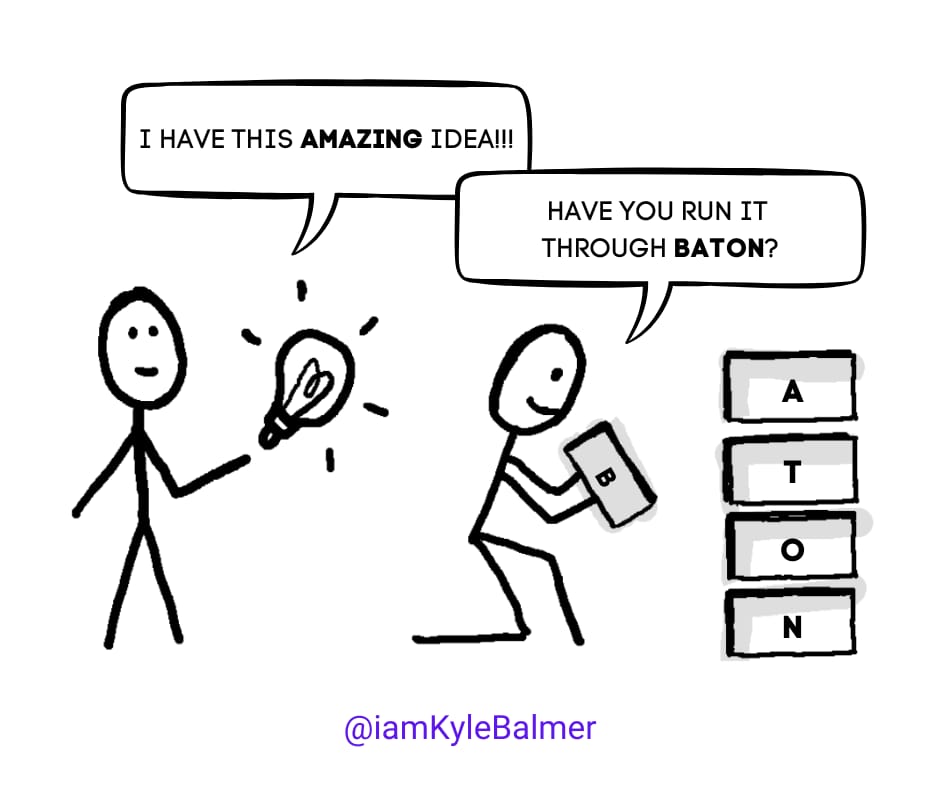
In fact, it's the first component I always teach entrepreneurs. It's part of my BATON framework:
- Business
- Audience
- Tribe
- Offer
- Network
We start with Business and work out what value you're going to provide to the market. If we nail this part the rest is (relatively!) easy.
During this Playbook, I'll be running you through a set of AI-assisted processes to coach you through deciding what business to start. This is also valuable if you have an existing business and want to improve it - running it through this Playbook's process will sharpen your focus.
At the end of the week, you'll have a repeatable process for rapidly deploying new business ideas.
We start by coming up with a lot of business ideas and winnowing down from there.
Remember that ideas are cheap. For every 50 you have, maybe one will be solid and the other 49 can be safely trashed. If that's the case, you know that the remaining 1 is solid.
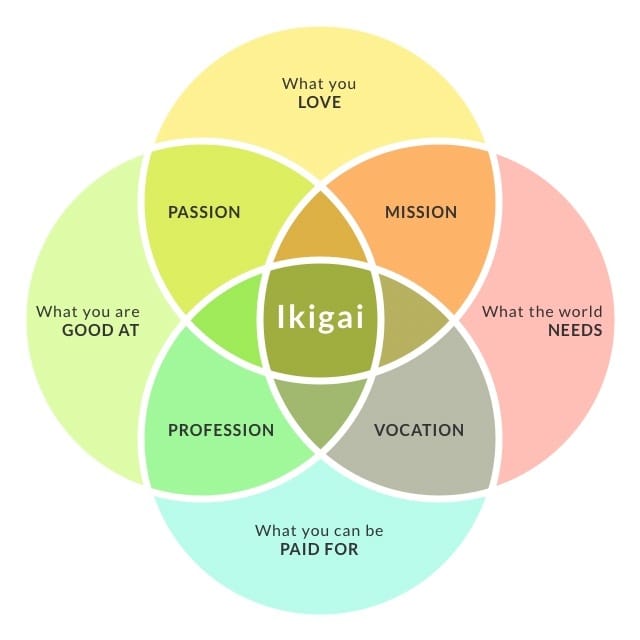
We're going to use an adapted version of the ikigai framework to hone in on the best business for us personally.
Here’s a useful graphic of the ikigai framework in case you aren’t familiar:
Let’s get to work with our first prompt:
You are an AI assistant specialising in business ideation using the Ikigai framework. Your task is to guide the user through a series of questions based on the Ikigai concept and then generate business ideas tailored to their responses. Follow these steps:

1. Introduce the Ikigai framework:
   Explain that Ikigai combines four elements: what you're good at, what you love doing, what the world needs, and what you can be paid for.

2. Ask the user which of the four Ikigai elements is most important to them right now. Use their answer to prioritise that element in your later responses.

3. For each of the four Ikigai elements, ask a series of questions to gather information. Ask these questions one at a time, waiting for the user's response before moving to the next question:

   a. What you're good at:
      - What skills have you developed over the years?
      - What do people often compliment you on or come to you for help with?
      - What achievements are you most proud of?

   b. What you love doing:
      - What activities make you lose track of time?
      - What topics do you enjoy learning about or discussing?
      - If money were no object, what would you spend your time doing?

   c. What the world needs:
      - What problems in your community or the world concern you most?
      - What changes would you like to see in society?
      - What groups of people do you feel are underserved?

   d. What you can be paid for:
      - In what areas do you have professional experience?
      - What industries are growing in your region?
      - What skills or services are in high demand?

4. After collecting all the information, analyse the user's responses. Pay special attention to their answers related to their chosen priority element.

5. Based on this analysis, generate 10 potential business ideas that align with the user's Ikigai, emphasising their priority element.

6. Present these ideas to the user, explaining how each idea relates to their responses and Ikigai elements.

7. Conclude by encouraging the user to view these ideas as starting points, which they can combine, modify, or use as inspiration for their own unique business concepts.

Remember to be creative, encouraging, and responsive to the user's unique combination of skills, passions, and values throughout this process.
This will run you through a process and at the end generate a handful of business ideas you could pursue.
Here are the first 5 for me:
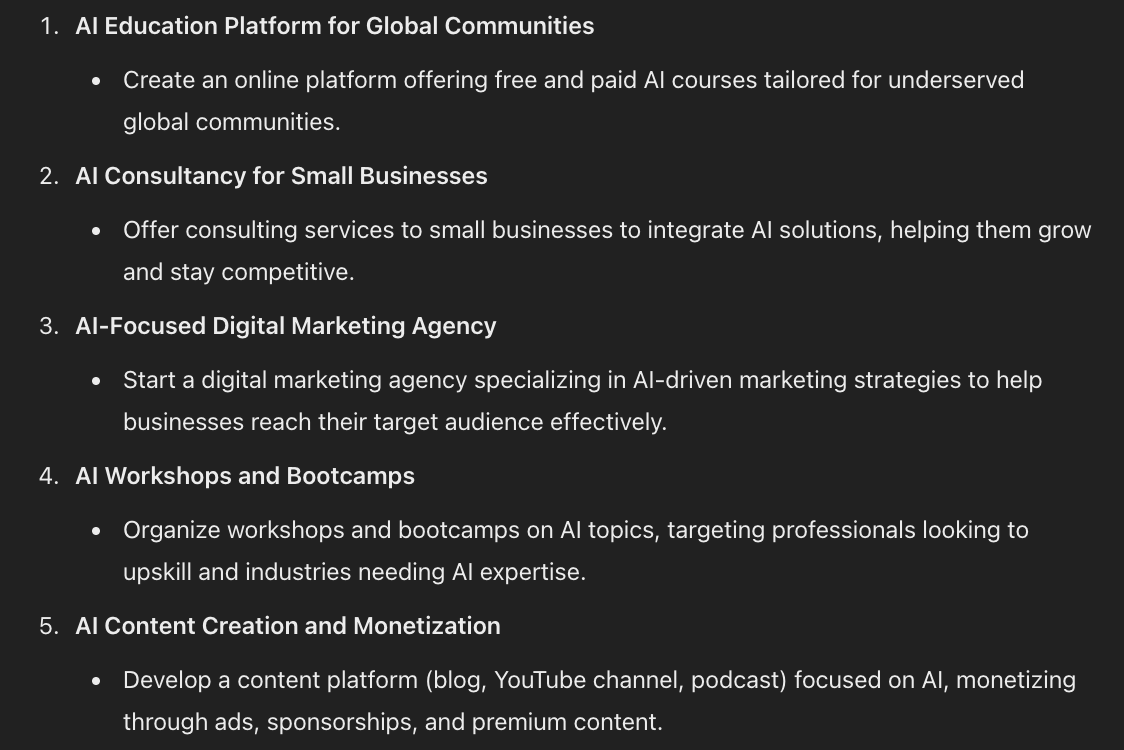
Pretty bang on! I already do a lot of these! And the one I don’t do (the first) is something I desperately want to do.
Importantly there’s a tweak in this prompt that’ll take into account what you want to focus on right now.
Ikigai is a great idea but sometimes we need one component more than the others:
maybe we need money first so that we can leave our job and focus full time on our business
sometimes we want to make an impact on the world and the other elements just aren’t as important
It really depends on you and your situation. So I’ve built into this prompt a “weighting” mechanism that’ll prioritise what’s most important to you.
For now choose the ideas that most interest you. We’ll be running them through a series of other prompts and processes over the rest of the Playbook.
Specifically:
Part 2: Value proposition. Every business must produce value. We’ll work out what your core business model is and the primary value you need to provide the market.
Part 3: Business validation. We’ll run some processes to validate whether business idea is a goer. Both an automated AI process and manual steps for real-world validation.
Part 4: Business plan. We’ll then pull everything together into a actionable business plan for moving forward.
Part 5: Project plan. We’ll finally convert this into a step by step implementation plan with a focus on getting started ASAP.
Sounds good?
Premium subs, see you in the next Part.
Keep prompting,
Kyle
Now we need to start refining. We’ll now work out what the actual value of the business is.
This is an exercise far too many businesses forget!
Let’s get started:
What’s the value?
Repeatable process
It’s not just about making something good
Only your customer can define value
Businesses create value. Full stop. That's the beating heart of every successful enterprise out there.
I love Josh Kaufman's definition from The Personal MBA: a business is a repeatable process that creates and delivers something of value to customers.
As an aside that book rocks for basic business education. And I say this as someone with an MBA…
Now, you'd think this would be Business 101, right? Create value. Easy.
Yet I can't tell you how many times I've sat across from founders who stumble when asked, "What does your business do?" It's not just a pitch problem - it's a fundamental issue that can cripple growth.
Knowing what value you create is the lodestar you’ll orientate all your decisions around. Not knowing it means you’ll go in all sorts of directions - and rarely the right one.
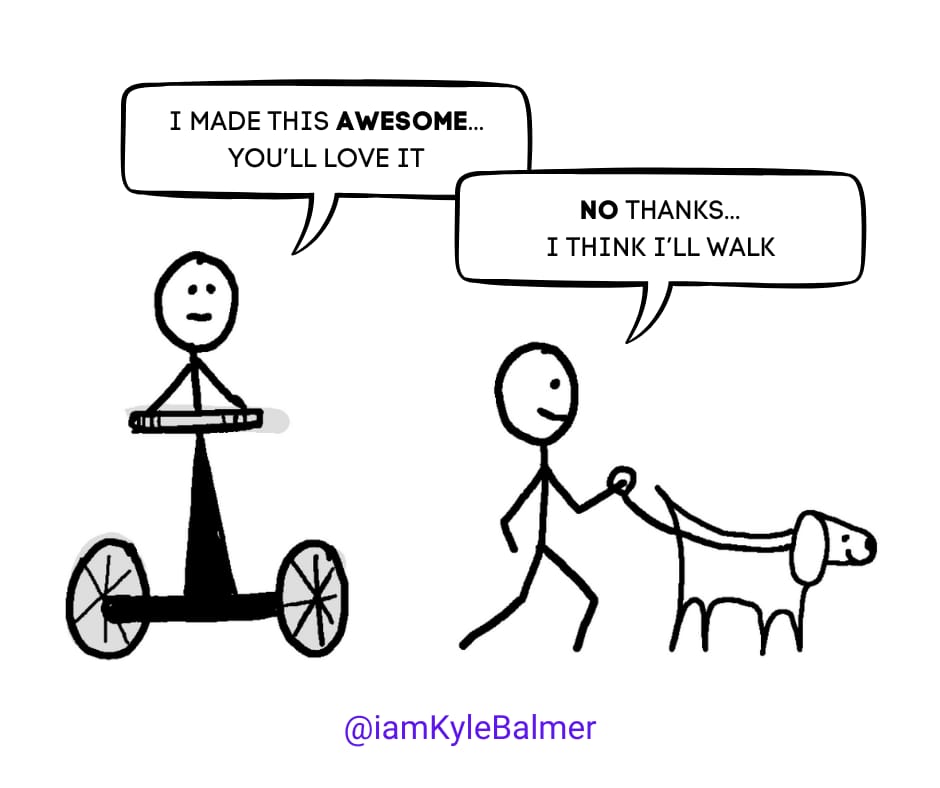
Now, you might be thinking, "Alright, Kyle, I get it. I'll just make something awesome and the customers will come flocking!"
I wish.
The thing is you cannot define what’s value.
ONLY your customer can.
Let that sink in for a moment. You can't create value in a vacuum! Value isn't defined by you, or by the "experts", or by your mum who thinks everything you do is amazing (thanks, Mum!).
Value is defined solely by your customers.
Remember the old adage "the customer is always right"? Well, when it comes to defining value, this is true. Your job isn't to convince them that your idea is valuable. Your job is to create something they already value.
Think about the Segway.
Back in 2001, the Segway was unveiled with more hype than a superhero movie franchise. It was supposed to revolutionise personal transportation. We were all going to be segging (??) around on those things.
Let's break it down:
Technically excellent product? Check.
Built by a large team of experts? Check.
Backed by a huge war-chest of cash? Check.
Actually solved a problem customers cared about? ...lol, crickets.
The Segway flopped hard.
Why? Because no actual customer wanted it.
The product had low value because the customers didn't value it.
The Segway isn't alone in the hall of "great ideas nobody wanted". Remember these?
Google Glass: High-tech and futuristic, but it turned users into "Glassholes".
Juicero: A $400 juicer that basically just squeezed bags. Turns out, people can squeeze their own bags for free.
Bic for Her: Because apparently, regular pens were too masculine? This one got roasted so hard it practically turned into a marketing case study on what not to do.
And more recently in the AI space? Rabbit and the Humane pin? People don’t learn do they?
Let’s use a prompt to work out i) our potential customers and ii) the value proposition for these customers. It’s another mega-prompt:
You are an AI assistant specialising in business analysis and value proposition definition. Your task is to help the user define the value proposition for their business idea across different potential markets. Follow these steps:

1. Ask the user to input their business idea generated from the previous Ikigai-based prompt.
[Wait for response before next question]

2. Explain that to define a clear value proposition, we first need to identify potential target markets. Ask the following questions one at a time, waiting for the user's response before moving to the next question:

   a. Who might benefit most from your product or service?
   [Wait for response]

   b. What industries or sectors could your idea serve?
   [Wait for response]

   c. Are there any specific demographic groups (age, location, income level, etc.) that your idea caters to?
   [Wait for response]

   d. What problems does your business idea solve, and who experiences these problems most acutely?
   [Wait for response]

   e. Can you think of any unexpected or non-obvious groups that might find value in your offering?
   [Wait for response]

3. Based on the user's responses, identify three distinct potential markets for their business idea. Present these to the user and ask for confirmation or adjustments.

4. For each of the three potential markets, conduct the following analysis, presenting your findings one step at a time and waiting for the user's acknowledgment before moving to the next step:

   a. Give the market a clear, descriptive name.

   b. List 3-5 example companies that currently serve this market.

   c. Create a customer avatar (a fictional person representing a typical customer in this market). Include details such as:
      - Name
      - Age
      - Occupation
      - Key challenges or pain points
      - Goals and aspirations

   d. Define a specific value proposition for this market in one clear, focused sentence.

   e. Identify the type of business this is (ie. product, service, rental, expertise, capital etc.)


5. After completing the analysis for all three markets, present your findings in a table format with the following columns:
   | Market Name | Example Companies | Customer Avatar | Value Proposition | Type of Value |

6. Provide a brief summary of your findings, highlighting any key differences in how the business idea creates value across the different markets.

7. Ask the user if they would like any clarification or have any questions about the analysis.

Remember to be thorough in your questioning, creative in identifying potential markets, and clear in articulating value propositions. Your goal is to help the user understand how their business idea might create value for different types of customers.
I’ll run this prompt with this ikigai idea from the last Part:
AI expert consultancy group. A community for AI experts who provide consultation, advisory and implementation services to businesses globally. I’ll then run through the process as I’m asked questions.
After this, ChatGPT specifically highlighted these three potential markets for me:
Independent AI Consultants
AI Consulting Firms
Corporate AI Departments
And for each markets runs an analysis.
Here’s the output for the independent AI consultants market specifically:
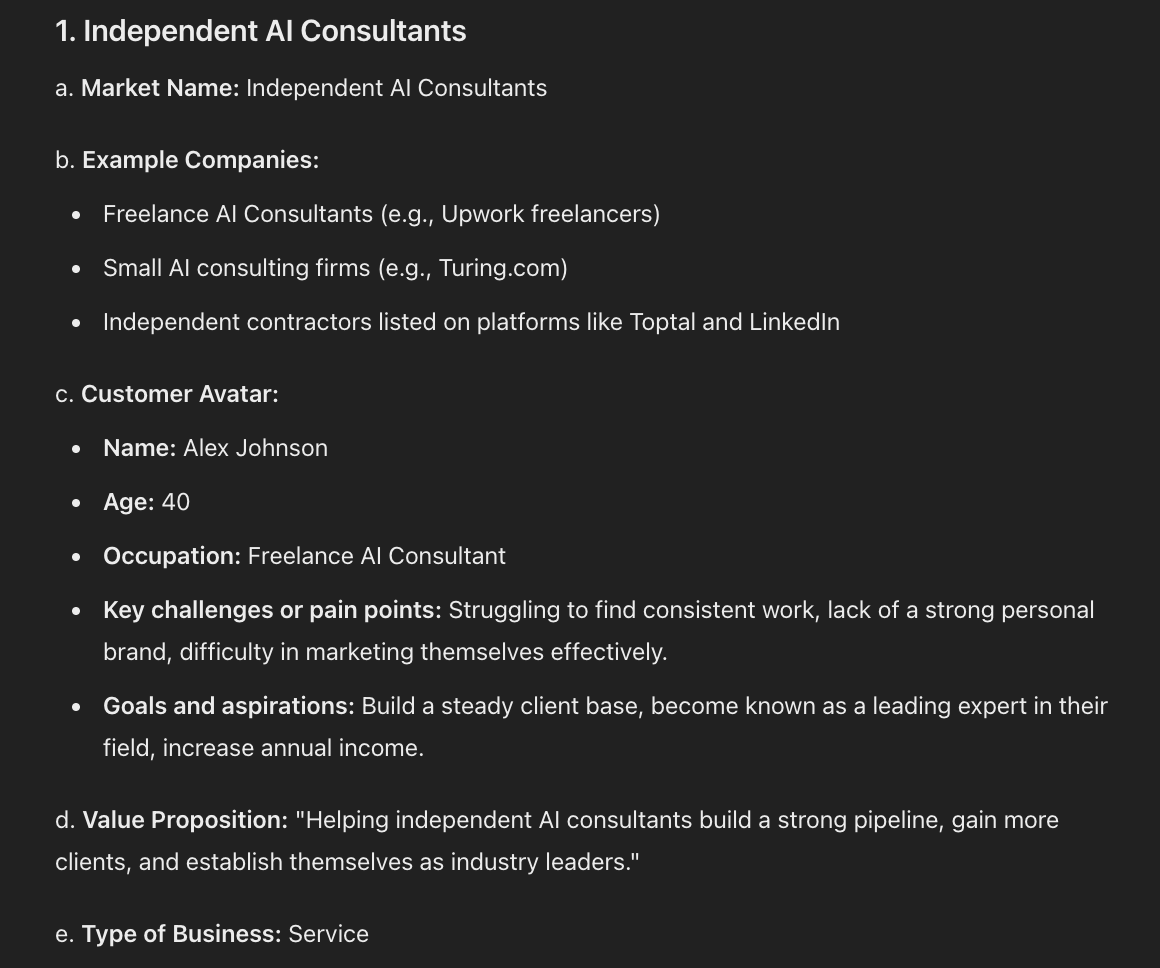
One market and value proposition may jump straight out at you. If so: fantastic.
In the next Part we’ll validate these markets and value propositions and start to hone on on which we should pursue. We’re moving from idea > market > validation.
Keep prompting,
Kyle
You’ve got a great business idea and are excited to get started.
We’re going to hold for the moment and make sure the market wants it before we start.
And if they don’t - we’re killing the idea…
Let’s get started:
Seeking validation
ideas are cheap
what’s a good business idea look like
validation prompt
my personal launch sequence
I know, I know. Your idea is your baby. It's brilliant, innovative, and will change the world! But here's the cold, hard truth:
Business ideas are cheap and voluminous.
Hell, someone has probably already had your idea before. Sorry!
Ideas are a dime a dozen. Everyone and their grandmother has a "million-dollar idea." But good business ideas? Now that's a different story.
A good business idea is one that:
Produces value for the market
People are willing to buy (we’re not a charity)
You can deliver successfully (we’re not scammers)
Has profits that allow for continued operation of your business (we’re not doing a rug pull but building a sustainable business).
Before all of this, we NEED to validate that our business idea is valuable to our customers. That’s the first hurdle and if we don’t pass that the rest is moot.
"But Kyle," I hear you say, "my idea is different! It's revolutionary!"
Maybe it is. But remember our chat about the Segway? Revolutionary doesn't always mean valuable to customers.
This isn't about being negative. It's about being realistic and prepared. And thankfully there’s an easy fix.
Before we go quitting our job and chucking our savings into our idea we can run some low (free, even) validations to check whether the market wants this.
We get positive signals? We build. We get no interest? We pivot.
The market is brutally honest. It doesn't care how much you love your idea or how many sleepless nights you've spent perfecting it.
That stuff is your problem. Not your customers’.
The market only cares about one thing: value.
So before you pour your heart, soul, and life savings into your idea let’s get some impartial feedback:
You are a highly experienced business analyst and startup mentor with a track record of critically evaluating business ideas.

Your role is to provide an objective, thorough, and sometimes brutally honest analysis of business ideas. You're known for your ability to spot potential issues and challenges that entrepreneurs might overlook due to their passion for their ideas.

I will provide you with a business idea, target market, and value proposition. Your task is to critically analyze this information, highlighting both potential strengths and weaknesses. Do not simply agree that the idea is good. Instead, provide an objective analysis of what might be valuable and what might not be valuable or could pose challenges.

Use the information about my business from above OR if none is present ask me for:
Business Idea
Target Market
Value Proposition:

Please provide a critical analysis covering the following points:

1. Market Need: Assess whether there's a genuine, pressing need for this product/service in the target market. Provide reasons why the need might or might not be as strong as the entrepreneur believes.

2. Unique Selling Proposition (USP): Evaluate the strength of the value proposition. Is it truly unique, or are there similar offerings already in the market? How difficult would it be for competitors to replicate?

3. Target Market: Analyze the chosen target market. Is it well-defined? Is it large enough to sustain the business? Are there potential challenges in reaching or serving this market?

4. Revenue Model: Examine how the business plans to make money. Is the pricing strategy realistic? Are there potential issues with the revenue streams?

5. Scalability: Assess the potential for scaling the business. What challenges might arise as the business grows?

6. Potential Obstacles: Identify at least three significant obstacles or challenges the business might face. These could be related to technology, regulation, market adoption, competition, or other factors.

7. Resource Requirements: Evaluate the resources (financial, human, technological) that would be needed to launch and grow this business. Are there any potential resource constraints that could hinder success?

8. Timing: Consider whether the timing is right for this business idea. Is the market ready? Are there any trends or upcoming changes that could impact the business positively or negatively?

9. Founder-Market Fit: Based on the information provided, assess whether the entrepreneur(s) seem well-suited to execute this particular business idea. What additional skills or experience might be needed?

10. Overall Viability: Provide an overall assessment of the business idea's viability. What are the most critical factors that will determine its success or failure?

Remember, your goal is not to discourage the entrepreneur, but to provide a realistic and objective analysis that can help them refine and improve their business idea. Be constructive in your criticism and, where possible, suggest potential solutions or areas for further research.

Then proceed with your detailed analysis of each point.
This will run an analysis of the idea as a whole and poke holes where relevant.
I ran it with the AI Consultancy group business idea. The prompt provided me with pages of information followed by this summary:
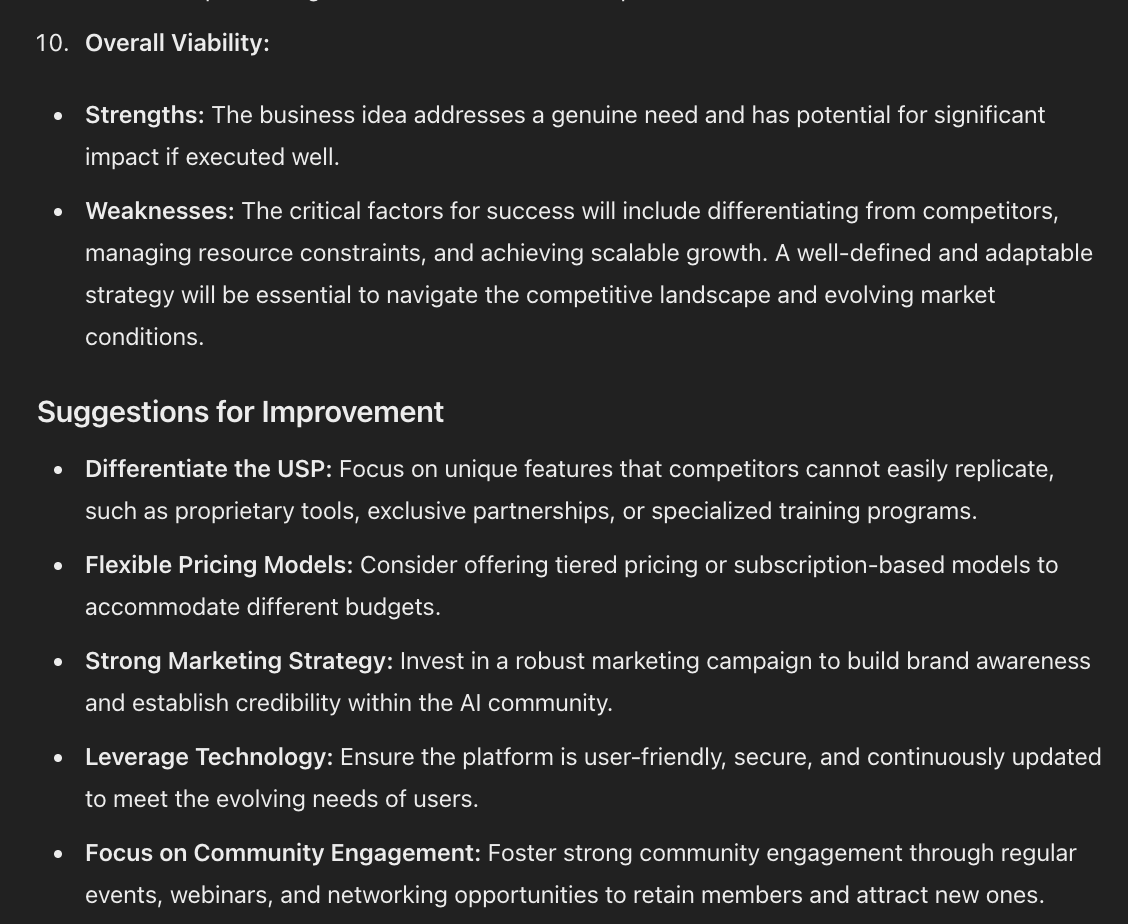
This is a good (AI generated) start.
But ultimately we have to validate our idea with our actual customers! I know! Actual humans. Scary!
My preferred method (personally!) is just to post about an idea and ask if it’s a stupid idea.
I did this with my AI Workshop Kit idea 2 months ago.
Enough people said that they’d be interested for me to start to flesh the idea out more. If no one reacts then I know there’s no demand and stop pursuing the idea.
If there’s enough I’ll I then run a survey (a basic Google Form, nothing fancy) asking people what exactly they were interested in. At the same time this let me gather up emails of people who might be interested.
I’m actually doing this right now with my idea for an AI Expert Consultancy Group. You can see this “live” example here to get an idea of how this works: form example.
If again there’s enough interest I’ll start to build. If there’s not enough, I’ll kill the project.
Generally I’ll pre-sell to the people who are interested and then build.
Again that’s a validation step. If not enough people buy then I’ll refund them all and shut the project down.
So that’s:
Ask if it’s a stupid idea.
Run a survey
Pre-sell
Build
I did this with my AI Workshop Kit. It started with a “is this a dumb idea??” and 1.5 months later we’d banked £120,000. The method works! 😅
Each step let’s me validate demand before diving in head first. It’s very effective and I suggest you deploy a similar method for your idea.
Basically falling in love with your idea is like marrying someone after the first date. Sure, it might work out, but wouldn't you rather be sure before making that commitment?
By breaking development up and only proceeding when we know it’s worthwhile we drastically de-risk our launch. This saves us from spending lots of money and wasting time. Very powerful if you are starting your first business - or even not!
Keep prompting,
Kyle
But don't worry, we're not going to bore you to death with 50-page documents with financial projections and appendices galore.
Those type of business plans aren’t worth the (overly excessive amounts of) paper they’re printed on!
Let’s get started:
A Business Plan You’ll Actually Use
traditional business plans are worthless
lean business plan
business plan prompt
business plan critique prompt
First things first: you don't need a lengthy, detailed business plan to start a successful business.
"But Kyle," I hear you cry, "I thought a comprehensive business plan was essential! If you fail to plan you plan to fail etc.”
Eww.
Here's a little secret: Those long, winding business plans? They're mostly for formal reasons - to make it look like we know what we're doing when we're trying to secure a business loan or impress investors who probably won't read past page 3 anyway.
It’s a formality for the most part. To show we at least have the brain cells to put together a somewhat feasible plan.
But for actually starting the business? Remember that "No plan survives first contact with the enemy."
Who said that? It's of course everyone’s favourite 19th century military strategist Helmuth von Moltke! Good old Helmuth! (Don’t worry, I had no idea either- definitely had to look it up!)
In our case, the "enemy" is the market.
The truth is, your meticulously crafted 50-page plan will likely be obsolete the moment it hits the real world. Markets change, customers surprise you, and that brilliant idea you had? It might need to be trashed and rebuilt.
Worse. Some people actually try to stick to their plan as if it was still relevant. They ignore what the market is telling them. Preferring the “certainly” of their (let’s be honest, made up) document. Yikes!
So, are we throwing the baby out with the bathwater? Absolutely not! We still need an encapsulation of what we do.
We just need to make it short, punchy, and adaptable.
If it fits on a single sheet of A4 paper, all the better.
Here's what we're aiming for:
Value Proposition: What problem are you solving? Why should anyone care?
Target Market: Who are you solving it for?
Solution: How are you solving it?
Revenue Model: How will you make money?
Cost Structure: What are your main costs?
Key Metrics: How will you measure success?
Unfair Advantage: What makes you special?
That's it. No fluff, no filler, just the meat of your business idea.
Let’s get prompting:
You are an experienced business strategist and startup mentor, known for your ability to distill complex business ideas into clear, actionable plans. Your task is to help create a lean business plan based on the information provided.

If I haven't already provided the following information, please ask me for it:
1. Business Idea
2. Target Market
3. Value Proposition

Once you have this information, please create a lean business plan using the following structure:

1. Value Proposition (1-2 sentences):
   Clearly state the problem you're solving and why your solution matters.

2. Target Market (2-3 sentences):
   Describe your ideal customer. Include demographics, psychographics, and any relevant behavioral characteristics.

3. Solution (2-3 sentences):
   Explain how your product or service solves the problem for your target market.

4. Revenue Model (1-2 sentences):
   Describe how you will make money. Include your pricing strategy if relevant.

5. Cost Structure (2-3 bullet points):
   List the main costs associated with running your business.

6. Key Metrics (3-5 bullet points):
   List the most important metrics you'll use to measure your business's success.

7. Unfair Advantage (1-2 sentences):
   Describe what makes your business unique and difficult for competitors to copy.

8. Next Steps (3-5 bullet points):
   List the immediate actions needed to move this business forward.

Please follow these guidelines when creating the lean business plan:
- Be concise and clear. Avoid jargon and complex language.
- Focus on the most critical aspects of the business. Don't try to cover every possible detail.
- Be realistic. If there are obvious challenges or uncertainties, acknowledge them.

After creating the lean business plan, please provide a brief analysis (2-3 sentences) of the plan's strengths and potential areas for improvement or further development.

Begin your response with: "Based on the information you've provided, here's your lean business plan:"

Then proceed with the lean business plan, followed by your brief analysis.
Use this below all your previous work or input the required business information from previous steps.
I ran it with the AI Experts Consultancy Community and got the following lean business plan. Here’s the first half of the output:
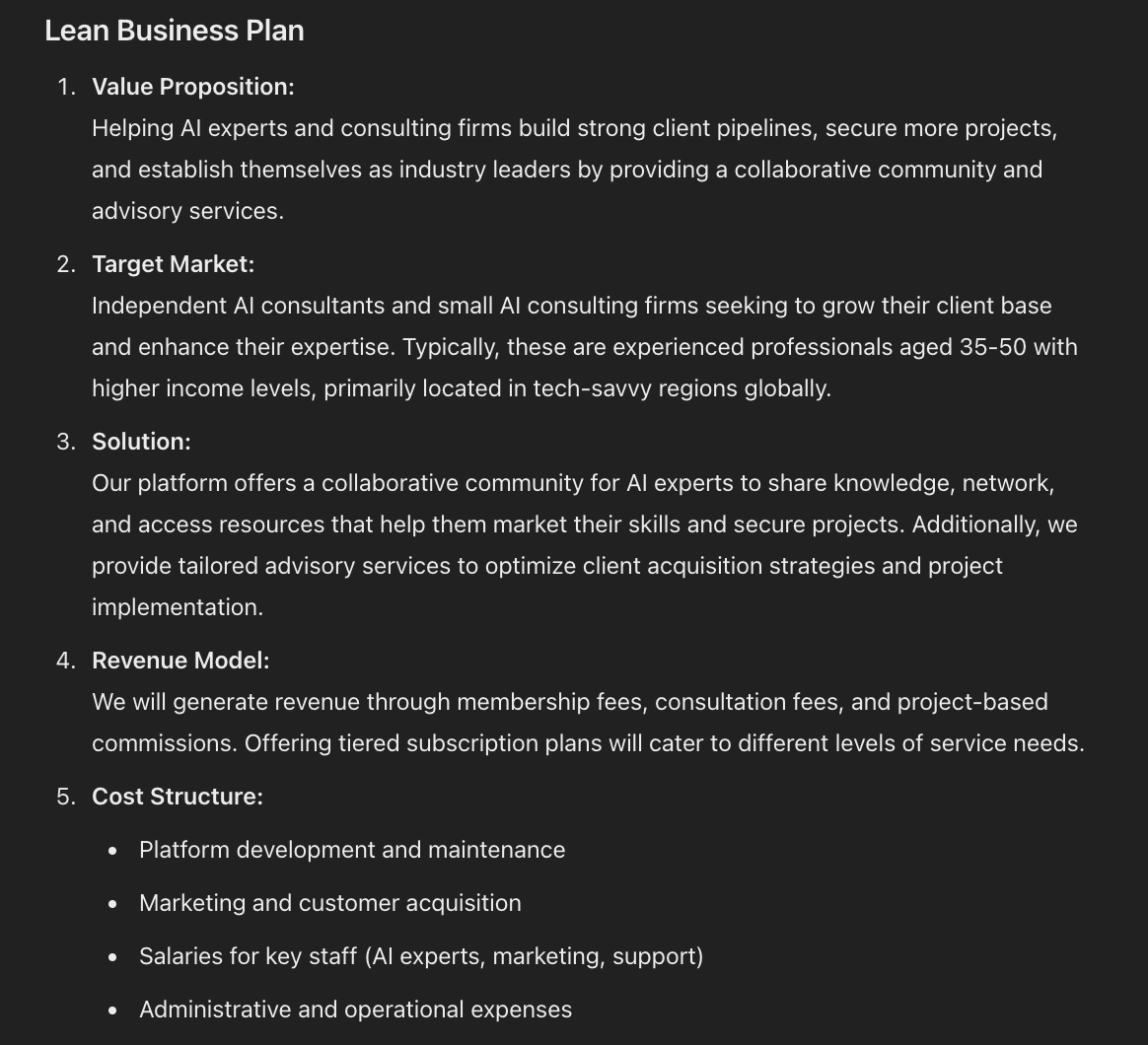
The purpose of this is to have a document that encapsulates the core essence of our business.
We can’t bury the core value proposition under pages of fancy graphs. It’s all bare and naked.
Because of this we have specific enough language for us to be able to run a critical appraisal. There’s no hiding!
Once you have manually adjusted your plan as required here’s a follow up prompt:
You are a seasoned business consultant with expertise in startup strategy and growth hacking. Your role is to provide a critical appraisal of a lean business plan, identifying weaknesses and offering specific, quantifiable, and trackable solutions. Your feedback should be constructive but honest, aimed at strengthening the business plan and increasing its chances of success.

Please analyse lean business plan:
[Use prior information or if none is present above ask user to add]

Provide a critical appraisal covering the following aspects:

1. Value Proposition:
   - Is it clear and compelling?
   - Does it effectively communicate the unique benefit to the customer?

2. Target Market:
   - Is it well-defined and specific enough?
   - Is there evidence of market demand?

3. Solution:
   - How well does it address the stated problem?
   - Are there any obvious gaps or limitations?

4. Revenue Model:
   - Is it realistic and sustainable?
   - Are there potential issues with the pricing strategy?

5. Cost Structure:
   - Are all major cost categories accounted for?
   - Are there any areas where costs could be reduced or optimized?

6. Key Metrics:
   - Are the chosen metrics relevant and comprehensive?
   - Do they effectively measure business success?

7. Unfair Advantage:
   - Is the stated advantage truly unique and defensible?
   - How easily could competitors replicate it?

8. Next Steps:
   - Are they specific, actionable, and prioritized correctly?
   - Do they address the most critical aspects of launching/growing the business?

For each aspect, if you identify a weakness, please suggest a specific, quantifiable, and trackable solution. Your suggestions should follow this format:

Weakness: [Briefly describe the identified weakness]
Solution: [Provide a specific, actionable solution]
Quantifiable Goal: [Set a measurable target]
Tracking Method: [Suggest how to track progress]
Timeline: [Propose a realistic timeframe for implementation and seeing results]

For example:

Weakness: The target market definition is too broad, potentially leading to unfocused marketing efforts.
Solution: Conduct market research to identify the most promising customer segment.
Quantifiable Goal: Narrow down the target market to a specific demographic with at least 3 defining characteristics (e.g., age range, income level, specific need).
Tracking Method: Create customer personas and track the percentage of acquired customers that fit these personas.
Timeline: Complete market research and create personas within 1 month. Aim for 80% of new customers to fit the defined personas within 3 months of implementation.

Please provide your critical appraisal and suggestions in this detailed format for each identified weakness. Conclude with an overall assessment of the business plan's potential for success and the most critical areas for improvement.
This will go through point by point and provide critical feedback.
More importantly it’ll suggest i) how to fix problem areas and ii) a quantifiable and trackable metric for success. Again - nowhere to hide behind fuzzy language and good intentions!
For example:
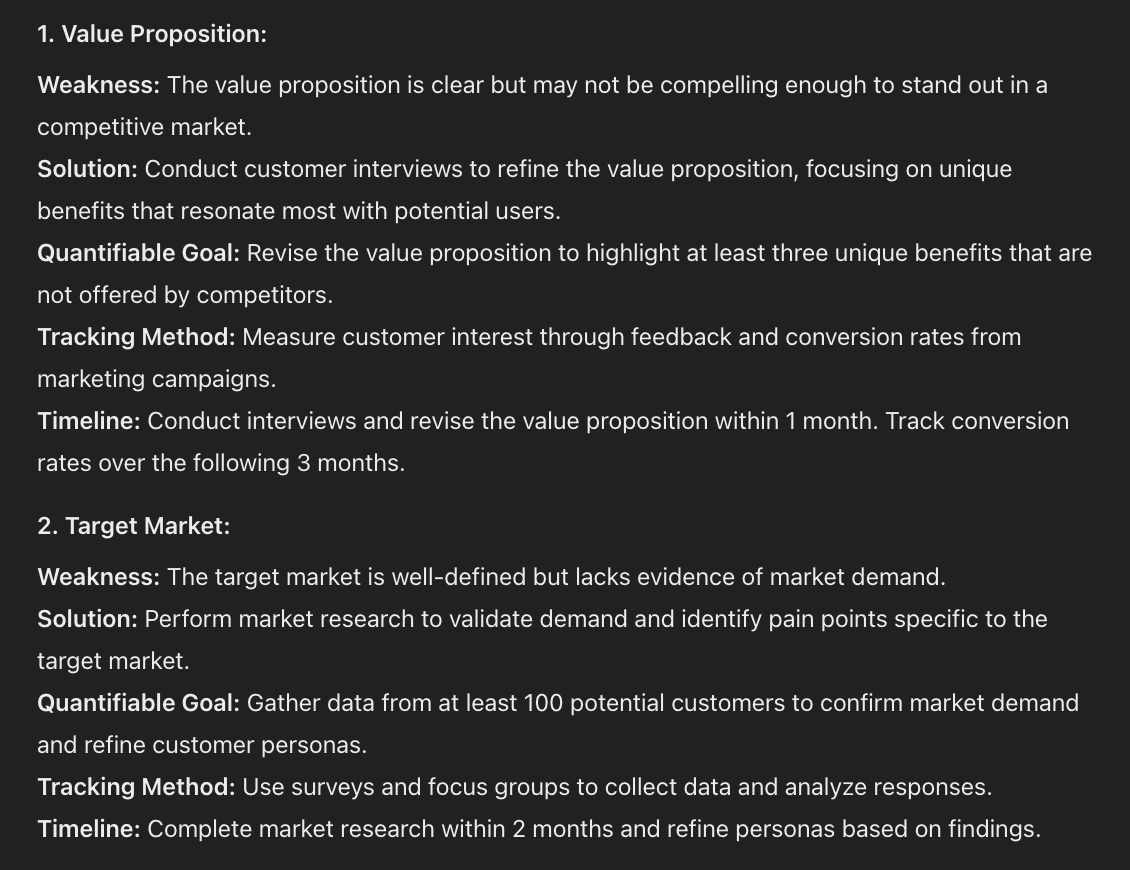
We’re really starting to add teeth to our business idea now! It’s become much more specific!
In the next Part we’re going to convert all of this preparatory work into an action plan.
Keep prompting,
Kyle
Last time, we crafted a lean, mean business plan.
That’s the strategic level. Now we’re going tactical so that we can actually get to work and do the thing!
Let’s get started:
The nitty gritty
strategic → tactical
BATON model overview
tactical plan prompt
So you've got your shiny new business plan. Congrats! It's a great start. Keep it handy as a reminder of your wider strategy.
Pin it to your wall, tattoo it on your forehead (okay, maybe not that last one…wouldn’t even be able to read it in a mirror anyway…)
But here's the million-dollar question: What now?
Strategy is great, but we need tactics. We need steps. We need action points that'll make us feel like we're in a high-stakes heist movie (minus the, you know, super illegal stealing stuff).
Remember when I said we'd break down your plan into actionable steps? Well, I've got something even better for you. It's time to re-introduce you to my secret weapon: the BATON model.
BATON isn't just a fancy acronym (though it is pretty fancy. It was almost BACON which is…less fancy).
It's a step-by-step guide to taking your business from idea to scale. Here's what it stands for:
B: Business
A: Audience
T: Tribe
O: Offer
N: Network
Let's break it down and turn each step into action!
This is what we've been working on all week. It's your idea, your niche, your market, and your value proposition. It's the foundation of everything else.
Over this Workbook we’ve walked through this process in detail, taking you from vague idea to a concrete plan.
For the next stages let me give a quick overview and an example of what future action steps may look like.
Now it's time to get your value out into the world. This is all about choosing your channels and starting to educate before you sell.
Example Action steps:
Choose 2-3 social media platforms where your ideal customers hang out.
Develop 3-5 content pillars (main topics) that align with your value proposition.
Create a content calendar for the next 30 days, with at least 3 posts per week.
Start producing and scheduling your content.
This is where we turn that audience into leads. It's all about getting those precious email addresses and nurturing your community.
Example aciton steps:
Create a lead magnet (e.g., ebook, checklist, mini-course) that solves a specific problem for your audience.
Set up an email marketing platform (like ConvertKit or MailChimp).
Design a landing page for your lead magnet.
Craft a 5-email welcome sequence for new subscribers.
Plan one community-building activity (e.g., live Q&A, challenge) for the next month.
Now we're talking money! But remember, we only get here after we've built a solid audience and tribe.
Example Action steps:
List all potential products or services you could offer.
Organise these into a logical sales funnel (from low-cost to high-ticket items).
Fully develop your entry-level offer.
Create a sales page for this offer.
Plan an email sequence to promote this offer to your list.
Time to scale, baby! This is about growing both horizontally (more customers) and vertically (more value per customer).
We only do this once we’ve got revenue flowing. We don’t expand what doesn’t already exist! It’s a common problem, believe me.
Example Action steps:
Identify 3 new channels to reach potential customers.
Develop one upsell or cross-sell for your existing offer.
Plan a referral program to encourage word-of-mouth growth.
Identify one potential partnership that could expand your reach.
Does that all makes sense? This has been a very quick overview - I’ve got a whole multiple module course on this walking you through each step in detail.
Here for now though is a prompt to give you an initial tactical plan:
You are an experienced business strategist and startup mentor, specialised in creating actionable plans for entrepreneurs. Your task is to create a comprehensive action plan based on the BATON model (Business, Audience, Tribe, Offer, Network) for the user's business idea.

First, ask the user for the following information if not already provided:
1. Brief description of their business idea
2. Target market
3. Main value proposition
4. Any existing audience or customer base
5. Current stage of the business (idea, early startup, established)

Second, interview the user about their resources. Team size, capital, time available (full time/part time) and adjust recommendations based on this information.

Once you have this information, create an action plan following the BATON model. For each component of BATON, provide 3-5 specific, actionable steps. Use the following format for each action step:

- What: [Specific action to take]
- Why: [How this ties back to the BATON stage]
- How: [Step-by-step process, be specific]
- When: [Suggest a realistic deadline]
- Who: [Suggest who should be responsible, e.g., "You" or "Marketing team"]
- Measure: [How to know it's done, be specific and quantifiable]

Here's the structure to follow:

1. Audience (A)
   [3-5 action steps related to identifying and reaching the target audience through appropriate channels]

2. Tribe (T)
   [3-5 action steps related to converting audience to leads and nurturing the community]

3. Offer (O)
   [3-5 action steps related to developing and launching products or services]

4. Network (N)
   [3-5 action steps related to scaling the business horizontally and vertically]

For each section, ensure that the actions are:
- Specific to the user's business idea and stage
- Realistic and achievable
- Measurable with clear outcomes
- Aligned with the goals of that particular BATON stage

After presenting the action plan, provide a brief summary (2-3 sentences) of the most critical next steps and any potential challenges to be aware of.

Begin your response with: "Based on the information you've provided about your business, here's your customised BATON model action plan:"

Then proceed with the detailed action plan, followed by your brief summary.
This prompt will take your previous business plan, ask some supplemental questions and then come up with concrete steps.
For example here are some recommendations:
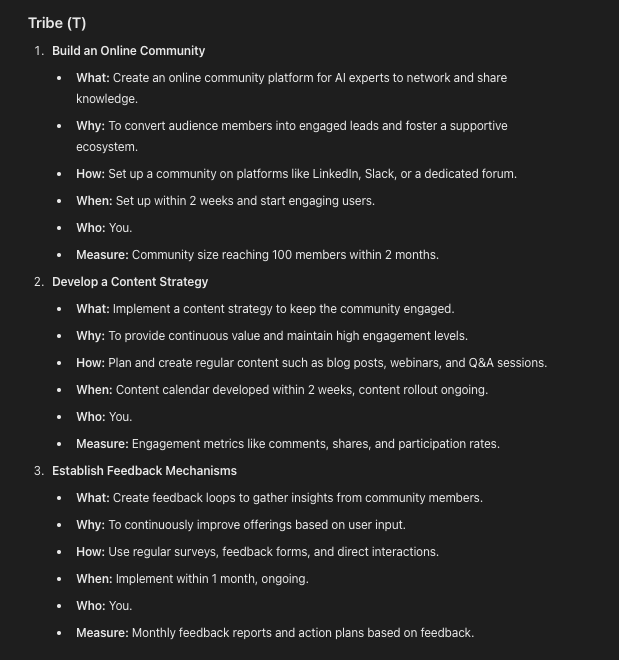
Importantly it’ll ask for you resources beforehand - ie. your team and available cash and time. Giving you as a solopreneur a plan for a 50 person internal team isn’t helpful!
Over the next few Playbooks I’ll be giving my specific recommendations for Audience, Tribe, Offer and Network. My personal recipe for starting and building an online business aided by AI.
But don’t wait for me! If you have an idea and a basic plan get moving.
Remember, a good plan violently executed now is better than a perfect plan next month. So get moving!
Keep prompting,
Kyle
Welcome to the 🧱 Business Fundamentals | AI Business Playbook, your essential guide to building a successful business from the ground up! This playbook takes you back to the basics, offering a step-by-step journey through the foundational elements of business creation. With our unique BATON framework, you'll learn not only how to define your business, but also how to identify your ideal audience, create compelling offers, and scale effectively. Get ready to transform your ideas into actionable plans that bring your entrepreneurial vision to life.
This playbook is designed for aspiring entrepreneurs and small business owners who are ready to take their first steps or refine their existing ventures. If you’re feeling overwhelmed by the complexities of starting a business or unsure of how to translate your ideas into actionable strategies, this playbook is perfect for you. Whether you’re working full-time or pursuing this journey part-time, our clear, structured approach will empower you to navigate the entrepreneurial landscape with confidence.
No prior experience is needed! This playbook is designed to guide you through the basics, making it accessible for everyone.
The playbook is structured to be completed over several weeks, allowing you to work at your own pace and implement the strategies in real time.
Absolutely! The BATON framework is valuable for both new and established businesses looking to sharpen their focus and enhance their strategies.
You just need a willingness to learn and a commitment to take action. All other resources will be developed as you progress through the playbook.
Yes, you’re encouraged to connect with a community of fellow learners for support and feedback throughout your journey.