
AI Authority
Are you ready to become the go-to authority in your industry for AI?
Start ReadingLast week at an event in London, a high level exec pulled me aside and asked, "Kyle, I've got a problem. Our board is pushing us on AI initiatives, but nobody in our industry seems to know what they're doing. We need someone to light the way."
I had to tell her - I’d love to help. But it ain’t me.
I don’t have the industry background to do them justice. It was far too out of my wheelhouse for me to be genuinely valuable. So I passed.
That conversation highlighted something: every industry needs their Key Person of Influence for AI.
Not just another voice - THE voice.
The person whose name comes up in conversations, who attracts the right opportunities, who can make projects successful just by being involved.
And right now? It’s an open goal.
Let's get started:
The opportunity to become your industry's Key Person of Influence
Why 2024/2025 is the perfect moment for AI voices
How to craft your perfect pitch
Why publishing is your secret weapon
The path to becoming highly valued and highly paid
Right now, we're in a fascinating moment. Every industry on earth is trying to figure out AI. Some are getting it right, others... not so much!
But here's what we are interested in: most industries still don't have their go-to AI expert. Their trusted voice. Their guide.
Or if they do you can probably count the individuals on a single hand.
Think about it. Who's THE person explaining AI for healthcare? For education? For manufacturing? For real estate? The seats are empty, waiting to be filled.
I hope: by you!
In just 12 months, I've built an audience of 250,000 people, a newsletter of 60,000 subscribers, and generated over £300,000 in revenue - all by becoming a trusted AI voice in the entrepreneurship niche.
And here's the thing: I'm not special. I just saw the opportunity, moved fast and stuck to it doggedly for a year.
But let's be crystal clear - this isn't about becoming an "influencer" (god, I hate that word). This is about building a business
There’s a difference. Influencers sell attention. Their product is attention.
You on the other hand will sell products, services, education, your brand, your likeness etc. etc.
For you attention is distribution. It opens up the ability to sell your actual offers.
Very (very!) key difference.
When you become your industry's AI voice, amazing things start happening:
Companies reach out for consulting work
Speaking opportunities land in your inbox
Product launches become infinitely easier
Partners want to collaborate
Doors open that were previously locked tight
Just these week I’ve had some fascinating offers - including becoming an advisor to a research journal. Mad.
And this is being written from a coffee shop in Heathrow Terminal 5 before hopping on a flight to the states to talk to 500 business owners. Why? The organisers saw my TikTok videos. And after being on stage I expect there will be other opportunities coming from the participants of the workshop. It all snowballs.
And again - this is me, introverted and shy, after a single year. I’m not special. You can and should carve out your space too.
Daniel Priestley, in his book "Key Person of Influence," outlines five steps to becoming highly valued and highly (disproportionately!) paid in your industry. Here’s a lovely graphic.
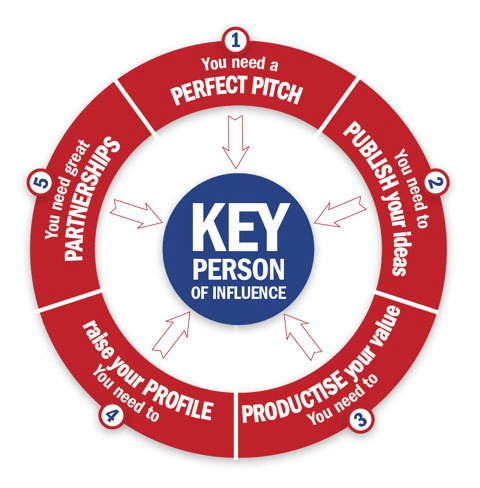
Right now, we're witnessing a unique moment where these principles intersect perfectly with the AI revolution. Every industry needs their AI authority - their trusted voice, their guide. And most of those positions are still wide open.
Your first step is crafting a clear, compelling pitch about how you help your industry with AI. Let's use this prompt to help you refine yours:
You are an AI assistant specialising in personal branding and pitch development. Help me craft a compelling pitch as an AI expert for my industry. Use Daniel Priestley's Key Person of Influence, Step 1: Pitch, as your guideline.

Please ask me these questions one at a time and wait for my response:

1. What industry do you work in or have expertise in?
2. What are the biggest AI-related challenges in this industry?
3. What unique perspective or experience do you bring?
4. Who exactly do you want to help?

Based on my answers, help me craft:
1. A one-sentence pitch (15 words max)
2. A slightly longer elevator pitch (2-3 sentences)
3. A story-based pitch for longer conversations (30 seconds)

Focus on clarity, specificity, and the unique value I bring to my industry.
Take a moment to run through this prompt. Your pitch is your foundation - it's how you'll open doors and create opportunities.
Once you have your pitch refined, the next step is getting your voice out there. Publishing builds credibility, authority, and trust. This will be the focus of this Playbook.
Over the next four parts of this series, I'm going to show you exactly how to seize this opportunity. I’m going to strip it down to a protocol that worked for me and has worked for many others I’ve shown it to.
Building an audience has so many variables and it’s easy to get overwhelmed. Most people don’t even start because of this. We’re going to cut through the noise with something simple- minimal variables.
Is it the only way? Nope! But it’ll work. And rather than try to do 10 different things poorly let’s do one thing correctly. At least for the next few months. The rewards are well worth it.
We'll cover:
Part 2: The only format you should be worrying about
Part 3: The content strategy that built my audience of 250,000
Part 4: My 5-minute video production protocol
Part 5: How to turn viewers into customers
No fluff, no theory - just the exact process I use every day and teach to my students.
The window of opportunity is open right now. But it won't stay open forever. The industries that don't have their AI expert yet? They're going to find them in 2025.
The question is: will you be that Key Person of Influence?
Keep Prompting,
Kyle
Want to know the most common response when I tell people they need to get on camera? "Ugh, I hate seeing myself on video."
Then they usually follow up with something about using AI avatars instead.
Here's the thing - I get it.
My first videos were awful. Like, properly awful.
But it didn’t matter.
Let's get started:
Why short-form video is THE format for 2024/2025
The trust advantage (and why AI avatars won't cut it)
Platform opportunities you can't ignore
Overcoming camera fear (with real examples)
Why imperfect videos often perform better
This hurts me but will help you. So here goes.
Here’s one of my early videos:
@iamkylebalmer What does Google think about AI content? We’re finally getting public announcements from google about how best to use AI tools lile chatgp... See more
It starts with a Millennial pause. I’m breathless for most of it. I keep covering my face (bizarrely) with images.
It also took me forever to do because I was faffing around in editing.
Worse. Because I hated the process so much I stopped making videos for months before coming back and trying again 6 months later.
Here’s how those went:
Couple hundred views each. Lots of experimentation. Lots of grinding. Lots of hating the whole process.
This time though I committed.
4 more months of it actually. Until this:

OK let’s go! We were off to the races. And from here the rest is history (ok that’s a bit overblown!). That video was less than a year from the time I’m writing this - 11 months actually.
But that video changed everything. It was a pivot point. And here’s the thing - we can engineer a pivot point for you.
Look, I've tried it all. Blogs, threads, LinkedIn posts, newsletters. But nothing - and I mean nothing - builds trust and authority faster than video. There's something about seeing someone explain complex AI concepts clearly that just clicks with people.
It’s YOU, raw, authentic. They are spending time with you. And you are spending time with them - just at scale.
Take that video above. It’s sitting at 40879 hours of watch time. That’s 1703 days or 4.66 years. Of people watching and listening to me. Absolutely obscene leverage considering it took 5 minutes to record and post. Video gives your that leverage.
But why short-form specifically?
Here's what most people get wrong - they think longer content means more authority. They plan elaborate 30-minute YouTube videos with fancy graphics and transitions. Then get overwhelmed and never start.
Long form has a place. Absolutely. But it’s lower in the funnel. It’s for people who are ready to “spend” more time with you. Getting someone to watch a 20 second video is much less investment from them than a 1 hour webinar.
So starting out short form is simply the most effective format you can possibly be using. It’ll get you to your goals of having an audience to sell to in the shortest possible frame of time.
Short-form video is just built different:
30-60 seconds to make your point
Film and post in under 5 minutes
No fancy editing needed
Lower pressure = more consistency
Faster feedback on what works
Plus, the algorithms are literally begging for it.
Let's talk numbers for a second. TikTok: 1.5 active billion monthly users. YouTube Shorts: 2 billion daily views. Instagram Reels: 675 million daily viewers. LinkedIn and X? Both pushing video content hard in their algorithms - both adding dedicated short video tabs.
"But Kyle, can't I just use an AI avatar? Or do faceless videos?"
Look, I get the appeal.
Here’s my counter: in a world where everything is becoming AI-generated, being genuinely human is your superpower.
I may be wrong. We will see. But this is my play and I’m recommending it as yours too.
Think about it. If you're trying to become your industry's trusted voice on AI, doesn't it seem a bit backward to hide behind an AI avatar? People aren't just looking for information - they're looking for someone they can trust to guide them through this transformation. A person. Specifically, you.
Short form video works well on pretty much all the platforms now. Because it’s what the social media platforms want.
Each platform has its sweet spot:
TikTok: Loves talking head educational content, especially tech explanations
Instagram Reels: more produced, animated explainers
YouTube Shorts: Ideal for how-to content because of the SEO
LinkedIn: Eats up anything AI business-related
Twitter: quick tips and insights, deeper level knowledge
You don't need to be on all of them. Start with one. Master it. Then expand.
If you are choosing one to start with I’d heavily suggest TikTok.
This is obviously caveated based on the (maybe) ban in the US. And this is relevant even if you are not in the USA because of second order effects - if US creators are removed from the platform audiences may follow them to Instagram or others. Which drops overall audiences even in your region.
TikTok has two major advantages:
Each video is shown to audiences based on its own merits. Not on the number of followers you have. IG and Youtube naturally show to more people when you have a higher follower count - big accounts get bigger. This means they are much slower burns as you day by day add followers. TikTok is different - if your first video is engaging it could go directly to 100s of thousands or even millions of viewers, regardless of your follower count. This makes it an amazing place to start.
The built in recorder is top notch. It allows start/stop recording, allowing you to get clip by clip by clip rather than having to shoot in one take or edit together clips later. Instagram has a similar recorder but the other platforms do not.
LinkedIn will obviously be a valuable platform for you (because you’ll be talking to your industry) but it doesn’t have an in-built recorder (technical barrier) and mainly shows to your followers (audience barrier). Use it as a secondary platform for this reason. The name of the game is ease!
Let's address the elephant in the room - camera fear. Here's what helped me:
Watch my first videos. No, really - go look at them on TikTok - you can filter by oldest and see the cringe. Even someone like Gary Vee's first videos were awkward. Everyone starts somewhere - you will too, and that’s fine.
Remember the "Coffee Shop Rule": If you can explain something to a friend over coffee, you can explain it on camera. Same energy, same person.
Focus on helping one person. Forget about the masses. Imagine explaining AI to that one colleague who keeps asking you questions.
Embrace imperfection. Some of my most successful videos were shot when I was rushing out the door. My most viral video? Shot wearing a jacket because I was heading out - people kept asking if I was cold. That "imperfect" video generated hundreds of thousand in business. (btw this makes smartarse comments about the jacket a lot easier to handle ha!)
Apart from that it’s all about practice. Turning up daily and shooting a video. Making it a habit. Making it boring rather than terrifying!
It is a skill and it can be learned. It just requires putting in the reps.
This is why I recommend simple simple simple when it comes to production. Don’t layer in complexity but instead focus on talking head videos, talking to camera. It’ll help you level up your skills faster and remove the need for editing and post-production.
Here's something most people don't realise: the algorithms (especially on TikTok) actually prefer authentic, "normal" looking content over highly produced videos. Why? Because that's what people engage with more.
When someone's explaining AI concepts clearly and naturally, viewers stick around. They comment. They share. And the algorithms love that. All hail our algo gods.
In Part 3, we're diving into exactly what to talk about. I'll share three content pillars that take the guesswork out of content creation. Nothing is worse than sitting down to record and having no idea what to say!
This is another barrier we need to remove so I’ll show you how to never run out of video ideas.
Remember, every Key Person of Influence started somewhere. The only question is, when will you start? Don’t make the mistake I made of waiting, stopping and starting and only eventually committing. I kick myself about it often!
Keep Prompting,
Kyle
Ever sat down to make a video and just... stared at your phone?
Here's how it usually goes: you know you should make a video, so you start scrolling for "inspiration." Forty-five minutes later, you've watched seventeen cat videos, read about the latest AI drama, and still haven't recorded anything. Oops.
I used to waste literal hours like this. Now I channel Stephen King.
At the end of each writing session, he deliberately stops mid-sentence. Why? Because the next day, he knows exactly how to start - just finish that sentence!
We're going to apply the same principle to your AI content. By the time you sit down to record, you'll know exactly what you're going to say. No “research”, no second guessing. Just recording.
Let's get started:
Setting up your content machine
The three pillars that never run dry
Finding and adapting proven formats
Building your content network
Prompts to eliminate creative block
Let's solve the "what do I talk about?" problem once and for all. No more staring at your phone wondering what to say. No more scrolling for inspiration. We're going to build a systematic approach to content creation.
We’re going to start you off with three Content Pillars. These will get you started. Early days you might want to experiment with more - that’s natural. But remember we are first and foremost aiming to build a habit. So let’s make it easy - remove another block.
Let’s run through three pillars you can start today.
(Or as I like to call it, "ethical stealing"). We are finding content that has a proven track record. We know the content works because it’s worked for others. We are going to adapt it to our particular niche.
Here's your step-by-step process:
Find successful creators in both AI AND your industry
Follow them, then check who THEY follow
Review those accounts and follow relevant ones
Repeat this process - you'll quickly build your network
Sort their profiles by most viewed content
Look specifically for EVERGREEN content (avoid news/temporary topics)
Create a spreadsheet with links to successful videos you can adapt
Want a shortcut? Start with my profile - find my most viewed videos and adapt them to your industry. Here's a prompt to help you transform any video for your niche:
You are an AI specialised in content adaptation. Help me transform this video concept for my specific industry.

Original video title/topic: [Insert title/topic]
My industry: [Insert your industry]
Target audience: [Insert your audience]

Please provide:
1. A 30-second script that:
   - Maintains the core concept
   - Uses industry-specific examples
   - Speaks to my audience's needs
2. A compelling hook sentence
3. Key points to cover
4. A strong closing call-to-action

Note: No camera directions or technical instructions needed.
Fun fact: I've actually built an automation that scrapes huge numbers of influencer profiles, grabs their subtitles (ie. their script), and rewrites them in my style for my audience using Claude. All sorted by most popular using engagement metrics. Overkill for you right now! But something you could build in the future.
Right now you just need a handful so that you can always sit down and know what to shoot. I’d say start with 10-20 for now.
Our second content pillar is focusing on what’s new. This is your opportunity to become your industry's AI news interpreter.
You’re going to subscribe to the top AI news focused newsletters and blogs and each day find an article that’s trending.
You are then going to simply flip that content into a video script. It’s a proven topic that is already trending so all you will be doing is bringing it to your audience in a short form video format.
Here's the structure:
Hook with the headline
Explain the main point
Break down why it matters for your industry
Here's a prompt to help you transform any AI news into industry-relevant content:
You are an AI specialised in news analysis. Help me create a video script about this AI news for my industry.

News article: [Paste article]
My industry: [Insert industry]

Please provide:
1. An attention-grabbing hook (5-10 words)
2. Main point explanation (2-3 sentences)
3. Industry implications (2-3 key points)
4. Call-to-action closing line

Keep the total script to 30-45 seconds.
Pro tip: Use a green screen to show the article behind you. Not required, but adds professional polish!
This is where you share actual solutions your audience members can use Again, specific to their industry and the use of AI therein. Here's a prompt to generate endless video ideas:
You are an AI specialised in content ideation. Help me generate AI-related video ideas for my industry.

My industry: [Insert industry]
Target audience: [Insert audience]

Please provide:
1. 10  video ideas that:
   - Solve common industry problems
   - Showcase practical AI applications
   - Can be explained in under 60 seconds
2. For each idea, include:
   - Engaging hook  (3 options)
   - Main body in step by step format
   - Call to action to use the tip + ask for their results
If stuck here one video that works well is giving them a prompt engineering framework. You can create your own or teach them about the RISEN™ framework. If you do, drop in my name and tag me and I’ll reshare (maybe shoot me a message too as I may miss the tag!)
Here's how to implement these pillars:
Week 1: Test Emulation
Find 5 successful AI-related videos in your niche
Adapt their content to your expertise and industry
Track which adaptations resonate
Week 2: Test Newsjacking
Find a handful of news sources for AI news
Each day feed the top story into the prompt
Focus on implications for your audience
Week 3: Test Prompting Tips
Use the prompt to come up with 5 video ideas for the week.
These may be longer videos - experiment too with free flow one take! It’s hard but works well with this type.
Week 4: Double Down
Review what worked best
Create more content in your strongest pillar
Start mixing and matching approaches
Focus on ONE pillar at a time, get used to it through repetition and only move on when you feel comfortable. Remember this is all about getting the practice in.
Now, you might be thinking, "But won't I just sound like everyone else?" Here's the thing - your unique perspective comes from your industry experience, not your content structure.
Given the same basic topic area every one of us would create a very different video.
Remember: volume creates clarity. Your first videos won't define your voice - they'll help you find it.
In Part 4, we're diving into the actual production process. I'll share my 5-minute video protocol that takes you from idea to posted content in less time than it takes to make a coffee.
Keep Prompting,
Kyle
"Five minutes? Come on, Kyle. Nobody can make a good video in five minutes."
I hear this a lot. Then I pull out my phone and make one right there in front of them.
Here's the thing - most people spend way too much time on the wrong things. They fiddle with editing software, worry about perfect lighting, and end up never posting anything at all.
That first 3M+ video I got was literally taken whilst leaving the house and thinking “ugh I need to do a video”.
Guess what? Your audience doesn’t care about the polish. They care about you dropping knowledge. As yourself. The expert.
Let's get started:
The 5-minute production protocol
Technical setup (spoiler: just your phone)
The start/stop trick that eliminates editing
Why lighting and sound don't matter (yet)
Building the daily habit
Here's exactly how I shoot my videos, timed out:
Minute 1: Setup
First thing - open TikTok or Instagram Reels (I prefer TikTok's recorder). Find somewhere quiet and position your phone at eye level - use a tripod or straight up hold the phone. I hold the phone - that’s fine.
Face a window if you can for natural light, but honestly, any decent lighting will do. That's it. Don't overthink this part - it's just about getting ready to record.
Minute 2: Practice Run
Take your hook and main points (which you have already, right?) and do one quick practice run. Record as it makes it “real”. But don’t worry about it being good. A dry run will help you work out the phrasing.
Minutes 3-4: Recording
Hit record and deliver your hook - it should take about 5-10 seconds. Hit pause and check if you like it. If not, just delete and redo that bit. Continue this process with each section, pausing between points.
We’re using this sort of Start/Stop recording (which is built into TikTok, Instagram and apps like Clips on iPhone) because it lets us nail each sentence one at a time.
Think of it like building Lego - piece by piece, not carving a sculpture from a single block. You're eliminating the pressure of getting everything perfect in one take.
Minute 5: Post
Final steps to quickly prep the video for discoverability:
add auto generated subtitles, correct spelling if needed (especially “ChatGPT”!)
add a text title on the video with the main topic, set time on screen to 1-2 seconds
write a caption/description for the video. Make sure you mention the main themes using terms like AI, ChatGPT etc. to help with discoverability.
choose a cover frame and add a text overlay with the same title as before as the text
hit post. Done. Move on with your day. The key here is not to overthink it - get it posted.
Quick note about the "Millennial Pause" - you know, that awkward gap at the start of videos where you can see people waiting to begin talking. I'm used to be guilty of it too. If you aren’t sure what this is here’s an amazing video that’ll make it VERY obvious:
@cameo Comment your fav millennial pause down below
Here's how to avoid it: take a deep breath in, hit record, and start talking as you exhale. No pause, no awkwardness, just natural flow.
About 5-10 minutes after posting (if using TikTok) hop back on the app and check the views.
If it’s at 200 or less then the video hasn’t popped. That’s fine. LEAVE IT alone. Just leave it. It might pop off later. Maybe even months later.
More importantly we don’t want you to worry about the performance of every video. Just move onto the next.
If it has moved above 200 views then it’s off to the races. Check if there are any comments and respond to the comments. This will show engagement and further boost your videos performance. The more you engage the better but remember you are a business owner not an influencer - checking your videos mustn’t become your full time job!
Except for when you get your first viral video - I’ll allow you to check as much as you like for that one! I certainly did!
Want to know what fancy equipment you need? Here's my main gear list: an iPhone, my arm and a window (for light). That's it. No ring light. No microphone. No fancy camera.
It’s sufficient. Especially starting out. And it means less faffing around with setting up lighting, connecting cameras and microphones etc.
"But Kyle, what about sound quality?" Phone mics are surprisingly good these days. Just make sure you're in a relatively quiet room. As long as people can hear you clearly, you're good to go.
"What about lighting?" Face a window. Natural light beats any ring light I've tried. If you don't have a window, any reasonably well-lit room will do. Remember, we're aiming for done, not perfect.
"What about background?" A plain wall works fine. Or your office. Or literally anywhere that isn't messy (and thus distracting!). Your audience cares more about what you're saying than what's behind you.
Can we make "better" videos with fancy editing and perfect lighting? Sure. But first, we need to build the habit and prove to ourselves that this is worth our time. Start simple, start consistent, upgrade later.
My best tip? Do it first thing. Before checking email, before meetings, before your brain can come up with excuses.
Don't rewatch your videos obsessively. Post and move on. Don't waste time on transitions or effects - they don't matter. Don't try to memorise a script - bullet points beat perfect words every time (plus you can record sentence by sentence using Start/Stop recording). And most importantly, don't aim for perfection. Aim for done.
Remember why we're focusing on volume over perfection: First, it's the only way to truly understand what your audience wants. You might think they need detailed technical explanations, only to find they engage more with quick practical tips. Second, there's no better way to improve your presentation and explanation skills than by doing it daily. Each video makes you a little bit better at communicating complex AI concepts.
In our final part tomorrow, we're talking about turning this momentum into real business results. Plus, I'll share details about joining our accelerator program where we give you 30 days of scripted content and accountability.
Remember, every video you don't post is a missed opportunity to be discovered by someone who needs your expertise. Start posting ASAP.
Keep Prompting,
Kyle
In the last year I’ve built up 250,000 audience members, 60,000 newsletter subscribers, over £300,000 in revenue - all from consistently showing up and sharing AI insights through short-form video.
Where does that cash come from? A whole range of sources:
direct product sales via own sales funnel
consulting/advisory work
sponsorships and ads
coaching individuals
direct TikTok creator fund revenue
Premium Subscribers
This is why you, as a business owner, are building an audience. We are NOT building an audience for the sake of vanity. We’re building it to drive our business. Now we’ll look at how.
Let's get started:
How to turn viewers into customers
The three paths to monetization
Building your revenue flywheel
Why consistency beats perfection
Your next steps (including the accelerator)
After building my own AI business through content, I've identified three clear paths to turning viewers into revenue. As outlined about there are far more but I’d recommend getting started with these (in this order!):
Direct Consulting Companies see your content, recognise your expertise, and reach out for help. It's the fastest path to revenue and requires no capital outlay from you.
Product Sales Once you've built an audience, creating and selling products becomes infinitely easier. These could be courses, templates, guides, or tools. The key is that you're not selling to cold traffic - you're selling to people who already know, like, and trust you.
Partnership Opportunities When you become known as your industry's AI voice, other companies want to partner with you. Speaking gigs, advisory roles, revenue shares - these opportunities start appearing naturally.
This is high level - let’s get into it and look at the nitty gritty set up.
Start with a service like consulting, doing it 1:1 initially. Yes, it's not scalable, but it gives you:
Immediate revenue
Deep understanding of customer problems
Case studies for your content
Testimonials and social proof
The reason we start with a service (consulting, advising, coaching etc.) is because we can immediately put this into action. There’s no upfront cost and you can get clients immediately once you have an audience starting to build. It’s also very flexible - you can find out what works and what doesn’t and very rapidly pivot. This is harder with a product because of the lead time to build.
Use your consulting experiences to create content that attracts more clients. Every client question becomes a video topic. Every success becomes a case study. This is a form of “building in public” - we’re basically documenting as we go alone.
Crucially, document the low points as well as the high points. If anything people are much more interested in those. And it cements your humanity and relatability.
Doing this creates a flywheel:
Content attracts potential service clients
Consulting provides insights
Insights fuel better content
Better content attracts more clients
Ta-da! You have a nice basic fly wheel in place.
Once you know what people want (from your consulting), create products that solve those problems at scale.
Most people jump to products right out of the gate. Don’t do that. You haven’t worked with enough clients to know what their problems are and how best to solve them. So anything you build will be based on your (sorry! probably wrong) opinions rather than objectively what they want.
Instead work with clients, learn more about the market, work out the common problems and build products around those problems. It’ll make life a LOT easier.
The One Thing That Makes It All Work
Want to know the secret ingredient? Consistency. Not fancy equipment. Not perfect scripts. Just showing up every day with value for your audience.
But here's the brutal truth - consistency is hard. Really hard. Especially when you're staring at your phone wondering what to talk about that day.
As you continue to create content, grow your audience and build a brand you’ll start to get opportunities.
The form they come in will differ - could be sponsorship, could be an advisory role in a company, could be speaking gigs, could be joint ventures. There are many forms opportunities take. But they will come.
Now you can just wait for them to come to you (that’s fine!) or you can decide what you actually want and go and hunt them out.
For example this year I want to be on more people’s podcasts - so knowing that I can set up a plan to do outreach and ask. Don’t ask don’t get.
Whether you wait for inbound or reach out actively having a larger audience helps a LOT. Don’t let people tell you size doesn’t matter here. It really does. A large follower count is strong social proof. Whether that’s “fair” or not doesn’t matter - it’s human psychology.
And the larger your audience grows in your niche the more opportunities open up for you.
All of this is very doable.
But it requires staying in the game.
All the people you currently follow on social media for AI content are the ones who just stuck it out for a year or more. There were many others but they bailed. They got bored. They got frustrated. They fell off.
If you keep plugging away, learning what works and what doesn’t, improving incrementally over time, adjusting to your audience and continuing to put out value then you will grow.
The key is consistency. For this reason I’ve put together an Accelerator to help people through their first 30, 60 and 90 days.
Here's exactly what you get:
Daily Scripted Content No more wondering what to say. We give you proven scripts every single day for creating content about AI for your niche - from my own content and from hard data from other accounts. Just customise them for your industry and record. Fifteen minutes a day is all you need - no overthinking, no perfectionism.
Real Accountability
Daily check-ins with the community
Direct feedback on your videos
Weekly group calls for support and guidance
Progress tracking to keep you moving
Special Bonus Complete all 30 days of content, and I'll personally feature you to my 130k+ TikTok audience, pointing people back to your account to follow. This alone is worth £1000-1500 in sponsored post value. But you've got to earn it - no skipped days, no excuses!
This isn't about becoming an “influencer” - it's about becoming THE voice for AI in your industry. We're building a real business asset here.
This will be a paid programme. £100 for the full 30-day program.
That's about £3 per day to:
Build your daily content habit
Get proven scripts that work
Receive real accountability
Be featured to a massive audience
Create a foundation for your AI business
We're opening 100 spots soon. If you want to join us, here's the link: waitlist.
Whether you join us or not, remember this: every industry needs their AI voice. The seats are still empty in most sectors. The only question is: are you going to fill one of them?
Keep Prompting,
Kyle
Are you ready to become the go-to authority in your industry for AI? 🤩 'Becoming an AI Key Person of Influence' is your comprehensive playbook designed to help you carve out your space and establish yourself as the trusted voice in AI. With the rapid evolution of artificial intelligence, industries are crying out for knowledgeable leaders who can light the way. This playbook provides actionable strategies to build your personal brand, attract lucrative opportunities, and turn your insights into income. Transform your career and the lives of those in your field by becoming the AI expert everyone seeks out.
This playbook is designed for professionals and entrepreneurs in various industries eager to harness the power of AI but unsure where to start. Whether you're a consultant, business owner, or an executive in a tech-driven company, you face the challenge of standing out in a crowded marketplace. You aspire to become the recognized authority in AI, but existing voices dominate the conversation. With this playbook, you’ll gain the tools and strategies to rise above the noise and become the trusted expert your industry needs.
No prior experience is needed! This playbook is designed for individuals at various levels, providing foundational concepts and advanced strategies for growth.
We recommend dedicating at least 15-30 minutes daily to start seeing results as you implement the strategies outlined in the playbook.
That's perfectly fine! This playbook will guide you on how to build your audience from scratch while positioning yourself as an authority.
Absolutely! The strategies in this playbook are specifically designed to turn your expertise into revenue through consulting, product sales, and partnerships.
Yes! The principles outlined apply across various industries, making it relevant for anyone looking to become a key person of influence in AI.