
AI Knowledge
Unlock the transformative power of artificial intelligence with the '💡Become an AI Expert | AI Business Playbook.' This comprehensive guide is designed to equip you with the knowledge and skills needed to thrive in the rapidly evolving AI landscape.
Start ReadingMontenegro is amazing if you ever get a chance to visit.
Even so - I’m jazzed to be back to writing, recording and building. Here’s literally the first text I sent my business partner the moment I landed:

I’m super grateful that I have work that I genuinely want to do. Educating and implementing AI for business is the perfect “job” for me!
Off the back of this is this week’s topic: how to become an AI expert.
Let’s get started:
The next big thing
Consultancy companies are pivoting
Plenty left for smaller outfits
Be better than the average consultant
Right now there’s a huge opportunity in becoming an AI expert specialising in consultancy and advisory work for businesses.
AI is going to hit business in the same way the internet did. Businesses, industries and whole sectors who are unprepared will not survive.
As a result the smart companies are realising it’s time to get onboard with this whole “AI thing”.
And this means opportunity for those of us who know how to use AI in business settings.
This ain’t just me saying this. The BIG consultancy companies are all jumping on this.
Here’s a New York Times article on the shift that explains how massive the change is: https://www.nytimes.com/2024/06/26/technology/ai-consultants.html
If you can’t access the article here’s an important snippet:

The smart money is flowing hard and fast into AI. And the biggest consultancy companies in the world know this.
40% (!!!) of McKinsey’s business in 2024 is generative-AI focused. A focus that literally did not exist a couple years ago.
Here’s the rub though: not every company can afford McKinsey.
McKinsey, the company who just charged New York City $1.6m for a slide deck that suggested using bins rather than leaving trash on the street as a fix for the city’s rat problem.
In fact the vast majority of businesses cannot afford huge consultancy firms. McKinsey and similar companies work up in the top tier with FTSE100 and Fortune 500 companies. Big money, big contracts. And leaving the vast majority of the market to similar consultancy outfits.
This is where the opportunity lies for you. We don’t have to be McKinsey to do very well from this opportunity.
This week’s focus is on how to become an AI expert and how to get into consultation, advisory and implementation.
More than that though this Playbook will also counter my pet peeve about consultants.
When I was getting my MBA in New York I was around lots of consultants and even looked at moving into it myself. I’ve also had consultants come into my businesses and businesses I work as an advisor to.
What turns me off is the fact that many consultants talk the talk but do not walk the walk. They are great at giving advice that sounds valuable but it’s all smoke and mirrors.
Most (all??) consultants in the big consultancy firms haven’t actually started and grown their own businesses. So their advice comes from a theoretical place rather than one of experience.
Instead we are going to:
gain AI expertise ourselves
deploy our AI expertise
then consult and advise using the expertise
This tweets sums it up for me:
Imagine you're a CEO and you're looking for a new marketer.
Would you go with the dude prolific in marketing who has everyone endorse him and who you can clearly see has results?
Or the random 14 year old who cold DM'd you with zero credibility?
Micro-authority in a nutshell.
— Aaron (@IAmAaronWill)
12:30 PM • Jul 20, 2024
We aren’t going to push services when we haven’t done it ourselves.
Bluntly : we’re not going to be bullshit artists. Shocking I know!
Through out the week I’ll talk about:
how to acquire AI for business expertise
how to deploy it on our own business
how to publicly show that we know what we are talking about
Do this and doors will open.
An illustrative example.
I’ve publicly been an AI expert for less than a year.
Tomorrow I’m going to chat to Google about AI training and advisory.
Yes, that Google.
This is possible because the AI expert industry is very much in its infancy. Everyone (everyone) is scrabbling to work out what the future holds. And this means opportunity for you.
Sound good?
Couple of ways forward from here:
If you are a Premium subscriber then over the rest of this week I’ll be outlining how to become a recognised AI expert and build a business off the back of it. Not a Premium subscriber? You can upgrade below no problem.
Cohort 2 of my AI Workshop Kit is open - early bird applications end this Friday. Workshops are the mechanism I personally use to open up clients for AI expert work (whilst getting paid $1000-4000/hour) - and now I’m licensing my workshop materials. Details and application here.
More experimentally. I’m looking to put together a community of AI experts where community members can learn and build together. I’m currently surveying what people want this to look like - give feedback here to i) shape what the community will be ad ii) be the first to hear if/when this launches.
Premium subs, see you in the next Part.
Keep prompting,
Kyle
Over this week we’ll be focusing on how to carve out your space in the growing AI expert market.
Hopefully the last Part helped whet your appetite about the opportunity that is opening up right now. Now we’ll get into the nitty gritty of becoming an AI expert.
The next big thing
Building a base of knowledge
Don’t over learn
Solid base of AI knowledge
Domain specific, project specific
DIY first then for others
First up you need to know your stuff.
The world doesn’t need more clueless consultants. There are too many already!
At the same time you do not need a PhD level understanding. In fact this can be a hinderance!
My mum runs a charity helping asylum-seeking mums get help throughout pregnancy and then bringing their kids up here in the UK.
Her charity had some very fancy AI consulting from KPMG including one talk from a highly lauded “expert” who’s been working in AI for decades.
All the accolades, all the qualifications.
Utterly valueless.
Being at that lofty level of knowledge detaches you from the reality of what your clients need.
He was telling them about neural networks and how generative AI works when what they needed was to know how to use AI in their organisation.
Too abstract, too high level. And without any practical value.
This doesn’t mean we should remain ignorant about AI.
I’d recommend at least taking some basic-intermediate courses on “abstract” topics from https://www.deeplearning.ai/
The courses there are free and excellent.
In particular:
These are two excellent beginner level courses to get you started. From there you can explore their whole catalogue.
More importantly though we don’t need to go down a deep rabbit hole here. You don’t need to become a coder to consult. That’s absolutely one route but it is not for everyone.
Instead I’d recommend meeting businesses where they are and solving their problems using AI.
We’ll do this by combining skills & knowledge:
our AI skills & knowledge
our niche industry skills & knowledge
our project based skills & knowledge
We want to find the sweet spot between these three and carve out our AI expert business here.
An example will be most instructive.
I personally focus my teaching, consulting, workshops, advisory and implementation business in the digital marketing realm.
This is my domain - this is what I know about. Landing pages, copywriting, sales funnels, advertising etc. etc.
I combine this with my knowledge of AI. This I’ve built over the last couple of years by obsessively testing out new releases, researching, reading and (importantly for me!) writing about the use of AI.
That’s enough for me to generally talk about marketing and AI. And this is where a lot of consultants are happy to operate.
It’s also why a lot of consultant advice is rubbish. Sorry guys.
We want to go a step further and layer in experience. This comes in the shape of the projects we do.
I shouldn’t go and consult for a company and tell them to use AI to optimise their Facebook ads until I have (you guessed it…) used AI to optimise Facebook ads.
Do the thing. Then go do the thing for other people.
This will give you the edge as someone who actually knows what they are doing. Rather than just sounding like you know what you are doing.
OK but what projects should you pursue for your own experience?
Start with what your industry needs.
Want to focus on the marketing departments? Cool - what problems do they have day to day?
Writing out countless copy for ads? Great. Get good at using AI for ad copy, get results and then go and do it for other people.
Preparing SEO optimised blog articles? No problem - optimise a blog using AI yourself. Rank it, get traffic. Learn and prove you can do it for others.
Generating faceless videos for TikTok? Build a channel with this technique to 100k followers then go show companies how you can do it for them too.
This sounds like common sense. But it is NOT how most expert consultants work.
FYI if you are looking for a (I think) good broad set of guides to deploy AI project then my Playbook Vault is a solid place to start. It’s now 50+ guides, here are just a few:
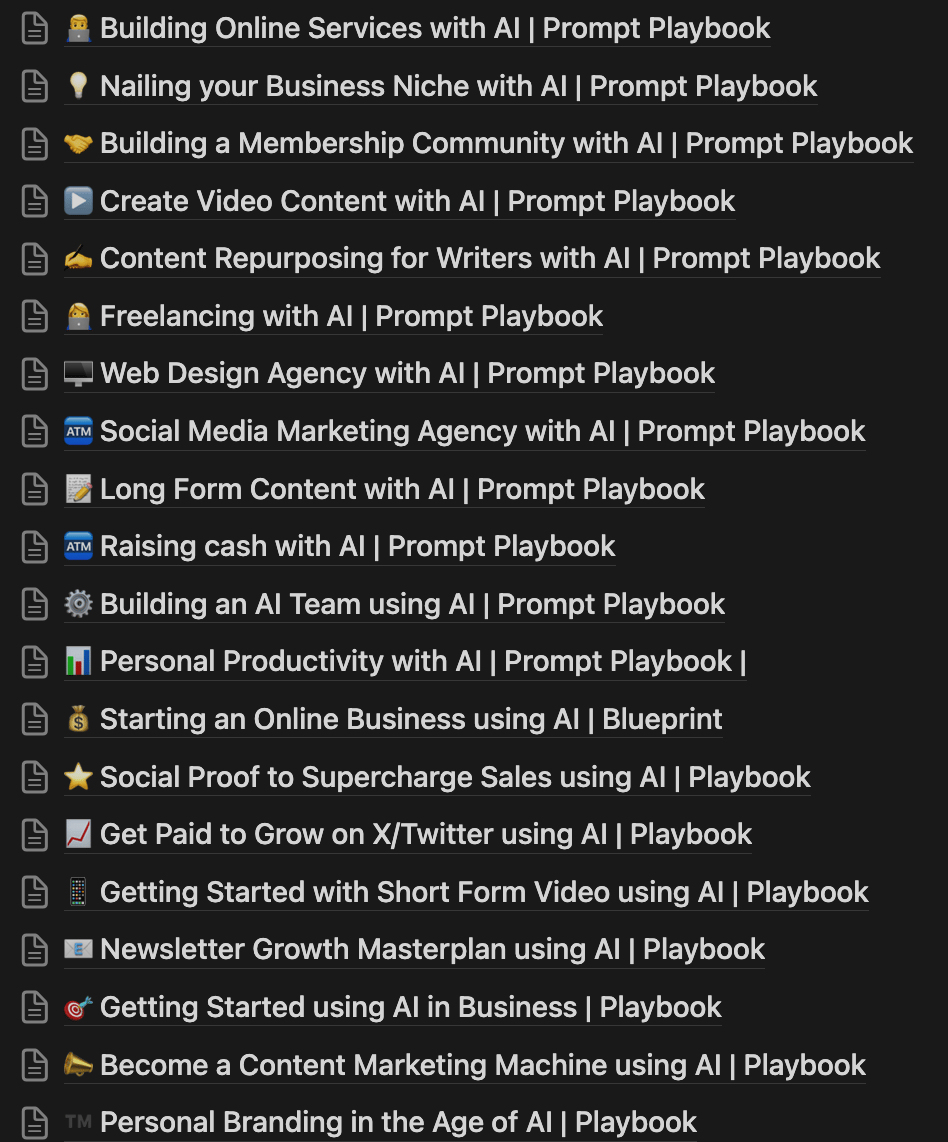
Choose one you’ll know will be valuable in your industry and follow it through yourself first. If you have a Lifetime membership ($197) you already have access to this and a lot more.
Alternatively YouTube is an absolute treasure trove of guides.
For example plug in a search term like “AI for facebook ads” and there are tonnes of videos like this:
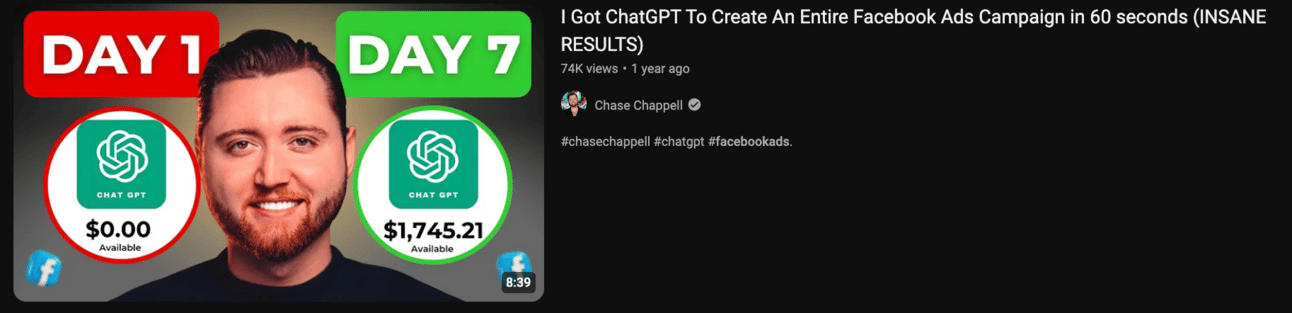
Learn what others are doing. Consume it all.
Apply it yourself. Get results.
Then spin it into a consulting offer. Showing others how to do it too.
This sounds simple. And it is. But it requires a focus that most consultants don’t bother to cultivate. This will be crucial moving forward.
We aren’t competing with the McKinsey’s and KPMGs who provide general consultation. We’re instead going to focus and carve out a powerful specialisation for ourself. We want to be the go-to for our expertise.
In the next Part we’ll look at how we start to build our reputation even before we’ve launched our consultancy.
For now just work out your niche and pick a couple of projects you believe will valuable in that industry. Then check my Vault and other sources for ready-made guides.
Keep prompting,
Kyle
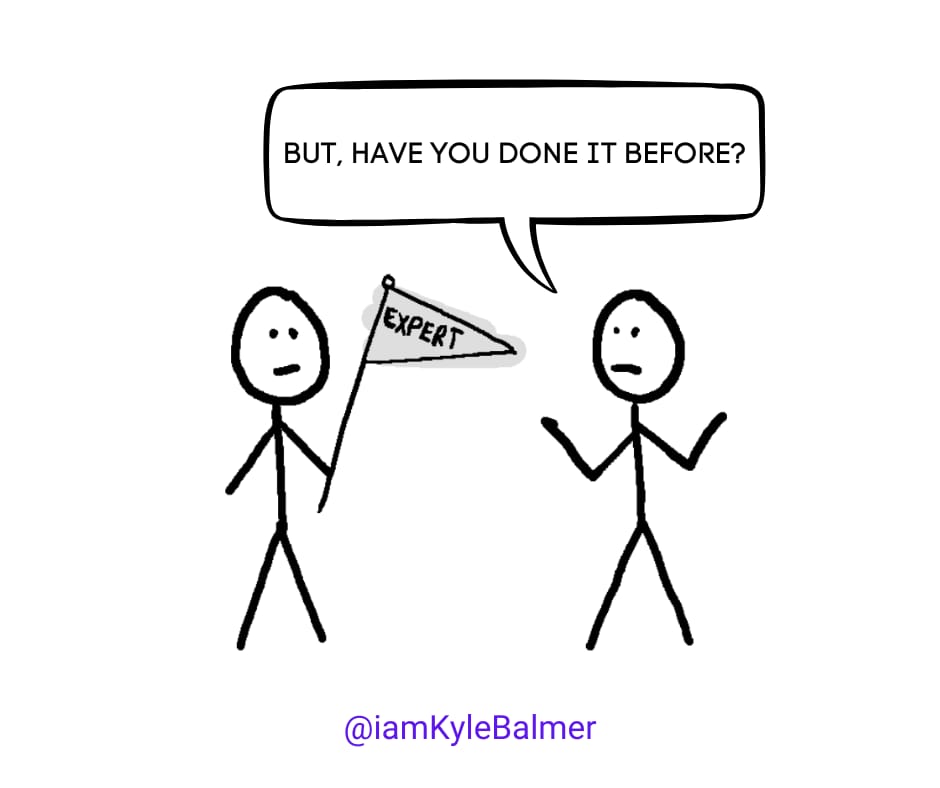
My pet peeve with consultants is that they’ve rarely done what they are advising you to do.
It’s easy to give advice when you have no experience and no skin in the game.
I don’t want to flood AI consultancy with more BS artists. So first we build.
Let’s get started:
Build something useful
Walk the talk first
Industry problem → proof of concept project
Step by step build
Deploy ASAP
Unlike many consultants we’re not going to help clients with tasks unless we’ve done them ourselves.
For that reason in the last Part we chose a handful of project to work on ourselves before we rush out to help others. We don’t want to be the blind leading the blind.
These projects should ultimately be in areas that are extremely valuable for clients. Knowing what is valuable will rely on your industry knowledge and experience. You need to intimately know the problems that these companies will have.
For instance if you want to target B2C companies then customer service is often a large problem for them. Based on this you might look into consulting on and building customer service chatbots for clients.
Let’s use a prompt to help point us in the right direction for projects:
You are a AI consultant for companies in the [industry] sector.

Identify 5 common and expensive problems in the sector

For each suggest an AI based solution
And for each solution suggest a proof of concept project
I plugged in “consumer goods advertising” as my sector and got a range of problems, solutions and proof of concept projects.
Here’s one I like:
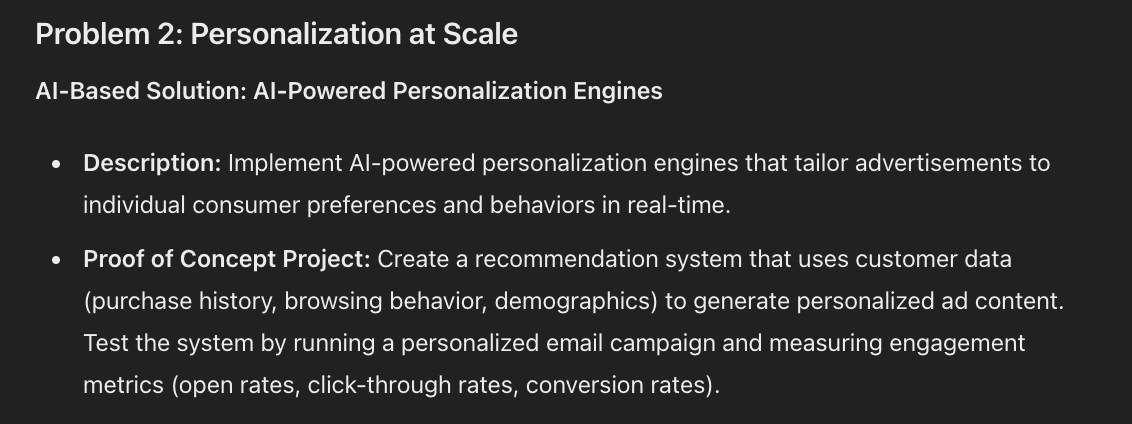
Build the proof of concept project as a portfolio piece for your industry.
The basic idea here is to build a generic version of a tool and then for clients you’ll advise, consult and/or build something specific to them.
An example:
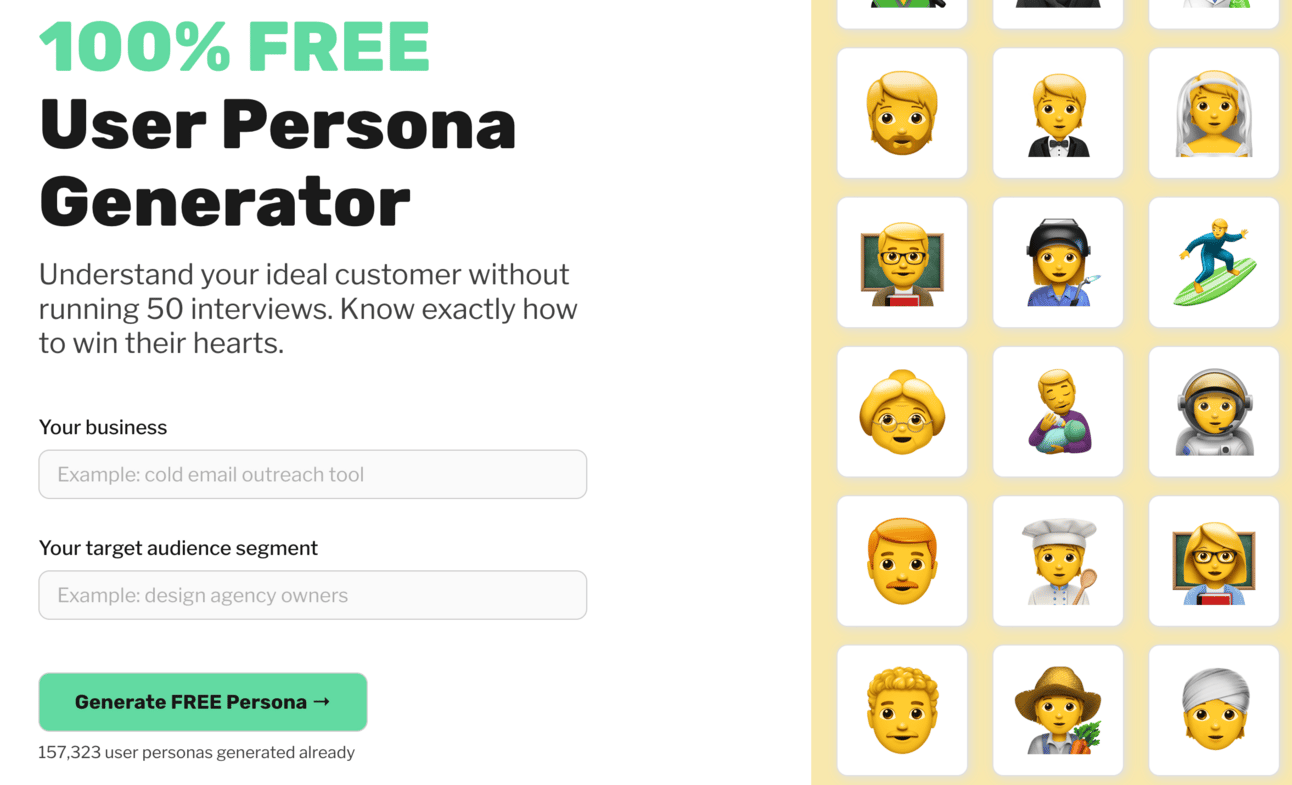
This is Dan Kulkov’s User Persona Generator. You can find it here https://founderpal.ai/user-persona-generator
It solves a similar problem the one we just identified with our prompt - creating avatars and then advertising recommendations off the back of the avatar.
Dan’s tool is public, polished and professional. He’s great at what he does.
You can build something like this eventually - it’s actually easier than it looks by using no-code tools hooked to ChatGPT - but it’s not required right out of the gate.
Instead we can build up step by step. In my workshops I teach something called the Levels of AI:
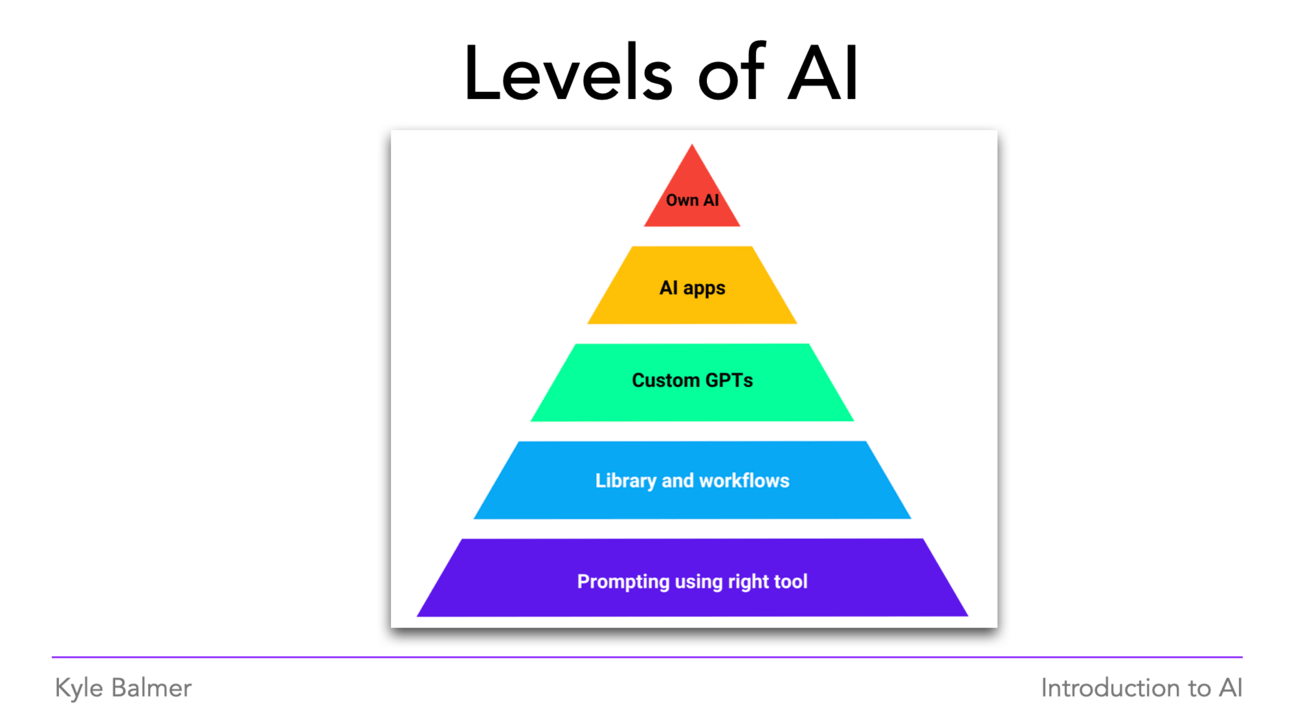
Basically we start at the bottom and move up, increasing in sophistication.
A basic one-shot AI prompt that fulfils the task
A set of prompts to complete the task step by step
A custom GPT
An app (like Dan’s above)
Here for example is a first shot at the first step:
You are an AI-powered advertising personalisation engine. Your task is to generate tailored advertisement recommendations based on individual consumer data provided. Use the consumer's preferences, behaviours, and demographic information to suggest the most relevant and effective advertisements.

Given input:
[User will input consumer details here, which may include age, gender, location, interests, browsing history, purchase history, etc.]

Your task:
1. Analyse the provided consumer data.
2. Identify key preferences, interests, and behavioural patterns.
3. Determine the most suitable product categories or services for this consumer.
4. Generate 3-5 specific advertisement recommendations, including:
   - Product or service name
   - Brief description (2-3 sentences)
   - Key selling points tailored to the consumer's profile
   - Suggested ad format (e.g., video, image, text)
   - Ideal platform for ad placement (e.g., social media, search engine, email)

5. Provide a brief explanation for each recommendation, highlighting how it aligns with the consumer's profile.

Remember to prioritise relevance, personalisation, and potential effectiveness in your recommendations. Ensure that your suggestions comply with ethical advertising standards and respect user privacy.
I’d run this prompt with consumer details to generate outputs and use the outputs to refine the initial prompt. I’ll keep doing this until the prompt can consistently produce solid results.
This gives me the foundation of all the other steps. It can be adapted into multiple prompts (a workflow), a custom GPT and even a full app. But it all starts with this foundational prompt.
Importantly, you do NOT have to be a coder. Nail the prompts first and foremost. Coding (or using a no-code) tool lets you wrap everything up nicely but it not required for the core prompt engineering.
Prompt engineering is a communication not a coding skill.
Ideally you should be using your prompts and tools in your own business and collecting results about how valuable they can be. This is the best proof.
However, sometimes this isn’t immediately possible.
If not then I’d recommend:
Building in public. Document your work on social media, showing people what you are working on. What works. What doesn’t work. Asking for assistance. Asking what people would find useful. This let’s your refine your work whilst also building interest from potential clients.
Providing your tools, prompts and knowledge to some businesses for low cost / free. Purely to get “real life” results and successes for them. These become your early case studies before seeking out high paid clients. They also allow you to further refine your knowledge and expertise.
Once we have a successfully deployed project and know it’s valuable for companies in our industry we can kick off consulting and implementation for others. We’ll get into that in the next Part.
Keep prompting,
Kyle
Once we have something of value to companies we begin to offer consultation.
Let’s look at the different ways you can get the word out, validate our core offer and begin to gather up prospects.
Let’s get started:
Getting the word out
social media post
onto a winner?
educational product
Once we’ve build a proof of concept we need to let the world know our results.
Here’s an example:
How I get PAID to build my email newsletter
A thread.
This is LONG so you're going to need to bookmark it. Don't say I didn't warn you.
— Kyle Balmer (@iamkylebalmer)
11:04 AM • Jan 5, 2024
This post shows some work I’d done for my own newsletter - basically a way to grow exponentially for “free” by recouping advertising spend with beehiiv boosts. Check the post on X/Twitter to see the format. The content itself is not important - just check the post for how I presented the information.
It was seen by 70,000+ people and bookmarked nearly 1000 times.
You’ll notice I basically tell people what I did. I lay it all out.
It’s an educational post that, if someone pays attention, would let them copy my methodology.
This prompt will get you started with a basic post for social media. Adapt the content top your specific channels and platforms as needed.
Some people will go ahead and do the work. They’ll read this, understand it and go and implement it. Fine. These people will always be DIY. They won’t pay you and never will. That’s fine.
However, many people will read something like this and think “wow that sounds great. I need this. But I don’t have the time/money/skills/inclination to do it myself”.
These people will get in touch with you to do it for them. These are potential clients.
From this single post of this single tactic I had 100+ people interested in learning more. At $1000 to consult or implement and that’s $100,000 right there.
You can do something similar with your project. Once you’ve cracked something valuable to your industry talk about it.
Here’s a prompt to help with your post:
You're a skilled marketing consultant specialising in creating compelling social media content for B2B audiences. Your task is to help me craft a concise, engaging social media post or thread about an internal project I've developed for a client. This post should highlight the value of the project and showcase my expertise.

Ask me questions one at a time to gather the necessary information. Wait for my response before asking the next question. Cover the project's title, the client's challenge, our solution, the start and end points, key methodological steps, and the most impressive result.

Once you have all the information, create a social media post or thread suitable for LinkedIn or Twitter. The post should be concise yet impactful, outlining the start point, end point, and methodology. Focus on demonstrating the project's value and my problem-solving skills.

Begin by asking me for the project title in 5 words or less.
Create a case study that guides people through step by step how you achieved the process. Give it all away (or as much as you feel comfortable - but believe me, more is better!).
If you’ve built a tool connected to your valuable insight share that too. Let people use the generic demo version and offer to make one for them or show them how to deploy it within their business.
Continue to post about your successes until something clicks.
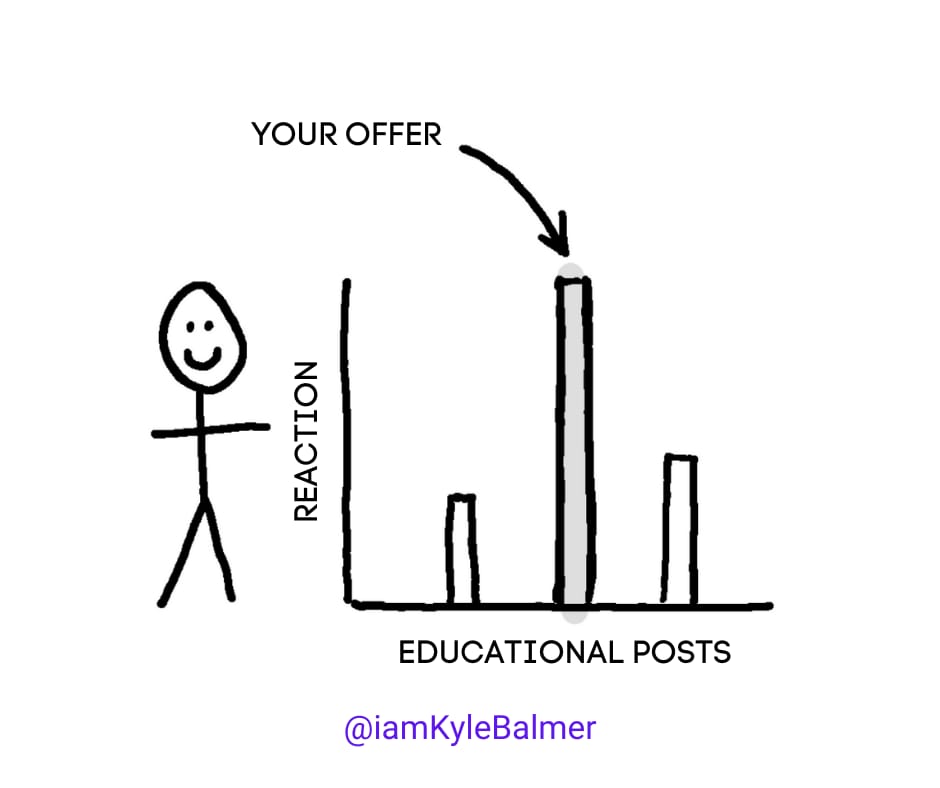
Some part of what you work on will (all of a sudden) strike a chord with prospective clients. There will be a certain topic that people will bite your hand off over.
If you haven’t had that reaction yet then guess what - the market probably isn’t that excited about what you’ve built or discovered.
Keep going. Only pursue winners.
When the market is excited you’ll know. It’ll tell you - loud and clear!
At the point you’ll receive interest directly in your comments and DMs.
Here’s an example from 2 days before writing this:
@iamkylebalmer New York Times highlights AI consultancy as next big boom. Follow the money? #ai #business #money #chatgpt
In this video I reference a New York Times article as context about AI consultancy businesses. I then mention I’ll be putting together a community for AI Experts sometime in the future. That’s all.
From this I’ve had 50 private messages from people who want to be part of this. That tells me immediately that the market supports the idea.
If you don’t have social media up and running yet this is hopefully a wake up call. You can use it to rapidly (within hours) assess business ideas. Also, you don’t need a large following if you use TikTok because TikTok doesn’t care how many followers you have when spreading your video. See my Playbook on Tiktokification for more details.
Once you have a post that has traction I’d recommend spinning up a more detailed form of education.
This could be:
an eBook
a video course
an AI copilot
a workshop
a cohort
Basically you want to capture your process in a way that you can sell to those interested.
You could jump straight to consulting (as a service) but having this intermediary educational piece is a good stepping stone.
It allow you to:
capture emails
immediately generate revenue
hone your process via creation
build trust with prospects
And then off the back of this you’ll sell a full AI expert consultancy offer.
In the final Part I’ll cover what your offer could be. We’ll look at consultancy, retainers, advisory, implementation, equity plays and more.
Keep prompting,
Kyle
Time to finally talk about what sort of offer you can provide to clients. And, more importantly, how to structure it up.
Let’s get started:
Consultancy offers
advisory → consultation → implementation
natural funnel built in
how did I personally start
workshops
Once we’ve convinced people of our expertise we sell our consultancy services.
Remember we prove expertise by doing the thing, not talking about the thing. Big difference.
Now we’ve shown that we know what we are talking about we can provide service to other businesses. Let’s look at some options.
Consultation comes in various forms.
I’m sure some of these aren’t technically considered consultation.
I don’t technically care! 😁
They are all about helping businesses solve problems - the specific vehicle for doing so is flexible.
Some options:
advisory
consultancy
implementation
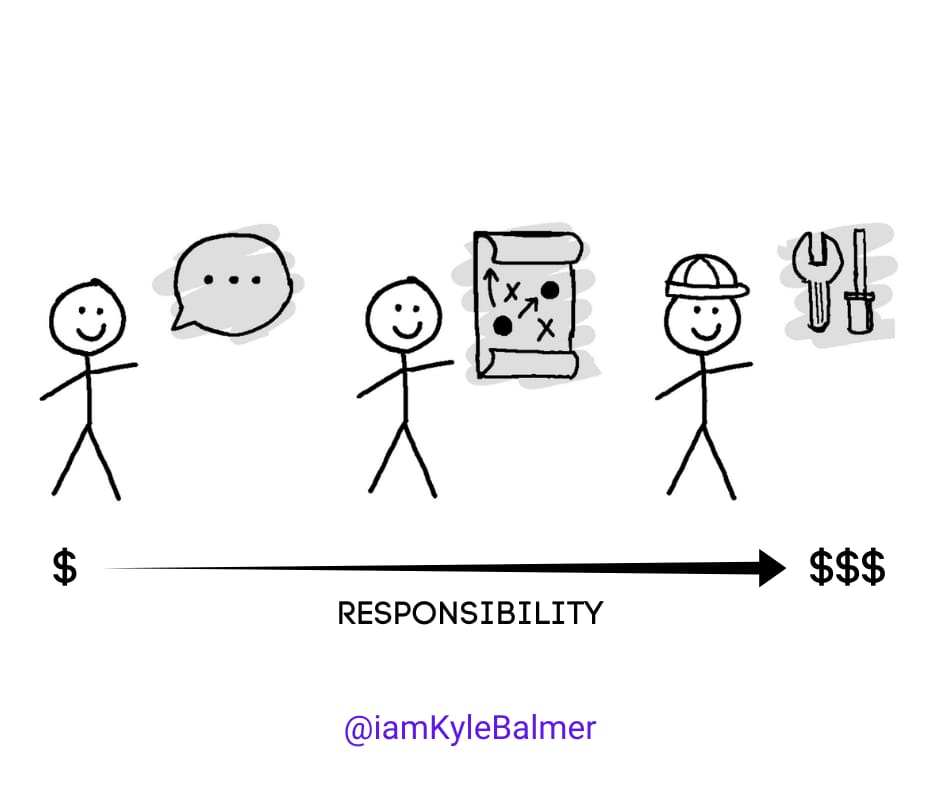
Advisory is providing your expertise. It may be a client has a problem and wants a quick yay/nay from you the expert. It may be that they have no idea what they need and require someone to come and help them get aligned. Either way advisory is light touch - it’s about being able to tap your expertise where they lack it.
Consultancy proper tends to be more specifically providing advice and a strategy for a particular project. The client needs a new branding design for example - a consultant can help the company work out what they actually want and then prepare a plan.
Implementation is a step further. Implementation moves us into becoming a service provider. We provide the advice, the strategy and then do the work itself.
Obviously this is all a continuum. And most of the time your offer will include a little bit of everything.
As you move up the scale you, as the consultant, have more responsibility.
Giving advice is easy when you aren’t tied to the outcomes of it. But when you are charged with actually implementing the ideas you’ve given a client it’s a different ballgame - you are directly responsible for delivering on what you’ve sold them on.
Because of this increased responsibility there is also a continuum of payment. Advisory → Consultancy → Implementation increases effort, workload, risk and thus how much you charge.
The eagle eyed amongst you may have noticed that makes this a very tidy pre-built sales funnel. There is a natural escalation.
Here’s the exact funnel I recommend:
Free content on social media to build an audience + Direct outreach via LinkedIn
A low cost workshop ($1000+)
Advisory calls ($1000+) or advisory retainer ($x000/month with 6+ month contract)
Project consultancy ($x0,000)
Project implementation ($x0,000-$x00,000++)
Each stage leads into the next as trust and invoice levels increase.
Specifically this also shifts from DIY to Done With You (DWY) to Done For You (DFY).
Your best clients will want to escalate naturally as you prove your value at each stage.
You provide a workshop to introduce the company to the value of AI. Who do you think they’ll call when they need advice about next steps? You.
You’ve been their impartial AI advisor for 3 months. Your advice has been solid. They are ready to scope out a project, getting their sales team upgraded with AI tools. Who’s the first person they ask? You.
You put together the plan. They love it. The strategy you’ve presented looks strong. The step by step guide to getting it done is feasible. Now they need someone to do the work. They try internally for a month - it’s not working. Time to get an expert. Who gets first refusal? You, again.
This isn’t us stiffing clients at each stage so they have to come back to us. Far from it. It’s us nailing each stage independently of the others.
And thus becoming naturally the go-to for the next stage. We don’t even need to pitch each stage - we just wait for the client to naturally get there!
I’ve shown you the funnel but that’s useless unless you can feed prospects into the top.
How do we get clients??
This is the question I get the most when I talk about AI consultancy. And for good reason. Lots of people say “oh well it’s easy for you - you have 50,000 subscribers and 100,000 TikTok followers”.
Lol, I wish it had been that easy.
I began consulting with cold outreach. And I recommend you do the same - personal network and LinkedIn are the top resources early on.
At the same time start to build up your organic reach via social media. Just know that it takes a long time and is hard work. Once it’s up and running hells yeah it means you’ll get leads - but until then use cold outreach to get the business rolling.
Also don’t go for the $100,000 consulting and implementation contracts off the bat. They’ll come. But as a first goal it’s silly. You need to build up the trust as shown in the funnel above.
What has worked for me as the first opener has been workshops.
Specifically I used LinkedIn to:
filter industry
filter company size
filter geographic location
And then reached out to 200+ decision makers a day saying “Hey this is who I am and what I do. Are you interested in an AI workshop for your staff? Price is $1000 for a 1 hour workshop. If yes I’ll send you over a one pager”.
Small ask for something that is highly in demand. It’s an easy sale at this low prince point. And remember that later there is a backend funnel. The workshop is the door-opener.
I then go on to deliver the workshops. In person if in London or international at a place I want to travel to. Online if not and I don’t want to travel.
The workshop that I personally deliver comes in a range of options - 1 hour, 1.5 hours, 2 hours and 3 hours - depending on the level of depth needed by the client.
The content is focused first on getting everyone in the organisation up to speed about what AI can be used for, what it can and can’t do, how to use AI properly and what sort of tasks it’s best deployed on. Pretty basic stuff! But mega valuable to companies, especially because about 60% is practical exercises rather than me just yapping!
This is a super powerful mechanism that I use to open up the rest of the funnel.
Whilst getting paid $1000-4000/hour. Which is a nice bonus!
I’d be remiss not to mention my cohort right now. I license ALL my workshop material for people to use, along with 4 weeks of training, live sessions, personal consultations and all my business docs. And the second cohort starts August 5th for anyone interested. Application here: Learn more and apply.
FYI: early bird deadline is today (Friday).
The type of AI consultancy we’ve been talking about in this Playbook is new.
Yes, yes, AI consultancy as a whole has been around for decades. What we’re talking about now is specifically generative-AI consultancy - a newer form connected to the public release of tools like ChatGPT.
As we looked at the big consultancy companies are rapidly pivoting their entire businesses in this direction.
So what about us?
Honestly - it’s up for grabs. We need to carve out what we can.
I don’t have the answer. No-one does.
But I think together we can start to work it out.
For this reason I’m setting up an AI Experts Community.
Right now it does not exist! People keep asking how to join. It doesn’t exist yet!
What I want to do is talk to people like yourself about what would be valuable. I want to build this together.
For this reason I’ve got a survey up - basically asking what people want from such a community. Link is here if you want to help shape it - AI Expert survey.
With all the community feedback we’ll build something really special.
Keep prompting,
Kyle
Unlock the transformative power of artificial intelligence with the '💡Become an AI Expert | AI Business Playbook.' This comprehensive guide is designed to equip you with the knowledge and skills needed to thrive in the rapidly evolving AI landscape. Whether you're a business owner, consultant, or aspiring professional, this playbook will empower you to navigate the complexities of AI implementation and consultancy, ensuring you stay ahead of the curve. Dive in to discover actionable insights, proven strategies, and expert advice that will elevate your career and provide tangible benefits to the businesses you serve.
This playbook is tailored for business professionals, consultants, and entrepreneurs who are eager to harness the potential of AI to drive growth and innovation. If you find yourself challenged by the rapid pace of technological change and the need to adapt your skills to meet modern demands, this playbook is your roadmap. It is perfect for those looking to transition into AI consultancy or enhance their existing knowledge, providing the tools and insights necessary to thrive in a competitive market.
No prior experience is required. This playbook covers foundational concepts and progressively builds your knowledge.
Results can vary, but many users report seeing positive outcomes within a few months of applying the strategies outlined in the playbook.
The playbook provides step-by-step guidance on how to position yourself as a consultant, regardless of your previous experience.
Absolutely! The strategies are designed to be scalable, making them applicable for businesses of any size.
Workshop materials are available in digital formats, including PDFs and presentation slides, making them easy to use and share.