
AI Authority
Learn how to deliver AI training to organizations.
Start ReadingThis week’s topic is inspired by a video I put out a few days ago.
It got a lot more interest that I was expecting!
Here’s the vid:
@iamkylebalmer Gauging interest : would you be interested in teaching AI to businesses? I run workshops and give talks but don’t have capacity to meet d... See more
It’s worth a watch but in case you prefer to read here’s the skinny:
I get paid $1500-4000/hour to do talks and workshops on AI for businesses.
There’s currently a massive demand for this sort of training because (frankly) businesses don’t know what’s happening and are panicking!
I think there’s an opportunity for you - someone who is actively learning about AI for business - to fulfil some of this demand with workshops and trainings
Based on this I asked my audience on Tiktok if people would be interested in learning how to deliver trainings like this to companies.
So far I’ve had 200+ people tell me they want to learn more. And that’s just off one video with only 5000 views. Solid!
So: I’m thinking that this is a topic that people are very interested in! And this week’s Playbook will be all about it. Ask and I shalt deliver!
Specifically, this week we’ll cover:
Part 1: Window of opportunity
Part 2: Niche use
Part 3: Preparing your material
Part 4: Securing clients
Part 5: Delivery and beyond
Let’s get started:
Window of opportunity
this is a very lucrative opportunity right now
why it’s relevant to you
why businesses need and want this
limited opportunity
As a Brit this part is a bit tricky.
We (generally) don’t like talking about cash. And I’m no exception.
But it’s important to highlight the opportunity in play here.
I’ve been building my personal brand in the AI entrepreneurship space for less than a year now.
I now go into businesses and provide education on AI and how they should be thinking about it.
My minimum hourly rate is £1000/$1500. And for larger groups it can be several thousands for the hour.
Basically making what I used to make in a month in a single hour. Wild.
And to make it even better I now take only the gigs that are abroad. Recently it’s been Geneva, Amsterdam and Las Vegas. Flights and accommodation paid. And then I stay on for a personal holiday.
I’m actually doing some outreach to Singapore and other Asian countries because I want to travel over there more! 😂
I’m not saying all this to boast. Those who know me know that’s not my style. It makes me uncomfortable.
Instead I’m talking about this because I think you can also do this.
As someone who is subscribed to my newsletter you have shown yourself to be much more in-the-know than the average person out there.
Without being rude sometimes when I deliver trainings I literally need to help staff members download and get access to ChatGPT.
The level of knowledge and ability is low.
You, as someone who has been using AI to build a business, are miles ahead of the average member of the public. Don’t underestimate how much further ahead.
There’s a huge opportunity for you to become the person in your city or country for your specific industry. And to dominate that niche.
Plus: this week I’ll tell you exactly what you need to include to train these companies.
Right now companies need this sort of training. And are willing to pay for it. Good money too.
They are facing a series of problems. That you, as someone who knows about AI, can go in and help them with.
Broadly speaking (I’ll talk about this more during the week) we’re looking at push and pull factors.
The push factor here is shadow IT.
Basically staff members are starting to use AIs like ChatGPT. Whether the business has allowed it or not!
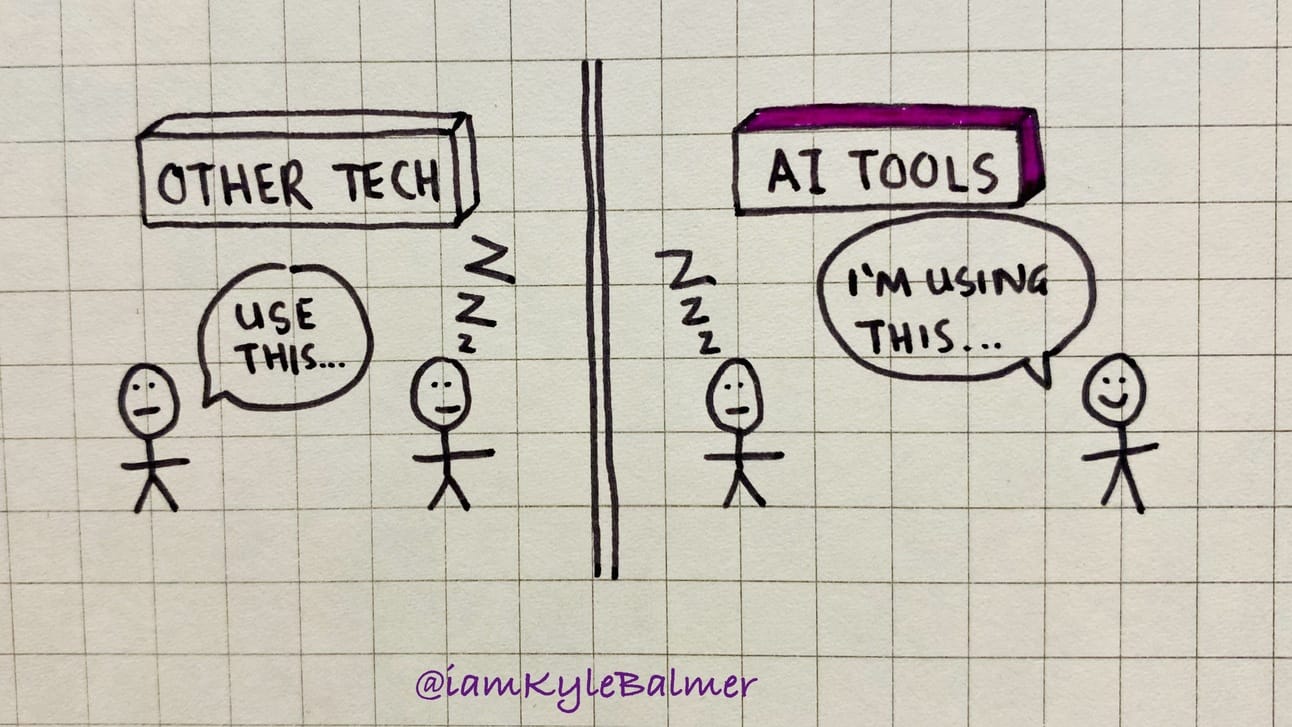
When most IT innovations come out it’s leadership and the IT department who need to force staff members to use it. For staff members it’s another damn username and password. Another system to use. Another boring mandatory training.
AI is different. It’s being driven from below. Staff members are using it and leadership is having to catch up!
Why? Because it’s so.damn.useful. That’s why employees are using it without being prompted to by leadership.
This opens up issues for businesses.
Specifically:
is AI safe to use?
is our data being leaked?
which AI should we use?
how to deal with AI inaccuracies and hallucinations?
what are the liability issues?
Because of this companies are desperate for trainings to bring all their staff members up to speed on safe, responsible use of AI.
They need to protect their downside and this means understanding and educating their staff on AI.
That’s the push factor. They have to work this stuff out or there are problems in the future.
There are also (for progressive companies) pull factors. Those companies who master AI tools and integrate them into their workflows first will do well. Very well. They are poised to absolutely smash competitors who don’t embrace AI.
I’ve worked with a few companies like this that want their staff to experiment with AI. They are giving staff free reign to work out how best to use AI, knowing that if they crack it there are massive efficiencies.
Basically the companies who ride this wave and leverage the technologies will survive.
Follow the money on this one. Investment is flooding into AI globally because the smartest investors in the world know this is where we are going. Right now it’s the tech companies leading the charge but this will soon be all industries as they catch on and realise the potential.
I’m pushing this hard because the window won’t be open that long.
Right now businesses globally are scrambling to work out what to do about AI.
And unlike most trends we’re talking about every business having to work this out. This is internet levels of disruption.
That’s a big total addressable market.
But how long will the opportunity stay open? I’m guessing 2-3 years.
Dual factors of i) people becoming more and more adept with AI tools and ii) AI tools becoming easier and more integrated into “standard” software that they are already used to.
If this is something of interest I’d recommend moving double speed on it!
This week I’m going to cover the process of putting together an AI education business.
Specifically:
Part 1: Window of opportunity (Today)
Part 2: Niche use
Part 3: Preparing your material
Part 4: Securing clients
Part 5: Delivery and beyond
We’ll first work out which industry you are going to focus on. We want to carve out a particular niche so you aren’t trying (and failing) to hit all niches at the same time.
We’ll then discuss how to put together your material for delivery. What length workshops and talks you need. The topics. The exercises etc.
From there I’ll show you how to acquire leads and clients via inbound and outbound marketing as well as how to pitch and close them.
Finally I’ll talk about delivering your training and then the business models and upsells (implementation) you can add on the back for profit multipliers.
Premium readers I’ll see you tomorrow.
If you are non-Premium you buy get the whole thing on Saturday or join the Forge to get access this week:
Keep prompting,
Kyle
Time to get into it. We’re going to start shaping up what your AI education business is going to look like.
Who will you be teaching? What do they need to know about AI? How will we know what to tell them.
Let’s get started:
Niche Use
all businesses need this
that doesn’t mean you target all businesses
focus on your industry
get a grounding in how AI is affecting your industry
In the last Part I said that the total addressable market for business AI education is “all businesses”.
All businesses are going to have to work out how AI affects their operations moving forward. Many of them are grappling with this question already - and others will be forced to once their competitors get on board with AI!
Think of this like the internet. Eventually all businesses had to work out what the internet meant for them and what side of its advance they wanted to be on.
Even the most seemingly basic, local and isolated businesses use the internet.
When I lived in China the dumpling stall at the base of my building gave me their WeChat (think Whatsapp, sorta) so I could pre-order dumplings from them. I ordered a lot of dumplings…
Or even more wild, once on a mountain pass in Tibet I was given a website by a woollen coat merchant and her husbands (2). Apparently shipping from their village back to London was no problem. 🤷♂️
AI will have a similar omnipresence, touching all industries and sectors.
Does this mean you should target ALL businesses as your potential clients?
Absolutely not.
Target everyone and you target no-one.
It’ll be a lot harder to land your first training gigs if trying to hit everyone.
Instead I’d recommend honing in on your particular industry.
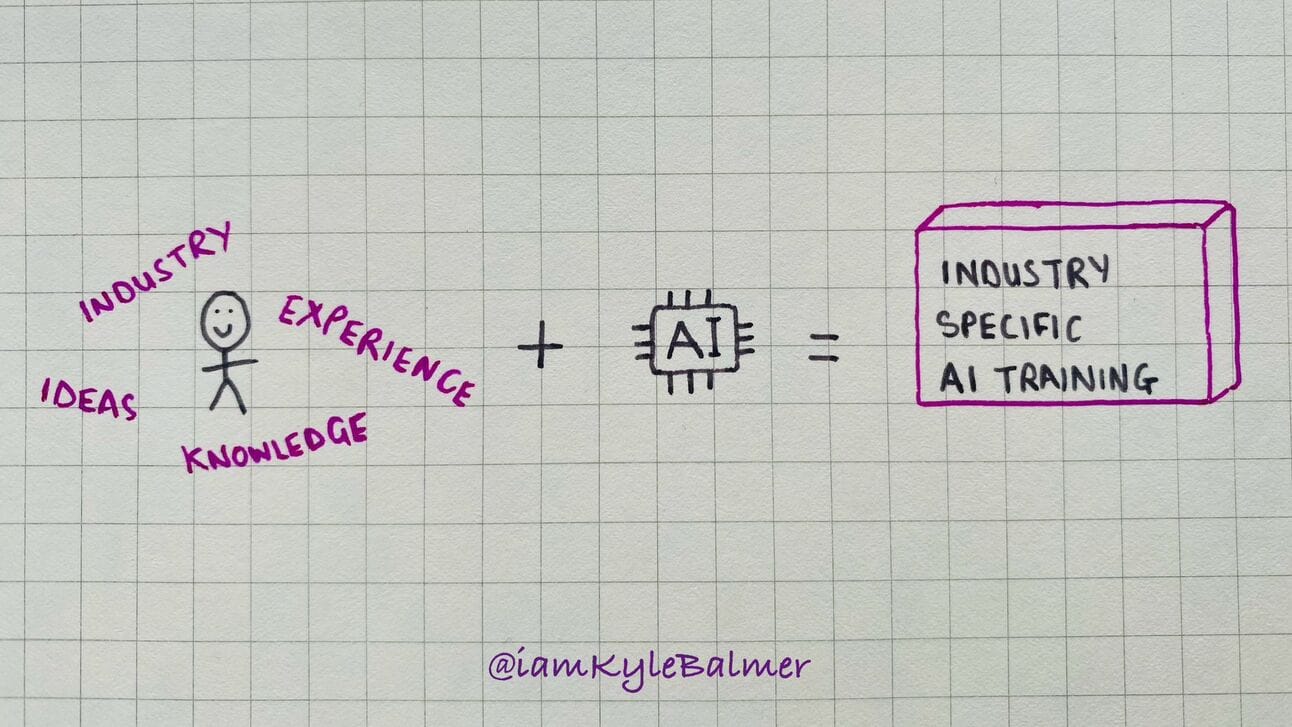
If you are a coach: teach AI to coaches and coaching companies.
If you work in healthcare: teach AI to healthcare companies.
Your edge is the ability to combine your own industry experience with AI education.
This is why I write Prompt Entrepreneur - it’s combining my years of experience starting and growing businesses with AI. That’s my edge.
By knowing the industry you’ll be in a better position to know:
what parts of AI industry people are excited about
what they are scared of
the general level of technical know-how
their specific industry language
specific use cases of AI that will be quick wins for them
All of this will help you immensely with pitching, selling and delivery.
In the next Part I’ll show you how I weave specific industry knowledge into my presentations and workshops.
Your particular niche will determine how deep your workshops and presentations need to go.
If your industry is tech then obviously the level of familiarity with AI tools will be higher than in other industries. But all business have staff members who don’t actually use AI, code or do anything “technical”. Businesses have HR, legal, marketing departments that won’t necessarily be au fait with AI.
This is where I recommend you focus. The lower-level and wider audience. Not training tech wizards but instead the employees who need a basic crash course in AI.
You’ll be surprised how basic a level this actually is. I’ll cover what to teach in the next Part but my one hour intro workshop (briefly) is:
what is AI and why should we be excited and not fearful
my RISEN prompting framework
how to choose what tasks to use AI on
That’s it.
One hour is not a long time. And it’s better to explain a few things well rather than many things poorly.
I’d much rather my audience grasps and go on to use one or two things rather than be bombarded by 50 things and learn nothing.
Your job therefore is to get really good at teaching a small number of topics. And then teach that to many many companies.
As well as this base groundwork knowledge you’ll be teaching you’ll need to supplement with industry specific news and trends.
This will not necessarily be in your core content but will be very important for dealing with questions from people you teach.
Generally these questions will come from news stories people have read. And (more often than not) the news articles will have put a negative spin on the use of AI! So it’s handy to know what’s being said so that you can address these fears and concerns. Otherwise it’s easy to get derailed!
Thankfully we can use AI to help us here. Here’s a prompt:
I work in AI education in the [industry name] industry.

Collect a rundown of the most important AI developments in the industry over the last 2 years.

Provide sources.
This will head out and compile a list of topics from your particular industry:
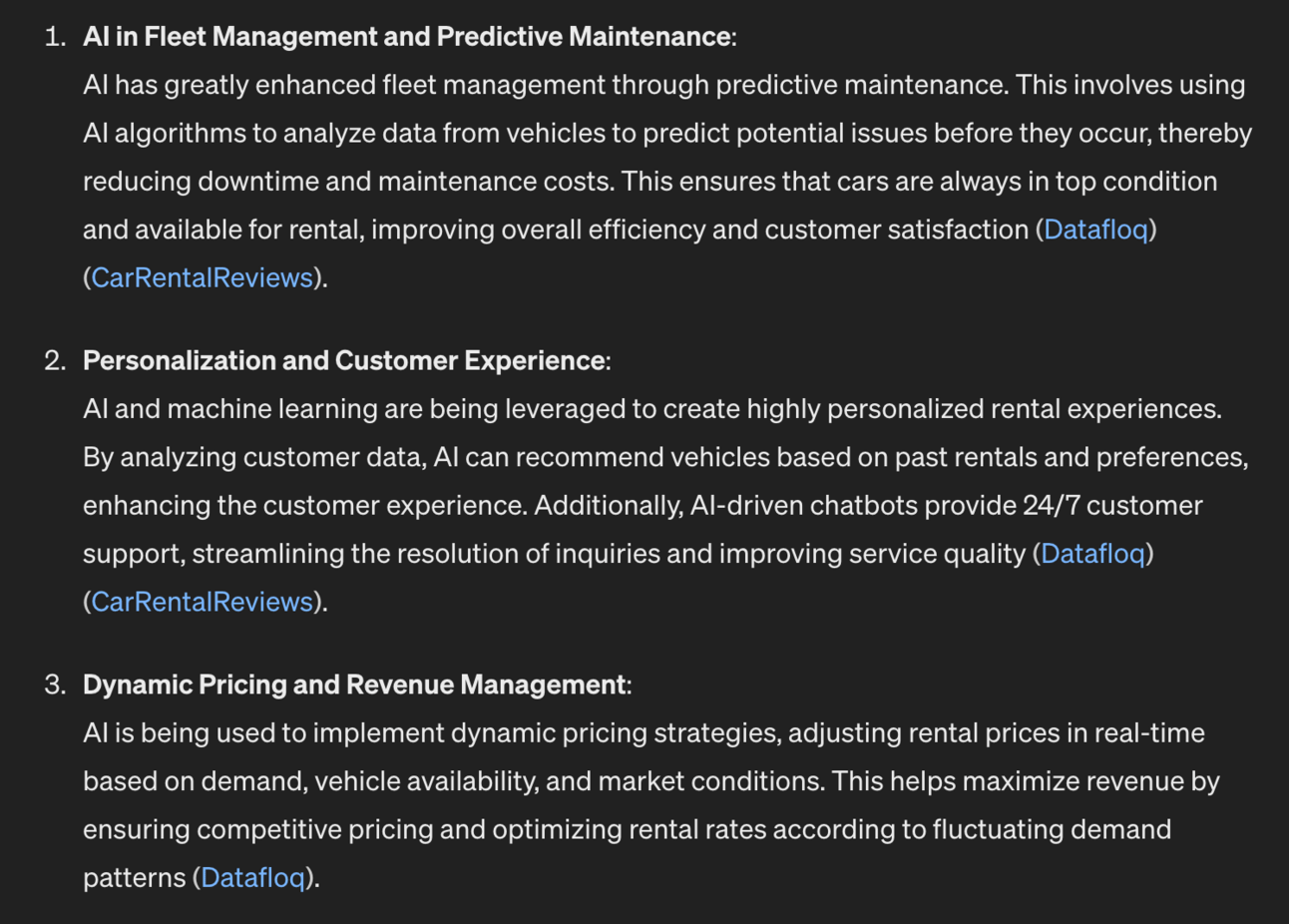
This will help you get a basic survey of the use of AI in your industry.
I would also recommend finding an up to date source of news about AI in your industry of choice. We’re talking:
newsletters
blogs
social media accounts
that summarise the latest AI updates in the industry.
Nothing like this? Well…looks like an opportunity for you then. If you can become the authority here via a newsletter and on LinkedIn or similar then your lead flow is about to get a lot easier!
Any which way get educated about what’s going on with AI in your industry.
We’ll be weaving that into your material in the next Part.
Keep prompting,
Kyle
Today I’m going to walk you through my one hour workshop. It’s a big one!
Let’s get started:
Preparing your material
start with a one hour workshop
limit your learning outcomes
my structure and timings
my workshop step by step
I recommend you focus on a one hour workshop as your first educational offer.
One hour is a great place to start because:
it’s less for you to prep
it’s a lower price point for clients than a half day / full day
it fits easily in a company’s schedule (ie. a lunch talk) - lower friction
it’ll leave them wanting more
Also notice that this is a workshop. Not a presentation. I recommend this because:
it’s less work for you (!) - I spend maybe 30 minutes talking in a 60 minute workshop
AI is a skill and needs to be practiced. Simply telling them about how to use AI won’t help anyone.
What I’m going to do in this Part is literally outline the core 1-hour workshop I deliver. I charge between $1000-4000 for this one hour workshop, depending on audience size and industry.
You can borrow my workshop structure and use it as a jumping off point.
Or, hell, you can use it wholesale.
I’m actually looking into licensing out my teaching material so that people can teach this globally. Reply to this email if this sound interesting - we’re looking for beta testers amongst our premium subscribers first.
One hour is not a long time.
Especially because we’ll have exercises. Do you know how long exercises take? Goodness me! Forever!
Because of our limited time we need to limit what we’re teaching.
We’re aiming for quality over quantity. Skills over knowledge. Action over theory.
If you go up and teach them 30 things about using AI in business they won’t remember anything. It’s overload. And they’ll switch off.
Instead we’re going to have 3 learning outcomes:
AI is a useful tool for my work and I need to start using it
How to use AI properly
I don’t need to be scared of AI
That’s it.
If people walk away with these learnings I’m happy. And so is the client company who wants their staff to have a basic foundation in AI and wanting to learn more.
In an hour that’s a result!
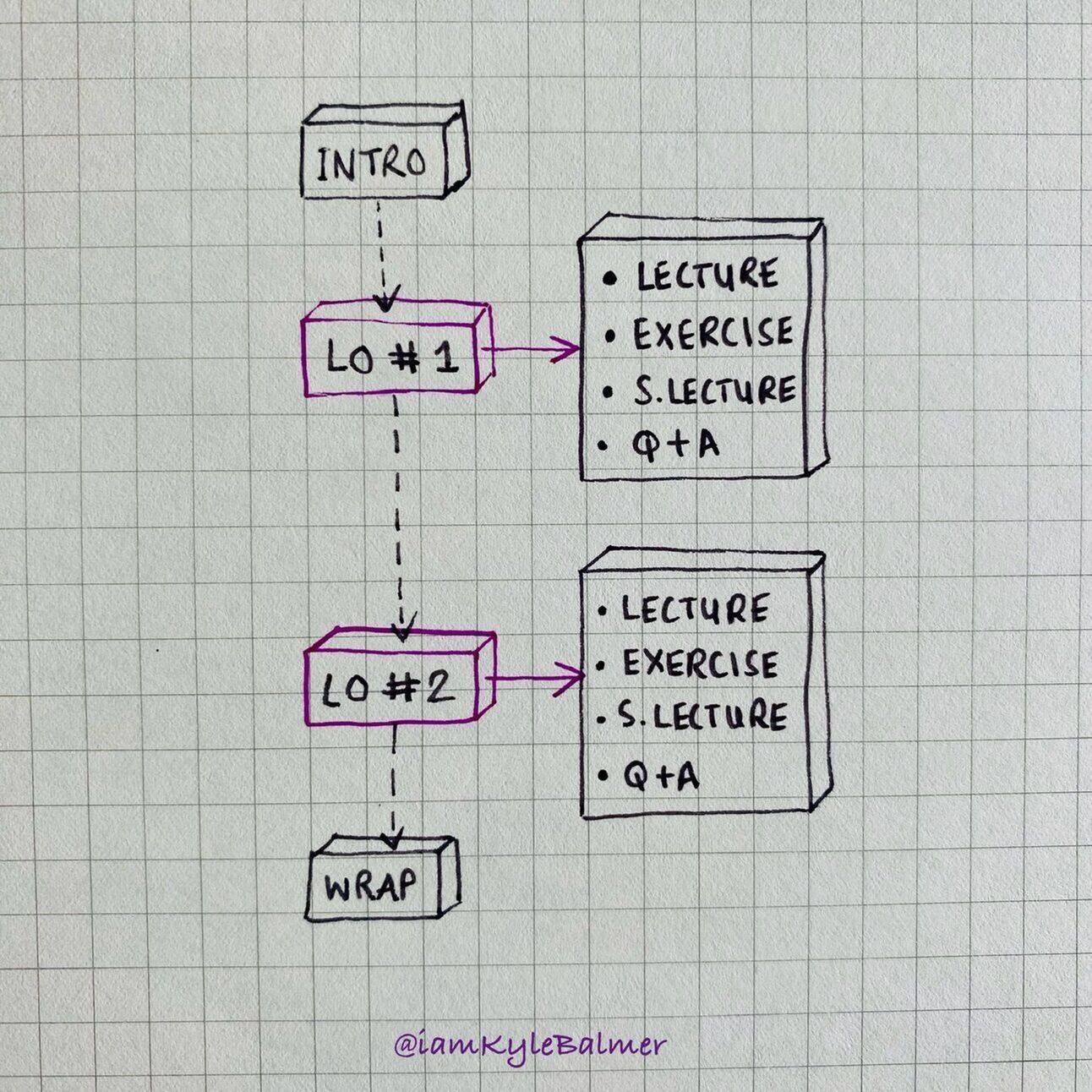
My structure is as follows:
Intro (5 minutes)
How to think about AI (15 minutes, lecture)
RISEN framework exercise (20 minutes, exercise)
Q&A (5 minutes)
Concerns about AI (10 minutes, lecture)
Q&A (5 minutes)
An Intro, three main sections and two Q&As.
Notice how I switch formats every 15-20 minutes. This is to keep energy up.
Talk for more than 20 minutes and people get bored. Run an exercise for more than 20 minutes and they’ll get distracted.
Switch back and forth between them? You keep people engaged because there’s alway something new.
The Q&As are in there to (obviously) answer questions but also as time buffers.
Are people enjoying and learning from the exercise? Extend it out and cut the Q&A. Running over? Cut the Q&A. Worst comes to the worst you can answer questions after the session. Think of Q&A as structural buffers to help you control the timings.
Make it about them. And keep it short.
At the beginning you have the benefit of the doubt from the audience. They assume you know what you are talking about and it’s going to be helpful. It’s your job to maintain that goodwill for the duration of the workshop.
To kick this off on the right note I literally spend the first minute or two getting them to like me.
Sounds wild but it’s effective.
I personally use humour and vulnerability. Because that’s me. You’ll need to use what’s true to you.
This is the part of the workshop I actually prepare the most - my silly jokes for the first few minutes. If I can get them to laugh they relax. That done I can crack on.
Once you’ve made them realise “ok I can relax I’m in good hands” we tell them what they’ll be learning.
We do not tell them "why you are here”. I hate this slide. But people always use it.
Most of them are here because their boss told them to be. Let’s be honest.
Instead I hit them with a quick “what we’ll be learning” - a slide with the sections on it. And tell them it’ll mainly be exercises so they won’t just be sitting listening to me for an hour.
And then, at the very end, I’ll tell them who I am with a quick slide and introduction:
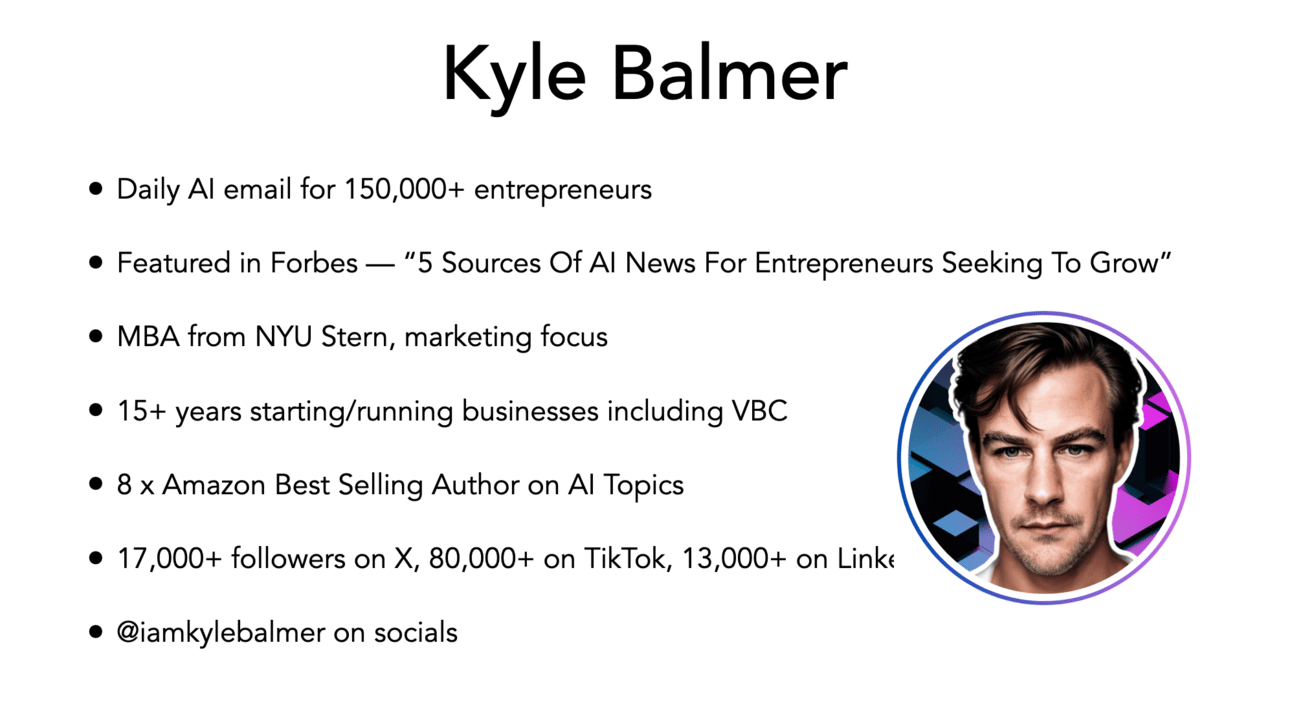
This comes at the end because the introduction is about them. Not me. I just tack it on as a “I know what I’m talking about, you are in safe hands” reminder.
This first section is focused on making people want to start using AI.
This is the most straight “lecture” part of the workshop.
The main points I make are:
think of AI as a hyper-intelligent assistant
who still needs context and instructions
learning how to instruct the AI is the skill we’re focusing on
thankfully it’s not about coding, it’s not technical
using AI is like using Whatsapp
it’s a communication skill
specifically the communication skill is called prompt engineering
I use this section to get everyone on board. Especially the technophobic. And make sure they know it’s all about clear communication, not code. People who started off looking terrified quickly relax during this section
I then immediately roll us into the main exercise.
This is the meat of the workshop - running them through my RISEN prompt engineering framework.
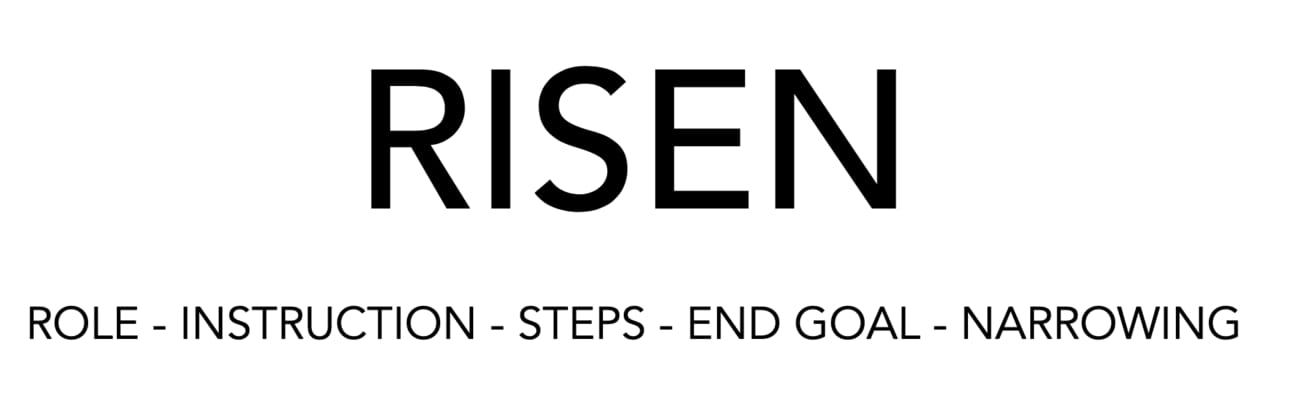
This takes 20 minutes because they are doing it live with me.
I have them add in parts of the framework bit by bit to see how it affects their end results. I ask for show and tell. I ask for them to compare with neighbours. All this takes time but makes the exercise much more powerful.
Importantly I tailor my example prompt for this exercise. Depending on what the company is and what department I’m talking to.
This is crucial to make the exercise relevant. If I’m talking to a law firm and my exercise is all about creating prompts for social media posts for a farm equipment company the exercise is not valuable.
Choosing the specific example prompt therefore is one of the most important preparation tasks before the workshop. And we gather that information in discovery, which I’ll cover in the next Part.
I use the first Q&A to deal with questions about the RISEN framework. I ask specifically for questions related to what we just covered.
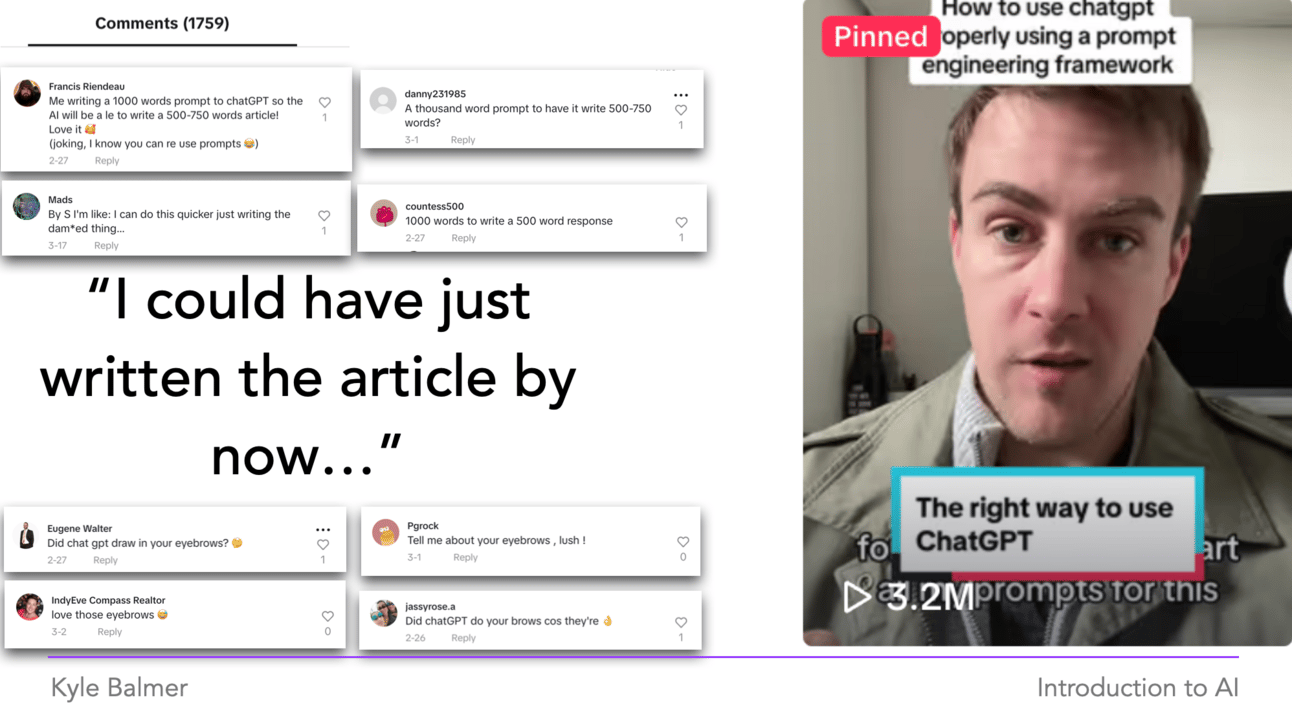
One that nearly always comes up is that we could have just done the task instead of writing such a long complex prompt.
This one is so common that I sometimes address it directly before the Q&A or wait for it to pop up. Either way I literally have additional slides ready to go.
One on how common the question is:
And one on the answer (better prompts made using the RISEN framework are reusable again and again. They are business assets) :
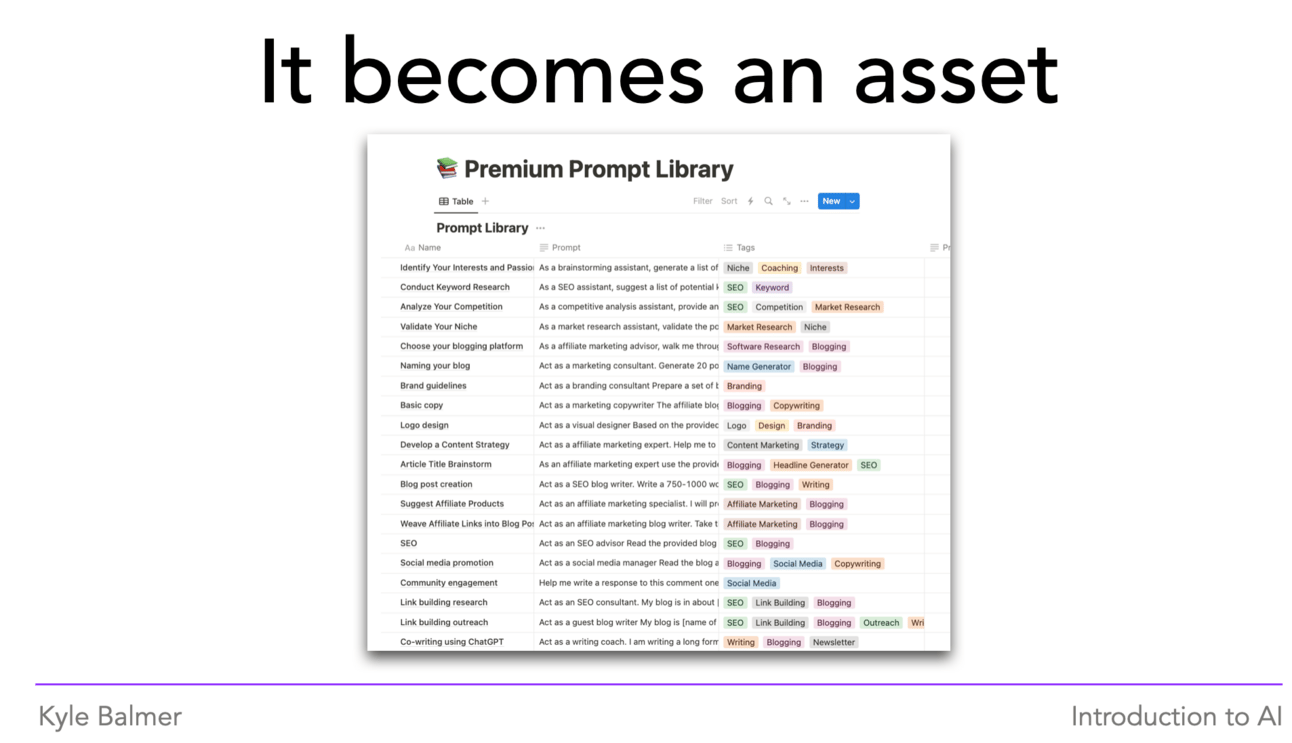
As you do more workshops you’ll know the common questions and will be able to answer them easily. Make sure to let the question asker complete the question though - even if you know what they are about to ask!
After the exercise I switch back to lecture mode and address head-on the reservations people in the room have about AI.
How do I know what they worry about? What scares them?
I’m a mind reader! Nah- I use a sneaky tactic. A survey!
Before every workshop I send out a survey. I’ll cover this in detail in the next Part.
The survey specifically has a question - what are your biggest concerns about using AI professionally?
From this I get a lovely chart of their concerns:
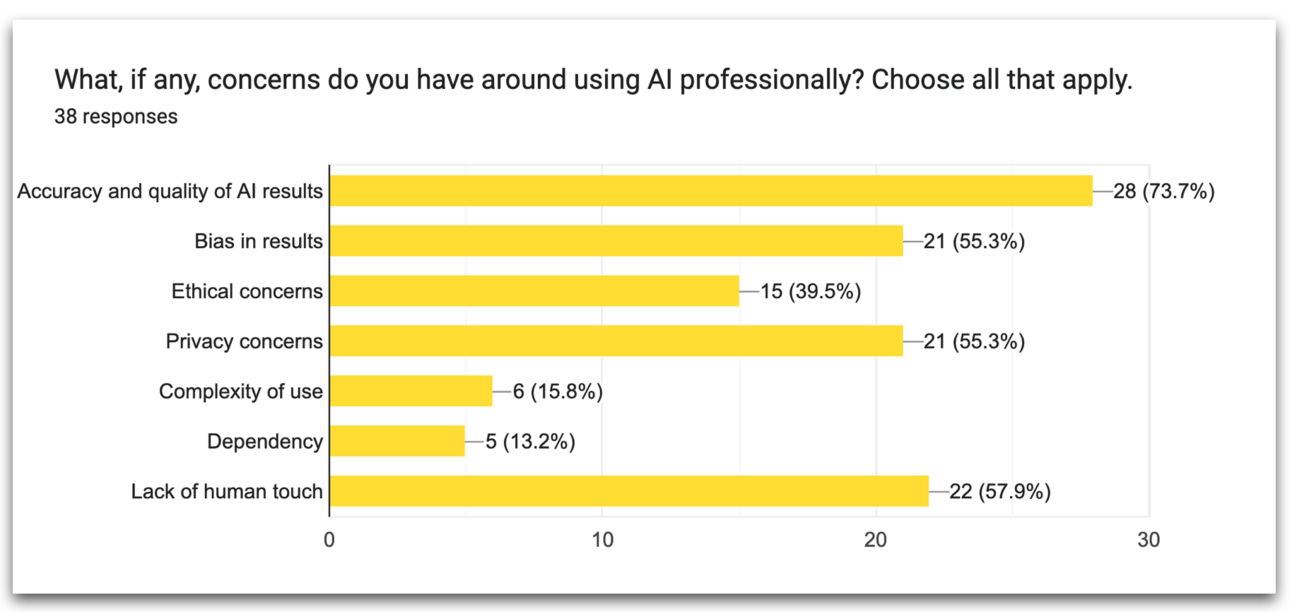
I use this to structure this final section, hitting 2-3 of the biggest concerns.
I don’t tell them the concerns are stupid. They are often valid!
But I do show them where genuine issues are and how to avoid them.
For example here’s a bit on “Privacy Concerns”:
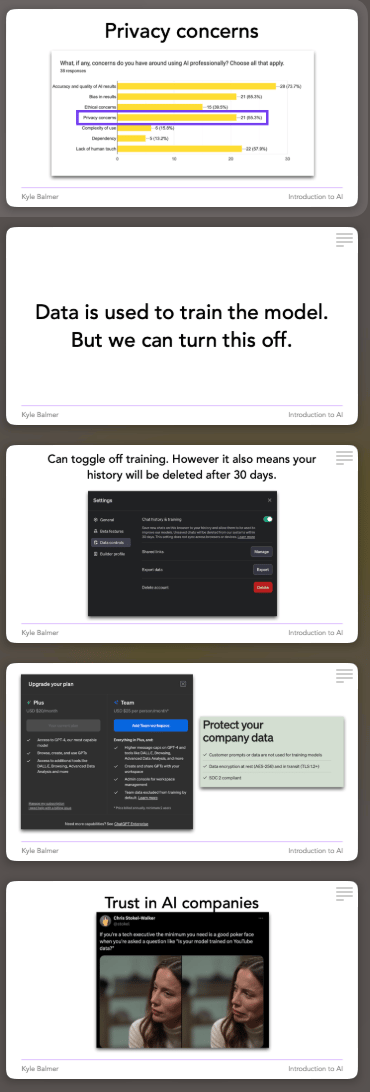
I show them how to turn off OpenAI’s use of their data to train their model. And quickly show them the paid options which give better privacy protection.
I’ll do this quickly for each of the main 2-3 concerns to basically bust those barriers and help with AI uptake.
To wrap it all up I end with a 5 minute Q&A.
This tends to be a lot more freeform and it’s where people will bring up stuff they’ve read in the news (which is why it’s helpful to keep up to date!).
Anything that is overly complex I suggest you ask the question answering to chat with you after the event. We want to keep this generally valuable for everyone and not let it go into the weeds and scare people off AI again!
My favourite questions here are when people ask a specific business problem and how I’d use AI to help. These are great because I can immediately help one person go away and use AI to deal with something that’s been annoying for them. When others see this in action they start to think about what they can use AI for to.
Phew. That was a long one. And I could talk in a lot more detail about my workshop. Hopefully this gives you an idea of the structure, timing and content though.
You’ll notice it’s very high level. And there isn’t that much “in it”. Yet I charge $1000-4000/hour for this.
That’s because this is what companies need right now. They don’t need more detail. They don’t need more technical. They don’t need more advanced.
They need enough to get their staff members all on the same page with AI.
In the next Part I’ll show you how to begin to acquire clients.
Keep prompting,
Kyle
Today we’re talking about how to secure paying clients.
I’ll show you a way to walk into this step by step which is perfect if you are new to pitching. We’ll go nice and slow, building upon each step.
Let’s get started:
Securing Clients
start small and free for testimonials
start inbound marketing but don’t expect speed
use outbound marketing to kick start lead flow and cash
keep it simple with one message, one pager and proposal
how to price your workshops
First up I recommend doing your workshop for free or low cost.
You want to:
get in some practice
get some early testimonials
start word of mouth
Reach out to local companies, charities, co-working spaces and networking groups offering a session. Price is to cover your costs or just do it free for the reasons above.
Make sure to get photos of you facilitating! And follow up to get testimonials from the organisers.
Also use the survey method I’ll talk about in the next Part to get before and after information from your students - you’ll be using this to approach paying clients.
There are two basic pillars here: inbound and outbound.
Inbound is where people see your content online, like what you do and contact you to book time with you.
I personally get most of my inbound from Tiktok then LinkedIn.
What happens is that people at businesses will see my Tiktok video and think “huh who’s this guy?”. They will then go and look me up on LinkedIn and contact me there!
Your inbound channel will depend on where your particular niche hangs out. Which depends on the industry. Because you are (ultimately) selling to businesses though LinkedIn is powerful.
Inbound is crucial. But it takes a longer time to build up. It’s taken me 9 months full time to build an audience of 150,000. It’s doable but a lot of work and not instantaneous.
As such I recommend immediately starting with outbound too.
Here’s the message I send:
Hi {firstName},

I won't beat around the bush. I dislike random LinkedIn messages too! So here's it it:

I’m running London based workshops about how AI is changing business and how to stay ahead of the curve.

I’ve recently [list of recent companies trained]

As great as all that travel is I'm looking I'm doing outreach to London based companies and organisations to see if there's interest!

I write a daily newsletter to 50,000+ professionals and educational video content for 150,000+ on social (primarily Tiktok interestingly!) and have written 8 Amazon bestsellers on the use of AI in business. I've also got an MBA from NYU. So this isn't just vague AI handwaving - I teach how to combine business, entrepreneurship and AI.

I have two basic workshops
-one teaching staff members how to start using AI
-another for leaders on how to deploy AI across the organisation
-or a longer combined one

Currently booking in one workshop per week.

Would this be of interest?

If so let's chat! I can send over details + pricing etc.

No silly business wasting your time on sales calls. I'll just send over a one pager..

Kyle
If they respond with a yes I ping them over a one pager with details about the workshops and pricing.
Very simple but effective. And more than enough to get started with.
Set your filters to:
your location
industry you want to target
job titles / roles in training and professional development (in large companies)
founders in smaller companies.
When you get your first hits I’d recommend hoping on a call with them.
Even if you don’t sell anything you’ll be gathering super valuable intel about what they are looking for.
You want to ask them about what they need, what problems they want to solve, what they fear.
Let them speak. And take note of the language and vocabulary they use.
You’re then going to echo all of this back to them in your proposal.
I’ll be sharing my full one-page, proposal and emails (and the actual slide deck!) in the AI education course I’m putting together. Should have more details next week! Email us if you are interested in accessing all this though so we have an idea of how many.
Here’s the big question!
How much do you charge?
It’s really hard to give a hard and fast number here because it’ll depend on:
your location
your target industry
your personal experience
track record
confidence asking for money!
The last is the issue I see the most people run into! People tend to undercharge. I’ve been (very) guilty of this.
Remember though the value you’re going to be dropping. It’s worth a lot to the company hiring you. Potentially hundred of thousands or millions if they get on board with AI before their competitor.
If you still struggle I like to think about the per person model.
Charging one person $50 for an hour would be cheap right? Yes!
Let’s say you are going to talk to 30 people.
Just charge 30 x $50 and that’s $1500/hour. That’s your rate because you are teaching lots of their staff at the same time.
I have an upcoming 1 hour presentation which is $4000. That sounds like a lot for just one hour of my time right?
But it’s to 400 people. It actually works out that each person is getting the workshop for $10! ($4000 / 400 people = $10 each).
Cheap as chips!
Once you disconnect it from your hourly rate and start thinking about how much value you are delivering to a large number of people it become easier to charge much more.
If in doubt though start lower. And each time someone says yes your raise your price. My first paid workshop was $500. They said yes immediately. So for the next I went to $750. They said yes immediately - so we went up to $1000.
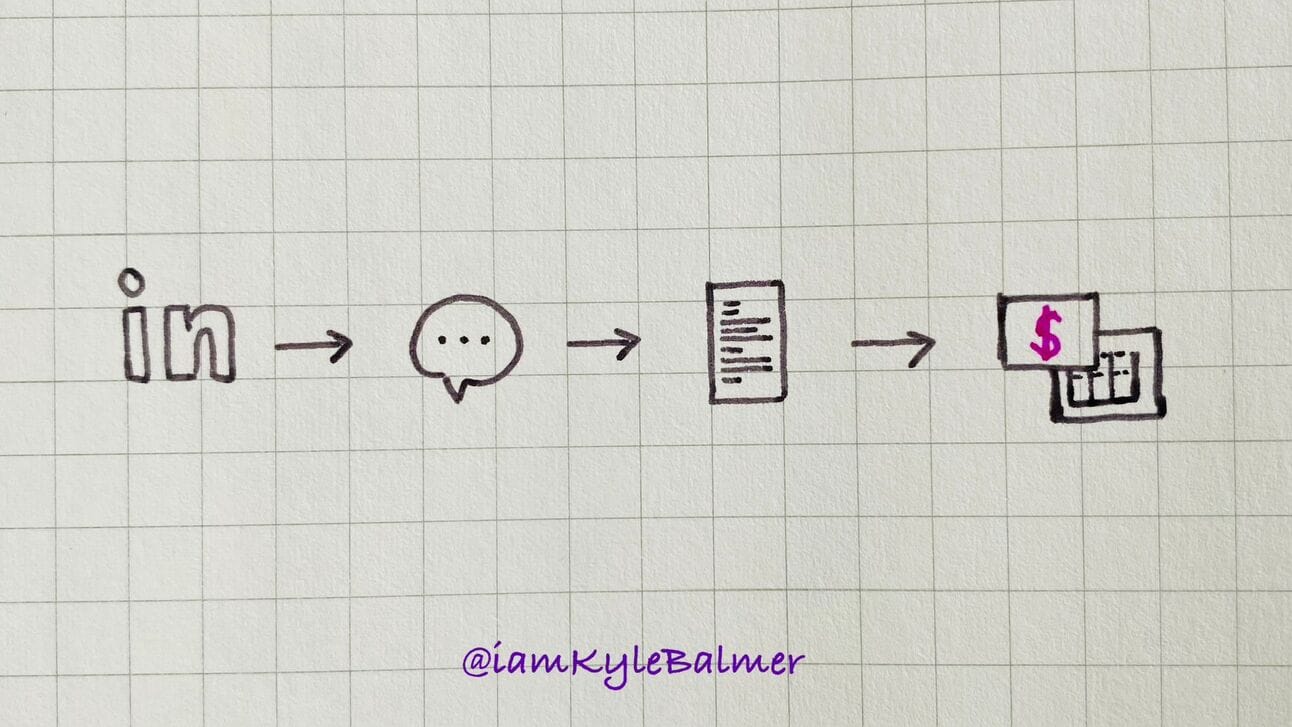
You do not need an all singing all dancing lead generating machine.
You need:
an outbound method like LinkedIn outreach
a message to get attention
a one pager
a proposal document
a pricing chart
That’s it for now. And you don’t even need them all to start. You can create as you go along: get that first lead, use discussions with them to make the one pager. Create as you proceed.
In the lat Part we’ll talk about the actual facilitation: preparation, on the day and post-event
Keep prompting,
Kyle
Today we look at how we deliver events so good that we open up whole new revenue streams.
I’ll give you my basic processes to make sure your workshops are customised without taking hours of work each time you deliver.
Let’s get started:
Delivery and Beyond
know your audience - use surveys
minimum dosage customisation
what I’ve learned about facilitation
collect info to roll into next pitch
upsell once foot in door
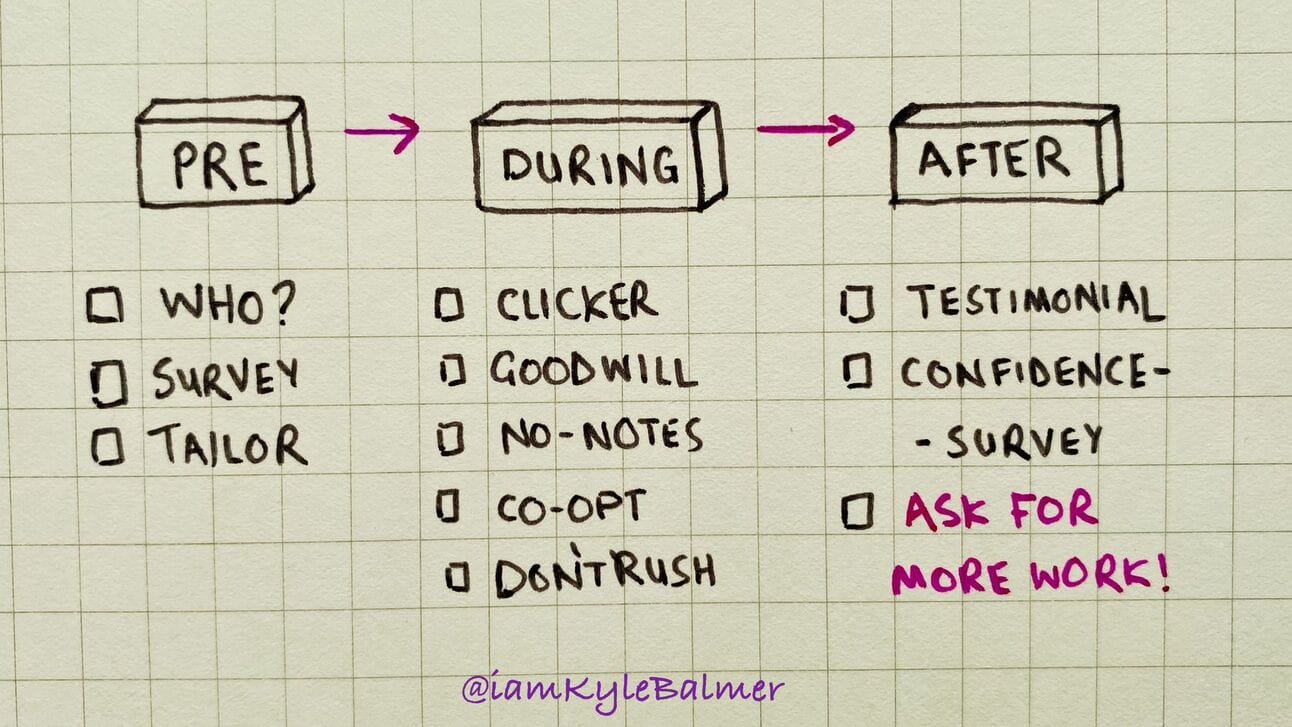
Prior to the event you want to find out as much as humanly possible about your audience.
A basic way to do this is to ask the organiser - literally “who will be attending?”.
Get information about their seniority, function, levels of IT/AI literacy, what AI tools they already use. Anything that helps you tailor your material specifically to them.
The better way to do this is a survey. This is what I personally do and it works wonders.
It works better than asking the organiser because you’re getting the info directly from the attendees.
I did an event where the organiser told me that the level of AI usage was fairly high because they are a tech company. I sent a survey directly to the participants and found out that 15% of them hadn’t even used ChatGPT.
If I had listened to only the organiser I would have gone in at a more advanced level. And immediately lost 15% of my audience. Oops!
The question I ask are:
do you use AI professionally, personally or for both
what AI tool do you use professionally, choose all (from list)
what’s your comfort level using AI professionally
what’s your department/function (from a list I get from organiser)
what are your concerns about using AI, choose all (from list)
I keep it short and sweet rather than bombard them with 20 questions. Too many questions and they won’t fill it in.
Depending on the agreed upon fee I may create the workshop from scratch. That’s just built into the price - the hours needed to research, create slides and make the content matches their needs perfectly.
For my basic workshop though the customisation is limited.
I’ll use:
the niche / industry
audience size
questionnaire
To make changes to:
my introduction (fully custom)
RISEN example (to match niche)
AI concerns that I tackle (based on questionnaire)
These changes don’t take too long after you’ve done a few workshops but mean you end up with a presentation that seems entirely custom made for them.
Once your preparation is done you’ve honestly done all the hard work. Preparation is 4/5th of the battle.
I’ve designed the workshop blueprint I gave you with natural switches between lecture and exercises. This alone will help carry you through and keep the energy up.
I can’t cover all of facilitation. It would be a whole book. Too much for even me.
So here are some things I’ve found helpful:
buy a clicker. Don’t expect the venue to have one. Also bring whatever adapters you’ll need for hooking your laptop to a projector. And have a backup version of your slides on a USB and in your email. Assume nothing.
you start with goodwill. It’s your job not to lose it. Do this by keeping the energy up and not droning on. Switch teaching formats regularly to keep them on their toes and the hour will be done before you know it.
don’t read your notes. You can have presentation notes (my slides do) but they are there for emergencies only. Instead get in front of the lectern, in front of your laptop so you can engage with the audience directly. Don’t hide behind the screen - it immediately kills charisma.
co-opt experts. Sometimes there will be a know it all or someone who genuinely knows more than you. They are sitting there thinking “I know this, this is my territory, why are they here telling me this?” Disarm this by bringing them in as a co-teacher. If someone asks you a very specific question say “amazing question and one that Michael is in a better position to answer than me. Michael what do you think?”
your audience don’t know you are behind. Falling behind? Only you know that. No-one else knows your timings and content. Don’t speed up to catch up - you’ll lose people’s attention if you suddenly start sprinting through your slides. Instead cut sections, starting with your Q&As. It’s better to properly get through most of you material rather than rush all of your material.
scale up your audiences. If the idea of talking in front of 100 people is terrifying: don’t. Talk in front of 10. Nail it. Then 25. Then 50. Then 100. Build it up, building comfort at each level. This will naturally fit with your expanding business thankfully- being asked to talk to larger and larger audiences each time.
Workshop done. Job’s done right?
Not quite!
We need to collect evidence about the event that we can present to our next clients.
Two main ways to do this: testimonial and survey.
First up, make sure to get feedback and a testimonial from your client after the event.
We use Senja (affiliate) to collect testimonials but a simple email (or even text!) is sufficient. Ideally you want text and a video testimonial. Getting video can be tricky so make sure you at least get text.
Use these testimonials in your future one-pagers and proposals. The more the better!
Second, send out a survey after the event. The main question we want to ask if their comfort with using AI professionally.
In the pre-event survey I ask people to rank their comfort on a 1-10 scale. I then ask the same after the event. The increase in their comfort is a quantifiable “bump” from the training you provided. Make sure to give the client this data - it’ll help them with their bosses. And use it in future proposals.
Once you’ve delivered a one hour introduction to AI workshop at a company you’ve opened the door to more work.
This could be:
additional workshops for leadership
additional workshops for specific departments
coaching
advisor on retainer
implementation work
You’ve already come in and shown your expertise so you become the natural next step for this sort of work. This is where the much chunkier contracts lie.
Over this week I’ve outlined how to get into the (lucrative) game of AI education for businesses.
We start with a one hour introduction to AI that we deliver to a specific niche. We can easily charge $1000+/hour for this basic workshop and as such make a solid revenue with just this.
One a week is $4000/month ~$50,000 a year. Not bad for 50 hours of work.
Beyond that though once the door is open you can sell more premium workshops and more. That’s where you can really build an education business funnel.
Again, I’m looking at licensing my teaching material (slides, notes, processes, proposals etc.). If this is of interest reply to this email - we’re collecting responses and will get back to everyone when we have the details locked!
Keep prompting,
Kyle
Unlock the potential of AI for your business with the comprehensive 'AI Training for Businesses | AI Business Playbook'. This playbook is designed to guide you through the intricacies of AI training, empowering you to lead workshops and deliver impactful talks that resonate with today's corporate landscape. Dive into a wealth of knowledge that not only addresses the pressing demands of businesses struggling to keep up with AI advancements but also positions you as a sought-after expert in your field. By the end of this playbook, you'll be equipped to turn AI training into a lucrative opportunity that benefits both you and the organizations you serve.
This playbook is perfect for entrepreneurs, consultants, and trainers who are eager to expand their skill set and capitalize on the increasing demand for AI education in the business sector. If you have a solid understanding of AI but struggle with how to communicate its value to organizations, this playbook will provide you with the tools and strategies to overcome that challenge. You'll discover how to turn your knowledge into a profitable training service that helps businesses navigate the complexities of AI implementation.
A basic understanding of AI concepts is beneficial, but this playbook provides foundational knowledge to get you started.
The playbook is structured into five parts, each designed to be completed at your own pace, typically within a few hours each.
Absolutely! Each section includes actionable steps that you can implement right away in your training sessions.
No worries! This playbook includes tips and techniques for effective delivery, making it accessible for beginners.
By mastering AI training, you can position yourself as a leader in this emerging field, opening up new revenue streams and opportunities.