
There's a massive opportunity right now at the intersection of AI and business.
It's an opportunity I'm passionate about because it has the potential to either democratise wealth or rapidly increase disparities—and which path we take depends largely on who steps up to lead.
(Hint: we want the one that makes everyone better off please and thanks)
My mission is making AI accessible for everyone in business and work.
Not just white dudes like me (yes yes, I see the irony!) or large corporations with massive budgets.
One of the core activities I do is workshops—going to companies and talking about AI and how to start using it. This is something that you can do too, whether as an employee of said company or freelance consultant (or, if you’re smart, both).
The beauty is that it delivers triple value: you stay on top of the AI wave rather than being submerged by it, you bring your domain expertise and AI knowledge together to help others in your industry, and you profit—either by becoming indispensable at your company or by expanding your income through teaching and consulting.
Win, win, win, win. Yes - I added an extra win in. Why not‽
This Playbook is all about how to position yourself at the centre of this opportunity by mastering the executive briefing—the crucial first step in establishing yourself as an AI translator for your industry.
Let’s get started:
The gap and how to fill it
Why you are in the right place at the right time
Internal or external
Your super power isn’t tech - it’s insight
Bridge the gap, save your future
Two truths. And no lies.
First, companies absolutely need to implement AI to remain competitive. This isn't optional anymore. Businesses that fail to effectively incorporate AI in the next 1-3 years will face existential threats from competitors who do. The productivity and cost advantages are simply too significant to ignore. They’ll be dead in the water, either to competitors who implement AI or new entrants who are AI-first.
Second, executives are the gatekeepers who control this process. They control the budgets, set strategic priorities, and ultimately decide whether and how AI gets implemented across the organisation.
Without executive buy-in, nothing meaningful happens with AI adoption. And the smart ones know that if they don’t work this out ASAP it’s game over.
This creates the gap that we are going to slide into: Companies desperately need AI implementation, but the decision-makers—executives—are often the least technically equipped to evaluate and guide this transformation.
They're drowning in buzzwords, confused by contradictory advice, and scared of making expensive mistakes.
So..the people who hold the pursestrings are confused and scared. That’s opportunity.
What these executives desperately need aren't technical specialists who speak in code and jargon. They need translators—people who understand both AI capabilities AND their specific industry challenges, and can communicate this in clear business terms that help them make confident decisions.
This creates an extraordinary opportunity that's still wide open in 2025.
One of the core activities I do is workshops—going to companies and talking to leadership about AI and how to start using it effectively.
This is something that you can do too, whether as an employee or freelance consultant (or both). It allows you to:
Stay on top of the AI wave rather than be submerged by it
Bring your domain expertise and AI knowledge together to help others in your industry
Profit—either by becoming indispensable at your company (Head of AI Readiness, anyone?) or expanding your income by teaching this stuff to other businesses
The best part? Literally every company (and thus every executive team) needs this right now. The demand for clear, niche-focused AI guidance far outstrips the supply of people who can confidently speak this language to leadership.
"But Kyle," I hear you say, "I'm not an AI expert! I don't have a PhD in machine learning or years of coding experience."
Perfect! That's actually your advantage when talking to executives.
Most technical AI experts are terrible at explaining things to busy executives. They get lost in capabilities and features rather than focusing on business outcomes. Executives' eyes glaze over the moment someone starts talking about "transformer architecture" or "attention mechanisms."
I’ve given workshops at big tech companies for this exact reason. The head of IT or the head of AI has tried to educate execs and staff members on AI and it’s caused confusion rather than clarity. That’s when people like me get called in to clear up the mess.
What executives actually need is someone who:
Understands their business well enough to identify valuable use cases
Knows enough about AI to realistically match capabilities to problems
Can translate technical possibilities into business realities
All without mentioning back-propagation, transformer architecture or gradient descent.
Let me be blunt: some of my clients struggle to log into ChatGPT. I've literally had workshops where I've needed to walk executives through the basic login process. I also got paid $1000+/hour for my time btw… The technical bar is often (waaay) lower than you might expect, even in technology companies.
This isn't to disparage executives—they're brilliant at what they do. But what they do ain’t AI. Their focus is on business strategy and outcomes, not technical implementation details. Your job is to bridge this gap.
There are two primary ways to leverage this opportunity and the best one for you depends on where you are right now:
Path 1: The Internal AI Champion
If you're currently employed, becoming your organisation's AI translator to leadership creates extraordinary job security. While many roles face automation risk, the person who can effectively communicate AI's value to executives becomes increasingly essential.
I've seen marketers become Chief AI Officers, customer service reps become AI Implementation Managers, and administrative assistants become AI Productivity Specialists—all because they stepped up as the translator between AI's capabilities and their company's leadership team.
Path 2: The Independent AI Advisor
Alternatively (or additionally!), you can leverage this expertise externally as a consultant, workshop leader, or implementation specialist who works directly with executive teams. You become a hired gun.
The executive briefing and workshop market is particularly hot right now.
My students charge $1,000+ per hour for quality AI workshops that help teams understand the practical applications within their industry. I personally charge $3000-4000/hour. And that's just the beginning—these initial briefings often lead to ongoing advisory relationships or implementation projects. You become the “AI person” for the company which opens up more work.
This path offers:
Significantly expanded income potential
Freedom to work with multiple clients across your industry
The ability to scale your impact beyond a single organisation
An entrepreneurial path with relatively low barriers to entry
The beauty is that these paths aren't mutually exclusive. Many people start as internal champions who brief their own executives, while gradually building an external practice on the side. You can cut your teeth on internal work then spin off as a freelancer. This creates both security and optionality—yay, we like having our cake and eating it!
The gateway to either path—internal champion or external advisor—is the ability to effectively communicate AI's value to leadership. Specifically to those who are making decisions. Hence the focus of this Playbook - we’re going to learn how to build a great executive briefing that’ll unlock the opportunity for us.
A well-executed executive briefing accomplishes several crucial things:
Establishes you as knowledgeable and forward-thinking
Frames AI in terms of business outcomes leadership cares about
Creates excitement without unrealistic expectations
Sets the stage for more detailed conversations and implementations
Positions you as the natural guide for the journey ahead
And because execs are busy we generally have 5-30 minutes to do this all in. Yikes.
But…if we can nail this we open up a lot of doors. Sounds good?
Over the next four parts of this playbook, I'll walk you through exactly how to create and deliver powerful executive briefings that position you as an invaluable AI translator for leadership teams.
In Part 2, I’ll give you an overview and we'll explore the different briefing formats—5, 15, and 30 minutes plus how to structure each for maximum executive impact. You'll learn how to quickly capture leadership attention and maintain it regardless of the time constraints you're working with.
Then in Part 3, we'll dive into crafting your core message about why AI matters for your specific industry in terms executives care about. You'll discover how to balance opportunities and threats, address emotional resistance, and tailor your message to different executive perspectives.
Part 4 will focus on creating your killer demonstration example—that perfect, compelling use case that makes the abstract concrete and the theoretical practical for leadership teams. This is often where the light bulb moment happens for executives.
Finally, in Part 5, we'll cover how to convert initial leadership interest into committed action, whether that's securing executive sponsorship for internal initiatives or closing deals for external consulting work.
The AI transformation is happening with or without you. So by stepping into the translator role at the executive level, you can not only secure your own future but also profit handsomely.
Keep Prompting,
Kyle
Ok, so you're going to approach the leadership of your company. Or maybe you've managed to talk your way into a call with a company that you don't work for. Good job.
Now what?
Your first instinct might be to prepare a comprehensive workshop demonstrating all the amazing things AI can do. Text generation! Image creation! Video synthesis! Audio production! AI avatars! The smorgasbord approach.
Don't do this.
I've seen this mistake countless times. Someone finally gets their shot with executives and then proceeds to overwhelm them with a buffet of AI capabilities, hoping something—anything—will stick.
It's the equivalent of throwing spaghetti at the wall, and as all those Just Stop Oil protests have shown executives hate having spaghetti thrown at them (especially if they're wearing nice suits).
Executives have extremely limited time, and their primary job is to make decisions. Our only job during an executive briefing is to help them make a decision in a short amount of time. That's it.
And what decision are we aiming for? It's not commitment to a six-figure pilot program. It's not automating the entire HR department. It's simply: "Ok, we want to do something with AI, and you seem to know what you're doing—lead it."
That's all we need from the first meeting. Just enough commitment to move to the next step, whether that's a staff workshop, a small pilot project, or a deeper dive session. Get that first "yes" and you're on your way.
Let’s get started:
Why executives need different briefing formats (5, 15, and 30 minutes)
Universal three-act structure
Tailoring your approach for elevator pitches, initial meetings, and formal presentations
How to maintain pace and ensure you get a decision
Common pitfalls that derail executive briefings
Executives operate in a different reality than the rest of us. Their calendars are booked weeks in advance.
I just booked in a call with a high-flyer and it’s 2 months from now. He’s just booked up until then - and that’s that.
Their attention is pulled in a dozen directions simultaneously. Their ultimate currency isn't money—it's time. Which is (incidentally) why people start to get into longevity and bio-hacking once they’ve made enough money…they need more time.
This reality shapes how we need to approach them about AI. We must be prepared to deliver value in whatever time window we're given, whether that's a 5-minute elevator conversation, a 15-minute introductory meeting, or a full 30-minute presentation slot.
Here's the golden rule of executive briefings: no one ever complains about something being too short. (Get your mind out of the gutter if you giggled at that.)
We hate it when a movie goes on too long. But when it’s too short? That just means we loved it and want more. Ditto for presentations.
If you're scheduled for 15 minutes, prepare to deliver your core message in 10. If you've got 30 minutes, aim to cover your essential points in 20. This leaves room for questions, which is where the real engagement happens.
The shorter the briefing, the better. If a meeting runs longer than scheduled, it's because they're interested—and that's a win. But if you try to cram 30 minutes of content into a 15-minute slot, you'll lose them before you ever get to your point.
Regardless of whether you have 5, 15, or 30 minutes, all effective executive briefings follow the same three-act structure:
Act 1: Why AI Matters to This Specific Business Make the case for why AI should be on their priority list, with specific relevance to their industry, company size, and competitive landscape.
Act 2: One Concrete Example With Real-World Impact Show, don't tell. Demonstrate one clear, specific use case with tangible results that they can relate to their business.
Act 3: Clear, Actionable Next Steps Tell them exactly what decision you need them to make today, and what the immediate next action looks like.
This structure works because it aligns with how executives make decisions:
Is this relevant to me? (Act 1)
Can I see evidence it works? (Act 2)
What's the immediate action? (Act 3)
Or alternatively: why should I care about this? Prove it. OK fine what’s the action?
The difference between time formats isn't in the structure—it's in the depth and breadth of what you cover in each act.
Over the next few Parts of the Playbook we’ll cover each of the Acts, one per Part. But for now you need to know the outline so we know where we are going.
The 5-minute briefing isn't actually a formal briefing—it's an elevator pitch that happens in hallways, before meetings, or when you unexpectedly find yourself with executive access.
What to Include:
A single, industry-specific pain point AI can solve
One example with clear, quantifiable results. “Company X did this and saved Y%”
Request for a specific follow-up (usually a proper meeting)
What to Cut:
Technical details of any kind - very likely you won’t have a screen or any visual aids so it’s got to be verbally understandable.
Multiple use cases or examples. One example only. And make it work.
Lengthy explanations of how AI works. This isn’t a lecture.
Your Goal: Secure a longer meeting where you can present more formally.
Example Opening: "Companies in our industry are seeing 35% productivity gains in [specific department] by implementing targeted AI solutions. Here’s a paper from the Harvard Business Review about this. I've identified three areas where we could see similar results. Could I get 15 minutes on your calendar to walk through the specifics?"
When you have just 5 minutes, you're not trying to get full commitment to an AI implementation—you're simply trying to get enough interest for a proper conversation. Be ready to also deliver this in an ever shorter time- can you get it to 30 seconds? Good.
The 15-minute briefing is your most common scenario—an initial meeting where you have just enough time to make your case and secure commitment to a next step.
I would personally do this without slides so you can focus on engagement. Slides also mean technical setup and dependencies. If you spend the first 3 minutes faffing with getting the slide deck on screen and making sure everyone can see it you’ve lost 20% of your time. Too risky.
Structure Breakdown:
Act 1: Why AI Matters (3 minutes)
Act 2: One Detailed Example (8 minutes)
Act 3: Next Steps & Decision Request (4 minutes)
What to Include:
Industry-specific AI trends and competitive pressures
One fully developed example with before/after comparison
Clear ROI metrics from the example
Specific proposal for next steps (workshop, pilot, etc.)
What to Cut:
Slides. Personally I’d run without slides on this one. But use what works for you.
Multiple examples (stick to your strongest one). You still don’t have anywhere near enough time for multiple examples - choose one and nail it.
Long-term visions (stay focused on immediate value and immediate wins)
Your Goal: Secure commitment to a concrete next step, typically a workshop with broader staff or a small proof-of-concept project.
This timeframe is ideal. It's long enough to make a compelling case but short enough to maintain focus and urgency.
If the meeting goes longer—great! Deliver your material efficiently and then shift to Q&A. If they're asking questions, they're interested. I've written multiple Playbooks on how to up your AI knowledge and be able to answer more in-depth questions. Refer back to those if you need a refresher.
The 30-minute briefing is typically a formal presentation where you have the opportunity to build a comprehensive case for AI adoption.
At this point you may bring in slides. You have enough space to breathe and having some visual examples on screen will be compelling. Keep it super light though and goodness me don’t just read from the slides!
If you are presenting in a room stay out from behind your laptop too. That’s a charisma dead-zone!
Structure Breakdown:
Act 1: Why AI Matters (7 minutes)
Act 2: Primary Example + Supporting Cases (15 minutes)
Act 3: Implementation Roadmap & Decision Request (8 minutes)
What to Include:
Comprehensive business case with industry data
One primary example explored in depth. You can really stretch your wings here and give the full details. Importantly you can better prove your business case.
1-2 supporting examples showing breadth of application. Think of objections and use supplementary short examples to knock them down. For example you might have one about cost (pilot programmes can be low cost) and one on data protection (we’ll do it internally to secure data).
Specific decision request with clear next actions
What to Cut:
Technical deep dives. Still no need for technicals. You are talking to executives - they don’t need the technical breakdowns!
Overly ambitious proposals. You want a little sizzle sure but if you go in too hard you’ll lose trust.
Your Goal: Secure formal approval for a defined initiative, whether that's a department-wide workshop, a funded pilot project, or your engagement as an advisor. Or failing that secure a request for a proposal from you.
Even with 30 minutes, remember that less is more. Better to thoroughly cover fewer points than to race through a comprehensive overview that leaves executives confused about what you're actually proposing.
Here are the most common mistakes I see in executive AI briefings:
Overly technical: Focusing on AI capabilities instead of business outcomes. Executives don't care about how the technology works—they care about what it does for the business. Leave the acronyms at home. And if I hear you say gradient descent or back propagation I’m going to bust in through the window of that board room myself to shut it down.
Overly stuffed: Trying to cover every possible AI application instead of focusing on the highest-value opportunities. Yes AI can do an awful lot. But trying to cover all potential uses dilutes any single one. Hone in on one immediately valuable use case for the business and focus here.
Ambiguous Ask: Ending without a clear decision request. Always be explicit about what decision you need today. Give them the next steps and ask if they are interested. Then stop talking. Works wonders.
Fantasy Land : Painting a picture of AI transformation that's so ambitious it seems unrealistic. Start with concrete, achievable wins. Execs are bombarded with AI hype already - acknowledge this and say that we’re going to instead focus on stuff that we can do right now.
OK, we’ve covered a lot. Let’s condense it in a prompt. Here's a prompt to help you create a customised briefing outline for your specific industry and timeframe:
You are an expert in executive communications about AI adoption. Create a detailed briefing outline for my specific situation:

Industry: [Your industry]
Company size: [SMB, Mid-market, Enterprise]
Briefing length: [5, 15, or 30 minutes]
My role: [Internal employee or external consultant]
Target audience: [C-suite, department leaders, board, etc.]
Specific outcome I want: [Decision you're seeking]

For each section of the three-act structure (Why AI Matters, Concrete Example, Next Steps), provide:
1. Exact time allocation
2. 2-3 bullet points of what to cover
3. 1 compelling data point or statistic to include
4. 1 potential objection to prepare for

Also suggest a powerful opening hook and closing call-to-action specific to my industry and audience.In Part 3, we'll look at Act 1: your core message about why AI matters for your specific industry. We’ll start to fill in the structure that we’ve covered in this Part.
Keep Prompting,
Kyle
This sentence sends shivers down my spine. I hear it at least once a week from executives who genuinely believe their industry is somehow immune to the AI transformation sweeping through every sector of the economy.
Often these people when asked will acknowledge AI is about to change everything. For everyone. Just not, you know, their specific situation. Ha!
We all think we are special, unique and not like anyone else. Yeah…about that….
There isn't a single industry that won't be fundamentally changed by AI in the next 5-10 years. Not one.
Sure, some physical roles have some leeway. But when robotics starts to catch up and has its ChatGPT moment? We’re going to see the same impact.
The question isn't if AI will impact your industry—it's how quickly, how deeply, and whether you'll be leading that change or scrambling to catch up.
That’s the realisation we need the executives to come to.
Remember in Part 2, we established our three-act structure for executive briefings:
Act 1: Why AI Matters to This Specific Business
Act 2: One Concrete Example With Real-World Impact
Act 3: Clear, Actionable Next Steps
In this Part we're focusing entirely on Act 1—crafting a compelling business case that makes executives sit up and take notice.
This is where you establish the foundation for everything that follows. Get this wrong, and it doesn't matter how brilliant your example is or how clear your next steps are—the executive has already mentally checked out and are thinking about what to have for lunch.
Let’s get started:
Carrot and stick: Balancing opportunities and threats
Industry-specific data
Addressing emotional barriers
The most effective business case for AI combines both opportunities (the carrot) and threats (the stick). It's human nature to respond to both gain and loss motivations, but in different ways.
Most executives are actually more motivated by preventing losses than by achieving equivalent gains—a psychological principle known as loss aversion.
Why is this? Well…they are at the top already. They now need to protect what they’ve earned.
If they were young and hungry then opportunity (even with risk) is attractive. But when you are within spitting distance of retirement your only goal is to guide the boat in without sinking it.
Here's how to structure this part of your briefing:
Start with the Opportunity (The Carrot)
Begin with the positive vision because it creates openness and enthusiasm. We don’t want to go in with doom and gloom because it’s a grim way to start a talk! Focus on specific, tangible benefits for their business.
Get some actual data here (use a research model to find case studies and articles) to show what others are doing and some of their successes. These don’t have to be from your industry specifically but if they are you can pivot into the threat very neatly.
Then Introduce the Threat (The Stick)
After establishing the opportunity, introduce the competitive threat:
Disruption risk: "Traditional industry leaders who delay AI adoption are being leapfrogged by more agile competitors"
Cost disadvantage: "Companies without AI automation are facing a growing cost structure disadvantage—averaging 30% higher operational costs"
Talent exodus: "Organisations seen as technology laggards are losing their best talent to more innovative competitors"
Existential risk: "In similar industries, companies that delayed AI implementation for just 2-3 years found themselves unable to catch up"
Again, you want to find real facts and figures here. You need ONE good data point to start. Don’t worry about providing a sheet of references - we want one focused, powerful point.
The balance between opportunity and threat should be calibrated to the executive's personality and corporate culture. Some respond better to opportunity, others to threat. Read the room and adjust accordingly.
You’ll also need to adjust your language so it doesn’t sound like you are directly criticising their leadership. This’ll end the meeting pretty quickly! Instead talk about other companies who aren’t investing in AI - maybe even in other (related) industries. Use these parallel examples so as not to offend but also making it clear this could happen in their company.
Generic AI statistics are a dime a dozen. What executives need is evidence specific to their industry, company size, and situation. Here's how to find it:
Industry Research Reports
Analyst firms like Gartner, Forrester, McKinsey, and Deloitte regularly publish industry-specific AI impact reports. These carry credibility with executives. Stick to big names and you can immediately borrow authority.
Example: "According to McKinsey's 2025 Industry Digitisation Report, insurance companies implementing AI-powered claims processing are reducing cycle times by 70% while improving accuracy by 30%."
Right there you are hijacking McKinsey’s authority. You didn’t do the study. You don’t need to. But you’re hopping onto McKinsey’s names and using it to immediately secure credibility.
How to find these reports? Use an AI research model.
Competitive Intelligence
Sneaky one but this works amazingly well.
Nothing motivates executives like learning what their competitors are doing. Research competitors' AI initiatives through:
Press releases and annual reports
LinkedIn posts from their employees
Industry conference presentations
Tech vendor case studies
Example: "Your competitor XYZ launched an AI customer service platform last quarter and is publicly claiming a 40% reduction in resolution times."
The simplest way to start finding this is Googling the competitor’s name + AI and see what turns up.
Case Studies from Analogous Industries
If direct examples in their industry are limited, look for parallels in adjacent sectors:
Example: "While AI adoption in commercial real estate is just beginning, the residential sector has seen property management companies reduce maintenance costs by 35% using AI-powered predictive maintenance. There’s an opportunity here to be the first in commercial real estate gaining these savings."
If there aren’t many case studies in the specific industry this is actually a good hook for you to use. You can posit this as an opportunity for the executives you are talking to to spearhead AI adoption in the industry. Think of the plaudits, the industry paper write ups, the awards, the fancy galas? That’s the image you want to embed.
For all of these we can use a research AI to help us gather up information. This prompt will help you gather industry-specific evidence:
You are an AI research assistant helping me prepare for an executive briefing on AI adoption. Please help me find industry-specific evidence about AI impacts in the following sector:

Industry: [Specify industry]
Company size/segment: [SMB, Mid-market, Enterprise]
Geographic focus: [Optional - specify region]

Please provide:
1. 3-5 specific data points about how AI is creating competitive advantage in this industry (with sources if available)
2. 2-3 examples of leading companies in this space implementing AI (what they're doing and results)
3. 2-3 examples of companies that delayed AI adoption and faced negative consequences
4. Key industry-specific metrics that executives in this field typically care about and how AI impacts them

Focus on concrete business outcomes rather than technical implementations.
With research AIs in particular make sure you go back and check the sources. We need them to be watertight. You don’t need many - but you do need them to be good. So take the extra time to confirm everything the model digs up.
Beyond rational concerns, executives have emotional barriers that often go unspoken but significantly influence decisions. Now, they won’t necessarily express these (in so many words) so you need to be on the lookout for language that gives away what they are feeling.
Fear of Personal Obsolescence : "If AI can do strategic thinking, what's my role as an executive?"
Solution: "AI processes data but lacks judgment and leadership. The best executives will use AI to focus on truly strategic decisions that require human wisdom. If anything your jobs are the safest right now."
Fear of Looking Foolish: "What if I champion AI and it fails?”
Solution: "Start with small, contained wins before broader rollout. This protects your credibility while positioning you as forward-thinking. Position the projects as experiments from the start."
Impostor Syndrome Around Technology : "Everyone seems to understand this AI stuff. I don't want to reveal how little I know."
Solution: "Many executives feel this way. And the good thing is it doesn’t really matter. Do you know the ins-and-outs of how the internet works? Probably not - and we don’t need to. Implementation doesn't require technical expertise—it requires business judgment about where to apply AI. That’s what you bring."
Fear of Cultural Resistance: "If I push this and the team resists, I'll be blamed for the disruption."
Solution: "Involve employees in identifying opportunities. In fact I recommend as a next step a staff-led workshop for exactly this reason. When people see AI as making their work more valuable rather than threatening their jobs, resistance transforms into enthusiasm."
Remember, executives rarely make purely rational decisions. As Johnathan Haidt writes they instead make human decisions influenced by emotions, then justify them with data. Address both for the most compelling case.
Here's a framework for structuring the "Why AI Matters" portion of your briefing:
1. Industry Context
Current state of AI adoption in their industry
Key competitive dynamics being shaped by AI
Specific challenges AI is uniquely positioned to address
2. Opportunity Overview
3 key areas where AI creates value in their specific business
Concrete metrics and outcomes from industry examples
Timeline for realising these benefits
3. Risk of Inaction
Competitive consequences of delayed adoption
Cost and efficiency disadvantages
Potential strategic limitations
4. Addressing Key Concerns
Proactively tackle the specific objections you anticipate
Demonstrate empathy and understanding of legitimate concerns
Pivot to how these challenges can be mitigated
5. Transition to Concrete Example
Bridge to your Act 2 by saying something like: "Let me show you exactly what this looks like in practice with a specific example relevant to your business..."
Adapt this to different time constraints. In a 5-minute pitch, you might compress Act 1 to just 1-2 minutes. In a 30-minute presentation, you could expand it to 7-8 minutes with more detailed examples. But the basic thrust remains the same.
Use this prompt to generate a first draft for Act 1”
You are an AI consultant preparing the "Why AI Matters" section of an executive briefing. Create a compelling business case for AI adoption in the following context:

Industry: [Specify industry]
Company size: [SMB, Mid-market, Enterprise]
Current AI maturity: [Early, Mid, Advanced]
Key executive concerns: [List any specific concerns/priorities]

Please provide:
1. An industry context overview (2-3 paragraphs)
2. Three specific opportunity areas with concrete metrics and examples
3. Two key risks of delayed adoption with supporting evidence
4. Preemptive responses to the most common objections in this industry
5. A smooth transition to introducing a specific example

Format this as a script I could potentially deliver in about 5 minutes. Use persuasive but factual language appropriate for senior executives. Include 2-3 compelling statistics or data points with sources if available.In Part 4, we'll dive into Act 2 of your executive briefing: creating a killer example.
You'll learn how to select, develop, and present a compelling use case that makes the abstract more real and convinces executives that AI implementation is actually doable.
Keep Prompting,
Kyle
We've all been there—sitting through a presentation where someone rambles on about abstract concepts and theoretical benefits. Eyes glaze over. Attention wanders. TikTok calls for you.
Then everything changes when they say, "Let me show you a specific example of how this works." Suddenly, people are leaning forward. The abstract becomes concrete. The theoretical becomes practical.
In our three-act structure for executive briefings, we've covered Act 1: Why AI Matters. Now we're moving to Act 2: One Concrete Example With Real-World Impact. This is where you transform AI from a buzzword into something “real” that executives can grok.
Let’s get started:
Working through a complete example—from problem to measurable results
Calculating and presenting ROI
Helping executives see beyond the single example
Not all AI use cases are created equal—especially for demonstration purposes. The perfect example for an executive briefing needs to balance several factors:
High business impact - Addresses a significant pain point or opportunity
Low implementation risk - Can be executed reliably with minimal complexity
Clear before/after contrast - Shows a visible transformation
Measurable results - Demonstrates quantifiable benefits
Relatable to their business - Maps directly to their operations
Let’s cut through this and use a prompt to help identify some potential killer examples for your industry:
You are an AI consultant helping me identify the optimal use case for an executive briefing on AI implementation. For the following industry, please analyse potential AI applications according to business impact and implementation risk:

Industry: [Specify industry]
Company size: [SMB, Mid-market, Enterprise]
Available data: [Describe what data the company likely has]
Primary business objectives: [Cost reduction, revenue growth, customer experience, etc.]

For each category below, provide 2-3 specific AI applications with:
1. Brief description of the use case
2. Business impact (quantified if possible)
3. Implementation complexity/risk
4. Approximate timeline to implement
5. Data requirements

Categories:
- High Impact, Low Risk (primary focus)
- High Impact, High Risk (future consideration)
- Low Impact, Low Risk (quick wins)
- Low Impact, High Risk (avoid)

Recommend the single best use case for an executive demonstration, with justification.
This will take the factors above and details about the company you are talking to and spit out some potential examples. You’ll have to use your judgement and what you know about the company (and its executives specifically!) to select the best one - but this will at least get you pointed in the right direction.
Now, you could show them a before/after picture. Have some nice slides explaining what the use of AI would achieve. That’ll be sufficient most of the time.
I’m not going to waste your time explaining how to build those slides.
BUT….the most compelling example isn't just one you talk about—it's one you can actually demonstrate. Nothing convinces executives faster than seeing a working solution, even in prototype form.
Before your briefing, create a simple proof of concept that demonstrates the key capability:
Use actual company data (with permission) or mock up data if this will be a problem
Focus on the core function, not fancy interfaces
Ensure it works flawlessly for your demo scenario (test test test!)
Keep it lightweight and focused, zero bloat
Proof of concepts don't need to be full solutions—they just need to show the key capability in action. For example, if your use case is document analysis, build a simple app that can analyse a few sample documents from their company in real-time.
A (very) basic working automation or workflow will go much further than any abstract explanation you give. So I highly recommend bringing your A-game with a super simple prototype.
If you have no idea how to build something like this then my AI Automation Accelerator would be a good place to start.
Make It Interactive
If you really want to style it out then allow executives to interact with your proof of concept:
Let them try different inputs
Show how results change based on different scenarios
Give them control of the demo where possible
This is obviously higher risk as there’s more chance of it not working. But if your prototype is slick enough that you know they won’t hit issues then this will elevate the demo.
Keep in mind that nothing kills credibility faster than a demo that fails. Always have fallbacks ready.
The most effective examples don't stop at a single use case—they help executives see the broader potential. Once you've presented your specific example and they “get it”, help them understand how it scales:
Similar Processes Across the Organisation
Identify other areas where the same approach could apply: "The same approach we used for accounts payable could be applied to accounts receivable, HR onboarding documentation, and customer contracts—all of which involve similar document processing challenges."
Suddenly one solution for a team of 10 can be applied over all 1000 staff. This is about width - applying the same thing with more people.
Building Block Approach
Show how this initial application creates a foundation: "The document understanding capability we're developing here becomes a building block for more advanced applications, such as automated compliance checking and contract risk analysis."
Your demo is the basic core functionality. But help them imagine the “add ons” that could be integrated alongside. Let them pepper you with ideas - get that excitement up.
This is about depth. Increasing the sophistication of our AI tool so it performs even better.
This "scale up" conversation is crucial because it helps executives see beyond the immediate use case to the broader transformation potential. But always remember to ground this in practical reality—avoid painting science fiction scenarios.
Before you go in make sure you know who you are talking to. Because we want to hit different outcomes for each executive depending on who they are. Different stakeholders will connect with different aspects of your example:
For Financial Executives (CFO, Controller)
Emphasise cost savings and ROI
Be precise about numbers and payback period
Address audit and compliance considerations
For Operational Executives (COO, VP Operations)
Focus on process improvements and efficiency
Highlight error reduction and quality improvements
Emphasise integration with existing workflows
For Technical Executives (CTO, CIO)
Address system integration points, make sure they feel like part of the conversation
Discuss data requirements and governance
Outline implementation approach and resource needs
For Vision-Focused Executives (CEO, Board)
Connect the example to strategic initiatives (Read their mission statements!)
Show how it creates organisational capability
Illustrate the broader transformation potential
When briefing multiple executives together, touch on elements that matter to each person in the room, while maintaining a coherent narrative. If in doubt aim for the CEO because ultimately they’ll have the final say.
In our final Part we'll cover Act 3 of the executive briefing: moving from interest to action.
We’ve got them excited. Now we need to round out with action.
You'll learn how to convert initial enthusiasm into committed next steps, whether you're an internal employee looking to lead AI initiatives or an external consultant seeking to secure client engagements.
Keep Prompting,
Kyle
You’ve given your briefing. Lots of nods. Lots of questions. It’s going great.
Then come those magical words: "This looks fantastic. So... what do we do next?"
This is the moment that separates successful AI advisors from the rest. The executive has opened the door—they're ready to move forward. But to where? With what? How quickly?
The worst answer is "Let's schedule another meeting to discuss possibilities..."
Don’t you dare!
This is the moment to be crystal clear about next steps. You've got their attention and interest—now you need to convert that into committed action. Remember that these are busy people. Do not waste their time.
You’ve got to be ready for when you get your shot.
Let’s get started:
trust first, juicy contracts later
workshop approach: engaging staff before projects
workshop structure and pricing (internal vs. external)
from workshops to pilot projects
The end of your briefing is the most critical moment. Executives are busy people with countless priorities competing for their attention. If you don't secure a clear commitment to next steps before the meeting ends, your momentum will likely evaporate.
That said…after your initial executive briefing, you should not be diving straight into implementation. That's premature and likely to fail. Implementation comes much later, after you've built trust, demonstrated value, and proven your approach works.
I recommend you make the journey look more like this:
Executive briefing (5, 15, or 30 minutes)
Workshop with staff (1-3 hours)
Small pilot projects based on workshop findings
Only then, once you've proven value: larger implementation
Your approach should differ significantly depending on whether you're an internal employee or an external consultant. Let’s cover them quickly.
As an internal employee, you have certain advantages: you know the organisation, have existing relationships, and are already on the payroll. But you may lack formal authority and face skepticism about your expertise.
Your optimal next step is typically some sort of exploratory project with executive sponsorship:
"Based on today's discussion, I'd recommend a four-week discovery phase where I work with the finance team to implement the document processing automation we discussed, aiming for a 30% reduction in processing time. I'd need 25% of my time allocated to this, plus two hours per week from the finance team. I'll report progress weekly and present final results to this group after four weeks. Would you be comfortable authorising this project, with you as the executive sponsor?"
Notice several elements here:
Time-bounded: Four weeks, not an open-ended commitment
Specific outcome: 30% reduction in processing time
Clear resource requirements: 25% of your time, 2 hours from finance
Accountability mechanisms: Weekly updates and final presentation
Direct ask for sponsorship: Creating executive ownership
By asking for sponsorship rather than just permission, you're inviting the executive to share in both the risk and the success of the initiative. They now have skin in the game. Obviously adapt this format for your specific circumstances.
As an external consultant, you need to secure paid engagement. The goal is to convert initial interest into a client relationship.
Again, don’t go straight for the big money implementation projects unless you have a solid track record. Instead I’d recommend stepping up to that.
After your initial briefing (whether 5, 15, or 30 minutes), the ideal next step is a workshop with key staff members. This creates the perfect bridge between executive buy-in and identifying potential pilot projects.
Why workshops work:
Low commitment, high value: A 1-3 hour workshop requires minimal investment but delivers immediate insights
Staff involvement: Gets the actual users engaged early, building enthusiasm rather than resistance
Opportunity identification: Uncovers specific use cases from the people who know the processes best
Skill assessment: Helps determine current AI literacy and identifies potential champions
Practical focus: Produces tangible outputs that can lead directly to pilot projects
I personally deliver workshops (and have licensed my materials to several hundred workshop facilitators) with a clear three-hour structure. Very roughly it’s along these lines:
Hour 1: What is AI & Breaking Down Barriers
Demystifying AI in practical terms
Addressing common misconceptions and fears
Establishing a shared vocabulary
Interactive exercises to build comfort with AI tools
Hour 2: What AI Can and Can't Do
Realistic capabilities and limitations
Industry-specific examples and applications
Hands-on demonstrations with real tools
Opportunity areas vs. inappropriate use cases
Hour 3: Identifying Best Tasks for AI + Capstone Exercise
Framework for evaluating AI-suitable tasks
Team-based identification of potential use cases
Prioritisation matrix (impact vs. risk)
Capstone exercise: Teams present their top AI opportunities
It’s very practical with about 50% of it being exercises. You don’t want to just be droning on for 3 hours about AI believe me!
My students regularly charge ~£1,000/hour for these workshops, meaning a standard half-day workshop brings in £3,000. I personally charge ~£3000-4000/hour, depending on the size of the audience.
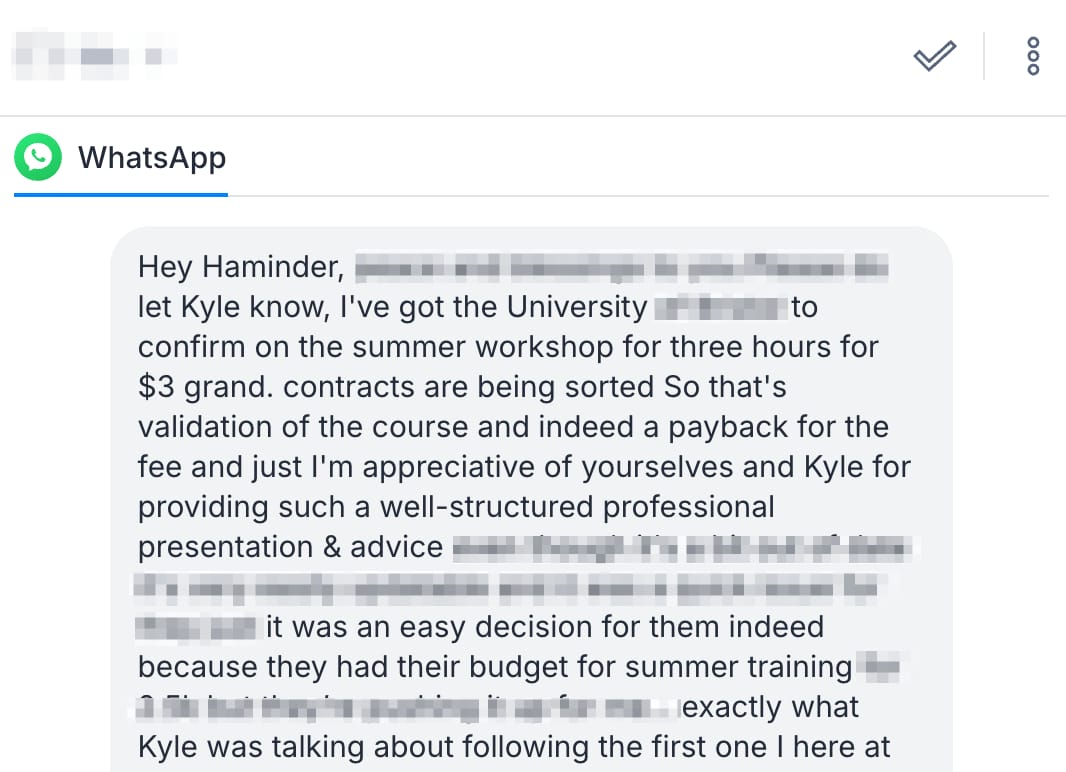
This pricing reflects the value you're delivering—identifying opportunities that could save or generate hundreds of thousands in value…and as such even though it may seem like a lot for you to earn it’s small compared to the value to the client business.
If you want to learn more about licensing my materials there are details here: AI Workshop Kit.
Structure your workshops so that by the end your participants have identified tasks they can apply AI to.
Now, they could go off and do that themselves. But you’ve put in place another next step: you’re going to facilitate those sessions, helping staff members to refine and build their AI automations and workflows.
Here's how it works:
The workshop identifies 3-5 potential AI use cases prioritised by impact and feasibility
Select 1-2 highest potential opportunities for pilot projects
Define small, focused pilot scopes with clear success metrics
Assemble small teams (2-3 people from the affected department plus you)
Set a short timeframe (2-4 weeks) for initial results
These pilots are deliberately small and focused. We want something to show in a few weeks not a few months. Because remember we proving the concept works before asking for larger commitments.
For internal employees: Position yourself as the pilot project lead, with partial time allocation (ie. 10-20% of your time). Document everything meticulously.
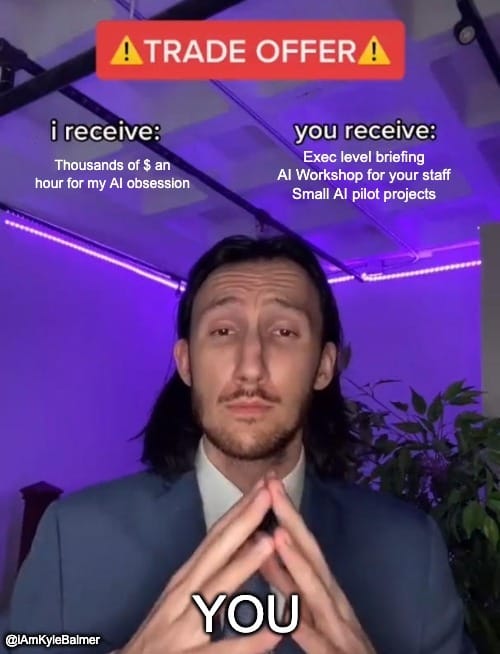
For external consultants: Propose a separate engagement for the pilot phase, typically at a day rate or fixed project fee. £5,000-£10,000 is common for a 2-4 week pilot, depending on scale and industry obviously.
If you're currently employed, here's a powerful dual approach:
Internal leadership: Run workshops within your current company, building your skills and creating documented case studies (with permission)
External opportunity: Assuming your contract permits it, begin offering workshops to companies in non-competing industries during evenings or weekends
This combination approach builds your expertise rapidly while creating an external income stream that could potentially replace your salary. I've seen numerous professionals transition from employee to consultant using exactly this method, with several now earning multiples of their previous salary. Sound crazy but not too difficult when you can charge £1000+/hour really!
The key is delivering exceptional value in your internal workshops first. This builds your confidence, refines your approach, and gives you concrete results to reference when pitching external clients. Use the existing set up as a jumping off board basically. Cheeky? Yup! Effective? You betcha.
We’re at the end of our Executive AI briefing playbook. Let's recap what we've covered:
Part 1: The Massive Opportunity in AI Leadership We explored the leadership gap in AI and why you—with your combination of business knowledge and AI awareness—are perfectly positioned to fill it.
Part 2: Crafting Your Executive Briefing We built the three-act structure that forms the foundation of an effective briefing, with variations for different time constraints.
Part 3: Making the Business Case for AI Adoption We learned how to create a compelling case for AI that balances opportunities and threats while addressing industry-specific needs.
Part 4: Your Killer Example We developed approaches for selecting and presenting concrete examples that make AI's potential tangible and relatable.
Part 5: Closing the Deal We've just explored how to convert initial interest into committed action, with specific strategies for internal and external scenarios.
This is your moment to step forward as an AI leader. The executives you brief today will remember you as the person who helped them navigate this transformative technology. And whether that leads to internal advancement or lucrative consulting opportunities, it represents a significant career advantage in a rapidly evolving landscape.
Go for it. The executives are waiting for someone just like you to help them make sense of this AI revolution. Take your shot.
Keep Prompting,
Kyle
Unlock the transformative potential of artificial intelligence in your business with the '👔 AI Executive Briefing' playbook. This comprehensive guide is designed to equip you with the insights and strategies necessary to bridge the gap between AI technologies and executive decision-making. By mastering the art of the executive briefing, you will empower yourself to become a vital translator of AI capabilities, ensuring that your organization not only survives but thrives in the era of AI. Dive in to discover how you can harness these tools to democratize opportunities and drive impactful change within your company.
This playbook is designed for business professionals, executives, and consultants who are navigating the complexities of AI integration within their organizations. If you're feeling overwhelmed by the rapid advancements in AI and unsure of how to effectively communicate its value to leadership, this playbook will provide you with the clarity and confidence needed to drive meaningful conversations about AI. Whether you are looking to elevate your role within your company or expand your consultancy services, the '👔 AI Executive Briefing' will empower you to lead the AI charge and capitalize on this unprecedented opportunity.
No, you do not need to have a deep technical background in AI. This playbook focuses on practical strategies for communicating AI concepts to executives, making it accessible for professionals from various backgrounds.
The playbook is designed to be flexible. You can start implementing strategies immediately and gradually build your skills over time, fitting the learning into your existing schedule.
The playbook provides techniques for engaging executives and addressing their concerns, helping you build trust and demonstrate the tangible value of AI initiatives.
Absolutely! The insights and techniques outlined will enhance your ability to communicate effectively with leadership, positioning you as an essential resource in your organization.
You will learn how to conduct effective workshops, identify pilot projects, and develop a clear action plan for AI implementation that aligns with your organization's goals.