
AI Business
Unlock the power of AI entrepreneurship with the '📕 AI Entrepreneurship 101 | AI Business Playbook'.
Start ReadingIn this Playbook I’m talking about AI entrepreneurship. This is a concept I’ve been exploring and building out for the last year in my newsletter.
I too often meet two types of people.
On one side seasoned entrepreneurs who are convinced AI is just a passing fad and refuse to even consider how it might impact their industry.
On the flip-side expert AI builders who create fantastic AI applications but have zero idea how to monetise.
These two people illustrate why we're here. One has the tech skills but lacks business acumen, the other has business experience but is blind to the AI revolution.
The real opportunity lies in bridging this gap. This is the crux of AI entrepreneurship: bringing these two worlds together.
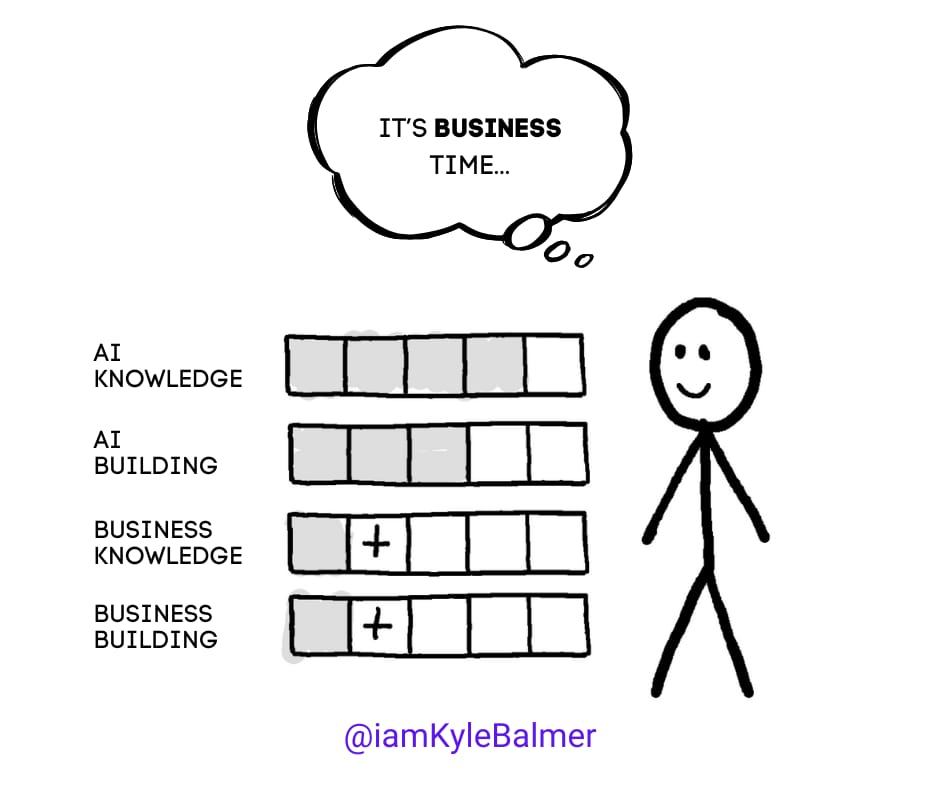
And that's exactly what we're going to do in this Playbook We're going to grow your AI knowledge and business skills in parallel, starting right here with the fundamentals.
Let’s get started:
Speed and volume
The power of speed and volume in AI app development
Build your AI knowledge base
Build your business knowledge base
Translate your AI knowledge for your industry
Let's talk about building your AI knowledge. I'm not saying you need to become the next Alan Turing, but you do need to understand more than the average Joe about AI.
Here's the good news - you don't need a Ph.D. to get started. In fact Ph.D. would probably harm your ability to bridge between AI and entrepreneurship. Don’t believe me? Ask yourself how many university lecturers are millionaires? 😅
There are tons of free resources out there to help you build a solid foundation. I'd recommend starting with the courses on deeplearning.ai. They're free and absolutely brilliant.
Focus on courses like "AI for Everyone" and "Generative AI for Everyone." These will give you a great overview of AI concepts without drowning you in technical jargon.
Remember, the goal here isn't to become an AI developer (unless that's your thing, in which case, go for it!). The goal is to understand AI well enough to spot opportunities and communicate effectively with both techies and business folks.
This is Stage 1. As we progress through the week we’ll talk about developing your AI expertise - specifically into workflows, app building and consultation. But first: the basics!
Now, let's talk business. If you're coming from a tech background, this might be new territory. But trust me, it's just as important as the AI stuff. We need to develop both simultaneously.
Start by brushing up on basic business concepts. Understanding things like market analysis, value propositions, and business models is crucial. There are great resources out there - personally, I'm a fan of the "Personal MBA" by Josh Kaufman. It's a solid primer on business essentials. It’s also free online. I actually have an MBA (and spend $100k+ on it) but still think the Personal MBA is more useful!
I also personally have a framework called BATON (Business, Audience, Tribe, Offer, Network) that I cover extensively elsewhere in Playbooks and full video courses. All my Playbooks cover specific business strategies and so are a great place to start fleshing out entrepreneurial knowledge. You can get them all in Premium.
Here's where things get interesting. You're not just learning about AI and business separately - you're combining them in a way that's specific to your industry.
This is how we’re going to make money. We’re going to focus our skill development on this industry and the problems within it.
We won’t be learning any and all things about AI and entrepreneurship.
Quite the opposite. We’ll be learning what’s relevant and specific to the needs of the industry. And learning by teaching, creating content, building projects, talking to people in the industry etc. It’s all specific.
Start with your own background. Where do you already have experience? Then, start thinking about how AI could be applied there. What problems could it solve? What processes could it optimise?
If you’ve worked in the education industry start here. If in eCommerce start there. If in manufacturing then start there. ALL industries need AI so you can combine your prior experience, contacts and expertise with AI to much more rapidly start to solve problems and build a business.
Your unique value as an AI Foundations Specialist lies in your ability to translate complex AI concepts into practical applications for your chosen industry. This will is your superpower and foundational to the rest of the Playbook.
Let's use a prompt to help identify some potential AI applications in your industry:
You are an AI expert specialising in industry-specific applications. Based on the following industry, suggest 5 practical ways AI could be applied to solve common problems or improve processes:

Industry: [Insert your chosen industry here]

For each suggestion, provide:

1. A brief description of the AI application

2. The specific problem it solves or process it improves

3. The potential impact on the business (e.g., cost savings, efficiency gains, improved customer experience)

4. Any potential challenges or considerations for implementation

Present your response in a clear, easy-to-understand format that a business person without technical AI knowledge could grasp.
Run this prompt with your chosen industry, and you'll have a great starting point for understanding how AI can be applied in your field. This is just a starting point to get you thinking. As we move forward we’ll be identifying real world applications and focusing there.
You’ve got an industry where you’ll be building your business. You’re starting to learn more about AI. Great: that’s a powerful combination already.
But to really kick everything off I want you to start documenting your learning journey. Share insights about AI applications in your industry. Write blog posts, create videos, or start a podcast - whatever format suits you best.
The key is to make it valuable and accessible. Explain AI concepts in simple terms. Share case studies of AI being used effectively in your industry. Offer practical tips for businesses looking to adopt AI.
This content serves two purposes: it helps solidify your own understanding (this is the Feynman method of learning) and it positions you as a go-to expert in your field. It’s a 2 for 1.
This is basically how I build Prompt Entrepreneur. Researching, learning and then documenting everything in newsletter format and short form video.
Do the same but for your specific industry and you’ll be able to capture your niche. There are very few people doing this at the moment so a great opportunity to rapidly build a reputation and audience.
Your capstone mission at this stage of AI Entrepreneurship, should you choose to accept it is to prepare a workshop on AI for your industry. This isn't just a theoretical exercise - you're going to deliver this workshop, either online or in person.
Don't panic! Remember, you're not teaching people how to build AI from scratch. You're introducing them to the possibilities of AI in their industry. You're translating the complex world of AI into practical, actionable insights for your audience.
Here's a basic structure you could follow:
Introduction to AI: What it is, what it isn't, and why it matters for your industry.
Current Applications: Real-world examples of AI being used in your industry.
Future Possibilities: Potential applications that could revolutionise the industry.
Getting Started: Practical first steps for businesses to start exploring AI.
Q&A: Address concerns and answer questions.
I personally deliver workshops for businesses and charge $1000-$4000 a hour. There’s a lot of demand for this, across all industries. If you are interested in licensing my materials and learning how to find clients, tailor and deliver workshops like this then there’s an application process.
Congratulations! You've taken the first step towards becoming an AI entrepreneur. By focusing on building both your AI knowledge and business skills, you're positioning yourself at the forefront of this exciting field.
In the next part, we'll dive into Stage 2: AI Workflow Consultant. We'll explore how to start applying your AI knowledge to optimise business processes and create value for clients.
You are currently on the free plan or trial.
The email you just read is only Part 1 of 5.
Every week I write an AI Business and Entrepreneurship series to help you take advantage and profit from the AI revolution.
And when you join you instantly unlock my entire back catalogue of playbooks.
If you feel this is not for you — Unsubscribe here.
Keep Prompting,
Kyle
Prompt engineering might be the new hawtness but it is not a business.
Prompt Engineering is Necessary but Not Sufficient.
Here's the truth: prompt engineering is a foundational skill in the AI world. It’s how to talk to AI. It's crucial, it's powerful, but it's not a business by itself.
Hell, I have a trademarked prompt engineering framework (RISEN™) framework and even so I’m telling you prompt engineering is just a small part of the puzzle.
Can you sell prompts? Sure, kind of. Lots of people do. But let's be real – a raw prompt collection is a low-quality asset. They are mostly crap. You've probably downloaded a few yourself (and promptly ignored them, pun intended).
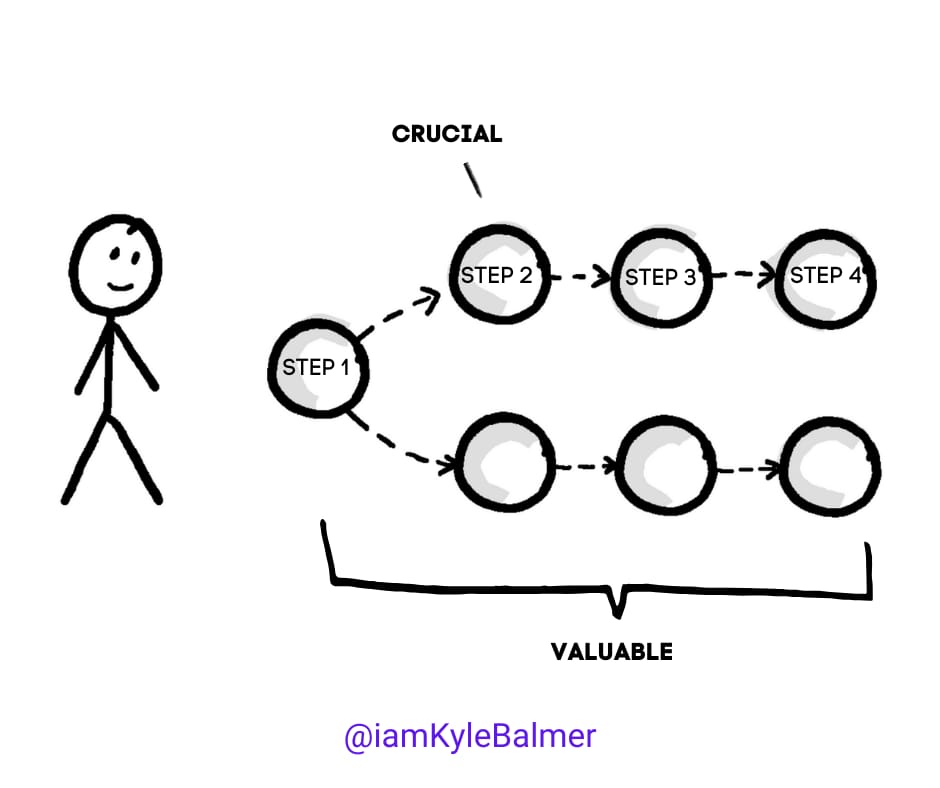
The real value, the place where the rubber hits the road, is in workflows. Specifically, stringing together prompts to help a business DO SOMETHING.
Let’s get started:
Workflow Consultant
Prompt engineering: A foundation, not a business
Identifying automation opportunities in business processes
Developing your AI toolkit for workflow optimisation
Building your consulting brand and attracting clients
Practical challenge: Optimising a real-world business process
Your job as an AI Workflow Consultant breaks down into two crucial stages:
Identify: This is where your business skills shine. Bring your industry knowledge to the table. Find processes that companies want to optimize, areas where they're looking to reduce costs or save time. The key is to systematize what matters, not to automate for the sake of automation.
Implement: This is where your AI skills come into play. Once you've identified the opportunity, you'll use your AI knowledge to create solutions.
Remember that our skills as AI entrepreneurs come from marrying business and AI. This is true here and beyond.
Let's break these down further.
The foundation of great consulting is asking the right questions. To help you get started, here's a prompt to generate a framework for client interviews:
You are an expert business process consultant. Create a framework of questions to ask a client to understand their business needs and identify processes ripe for AI optimisation. The questions should help uncover:

1. Current inefficiencies and pain points
2. Key business objectives
3. Existing workflows and processes
4. Input and output requirements for each process
5. Resource allocation (time, money, personnel)
6. Decision-making bottlenecks
7. Data management challenges

Provide at least 3 questions for each category. Present the questions in a logical order that would flow naturally in a client interview.
Use the output from this prompt as a starting point for your client interviews. Remember, the goal is to understand the inputs, processes, and outputs of their current workflows.
Pay close to attention to suggestions like this:
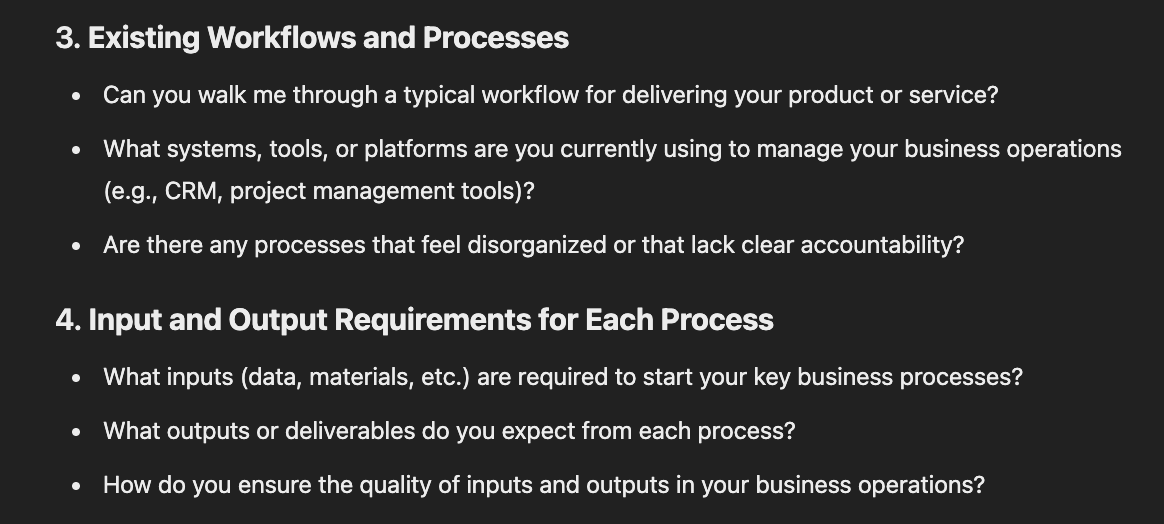
Because you already know your industry (you focused on an industry you already know right? Right?) you can adapt these questions to your industry. You probably already have a fair idea of the problems that can be solved but always (always) ask your customers. We tend to get this part wrong!
When you sit with clients you’ll want to listen and be sketching out what these processes might look like. Then we’ll use this in the next step.
Once you've identified the processes to optimise, it's time to put your AI skills to work. But here's a secret: you don't need to build everything from scratch.
For now, you can do an awful lot with off-the-shelf automation tools like Make (formerly Integromat) and Zapier. The basic idea is to chain prompts and software together to create efficient workflows.
Here’s what a workflow “looks like” in Make for example:
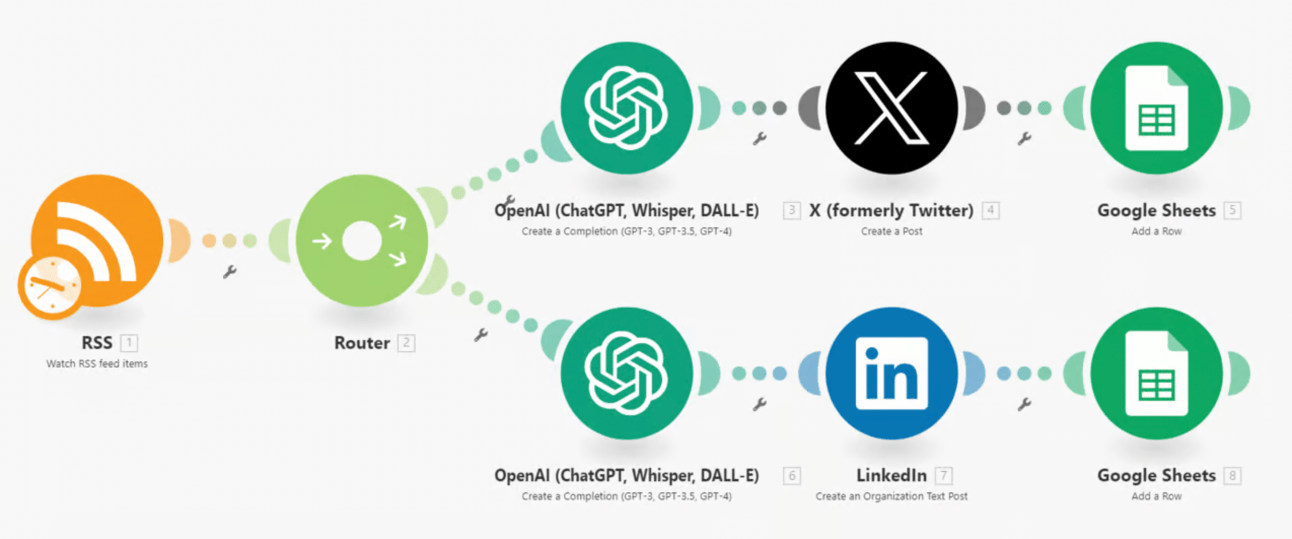
Your job is to identify problems (as above) and translate that into automation workflows like the one above.
The very basic idea here is to take an input, run it through a process (or processes) to create a output. Your success comes from simplifying this flow as much as possible so that an AI can run the workflow.
To help translate client needs into actionable processes, use this prompt:
You are an AI workflow designer. Based on the following customer problem, inputs, and desired outputs, suggest a high-level workflow that uses AI and automation tools to solve the problem:

Customer Problem: [Insert problem here]
Available Inputs: [List available data or resources]
Desired Outputs: [Describe the ideal end result]

Your workflow should:
1. Identify key steps in the process
2. Suggest specific AI tools or models for each step (e.g., GPT for text generation, computer vision for image analysis)
3. Highlight any potential challenges or considerations

Present your response in a clear, step-by-step format that a non-technical business owner could understand.
This prompt will take the customer problem and map out the workflow for you. It’ll do the heavy lifting. We’re using AI to suggest AI processes. Cause we’re smart! 😋
Pro Tip: Zapier has a built-in tool to suggest workflows. Don't reinvent the wheel – use it as a starting point and then customize based on your client's specific needs.
Let’s say that we have a specific input/process/output step like this:
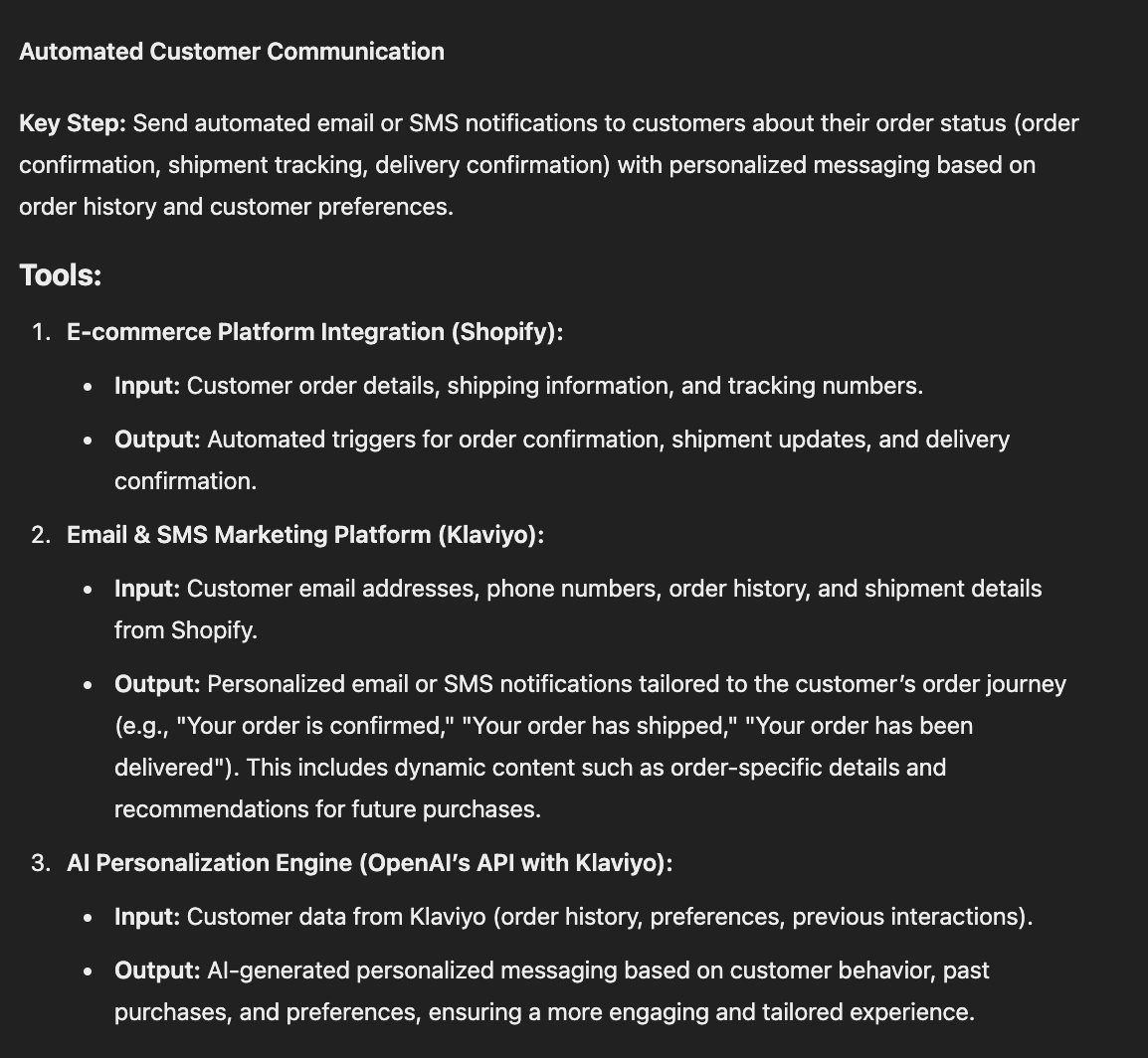
We’d ask our AI to shorten it (less than 400 characters) which gives us:
Automate customer communication by integrating Shopify with Klaviyo for real-time order status updates (confirmation, shipment, delivery). Use OpenAI's API within Klaviyo to generate personalised messages based on order history and customer preferences.
I can now plug that into Zapier’s AI suggestion tool and it builds the workflow for me:
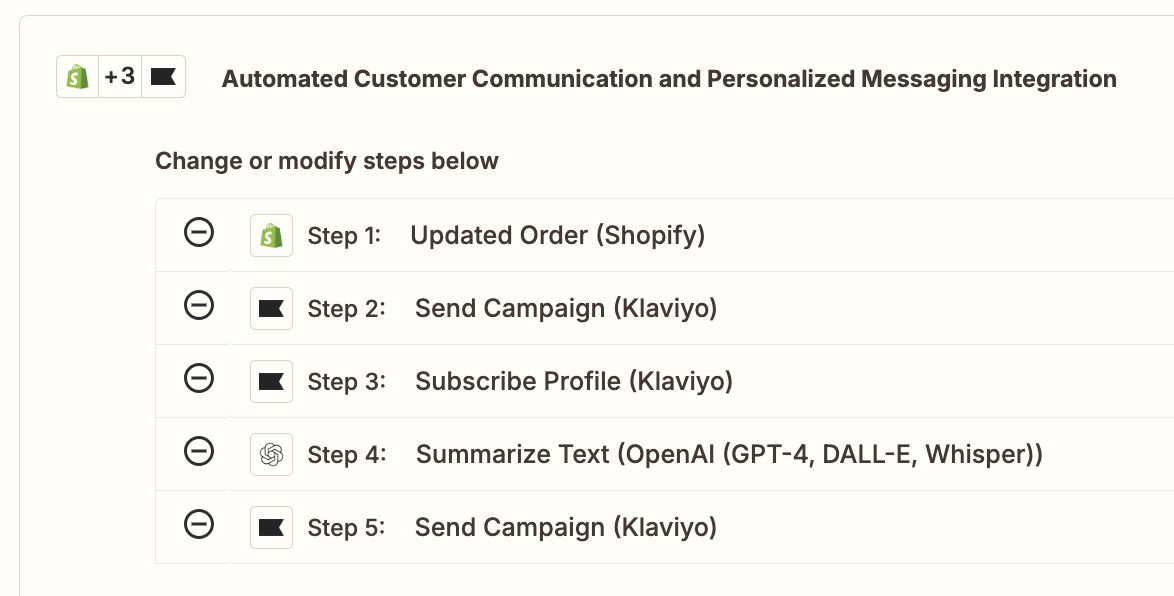
Work from here to refine and then test, test and test more. Still work to be done but we’ve dramatically reduced our workload.
Now that you've got the skills, it's time to showcase them. Your content should demonstrate your ability to solve real business problems with AI workflows.
Try this:
Create case studies of process optimisations (hypothetical or, even better, real)
Write articles comparing different AI tools and automation platforms for specific business tasks
Start a YouTube channel demonstrating AI workflow optimisations
Host webinars on "AI-Powered Efficiency for [industry]: Streamlining Your Business Processes"
Remember, you're not just sharing information now – you're demonstrating expertise and problem-solving skills. People will not just go off and DIY. They’ll instead hire you.
How to get started with all this?
Reach out to a local small business or non-profit
Offer to analyse and optimise one of their processes for free in exchange for you writing and publishing about the process
Document the entire process, from analysis to implementation
Create a case study showcasing the results
Collect a testimonial
Publish it all!!!
This isn't just practice – it's the start of your portfolio. Proven results are key.
In Part 3, we'll dive into Stage 3: AI Builder. We'll explore how to create standalone AI tools that solve specific business problems. This is where you'll start to move beyond off-the-shelf solutions and into custom development.
Remember, every level builds on the last. Your skills in identifying business needs and creating AI workflows will be crucial as you move into building your own AI solutions.
Related Playbooks: Building profitable AI apps, Building AI assistants, Building your AI expert brand, Become an AI Expert, Expert Guide Marketing, Building an AI Power Team, Authentic Selling, Profitable Workshops…and more.
Upgrade today and get them all.
Or access the Vault if you are a premium reader.
Keep Prompting,
Kyle
I’ve been having lots of calls with my students recently, helping them chart a course and giving me more insight into how I can better help them.
A lot of my students are very impressive. Intimidatingly so! We’re talking founders, owners, C-suite and VP level, PhD. and experts in their fields. Amazingly high level people.
They have all identified high leverage uses of AI in their various fields. These are experts who have deep domain knowledge and know the sort of problems that AI could be applied to.
When we talk about what they need to push forward the answers fall into two categories:
Building. How to prepare a solution for their industry.
Marketing. How to get the industry on board and purchasing.
These are the two pillars of AI entrepreneurship we’ve been discussing throughout this Playbook. It was discussions with students that helped me to come up with this dual pillar focus so that makes sense!
In this Part we shift gears again to a new stage.
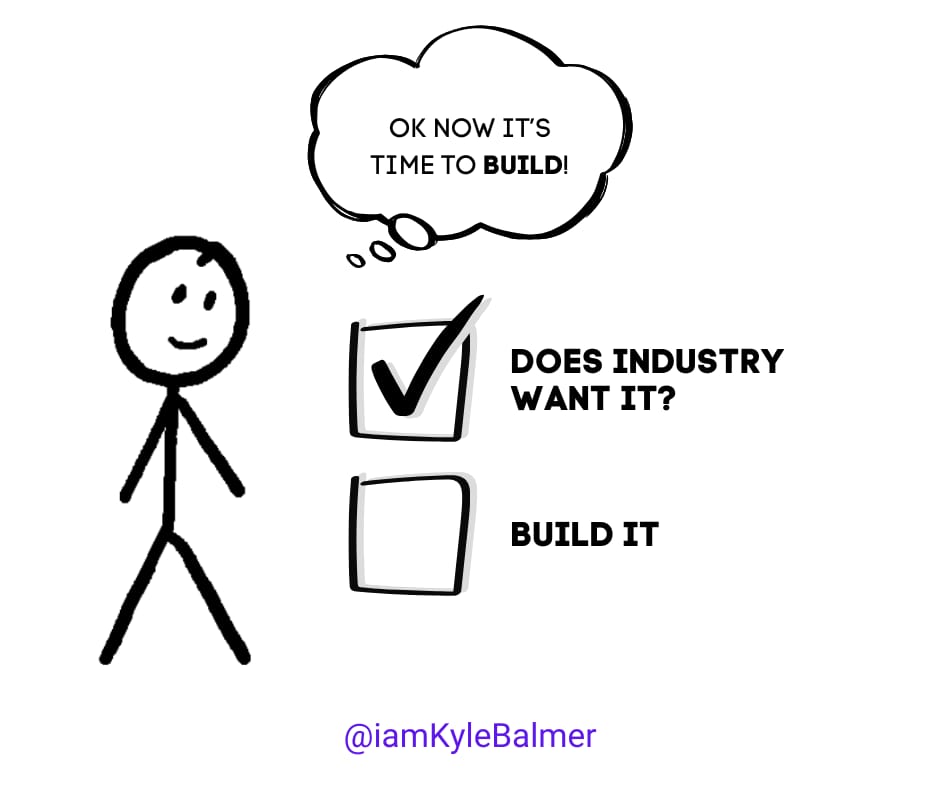
Let’s get started:
AI Builder
The transition from AI workflow consultant to custom AI app builder
Why custom AI apps are sometimes necessary
Business Pillar: Validating and marketing your custom AI app idea
AI Pillar: Choosing the right development approach for your skill level
The importance of balancing market needs with technical capabilities
Previously we talked about AI automation. Sometimes this is insufficient and we need additional sophistication.
There are several reasons why you might need to build a custom AI app:
Integration Limitations: While workflows can connect existing tools, they might not offer the deep integration needed for complex processes. A custom app can provide seamless data flow and user experience.
Performance Requirements: For applications requiring real-time processing or handling massive datasets, a custom solution might be necessary to achieve the required speed and efficiency.
Intellectual Property: Building a custom AI app allows you to create proprietary technology, potentially giving your business a significant competitive advantage. It’s a protectable IP asset.
Security: Some clients just will not want their data being sent through automation flows and want it instead centralised and protected.
Funding: More of an edge case but some countries provide grants/loans for new AI IP being created. A custom deployment is much more likely to be approved for funding than a set of AI automation connected in Zapier!
Building custom AI solutions is the next step if simpler automations are not viable. They are also much more expensive when you charge a client - if automations were in the tens of thousands we are now moving into the hundreds of thousand range.
Now, let's dive into the two pillars when building custom AI apps: the Business Pillar and the AI Pillar.
Before we start building, we need to ensure there's a market for our custom AI app. Again we need to avoid this situation:
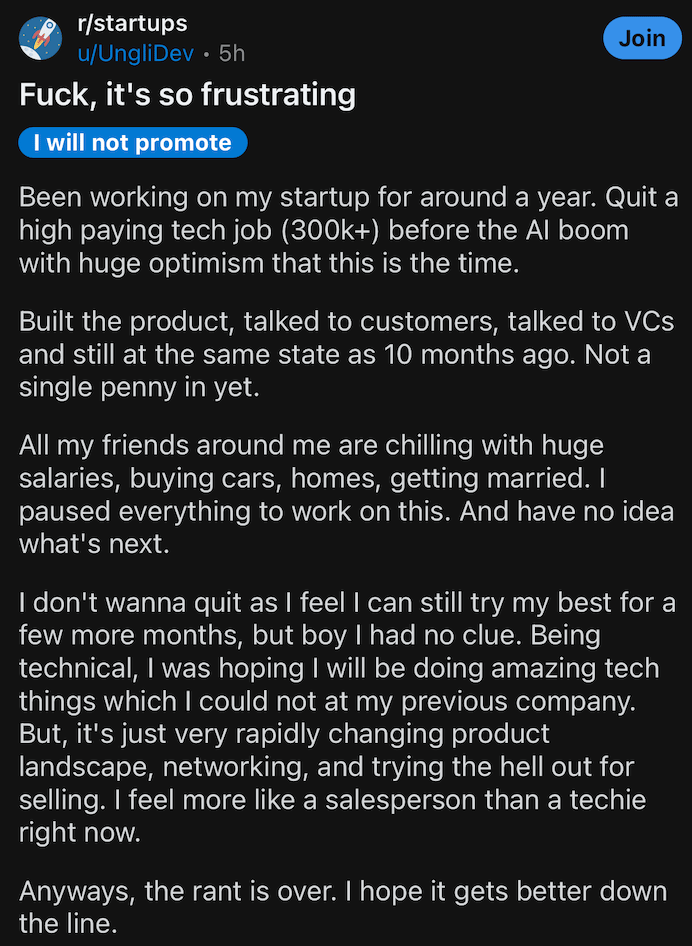
Notice his problem here? “Built the product, talked to customers”.
We have to talk to customers first! Then build what they are telling us they want to buy. I sound like a scratched record on this point - and I won’t apologise!
Ideally you already have a customer lined up. Someone who has (after your workshops and automation work) asked you to help them with something bigger. That’s the ideal.
Still need some ideas? Let’s run this prompt to kickstart:
You are an AI innovation consultant specialising in custom AI applications. Based on the following industry and customer problems, generate ideas for custom AI apps that address these issues.

Industry: [Insert industry here]
Customer Problems: [List 2-3 major problems customers in this industry face]

For each problem, suggest a custom AI app idea. Provide 5 ideas in total. For each idea, include:

1. App Name: A catchy, descriptive name for the AI app.

2. Brief Description: Write a tagline and basic marketing materials I could use to pitch this to people in the industry. A 2-3 sentence explanation of what the app does and how it solves the problem.

3. Key Features: List 3-5 main features of the app.

4. Custom AI Justification: Explain why this needs to be a custom AI solution rather than using existing tools. Choose from and elaborate on 1-2 of the following reasons:
   - Unique problem set
   - Integration limitations
   - Performance requirements
   - Intellectual property creation
   - Scalability needs
   - Regulatory compliance
   - User experience control
   - Data security and privacy
   - Competitive differentiation
   - Complex decision making

5. Potential Impact: Describe the potential impact this app could have on the industry or customer operations.

6. Data Requirements: Briefly outline the type of data this AI would need to function effectively.

7. Possible Challenges: Identify 1-2 potential challenges in developing or implementing this solution.

Present your ideas in a clear, structured format. For each idea, provide a compelling case for why it would be valuable as a custom AI solution in the specified industry.
Use this prompt to get a starting point for your marketing and sales approach.
You need to validate with actual people. Actual customers. AI can’t help you here. Go and talk to people!
Now that we've identified a promising custom AI app idea, it's time to figure out how to build it. The approach you take will depend on the complexity of your app, your current technical skills, and the specific requirements of your solution.
There are several levels of AI app development, each requiring different skills and tools:
No-Code Platforms: Tools like Bubble or LaunchLemonade allow you to build simple AI apps without coding.
Low-Code Platforms: Platforms such as Mendix offer more flexibility with minimal coding required.
AI Development Frameworks: For more complex apps, frameworks like TensorFlow or PyTorch provide powerful tools for building sophisticated AI models.
Custom Development: For highly specialised needs, you might need to build from scratch using programming languages like Python or Java. You can use tools like Cursor to aid you here but will still need to know coding.
To help you determine the most appropriate approach for your app and understand the potential for future development, use this prompt:
You are an AI development strategist specialising in custom AI applications. Based on the following AI app idea, recommend the most suitable development approach and provide a roadmap for potential future enhancements.

AI App Idea: [Insert your app idea here]

Please provide:

1. Recommended Initial Development Approach:
   - Suggest the MOST appropriate method (No-Code, Low-Code, AI Framework, or Custom Development)
   - Explain why this approach is suitable for the current idea
   - List 2-3 specific tools or platforms to consider
   - Outline the basic steps to start development using this approach

2. Skill Development Roadmap:
   - Identify the next level of development sophistication
   - Explain the benefits of this higher level for the app idea IF it's required.
   - List the key skills needed to reach this level
   - Suggest 2-3 resources (courses, books, etc.) for acquiring these skills

Present your response in a clear, structured format that guides the entrepreneur through the current development needs and future possibilities.
This prompt has been designed to identify the level of skill required to tackle your project idea and then also push your development by suggesting the next level.
Remember, the journey from concept to custom AI app is not just about coding or using the right tools. It's about understanding the unique problems in your industry, identifying opportunities where custom AI can make a real difference, and then strategically approaching both the market and the development process.
Got to do both! Do not just build.
Related Playbooks: Building profitable AI apps, Building AI assistants, Building your AI expert brand, Become an AI Expert, Expert Guide Marketing, Building an AI Power Team, Authentic Selling, Profitable Workshops…and more.
Upgrade today and get them all.
Or access the Vault if you are a premium reader.
Keep Prompting,
Kyle
We’re making another step up today - looking at organisational transformation. This is where we take all the knowledge and skills we've built so far and apply them at a higher, more strategic level.
As you collaborate with businesses on AI projects, something exciting happens. The level of engagement naturally deepens. But in a special way unique to AI as a new technology.
It's a two-fold process: the company grows to trust you more, and simultaneously, they begin to trust in AI itself.
This journey isn't instantaneous. Any good leader approaches AI adoption step by step, allowing AI to prove its worth at each stage. As an aside: if anyone hires you to “do AI” for the whole company run for the hills.
Instead it’s a gradual build-up of confidence and capability - in you and AI.
But here's where it gets really exciting: Eventually, the conversation shifts. It's no longer about isolated AI projects. Instead, the topic of a full AI overhaul comes into play.
Let’s get started:
AI Builder
The evolution from AI Builder to AI Business Consultant
Developing comprehensive AI strategies for entire businesses
Navigating enterprise-wide AI transformation challenges
Building your credibility as an AI thought leader
As an AI Business Consultant, your role extends beyond solving individual problems or building specific tools. You're now helping to shape the overall AI strategy for businesses.
You're not just looking at individual processes anymore and devising automations and apps. You're instead examining whole teams, entire functions, even the core business model itself. The question becomes: "What can AI do here?"
And as you already know the answer to that is…quite a lot!
Sometimes, it's about extending existing capabilities. Other times, it's about complete replacement. But always, it's transformative work. You're guiding the organisation, sometimes kicking and screaming, into the AI age.
I love a good matrix.
No not the boring type with Keanu Reeves. The 2×2 squares for decision making. Much more exciting!
To help businesses prioritise their AI transformation efforts, let’s use an AI Impact Matrix.
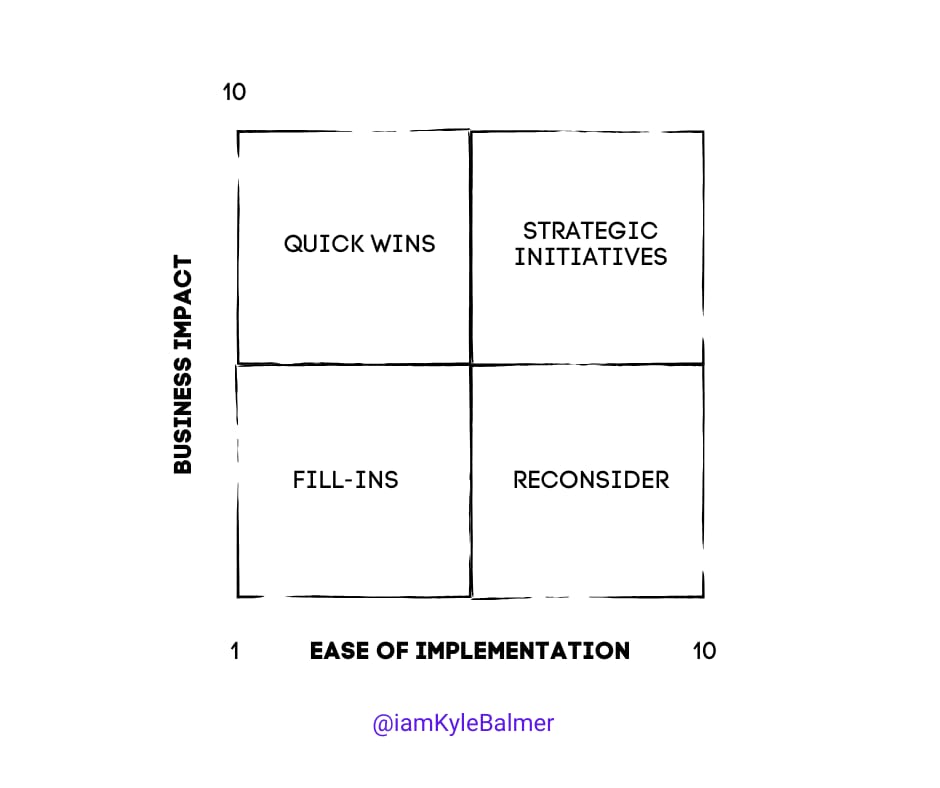
This framework helps organisations assess potential AI initiatives across two key dimensions:
Ease of Implementation: How quickly and easily can the AI solution be implemented?
Business Impact: How significant is the potential impact on the business?
You are going to sit down with their teams and hash this out. Then pull it all together for leadership.
Here's how to use the AI Impact Matrix:
Step 1: Identify Potential AI Initiatives: Brainstorm potential areas where AI could be applied in the organisation. Consider all departments and functions. Let them guide the process as you want to find the task that take up their time and are fit for automation.
Step 2: Score Each Initiative: For each potential AI initiative, assign a score from 1-10 for both Ease of Implementation and Business Impact.
Ease of Implementation factors:
Availability of required data
Complexity of the AI solution needed
Integration with existing systems
Required organisational changes
Regulatory or compliance considerations
etc.
Business Impact factors:
Potential cost savings
Revenue growth opportunities
Customer experience improvement
Competitive advantage
Risk reduction
etc
Do this with management and leadership for a more balanced overview of the business.
Step 3: Plot on the Matrix : Plot each initiative on a 2x2 matrix:
X-axis: Ease of Implementation (1-10)
Y-axis: Business Impact (1-10)
Step 4: Analyze and Prioritize :The matrix will now have four quadrants:
Quick Wins (High Ease, High Impact): Focus here first for rapid results
Strategic Initiatives (Low Ease, High Impact): Plan these for long-term transformation
Fill-Ins (High Ease, Low Impact): Implement these as resources allow
Reconsider (Low Ease, Low Impact): Deprioritise or dump these initiatives
Then feed them everything into this prompt:
You are an AI strategy consultant tasked with developing a prioritized AI transformation plan. Based on the following AI Impact Matrix results, create a phased implementation strategy:

Company: [Insert company name]
Industry: [Insert industry]
Current AI maturity: [Low/Medium/High]

AI Initiatives (provide for each):
1. Initiative Name: [Name]
   Description: [Brief description]
   Ease of Implementation (1-10): [Score]
   Business Impact (1-10): [Score]

2. [Repeat for all initiatives...]

Based on these inputs, please provide:

1. Prioritised Initiative List:
   - Sort initiatives by their combined score (Ease + Impact)
   - Include only initiatives with a combined score of 12 or higher

2. Phased Implementation Plan:
   - Phase 1 (0-6 months): Top 2-3 "Quick Win" initiatives
   - Phase 2 (6-12 months): Next 2-3 highest scoring initiatives
   - Phase 3 (12-24 months): Remaining high-scoring initiatives

3. For each phase, provide:
   - Key objectives
   - Required resources (personnel, technology, budget estimate)
   - Potential challenges and mitigation strategies
   - Success metrics

4. Long-term Vision:
   - Briefly describe how these initiatives will transform the company in 2-3 years

Present your plan in a clear, structured format suitable for executive presentation.
It’s a long form prompt that will (in brief!):
Take in the results of the AI Impact Matrix analysis
Automatically prioritize initiatives based on their combined Ease and Impact scores
Discard low-priority tasks (those with a combined score below 12)
Generate a phased implementation plan focused on the highest-impact, most feasible initiatives
If you're new to AI Business Consulting, you might be wondering: "How do I get transformation clients if I don't have any case studies to show?" It's the classic chicken-and-egg problem.
I’d recommend creating a hypothetical case study that showcases what's possible with AI transformation. Most leaders can’t imagine it and need examples to spark their imagination.
So we can create a mockup case study to kick us off.
Here's how:
Create a Fictional Company: Invent a company in that industry, complete with realistic challenges and goals.
Run the AI Impact Matrix: Use the framework we discussed earlier to identify potential AI initiatives for this fictional company.
Generate a Transformation Plan: Feed the results into our AI strategy prompt to create a comprehensive transformation plan.
Write It Up: Present this as a case study, detailing the process, decisions made, and projected outcomes.
Remember, the goal here isn't to deceive. Be clear that this is a hypothetical case study designed to illustrate the process and potential of AI transformation.
This is all very new to organisations and they just don’t know what’s possible and what’s not. We can use this case study to help them visualise.
In our final Part we'll explore Level 5: AI-Based Business Owner. We'll look at how to transition from consulting to building and running your own AI-powered business.
Related Playbooks: Building profitable AI apps, Building AI assistants, Building your AI expert brand, Become an AI Expert, Expert Guide Marketing, Building an AI Power Team, Authentic Selling, Profitable Workshops…and more.
Upgrade today and get them all.
Or access the Vault if you are a premium reader.
Keep Prompting,
Kyle
You've been crushing it as an AI Business Consultant.
You've been building custom AI solutions for various, let’s say, e-commerce companies, helping them optimise their inventory management and supply chain processes. Something juicy like that.
One day, while working on yet another inventory management system, you have an epiphany. You realise that the core problems you're solving are remarkably similar across different clients. Like…the same damn thing every time.
The AI models you're building, while customised, share a common foundation.
You think, "Why am I rebuilding this wheel for every client? What if I could package this AI solution into a product that any e-commerce business could use?"
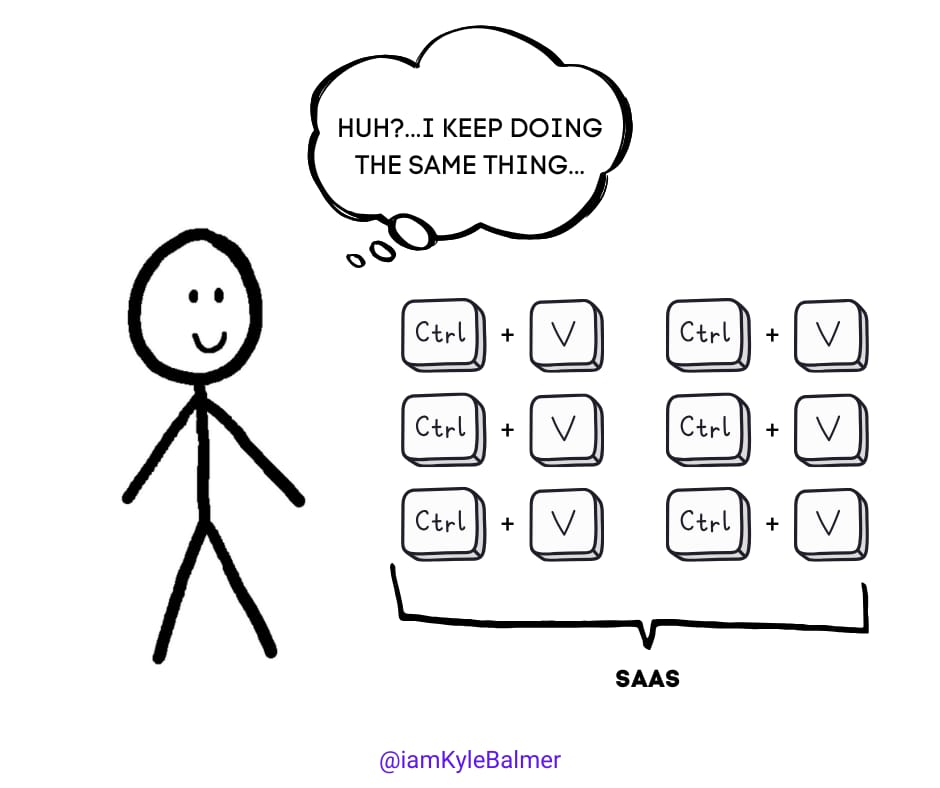
SAAS time!
Let’s get started:
Software as a Service
Verified demand through consulting experience
Transitioning from service to scalable product (SaaS)
Reduced risk due to market understanding
Building a SaaS platform
Marketing your SaaS using the BATON model
By working directly with clients as an educator, automator, implementor and consultant (busy you!), you've already validated that there's a market need for your solution.
You've seen firsthand the problems businesses face and how AI can solve them. You’ve been at the coalface and have intel that very few others have.
You know what the market wants. This reduces the risk of building something that won’t sell.
Transitioning from a service to a SaaS (Software as a Service) allows you to scale your impact. Instead of constantly trading time for money, you're now creating a scalable asset that can serve multiple clients simultaneously.
Never heard of a SaaS? No worries- it's a software distribution model where a provider hosts applications and makes them available to customers online. Instead of installing and maintaining the software, users can access it via the web, paying a subscription fee.
Slack, Dropbox, Canva etc. are all SaaS companies. Probably heard of them!
Starting a SaaS is complex but you’ve solved the biggest problem. As a consultant turned SaaS founder, you've already done the hard work of understanding customer needs and validating your solution.
Now, let's look at the two pillars of building a successful AI-based SaaS business:
Start with a No-Code MVP: Begin with a no-code solution like Bubble. It'll let you validate your idea quickly and cost-effectively before investing in custom development.
Find a Beta Tester: Ideally, build your SaaS with a client who knows it'll become a product. Be transparent about your intentions. They get a custom solution, and you get valuable feedback and a real-world use case.
Scale When Proven: Once your MVP gains traction, consider a custom build. Don't rush into complex development before you've validated your concept.
I've written a comprehensive guide on app development in another Playbook, so refer to that for more detailed information on the building process.
Here’s a prompt for now that will help differentiate:
You are an AI product strategist specialising in SaaS development. Your task is to help prioritise features and determine the level of customisation needed for a new SaaS product. Based on the following information, provide recommendations for feature sets.

Ask the user to provide:
1. Brief description of their SaaS concept
2. Target market
3. List of 5-7 main customer problems their SaaS aims to solve

For each problem listed, ask the user to rate its importance on a scale of 1-10 (10 being most important) and explain why.

After receiving the ratings, ask follow-up questions to help further prioritize the problems. These questions should probe into:
- The frequency of each problem
- The cost (time or money) associated with each problem
- The emotional impact of each problem on customers
- The current solutions available for each problem and their shortcomings

Once you have this information, provide three feature sets for the SaaS:

1. Fully Standardised (No Customisation):
   List core features that solve the highest priority problems without any customisation.

2. Mild Customisation:
   List features from the standardised set, plus 2-3 features that allow for minor customisation.

3. Medium Customisation:
   List features from the mild customisation set, plus 2-3 features that allow for more significant customisation.

For each feature set, provide:
- Estimated development time
- Potential challenges
- Scalability considerations
- Pricing implications

Suggest 3-5 next steps the user should take based on your recommendation.

Ask if there's any part of the analysis they'd like expanded upon.Now that we've mapped out our feature sets, from standardised to custom, it's time to tackle the marketing side of things.
We're going to use my BATON model to create a comprehensive marketing strategy that aligns with our staged approach to product development.
We’ll start with the non-custom version first. This is our lowest price point, our foot in the door. As we expand our custom options, we'll increase our prices, with the top tier being the fully custom service – essentially, the consulting service you were already providing. It just becomes backend offer (at a premium obviously).
Let's break down the BATON model and see how it applies to our staged SaaS release:
B - Business: What core problem does your standardised version solve? How do the custom options expand on this?
A - Audience: Who needs your standardised version right now? How do we reach them?
T - Tribe: How do we capture the attention (and contact details!) of potential customers?
O - Offer: What’s the offer, price, sales strategy?
N - Network: How to expand and increase MRR?
To help you flesh out this strategy, I've created a prompt that will guide you through creating a marketing plan that takes into account both the BATON model and our staged approach to customisation. Here it is:
You are a SaaS marketing strategist specialising in AI-powered products. Your task is to create a comprehensive marketing plan for a SaaS product that will be released in stages, from a standardised version to increasingly customised options.

First, ask the user to provide:
1. Brief description of their SaaS product
2. Target market
3. Key features of the standardised (non-custom) version (or collect from above this prompt)
4. Planned customisation options for future releases
5. Suggested price point for the standardised version
6. Competitor offers and pricing (ask them to copy/paste pricing tables or similar)

Now, create a marketing plan using the BATON model (Business, Audience, Tribe, Offer, Network) that addresses the staged release of the product. For each element of BATON, provide:

1. Business:
   - Value proposition for the standardised version
   - How this value proposition evolves with custom options
   - Positioning strategy against competitors at each stage

2. Audience:
   - Ideal customer profile for the standardised version
   - How this profile changes for custom options
   - Strategies for reaching each audience segment

3. Tribe:
   - Lead capture strategies for initial users
   - Lead nurture strategies


4. Offer:
   - Pricing strategy for the standardised version
   - How to structure pricing for custom options
   - Upselling strategies to move customers from standardised to custom

5. Network:
   - Potential partnerships for the standardised version
   - Integration opportunities that become available with custom options
   - Affiliate or reseller programs for different stages

For each stage of release (standardised, mild customisation, medium customisation, fully custom), provide:

1. Key marketing messages
2. Primary marketing channels
3. Customer acquisition strategies
4. Retention tactics
5. KPIs to track

Finally, provide a high-level timeline for the marketing activities, aligning them with the planned product releases.
Present this information in a clear, structured format that a SaaS founder can easily understand and implement.
This prompt will help you create a marketing strategy that aligns with the staged approach of our SaaS development.
As you work through this prompt, you'll likely find that some of your initial assumptions about your market and product are challenged. That's good! It means you're thinking it through. The prompt and the process are primarily to help you think this all out!
Obviously building and launching a SaaS is a BIG task. But remember that through working with clients and providing them a service you are already leagues ahead of any one else in the market. So take courage!
This has been a big week and not something you can follow along with day to day and implement everything. That’s fine! Consider this a survey overview. Come back to this guide as a reference as you develop your AI expert business.
Related Playbooks: Building profitable AI apps, Building AI assistants, Building your AI expert brand, Become an AI Expert, Expert Guide Marketing, Building an AI Power Team, Authentic Selling, Profitable Workshops…and more.
Upgrade today and get them all.
Or access the Vault if you are a premium reader.
Keep Prompting,
Kyle
Unlock the power of AI entrepreneurship with the '📕 AI Entrepreneurship 101 | AI Business Playbook'. This comprehensive guide is designed to bridge the gap between the tech-savvy innovators and seasoned business professionals. Whether you're an aspiring entrepreneur looking to harness AI for your next big idea or a tech expert unsure of how to monetize your skills, this playbook offers actionable insights, practical strategies, and real-world applications that will elevate your understanding and implementation of AI in the business landscape. Join us on this transformative journey and learn how to leverage AI to create impactful solutions and drive success in your industry.
This playbook is tailored for both budding entrepreneurs eager to enter the AI space and experienced professionals in tech or business sectors who want to integrate AI into their operations. If you're a seasoned entrepreneur skeptical about AI or a tech expert struggling with monetization, this guide addresses your unique challenges. With practical insights and expert advice, you'll gain the confidence and skills needed to thrive in the rapidly evolving AI landscape.
No, this playbook is designed for individuals from all backgrounds. It provides foundational knowledge in AI and business concepts, making it accessible for everyone.
Depending on your pace, you can complete the playbook in a few weeks. The structured approach allows you to learn at your own speed, with actionable exercises to apply your knowledge.
Absolutely! The playbook focuses on practical steps to identify AI opportunities, build a business model, and create a marketing strategy, all essential for launching your own AI venture.
That's great! This playbook will enhance your existing knowledge by providing business strategies and industry-specific applications of AI, helping you bridge the gap between technical and entrepreneurial skills.
Yes, the playbook includes links to valuable resources, recommended courses, and tools that can support your learning and implementation of AI in your business.