
AI playbook
Unlock the potential of AI with the ⚙️ AI Automation Business playbook, your essential guide to transitioning from overwhelmed novice to confident entrepreneur.
Start ReadingOver the past year, I've guided 500+ entrepreneurs through their first AI business projects, and they all start in the same place: overwhelmed by AI possibilities, unsure where to begin, and afraid of choosing the "wrong" thing.
Makes sense. AI entrepreneurship is a HUGE field. Where to begin?
In my eyes there are really three main approaches.
First, you can become known—build an audience, create content, establish expertise. Second, you can build—create tangible solutions like automations, apps and agents that businesses pay for immediately. Third, you can teach—run AI workshops for businesses showing them how to implement tools.
All three are valid paths to fast (and good) cash. They're not mutually exclusive—I actually do all three, and they complement each other brilliantly.
In this Playbook, we're focusing on building. And specifically building automations because they're the fastest to start and give you a tangible product that supports the other approaches.
I'm going to show you why simple automations are your best starting point and how they lead to real revenue faster than any other AI approach.
Let’s get started:
Why AI automations beat flashy projects for new entrepreneurs
The "boring solution" framework that generates immediate revenue
Addressing the elephant in the room: why not start with AI agents?
How simplicity becomes your unfair advantage
Why automations are the perfect entry point to AI entrepreneurship
The most consistently successful AI entrepreneurs don’t start with the most impressive projects. They didn't build sophisticated AI agents or create viral content tools.
They build boring solutions to obvious problems.
One of my earliest students was spending 10 hours each week manually entering leads from web forms into their CRM, then creating personalised follow-up emails. Their first automation? A simple workflow that did exactly that—captured form data, added it to Salesforce, and sent customised responses automatically.
She built it for herself initially and then spun it out as a service for others.
Client willingness to pay: £750/month
Time saved per week: 10 hours
Time to deploy for client: 90 minutes
Was it sexy? Decidedly not!
It was mundane. But valuable. And something that (importantly!) businesses were willing to pay her to implement for them.
Before we go further, let's address what everyone's thinking: "Kyle, why shouldn't I start with AI agents? They're obviously more advanced, more impressive, and potentially more valuable."
Fair question. Here's the reality about AI agents in early 2025.
They're unpredictable. Agents can handle complex scenarios brilliantly—until they encounter something unexpected. And when they go wrong they go really wrong. Then they can fail spectacularly, potentially damaging client relationships.
They're complex to build. Getting an agent to work reliably requires understanding prompt engineering, error handling, and often custom development. That's months of learning before you create value.
They're also hard to justify financially. When an agent costs £5,000-£10,000 to build properly, you need clients with substantial budgets and patience for testing. That’s all well and good but trickier early doors because you don’t have a track record yet.
Compare this to automations: they work consistently every time, they're built using proven tools, they solve immediate pain points, and they generate revenue within days, not months.
Think of agents as the sports car of AI solutions—impressive but impractical for most daily needs. I remember once (unthinkingly) taking a 911 Turbo to Wholefoods and trying to load the stupid thing up with shopping. Doesn’t work.
Automations on the flip-side are the reliable station wagon/ estate car that shows up every day and gets work done.
And guess which one businesses are going to be more willing to pay you for? Automations ftw.
Automations represent the fastest path from idea to revenue in the AI space.
When you automate a manual process, the value is visible from day one. No waiting for "breakthrough" moments or subjective interpretations of success. Automations either work or they don't. There's no grey area, no variables to negotiate, no "but what about this edge case?" discussions.
The financial logic is crystal clear: time saved multiplied by hourly rate equals exact monetary value. I will literally work this out with a client:
“How many hours do you spend on this problem each week? 10? OK cool and what’s the staff member’s hourly rate roughly? £50/hour. OK so that’s 10 hours per week, 40 hours per month at £50/hour which is ~£2000 right?”
We then show them how we can take that work off that staff member’s plate forever.
And the great thing is that every business has repetitive tasks they hate. Even the most exciting sounding businesses have boring busywork.You're not creating a new market—you're solving known problems that already cost money. This is key (and we’ll explore in more in the next Part).
What makes this even better? Starting with automations doesn't limit your future options. It actually enables them. Once you understand what businesses really need (not what you think they need), building AI agents, creating content, or running workshops becomes much much easier—and more profitable. Think of automations as the jumping off point in solving problems using AI. And later we’ll just add in more sophisticated methodology like agents.
Here's the secret that most AI entrepreneurs miss: boring problems are goldmines.
This will be key moving forward. I’m going to help you identify the dullest (and most profitable) problems to solve.
Nothing shiny and exciting.
In fact if you explain you automation to something and they say “wow that sounds really cool!” then we shouldn’t want to do it. Boring is the watchword!
While everyone's chasing sophisticated AI implementations, there's real money in solving the tedious tasks that waste time every single day. Boring → profits.
Simple solutions often command higher prices and generate more revenue than complex ones. Why? Because simple solutions work reliably without supervision, scale effortlessly across teams, require minimal maintenance, and deliver immediate ROI that justifies the cost.
They are also much easier to sell. It becomes a much simpler discussion and a yay/nay. When you can say "This automation will save your team 10 hours per week starting tomorrow," the sale becomes obvious. When you say "This AI might improve your creative process with some training and optimisation," the sale becomes complicated.
We always lean towards simplicity. Even if it’s boring! 😛
The hardest part isn't building automations—it's choosing to start with something simple when infinite possibilities exist.
I’ll be shouting this from the rooftops forever. And y’all still do something overly complex!
So: I’m here to continue to harangue everyone! Simple first, then add complexity if needed.
Remember, automations aren't your final destination in the AI world—they're your entry point. So we start here. For now. Once you've built a few successful automations, you'll have revenue, client relationships, and practical experience that makes every other AI opportunity easier to pursue. But all that cool extra stuff comes later - after the first $ or £ is made.
So we’ll start off by nailing down a specific problem that we are going to solve.
Next up we'll explore how to identify these golden automation opportunities hiding in plain sight within your own industry. I'll show you a framework for extracting valuable problems from your professional experience—the ones you're so familiar with that you don't even recognise them as business opportunities anymore.
Spoiler: your biggest advantage isn't your technical knowledge. It's understanding exactly what drives people in your field absolutely bonkers every single day. That’s a superpower.
Part 1: The Power of Simple Automations - Understanding why simple solutions often win over complex AI projects, why automations beat agents as a starting point, and the secret value in "boring" solutions that generate immediate revenue.
Part 2: Your Industry Expertise is Gold - How your existing knowledge of your field's pain points gives you an unfair advantage, plus a framework for extracting profitable automation ideas from your professional experience.
Part 3: From Problem to Working Blueprint - Using AI to transform messy business problems into clear automation designs, avoiding common over engineering pitfalls that kill first projects.
Part 4: Tool Selection: Starting Smart - Cutting through the noise on Zapier vs Make vs n8n, why we recommend beginning with the simplest option, and when to consider upgrading your tools.
Part 5: Scaling Your Automation Business - How to evolve from single automations to complete solution suites, strategic pricing for packages, and knowing when to add technical complexity.
Keep Prompting,
Kyle
Some people struggle to see the treasure right in front of their eyes.
Here’s a powerful question.
"What's the most annoying part of your job?"
When asked this most people (understandably) vent:
"God, where do I start? I spend 8 hours a week copying client meeting notes into our CRM. Then there's the compliance reports where I have to gather data from five different systems. And don't get me started on creating those custom portfolio summaries for each client..."
THESE are the sort of problems we should be fixing with AI automation.
People think automation means building something revolutionary when the most profitable solutions are hiding in their daily irritations.
Because guess what - if you have these problems then hundreds, nay, thousands of other people do.
Your industry expertise isn't just helpful for building automations—it's your secret weapon. This is what gives you the edge. While others struggle to understand business problems from the outside, you already know exactly where the pain points are and what they cost. And this is invaluable.
Let’s get started:
Why your industry frustrations are automation goldmines
The "boring problem discovery" framework that finds hidden revenue
Identifying repetitive tasks with clear inputs and outputs
How to spot costly problems others can't see
The interview technique that extracts insights from your experience
Every time you think "I hate doing this" or "there's got to be a better way," you've identified a potential automation.
But we become blind to our own problems. The tasks that drain our time become so routine that we stop noticing them. That's like a fish asking "what water?" We swim in these inefficiencies daily without recognising them as business opportunities.
The longer you put up with these annoyances the less you notice them. But they are still annoying!
The examples I gave above might be tens or hundreds of thousands worth of annual automation opportunities. We just might not recognise them as such because they aren’t "AI problems"—they are just our daily problems.
This is your unfair advantage over generic automation builders: you don't need to research or guess at problems. You live them. You know exactly how much time they waste, what they cost, and who makes the buying decisions.
BUT … we need to extract them from you. Because you may be inured to them by now.
So what are we looking for?
When hunting for automation opportunities in your industry, focus on tasks that are:
Repetitive without being creative. You want processes you do the same way every time, not tasks requiring judgment or creativity. Copying data between systems? Perfect. Negotiating a custom deal with a client? Maybe not yet.
Time-consuming but not complex. If it takes hours but follows clear rules, it's automation gold. If it requires expertise that changes based on context, save it for later. We like simple!
Costly in terms of human time. Look for tasks where someone's valuable expertise is being wasted on manual work. An accountant doing data entry is expensive data entry. Their time should be used elsewhere on more productive tasks and the mundane automated.
Clear input, process, output. The best automations have obvious triggers (ie. form submission), defined processes (ie. validate and format), and specific outcomes (ie. create record and send email).
Here's a prompt that will use the interview method to extract this information from you:
You are a business efficiency consultant specialising in finding high-value automation opportunities. Interview me to extract specific problems from my professional experience, focusing on the most boring, repetitive tasks that waste expensive time.

Focus on identifying problems that are:
- Repetitive without being creative
- Time-consuming but not complex
- Costly in terms of human expertise being wasted on manual work
- Have clear input, process, and output steps

Ask questions one at a time, focusing on:
- Tasks I do repeatedly that take 30+ minutes each time
- Information I move between different systems or formats
- Processes where I do the same thing every time without variation
- Work that requires no creative input but wastes my expensive time
- Situations where small errors cost time but aren't critical

For each problem identified, help me estimate:
- Time spent per week
- Number of people affected
- Clear trigger points and predictable outcomes
- Whether this follows the same pattern each time

Begin by asking about my industry and role, then dig into those tedious processes that make me groan every time they appear on my to-do list.
Take 30 minutes to run through that interview prompt. Don't edit yourself—just capture every frustrating process you can think of. The purpose is to create a long list at this point.
Now we want to take our long list and slash and burn it. We’ll do a first rough pass removing any of these red flags:
The "nice to have" trap. If people tolerate the current process without major complaint, they probably won't pay much to automate it. Look for problems that genuinely cost significant time or money.
The "already solved" market. Avoid problems with 10 existing solutions unless you have a dramatically different approach. Competition isn't necessarily bad, but saturation is. For our first automation at least let’s find something relatively unique.
The "every instance is unique" challenge. Tasks where each case requires different handling are tough to automate. Focus on standardised processes with predictable variations.
The "requires human judgment" barrier. Automations excel at following rules, not making decisions. Save the complex judgment calls for later projects. We can add steps into our automation that ask for human intervention but again it’s additional complexity we don’t need right now.
Once you’ve removed the easy duds we should have a much shorter list. Now we want to more carefully analyse through six critical lenses.
Make a sheet a grade each problem on these areas:
Time Impact: Don't underestimate this. That "quick" task you do three times a week? If it takes an hour each time, you're looking at 150+ hours annually. Scale that across a department and suddenly you're talking about thousands in labor costs.
Financial Impact: Think beyond just time. What about the downstream effects? Delayed responses to clients, missed deadlines, errors from manual data entry—these cost real money. A single data entry mistake can easily cost more than an entire automation solution.
Market Size: This determines if you're building a one-off solution or a scalable business. Is this a problem specific to accounting firms with 10-50 employees? Or do all service businesses struggle with this? The more universal the problem, the bigger your potential market.
Technical Feasibility: Ask yourself: can this be broken down into trigger, simple AI processing, and output? If you're thinking about multiple decision points, exceptions, and custom rules—that's probably too complex for your first automation. Look for the straightforward paths first.
Competitive Landscape: Existing solutions aren't necessarily bad—they validate demand. The key question is: what's missing? Are current solutions too complex? Too expensive? Don't handle your specific industry's needs? These gaps are your opportunities.
Sellability: The easier it is to demonstrate value, the easier it is to sell. "This saves 8 hours weekly" is more sellable than "This optimises your workflow." Concrete, measurable benefits close deals.
Use these six factors to rank your problems. The winners? High time and financial impact, clear technical feasibility, and obvious sellability. Market size determines if you start with custom solutions or aim for a productised service.
FYI: I go into this in more depth in the AI Automation Accelerator (as well as providing analyse prompts) but this will get you started along the right track.
Next up we'll take these identified problems and transform them into specific automation blueprints.
I'll show you how to use AI to design clear workflows without overcomplicating things—the difference between products that actually get built and just another idea stuck on a to-do list.
Keep Prompting,
Kyle
I often get sent AI tools and automations that people want me to test out and give feedback.
Initially I was flattered to be asked! Kinda cool.
But after 10 or so (yeah, I’m slow) I noticed a pattern.
Far too often what I was being shown just didn’t work.
And didn’t work in a very specific way: the core functionality wasn’t good enough.
I’ll be shown a tool and told about the 15-20 amazing things it can do. But it does all 15-20 things in a substandard manner.
This is peak automation startup syndrome. People breed many-headed beasts.
The core functionality is completely broken, but instead of fixing what matters, they're busy adding more features on top. As if somehow accumulating enough half-baked capabilities will magically solve the fundamental execution problems.
The result? Tools that promise everything and deliver nothing reliably. This is lesson one in building automations that actually work: nail the basics before you even think about expansion.
Let’s get started:
Why feature creep kills more automations than technical limitations
Understanding where AI belongs in your automation (hint: it's specific)
The deterministic vs probabilistic choice that changes everything
Using AI to design focused, working blueprints
Validation questions that force simplicity
Feature creep isn't just an annoyance—it's the primary killer of automation projects.
I've watched talented entrepreneurs spend months building elaborate solutions that never quite work. Always on the edge of brilliance but not in a way that can practically be used by a business.
This pattern extends far beyond individual automation projects. The AI startup landscape is littered with companies that followed this exact trajectory. Go onto one the AI tool directories to behold a graveyard of good intentions and poor execution.
They start with a promising core concept, then begin adding features faster than they can stabilise them. The result? Platforms that feel impressive during (highly staged!) demos but fail in real-world usage.
You've probably experienced this: signing up for an AI tool that promises to revolutionise your workflow, only to discover it can't consistently handle the basic task you actually need. Meanwhile, the company's roadmap shows plans for ten more features nobody asked for.
You hopefully manage to cancel before the free trial is up!
The antidote is brutal focus. Your first automation shouldn't be able to juggle seventeen tasks. It should perform one specific function so reliably that people forget they ever did it manually. That is what businesses will pay you for.
Before we get into the complexity of where AI fits, let's establish the fundamental structure every automation follows. It's beautifully simple:
Trigger → Process → Result
That's it. Three steps. Every automation you build, whether it's basic or AI-powered, follows this exact pattern.
Trigger: Something happens that kicks off your automation. An email arrives, a form is submitted, a deadline approaches, or data changes in a spreadsheet.
Process: “Something” gets done in response to that trigger. This might be checking information, making calculations, sending messages, or asking AI to analyze and create content.
Result: Something specific happens as output. A record gets created, an email gets sent, a document gets generated, or a team gets notified.
Think of it like a domino effect: the first piece falls (trigger), which causes the middle pieces to fall in sequence (process), leading to a final piece falling exactly where you want it (result).
From here there are levels of complexity:
maybe multiple triggers need to align
the process itself could be multi-partite, conditional and branching to huge levels of complexity
results could be sent to multiple places simultaneously
etc. etc
But at its core everything starts with a simple trigger, process, result.
This framework forces clarity. If you can't clearly define all three components, your automation is probably too complex or too vague to build reliably.
Here's the crucial insight most people miss: not every step in an automation needs AI.
In fact, most shouldn't.
Shock horror!
The structure of an AI automation is trigger → AI process → result.
Notice AI sits in the middle—it doesn't handle triggers (those are deterministic), and it shouldn't format final outputs (those need to be consistent).
AI belongs in the process step when you need something probabilistic rather than deterministic. If your task involves understanding context, generating human-like text, or making educated guesses based on patterns, that's where AI shines.
But here's what makes this counterintuitive: if something can be done without AI, you probably shouldn't use AI for it.
Why? Because AI is fundamentally probabilistic, not deterministic.
It's going to be creative when you need consistency.
It's going to interpret when you need calculation.This creative unpredictability—AI's greatest strength for complex tasks—becomes a liability for simple ones.
Examples of when NOT to use AI in your automation:
Extracting structured data from forms (use standard parsing)
Simple calculations (use built-in functions)
Exact date/time operations (use system tools)
Formatting outputs to specifications (use templates)
Examples of when you DO need AI:
Understanding natural language enquiries
Writing personalised responses
Categorising ambiguous content
Generating human-like communications
So, again for those at the back: if something can be done without AI it should be done without AI!
OK let’s pull this all into an automation blueprint for you. We’re going to take ONE question from the last Part and feed it into this prompt:
You are an automation designer specialising in practical, minimal AI workflows for Zapier. Create a blueprint for a simple automation that solves one specific problem.

Problem to solve: [Your problem statement]

Provide:
1. Single trigger event (exact Zapier trigger)
2. Minimal AI process (specific task for ChatGPT/Claude)
3. Exact output format and destination

Design this for maximum simplicity - identify any steps that don't actually need AI and suggest standard Zapier actions instead. Address these validation questions in your design:
- Does this solve ONE clear pain point?
- Is the trigger concrete and specific?
- Is AI truly necessary for this process?
- Would someone pay just for this function?
- Can this be tested quickly?

Keep this as the absolute minimum viable automation.
This prompt creates a concrete blueprint that we can start to build from. Notice it talks about Zapier - we’ll address this shortly. For now just use the prompt to get your blueprint in play.
If you find yourself looking at the output and thinking it looks too simple that’s a GOOD thing. Here are a couple of things to watch out for - some mistakes to preempt.
The "While I'm At It" Syndrome: Since you're building an automation anyway, why not add just one more feature? This is how simple email automation becomes an entire CRM replacement that doesn't work properly.
The Creative AI Problem: Asking AI to handle deterministic tasks because "it's more intelligent." AI interpreting your invoice numbers differently each time isn't intelligence—it's a limitation of AI!
The Perfect Path Fallacy: Trying to account for every possible scenario from day one. Build for the 80% case first, then iterate when you find the actual edge cases.
Remember, your first automation is proof of concept, not production software. It should work reliably for its core function, not attempt to revolutionise how business gets done. And once we have the basics working we can build from there!
Next up we'll tackle tool selections - specifically why starting with Zapier (despite its limitations) often makes more sense than jumping to more powerful platforms. I'll share the exact thought process for choosing between Zapier, Make, and n8n, plus when each tool makes sense based on your current skill level and project complexity.
Keep Prompting,
Kyle
People often want to argue (online, who’d have thought it??) with me about which automation tool is "best."
They'll list feature comparisons, pricing tiers, integration capabilities, and technical limitations. They expect me to engage, to take a side, to defend positions.
But I don't care.
I mean, I do care about helping people succeed. Don’t get me wrong.
But which tool they use? Zapier, Make, n8n? They're all fine. They all work. They are all, on the whole, very good!
Unless one of you wants to strike up a brand partnership … then obviously yours is the best! 😛
But for real, you can build and deploy a valuable AI automation for a business using many tools.
What I actually care about is that they pick one and start building something.
People spending weeks researching tools while others just grab Zapier and are already generating revenue. The perfect tool setup is just procrastination wearing a research hat.
Let’s get started:
Why tool selection becomes the ultimate procrastination trap
Starting with Zapier: the "boring" choice that actually works
Quick tool overview without the analysis paralysis
Why switching costs are overblown
How to pick your tool in the next 5 minutes and get building
Research feels productive. You're learning, comparing, making informed decisions. It's the kind of work that looks responsible, professional, measured.
Like a real adult!
It's also the perfect way to avoid actually doing anything.
I've watched people spend more time creating comparison spreadsheets than it would take to build three working automations. They'll join forums, watch YouTube reviews, test free trials—anything except starting to solve a real problem.
Here's the truth: any of the major automation tools can handle your first project. They're all capable enough to prove whether your automation idea has value. The differences that seem massive when you're researching become trivial once you're actually building.
You’ll probably end up kicking the tyres on all the main tools anyway. So just start with one and we’ll worry about the rest later alright?
Which to start with? Well…the subheading just below is probably a give away here!
(If you want to move from procrastination to building, the AI Automation Accelerator is for you).
I recommend people start with Zapier for one simple reason: it's the least intimidating option.
Yes, it's more expensive than alternatives once you scale. Yes, it’s not open-source. Yes, it has limitations for complex workflows. Yes, power users eventually outgrow it.
And none of that matters for your first automation!
Zapier has the lowest learning curve. The interface is simple, almost childlike. Dumb-dumbs like me can use it!
The free tier gives you enough to test basic concepts. The community is massive—if you get stuck, there's probably already a forum thread about your exact problem.
Most importantly, Zapier removes the excuse that the tool is too complicated. When your automation doesn't work, you can't blame the platform. You need to fix your logic, your prompt, or your process.
Think of Zapier as training wheels. Yes, you'll eventually want a real bike. But first, you need to learn how to ride without falling over the handlebars.
Fun fact: I, despite the saying “just like riding a bike, you’ll never forget”, managed to forget how to ride a bike. Learned as a young child. Didn’t cycle for years. And had to relearn as an older child. See…dumb dumb! I can use Zapier and so can you!
Since you're determined to know your options, here's the ultra-condensed version:
Zapier: The gateway drug to automation. Point-and-click simple, drag-and-drop workflows. Expensive at scale but perfect for learning. My recommendation for you to start right now
Make: More powerful, more complex. Better pricing once you're doing serious volume. Visual workflow builder that's cleverer than Zapier but requires more thinking. Choose this when Zapier costs are hurting or you need more sophisticated logic. I actually use this as my workhorse but that’s after using Zapier for years. And I still use Zapier for any more basic work.
n8n: The developer's choice. Open source, self-hosted option. The “sexy” one, especially as it’s more agentic. Most flexible but needs technical comfort. Pick this when you're ready to run your own infrastructure and want complete control. Do NOT go straight to this.
There. You now know enough to make a decision. And it’s Zapier 🤣
"But what if I choose wrong and need to switch later?"
You probably will! And that’s fine. LATER.
This fear keeps people stuck in analysis paralysis. The truth? Moving automations between tools is easier than most people think.
Your automation's logic—the trigger, process, result framework we covered yesterday—remains the same regardless of platform. The underlying business problem doesn't change. You're just rebuilding the same solution with different building blocks.
Plus ultimately you'll learn what you actually need by building, not by researching. The features you think are essential often aren't. The limitations you worry about usually don't matter for your first projects. To quote Rabbie Burns: “The best-laid schemes o' mice and men Gang aft agley”.
Start simple, build something that works, then upgrade based on real constraints, not imagined problems.
I'm giving you exactly 5 minutes to choose your tool.
Not 5 hours. Not 5 days. Five minutes.
Right now, ask yourself:
Do I want the simplest option? → Zapier
Do I need better pricing and can handle some complexity? → Make
Am I comfortable with technical tools and want maximum control? → n8n
That's it. decision made. Cool.
Don't overthink it. Don't create comparison charts. Don't watch more YouTube videos. These tools all work. They all connect to the major apps you need. They all have free tiers to get started.
The only wrong choice is no choice.
You’ve now got an idea for an automation. One that you can sell.
You have broken that automation idea into distinct trigger, process and results.
And you’ve now chosen a tool.
Now you might wonder: "How exactly do I build this thing?"
The step-by-step technical process of building automations is more detailed than I can cover in this series. The good news? You don't need to figure it out alone.
My colleague Nat (@brandnat) and I run the AI Automation Accelerator, a focused 2-week program that takes you from complete beginner to having a launch-ready automation product.
Nat specializes in the technical building side using Zapier—she'll literally walk you through creating your first automation day by day. You can find details of the Automation Accelerator here.
But whether you go that route or learn another way, the key principle remains: start building immediately. Don't wait until you feel ready. You'll learn more in 2 hours of building than 2 months of researching. For real.
In the next Part we'll wrap up our series by looking at scaling—how to evolve from single automations to complete solution packages that command premium prices. I'll share real examples of how one simple automation can grow into a comprehensive service worth thousands of pounds.
How do we go from a single Zapier automation to a business basically!
Keep Prompting,
Kyle
The classic entrepreneur’s dilemma. One I’ve fallen into many times over the years.
A single product or service—even a successful one—doesn't constitute a business.
It's a starting point, a platform from which to build something larger and more sustainable. One successful automation is a proof point, not the endgame.
But on the other hand, entrepreneurs too often “scale” by jumping into completely new markets, creating unrelated products, or chasing exciting new technologies.
Doing something new and shiny rather than building methodically on what's already working.
Sounds familiar?
This is the balancing act every successful entrepreneur must master: recognising that your first success is but the foundation for something bigger, while also understanding that real growth comes from evolving what works rather than constantly starting from scratch.
Let’s get started:
Evolution, not revolution
Upstream/downstream/parallel framework
When (and when not) to graduate from simpler tools
Creating packages
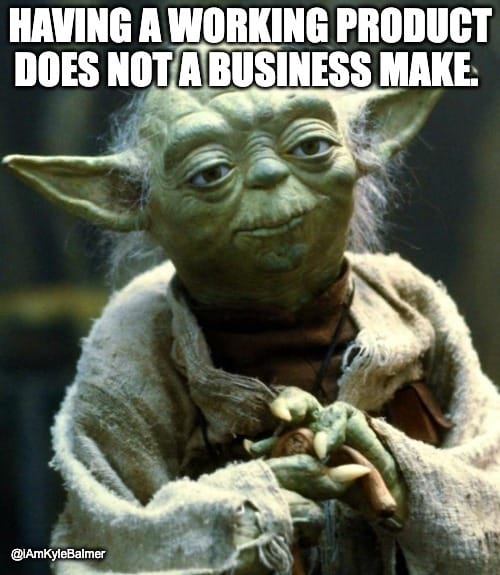
Having a working product does not a business make.
It’s an awesome starting point for sure. Indeed it’s the required first step. But once we get there we need to know the next step.
Most automation builders never evolve beyond the "freelancer with a product" stage.
They build something useful, sell it a few times, then immediately jump to something completely different—chasing the excitement of new creation rather than the discipline of systematic growth.
I get it. I’m like this. I want to move to the next cool thing. I want to create.
This is also why so many talented people end up with a collection of half-developed products instead of a thriving business. The secret to scaling isn't constant reinvention. That’s introducing too much (unnecessary) risk. Instead it's about methodical evolution around what already works.
Evolve, don’t revolve! Wait…no…not quite.
Successful businesses grow through iteration, not constant reinvention. Reinvention is a risky move. And it’ll go wrong most of the time.
Instead successful companies find one thing that works, then build around it—expanding capabilities, reaching adjacent markets, and creating complementary offerings.
Amazon provides the perfect example of this approach. They couldn't have become "the everything store" without first mastering one category: books

Do the boring stuff before launching Katy Perry into space. It’s better business.
Amazon focused relentlessly on books until they perfected their model, then methodically expanded to adjacent categories. They duplicated a working mechanism onto other market areas knowing that their sourcing, storage and logistics were on lock.
Contrast this with Borders, a traditional bookseller who was on the other side of Amazon’s rapid growth.
I knew Borders was done for when I walked into one of their stores and found that most of the floor space wasn't even devoted to books. It was toys, games, puzzles, bags, snow- globes, you name it —a mishmash of unrelated products.
Year after year the space dedicated to books dwindled. Even though they were meant to be a bookseller. Something smells.
They weren't expanding their offerings from a place of strength; they were desperately adding categories because their underlying model wasn't working. They were drowning.
Both Amazon and Borders started as booksellers. And both expanded their product range. But they did so for different reasons. Amazon from a place of security and sustainable growth. Borders from a place of panic.
We want to be like the bald man.
One successful automation can indeed become the foundation for an entire business ecosystem. But here's the critical part: that first automation has to actually work! It needs to genuinely solve a problem, generate real value, and have paying customers before you even think about scaling.
If you haven’t got there yet don’t start adding crap hoping it’ll right the ship. It’ll just sink you faster.
Alright, so once you've got that working first automation, there are three natural directions for expansion. Let's explore each one in detail.
Upstream expansion focuses on what happens before your current automation. It's about capturing the inputs that feed into your existing system.
Examples of Upstream Expansion:
If you've automated email responses, consider automating email categorisation
If you're automating report generation, look at intake form processing
If you've built a social media posting tool, consider content creation automation
This type of expansion captures more of the overall workflow and eliminates manual steps that precede your current automation. It's like extending a production line backward to include earlier stages of manufacturing.
Prompt for Upstream Brainstorming:
You are an automation strategy consultant. Help me identify potential upstream expansion opportunities for my existing automation.

My current automation: [Describe your core automation]

Please identify:
1. What inputs currently feed into this automation?
2. Who creates or manages these inputs currently?
3. What manual steps occur before my automation kicks in?
4. What processes could be automated to provide cleaner/better inputs?
5. Which of these upstream processes would create the most value if automated?
Downstream expansion addresses what happens after your current automation completes. It's about extending your impact further along the workflow.
Examples of Downstream Expansion:
If you're automating lead capture, consider lead nurturing automation
If you're automating content distribution, look at content reporting
If you've built an invoice generator, consider payment reminders and reconciliation
Downstream expansion ensures the value created by your initial automation isn't lost in subsequent manual processes. It also allows you to capture more of the value chain.
Prompt for Downstream Brainstorming:
You are an automation strategy consultant. Help me identify potential downstream expansion opportunities for my existing automation.

My current automation: [Describe your core automation]

Please identify:
1. What happens with the outputs from my current automation?
2. Where do these outputs go, and who handles them?
3. What decisions or actions are taken based on these outputs?
4. What manual follow-up processes could be automated?
5. Which downstream processes would save the most time/money if automated?
Parallel expansion looks for similar processes alongside your current automation. This is often the most profitable expansion route because it leverages your existing work with minimal changes.
Examples of Parallel Expansion:
If you're handling Instagram post scheduling, expand to Facebook and LinkedIn
If you're automating email outreach for sales, adapt for customer service
If you've built a Salesforce CRM integration, replicate for Pipedrive or HubSpot
The beauty of parallel expansion is that you can often take the exact same automation sequence and replicate it for other ecosystems. For example, if you've built a Salesforce integration that works beautifully, you can essentially copy-paste that workflow and adapt it for Pipedrive or HubSpot, instantly opening your product to customers who use different CRMs.
You know it’ll be valuable to them because it’s a proven automation. But they just happen to use a different ecosystem so were not part of your initial market. But duplicating into other ecosystems
This type of expansion gives you the highest return on your initial investment. You're leveraging the exact same logic, the same prompts, the same basic structure—just applying it to different platforms or ecosystems. It's the closest thing to "free money" in the automation world.
Prompt for Parallel Brainstorming:
You are an automation strategy consultant. Help me identify potential parallel expansion opportunities for my existing automation.

My current automation: [Describe your core automation]

Please identify:
1. What other systems, platforms, or departments have similar processes?
2. Which alternative tools do companies in this industry use for the same purpose?
3. What adjacent workflows follow similar patterns but serve different functions?
4. Which parallel expansions would require minimal changes to my current solution?
5. Which parallel opportunities open up the largest new customer segments?The beauty of this framework is that each new automation builds on your existing expertise and customer relationships. You're not starting from scratch (don’t do that!) —you're leveraging what already works.
This in turn lets us create. But within guardrails that ensure that what we create is valuable to customers.
As your automation portfolio grows, you gain the ability to create packages at different price points—dramatically increasing your average sale value without proportionally increasing your work.
Start by organising your automations into logical groups:
Basic Package: Your core automation(s) that solve the fundamental problem
Standard Package: Core automation(s) plus one upstream and one downstream
Premium Package: The complete ecosystem of connected automations that handle the entire workflow
For example, if you've built automations for a marketing agency workflow:
Basic (£3,000): Automated lead capture and qualification
Standard (£7,000): Lead capture/qualification plus automated proposal generation
Premium (£15,000): Complete system including lead capture, proposal generation, project management, and client reporting
This tiered approach creates natural upsell opportunities. Clients can start with the basic package, experience the value, then graduate to more comprehensive solutions as their comfort and trust grows.
And you can always add a next level up. Never underestimate what your customers will pay for the value you provide them - keep adding the next step up and you’ll be surprised when customers happily sign up.
As your automation business grows, you'll eventually face technical limitations. This is when people typically ask, "Should I move beyond Zapier to more advanced platforms?"
The answer isn't always yes. Technical complexity comes with trade-offs:
More capability = More maintenance
More customization = More support requirements
More sophistication = More that can break
Before graduating to more complex platforms, ask yourself:
Do customers think there is a limitation? Not you, but customers.
Am I repeatedly hitting specific limitations in my current tools?
Are clients requesting capabilities I simply cannot deliver with my current setup?
Do the economics make sense? (Will the additional revenue justify the increased complexity?)
If you answer "no" to any of these questions, consider staying with your simpler tools a bit longer. You'd be surprised how far basic platforms like Zapier can take you.
Upfront one time payments are the best way to get started. Lower friction, easier sale and less ongoing capacity required. Far better for testing out the market and ensuring you have a product that businesses actually want.
But….the holy grail of any business is predictable, recurring revenue. While one-time sales are the place to start, subscription income changes everything about your business dynamics. You know there is cash incoming each month and can better forecast growth.
For automation businesses, there are several paths to recurring revenue:
Maintenance Plans: Monthly fee for monitoring, updates, and minor adjustments
Usage-Based Pricing: Charge based on volume (processed forms, generated reports, etc.)
Outcome-Based Models: Tie your compensation to measurable results (leads generated, time saved, etc.)
Software-as-a-Service: Package your automations as a complete product with monthly subscription
There are many ways to implement this but don’t jump to these right out of the gate. Keep is simple!
We've covered significant ground in our automation series this week:
Part 1: The Power of Simple Automations established why automations represent the perfect entry point into AI entrepreneurship—offering immediate value without the complexity of agents or advanced AI systems.
Part 2: Your Industry Expertise is Gold showed how your domain knowledge is your unfair advantage, helping you identify problems that others can't see. This is what gives you an advantage in this new world of AI entrepreneurship.
Part 3: From Problem to Working Blueprint demonstrated how to avoid complexity and design solutions that actually work. You know, something you can actually sell!
Part 4: Tool Selection: Starting Smart cut through the endless tool debates to help you just pick something (Zapier) and start building.
Part 5: Scaling Your Automation Business looked at how to transform a working automation into a comprehensive business.
The through-line connecting all these parts is simple: start with solving one problem exceptionally well, then build methodically from that foundation.
Find a problem worth solving, build a reliable automation that addresses it, validate with paying customers, then expand systematically around that proven core.
Boring yes. Also effective. Sorry!
This approach isn't just about building automations—it's about building a sustainable business that grows with you over time.
If you want to get into this in more depth check out the AI Automation Accelerator I run with @brandNat. It’s a 2 week course to help you build your first sellable automation and bring it to market. We go into a lot more detail than this Playbook and guide you through the technical creation with video tutorials. There are more details on the page as well as start dates and pricing. Here is it: learn AI automation.
Keep Prompting,
Kyle
Unlock the potential of AI with the ⚙️ AI Automation Business playbook, your essential guide to transitioning from overwhelmed novice to confident entrepreneur. This playbook distills the insights gained from guiding over 500 entrepreneurs through their first AI projects, focusing on the most accessible and profitable path—building automations. With practical steps and real-world examples, you'll learn how to harness AI to solve business problems, streamline operations, and generate revenue quickly. Say goodbye to confusion and hello to clarity as you embark on your AI journey.
This playbook is designed for entrepreneurs and small business owners who feel overwhelmed by the vast potential of AI technology and are unsure where to start. Whether you're a freelancer looking to expand your service offerings or a business owner aiming to improve efficiency, this playbook addresses your challenges directly. It provides practical strategies to help you transition from feeling lost to confidently implementing AI solutions that can drive growth and profitability.
No prior technical skills are required! This playbook breaks down complex concepts into manageable steps, making it accessible for anyone willing to learn.
You can expect to see results within days of implementing your first automation, as they are designed to address immediate business needs.
The playbook guides you through identifying common pain points in businesses, ensuring you focus on high-impact areas that clients are willing to pay for.
Absolutely! The principles and strategies outlined in this playbook can be applied across various industries, making it versatile for any entrepreneur.
Yes! Even if you have some experience, this playbook offers fresh insights and frameworks to enhance your existing knowledge and skills.