Cognitive Friction: How to Use AI Without Outsourcing Your Brain
TL;DR
- •AI can solve problems quickly but may hinder learning.
- •Cognitive friction is essential for deeper understanding.
- •Use AI to enhance learning, not bypass it.
As AI continues to advance, its role in education and personal development becomes increasingly pivotal. With tools like ChatGPT and Claude, instant answers to complex problems are readily available, often tempting users to bypass the challenging learning processes that foster true understanding. This phenomenon, often referred to as cognitive friction, highlights the potential risks associated with over-reliance on AI technology. For entrepreneurs and learners alike, understanding how to navigate this landscape is crucial for maintaining intellectual growth and competence.
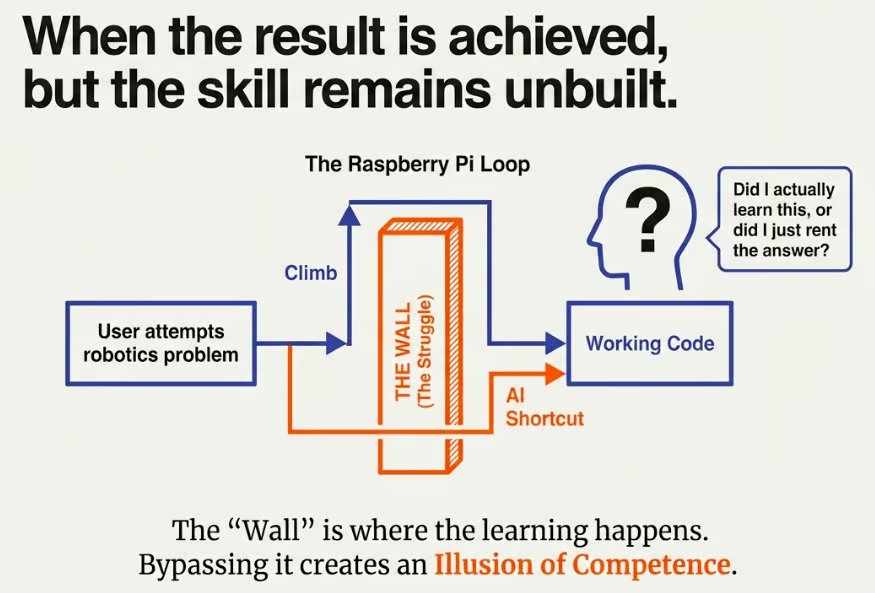
Understanding Cognitive Friction
Cognitive friction refers to the mental struggle that occurs when we encounter challenging problems. This friction is essential for learning because it forces us to engage with the material, think critically, and develop problem-solving skills. In an environment where AI can provide quick solutions, the temptation to skip this cognitive struggle is strong. While it may be efficient to have an AI generate an essay or troubleshoot a coding issue, doing so can deprive us of the valuable learning experiences that come from working through difficulties.
Consider the example of building a robot powered by a Raspberry Pi. When faced with coding errors, one might naturally reach out to AI for a quick fix. However, the process of debugging, understanding error messages, and finding solutions independently fosters a deeper knowledge of robotics and programming. Skipping these steps might yield immediate results but can create significant gaps in understanding that become apparent when faced with more complex tasks.
The Education Landscape
The current educational landscape is experiencing a shift due to AI's increasing presence. Students and professionals have access to tools that can complete tasks for them, raising concerns about the implications for learning and skill development. This is not just an issue for children; adults too are at risk of becoming overly reliant on AI to perform tasks that require critical thinking and creativity.
For example, a university student might use AI to write an essay rather than engaging with the material themselves. While they may submit a well-crafted paper, the underlying knowledge and analytical skills necessary for future tasks might remain undeveloped. This reliance on AI can lead to what some experts describe as an "illusion of competence"—a surface-level understanding that crumbles under scrutiny.
Real-World Examples and Insights
During a recent discussion, the impact of AI on learning was highlighted through various real-world examples. One anecdote involved a student at Oxford tasked with writing essays using a reading list provided by a tutor. The traditional educational model required students to engage deeply with the material, analyze it, and synthesize their thoughts into coherent arguments. This process builds critical thinking and analytical skills over time.
In contrast, if the same student now opts to use AI to generate essays quickly, they forfeit the learning process that shapes their ability to think critically about historical events. This reliance on generative AI can lead to a superficial engagement with the subject matter—students may find themselves unable to articulate their thoughts or defend their positions in discussions or exams, ultimately impacting their academic and professional success.
Leveraging AI Responsibly
So, how can you utilize AI effectively without compromising your learning? Here are some actionable strategies:
Limit Your Use of AI for Quick Fixes: Before turning to AI for answers, spend time attempting to solve the problem independently. This struggle is where learning occurs.
Ask AI for Guidance, Not Answers: When you do use AI, frame your questions to encourage deeper engagement. Instead of asking for a solution outright, seek hints or ask for explanations of concepts you don't understand.
Incorporate Learning Modes: Use AI to quiz yourself or create study materials. Tools like NotebookLM can generate quizzes and flashcards based on texts you are studying, fostering active recall and reinforcing learning.
Document Your Learning Journey: When AI provides solutions, take a moment to document what you learned from the experience. Reflect on the challenges you faced and the insights you gained, turning passive consumption into an active learning process.
Diversify Your Learning Approaches: Everyone learns differently. Use AI to present information in various formats—visual aids, podcasts, or infographics—to cater to your learning style and enhance comprehension.
Conclusion
As AI continues to evolve, the challenge for entrepreneurs and learners is to balance efficiency with genuine learning. Embracing the cognitive friction that comes with problem-solving is essential for developing the skills necessary for success. By using AI as a tool to enhance rather than replace the learning process, we can maintain our intellectual agility and readiness for the challenges of the future.
With these strategies, you can harness the power of AI while ensuring that you engage with the material meaningfully, fostering a robust understanding that will serve you well in your endeavors.
Key Terms Explained
Cognitive Friction
The mental struggle that occurs when facing challenging problems, essential for learning.
ChatGPT
A large language model developed by OpenAI capable of generating human-like text responses.
Claude
An AI model by Anthropic known for its conversational capabilities and ethical design.
NotebookLM
An AI tool that generates study materials, quizzes, and multimedia content to aid learning.
Generative AI
AI that can create content, including text, images, and audio, often used for problem-solving.
What This Means For You
Embracing Learning Amid AI Advancements
The rise of AI tools like ChatGPT and Claude presents both opportunities and challenges for entrepreneurs. While these technologies can significantly speed up problem-solving and content generation, they also risk undermining the foundational learning processes that foster critical thinking and competence.
To navigate this landscape effectively, consider adopting the following practices:
Prioritize Learning: View AI as a supplement to your learning journey rather than a shortcut. Engage with challenges to deepen your understanding.
Foster Active Engagement: Use AI to create quizzes and study materials that encourage active recall, ensuring that you are not just passively receiving information.
Cultivate Critical Thinking: Regularly reflect on what you learn from AI interactions. Document your thought processes to reinforce understanding and identify areas for growth.
By consciously applying these strategies, you can leverage AI's capabilities to enhance your learning while ensuring that you develop the necessary skills for future success.
Frequently Asked Questions
How can AI enhance my learning experience?
AI can provide personalized quizzes, study materials, and interactive learning experiences to reinforce understanding.
What is cognitive friction and why is it important?
Cognitive friction is the struggle faced during problem-solving, crucial for developing critical thinking and learning skills.
Can I use AI tools without compromising my learning?
Yes, by using AI for guidance and feedback rather than direct answers, you can enhance learning while maintaining engagement.
Sources & References
Love AI with Kyle?
Make us a Preferred Source on Google and catch more of our coverage in your feeds.