
You can build and ship a real, paid AI product this afternoon.
Not just a prototype. Not a "someday" project. But a legit thing with a landing page, a login, a payment button, and a result a stranger would pay for.
When I set up my first online business from a Chinese cafe about 15 years ago I had to do everything: product idea, market research, build the product, create a website, work out and run marketing, set up the eCom, run customer service.
It was… a lot.
And even up until a couple years ago launching an online product might have taken a small team and a number of months.
Now we can go from idea to launched product within a day. Easily.
I rebuilt Linktree in about twenty minutes the other week.
Not because I'm clever. Because they nudged their price up and I got annoyed (£8 to £12… hardly highway robbery, but it's the principle of the thing). Pointed Codex at my own Linktree page, said "make me this, just the bits I actually use, small backend so I can swap links in and out, off you go." Twenty minutes. Done. Bits I needed, anyway.
I'm going to walk through the whole thing - why it works, how to think about it, the actual stack - and then the build prompt. Paste it into Codex or Claude Code, it interviews you, then scaffolds the entire product for you.
"But Couldn't They Just Use ChatGPT?"
A lot of AI products on the market right now are basically ChatGPT-wrappers. Ie. under the hood info is sent to an AI like ChatGPT.
ChatGPT-wrapper is used pejoratively. But if you can build something that makes you an extra few thousand or 10k a month do you care? No. Let people say whatever they want.
There is a more valid objection I want to get out of the way first though. If your product is basically a pre-set AI workflow that collects some information from a user, runs an AI process and then spits out an output then surely your customers can just use AI themselves to get the same effect right??
Yes.
But it doesn’t matter.
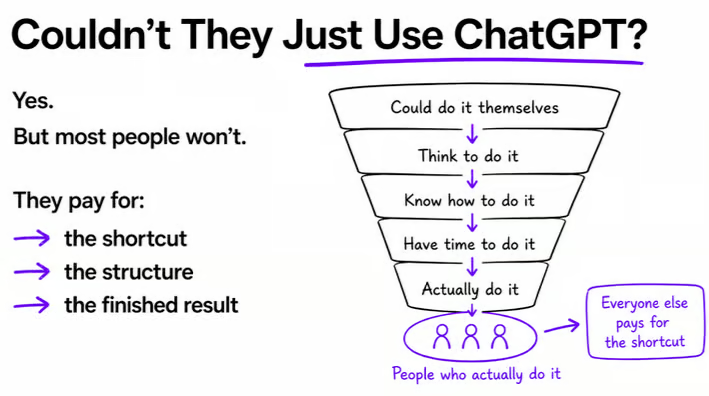
Think of it as a funnel. Everyone could do it themselves. Fewer would think to. Fewer still would know how. Fewer than that have the time. And right at the bottom, a tiny puddle of people who actually go and do the thing.
Very few people do anything. That’s a great secret in life! 😋
Everyone in the layers above that puddle is a potential customer. YES they could probably do this themselves. But they will not. They're not buying AI access - they've already got that. They're buying the fact that you already figured all this shit out. The shortcut. The "here's the button, now stop thinking about it."
Don't Be Clever. Be Specific.
OK what are we going to build?
First up we’re not going to be too clever.
Don’t try to do something new. Don’t aim for a $1B startup as your first product. Don’t try to change the world.
Wrong wrong wrong.
Build something basic that does a specific task well.
What do I mean by specific? Have a look at the difference:
"AI-powered business assistant" … no. Pants.
"Turn your messy product notes into a 5-email launch sequence" … now we're talking.
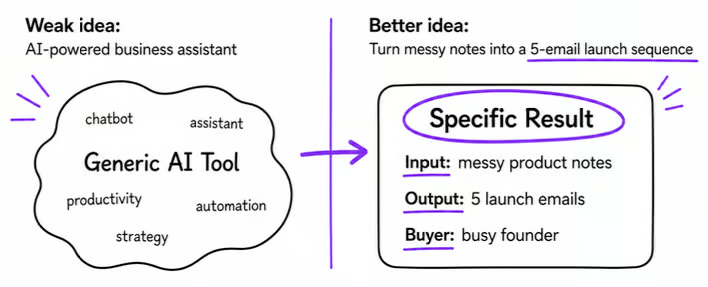
The second one names the input (messy notes), the output (five emails) and the poor sod who'll happily pay for it (a founder who hates writing emails). Boring. Narrow. Sells.
Your first product should be embarrassingly small. So small it feels like you're cheating. If you can't say it in one sentence with the input and the output named out loud, it's still too clever. Shrink it. Then shrink it again.
Steal A Job. Don't Clone The Company.
You do not need a brilliant original idea. You need to nick one job from a product that already exists.
And ideally adapt it to your specific market.
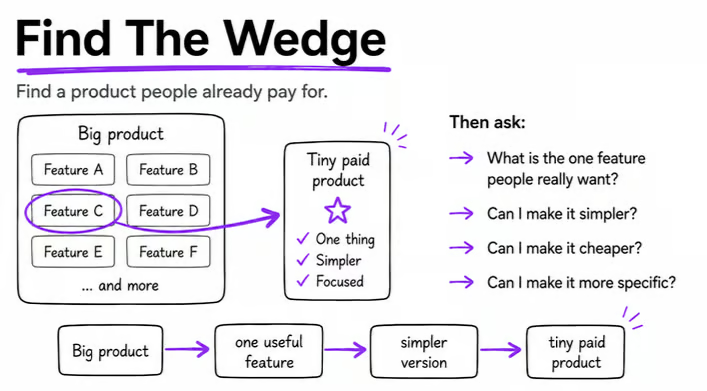
Take Rocket Money. You've heard of them, they advertise on every podcast ever recorded. Ten million members. Budgeting, credit scores, bill negotiation, spending insights, net worth widgets, the lot. You are not out-building that. Don't even try.
But look closer. One of those features is just track my subscriptions. That one little job. In fact that’s where they started. They just sorta sprawled out from there.
Now meet Vexly (no affiliation, just a good example). One person, Vu Nguyen from HCMC. It does the subscription bit and nowt else. No bank connection - you chuck in your subscriptions and it sorts them. Simple dashboard. £24 a year, or £40 forever.
This is your move.
Big platform → one useful feature → make it simpler → make it cheaper → make it specific. Do not clone the company. Pull out one job and do it properly.
Same thinking guts DocuSign, by the way. 7,000 employees, $3 billion in revenue, and at its heart it… signs PDFs. That's sorta it. They’ve just pilled on lots of cruft. Most of us just want to sign PDFs…
A stripped-down PDF signer for fifty quid one-off instead of $25 a month forever?? Yes please. And if you get really smart you build it for your specific industry/niche. So you know what they really need and can adapt accordingly.
What A First Product Actually Looks Like
Nice short list here. I’m not even going to break out the bullet points. You need:
One user. One painful input. One useful output. One clear result.
That's your. lot.
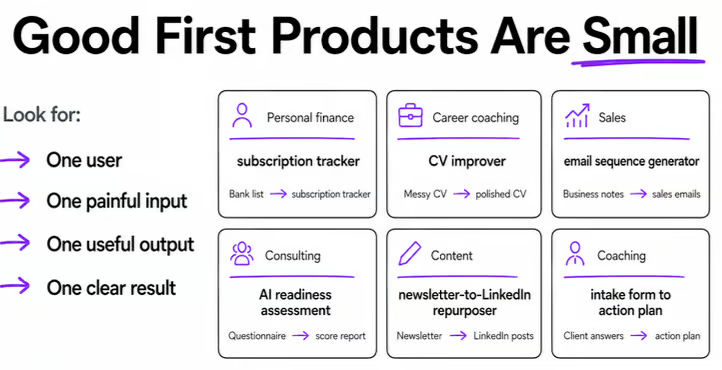
Do NOT be all things to all people. You can’t compete at that level. Don’t bother.
Same shape every time. Annoying thing goes in. Useful thing comes out. That’s it.
Your job is working out what goes in, how it is processed and what comes out. The AI bit is pretty simple if you know this.
Think about the maths here too. Again I’ll use Vexly.
Vexly. £40, paid once. Say the guy sells five a day. 150 a month. Six grand a month. Knocking on £72,000 a year. $100,000 ish. I used to live in HCMC myself and $100,000 would go a VERY long way there. Nhiều bát phở! Although I’m a Bún thịt nướng man myself 😂
For a large SaaS company it’s a rounding error. But for us, as individuals, that’s probably life changing. And that’s all we need to carve out for ourselves here.
The Build Is The Easy Bit
OK but now we have to build. This where everyone freezes. "I can't code. I don't know what Vercel is. What the hell is a Supabase. How do payments even work." Doesn't matter. Honestly. Doesn't matter at all. It seems like a big deal right now but that’s because you haven’t done it yet. Once you’ve built a first product this stuff is trivial. It’s not the hard part!
Here’s an example product we could build - an AI Readiness Assessment we sent to businesses in our industry and charge them $49 for a full report:
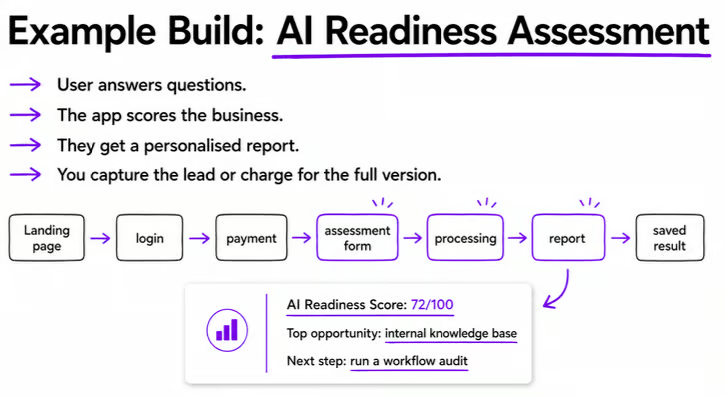
This above is the sequence that the customer goes through.
Here’s the same flow but from your “behind the scenes” POV.
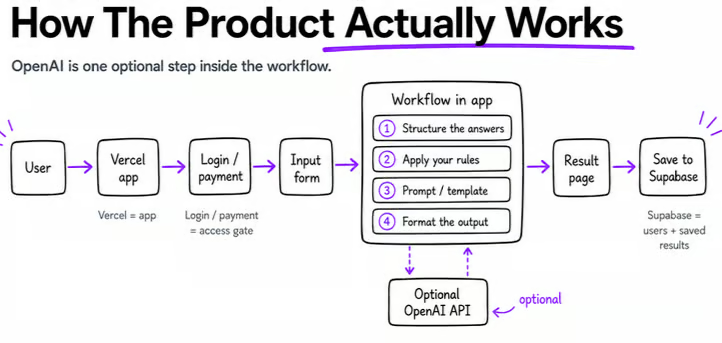
To build out something basic like this we can get started with AI. And allow AI to walk us through AND explain what is happening as it goes along with the project.
Here we go:
You are a full-stack product engineer helping me ship my FIRST paid AI product today. Keep it small, specific, and shippable. You will teach me as we work through the project, starting with high level concepts. STEP 1 - Interview me. Ask ONE question at a time, wait for each answer, keep questions plain. Ask in this order: 1. What painful task in your industry are you productising? 2. Who exactly is the buyer? (one specific type of person) 3. What is the ONE input they give? (be concrete) 4. What is the ONE output they get? (be concrete) 5. What is your logic / secret sauce? Walk me through how YOU do this task today - the rules, the scoring, the steps, what "good" looks like. This is the most important answer. 6. Does the processing actually need an LLM call, or is it deterministic code? (most are code - don't force AI in) 7. Pricing: one-off or subscription, and how much?
ask me clarifying questions. Encourage me to use voice mode to collect more information and to reduce self-editing. STEP 2 - Reflect my product back to me in one sentence: "[Tool] turns [input] into [output] for [buyer], priced [X]." Get my confirmation before building. STEP 3 - Scaffold the product, building BACK TO FRONT: a. Data layer: Supabase project - users, payments, saved submissions, saved results tables. Give me the SQL + the exact dashboard clicks. Pause and ask for my Supabase login/keys when you need them. b. Logic layer: implement MY workflow from answer 5 as the core. Scoring/rules/templates in code. Add an OpenAI (or Claude) API call ONLY if answer 6 said it's needed. Make the secret sauce easy for me to edit later. c. Input form -> processing -> result page (clean, on-brand, mobile-friendly). d. Auth + payment gate (Stripe or a hosted checkout). Pause and ask for keys when needed. e. Landing page LAST - sales page naming the exact input and output and buyer. Specific, not clever. f. Deploy to Vercel. Pause for my Vercel login when needed. Walk me through what we are building. Assume no/low knowledge. Do not make assumptions. Have me create free accounts when needed for supplementary services. Provide context but do not overwhelm with choices. RULES: - One feature only. Refuse my scope creep; tell me to ship v1. - Document exhaustively - Explain each step in plain English as you go. - Never invent credentials - always pause and ask me. - End with a launch checklist and the live URL. Begin with STEP 1, question 1. Wait for my answer.
You paste this into Codex (free, or $20/month - you do not need the $200 plan for this, ignore anyone telling you that you do!). It interviews you. What are you building, who's it for, what goes in, what comes out, what's the secret process in the middle. Then it builds the lot - the front end, the login, the payments, the database - and stops to ask for your logins when it needs them.
You can also use Claude Code. Or Lovable. Or Google AI Studio. Lots of alternatives. At this point it doesn’t matter that much.
The only part the AI cannot do is the middle. The process. The thing that's been rattling round your head for ten years. That's your job. The rest is the prompt's job now.
Work with the AI. That prompt should deal with 80% of the build for you.
BUT you will hit problems. That happens. It’s unavoidable. When it does just talk to your AI. Work through step by step. Remembering that the first time will be the most difficult - it gets much easier as you move up the learning curve.
To the task,
Kyle
Get the full daily digest in your inbox. Browse recent issues →