
The 7 Levels of AI Native - Your Progression Map Through the AI Chaos
A few weeks back, I shot a quick TikTok walking through Vauxhall Pleasure Gardens (wild name I know…it’s just a park), rattling off the stages of getting good at AI. Tens of thousands of people watched it. The DMs were all the same: "Can you turn this into a proper guide?"
I got distracted. Built other stuff. But I've finally looped back and put together something I'm pretty excited about. It’s still a work in progress but I think it’s pretty cool.
It's called the 7 Levels of AI. Think of it like a skill tree - if you've ever played an RPG, you'll get it immediately. If not, it's basically a progression map. Here's where you are. Here's where you're going. Here's what to focus on next.
The seven levels break into two acts. Act I (Levels 1-4) is the Daily Driver - transforming your everyday workflow through context and connection. Act II (Levels 5-7) is Builder & Operator - the advanced frontier of custom apps and autonomous systems.
I’ve put together a PDF briefing for you that you can grab here:
But here’s a quick rundown:
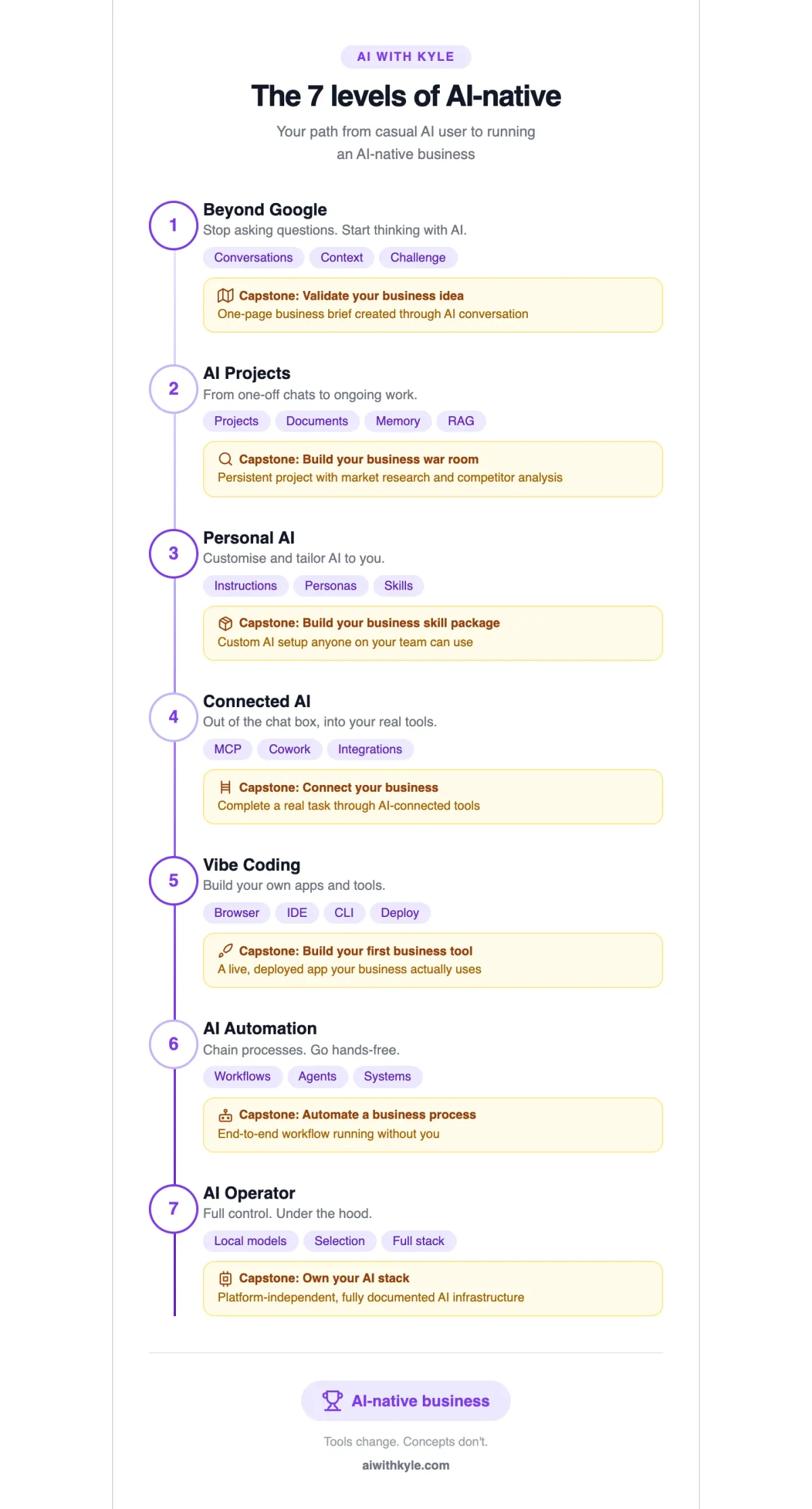
The idea is to build your skill level, step by step. Introducing pieces like Skills, MCP, CLI along the way when they make sense.
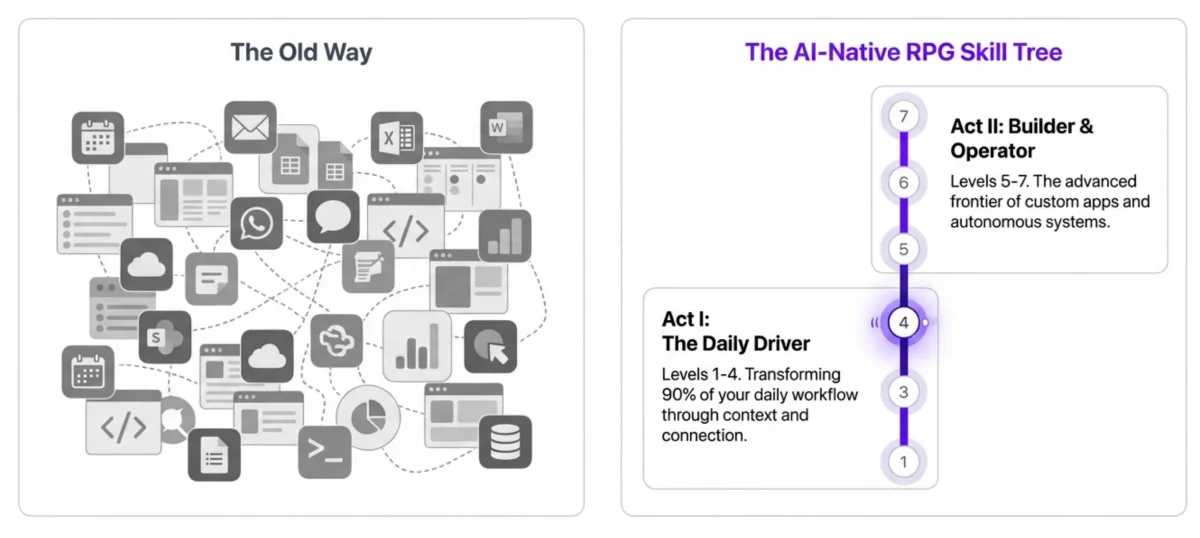
Right now everything is just sorta thrown at you. Think fast! And it all seems so urgent. But without the foundations and scaffolding it’s really hard to know where everything fits. And if it’s really important or not. My goal here is to help build that scaffolding.
The rough outline (still pending!) is:
Level 1: Beyond Google - Stop treating AI like a search engine. Start having actual conversations. Give it context about who you are, what you need, and why. The shift is from "getting answers" to "getting better at thinking."
Level 2: AI Projects - Stop starting from scratch every single chat. Create dedicated project workspaces, upload reference documents, and return to the same project across sessions. This is where things start compounding. I produce a newsletter every day out of a Claude Project that has examples of past writing, brand guidelines, and compressed context from 2.8 million words of content I created last year.
Level 3: Personal AI - This is where it stops being generic and becomes YOUR AI. Custom instructions, reusable personas, prompt templates, and increasingly skills - those little packages of files that give AI a specific role. The test? Someone else could sit down with your AI setup and immediately get useful output for your business.
Level 4: Connected AI - AI stops being a separate app and starts living everywhere. This is where MCP (Model Context Protocol) comes in - connecting your chatbot directly to your calendar, CRM, email, local documents. No more copy-pasting between apps.
Level 5: Vibe Coding - "I wish someone would build an app for this" becomes "I'll build it myself this afternoon." Start with browser tools like Lovable or Google AI Studio's free build mode. Then move to IDE tools like Cursor. Then CLI tools like Claude Code.
Level 6: AI Automation - AI goes from "helps me do things" to "does things for me." Start with human-in-the-loop, then once you trust the quality, switch it to fully autonomous. This is where people who claim they're doing 10x the work are actually operating.
Level 7: AI Operator - Platform-independent. Running local models, choosing the right model for each task, potentially fine-tuning on your own data. Overkill for most people, but worth knowing about.
The biggest problem right now isn't a lack of information - it's too much information. Hell, I don’t exactly help here. I’m giving you even more information every day! 🫠
BUT - with the right scaffolding in place at least you’ll know where to keep all the new information. How it fits. How it helps you.
Nobody's sat down and built an actual pathway through all of it. I looked at Anthropic's own training site - brilliant courses, but they haven't sequenced them. You're supposed to start with Claude 101 but it's buried after Claude Code and MCPs. Wut?
DeepLearning.ai? Amazing resource. But again hundreds of courses and it’s hard to tell where to start. The best starting point is actually the third one listed on their courses page - but as a beginner how would you know that??
So I'm building a 70-80% correct pathway. Is it the perfect path? Doubt it! But 80% in the right direction beats being completely lost. And the golden rule: tools will change in six months. These concepts are permanent. I don't care if you're using ChatGPT, Claude, Gemini, or whatever drops next month. The skills of contextualising, personalising, and automating transfer to any platform. It’s how we think that needs upgrading.
If you are interested in this project please tell me! So I know to invest my time here for you! If you vote then i) I know you are interested and ii) you can help guide if this should be a quick-hit or long-form!
Want me to build this? |
Member Question: "How do you find a worthwhile idea to build with vibe coding?"
Kyle's response: Don't. Not initially, anyway. Just build stuff. Too many people want to build the next billion-dollar app out of the gate. I highly recommend against that. Build little toy projects first to understand what you can and can't do. A calculator, a quiz tool, a link page. As you work through these smaller builds, you'll start to see opportunities that match your actual skills. I’m working on a bootcamp designed exactly for this - each project teaches you a new capability, and by the end you'll have a much better sense of what's achievable.
Member Question: "Where are you hosting your vibe coded web apps?"
Kyle's response: My backend is in Supabase and I use Vercel for deployment. Firebase is good too. I'm not one of these people who'll argue on Reddit vehemently about it - as long as the website stays up and is accessible, I don't really care. There are costs once you get enough traffic, but it's marginal
For my API costs, hosting, and Supabase backend across multiple apps and websites, I'm probably paying a hundred, maybe two hundred dollars a month. But when you're grossing tens of thousands a month, it just doesn't matter. It’s super marginal, basically a rounding error. That's one of the exciting things about AI - the cost of intelligence is so low you can deploy something better than a lot of SaaS businesses for pennies on the dollar.
Get the full daily digest in your inbox. Browse recent issues →