
What’s happening in the world of AI:
Highlights
The Invisible Shift: AI & The New Labour Equilibrium
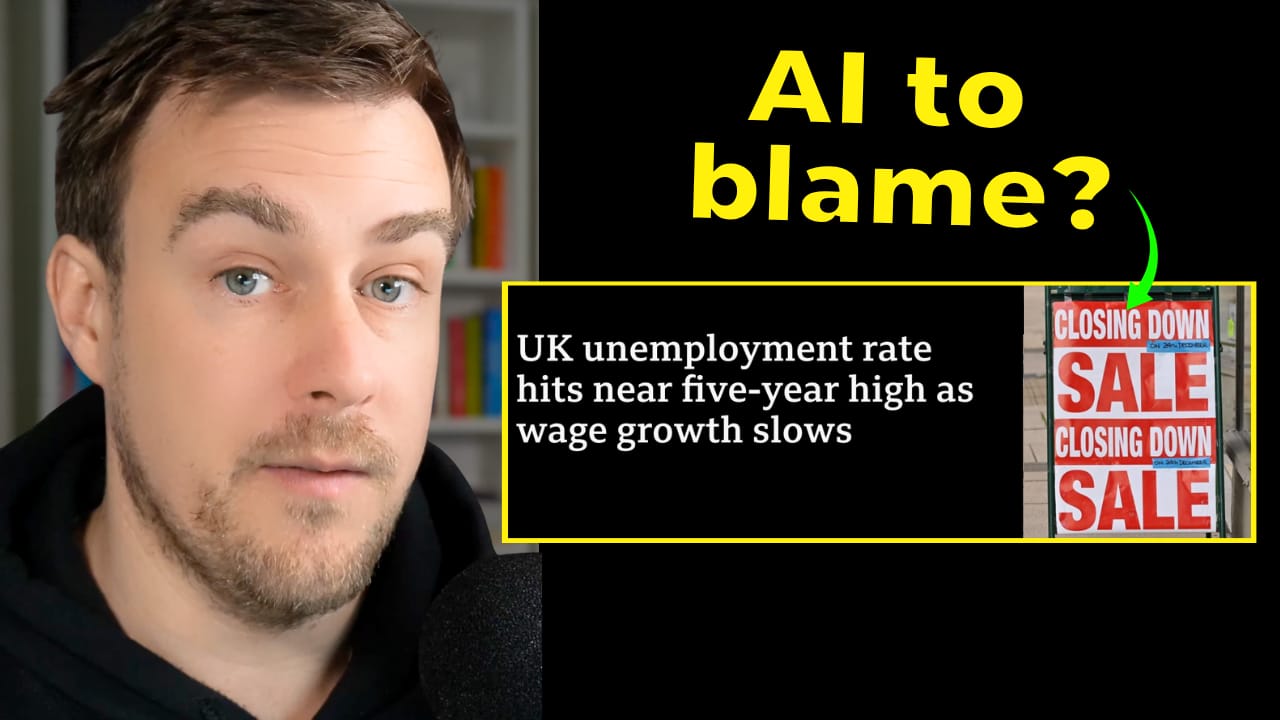
UK unemployment figures came out from the Office of National Statistics, and they're bad. Unemployment has hit 5.2%, a five-year high, meaning it's now at the same level as during COVID. Among 18 to 24 year olds, the rate is 14%. In some areas like Bradford, youth unemployment is hitting 20%. That's one in five young people looking for their first job and not finding one.

The ONS cited weak hiring activity and noted that more people are out of work and looking for jobs. Private sector wage growth has slowed to its lowest rate in five years. Redundancies are trending upward. It’s looking no bueno across the board.
This isn't just a UK problem. Unemployment is climbing across much of the Western world. And while politicians point fingers (Kemi Badenoch blaming Labour which is quite rich after her party have just been in power for 13 years…), the reality is much bigger than party politics. This is structural.
I put together a presentation to walk through what I think is actually happening, how AI fits into this picture, and what you can do about it. The full slide deck, "The Invisible Shift," is available here https://aiwithkyle.com/resources/will-ai-take-my-job
Cyclical vs Structural: The Distinction That Matters
The economy is soft for many reasons: a global pandemic, a spate of tech over-hiring, tariffs, interest rates, China, national debt levels across the board. We're in recession or teetering on the edge of one. If you go outside in most Western countries, there's a feeling of desperation. (Interestingly, I don't feel that when I go to China.)
This isn’t just because of AI. That’s too crude.
Here's the critical distinction though. Some of these forces are cyclical: interest rates fluctuate, demand rises and falls, government policies shift. These things come and go. We've always had economic cycles and we always will.
But underneath the cycles, there's a structural change happening. And unlike cyclical forces, structural changes don't reverse.

AI is introducing automation capabilities, productivity multipliers (one person doing the work of five to ten), full task substitution, and entirely new organisational structures built from the ground up with AI in mind. These are permanent shifts.
So: here’s the big part….
…When the economy eventually recovers, when interest rates change, when inflation adjusts, AI will still be here. The technological baseline has shifted upward, and it's not coming back down.
This means we’ll be building and growing in a new world. One that is less reliant on humans.
The New Hiring Equation
Previously, when a business needed more output, the equation was simple: deploy more labour and more capital. Now there's a new variable in that equation.

Every time a company needs to expand, there's now a question that didn't exist two years ago: can we do this with AI? Two years ago the answer was mostly no. Increasingly, the answer is yes
This is the key insight: AI is not primarily about firing existing staff.
Doris in accounts is not necessarily losing her entire job.
Mark in logistics is probably keeping his.
What's changing is the marginal hiring decision. Companies are inserting a new filter before they decide to bring someone on.

In 2018, the logic was: new demand → open requisition → hire junior.
In 2026, it's: new demand → can AI absorb this? If yes → no hire. If no → open requisition.
This "silent suppression" of open roles is far more significant than visible layoffs. We won't see dramatic headlines about AI taking people's jobs. We'll just see fewer and fewer new positions being created. That's harder to spot, harder to attribute to AI, and far more insidious (great word).
This is exactly what the BBC data shows. Weak hiring activity. The number of unemployed people per vacancy has increased to a post-pandemic high. Companies are simply not creating new positions at the rate they used to. Is that all due to AI. Nope! But increasingly this is a viable alternative.
The Pyramid Compression
Most organisations are structured as a pyramid. At the bottom: juniors doing grunt work (discovery in legal, basic account checks in finance, data entry everywhere). They cut their teeth on this work for a couple of years, then move up into management and review, and eventually into senior strategy roles. This structure has worked for hundreds of years.

AI is exceptionally good at exactly the work that sits at the bottom of that pyramid. In legal, it can go through a corpus of case notes, relevant law, and documentation far faster than a team of clerks, and present synthesised notes to the next level up.
We're already seeing hiring freezes at the bottom in consultancy. Legal firms are being obstinate about it, but they're in for a shock. Accountancy is starting to follow. This will affect all white collar work.
What happens is the base of the pyramid starts to shrink. You hire 10 people instead of 100. And those 10 who do get hired are in a strange position: they're using AI to do the work of a hundred, which means they're not actually going through the process of cutting their teeth. Their learning is thinner as they progress up the hierarchy.
The pyramid starts to look less like a pyramid and more like Japan's population graph: hollowed out at the bottom, top-heavy with experienced people overseeing work that increasingly doesn't exist. That's not a stable shape.

Japan’s wobbly population distribution…
You start trimming people off the top because they're being paid to manage work that AI is now doing. Meanwhile, AI is simultaneously working its way up the pyramid. We already have agent orchestration where multiple AI agents work on different tasks with orchestrator agents checking their work. That sounds a lot like middle management.
The result: entry-level jobs collapse first, management follows, and the entire structure compresses.
That 14% youth unemployment figure might look nostalgically low in a couple of years. Yeah…shit.
The Jagged Frontier: Why Your Industry Isn't Safe Yet
If you work in an industry where AI doesn't seem very useful, that's because the AI labs aren't focused there yet. All the frontier labs are pouring their time and money into making AI better at coding. Why? Because the people building AI are coders and that's their domain. And because cracking coding means AI can start to self-improve (Claude Code was used to build Claude Cowork, Codex 5.3 used early builds of itself to create later builds).

Once they've built an AI that can meaningfully improve itself, they can turn it on any industry. Building a self-improving tool is the priority. Once that's done, solving law or becomes a trivial problem. Then medicine. Then accountancy. And so on. They don't need to set up separate departments for each industry. They just point the general intelligence at it.
So if you're in an industry where AI seems irrelevant, pay attention to what's happening in software development. Even if you don’t code.
That's the canary in the coal mine right now. The most fragile workers right now are people on Upwork and Fiverr (those platforms have been decimated), but this will roll up to more stable roles.
Second-Order Effects: Nobody Is Truly Safe

Even if your specific role can't be automated, you have to think a couple of steps ahead. If you're a physiotherapist or massage therapist, AI can't do the physical manipulation. But your clients probably work in industries that will be affected. If unemployment hits 20% among your customer base then guess what… there's suddenly less discretionary money for PT sessions.
White-collar income compression leads to reduced discretionary spending, which weakens demand for the entire service sector. The ripple effects reach everyone eventually.
Three Types of AI-Resilient Roles (For Now)

Unstructured Physical Reality: Nursing is the perfect example. Every day is different, you might need to physically restrain someone, chase a patient, calm a family member. It's non-algorithmic and requires physical presence. Dog grooming is another good one: different shapes, sizes, and temperaments every time. These roles have some time because robotics lags behind generative AI, but robots need to become general-purpose and cost-effective first.
High Empathy and Trust: Roles that require forming genuine human bonds, communicating sensitively, calming someone before a procedure, sitting with a worried family member. AI can't do this yet, and it's a genuinely human skill. Guess what, nursing hits this too.
Legal and Fiduciary Liability: Some professions remain safe specifically because we cannot yet hold an AI legally responsible. When you hire a solicitor or an accountant, you're partly buying the ability to shift legal responsibility onto them. As long as AI can't be sued, these roles have a buffer. Though regulation and unions will only delay this, not prevent it. Huh, nursing again.
If your role sits at the intersection of all three (nursing being the best example!!), you're in a strong position for now. If your role primarily involves sitting in front of a computer doing spreadsheets, writing reports, reading information, and synthesising it, those tasks will be replaced. Sorry.

Important. Exposure isn't about job titles. It's about the nature of the tasks you perform. Every single job is basically a bundle of different tasks. If AI can do a lot of those tasks then you’re role is at risk. Repetitive cognition, structured data entry, pattern-based coding, and standardised review are all highly exposed regardless of what your job is called.
What You Should Actually Do
My recommendation, and what I've been focused on for the past couple of years: start something yourself.
Do not quit your job.
Hang on to it for as long as possible - get paid.
But understand that your job may not exist, your company might go under and your industry as a whole may cease to exist. As long as you're in a nine-to-five, you don't control the fate of your role. You don’t get any say.
What you do on the side is get ready. Build secondary and tertiary sources of income. Freelancing, contracting, starting a business. The specifics matter less than the principle: you need optionality. If you have one source of income, that's inherently riskier than having multiple sources. It’s a one legged stool.
I personally have about six or seven revenue streams, for the specific reason that I do not know which of them will still be viable in a couple of years.
Nobody knows.
Sure my newsletter makes money, but people could eventually get the same information from AI. That's why I'm not reliant on just the newsletter. I have 5+ other streams.
Two very specific approaches that work well right now: first, leverage your domain expertise into some kind of AI tool that you sell. You're essentially putting yourself out of a job, but you're doing it first, before someone else does it to you. It sounds cynical, and it is, but there's a real opportunity to package up your industry knowledge and help thousands of companies with it.
Second, go and teach businesses how to use AI. I make about £2,000 per hour giving workshops. If you're watching this, you know far more about AI than most people. Package that up with your specific domain expertise and go teach others. There's a free course on this at aiwithkyle.com/courses called the AI Workshop Masterclass.
The real risk isn't apocalypse. It’ll be far less exciting. And much more miserable.
It's more about fragility. Fewer entry-level roles, slower wage growth, thinner career ladders with fewer rungs to the top. We cannot sit and wait.
Remember, a year from now, 5.2% unemployment might look like the good old days.
God, I hope I am wrong.
Member Questions:
"What's the best service you can give to local business owners using AI?"
Don't try to sell AI to businesses. Go and talk to the business owner first. Find out what tasks are repetitive, time-consuming, and boring. Start there. Once you've solved problems for a handful of businesses in a specific area (say, building voice agents for restaurants that miss phone bookings), then you can productise that solution and take it to others with case studies. But you only settle on a distinct product once you've actually solved real problems for real people.
"Does it still take years to implement AI in regulated industries?"
Yes for sure, regulation and unions can delay adoption by five, ten, maybe twenty years. But all they're doing is stemming the tide. The economics will eventually make resistance unsustainable. These forces slow things down. They don't reverse them. It’s a game that is already lost but the players don’t realise yet.
Get the full daily digest in your inbox. Browse recent issues →