
The skinny on what's happening in AI - straight from the previous live session:
Highlights:
🔥 Google TPUs Are Coming for Nvidia's Throne
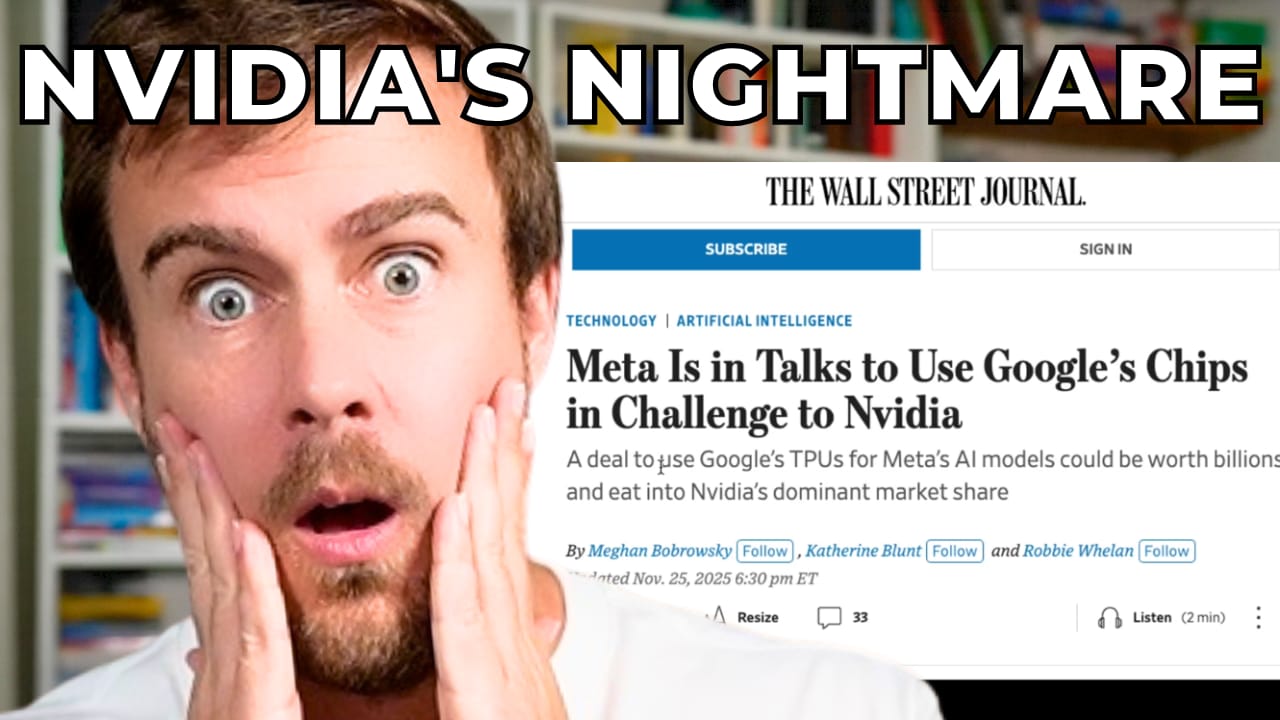
Meta is in talks to use Google's tensor processing units (TPUs) for their AI models. This follows Anthropic's announcement that they're expanding their TPU usage. Wall Street Journal says the deal could be worth billions. Meanwhile, Nvidia's shares dropped 3% on the news…and they put out a “it’s all fine guys!” tweet:
Kyle's take: The fact that Nvidia felt the need to put out a defensive statement tells you everything. They tweeted about being "a generation ahead" and having "greater performance."
When you're actually ahead, you don't need to announce it.
For years Nvidia has been the only game in town - that's why they hit $5 trillion market cap. But Google trained Gemini 3 entirely on their own TPUs, and it's state-of-the-art.
Very broadly: GPUs are more flexible, can be applied for multiple uses like working with graphics. TPUs are super specific and basically can only do the mathematics required for training LLMs.
Because of this TPUs are more power efficient. But focus on a smaller set of uses.
The media is making this seem like GPUs (Nvidia) vs. TPUs (Google). Reality is, data centres will probably use a mix of both. But the narrative of Nvidia's unassailable monopoly just took a massive hit. Could this pop the bubble? Maybe not this alone, but it's definitely challenging some assumptions.
Source: Wall Street Journal
🇪🇺 Lovable's Tax Drama (And Why Their Response Was Perfect)
Lovable - the fastest-growing software company in history - got called out for not paying VAT in Europe. Cue a pile-on about EU regulation killing startups. But CEO Anton's response was genuinely brilliant: "We can build a generational company from Europe and I want to prove it. I'm not asking Europe to stop being Europe."
Kyle's take: This is how you handle a crisis. No blame, no excuses, just owning it. Anton basically said: we'll pay everything we owe plus any fees, we believe in Europe, and we're proud to be here.
He even pointed out that high-trust societies with healthcare have advantages over other (ie. American) model. For anyone still wondering if they should use Lovable - nothing changes. They're not in trouble, they'll sort their taxes, and it's still the best place to start if you're learning to vibe code. .
Source: Anton on X
Today’s issue brought to you by:
FREEDOM OS: Discover your AI money model — in just 2 hours — based entirely on your starting position.
"Thank you for sharing this. It's been more helpful than you'll ever realise." - Emma
🚀 Genesis Mission: $200 Billion of Federal Research Fed to AI
Trump signed an executive order called "Genesis Mission" giving AI access to all federal scientific data sets - worth roughly $200 billion per year of research. The Department of Energy is leading it, comparing it to the Manhattan Project and Apollo mission. For context: Amazon's R&D budget is $80 billion. This is bigger than Amazon, Google, Meta, Apple, and Microsoft combined.
Kyle's take: This is massive and slight mad. They're essentially feeding every piece of American scientific research into an AI to see what comes out the other end.
It’s not clear who's building this AI or running it, but the scale is unprecedented.
It aligns with America's AI Action Plan from July - specifically the "counter China" bits. Xi Jinping identified AI as strategically critical years ago; America's now responding in kind. Could be a mess, could be brilliant. But you've got to admire the audacity.
Source: Energy Department article / AI Action Plan
💡 What Skills Actually Matter Now?
Asked some smart people what career skills prepare you for AI progress. Jeremy Howard: be a generalist. Richard Ngo: curiosity and desire to explore. Anonymous engineer: if you're just writing code AI can write, shift to leadership or customer interaction. Finbar Timbers: figure out what AI is good at and complement it.
Kyle's take: I agree with all of this. Generalist knowledge is suddenly valuable because you can now call on AI specialists for the deep stuff - you just need to know enough to ask the right questions. Curiosity matters because most people with LLM access could have discovered things nobody else knew, simply by talking to them properly. But they didn't, because that mindset is rare.
And yes, if your entire job is writing code that AI can write, you're in trouble. The hard part was never the code - it's figuring out what to build and whether anyone wants it. Human stuff. Talking to customers. Getting on stage. Things AI can't do yet.
I'm introverted and don't naturally love networking or speaking, but I've learned to lean into it because that's where the value is heading.
Source: Original discussion
🎨 Nano Banana Pro: Incredible, But Someone Tell It to Calm Down
Matt Wolf recreated infographics he'd made 8 months ago with the old Imagen model. The difference is staggering. But there's a problem: Nano Banana Pro puts too much in. It can do so much that it overdoes it - overwhelming infographics with every piece of information it can think of.
Kyle's take: Just because it can doesn't mean it should. I've found you need to explicitly tell it to simplify. "Keep it simple. Do not overload this with information." Otherwise you get technically impressive graphics that are impossible to read. The old model couldn't do text properly - this one adds text, diagrams, mathematical formulas, little doodles, smiley faces. The whole shebang.
Brilliant, but chaotic.
Source: Matt Wolfe on X
Member Question: "What do you think the main revenue streams will be for AI companies in 2-3 years?"
Kyle's response: Advertising. I was at a Google event last night and chatted to some Googlers about this. Google makes 70% of their £350 billion revenue from ads - 60% from search ads alone. AI is cannibalising that business. Ads are the simplest way to replace.
This isn’t just Google though. OpenAI just launched "Shopping Research" right before Black Friday. Why is a company supposedly focused on AGI building shopping assistants? Because that's where ads go.
Nobody wants to be first to stick ads in AI responses, so everyone's waiting for everyone else to do it. My prediction: we'll see proper advertising in all major AIs by end of 2026. The subscription and API model hasn't proven it can generate that kind of revenue.
Member Question: "What are your thoughts on the new Gemini and Nano Banana Pro?"
Kyle's response: Gemini 3 is good, but I still prefer Claude. Nano Banana Pro though? We've basically hit AGI for visual reasoning. Andrej Karpathy showed it filling out physics and chemistry exam papers - in handwriting, with workings out, little doodles, the lot. It's not just generating images. It reads the exam, routes it to the reasoning model, gets answers, then generates the filled-in paper. True multimodal intelligence. Visual AI is now pretty much a “solved” problem. I don't think that's fully appreciated yet.
Want the full unfiltered discussion? Join me tomorrow for the daily AI news live stream where we dig into the stories and you can ask questions directly.
Get the full daily digest in your inbox. Browse recent issues →