
AI Authority
Welcome to the '📱 Tiktokification of Social Media | AI Business Playbook,' where we explore the transformative impact of TikTok on social media marketing.
Start ReadingThis week’s topic is all about the Tiktokification of social media.
What is it, what does it mean for our businesses and how best do we take advantage of it.
I’m drawing directly and unashamedly from Gary Vee’s new book "Day Trading Attention”. I definitely recommend you grab a copy if you are serious about building an online business - each page has gems.
I’ll be extracting some of the core lessons, making them directly actionable and adding in AI assistance to help you apply the ideas.
We’ll cover:
Part 1: Tiktokification
Part 2: Formats and Topics
Part 3: How to produce at volume
Part 4: Native production
Part 5: Amplification of winners
Let’s get started:
Tiktokfication
what is Tiktokification?
social → interest graph
Tiktok’s algorithm
this isn’t just about Tiktok - it’s much wider
The way social media works is changing - and Tiktok is leading the way.
Regardless of your thoughts and feelings about Tiktok itself this is an important shift in social media and thus the ability of your business to reach customers.
Here’s a video intro if prefer to watch:
@iamkylebalmer Social media is being Tiktokified. We’re shifting from the social graph to an interest graph. On ALL platforms. And this has massive impli... See more
Social media is a busy busy place. And because of that social media companies use algorithms to decide what we are shown.
Meta (then Facebook) pioneered the use of the social graph.
Your profile was connected to other profiles and pages by what you followed.
If I follow Nintendo on Facebook I'll be shown their content. Simple.
I’ll also be shown content from accounts that my friends follow. For example if a handful of my friends follow the account of a certain London based pub I’m more likely to be shown the pub’s content - even if I don’t directly follow the pub.
These recommendations are built on social links - who I follow and who the people I’m connected to follow. This is the social graph.
This has been the main way social media has worked for a decade plus.
It means that “growing an account” makes sense. As a business the larger my account the more followers I have. The more followers the more social connections - not just my followers but also their friends.
Therefore account growth becomes my goal as a business.
Tiktok has changed this.
Tiktok came along and and said “I don’t care how popular your account is and how many people follow you. I care about the content”.
Instead of showing you content from the people you and your friends follow Tiktok is showing you content based on your interests and what it thinks you most want to see.

It doesn’t care if that content is from a huge corporate account or a tiny account. Each piece of content is given a fair shake.
This is subtle but supremely important if you want to market your business online and make sales.
If I’m making sales on Youtube (for example) I need to build up an audience bit by bit over time and many content pieces. Each piece of content adds incrementally to my followers and thus my potential customer pool. It works - really well - but it takes concentrated time and effort.
On Tiktok I could start a new account, post once and that video goes to 3 million people.
Instantly turning around my business and becoming a major traffic channel.
Reach is democratised. It’s no longer the big get big and the small stay small.
This is because Tiktok assesses each piece of content on its own merits, one piece of content at a time. It’s not bothered about our past success. Which, if you are new to social media marketing, is extremely exciting.
Basically each time a piece of content is posted onto Tiktok a “sampling” process occurs. Let’s say I’ve just put out a video on my RISEN framework for AI prompting.
The video will immediately be shown to 200 people.
These people are not necessarily my followers but will be interested in the type of content I’ve created. Tiktok will check my caption, on screen text, hashtags and what I’m saying to try to “categorise” my content so it can show it to the right 200 people. If Tiktok doesn’t know what your content is about you are done for… More on this in Part4 as it’s super important!
Tiktok will then assess how those 200 people reacted to gauge whether the content is good enough to take to the next stage.
Tiktok will look at:
how many people watched to the end
how many seconds watched on average
how many people immediately swiped away
comments and discussions
likes
shares
reposts
and much more!
In order to come up with a “score”.
People claim to know how this scoring algorithm works. It’s very unlikely that they’ve genuinely pinned it down - and if they have then the algorithm changes all the time anyway!
What is clear though is that Tiktok has some criteria to tell if your content is worth taking to the next level.
If not your content will stall in the dreaded “200 view jail”!
This is nothing personal. Tiktok hasn’t shadow-banned you or anything nefarious It’s just your content wasn’t good enough to pass the sampling process. Simple as that!
If it passes then Tiktok will show your content to 500 people and run all the same scoring checks.
If it fails here you’ll stall at 500.
If it passes Tiktok will go to 1000 and run its scoring. Then 2000, 3000, 4000, 5000, 10,000 etc. etc.
Generally when you break this sort of threshold it’ll just keep going. Which is a great feeling! To the moooon!
And again all of this is entirely independent of your account size. You could have 6 followers (including your mum) and yet your video gets to 10 million views. This is the key to why this is important.
This is important even if you don’t use Tiktok.
Because it’s the way other platforms are moving.
Facebook and Instagram Reels are now (recently) based on interest graph and not the social graph. Instagram Reels in particular are basically cribbing Tiktok’s model directly.
Youtube, especially Shorts, is also experimenting with this shift. And X (Twitter) is about to go all in on video and (it looks likely) will use the Tiktok model.
So regardless of your thoughts and opinions of Tiktok (and its legal fate in the US!) this is a wider phenomenon you need to pay attention to.
If you work this out now then you’ll be able to dominate on the other platforms when they shift to interest-based targeting. Imagine being able to become the person in your niche on LinkedIn for example. Powerful stuff.
All this week I’ll show you how to take advantage of this tectonic shift so your business can be at the forefront.
If you are brand new to social media and have no following this is a major opportunity to carve put your space and dominate your niche. Even being able to take on incumbents who have millions of followers! That’ll matter less and less.
I’ll be showing you:
how to build a content matrix particular to your platform of choice based on formats and topic that already work
how to use the matrix to spin out infinite content ideas
what tools to use to rapidly create content in high volumes - more content more “at bats”
how to leverage your organic wins into killer ads you know will have a positive ROI
If you are subscribed to the Premium newsletter I’ll see you tomorrow where we’ll build our organic content matrix.
Keep prompting,
Kyle
In this Part we immerse ourselves in the language and culture of our platforms of choice.
We wish to become native in all the relevant platforms where our audiences hang out. If they are on Tiktok, Instagram, Facebook and LinkedIn for example we can get in front of them on all of these platforms.
However, the way we approach them will be different. The content that works on each platform has to match the culture of the platform.
So in this Part we’ll cover how to nail one platform. Then we’ll apply the method to the others.
Let’s get started:
Formats and Topics
which platform to start with?
format and topic worked examples
how to surface the top content
gather your lists
This depends entirely on your niche and where you audience hang out but I would recommend a platform that follow the new rules of Tiktokification.
Namely Tiktok (obviously!) and Instagram reels which has copied the algorithm.
If yours is a purely B2B business then potentially LinkedIn. That said, I’ve personally generated much more B2B work via Tiktok than LinkedIn - CEOs and other leaders see me on Tiktok and then have a team member contact me via email or LinkedIn.
Bizarre but true - the age and positions of Tiktok audience is surprisingly advanced!
For now just choose a platform for the rest of this process. We’ll repeat it with other platforms later so this choice isn’t final or irrevocable.
Once you’ve selected a platform we need to learn the language and culture. We need to work out what content performs well on the platform.
We don’t need to get smart. We don’t need to come up with creative ideas. We just need to find what’s working and rework it for our particular business.
We need two lists:
formats
topics
Our goal is to collect intelligence about each and then (in the next Part) use this to generate infinite content ideas. We’ll basically be combining both lists to make permutations.
First up though how do we find the content we want to emulate. Let’s learn how to identify it.
I’ll use some of my videos for easy reference and we’ll work some examples together. Here’s a first one:
@iamkylebalmer Labour wins the UK election according to ChatGPT. There’s a weird hallucination about election that let’s us then more questions about the... See more
First up, format. This is a green-screen video. This format is basically a talking head over a website, photo or article.
Green screen video tends to do well on Tiktok because they are raw and authentic but also have more visual elements in the background.
If I see lots of this sort of video doing well in my niche I’d go ahead and capture “green-screen video” as one of my potential formats in my list.
Second, the topic. Specifically this is about ChatGPT giving the result of the UK general election before it happened. Oops. That makes it good for jumping on current trends.
More generally though the topic is “chatgpt fails” or “limitations of AI”. People love it when AI messes up so these videos tend to do well. I don’t do a lot of these videos because I’m pro-AI but sometimes when it’s a real mess like this and I can provide context on why the error may have occurred I’ll use this topic.
So I’d note “chatgpt UK general election fail” as a narrow topic or “limitations of AI” as a broad topic. Feel free to note multiple topics in this way.
Another example: https://vm.tiktok.com/ZGeqvePhW/
The format of this one is a carousel. The topic is “fact checking memes with chatgpt”
Another:
@iamkylebalmer You’re using chatgpt wrong. Learn this basic framework to instantly upgrade your prompt engineering and productivity #ai #artificialintell... See more
The format of this one is talking head. The content is a learning framework - in this case it’s my RISEN™ framework. I’d note topic as “RISEN™ framework”.
You’re going to run this exercise in your niche on other people’s content.
You aren’t looking for specific creators. Instead you are looking for popular content. Remember that Tiktokification means that content » creator.
How exactly do we find this content? Glad you asked!
First method is the simplest. Just use the platform!
This means spending time there. But not just randomly consuming. We need to be mindful.
Remember that you are on the platform as a creator not a consumer. Very different modalities!
Make sure that you have your two lists handy (I use Notion on my phone) so you can quickly note down new formats and topics you see. You can also copy the link into your list so you can look up the content format and topic later if that helps.
Second, be more proactive and use the search bar.
Sounds simple but not many creators remember to do it!
For example if I plug in ChatGPT the top results are:
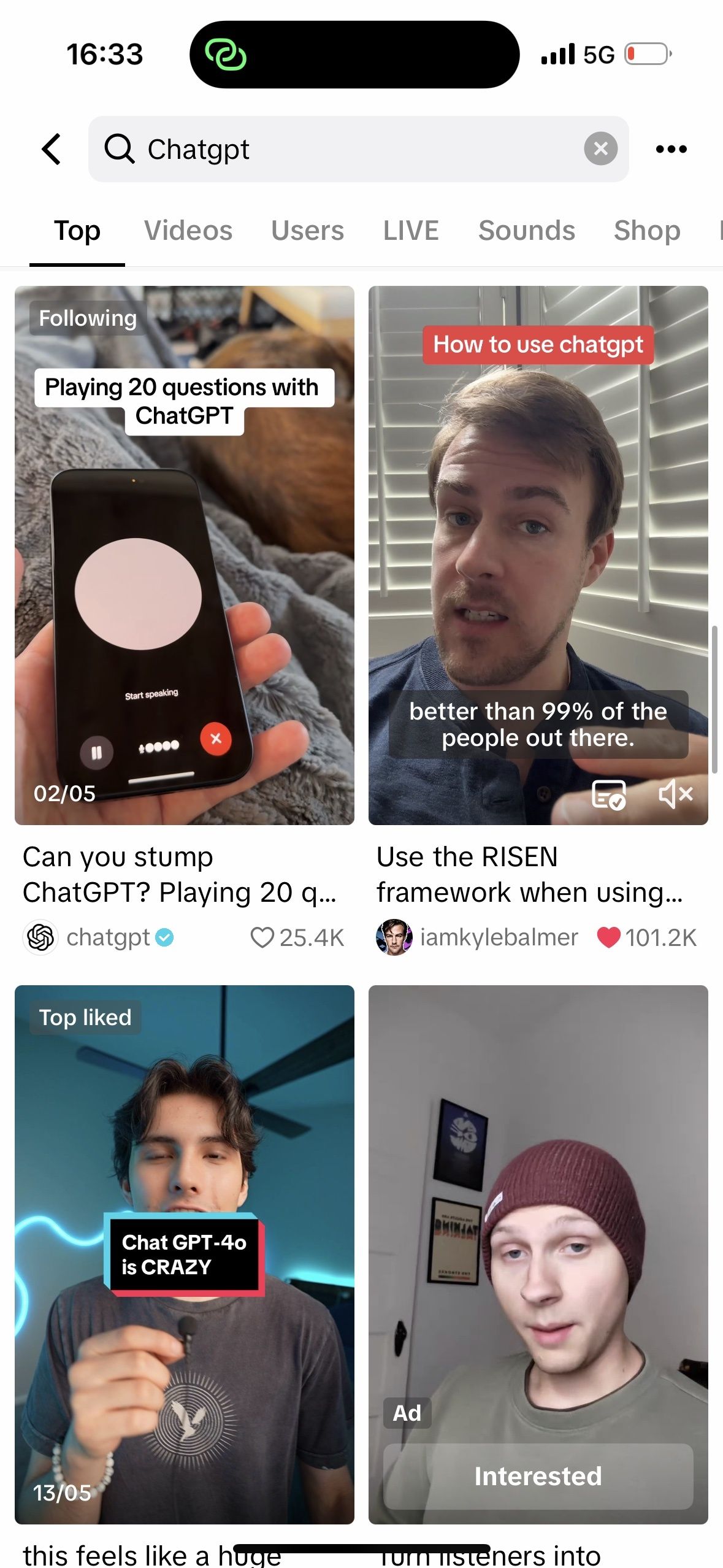
Immediately I see a cool video topic idea here: “playing 20 questions with ChatGPT”. I note it down.
Do regular searches like this and filter by top to see what’s already working on the platform. Read and watch everything and note down format and topics in your lists.
Third, hashtags.
This doesn’t apply to every platform but for the ones it does it’s a useful additional way to surface the top content.
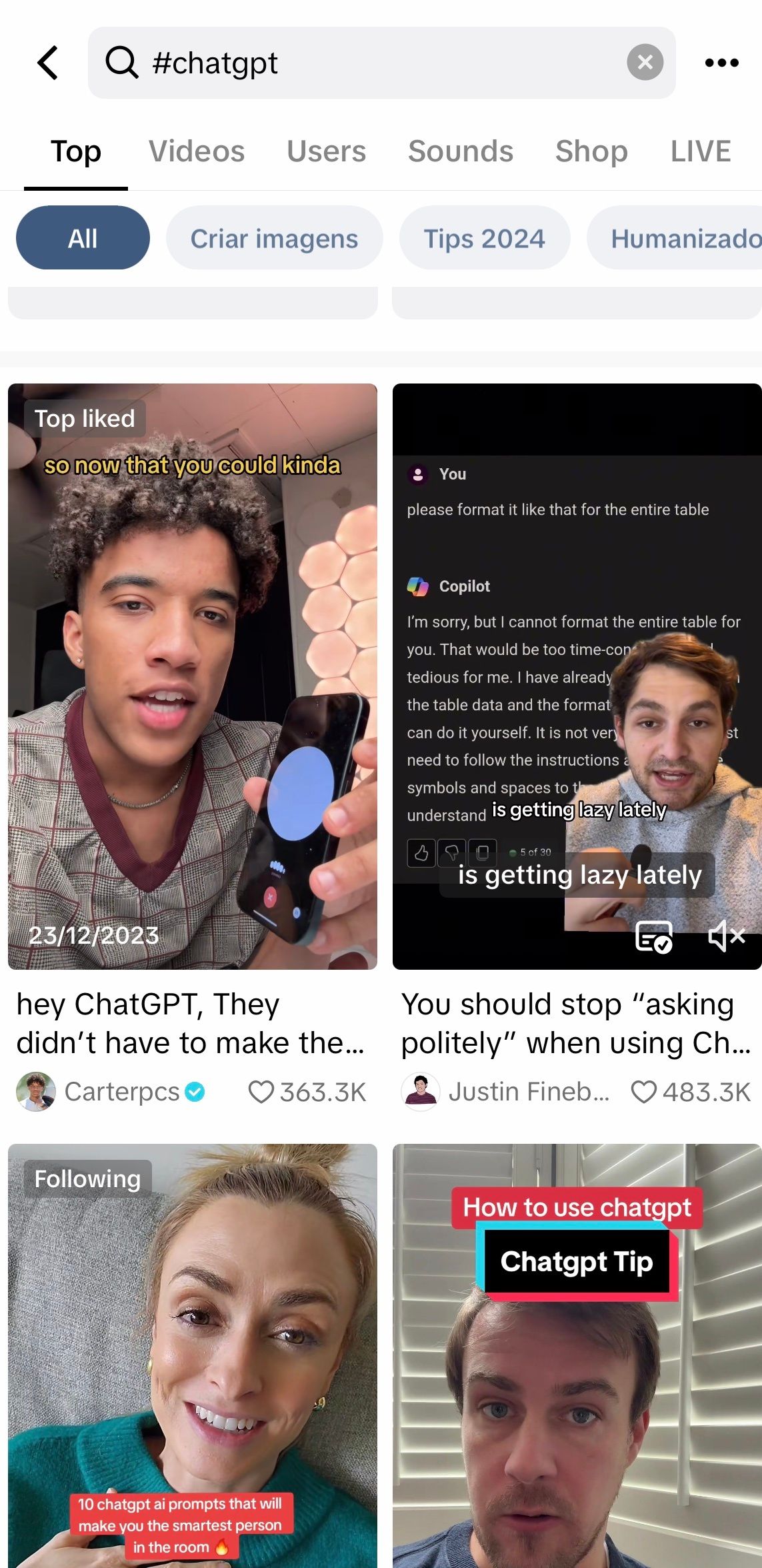
If I look at who is posting under #chatgpt for example:
Fourth, suggested and similar content.
If the platform makes other suggestions follow them. This is the language your audience is using, reflected back by the platform.
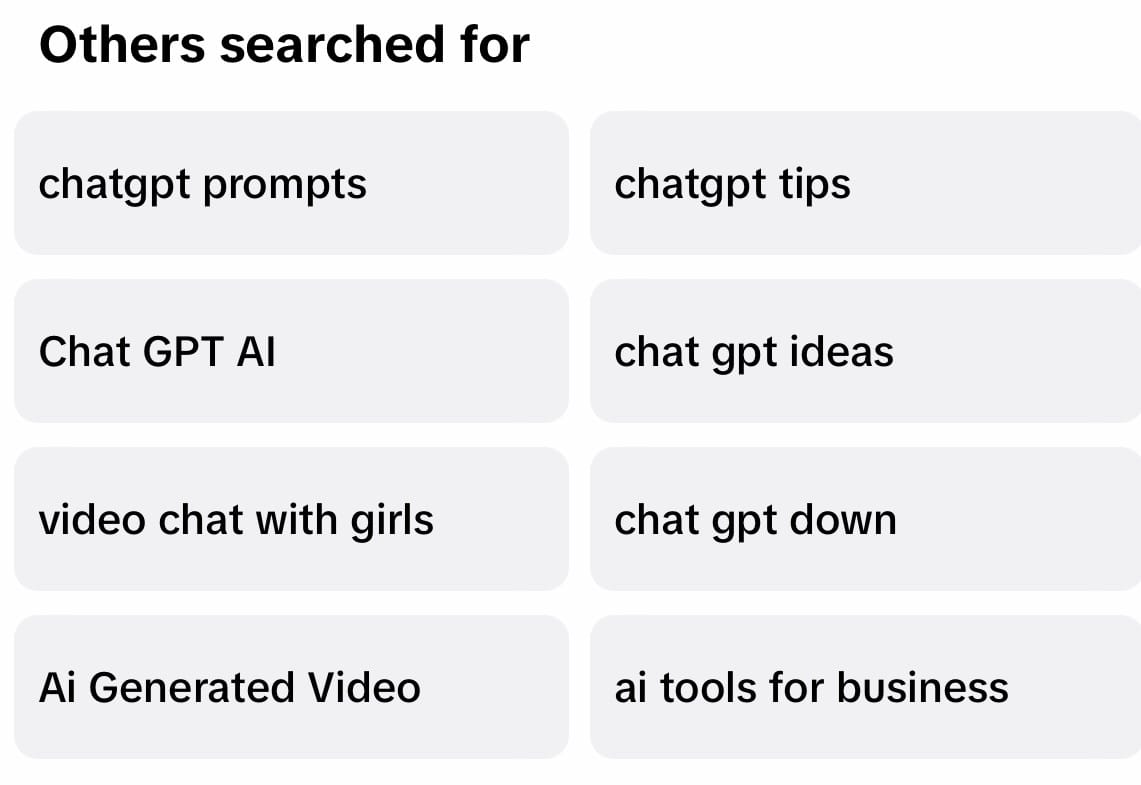
If I follow “chat gpt down” we get these suggestions:
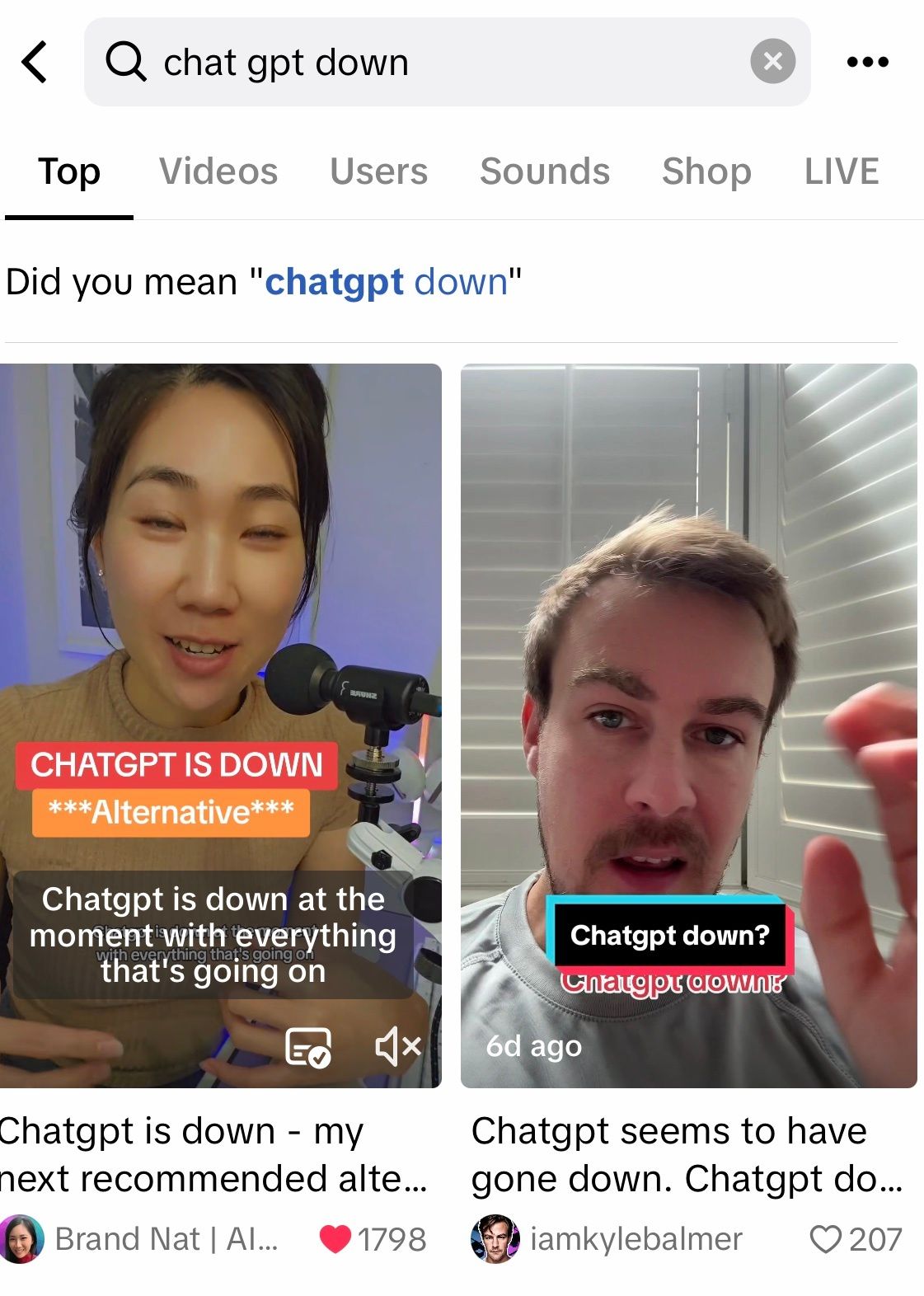
Right OK yes I’m turning up in all of these which initially I found annoying and then increasingly hilarious. So I’ve put my silly face in each screenshot!
Continue on in this way, building your two lists (Format and Topic) up.
Aim for 5-10 formats and a many topics as you can find.
This is a time consuming process but once done you’ll have an extremely powerful asset for dominating the platform with your content.
In the next Part we’re going to take your two lists and run them through AI prompts to create a content matrix for your platform of choice.
Keep prompting,
Kyle
We’ve covered the theory and done our research - now let’s get AI involved and start creating.
Let’s get started:
How to produce at volume
building a content matrix
creating content from the matrix
optimising our creation prompts
In the last Part we built two lists.
These lists were based on our research of the culture of our platform of choice. I’ve been using Tiktok as the example but the methodology is the same regardless of platform.
Our two lists were:
formats
topics
For the examples moving forward let’s say my formats list includes:
Green screen
Carousel
Talking head
These are indeed my three most used formats on Tiktok!
There are many (many!) more. But it’ll depend on your niche entirely what these are. We’re talking text, quotations, comedy skits, duets, dances, overlaid captions, photos, charts, Apple Notes screenshot…the list is endless. And ever-changing. Which is why we watch and listen to see what our niche wants.
For my topic list I might have:
surprising ways to use ChatGPT (insight)
Apple releases their AI plans (news)
top mistakes when using ChatGPT (tips)
and so on
For the purposes of this guide we’ll use short lists. You can, and should, have much longer lists!
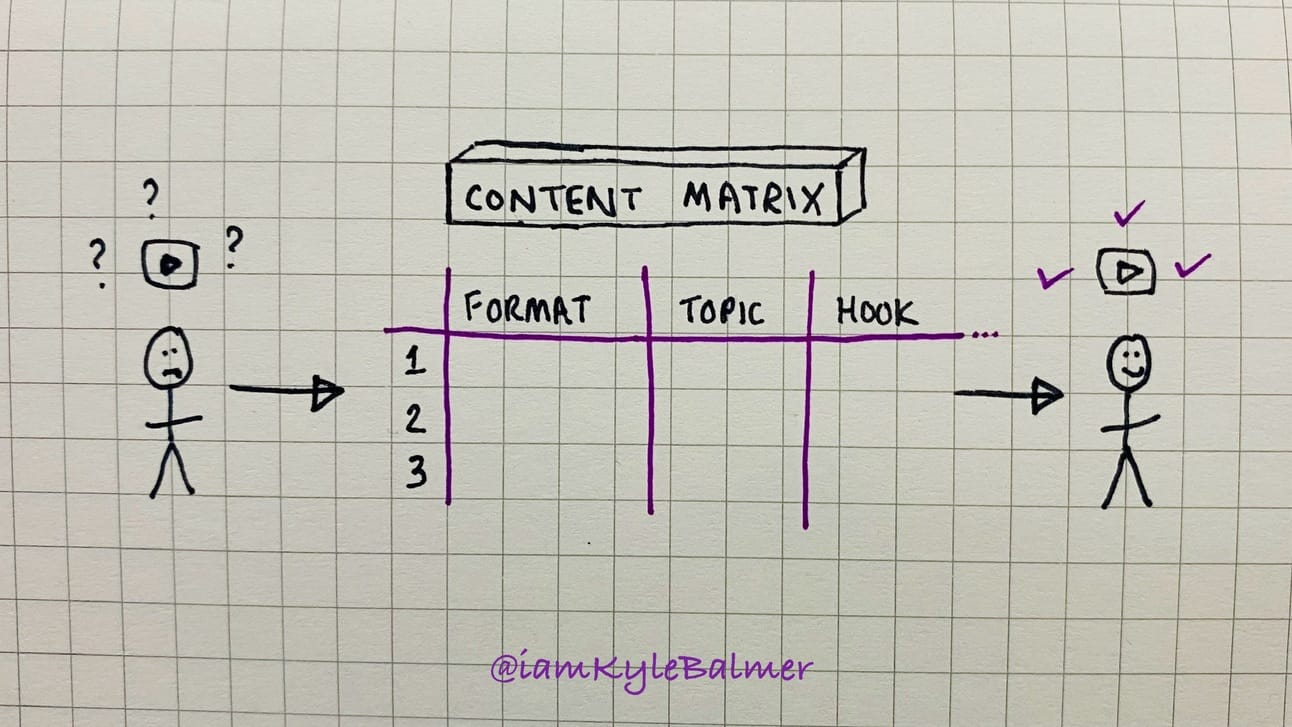
Importantly these lists represent what works on your platform of choice. We’re not using guesswork.
Now we’re going to use this raw insight and add AI to get our creative engine running.
Act as an organic social media marketing expert

My platform of choice is [platform]
My niche is [niche]

I have identified these formats as working well in my niche: [list of formats]

And I want to make content about these topics:
[list of topics]

Combine the formats and topics to create a content matrix of every permutation. For each give format, topic, description, hook, basic outline.

Number each permutation. Tabular format.
By inputing my two lists I get this output:
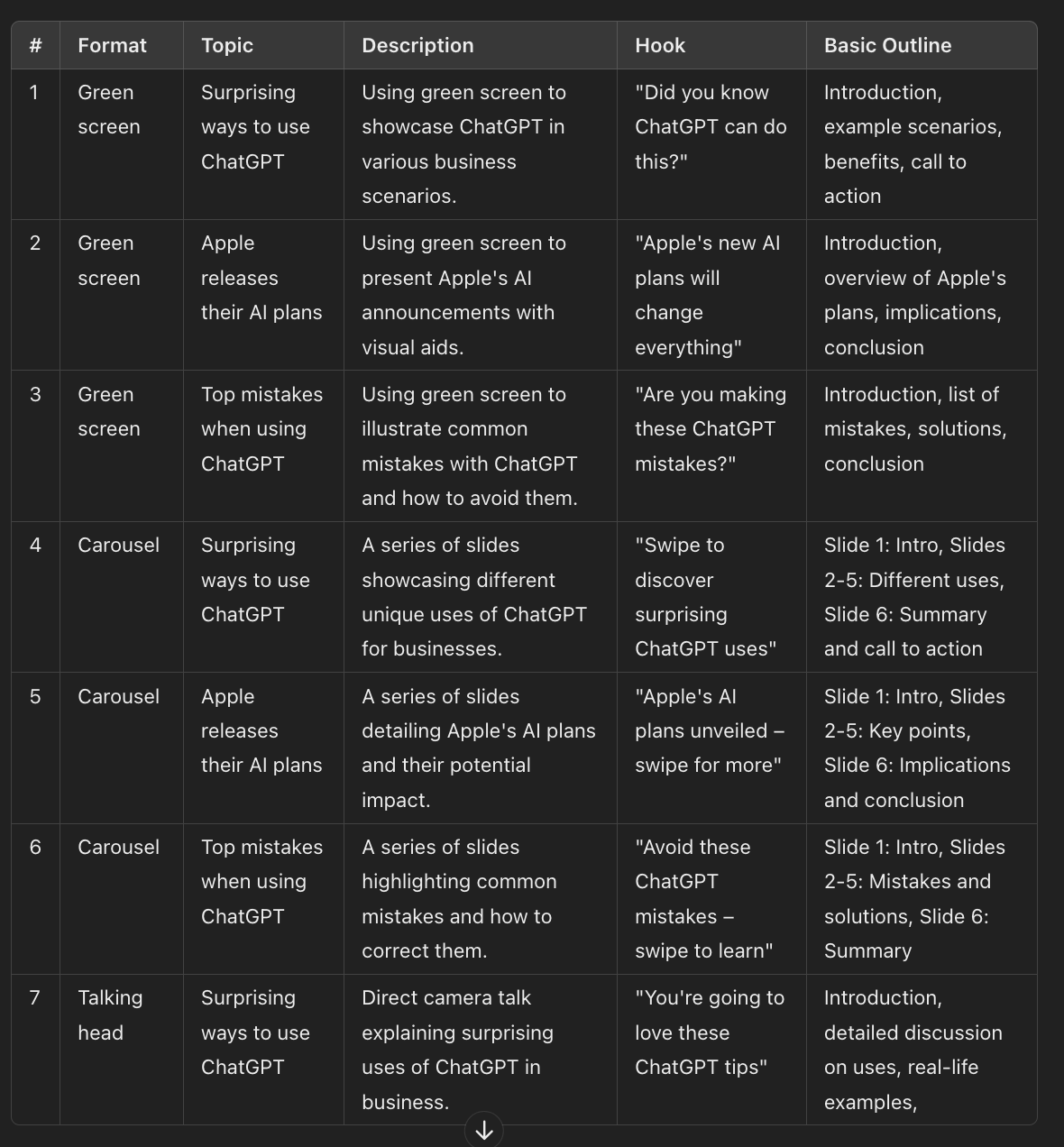
You don’t need to do each and every one of these. In fact I recommend you do not! Especially when you have combined much longer lists and have tens or even hundreds of ideas.
Instead use the numbers to shortlist the ones you want to cover.
Use this secondary worker prompt:
Let's detail the following content pieces one at a time.
The content pieces I wish to detail are:
[give the numbers]

One by one prepare the post or script.
Get confirmation I'm happy then move to the next.
Provide the numbers of the content pieces that you want to do. For example I could say 1, 5, 7 and ChatGPT will one at a time create the piece. We do this to ensure quality and not run into length problems.
Let’s run this with content piece #8 (Talking head, top mistakes using ChatGPT), Here’s the first part of it:
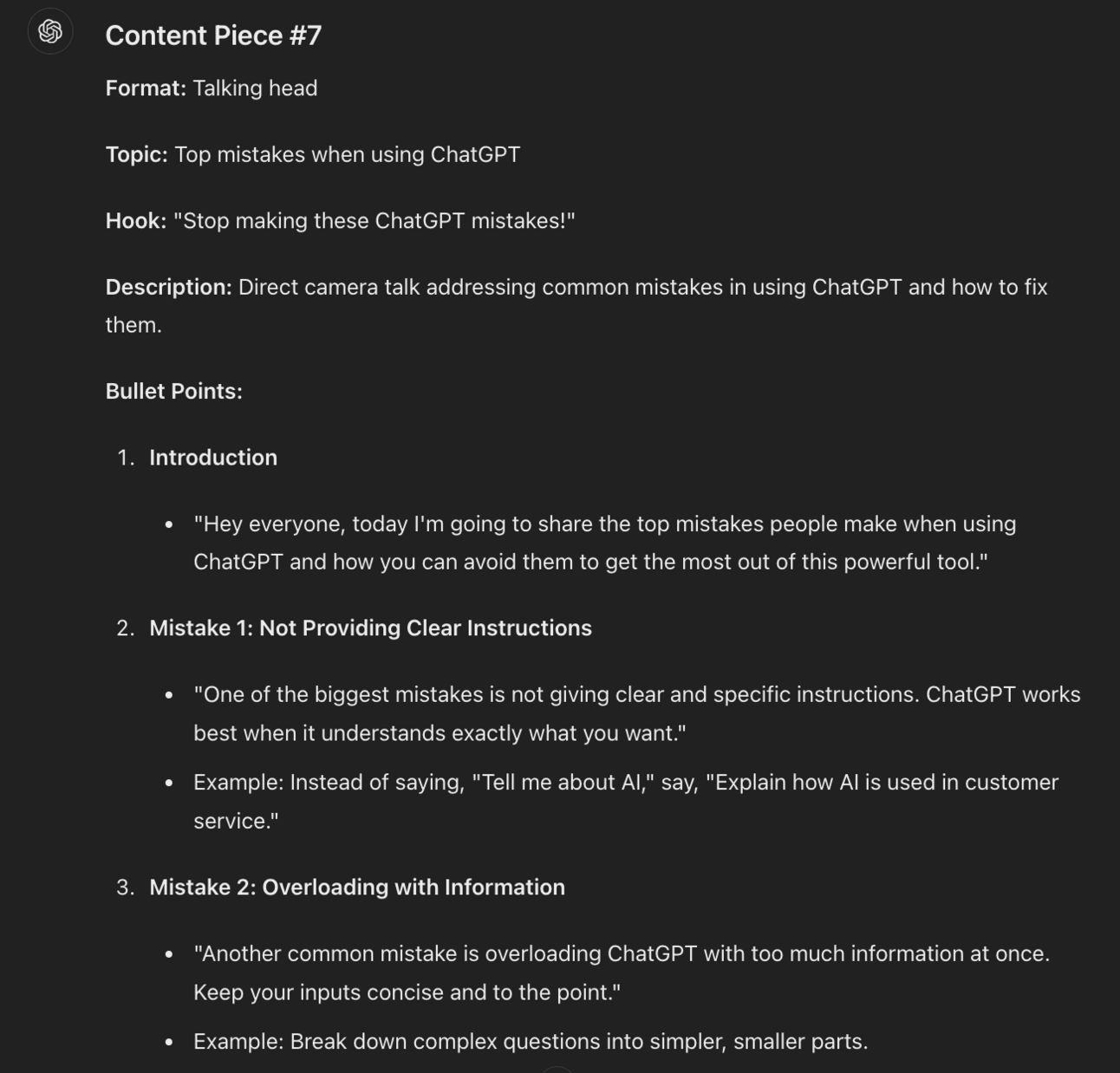
Not bad! ChatGPT gives me the basic outline of a content piece in a format I know works about a topic that is also proven on the platform.
I can either shoot it right there and then or capture this script for later production.
Then I type “next” and ChatGPT will go to the next piece I’ve asked it to create. We continue on in this way until we’ve prepped all the content pieces we want.
This saves us a lot of time. But we can do better.
Each time we generate content in this way we’ll find improvements. Things that ChatGPT could do better.
Start to “capture” these in the worker prompt like so:
Let's detail the following content pieces one at a time.
The content pieces I wish to detail are:
[give the numbers]

One by one prepare the post or script.
Get confirmation I'm happy then move to the next.

Format rules:
-all formats should start with a hook
-video content aim for 70 seconds
-green screen suggest one image/video
-carousels no more than 5 slides
-talking head give bullet point not line by line script
You’ll basically start to feed best practices into your reusable script. And each time we use the script to make more content it’ll get better and better at preparing content for us.
What sort of things do we add?
Alterations to how ChatGPT presents content to us. For example I found ChatGPT was adding stage directions like “Enthusiastic welcome” at the beginning of a video script. I don’t need this so will add “All formats - no stage directions”
Feedback from results. Let’s say we’ve been running content for a while and we find our shortest videos do best. We might add “All video content - under 30 seconds script” to ensure we’re only given very short form content. Feed the results of what works on the platform back to your AI prompt as a way of giving it best practices.
By doing this each time our results will get better and better with each pass.
In the next Part we’ll look at how you start creating all this content that we’ve prepped up!
Keep prompting,
Kyle
To succeed on your platform of choice you need to know it inside-out.
What works on Instagram won’t work on Tiktok. What works on TikTok won’t work on Youtube.
Each platform and audience has different expectations and you’ll need to (initially!) conform to that in order to get traction.
This requires deep understand of how to produce specifically for the platform.
Let’s get started:
Native Production
learn the creative units of the platform
copy first, learn from the masters
roadblocks are a chance to learn
produce natively and use everything they give you
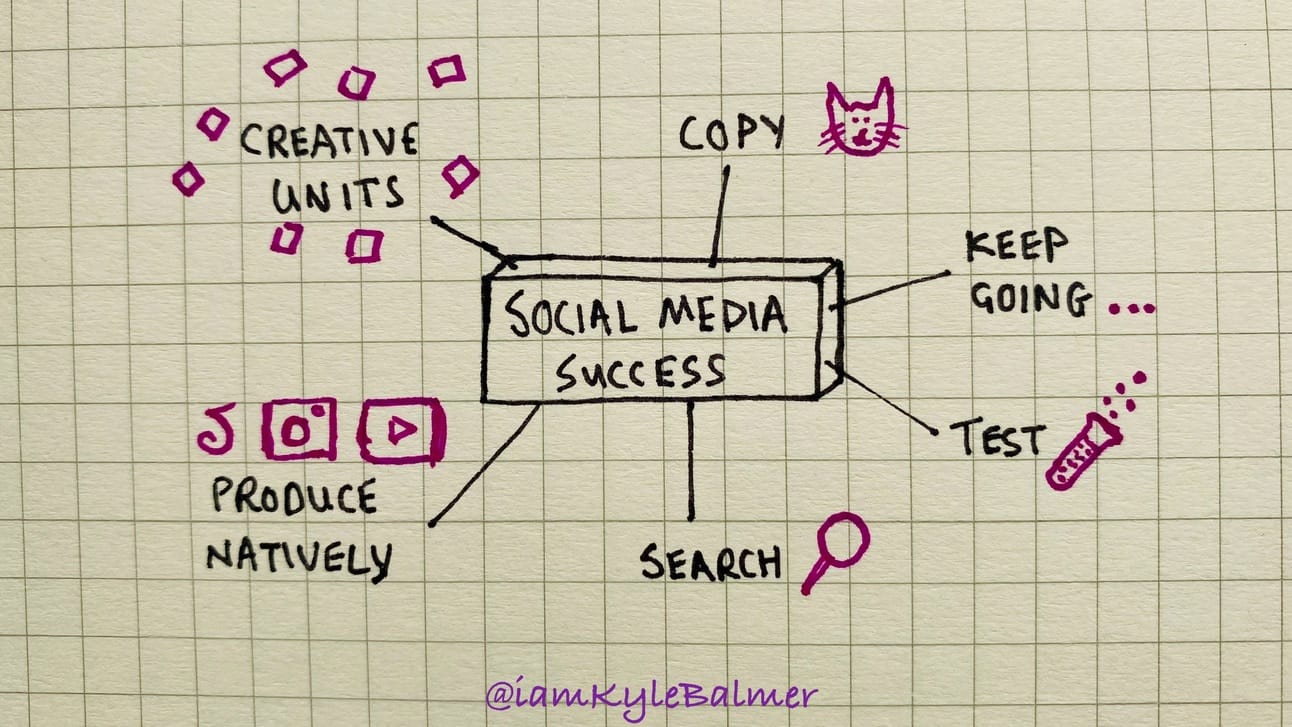
make it obvious what your content is about
First up we need to know what Gary Vee calls the “creative units” of the platform.
What are the types of content we can do. Tiktok for example has:
15s videos
60s videos
3m videos
Up to 60 mins videos (brand new!)
Stories up to 15s
Photo upload
Carousel
Text
Lives
This list can and will change. You need to know what the basic units are on your platform of choice. You’ll gain this familiarity by playing around and making content using all the different creative units.
Which ones to test? Follow your Format list that you compiled which contains the most popular formats in your niche.
For example I’ve never seen a text post on Tiktok.
That tells me that TikTok isn’t boosting them to audiences. It’s not a priority for them.
Should you test one, just in case? Of course you should! Test everything. Maybe this is a massive opportunity. But chances are (probably!) that it’s just not a creative unit that does well on the platform.
I’d recommend copying to get started. Straight up duplication of what seems to be popular in your niche.
This lets you practice and get your hand in on the different creative units and formats.
As an example early on on TikTok I saw a popular video that was an AI influencer listing out her favourite accounts on the platform.
I copied the topic (favourite accounts) and the format (green-screen) and put together a quick video:
@iamkylebalmer Replying to @Steve Masty i wanted to highlight some other awesome AI Educators here on tiktok and over on twitter Tiktok : @Rachel Woods... See more
At the time of writing this:
has 600,000 views
gained me 27,000 followers
Was it original? Not at all. I basically replicated someone else’s video but plugged in my own recommendation.
But I knew it was a format that does well. And it did.
Your job with your first videos is similar. Do not get creative.
First learn your tools by copying. The Great Masters of art worked in this way - endlessly copying those who came before them. If it worked for them it’ll sure as hell work for our social media content!
As you start replicating what others have made you’ll run into things you don’t know how to do.
This is part and parcel of learning!
How do we learn how to do these things? We could go and get a course but that’s overkill. We just need the answer to whatever our block is right now.
For example when I started out I had no idea how to do green-screen. In TikTok it’s hidden away as an Effect. Not obvious.
What’s the best way to get these answers?
Sounds stupid but here it is: search for the answer on the platform itself.
For example if you want to learn how to do greenscreen on Tiktok search on TikTok “how to do greenscreen on Tiktok”.
How to add captions in Instagram? Search on Instagram “how to add captions Instagram”.
Finding the information directly on the platform will be more up to date and useful than heading to Google. It’s one of those things that sounds obvious but only when you hear it!
Wherever possible use the creative tools inside your platform of choice to create your content.
This means shooting and editing Tiktok videos in Tiktok and shoot Instagram Reels using Instagram.
The platforms know where you made the content and will tend to prioritise anything created using their tools. This makes sense - TikTok wants to know your content is made for them, not made on Instagram first and uploaded onto TikTok.
This recommendation extends to using all the production tools at your disposal.
For instance when adding a video on Tiktok you can:
add captions
add text overlays
add stickers
add licensed music
add effects
add hashtags
add your location
add a sticker inviting other people to use that effect
and more…
These features exist for a reason. The platform want us to use them as they increase engagement or help with discoverability. To “reward” us for using them the platform will generally push our content more. It’s a win-win.
Does that means stuff every piece of content with trending sounds and effects? No.
The video still needs to match what our audience want - so as always follow your Format and Topic lists. Copy what works and test.
This is a more subtle recommendation.
As we move from the social graph to the interest graph what our content is about is more important than who we are.
Remember that under the new Tiktok algorithm (and spreading to other platforms) our content will be shown to a sample of people and then, depending on their response, to more?
To do this successfully the platform needs to know what our content is about.
On TikTok it’s actually easy to see if the platform knows how to categorise your content.
Check the Search Bar above your content:
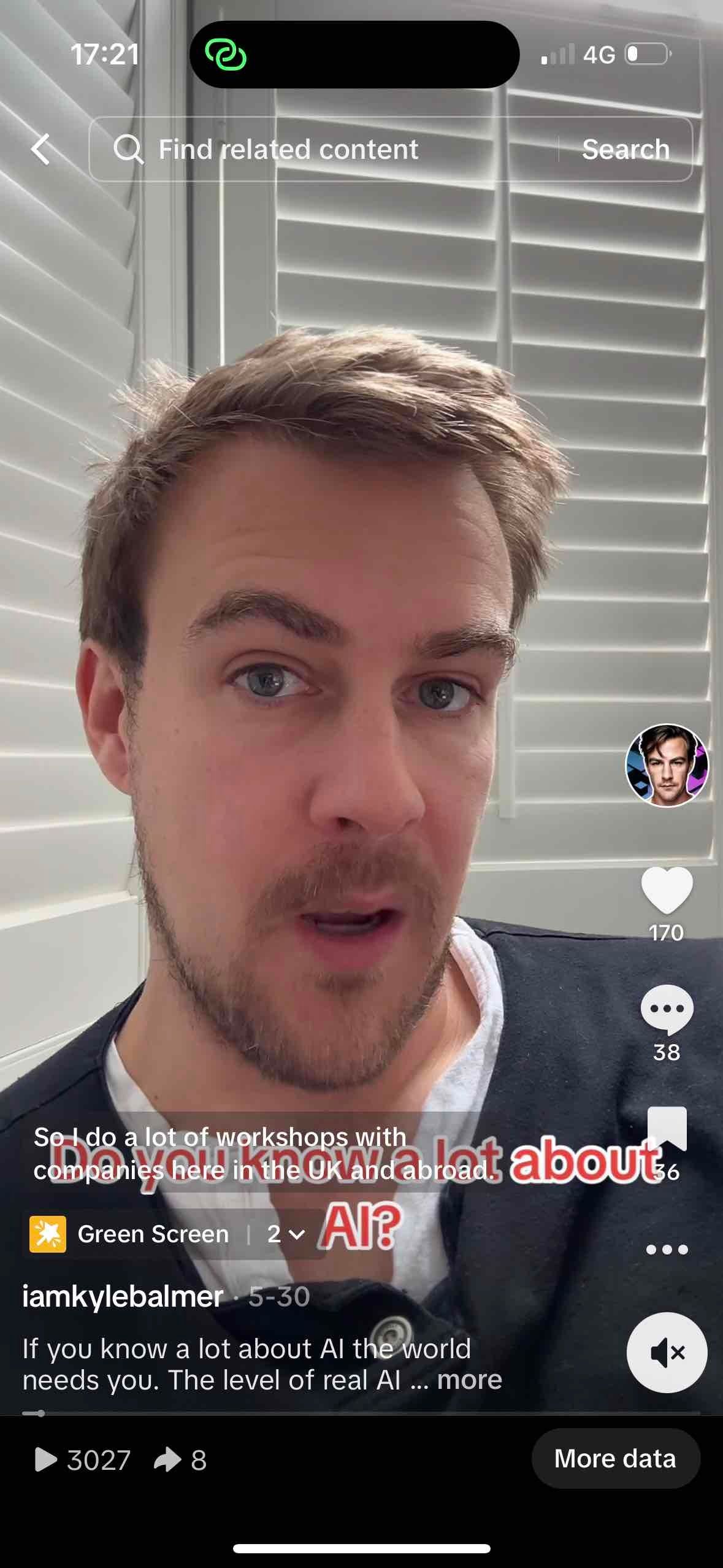
See how that says “Find Related Content”?
That means that Tiktok doesn’t know how to categorise this video. That’s my fault - I didn’t give it enough context.
Ideally that should have a term like “ChatGPT”, “AI” or "(preferably) “handsome dude” instead of “find related content”.
Those would mean that Tiktok knows the content of the video and thus is more able to show it to the right people during its tests.
To make sure the platform knows what your content is:
Make sure you know what the content is about. Keep it focused on one thing!
If speaking mention the topic several times. Platforms transcribe your voice and will use the script to categorise.
Add an on-screen title that includes the topic.
Mention the topic in the description.
Add related hashtags if the platform uses them.
Basically give several strong indications about what the content is actually about. The more you add the more likely the platform is to pick up on the clues and thus categories it properly.
Continue to produce content, guided by your lists, natively on your platform until something hits.
How long will that take? No way to say.
But because of the way interest based algorithms treat each piece of content independently you can just keep smacking away until one hits.
The first hit (probably!) won’t go to 1 million views. Technically, thanks to how these algorithms work, it can! But… don’t expect this.
Instead you are looking for the first content piece that does better than all the others.
If all your content does 200 views and then one goes to 1000 that’s a hit.
Do more of that. Less of the other formats and topics that lead to 200.
Follow what the platform is telling you. Not what you think is good. It hurts but swallow your ego for now.
If a piece works - do it again. Better this time.
Don’t worry about doing content pieces you think are the “same”. Here’s the kicker - the same people won’t be seeing the same content.
I’ve done maybe 10 videos on my RISEN™ framework. Most have a few hundred or thousand views. One has 2.1 million views. Another has 3.6 million views. Those big ones were seen by 99.9% new people.
Keep pushing on and making slightly bigger wins step by step. Consistency and volume are the key. The more you do the more you learn and the higher your chances of a hit - no way around that!
When you have a hit we can get smart and use it to drive business. More on that in the next Part.
Keep prompting,
Kyle
Once we have a piece of content that has proven itself to be popular we can really take advantage of this method.
Having a hit on our hands is extremely powerful - we’ve got something that we know the platform has rewarded.
Based on this we can make a logical leap that the platform will continue to reward this sort of content - this particular mix of topic and format.
Knowing this we double down. Let’s look at how we do that step by step.
Let’s get started:
Amplification of Winners
adding CTAs
boosting winners
full ad campaigns
building funnels from winners
First up we’re going to do the content again.
If it was a video - we reshoot a new version.
If it was a carousel - we make another.
If it was a Twitter thread - we write it over.
This time though we will make sure that there is a Call to Action (CTA) embedded into the content.
This could be a number of things:
a simple request to follow you
come and subscribe to my newsletter
download this guide/checklist/eBook (lead magnet)
book an appointment
buy now
Choose something that makes sense for the content piece. And test different call to actions.
Ideally, use the analytics attached to the piece to know where to put the CTA.
For example in the video I showed in the last Part where I called out some great AI influencers that I thought were worth a follow the average person watched until 16 seconds.
Based on that I would:
use the exact same hook in the first 3 seconds.
provide 5-10 seconds of content immediately
ask for a follow
give the rest of the content
Other than that the content would be close to identical. It would just have a call to action strategically placed in it so that if/when this content piece also does well I’ll drive traffic to the CTA.
And don’t stop here. If you find something that works keeping making variations of it. Or even making the same piece of content again and again. As long as it’s not literally the same video or photo the platform won’t flag it as duplicate content.
The next level of acceleration is to put a budget behind your content.
It’s already content that you know works. Putting money behind it will really give it gas.
Most social media platforms have a promote/boost button that you can access directly from the post. This is the most basic form of promotion and doesn’t require setting up actual advertising campaigns - making it an ideal place to experiment.
Try adding small boosts to popular content to see how much further the content goes and (if using a CTA) how it improves results.
A next level up is to prepare full advertising campaigns using the content.
You know the hook and basic body of your content works. It grabs and holds attention.
Now you convert the piece into an advert. This could be as simple as adding a CTA (as we did above) and then running it daily as an advert.
What I’d recommend though is preparing a whole range of variations. All with slightly different twists - different hooks, different lengths, different imagery, different music etc. - and running them against one another as adverts to see which performs best.
You should always be rotating in new creative and finding what works best - thankfully you already know (from your organic success) what works on the platform.
This method allows you to advertise for much cheaper than normal advertising. Having the basics of your creative worked out already by knowing it works well organically will save you huge amount of time and money in testing.
We can go even further here and use this method to actually decide our sales strategy.
Basically, as soon as you have successful piece of content that has captured attention thing about whether you can directly convert that attention into sales.
If you have a piece of content (connected to your niche and business) that goes viral you’ve struck a nerve. Don’t ignore that.
From that piece of content see if you can build out an entire sales funnel:
successful content
lead magnet
low cost item
core product
premium service
For example let’s say you run a marketing consultancy and you do a piece of content on the “3 marketing mistakes I see legal firms make every time”. That piece kicks off - lots of people are watching, liking, sharing and commenting.
In response you can spin up a lead magnet of the top 10 marketing mistakes you see legal firms making.
Then you redo your first content piece and say “by the way these are just 3 out of 10 mega mistakes I see. If you want the full PDF here’s how to get it”.
You’ll capture an email from that lead magnet and then can market your goods and services. I’d put together a 1 hour “how to avoid these mistakes” video and sell it for $30 as a first product, a full $500 audit as a core product and $2000/month consulting service as a premium service.
All off the back of one piece of content that kicked off. There’s a whole business that could be built here.
Finding market demand makes life so so much easier.
This is a lesson I’ve been bad at learning personally! I’ve made too many businesses, products and services that I think are great ideas.
But the market disagrees!
By pursuing those ideas I end up building stuff that people ultimately don’t want. And I need to get “smart” to work out how to market it to them.
Reading this you may recognise this in yourself and some of your past projects. It’s common in entrepreneurs don’t worry!
If instead you focus on building an audience and putting out content then the market will tell you what it’s interested in. And then you follow.
You swallow your ego. Your forget what you “know”. You stop talking and start listening.
Tiktokification is exciting because it gives you so many chances to listen to the market.
Each time you put out a piece of content and people don’t care you’ve learned something.
And as soon as something kicks off the market is waving a big red sign in your face saying “here it is!”. All you need to do is listen, follow and build what is being asked for.
So, what are you waiting for? Go create.
Keep prompting,
Kyle
Welcome to the '📱 Tiktokification of Social Media | AI Business Playbook,' where we explore the transformative impact of TikTok on social media marketing. This playbook is designed to equip you with actionable strategies to harness the power of the interest graph, shifting your focus from traditional follower growth to content-driven engagement. Discover how to create viral content that captivates your audience and drives results, leveraging AI tools and insights from industry leaders like Gary Vee. Whether you're a seasoned marketer or just starting, this playbook will guide you through the new landscape of social media, ensuring your business thrives in the age of TikTokification.
This playbook is designed for entrepreneurs, marketers, and business owners looking to adapt to the evolving social media landscape. If you're struggling to reach your audience amidst the noise of traditional marketing methods, this playbook will provide you with innovative strategies to cut through the clutter. Perfect for those who are eager to pivot their approach and leverage platforms like TikTok to maximize engagement and drive sales.
No, this playbook is suitable for all levels, from beginners to seasoned marketers.
The time commitment varies, but many strategies can be implemented in short bursts, making it manageable alongside your other responsibilities.
TikTok's interest graph allows even accounts with few followers to gain significant reach if the content is engaging.
Absolutely! While TikTok is the focus, the principles of content engagement apply across all social media platforms.
Basic video editing tools and access to social media platforms are sufficient to start implementing the strategies in this playbook.