
AI playbook
Are you ready to unlock the potential of affiliate marketing with the power of AI?
Start ReadingWe asked you last week if you wanted an in-depth guide on how to start a business using ChatGPT and you answered with a resounding YES!
We followed that up with another poll (yay democracy!) on which business you wanted us to cover. The results said:
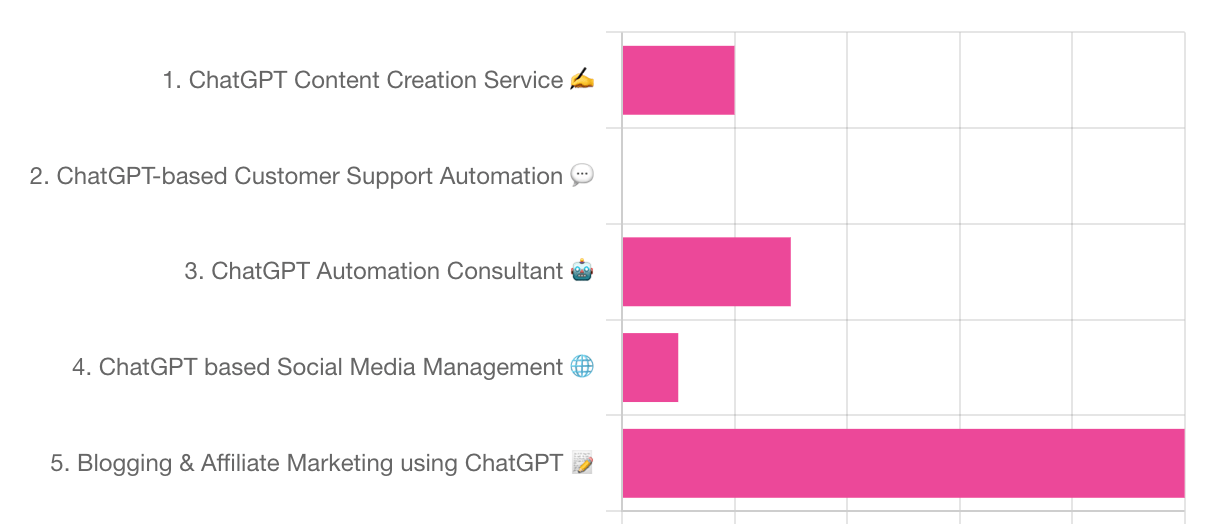
Blogging & Affiliate marketing using ChatGPT! Nice!
This is one that’s near and dear to my heart.
My first big blog was https://learnchinesecharacters.academy/, a blog site to help people learn Chinese characters. In fact this was my FIRST online business.
Therefore helping others get started in this space is really exciting
In short this business revolves around:
Setting up a blog that attracts traffic
Adding "affiliate” links to your content that, when clicked and lead to a purchase, pay you a % of the purchase.
For example if I add an Amazon link to some £120 Birkenstock sandals into one of my blog articles and someone clicks the link, goes to Amazon and purchases I will get 10% or £12 from Amazon.
If I can send 100 people to purchase via that link I will generate £1200.
The key with affiliate marketing is volume, which comes from ranking well on Google which, in turn, depends on having lots of good content on my blog.
Blog articles are the engine that drives affiliate marketing: news, reviews, features, comparisons, in depth breakdowns of products in my affiliate category.
Blogging and affiliate marketing is BIG business
According to Statista, affiliate marketing spending in the U.S alone was set to hit $8.2 billion by 2022. Furthermore, a report by Hosting Tribunal reveals that bloggers who earn over $50,000 per year spend an average of 3-10 hours writing a blog post, while 63.2% of those earning over $2000/month invest less than 3 hours.
You're probably thinking: "That sounds amazing, but how do I keep up with the constant demand for fresh content?" A blog needs to be fed with LOTS of new, fresh, quality content for Google to take notice.
With ChatGPT, you can create quality content faster and more efficiently, allowing you to stay ahead of the curve, and offering you a competitive edge in today's fast-paced digital environment.
ChatGPT means that affiliate marketing is at an inflection point where business owners who use AI can outstrip business owners who do not.
And I’m not just talking about blog writing - ChatGPT can be used at all points in the set up and operation of an affiliate marketing focused blog.
And that’s just what we’re going to show you this week!
It’s going to be a busy week. But by the end you’ll have the structure, system and prompts to launch your own affiliate blog. In brief here’s the week:
Market Research and Niche Selection: This stage involves identifying your interests and passions, conducting keyword research to understand what potential readers are searching for, analysing your competition to identify their strengths and weaknesses, and validating your chosen niche to ensure there's a viable market and potential for monetization.
Blog Setup and Design: This stage involves choosing a blogging platform, selecting a domain name that's relevant and easy to remember and designing a brand.
Content Creation with ChatGPT: This stage involves developing a content strategy and calendar, using ChatGPT to generate content such as blog posts, outlines, and new content ideas, editing and optimizing the content for accuracy, style, voice, and SEO, and including affiliate links in a natural, non-spammy way.
Promotion, SEO, and Link Building with ChatGPT: This stage involves using ChatGPT to generate SEO-friendly meta descriptions, title tags, and alt text for images, promoting your blog posts on social media, building an email list and sending regular newsletters, reaching out to other bloggers for guest posting opportunities and link building, and monitoring and adjusting your strategy based on your blog's performance data.
And here’s a challenge. I’ve intentionally split this guide up over four emails so you have a handful of actions to do daily. Instead of being overwhelmed. So if you are up for up, follow along.
Connect with me on Twitter and let me know how it’s going.
The first step is to identify what you're passionate about. This could be anything from cooking to technology to fitness.
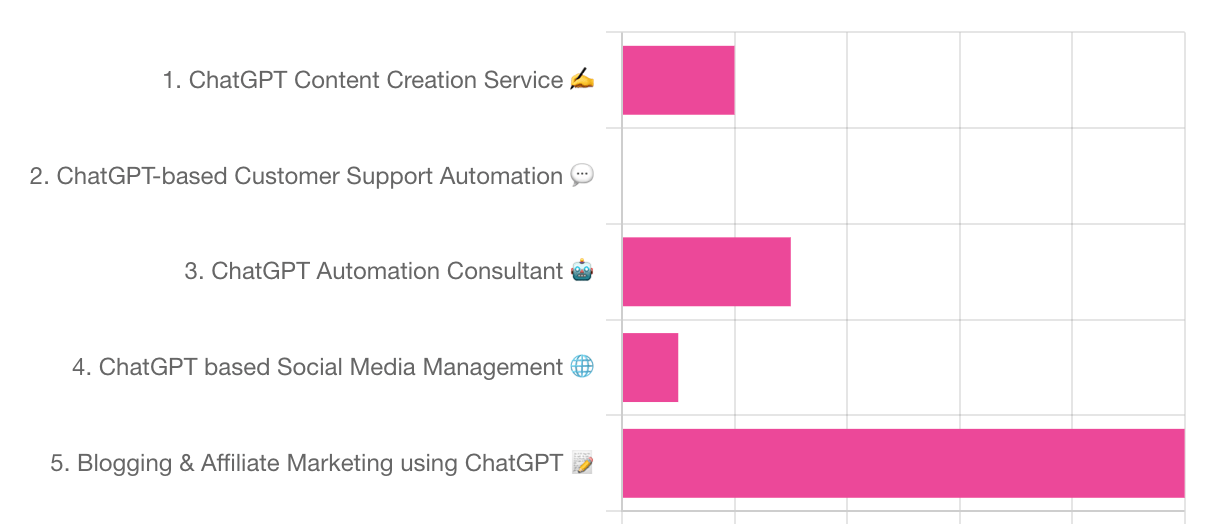
Here is an initial ChatGPT prompt to start brainstorming topics:
As a brainstorming assistant, generate a list of potential blog niches based on my interests in [insert interests here].

The goal is to come up with unique and engaging niches that combine these interests. Combine interests where they naturally intersect but do not force combination. Please avoid overly wide niches.
Plug in interests, your work area, skills, hobbies. Anything that is important to you.
It’s important that we start from a basis of what you actually want to write about if we want to create a unique and genuinely interesting blog.
Yes, we’ll be using AI to help with writing later but we need the personal touch from working with a topic we want to write about and have the authority to write about.
Once you've identified your niche, it's time to conduct keyword research. This will help you understand what potential readers in your niche are searching for.
Keywords are basically how people use Google - their search terms.
You can use tools like Google Keyword Planner, SEMrush, or Ahrefs, or you can ask ChatGPT to get started.
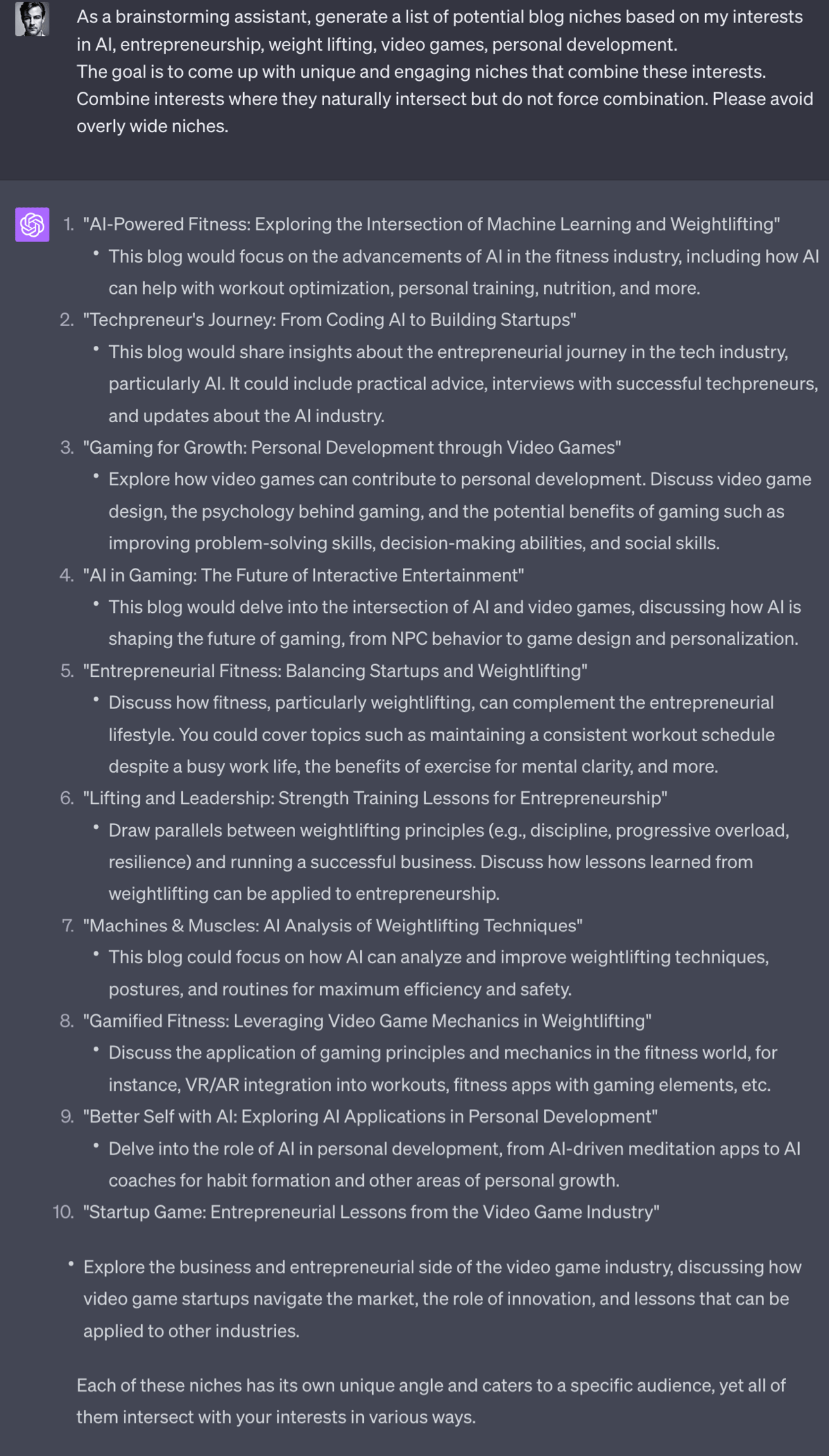
As a SEO assistant, suggest a list of potential keywords for a blog focused on [topic]. The task involves identifying high-volume, low-competition keywords.

The goal is to find keywords that can drive organic traffic to the blog. Please avoid extremely competitive keywords.
For topic take the topic you’ve decided upon from the first step. Or plug in the whole answer that ChatGPT gave you (with title, description etc.) to get even more detail.
For better results use the ChatGPT plugin SERPstat SEO tool to use live data. Requires paid ChatGPT plan
Alternatively take your keywords to Google Ads Keyword planner to get precise keyword volume and competition. Free tool.
Also plug your topic into Answer the Public to start to widen your keywords and see the sort of blog topics you could be writing.
Understanding your competition is crucial. Look at the top blogs in your chosen niche. What are they doing well? What can you do better or differently?
ChatGPT can help with this:
As a competitive analysis assistant, provide an analysis of the top three blogs in the [topic] niche. The task involves identifying their strengths, weaknesses, and unique selling points.

The goal is to understand what they're doing well and where there are opportunities for differentiation.

Please avoid personal opinions and stick to objective analysis. Present results in a table.Using [entrepreneurship and fitness] as the niche:
Finally, you need to validate your chosen niche. Is there an audience for your topic? Are there affiliate programs available?
ChatGPT can assist with this validation:
As a market research assistant, validate the potential of the entrepreneurship and fitness niche. The task involves identifying the size of the audience, potential for monetisation, and availability of affiliate programs.

The goal is to ensure there's a viable market for this blog. Please avoid assumptions and use data-driven insights.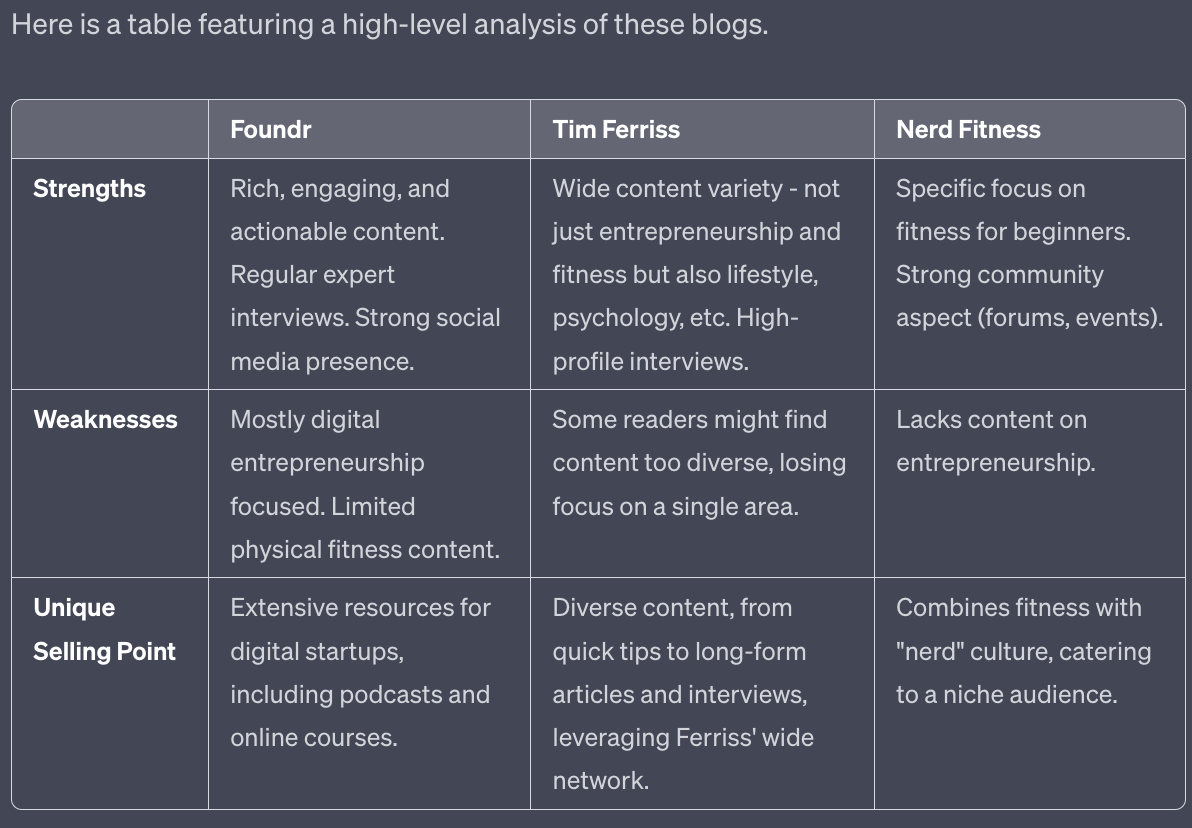
These four prompts will get your started with defining what exactly your blog is going to be about.
We started with your skills and interests, combined this with keyword research to convert into “Google speak” then checked competition and business viability.
If the results from ChatGPT aren’t encouraging (especially in prompt 4!) go back and tweak your variables until you land on something more promising.
It’s super important to have a strong, exciting idea that also has a market for you build a business. Getting this stage right will make the rest of the process much easier!
And remember, over the next few days we’re going to cover the three remaining steps:
Blog Setup and Design: This stage involves choosing a blogging platform, selecting a domain name that's relevant and easy to remember and designing a brand.
Content Creation with ChatGPT: This stage involves developing a content strategy and calendar, using ChatGPT to generate content such as blog posts, outlines, and new content ideas, editing and optimizing the content for accuracy, style, voice, and SEO, and including affiliate links in a natural, non-spammy way.
Promotion, SEO, and Link Building with ChatGPT: This stage involves using ChatGPT to generate SEO-friendly meta descriptions, title tags, and alt text for images, promoting your blog posts on social media, building an email list and sending regular newsletters, reaching out to other bloggers for guest posting opportunities and link building, and monitoring and adjusting your strategy based on your blog's performance data.
See you tomorrow Prompt Entrepreneur!
Until then, keep PROMPTING!
Kyle, Harms and 🤖
PS: Remember to refer a friend to our newsletter and unlock Facebook Advertising Mastery using AI 👇.
Today is Part 2 of our deep dive into Starting an Affiliate Marketing Blog with ChatGPT
If you missed Part 1 here’s the link: Starting an Affiliate Marketing Blog with ChatGPT PART 1
FYI we’ll be compiling the whole guide into one document with additional resources later. Stayed tuned for more details on how to get that document + additional resources.
First up we need to chose what we’re building our blog on.
ChatGPT is not going to build our blog for us. That’s not what it’s for.
Instead we can use ChatGPT to explore options and make suggestions based on our personal circumstances.
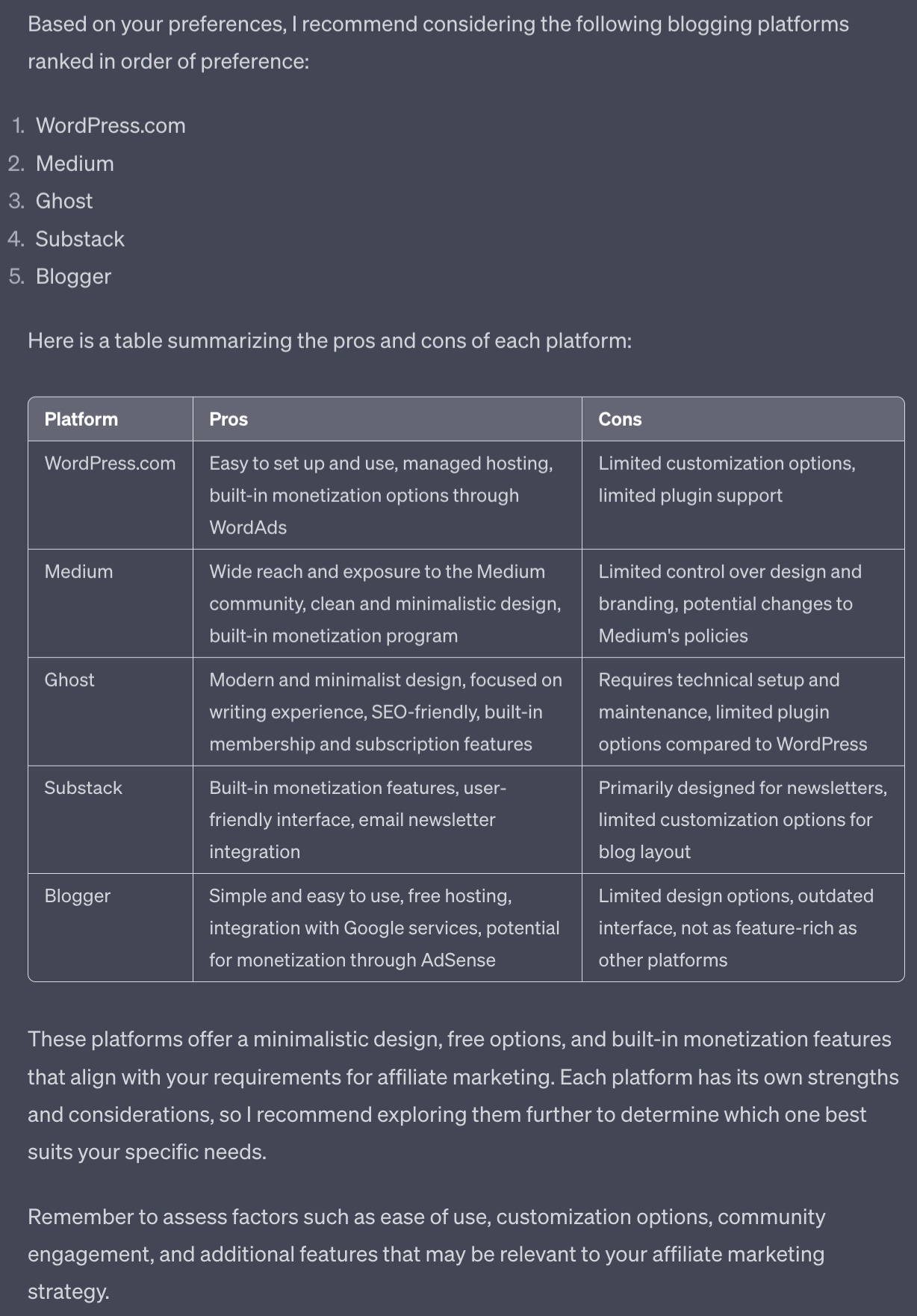
As a affiliate marketing advisor, walk me through my choice of the best blogging platform.

Ask me questions about my budget, my technical experience and how much time I can commit to this project.

Possible blog platforms include but are not limited to Wordpress self-hosted, Wordpress.com, Medium, Ghost, Wix, Squarespace, Weebly, Blogger, Substack and beehiiv.

SEO is important for this blog. Traffic will come from Google SEO primarily and social media secondarily.

Return your ranking of results in order of highest to lowest preference based on my responses, with pros and cons of each platform, in a table.
This prompt will run you through a similar set of questions to what I would personally ask you if we were sitting together.
This helps narrow down the potential blogging platform. Supplement this with your own research of course!
If you want a quick answer though - if you are good at tech go with self-hosted Wordpress + an Elementor theme. If you are not good at tech go with beehiiv (if you are also interested in a newsletter at some point - and it makes sense for your niche) or Wordpress .com (if you don’t want a newsletter).
Next we’re going to generate a killer name for our affiliate blog.
Use the prompt below to generate a list of names.
Plug in your niche and top 2-3 keywords from the previous Step 1.
Act as a marketing consultant.
Generate 20 potential business names
My business is a blog that is focused on [niche]
We provide educational content, news and reviews
Use the following keywords as inspiration: [copy paste top keywords]
Ideally the business name should incorporate a top keyphrase but also generate ideas outside of these keyphrases
Focus on easy to say and write names using simple language that works for SEO
Keep the business name to 2-3 words maximum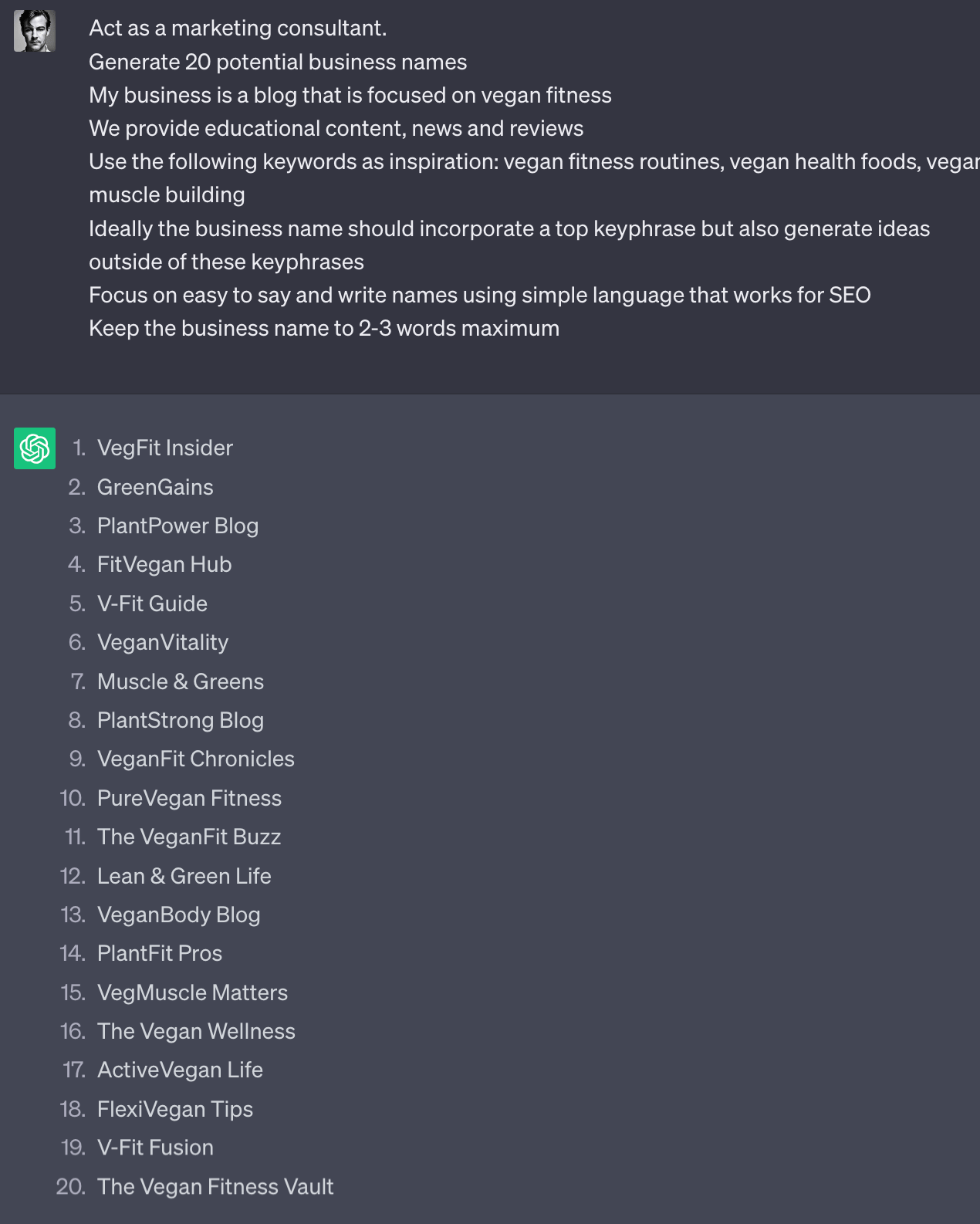
Once you’ve generated a list of names go through and choose the ones you like the sound of.
If you need more just enter “more” into ChatGPT.
If you want a different style, for instance more professional sounding, go ahead and tell ChatGPT: “more professional”.
Continue doing this until you have 10+ names that you like.
Next step is to go to https://www.namecheckr.com/
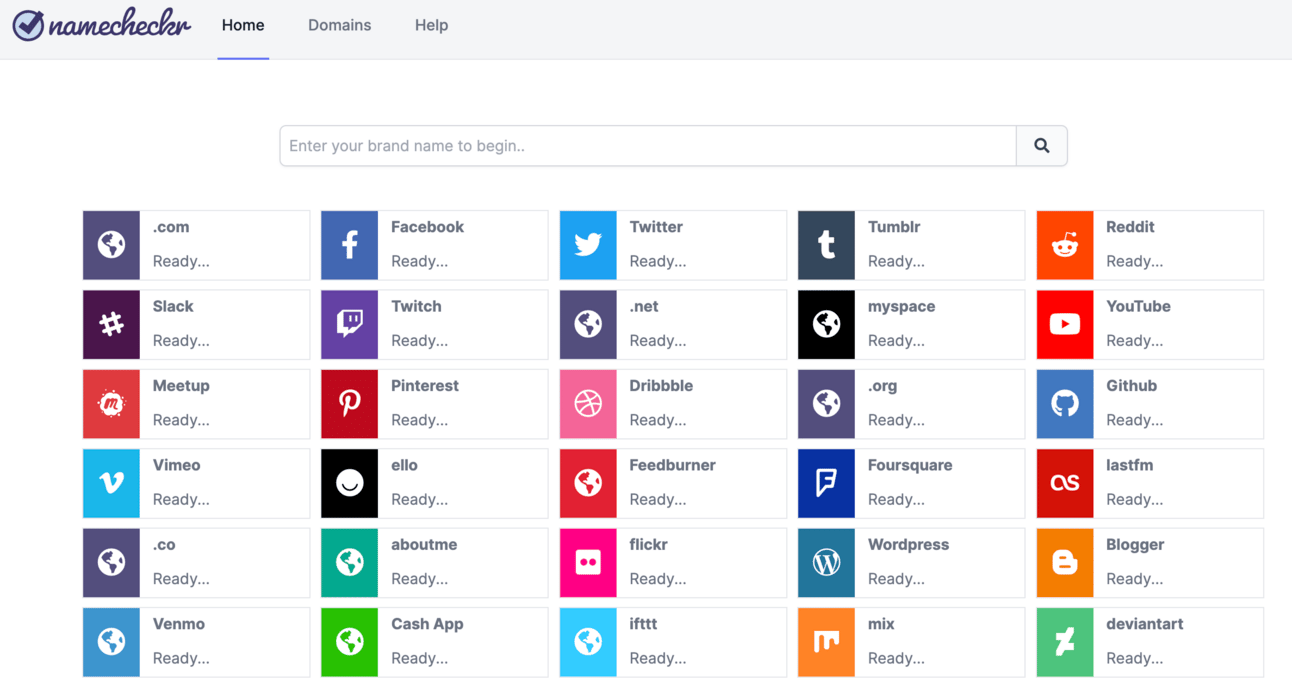
This website lets you check name availability on multiple platforms at once. Plug your business name in to see if it’s available.
You are looking for name that is available on:
.com
Youtube
And TikTok, which you need to check manually.
Once you’ve found a name that i) you love and ii) is available on all or most platforms you’re good to go.
Now we have a name let’s flesh out the brand a bit by building up some brand guidlines.
Here’s the prompt:
Act as a branding consultant

Prepare a set of brand guidelines for an affiliate blog in [niche]
The name of the blog is [name of blog]
The main keywords the blog will be ranking for are [top keywords]

Provide me with a brand description, elevator pitch, target market, brand promise, brand mission, value proposition, brand voice/personality and brand culture.
As always, plug in your specific details.
Notice how we are using results from previous steps in each new prompt - we’re iterating and adding more detail each time.
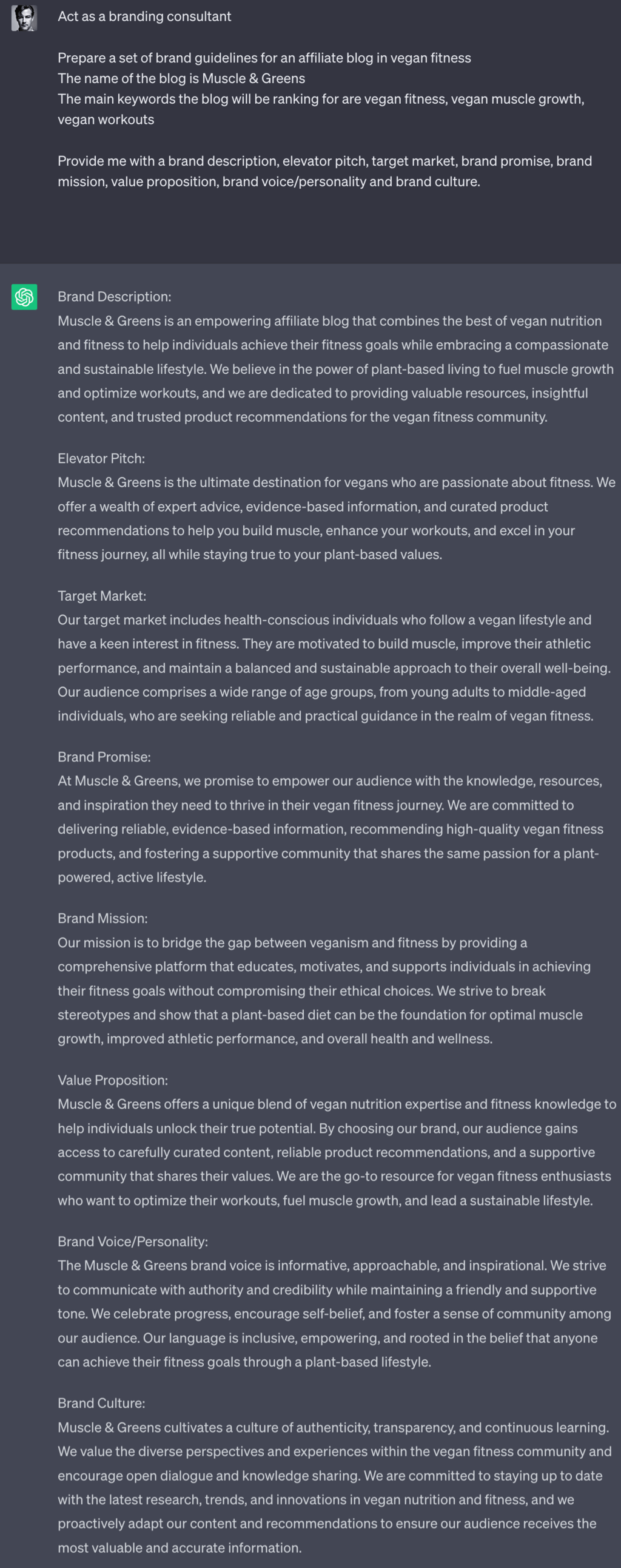
Adjust as required, specifying changes directly to ChatGPT until you are happy with each section. We’ll be using all of this in the next section so make sure you
We’ve got our blogging platform decided. We’ve chosen a name. We’ve got some brand guidelines.
Go ahead and set up the basics of your blog. If you need instructions on how try “steps to set up an affiliate blog on PLATFORM NAME” in ChatGPT or head to Google/Youtube to follow some tutorials.
Whichever platform you chose we’re going to need some basic “copy”.
Copy is short for copywriting and is basically text about our business.
We’re going to use this copy in lots of places: our website, on our social media accounts. Basically generating a whole load of copy that be plugged into your blog and social media whenever needed.
Act as a marketing copywriter

The affiliate blog's topic is [niche]
Create copy for my affiliate blog named [blog name]
The primary keywords are [top keywords]
Incorporate information from these brand guidelines
#brand guidelines begin#
[copy/paste brand guidelines]
#brand guidelines end#

Use this information to generate

Company slogan
Tagline
Blog home page headlines x 5
Blog home page subheadline x5
Primary features/benefits of the blog
Page meta description
Twitter bio description
Instagram description
Facebook page description
LinkedIn Page About Us description
Tiktok description

Provide results in tabular format
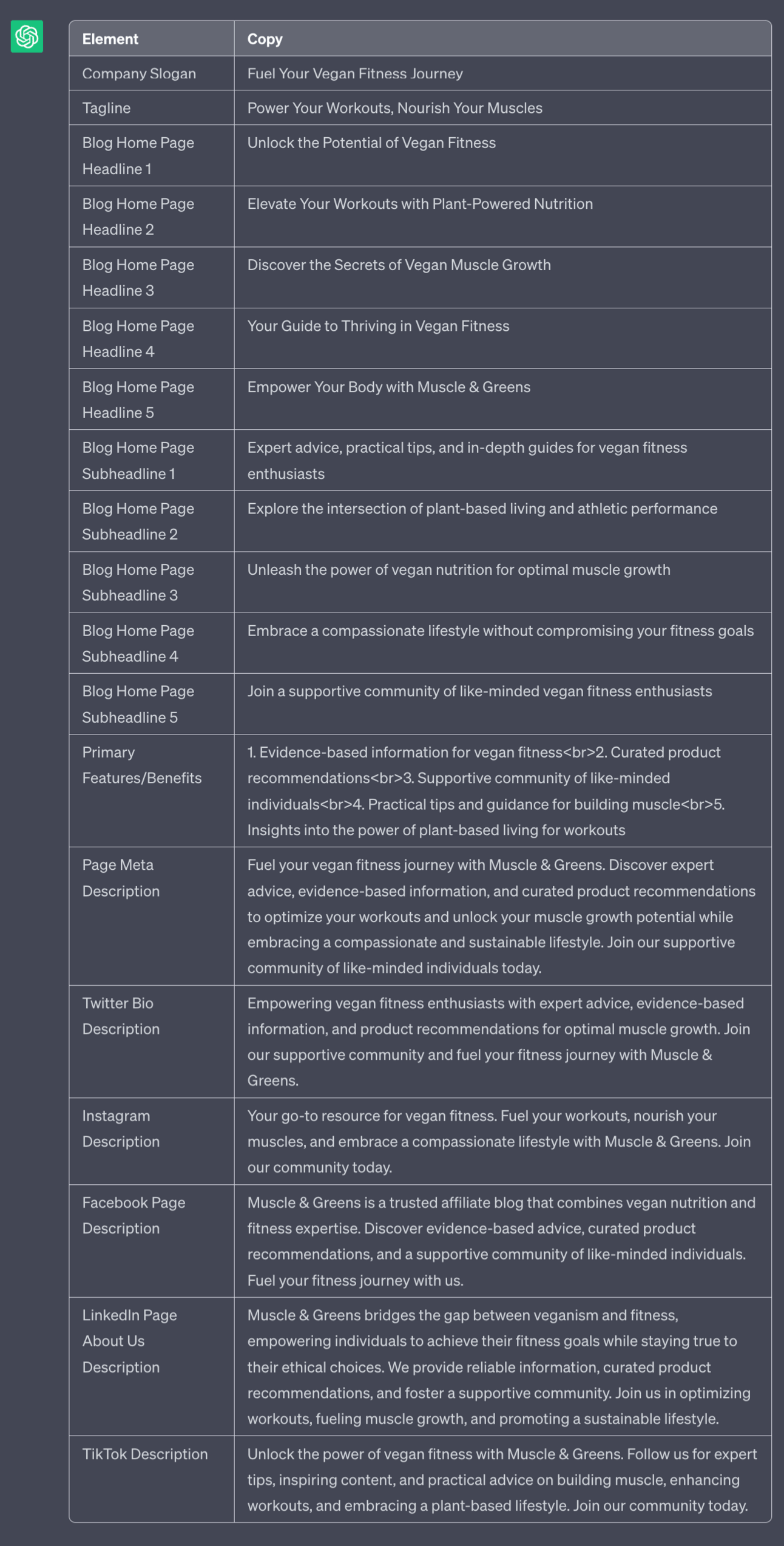
Need additional specific copy? Use the same prompt + details and just change the outputs you want.
Wrapping up today we’re going to generate instructions for a brand logo.
Here’s the prompt:
Act as a visual designer

Based on the provided brand guidelines describe 5 logo ideas

The company name is [company name] and should be the only text in the logo
#brand guidelines begin#
[copy/paste brand guidelines]
#brand guidelines end#

Provide logo description, colors with hex code, text font and size if included.
These descriptions will be used as creative briefs so be exhaustive in your details

Provide in tabular format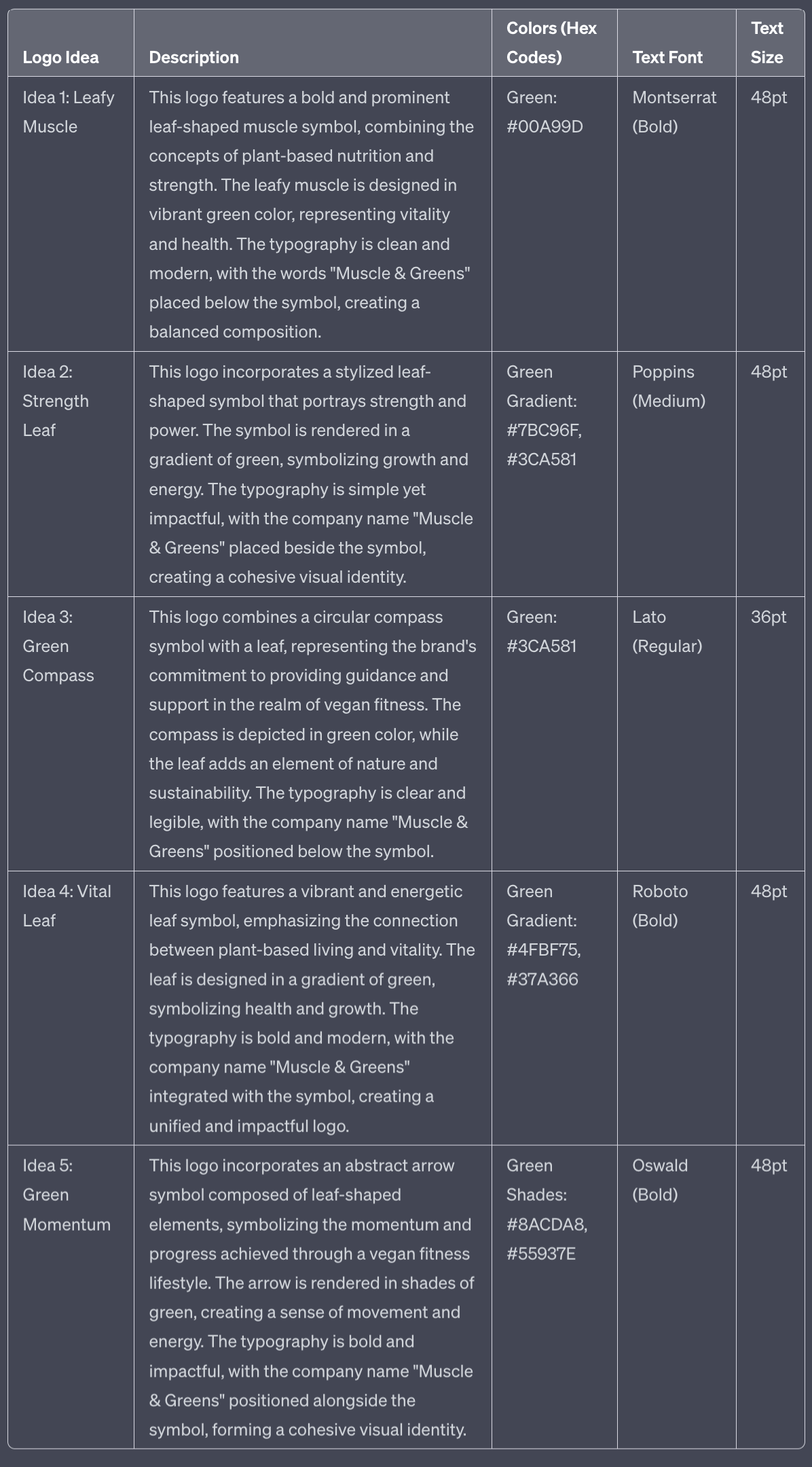
Now that we have a text description we have a few options.
First up you can hire a designer on Fiverr or Upwork to design the logo for you. Provide them with your logo specification as a starting point.
Alternatively you can use an AI generator to create your logo. Here’s Midjourney’s attempt of the first logo (Leafy Muscle):
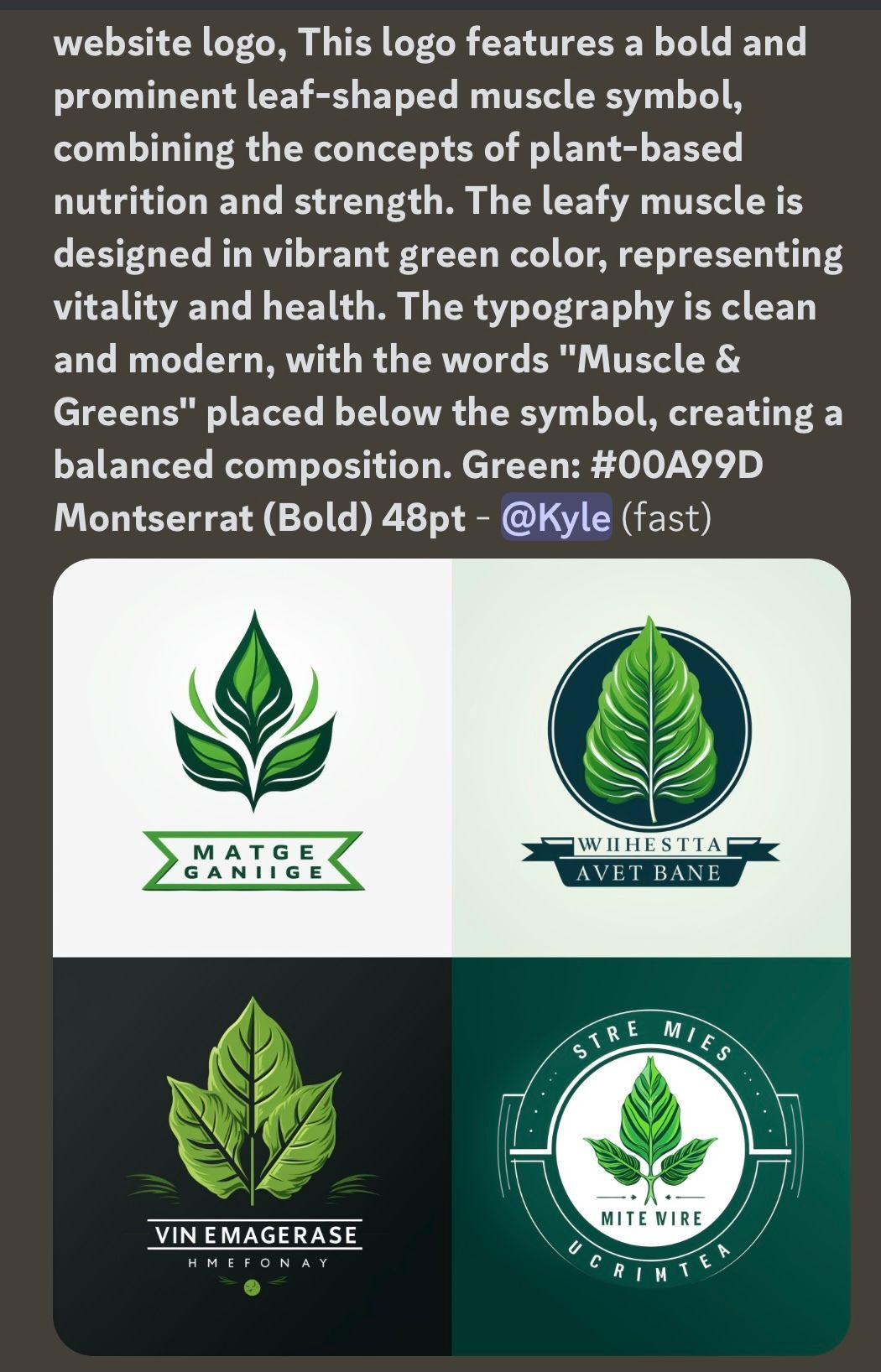
You’ll notice that Midjourney is good at the visual elements but not the text elements! So these would need to be edited to adjust the text. If you’re good with Photoshop this is strong alternative.
Teaching how to set up Midjourney is beyond this article. Here’s the quick start guide.
Wow!
We’ve got a LOT done in these past 5 prompts.
You now have the basics of your brand ready. Go ahead and plug all these details in your blog platform of choice.
We’ve now done the main setup for the business: deciding the niche and setting up the brand basics. Good job!
Over the next 2 days we’re going to get into the MEAT of affiliate marketing using ChatGPT - creating the content and getting it seen.
Content Creation with ChatGPT: This stage involves developing a content strategy and calendar, using ChatGPT to generate content such as blog posts, outlines, and new content ideas, editing and optimizing the content for accuracy, style, voice, and SEO, and including affiliate links in a natural, non-spammy way.
Promotion, SEO, and Link Building with ChatGPT: This stage involves using ChatGPT to generate SEO-friendly meta descriptions, title tags, and alt text for images, promoting your blog posts on social media, building an email list and sending regular newsletters, reaching out to other bloggers for guest posting opportunities and link building, and monitoring and adjusting your strategy based on your blog's performance data.
See you tomorrow Prompt Entrepreneur!
Until then, keep PROMPTING!
Kyle, Harms and 🤖
PS: Remember to refer a friend to our newsletter and unlock Facebook Advertising Mastery using AI 👇.
Today is Part 3 of our deep dive into Starting an Affiliate Marketing Blog with ChatGPT
If you missed Part 2 here’s the link: Starting an Affiliate Marketing Blog with ChatGPT Part 2
FYI we’ll be compiling the whole guide into one document with additional resources later. Stayed tuned for more details on how to get that document + additional resources.
First up we’re going to have ChatGPT help work out our high level content strategy.
We’re borrowing an SEO concept called content pillars: in short having a range of content all grouped into categories.
We’re then asking for blog types within these pillars: for instance reviews, testimonials, expert advice.
Here’s the prompt:
Act as a affiliate marketing expert.
Help me to design a content strategy for my affiliate marketing blog.

The category is [niche]

My keywords are [copy/paste keywords]

Provide 5 content pillars

Provide 3 blog formats per content pillar, each should be text, no video or image based content

Give examples of each of the content types for each of the 5 content pillars for a total of 15 content pillar/format combinations

Take into account these brand guidelines in your response

#begin brand guidelines#
[copy/paste brand guidelines]
#end brand guidelines#

Provide everything in tabular format
Plug in your niche and top keywords to customise the prompt to your needs.
Also drop in your brand guidelines to help ChatGPT modify suggestions. For instance if your brand is focused on ethical consumption and organic goods this will be added into your content strategy.
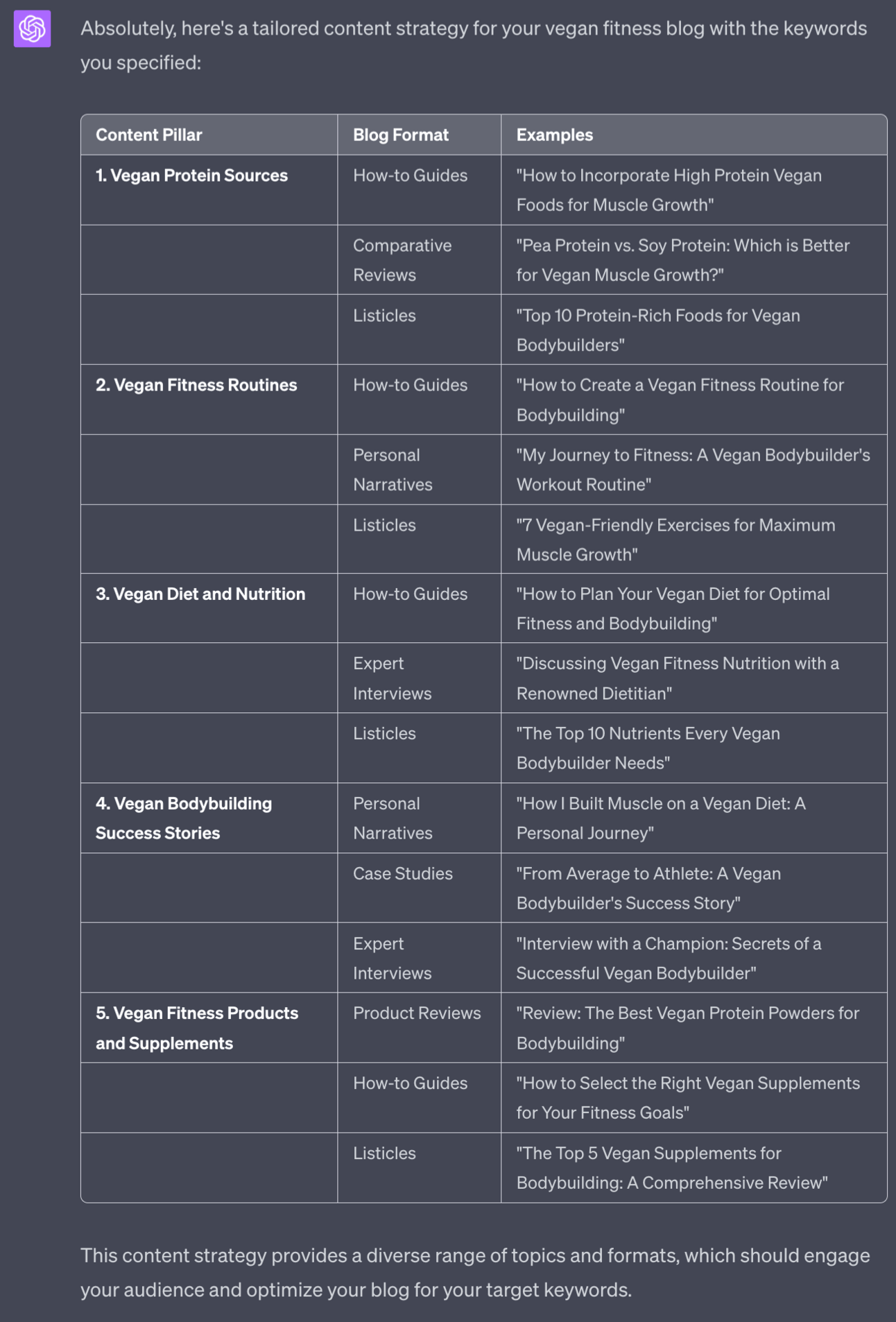
As always if any content pillar or blog format doesn’t interest you ask ChatGPT to make the appropriate changes.
When happy we’ll be using this strategy in the next step.
Armed with our content strategy we’re now going to have ChatGPT come up with blog titles.
The blog titles are the first step in SEO and generating traffic - the titles will be the starting point for the actual blog articles themselves. So we need great blog titles first and foremost.
As an affiliate marketing expert use the provide content strategy to generate blog titles for my affiliate blog

My blog is focused on [niche]

My top keywords are [top keywords]

I will provide you with a content strategy which contains 5 Content pillars, each of which has 3  blog formats for a total of 15 combinations.

For each of the combinations generate 20 potential SEO optimised and clickable blog titles. Keep each title between 50-60 characters optimally.

Provide results in list format.

#content strategy begins#
[copy/paste content strategy]
#content strategy ends#This prompt is going to kick out a LOT of information.
300 blog titles in fact.
Here’s the output for just one of the content pillars:
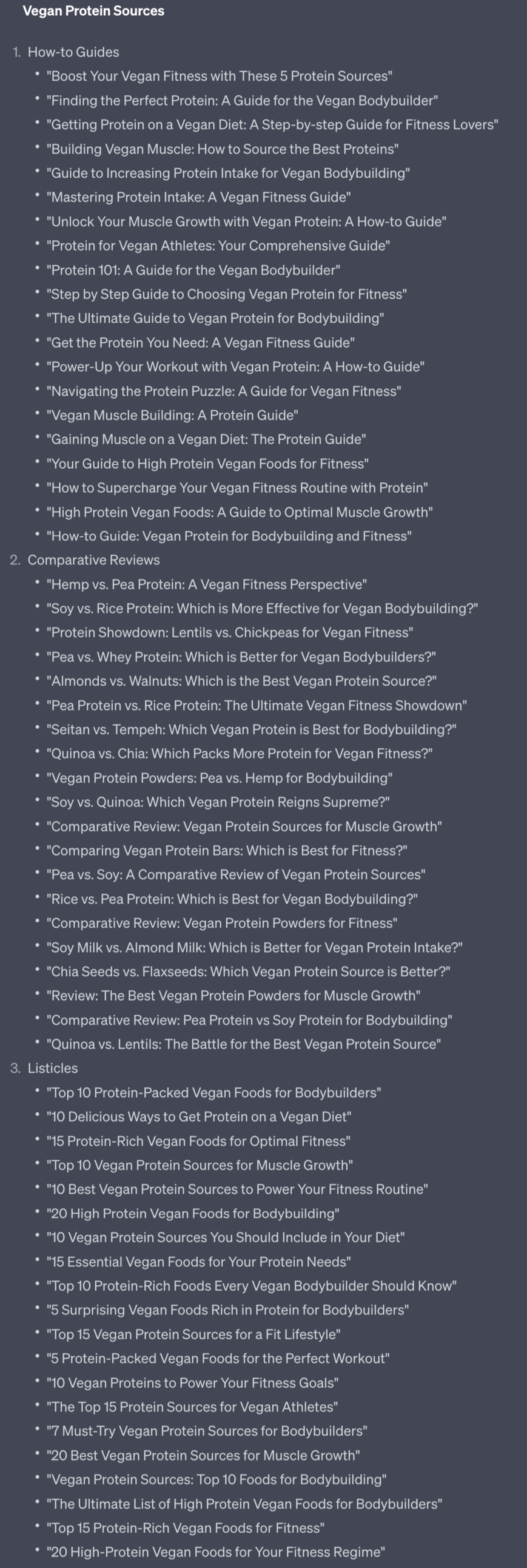
This is 20 blog titles per format type. And there are 3 format types per content pillar. For a total of 300 blog article titles.
This is going to give you and extremely wide range of coverage for SEO and will lead to interesting and readable content.
We could have just asked for 300 blog articles about one topic - that might be good for Google SEO.
But imagine how boring that blog is going to be for actual human readers. Very!
So instead we are building up an interesting base of content pillars and format types for variety.
We’re now going to take these blog titles into blog creation.
First up - the elephant in the room. SEO and AI.
Lots of people say that AI content will not work for SEO because Google will eventually deprioritise it and stop showing it to visitors.
This is true.
If I just went into ChatGPT and said “write me a blog post on vegan protein sources”. ChatGPT would create something generic that sounds very “AI”.
Try it now! The results will be rubbish.
But what we’ve been doing up, through these multiple steps, is building up material so that our blog posts will be unique and undetectable as AI generated.
We started in Part 1 with keyword research and choosing our niche. In Part 2 we built on this with a name and brand guidelines, which were built on Part 1.
We’ve now folded all of this information from Part 1 and 2 into today’s work - our content strategy and blog titles are based on the brand guidelines which in turn are based on prior work!
See what we’ve been doing? Each time we build on past work we’re making the results more and more unique. This is why it’s important to go step by step, always using outputs from the previous work in new prompts.
Now we’re going to use all of this to generate unique, interesting and undetectable SEO optimised articles.
Here's the prompt:
Act as a SEO blog writer.

Write a 750-1000 word SEO optimised blog article with the title :  [title]. Optimise the article for keyphrases in the title.

This is a [blog format] article

Use the AIDA writing framework

Use subheadings, bullet points and make suggestions for images when appropriate

Implement the following brand guidelines, paying special attention to the tone of voice

#brand guidlines begin#
[copy/paste brand guidelines]
#brand guidelines end#This will kick out an entire blog article for you. Here it is, apologies for the size!
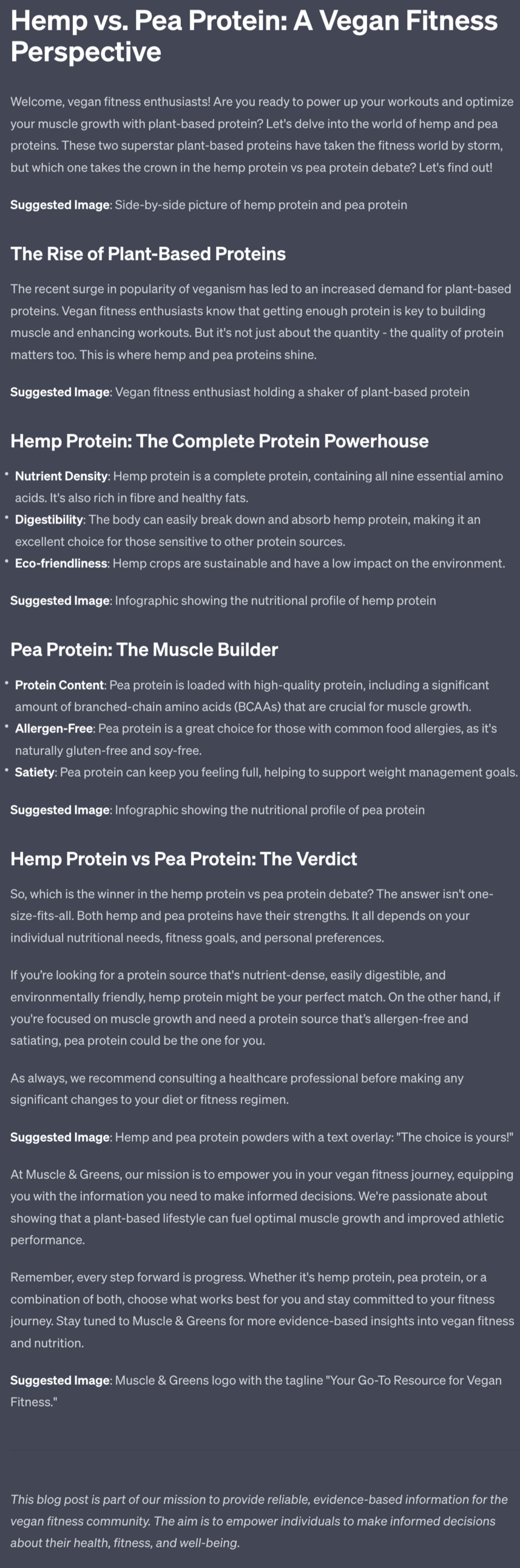
This article will include all of your previous work, which makes it much more undetectable as AI written.
However, it’s still good practice to take you article over to https://contentatscale.ai/ai-content-detector/ to run a check.
This will show you parts of the article that seem to be AI written. Delete or rewrite these parts. If possible make use this manual edit to really add some human spin.
For example in this article “The answer isn’t one-size-fits-all” was flagged up as likely to be AI generated. So I switched it out to “Sadly, it ain't that easy!” which passed with flying colours.
Even if you need to do a little manual tidying you’ve still got the bulk of the work done in seconds rather than hours.
Or you’ve saved yourself having to hire a writer to prepare the article for you. A 750 word blog article on Fiverr is $20+ so 300 articles like this would cost you $6000. Oof.
Instead on your side you need to simple swap out the title and generate more.
Now that you’ve seen how to generate articles en-masse let’s loop to the affiliate products we’re going to promote.
You might be wondering why we’ve left this so late.
There’s a reason: we want to focus on making good content first.
If we instead find the affiliate products first there’s a temptation just to write about the affiliate products.
But guess what…that’s what every other affiliate marketer is doing.
Instead we’re going to build a solid base of quality content on a range of subjects. Make the blog genuinely useful. And then plug in relevant affiliate offers.
Here’s the prompt:
Act as an affiliate marketing specialist.

I will provide you with a blog article and with brand guidelines

Based on both of these please provide me with a list of 20 potential affiliate offers options I could feature in the article. I will feature one offer but provide me with options so I may choose.

#blog article begins#
[copy/paste blog article]
#blog article ends#

#brand guidelines begins#
[copy/paste brand guidelines]
#brand guidelines ends#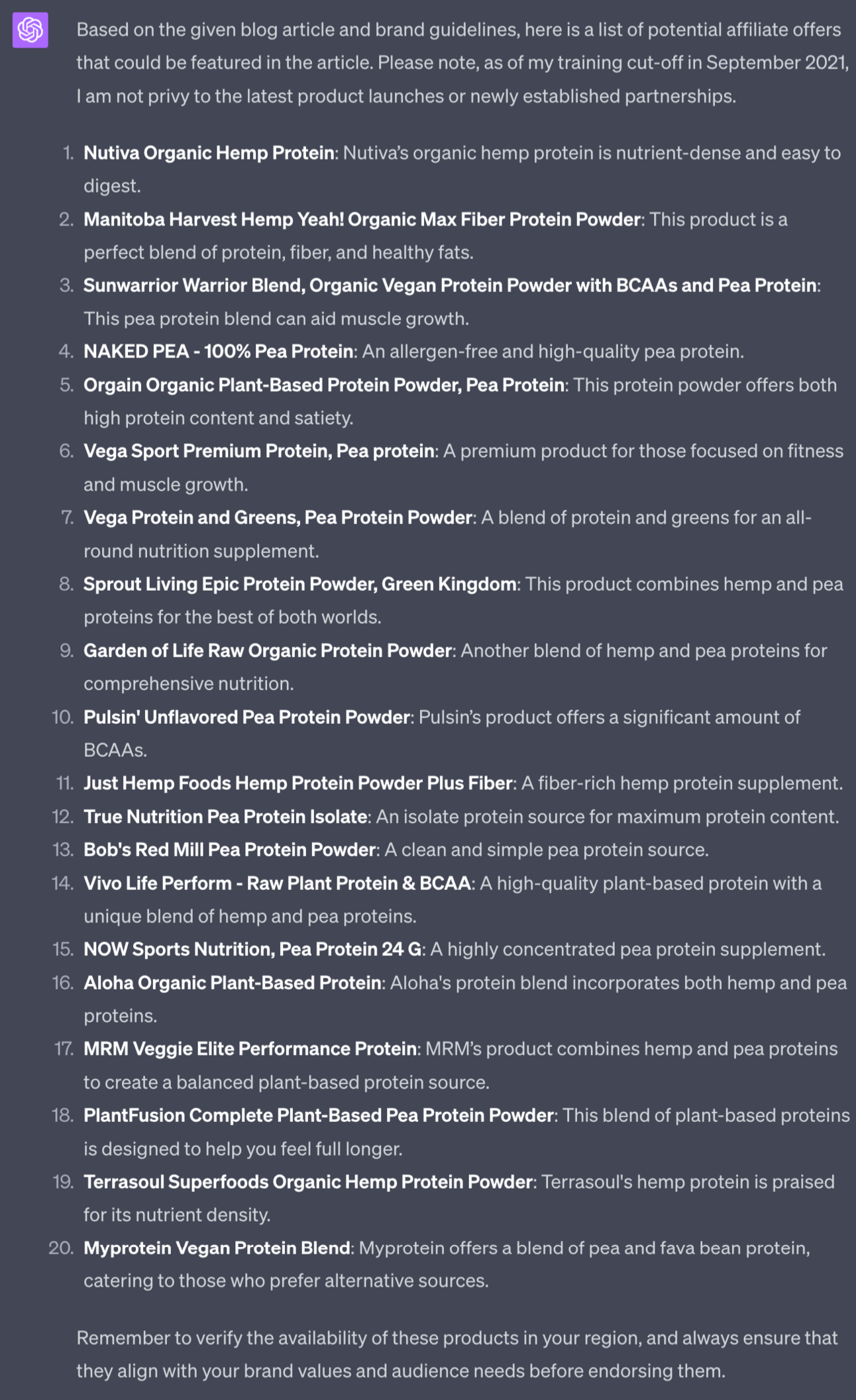
This spits out 20x potential affiliate offers.
I’ve not asked the prompt to give direct links. This is because ChatGPT tends to make up links when it doesn’t know.
Instead use this to Google the product along with the word “affiliate” to find the affiliate sign up page.
Most products will also simply be on Amazon. If that’s the case you can just recommend the Amazon listing via Amazon Associates. Simple.
Seems like lots of work? Yes and no. Once you’ve done this process a few times with your first blog articles you’’ start to know the affiliate landscape for your niche.
And then you can simple recommend the same products in multiple blog articles. This prompt is therefore primarily to get you started.
Once you’ve chosen the product from the list use this prompt (in the same window) to close out the article.
Act as an affiliate marketing blog writer.
Take the blog article from above and weave in a product recommendation for [chosen product] where appropriate
make the recommendation subtle and part of the flow of the article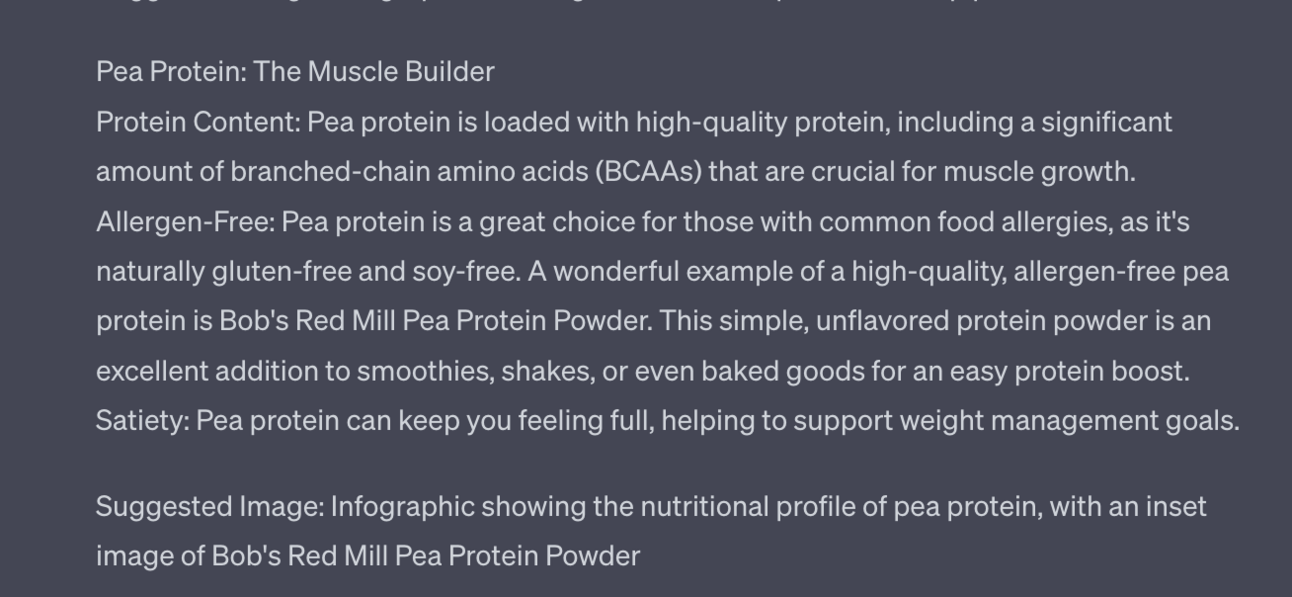
This will take the product that you’ve recommended and adjust the original article to fit it in naturally.
Notice that we went from blog article to product back to article.
The content came before the sale. This ensures a higher quality affiliate marketing blog than your competitors.
In your blogging platform simple turn Bob’s Red Mill Pea Protein Powder into a link and insert your affiliate link. Done.
OK we’ve broken the back of the process!
Today was the meat and potatoes of SEO : creating content, en masse, to drive traffic.
Now that we have a process in place to create this content you need to set yourself a target output and keep producing.
More is better. Always. But set a sustainable target for yourself moving forward.
Tomorrow we’re going to move on to how to get the word out about your blog and start driving traffic to kickstart the SEO process.
See you tomorrow Prompt Entrepreneur!
Until then, keep PROMPTING!
Kyle, Harms and 🤖
PS: Remember to refer a friend to our newsletter and unlock Facebook Advertising Mastery using AI 👇.
Today is Part 4 of our deep dive into Starting an Affiliate Marketing Blog with ChatGPT
FYI we’ll be compiling the whole guide into one document with additional resources later. Stayed tuned for more details on how to get that document + additional resources.
This Part of the guide focusing on starting to build traffic for your blog.
Traffic is the fuel that starts your affiliate marketing engine - so we need as much as possible.
We’re going to look at Search Engine Optimisation (SEO), social media and link building as methods to start your engine.
These all work hand in hand so make sure to deploy all the methods here for full effect.
First up is SEO. SEO is basically “getting to the top of Google”.
Once you have ranked on Google you’ll be exposed to large amounts of free traffic.
That’s the good news.
The bad news is that this takes time and work.
Time: because it takes time for Google to find and rank your website.
Effort: because we need to do some SEO optimisation on the site.
Thankfully ChatGPT can help here. Here’s a prompt:
Act as an SEO advisor

Read the provided blog article.

Optimise the article for the keyword [primary keyword from title]

Write alt tags for the images based on description given
Provide a Google-friendly meta-description

#Blog article begins#
[Copy/paste blog article]
#Blog article ends#
The primary keyword will come from the keyword research we did that was then used to create headlines. If you are uncertain it’ll be the main “subject” of the blog title - ChatGPT built titles using this structure.
The image alt tags are important if you are using images - basically it’s a “text version” of the image and this allows us to give more information to Google and rank better.
The meta description is a brief summary of what the page is about and again is considered valuable to Google.
We can’t go into SEO fully here - if you want to learn more Moz has an excellent guide to SEO.
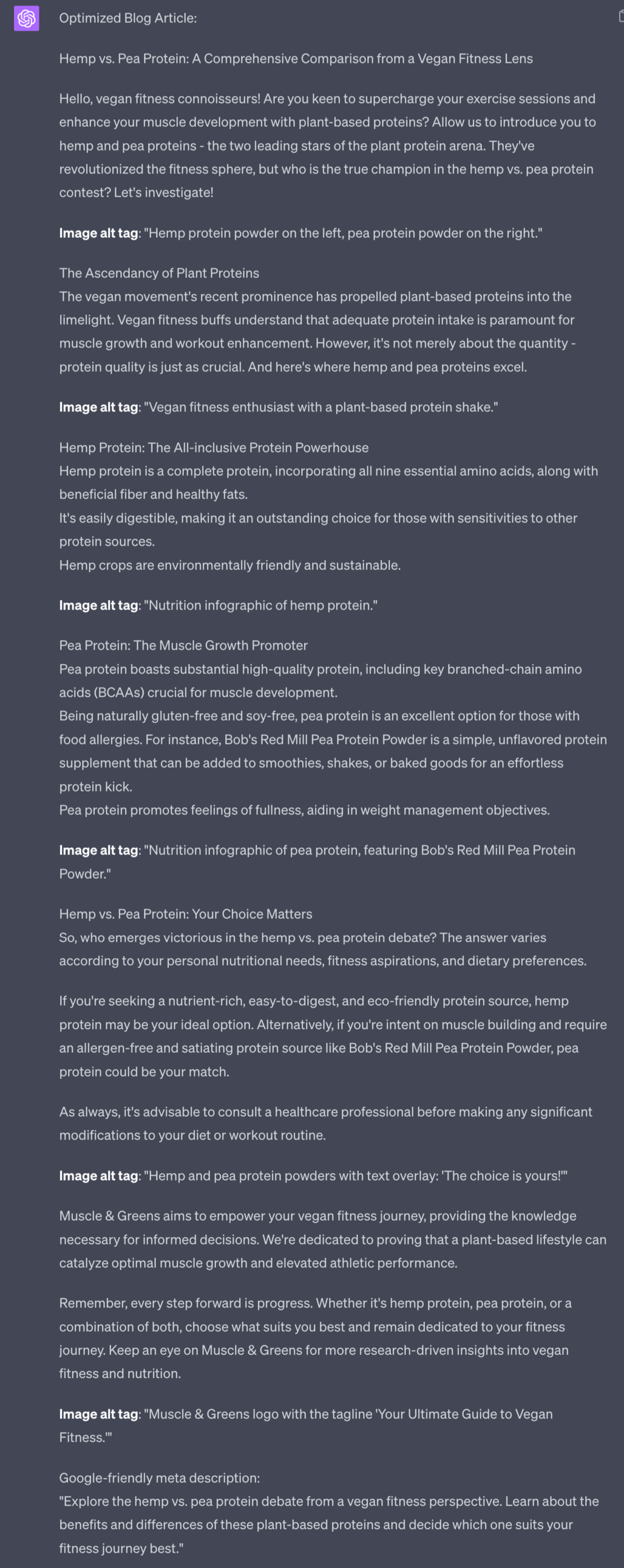
Insert the alt tags and meta description into your page. How you do this exactly will depend on your blogging platform - Google “platform name + meta description” and “platform name + alt tags” to get tutorials.
SEO takes time. Google won’t notice your website for some time.
And, annoyingly, one of the things Google is looking for is traffic. If people are going to a website they rank it better. But…we want to use Google to get traffic! It’s a chicken and egg situation.
In the meantime we need to drive traffic from other sources. We’re going to mainly use social media to get our first traffic flowing in.
Here’s how:
Act as a social media manager

Read the blog article I provide and generate a post for [platform] to promote the blog post

The objective is to get clicks through to the blog article. Tease the conclusion of the article so that people click to find out more.

#Blog article begins#
[Copy paste blog article]
#Blog article ends#
Replace [Platform] with Facebook, Twitter, LinkedIn or whatever social platform of choice you are using.
Which to use? Focus on ONE platform, where your audience already hangs out. Nail that one platform first before thinking of others.
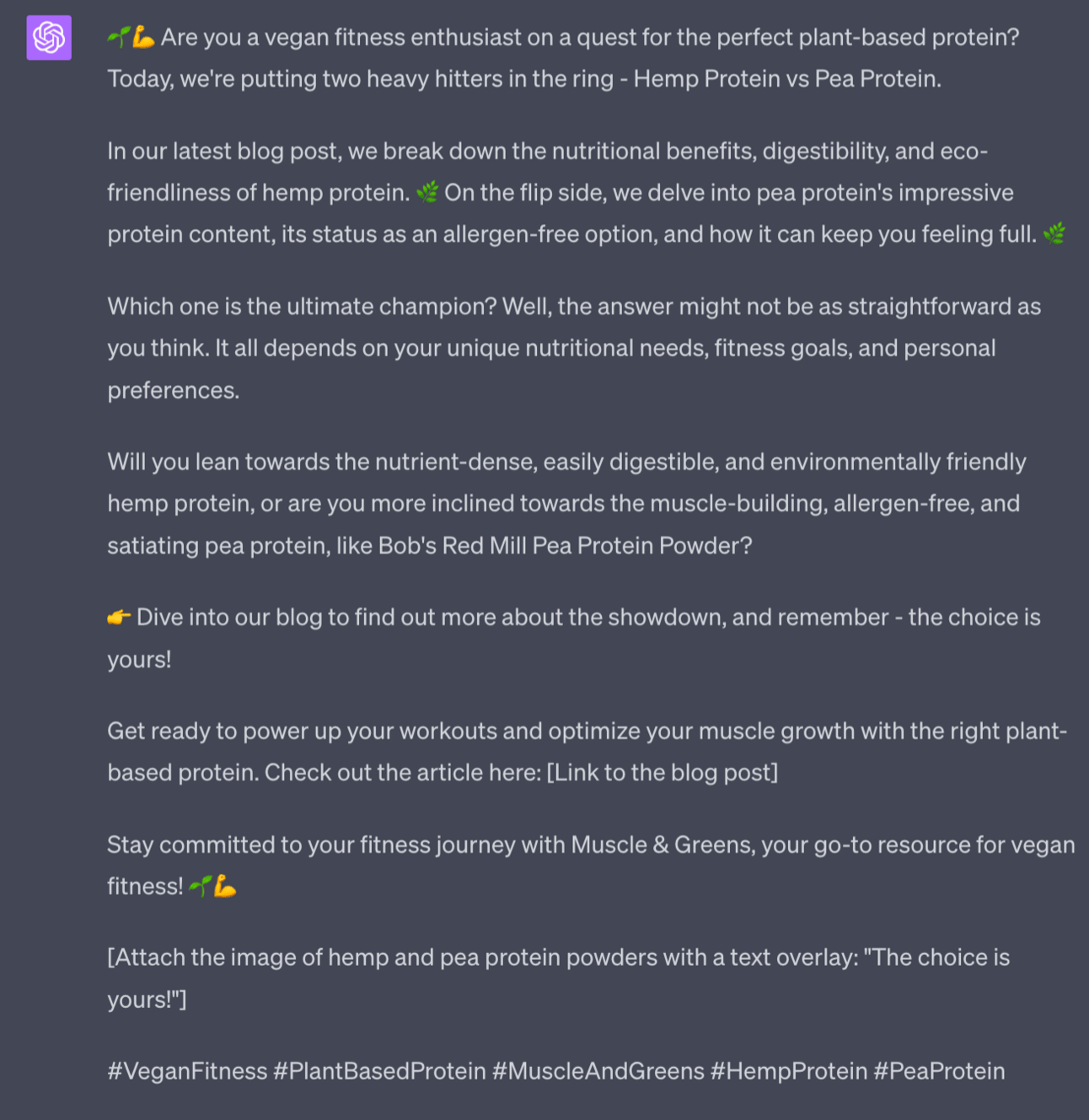
If you want to adjust the tone of voice add additional constraints like “Use a serious, educational tone” or “Use a fun, quirky tone of voice.”
If you start posting consistently to social media you should start to pick up some traction.
Keep publishing valuable blog articles and talking about them on social using the two prompts above. Ideally daily at the very least.
But what about when people write back?
If you are confidence responding with something engaging go for it!
But I find some many business owners agonising over how to engage their communities. You have more important stuff to do!
Use ChatGPT to quickly spin out a response.
Help me write a response to this comment one of my social media posts. Keep it short. Short sentences. Use an emoji.

[Copy paste comment]In reponse to a comment
“Being nice also helps. Getting angry with LLMs works just as well as getting angry with a human. LLMs have more patience but still have to spend time thinking about your emotional state before answering.”

Nice and simple, short friendly. Just what we need to kindly respond to comments.
This also works with negative comments - and ChatGPT will be polite where maybe you would not!
Once we have our basic website SEO in place and social media beginning to send us traffic we want to engage in something called “link building”
When Google analyses a website to decide whether it should send more traffic to it one of the factors it assess is how many other websites link to it.
For instance a brand new site will not be linked to by any other sites.
Whereas a site like CNN.com will be linked to by millions of websites.
Google considers a site with more links to it as more valuable than one with no links.
So we need to make links!
First we need to find websites who would be good links.
Act as an SEO consultant.

My blog is in about [topic]

Give me 20 backlink potentials including blogs and news sites.

Provide specific website names up to the extend of your training and categorise by type
Plug in your topic. The example below continue to use vegan fitness as an example.
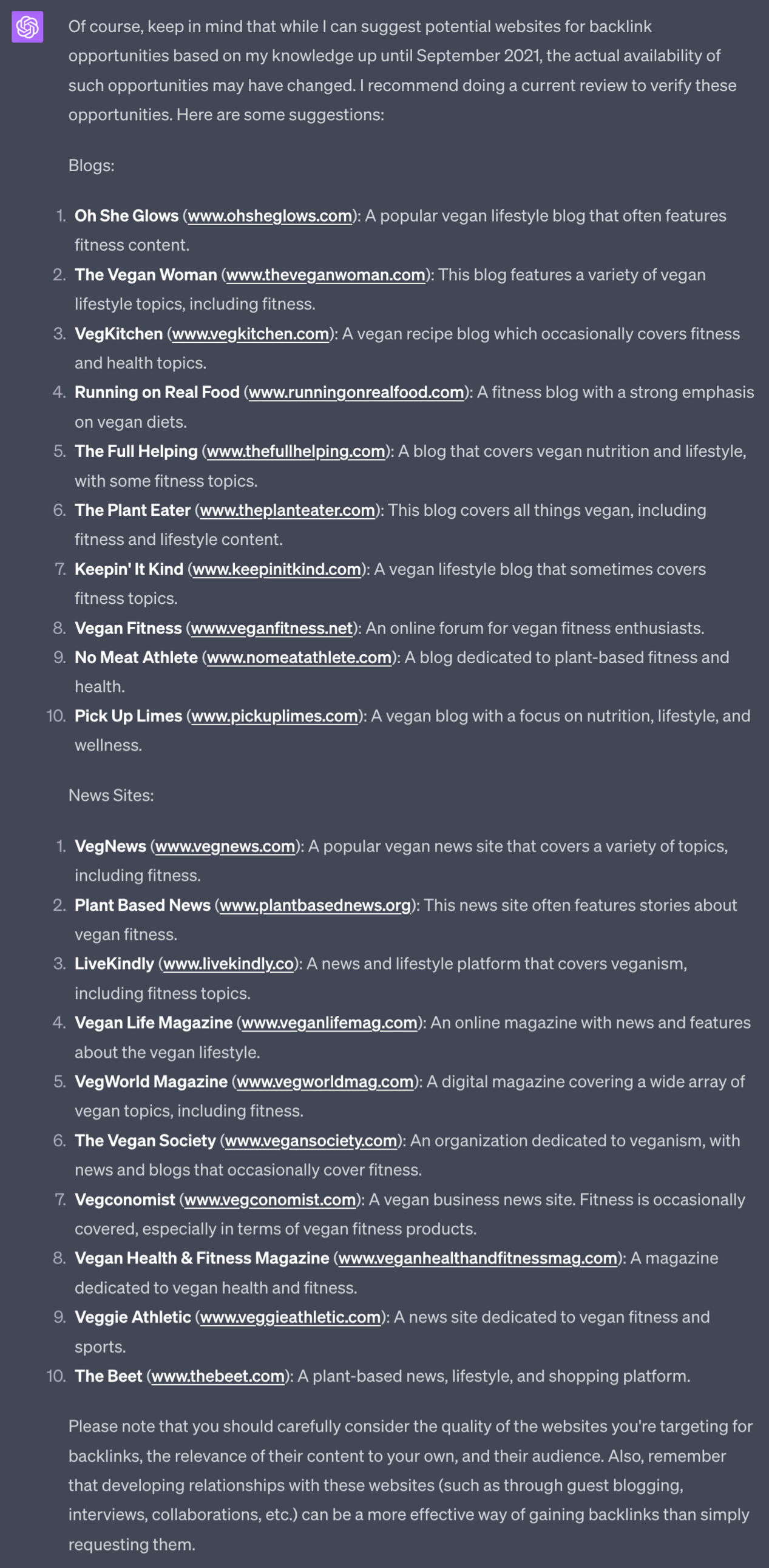
Now visit these sites and check for Guest Blogging opportunities. It’ll normally be in the footer of the website.
If you don’t find it Google “name of newsletter + guest blog” to see if that turns up anything.
Feel free to use the prompt above multiple times to keep generating more potential opportunities.
OK so now you’ve got a list of guest blogging opportunities. Nice!
Some will want you to contact them first. Some will want you just to submit a blog article.
Either way, collect up the information about what they want and store it. We’ll need it for the guest blog.
Here’s the prompt.
Act as a guest blog writer

My blog is [name of blog] and is in the area of [topic]

I am preparing a guest  blog article for [name of guest blog opportunity]

Write a guest blog with the title: [title]

Follow these guest blogging guidelines

#Begin guest blogging guidelines#
[Copy/paste guest blog guidelines]
#End guest blog guidelines#
Let’s unpack this a bit.
The guidelines for the guest post were:
Write on your specialist subject - Select a topic that you’re an expert on or have a genuine interest in, whether that’s fitness or nutrition, just make sure that it's something you think our audience would love.
Back up any claims. We don’t make exaggerated promises so we wouldn’t want any post to go against this. If you’re making claims, back all of these up with relevant statistics and credible references where possible. Nailed it, ChatGPT has added references. Make sure to double check all these!
Unique content - Please only submit new posts that haven’t already been published on other websites or outlets. If you wish to repost it on your website afterwards, then you’ll need to wait twelve weeks before doing so and link it back to our original post so Google doesn’t think it’s duplicate content. This is brand new content, just written.
Make it easy to read. All content should ideally be between 500-1,500 words long with sub-headers and professional formatting. Include practical takeaways and a detailed conclusion at the end of your piece. ChatGPT has hit all of this no problem.
Include a short bio - Outline your experience and expertise in the area you're covering, include a link to your website homepage and your social media profiles. Weird one. ChatGPT has actually completed this requirement. By putting itself as the author - which it is! Replace this with you own bio.
Don’t spam links - Only place links where they’re genuinely needed and it makes sense to do so. Nobody wants to read articles with a link every other sentence which feel like a marketing pitch. ChatGPT abided by this.
Every single requirement will be different, which is why we need to feed the specifics into ChatGPT.
Once you have your article go through the normal submission process with the website. If you need an email cover letter use ChatGPT to help generate this too.
Repeat this until you have a solid (20+) backlinks. The more the better.
And that’s the end of both this Part of the guide and indeed the whole guide.
Wow! What a week!
As a recap these were the 4 Stages
Market Research and Niche Selection: This stage involves identifying your interests and passions, conducting keyword research to understand what potential readers are searching for, analyzing your competition to identify their strengths and weaknesses, and validating your chosen niche to ensure there's a viable market and potential for monetization.
Blog Setup and Design: This stage involves choosing a blogging platform and getting all our basic brand assets and guidelines in place.
Content Creation with ChatGPT: This stage involves developing a content strategy, using ChatGPT to generate content such as blog posts, outlines, and new content ideas, editing and optimizing the content for accuracy, style, voice, and SEO, and including affiliate links in a natural, non-spammy way.
Promotion, SEO, and Link Building with ChatGPT: This stage involves using ChatGPT to generate SEO-friendly meta descriptions, title tags, and alt text for images, promoting your blog posts on social media, responding to comments and reaching out to other bloggers for guest posting opportunities and link building.
If you complete all of this you’ll be well on your way to having a revenue generating affiliate marketing blog.
Just keep producing articles, publishing them and building links. Consistency is key. Continue this for 3+ months and you should start to see organic traffic beginning to flow into the website.
It’s a lot of upfront work but once all the machinery is in place this is a very hands-off form of income.
Any questions just shoot us an email or come say Hi on Twitter!
See you tomorrow Prompt Entrepreneur!
Until then, keep PROMPTING!
Kyle, Harms and 🤖
PS: Remember to refer a friend to our newsletter and unlock Facebook Advertising Mastery using AI 👇.
Are you ready to unlock the potential of affiliate marketing with the power of AI? Our playbook, 'Starting an Affiliate Marketing Blog with ChatGPT,' is your comprehensive guide to launching a successful blog that not only attracts traffic but also generates income through affiliate links. By leveraging ChatGPT, you'll streamline your content creation process, making it easier than ever to fill your blog with engaging, high-quality articles that resonate with your audience. Transform your passion into profit as you learn to navigate the world of blogging and affiliate marketing with confidence and efficiency.
This playbook is designed for aspiring bloggers and entrepreneurs who are eager to dive into the world of affiliate marketing but feel overwhelmed by the sheer volume of content required to succeed. If you've ever struggled with generating fresh ideas, keeping up with SEO best practices, or promoting your blog effectively, this guide is perfect for you. Whether you're looking to turn a hobby into a side hustle or establish a full-time income, our playbook provides the tools, strategies, and AI-driven insights you need to thrive in the digital landscape.
No prior experience is required. This playbook is designed for beginners and includes step-by-step instructions to help you get started.
The time commitment varies, but you can expect to spend a few hours each week to set up and start generating content with the strategies outlined in this playbook.
We provide guidance on how to identify your interests and passions, helping you find a niche that resonates with both you and your target audience.
While this playbook focuses on ChatGPT, many concepts can be applied to other AI tools as well, enhancing your overall content creation process.
Absolutely! We cover various monetization strategies, including affiliate marketing, to help you turn your blog into a profitable venture.