
AI playbook
Are you ready to turn your passion into profit?
Start ReadingWe’ve covered a lot of “theory” above so today’s actions are more limited.
We’re going to borrow and adapt a prompt we’ve used before :
As a brainstorming assistant, generate a list of 50 potential newsletter niches based on my interests in [insert interests here] combined with my skills [insert skills here]

The goal is to come up with unique and engaging content niche that combine these interests and skills.

Combine where they naturally intersect but do not force combinations. Please avoid overly wide niches.
Sit down with a pen and paper (I know, medieval!) and sketch out your interests and skills.
Why paper? It’s easier to avoid self editing.
Just go nuts and get as much down on paper as possible. We’ll let ChatGPT do the sorting.
If something falls under interest and skills add it to both. This is normal. What we are interested in we tend to do more. And doing it more makes us skilled at it.
In this example I inputted
[interests] = AI, productivity, writing, board games, video games, weightlifting, cycling, entrepreneurship
[skills] = systems thinking, writing, AI, endurance sports, entrepreneurship, business strategy
Add more if you can, the more the better.

These are the first 20 of 50.
Keep generating and copy/paste the ones that you like.
When you have ~10 ideas that sound good to you (based on your interests and skills) feed them back into ChatGPT and tell it that these are your favourites and to generate more ideas based of those.
Combining interests and skills is a first step.
But this is a business. We need to make sure that the newsletter we create can also generate an income.
Therefore we need a third variable: a good market!
Here’s the next prompt:
As a marketing strategist analyse this list of newsletter business ideas. This business involves creating a newsletter, building an audience and then monetising the audience through advertising and sponsorships.
Analyse them by these factors: total market size(+), value of subscribers(+) and competition(-). Score each factor out of 100 and use this to create a composite total score of 300 for the attractiveness of the newsletter business idea.
Sort all entries by their composite score, highest composite score at the top then descending. Present results in tabular form.Here’s my ranking using ideas from the previous step.

Use this ranking to start to filter out ideas that have no obvious market. Lots of mine have solid market potential but this is a function of the interests and skills I put in.
Once you’ve honed in on your rough niche we want to see what the current newsletter landscape is like.
Don’t worry about having totally nailed the niche yet. Honestly, it’s going to shift and adapt as you get going and work out what your readers want. You just need to know the topic.
Here’s the prompt:
Give me a list of newsletters that cover the topic of [copy/paste whole title, description]Copy in the whole name and description that ChatGPT generated. For instance “AI Driven Entrepreneurship: Future-Proofing Your Business”
This will give ChatGPT as much context as possible.
Using the prompt “Give me a list of newsletters that cover the topic of AI Driven Entrepreneurship: Future-Proofing Your Business”

Warning: this is a case when ChatGPT’s learning period comes into play. This is a decent list but AI (which is the topic entered into ChatGPT) has exploded since September 2021, the end of ChatGPT’s training period.
If you have access to Claude2 (currently UK and US only) use this tool instead because it’s training period is up to 2023. It’s free.
Here’s Claude2’s output:

If that’s not an option head to https://inboxreads.co/ as a good place to run research.
Once you’ve got the newsletters go ahead and subscribe to them all! You need to see what they are writing about.
We’ll be referring to their content in future parts of this guide.
Not an AI prompt but potentially the most important action today.

Why? It’s run by Matt McGarry who is THE newsletter guy. He talks about how to grow and monetise a newsletter and is basically the best in the biz.
If you are serious about making a profitable newsletter business his emails are gold-dust - it’s all actionable and tested advice.
That’s everything for today.
It’s been a theory heavy day rather because I needed to outline what exactly a newsletter business is and what we’re going to be working towards over the next week.
There will be more actions in the next 4 steps, don’t worry!
The previous part was very theory heavy so you understood what sort of business we’re working on this week.
Now will be very action heavy to get the basics in place.
Also, only some of these will use AI today. Don’t worry - the next two parts when we look at content it’ll be 100% prompts!
Without further ado let’s crack on.
There are a multitude of options for you newsletter tool.
I’ve used SO many of them over the years. And more recently surveyed them all for one of my other businesses (emailsponsorship.com).
I’ll cut to the chase: right now beehiiv is the best tool on the market.

It’s also free up to 2,500 subscribers which is more than enough for you to start generating an income.
Unlike other platforms it also comes with a bunch of built in monetisation tools so you can immediately begin to generate revenue.
I’ll go into these in more detail later in Part 5 when we talk about how to generate revenue from your newsletter.
Finally, beehiiv has also embraced AI writing and image creation and built them directly into their tools. As of the time of writing no-one else has.
This suggests beehiiv will be the most friendly with AI creators, which is good news with us.
First step then: grab a free beehiiv account. It’s free up until 2,500 subscribers and then reasonable costs for building a business.
If you want to support me then here’s a link that means I get paid if/when you get a paid plan: Sign up to beehiiv (affiliate). No extra cost to you.
If you think I’m stinky and your spite reading this newsletter then here’s the non-affiliate link: Sign up to beehiiv (non-affiliate). Use either - I won’t be (too) mad! 😛
How do you know I actually think beehiiv is good? This email you are currently reading is beehiiv - it’s what I personally use!
Next up we’re going to test out beehiiv’s AI writing tool. Tomorrow we’ll get into depth with the actual content - for now I want you to see the ease with which we can generate quality content.
If you aren’t using beehiiv this will also work in ChatGPT. You’ll just need to copy/paste into your newsletter platform of choice.
If in beehiiv create a draft of a newsletter. Don’t worry, we’ll delete it. Once in the draft just type /ai to bring up the AI writer or tap the plus symbol then select AI Writer.
You’ll see something like this:

In settings you can tell it how many paragraphs to create and set the language and the tone of voice.
Here’s how to play around and experiment with the tool:
Useful list? Great: beehiiv’s AI generated all of that. I hardly lifted a finger.
Also, this same tool can be used to rewrite content that you write yourself - to make it shorter, longer, simpler etc. It’s a very powerful tool.
For now just test it out. We’ll be going into depth in Parts 3 and 4.
The last two steps have hopefully shown you how much time can be saved compiling a newsletter using AI.
A huge barrier for most people is the time it’ll take to write a newsletter and create or find images for it. These barriers are now much lower.
We’re going to go into a LOT more detail about newsletter content creation over the next 2 days.
All I want right now is for the time/energy barrier to have been surmounted so that you can think freely about what sort of newsletter you can now create.
We have 3 choices to make.
There are two basic types of newsletter:
Content creation newsletters are based on you creating content from scratch. These tend to be newsletters that inform, educate or entertain based on your personal skills and take on life.
This newsletter that you are reading is creation focused: every day I’m sitting down to write this out from scratch. Actually, I’m standing at a standing desk but that’s not important!
Content curation newsletters on the other hand are about finding existing content that someone else had made and bringing it together in a single newsletter.
Curation could be:
Whatever their particular format what they have in common is that they are based off existing content rather than on new content.
Our recommendation is to create a newsletter that is a bit of content creation and a bit of content curation.
Stacked Marketer is a great example of this. The core content is curation - it’s a set of interesting news stories, product launches and educational links. But the publisher also adds a few paragraphs of context about why these links are useful.
This is a strong combination of curation (the links) and creation (the editorial comment).
The rest of this guide will work whether you are creating or curating. But we’ll use a mixed hybrid of creation/curation moving forward.
For now your action is to simply to decide the format - creation or curation.
Next up - what’s the length of your content?
Going back to For the Interested you’ll see that this email is literally one line of context and one link.
This newsletter has over 40k subscribers and charges $350 to sponsor an issue. It’s published daily so that’s ~$127,750 per annum for one sentence a day.
So: short can work!
Alternatively there are newsletters like this one which are much more long form. It’s a creation based newsletter than matches my style of creation - in-depth guides.
In the middle there are newsletters like Stacked Marketer than have 5 or so items per issue. 5 links, with 5 pieces of context.
Your choice will depend on what is most valuable for your niche. And that’s based on your own expertise in this area as well as your research you did when subscribing to competitor newsletters.
What do you think will be most valuable? Indeed, as someone who is interested in this topic: what length of newsletter would you want to read?
The third choice is how often you’ll publish.
For the Interested, Stacked Marketer and this newsletter are daily.
Other newsletters are weekly. Some are even monthly.
I’d recommend minimum once a week. Daily if you have the time and inclination.
Why? More issues means more sponsor slots which will be important when we come to monetise the newsletter.
How often you publish will really depend on what priority this business is to you. If you are uncertain start with weekly. And then if it takes off look at moving to 3x/week or even daily.
Now we’re going to generate some assets to plug into our new beehiiv to start making our newsletter more professional.
First up the newsletter description. Here’s the prompt:
Act as a marketing copywriter.
I have a new newsletter about [topic]
the content is primarily [original content/content curation/mix of original content and content curation]
The newsletter is published every [time period]
It is a [long/short] newsletter - focus on the benefits of its length

Give me 10 potential titles for this newsletter
as well as a short description of the newsletterUsing the prompt :
Act as a marketing copywriter. I have a new newsletter about Driven Entrepreneurship: Future-Proofing Your Business
The content is primarily mix of original content and content curation The newsletter is published every week It is a short newsletter - focus on the benefits of its length
Give me 10 potential titles for this newsletter as well as a short description of the newsletter.

Great. By working through today’s steps you have the basics of your newsletter in place.
That’s the actual platform (beehiiv) but also the foundations of what your newsletter will be actually publishing in each issue.
Continue to review your competitors in the space as you’ll keep finding new ideas that you can potentially fold into your newsletter.
This will become important as we move into actually creating content next.
In this part we’re getting into the meat of our newsletter: the content.
I’m going to cover both content curation and content creation.
We talked about both of these in the last Part so if you have no idea what I’m talking about go back and refresh yourself.
We’re going to be quite high level in this issue, giving you the basic prompts for content that you need to get started.
Next we’ll look at refinements. Right now just push ahead with making something.
That said…
We’re starting with curation because:
i) it’s simpler and
ii) even if you are writing original content it’s good to keep your finger on the pulse with your topic
This first prompt does both. We’re going to find out the exact people and publications we need to be following so that we can either curate from them or simply for original content creation.
Here’s our first prompt:
Act as an online research assistant

I am writing a newsletter about [topic]

Help me research other sources of information in this space

Give me 10 blogs, 10 news sites, 10 newsletters, 10 reddit subreddits, 10 twitter influencers, 10 instagram influencers, 10 tiktok influencers,

Present the information in a table.For topic = “ building side hustles”
And reduced to 2 per category for brevity.

Note: ChatGPT won’t be able to give you the most up to date influencers and blogs because of its training limit.
Therefore supplement this with Google searches - ie “blogs similar to Smart Passive Income” to find more.
Alternatively use a more up to date model like Claude2 if you have access.
In either case you want to pull together a list of 20+ sources that you’ll be curating from.
To keep on track of all these sources I recommend an app called Feedly. It can pull together blogs, newsletters, Reddit communities all in one place so you can monitor without having to go to separate parts of the internet.
Act as a newsletter writer and editor

I will provide you with the text of a post

Convert the post into a short newsletter section

Focus on the main points, removing extraneous details. Condense to 200 words maximum.

Provide a section title

Start with a hook like a question or bold statement. Make each sentence want the reader to move to the next sentence.

Ignore quotes.

Use bullet points when possible

No long paragraphs - use single sentence paragraphs.

Use a [tone] tone of voice.

##Post begins##
[Copy/paste post here]
##Post ends##
This prompt will take an existing article and rewrite it in a format more suitable for a newsletter.
Simply copy/paste the source article you want to use into the prompt at the bottom.
I’ve also added a tone of voice parameter you can use to modify the output. Try serious, professional, cheeky, funny, rude etc. Or a combination!
One tip here is to take a sample of your own writing, paste it into ChatGPT and ask “How would you describe the tone of voice in this article?”
Here’s how ChatGPT describes my writing:

So if I wanted to match my tone of voice I’d add “informative, encouraging, conversational, insightful, enthusiastic” tone of voice.
The output will be a short, rewritten version of the original article that you can use in your newsletter. I’d recommend leaving a Read More link to the original piece - remember you are curating here!
Based on original article from BBC News.

The output will be a short, rewritten version of the original article that you can use in your newsletter.
I’d recommend leaving a Read More link to the original piece - remember you are curating here!
This is a variation of the above prompt for a much shorter editorial comment.
You’ll see this sort of curation in a short form newsletter than gives links and maybe a sentence of context per link.
Act as a newsletter writer and editor

I will provide you with the text of a post

Create a short descriptive one sentence hook that makes people want to clock through to read the full post.

##Post begins##
[Copy/paste post here]
##Post ends##
Alternatively ask for a super short version by specifying “short descriptive 10 word hook”

Match length to your newsletter format decided in the previous Part. And if in doubt remember to go and check other newsletters for inspiration.
The last three prompts have been curation focused and give you a solid way to find, condense and editorialise existing content.
Now we’re switching to content that we write ourselves.
If you are only doing curation no problem - you can skip these last two prompts and we’ll see you in the next part. Early end to school!
If you are creating here’s our first prompt:
Act as a newsletter writer and editor

I write a newsletter on [topic]

Provide me with a list of 50 potential newsletter issues I can write, along with the subject line.

Give me a mix of inspirational, instructional, listicle, review, interview, case study, deep dive, personal story, round up, opinion/editorial, survey, behind the scenes. Provide this information next to the result.

Results in a table.Using [topic] = "how to make money using AI tools”

This should start giving you a whole lot of ideas for issues. As always, pick out the ones you like and ignore the rest. Then ask for more from ChatGPT, cherrypick the best, repeat.
Continue this until you have 10-20 potential issues to get started with.
Bonus: try adding the line “Do not provide generic suggestions” to get more creative suggestions.
Now we’re onto the creative part.
Here’s the prompt:
Act as freelance writer, preparing a newsletter.

The topic is [topic]

The category is [category]

Prepare a newsletter issue of 700 words.

Include a personal introduction

Use bolded section headers

Use bullet pointed lists where applicable

Do not provide generic information, aim for unique and creative POV.

Use a [tone] tone of voice.

Make suggestions for images

Make suggestions for additional resources
For [Category] use information from the previous step to generate different types of newsletters.
Using [topic] = "Exploring Coffee Origins: A Deep Dive into Bean Sourcing"
[category] = “instructional”
[tone of voice] = light, fun

You’ll have one of two reactions at the point. Either:
1. This is excellent
2. This is terrible
Both reactions are great!
If you think the result is excellent then you are good to go. You have your newsletter issue - go ahead and load it into beehiiv or whatever tool you are using.
If you thing the result is terrible then you have a first draft you can start with. Editing is so so so much easier than writing from scratch.
And because you know it’s bad that also means you know what would be good. So adjusting should be easy!
Either way you’re much closer to having a full issue of the newsletter and it’s taken a fraction of the time it would to work from a blank page. You’ve skipped the awful stage of staring at a blank white screen and a blinking cursor.
I told you we’d have lots of prompts in this part!
We’ve covered both content curation and content creation today which is the core of newsletter publishing.
Next will be about refining our issues and starting to build an audience.
Today is a fun one - we’re going to start getting our newsletter out into the world and start audience build.
The basic idea here is to leverage social media networks to grow an audience then use a special technique to get those audience members over into our newsletter list.
You have probably noticed in my email newsletter that I start every edition with:
“Hey Prompt Entrepreneur”
This is a conscious decision to carve out a Tribe.
Seth Godin famously introduced this concept into marketing. You can learn more about it here: Seth’s Blog.
The short version though is : a Tribe is a group of people connected to one another connected to a leader and connected to an idea.
In our case:
You need to do the same with your newsletter business. You need to become the leader, the authority, the voice that people want to listen to.
The first part of this is coming up with a name for your tribe. This starts to help people identify.
We use "Prompt Entrepreneurs”. That’s who we are.
Let’s work out your tribe name.
Act as Seth Godin, marketing thought leader and author of Tribes.

I write a newsletter about [topic]

The name of the newsletter is [name of newsletter]
Here is a description of the newsletter:

#start description#
[insert newsletter description]
#end description#

Give me 10 possible catchy, easy to say Tribe names.

Give me a mission statement and a vision statement.
Plug in details that we created using ChatGPT in Parts 2.
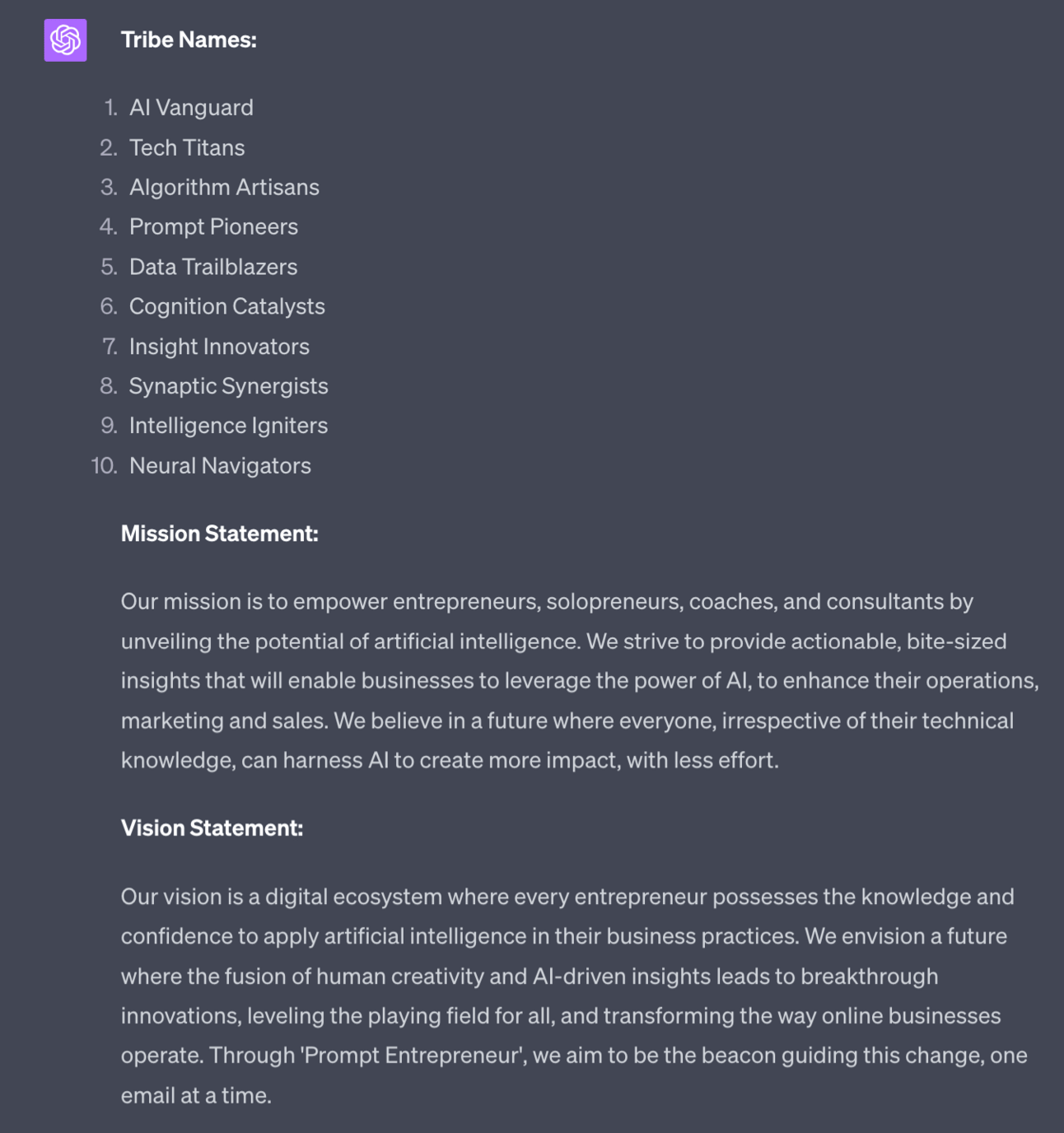
This gives me a couple of jumping off points for my Tribe name, as well as some additional information about the mission and vision of the newsletter.
As always ask for more examples if needed. And if they need a tone change say something like “less serious” and you’ll get more fun names. That gave me “AI Avengers” which could be a lot of fun - telling my AI Avengers to assemble!
Use this Tribe name in all your newsletters that you publish from now on. And sprinkle it into social media too when relevant.
Our best tool in getting initial subscribers, for free, to our newsletter is via social media marketing.
The best tool overall is paid advertising - but that should come later once you’ve proven the business model and want to scale.
For now we’re going to leverage social media using a specific technique we’ll develop in the remainder of this part.
There are MANY different techniques you could use but I’m going to give you ONE surefire method to build an audience and gain subscribers.
Act as a social media strategy expert

I want to promote a newsletter called [title]
The topic is [topic]

I will be using a DM giveaway as the primary mechanic to build my audience initially.

I am choosing the best social media platform to use.

Provide me with different social platform options, their pros and cons and rank them by attractiveness.

Expand on your top choice in detail.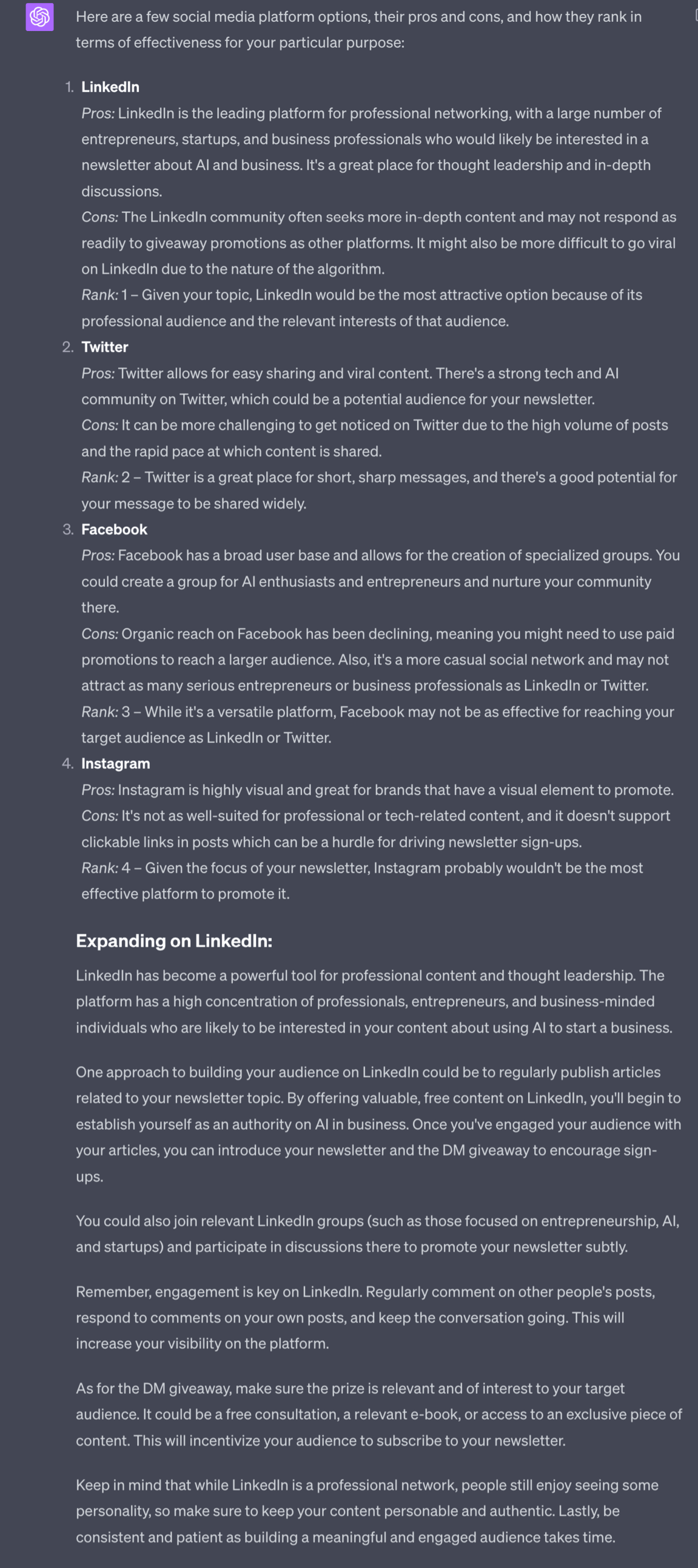
This was using my own newsletter and LinkedIn and Twitter are my primary platforms.
I actually use Twitter as primary and LinkedIn as secondary but ChatGPT’s analysis is spot on. The high frequency and effort required for Twitter is why ChatGPT chose to put it in #2 instead of #1 but for me personally that’s not a problem, hence it being top choice.
Run this analysis on your own newsletter to come up with suggestions.
Still in doubt? Use Twitter. It’s the main platform for a lot of growing newsletters. And very likely it will work for you too.
Building an audience from scratch on any social media platform is difficult. I can’t cover a full strategy here, especially for multiple platforms. Well - I could…but for your sanity we’re keeping it simple!
Instead we’re going to focus on a tried and tested method called a DM giveaway.
The basics are:
That’s sort of it.
It works on all social media platforms but best on Twitter. Especially when combined with tools like *Tweethunter that do the DM’ing for you automatically. *Sign up to Tweethunter here (affiliate link).
It’s easier with an example. Here’s one I made earlier:
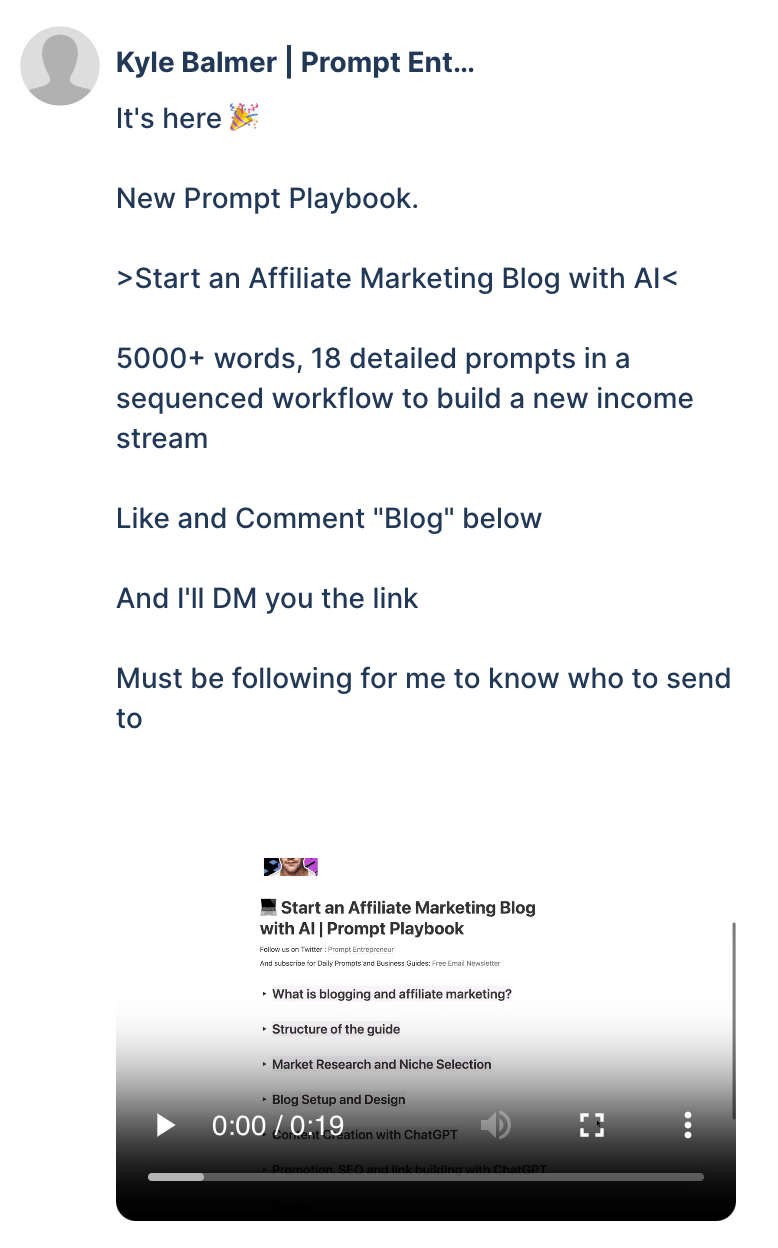
This tweet told people about something of value : a new prompt playbook.
It gives them instructions to follow, like the post and comment Blog on the post.
As soon as they do that they get sent this follow up:
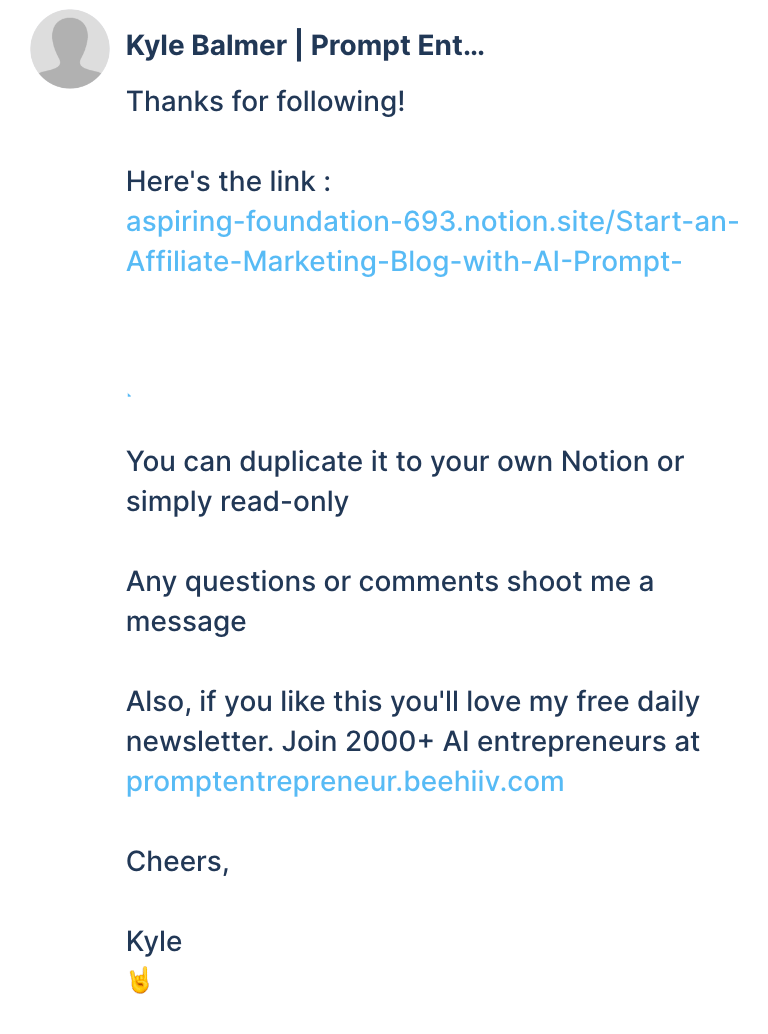
What' we’ve done is:
1. Gain a new follower
2. Gained like + comment engagement on the original tweet (which in turn means it will be seen more)
3. Plugged your newsletter in the DM so people can then subscribe
4. Delivered something valuable to your new audience member so they become a huge fan.
That’s the play. Capiche?
It works on Twitter, Facebook, Instagram, LinkedIn or any other platform where you can DM the individual.
I’m going to focus on Twitter because i) it’s generally the best platform for newsletter audience growth and ii) there are powerful tools to automate the DM’ing process.
First though: we need something of value to give to audience members!
“Lead magnet” is a term we use in online marketing.
It basically means something attractive (like a magnet!) that brings in leads for our business.
An eBook we give away in exchange for an email? That’s a lead magnet.
A free consultation in exchange for a telephone number? That’s a lead magnet.
A free Notion guide to AI in exchange for a Twitter follow, like and comment? That’s a lead magnet.
Lead magnets take a huge amount of forms. But there are similarities.
Lead magnets need to be:
What the exact form and content of the lead magnet will be will depend entirely on your topic and expertise.
Let’s use ChatGPT to help us brainstorm some possibilities:
Act as a marketing strategist

Help me create a list of lead magnet ideas for my newsletter

The goal is to get people to engage with my social media content in exchange for this lead magnet.

My topic is [topic]

The lead magnet must be highly valuable, unique not generic and easily consumable (ie. less than 5 minutes to read, watch, listen to)

Give me a list of 10 possible lead magnets including title, format and brief description.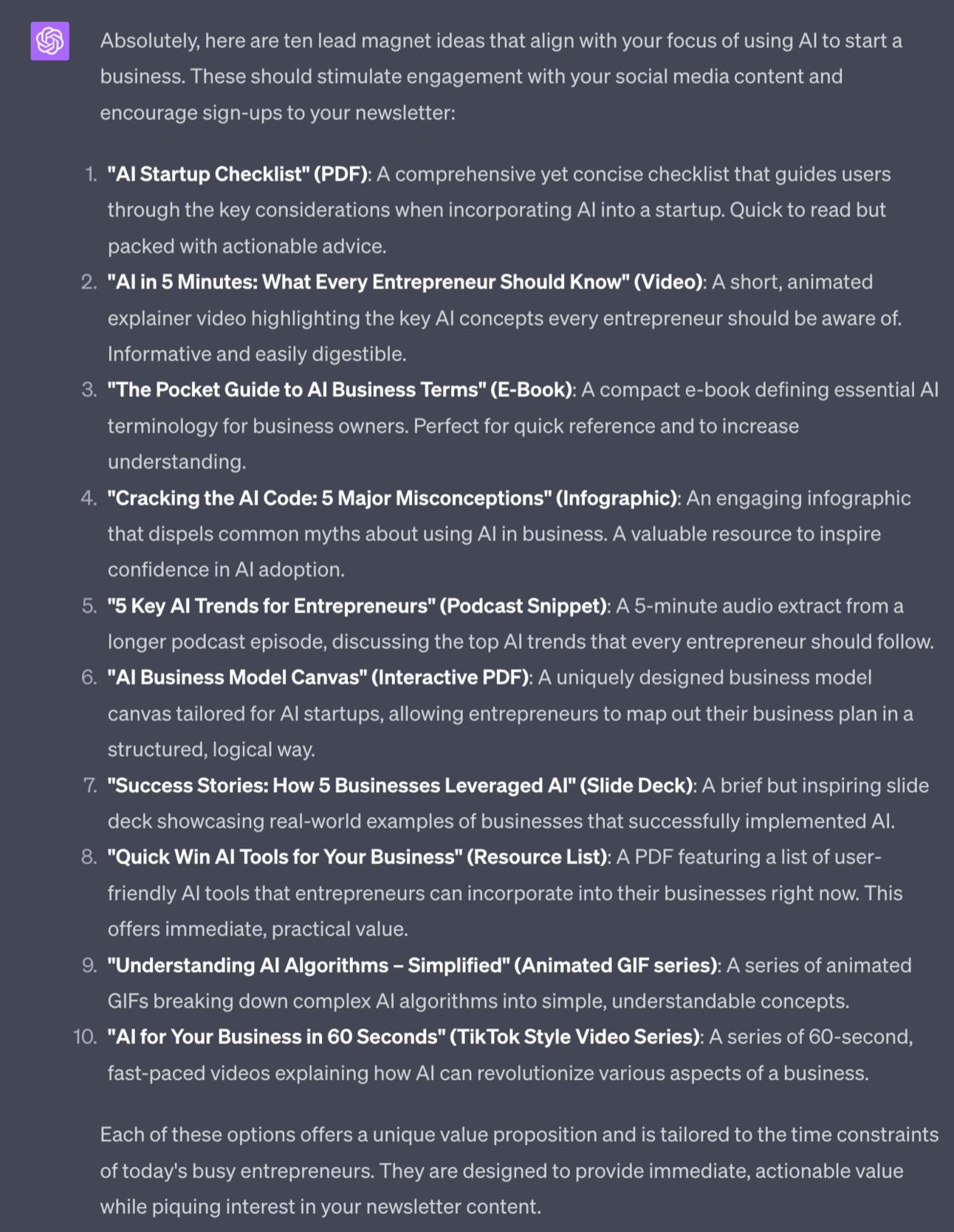
Choose the ones that you like and ask for ChatGPT to expand.
For example I like the first one here. I simply put “Create Option 1” into ChatGPT and get given a checklist to use as my lead magnet.
From there adapt using your own expertise and style. Don’t just copy/paste ChatGPT as your lead magnet.
Why? Well: it’s lazy.
But also remember this is the first big interaction people will have with you. You need this first interaction to leave them stunned - “wow! they gave away a lot of valuable information here!” Leave a first good impression.
Nearly there - we need a handful more elements to launch your giveaway.
Namely
For the giveaway tweet use this prompt to get started:
Act as a [social media platform] engagement expert

Write a post for a DM giveaway post and a thank you message.

##instructions for giveaway post begin##

The giveaway is for this lead magnet:
#begin lead magnet#
[copy/paste text of lead magnet]
#end lead magnet#

To receive the lead magnet they must follow, like the post and comment "DM". Add these details.

##instructions for giveaway post end##

##instructions for thank you message begin##
Write a thank you message that delivers the lead magnet.

Add a thank you

Add a placeholder for me to add a link to the lead magnet

Add a plug for the newsletter [name] with the link [link] suggesting they sign up

Sign off

##instructions for thank you message end##
Replace [social media platform] with whichever platform you are using, ie. Twitter, LinkedIn.
Is your lead magnet video or audio? Copy paste the script in here. It’s just to give context to ChatGPT about what the content is.
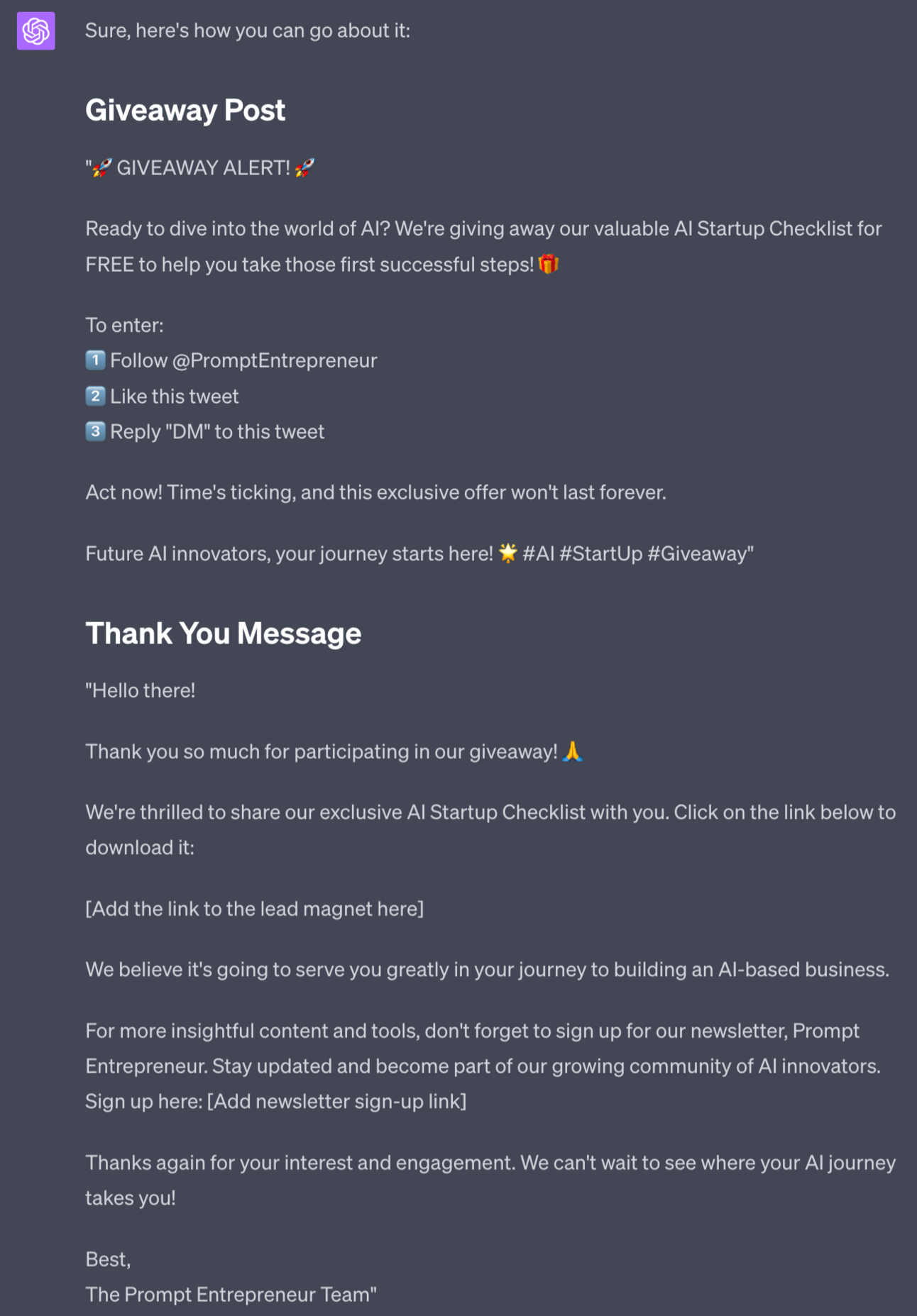
From here just plug in the details like the link to the lead magnet. I personally use Notion, which allows me to easily share documents to the web via a public link.
For the actual giveaway you can certainly do it manually, especially initially when volume will be low. Just have your thank you message somewhere easy to access and copy paste it to anyone who signs up.
If you want to automate it though TweetHunter is fantastic. That’s what I personally use and recommend it highly.
In this part we’ve fleshed out a single tactic for building your audience using social media.
It’s my belief that having one strong strategy is better than 10 weak strategies. Don’t spread yourself thin.
Instead focus on one thing, get it working and automated, then onto the next.
I’ll explore social media platforms and growth in more depth in other guides but right now just nail one audience growth channel using the technique above.
We’re moving into the end of the playbook now.
Next is monetisation and howe actually make money from our newsletter. Fun!
And here we are at the end of the process.
Over the past 4 Parts we’ve laid our foundations for growth.
Now I’ll talk about how you’ll go about monetising your newsletter.
This will be a mix of methods for immediate revenue as well as reviewing the later possibilities so you know what you are aiming for.
The first technique you can immediately start using is generating revenue from each new subscriber you get.
We can do this by recommending other newsletters we think would be helpful for our readers.
An example. I like the newsletter “The Rundown”. It’s a great breaking news newsletter for AI. Therefore when people sign up for my newsletter I show a quick message that asks if they want to subscribe to “The Rundown”.
It looks a bit like this:

If someone clicks the link, I get paid $1-2. The exact amount depends on the newsletter.
Better, the widget I show has 3 newsletters that I recommend, which means for every new subscriber I get I can potentially generate 3 x $1-2 or $3 to $6.
It’s small but adds up. 10 new subscribers a day could mean $60 of revenue for instance. Pretty cool.
How do we set this up?
In beehiiv it’s easy. We use Boosts. Go to Monetisation > Boosts and you’ll see a list of offers, how much they pay and their terms.
Just choose ones that you think would be genuinely useful for your audience. Make sure to actually read the newsletter! Don’t just choose newsletters based on who is paying the most - your brand reputation is more important than this.
Not on beehiiv? No problem - check out Upscribe by Sparkloop. It’s free. It requires more manual installation than beehiiv but is a great option if you aren’t using beehiiv.
Use recommendations to get your revenue flowing as the first step. It’s automatic, easy to implement and no brainer additional cash.
The next layer of monetisation we add is affiliate offers.
An affiliate offer is basically a link to a product or service that you add to you newsletter. If a reader goes to that link and makes a purchase you, the person who sent them, gets a percentage of the sale.
One of the best known affiliate programmes is Amazon Associates. By becoming an Amazon Associate you can send people to Amazon to buy products. When they buy you make a percentage of that Amazon sale.
If I ran a board gaming newsletter I could review and recommend a board game in my newsletter and add a link to the board game on Amazon.
If someone buys the board game I’d make 6% of the sale. If the board game was $50 I’d make $3. If I drove 100 purchases I’d make $300. Nice.
To check out Amazon’s pay out rates check here for USA: Associate Commissions or Google “your country + Amazon Associates Commission Statement” to find the local rates.
The reason this works well with early stage newsletters is that size doesn’t matter. You can join an affiliate programme and drive however many sales - you aren’t locked into delivering a certain result. Therefore it’s a good early stage revenue stream.
And there are many many affiliate programmes out there. Amazon is one of the largest but we’re going to use ChatGPT to find others.
Here’s a prompt for starting our affiliate journey:
Act as an affiliate marketing expert.

I write a newsletter about [topic]

Give me a list of known affiliate offers (products and services) in this niche from a wide range of sources like Amazon, Clickbank and other affiliate marketplaces, education marketplaces, individual brands, blogs and influencers

Give me a total of 20 specific known offersUsing [topic] = board games

This prompt will give us places to go and check out.
From here visit the websites and find their affiliate programmes. Google "name of website + affiliate” to find the exact page quickly.
From there check their payout rates and terms and conditions. Register for the ones you like the look of to get your affiliate links. Then simply start to drop those links into your upcoming newsletters.
This could be an issue that is specifically a review.
Or it could be a general link to their website - for example I might say “This issue brought to you by Zatu Games” at the top of my site and add my affiliate link straight to their homepage. If they then browse around and make a purchase you’ll take a cut.
Next up is sponsorship.
This is when a company pays you to feature their product or service.
It could be a link at the top of your newsletter, a small classified advert, a featured piece in the newsletter or even a whole issue takeover.
There are lots of creative ways to do sponsorships but always make sure that it is a positive experience for your readers too!
Generally you’ll need a few thousand subscribers before sponsorship makes sense. I’ve seen newsletters do it with 2000 subscribers in certain niches but generally you’d want to be at 5,000 or ideally 10,000 before it becomes worthwhile for a company to sponsor you.
Act as a sponsorship broker

I publish a newsletter about [topic]

Provide me with a list of companies that might be interested in sponsoring my newsletter.

The companies must match the size of new newsletter. For example a small company will be interested in sponsoring my newsletter when small but a large company will not. I wish to get larger and larger companies as sponsors as I grow.

Provide 5 suggestions for each stage of growth:
1000-5000 subscribers (very small)
5000-10000 subscribers (small)
10000-50000 subscribers (medium)
500000-100000 subscribers (large)
100000+ subscribers (very large)

Provide specific company names

Return everything in tabular formatUsing [topic] = vegan fitness

Use this a starting list to start reaching out to potential sponsors. At this point it’s basically cold outreach via email and LinkedIn until you get some interest.
That’s a little too much to go into here so I’ll refer you to Email Sponsorship as a solid resource.
Alternatively you can work with companies that will do outreach for you and help you secure sponsorships. They’ll charge a flat monthly fee, take a commission or both.
If you have a strong audience in the right niche this investment is well worth it. Shoot me a tweet or DM and I can provide up to date recommendations here.
Advertising in the context of newsletters is allowing ads to be inserted directly into your issues.
This is done “programmatically”. The ads can change and alter to best fit your audience and (theoretically) lead to more clicks and better performance for your advertisers.
As such this tends to the be most high volume, highest paying source of revenue. It’s also nice and automatic, especially compared to securing sponsorships.
However, it means ceding some control over exactly what is shown to your audience. That’s a deal breaker for some newsletters.
beehiiv has their own advertising platform directly in the interface: beehiiv Ad Network which makes everything a bit easier.
If using a different newsletter system though then Paved is the big player in this industry.
In this part we’ve covered how to start generating revenue from your newsletter.
In brief
These four pillars will give you a solid foundation of revenue - automatic low level payments from recommendations and affiliate and more manual big chunks of cash from sponsorships.
And of course as you continue to grow your sign up rate, subscriber count, clicks and sponsorship prices go up so that all of these methods also increase the amount of revenue they are generating.
Are you ready to turn your passion into profit? The 🗞️ Start an Email Newsletter Business with AI | Prompt Playbook is your step-by-step guide to launching a thriving newsletter business using the power of artificial intelligence. This playbook is designed to help you identify your unique interests and skills, find profitable niches, and connect with your audience in a way that fosters engagement and drives revenue. Whether you're an aspiring entrepreneur or a seasoned marketer looking to pivot, this playbook will equip you with the tools and strategies to create a successful email newsletter that stands out in today's crowded market.
This playbook is perfect for entrepreneurs, content creators, and marketers who are eager to harness AI tools to launch their own email newsletter business. If you're feeling overwhelmed by the competition or unsure how to monetize your passion, this playbook will provide you with a clear roadmap to success. Whether you’re a novice looking to break into the newsletter space or a professional seeking to enhance your existing marketing efforts, you'll find valuable insights and actionable steps to elevate your business.
No prior experience is required! This playbook is designed to guide you through the entire process, from brainstorming ideas to launching and monetizing your newsletter.
The playbook is structured into five parts, with each part designed to be completed at your own pace. Expect to invest a few hours each week to implement the strategies effectively.
We'll introduce you to various AI tools and platforms that can streamline your newsletter creation and monetization processes, but you can start with just a basic email service provider.
Absolutely! This playbook covers multiple monetization strategies including affiliate marketing, sponsorships, and recommendations that can generate income as your subscriber base grows.
Yes! The strategies discussed in this playbook can be adapted to various niches, allowing you to leverage your unique interests and skills for success.