
AI Authority
In the rapidly evolving landscape of AI, personal branding has emerged as a crucial superpower that can set you apart from the competition.
Start ReadingPersonal brand is a superpower if you can nail it.
I believe everyone can. You are a person. You can work from there!
Personal brand is, in short, sticking your name and face on the front-end of your business.
It makes it a lot easier, cheaper and effective to grow an Audience and Tribe and thence make sales. Yes I said “thence”, sue me.
Over the course of the week I’ll show you my CISIP framework:
Commit to personal brand
Focus on your Individuality
Nail your personal Story
Build a consistent Identity
How and where to Project your brand
We’ll cover one element a day as per usual. Kicking off today with a focus on what exactly personal brand is, why it’s so effective and how to commit to it.
We’ll cover:
Part 1: Commitment to the bit
Part 2: Harness your individuality
Part 3: Your personal story
Part 4: Identity crisis
Part 5: Project and be heard
Let’s get started:
First up it’s my job to convince you to use personal brand.
There’s a tonne of resistance to personal brand, generally for two reasons:
You don’t want to put your personal brand on the front of your business
You think that personal brand doesn’t work in your industry.
On the first point (not wanting to be the face) I get it. I’m naturally introverted. I hate being on camera. I don’t like being the centre of attention.
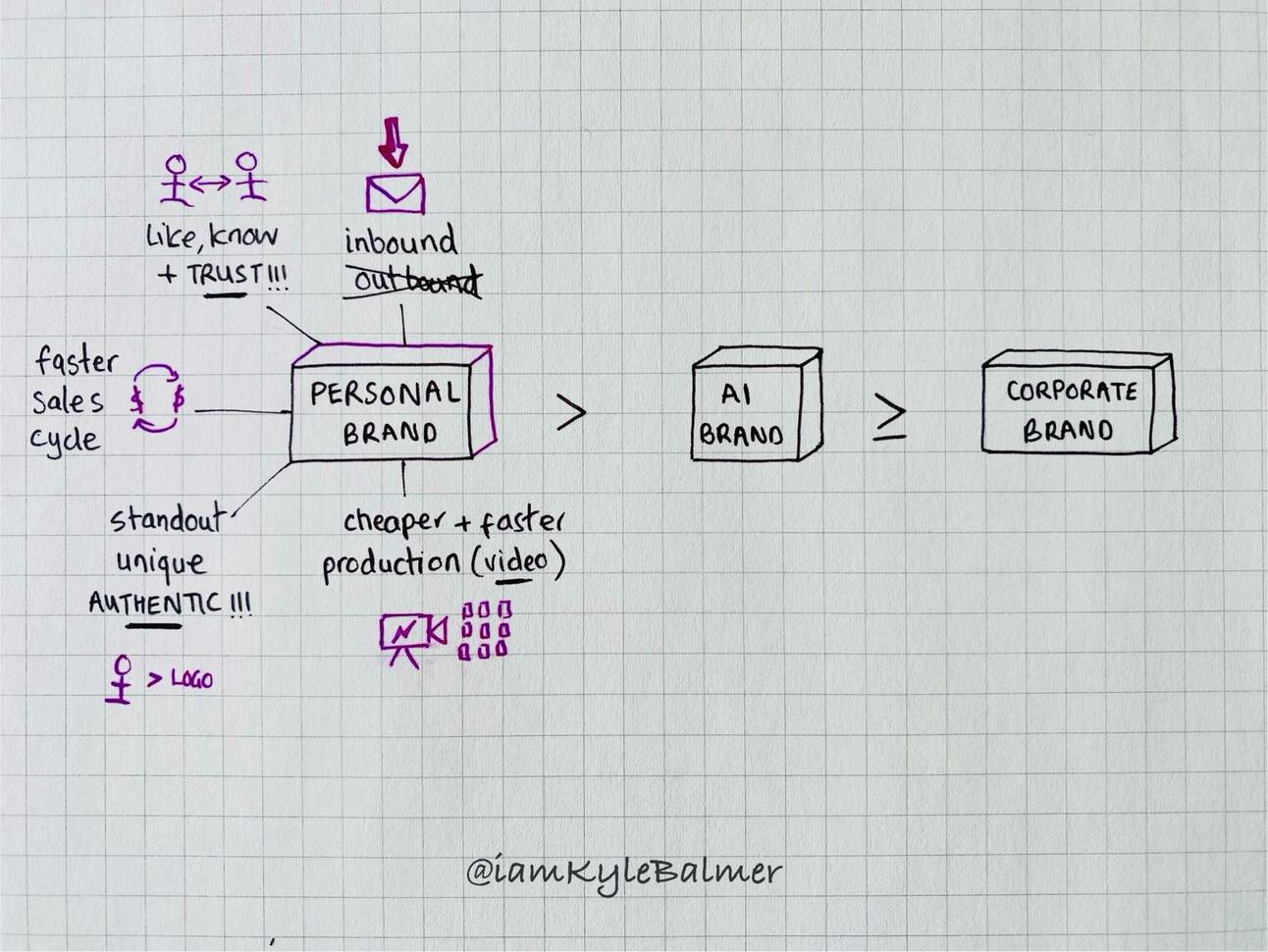
But I know that the benefits of personal branding are too powerful to ignore.
Today, just today, which is a Saturday my personal brand has brought in 1 partnership deal, 2 inquiries for 1:1 coaching and 3 requests for requests for corporate training.
All landing in my email and DMs - inbound rather than me chasing people. And none of these people knew me on Friday.
The net value of those (if they come to fruition) is probably $20k+
That’s from me sitting down and recording a 3 minute video. My face, my voice. Explaining a topic that I know a bunch about.
People do business with people. They need to know, like and trust the person before deciding to work with or buy from the business. Personal brand accelerates this process exponentially.
Would this have happened if:
my profile picture was a logo?
my writing was corporate?
my videos were highly produced, edited animations?
Nope.
And the ironic thing is that doing it using the personal touch is much cheaper and faster than the “produced” route.
Higher upside and lower cost. In business we call that an absolute no brainer.
You may have seen the newer AI avatars. Basically tools that allow you to make an AI replica of your image and voice.
It’s super impressive technology. And super powerful for a lot of companies.
Does this mean you can avoid putting your face out there?
Technically yes. But I don’t think that’s the play.
As these AI avatars become cheaper and easier it’ll become the default.
By sticking with raw, authentic less produced video and text you’ll distinguish yourself. You’ll stand out amongst the mass of beige boring AI avatars.
This sounds a bit anti-AI right? In this particular case yes!
I think AI is really useful at dealing with certain tasks. And the reason we’d want these tasks done by an AI is so that we can free up our time for more creative personal tasks.
Like building a personal brand!
We free up capacity using AI precisely so we can double down on the thing that humans are better at doing - being human!
OK what about the more “corporate” B2B companies. Surely you can’t put your personal touch on the brand right?
Nah. Of course you can.
Businesses are still composed of people. And people do business with people.
LinkedIn for example - the most successful content on LinkedIn is from people, not company accounts.
If you’ve ever set up a company page on LinkedIn you’ll know this struggle. It’s easy to get personal profile connections and impossible to grow your company page. Nobody cares.
Coming back to my recent video that brought in partnership and consultation offers. 2 of them saw me on TikTok and then reached out to me on LinkedIn. And one of them works with a sovereign wealth fund.
It’s all very B2B but again they connected with me because I’m a human being, not a brand. Personal trumps professional.
If you are starting or growing your own business there’s also the hard fact that it’s impossible to outspend most large corporations on advertising.
Personal branding is your competitive advantage. Hell, massive conglomerates wish they had a personable face. Why do you think Nike pay athletes so much to feature in their adverts? Why do you think perfume adverts are all fronted by celebrities?
Leverage your comparative advantage.
Hopefully you are already warming to the idea of developing and deploying a personal brand. We’ll build on that over the week.
For now though what I find is helpful is reviewing the other personal brands in your sector.
You’ll need an AI with internet access for this. A paid version of ChatGPT or alternatively use the free version of Perplexity.
Here’s a prompt:
Act as a marketing research assistant

Help me find strong personal brands in my industry.

My industry is [niche]

Find individuals who leverage their personal brand to expand their reach online

Find me 3 x large, 5 x medium and 10 x small accounts

For each provide their primary platform
For this example I plugged in “business coaches in the UK” as the niche. Go as niche as possible for best results.
Here’s what ChatGPT returned:
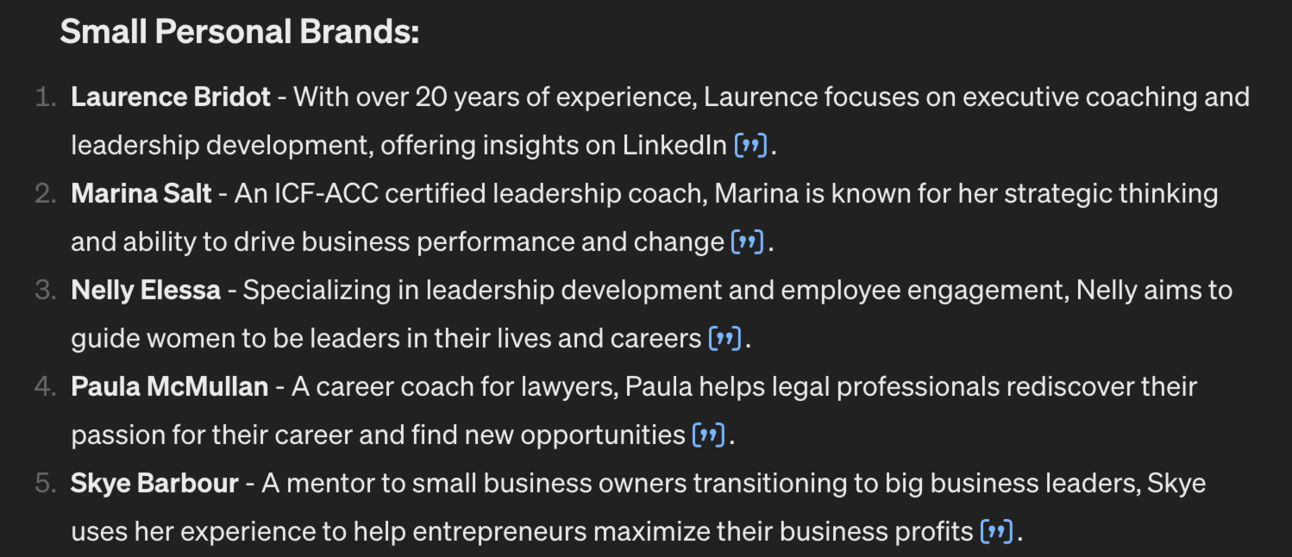
Perfect - these are all solid accounts to look into. It’ll generate large, medium and small accounts.
Your task is just to visit these personal accounts and have a look at how they have positioned themselves. Look for inspiration.
One caveat here: it’s easy to look at these polished profiles and lose hope. Remember that these are the end goal - not where we’ll be starting!
In the next Part we’ll be looking at how we turn you into a brand.
This will be focused on your values, your strengths, your personality.
Let’s also see what gaps there are in the market and see where you'll fit.
Below the research prompt let’s follow up:
Analyse each of these accounts and return their strengths and weaknesses

Find potential gaps in the market

Return results in a tabular format.
This will run a quick competitive analysis for you and return everything in a tabular format:
This flags up a handful of potential gaps. Specifically digital transformation and adaptation to hybrid work, sustainable practices, social entrepreneurship and youth entrepreneurship.
If any of these jive with you - fantastic. That’ll be something to focus on moving forward. If not - no problem, we’ll be creating a market of one (you!) in the next Part.
By now you should at least be intrigued by the potential of building a personal brand. If you are still on the fence not to worry!
Over the rest of the week I’ll be showing you a framework to work out what exactly your personal brand will be and how we can use it to build your business.
Part 1: Commitment to the bit
Part 2: Harness your individuality
Part 3: Your personal story
Part 4: Identity crisis
Part 5: Project and be heard
Keep prompting,
Kyle
Today we’ll look at carving out your space online and where your personal brand sits.
Good news: you have the most powerful asset already. Yourself.
We’ll run through capturing how to translate yourself into a personal brand.
Let’s get started:
You already have the greatest asset your need for your personal brand: yourself!
In this Part we are just going to refine and codify your brand by using a coaching prompt.
We’ll end up with three main components:
core messages
character flaw
what you stand for
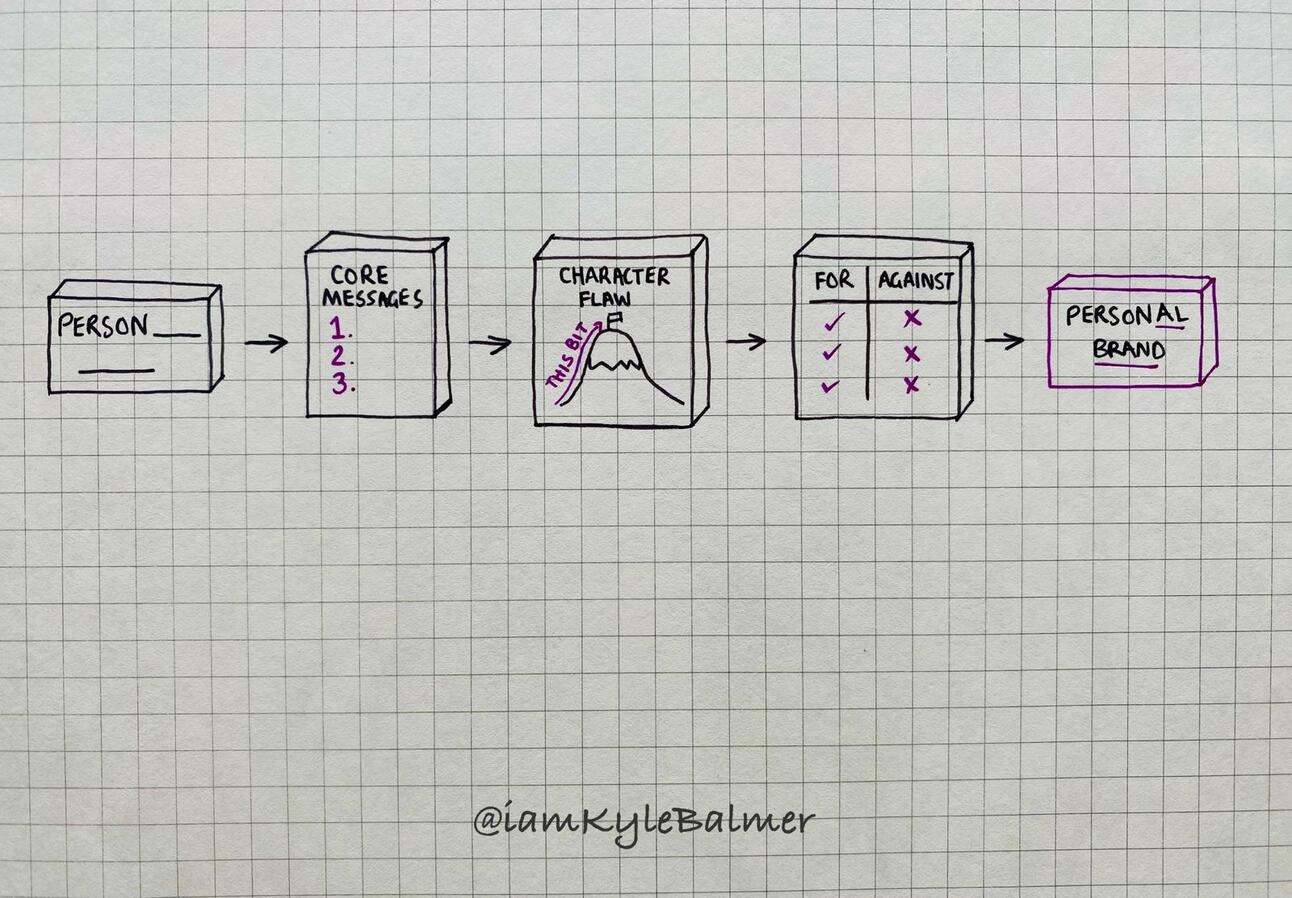
Your core messages are going to be the 3 main things you talk about. They will become your “content pillars” later on - core topics that you will base your content on.
They do not all need to be in the same area. Instead this is where we bring in the fact that we are humans with varied interests.
It’s our diversity of interests thats makes us…well…interesting. Be interested to be interesting.
If we talk only about one topic all the time we end up very flat. Sounding like a corporate spokesperson rather than a human!
Ever felt LinkedIn is a bit dull? This is why. People show one face only on LinkedIn. And it tends to be the boring professional face! Yawn.
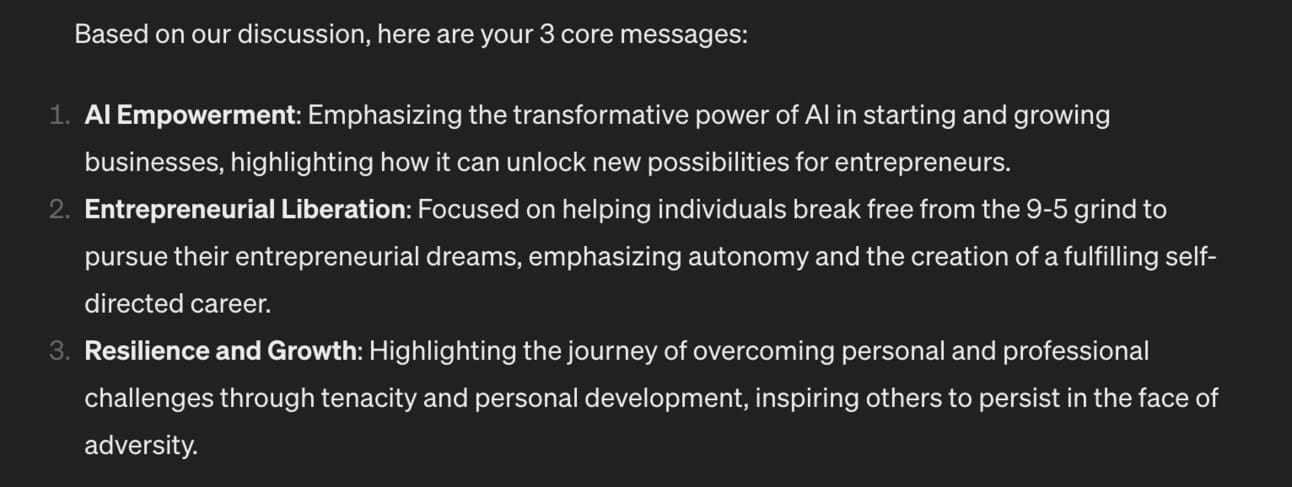
Instead we’ll have 3 core messages to give more variety. Mine for example are AI, Entrepreneurship and Personal Development.
If it was just AI it’s very flat. But by combining with other areas we have a wider base to build our personal brand from.
Next up is our character flaw.
Wait what?? Why are we talking about this?
This is the key to making you an attractive character online. It’s about showing you are a human being, not just a brand.
All the best heroes from film and literature have a flaw. That’s what makes them likeable. As humans we don’t like perfect robots.
FYI: This is especially important as AI influencers become the norm.
Also people aren’t interested in your success right now. They are interested in how you got there. And therefore how they can get there.
So we need to talk about our struggles and flaws to really connect.
Finally we need to define what you stand for and, more importantly, against.
Burr, the revolution's imminent, what do you stall for?
If you stand for nothing, Burr, what'll you fall for?
We need to define our allies and enemies.
Being milquetoast and agreeing with everything is not an attractive personal brand. There needs to be an enemy.
Don’t worry - I’m not telling you to personally attack people! Instead our enemy will be a concept, idea or axiom that people take for granted but we abhor.
Ok - let’s roll with a prompt that’ll help us define all of the above!
It’s a coaching prompt so load it into ChatGPT and then answer all the questions it throws at you. The more information and context you give the better.
Act as a personal branding expert

Help me identify my 3 content messages, "flaw" and what I stand for and against.

Each message should be a short word/phrase like holistic health, money, entrepreneurship.

Inquire into the following areas one at a time. Await my response then move to the next. Collect all the information before processing results.

1. what is your business niche?
2. who does your business help?
3. how do you help people differently to your competitors?
4. what topics excite you? what sort of news do you keep up with because you enjoy it?
5. what have you have to overcome to get to where you are?
6. how did you overcome this block? What got you to where you are now?

Use this information to determine my 3 core messages.
And what is the "flaw" that I overcame
What do I stand for and against- create a polarity.
Run through the coaching process with ChatGPT until the end. Then it’ll return your results, starting with your core messages:
Followed by your “flaw”:

And finally what you stand for and against:
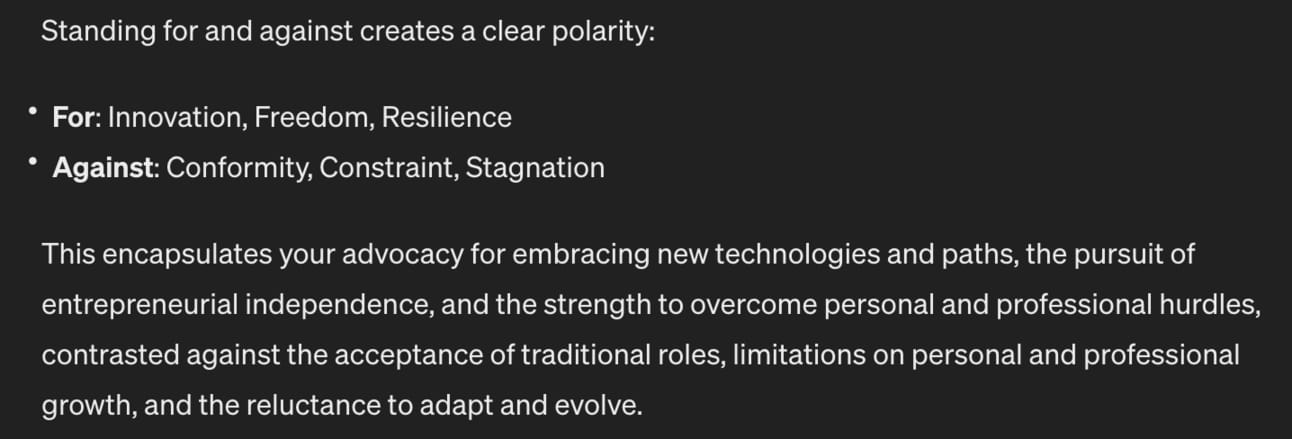
As always use this only as a jumping off point
The great thing about having a first draft is that it is a lot easier to correct and edit than it is to create from scratch.
This is particularly the case when writing about ourselves! Hence the use of the coaching prompt to elicit the details from you. It’s easy to answer these questions.
Let’s go a step further with our personal brand refining.
Instead of just working out our basic messages, flaw and what we stand for/against we can combine this into one powerful concentrated idea.
You want to become the ____ guy/gal. Pardon my use of guy/gal here but it’s a useful shorthand. For example:
NFT_God is the Twitter algo guy.
Amy Porterfield is the online course gal.
Ramit Sethi is the personal finance guy.
Grant Cardone is the real estate guy.
Katelyn Bourgoin is the consumer psychology gal.
Alex Hormozi is the $100 Offer guy
Russell Brunson is the funnels guy.
Tai Lopez is the “here in my garage” guy.
I’m only half joking on the last one. It’s still a recognisable brand!
What they all have in common is that they have taken a whole area. They are inextricably linked with that area now.
So even when someone doesn’t know their name they can still remember the face and be able to say “oh yeah the funnels guys”.
That’s branding. That tight association with your core field and the value you bring to it.
Use this prompt below your existing work:
As a further step condense this into a single topic that I can make the core of my personal brand

It should ideally be one word, maximum two that sums up the essence of my brand
For me it turned out “AI Resilience” which is great. The “AI Resilience guy” has a decent ring to it.
Ask for more as needed and use these to carve out your space.
Great work. This might have been tough depending on whether you enjoy introspection.
We’ll be taking the results from this Part into the next where we craft our compelling narrative.
A reminder of what we’re covering:
Part 1: Commitment to the bit
Part 2: Harness your individuality
Part 3: Your personal story
Part 4: Identity crisis
Part 5: Project and be heard
Keep prompting,
Kyle
Storytelling is a key personal branding skill. Thankfully it can be learned.
We’re going to use ChatGPT to draft our personal story and then work on converting it into our own words.
Let’s get started:
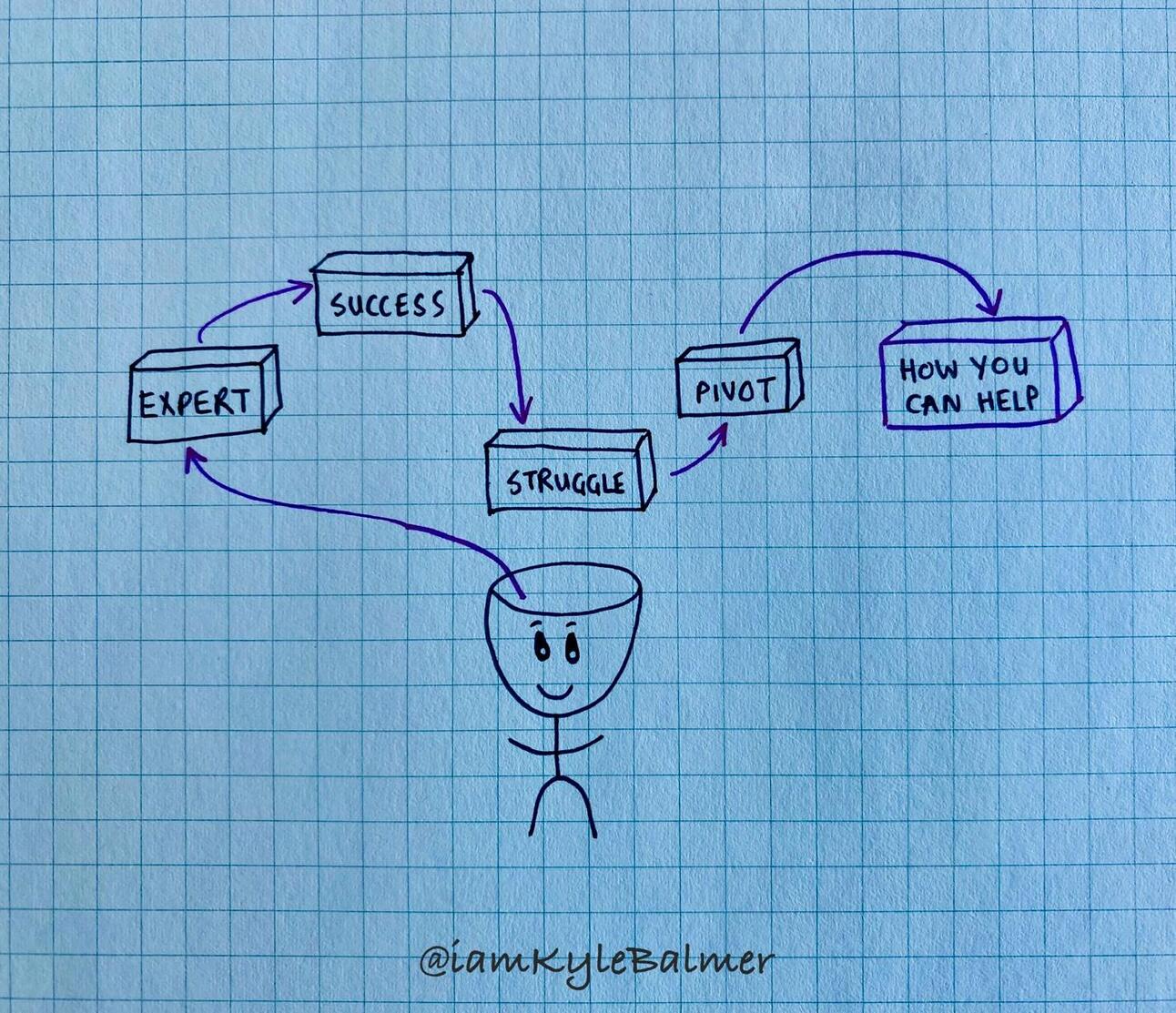
Being able to tell your personal story is super valuable in business.
When someone asks what you do we don’t want to be caught saying" “um, like internet stuff”.
Instead we want to be able to deliver a succinct, powerful short story that explains who we are and what we stand for.
“It's like everyone tells a story about themselves inside their own head. Always. All the time. That story makes you what you are. We build ourselves out of that story.”
Here’s a prompt that we’ll use below the previous work from the last Part:
Act as a personal brand strategist who specialising in helping individuals craft their story

Using the above notes craft a compelling personal narrative. Include but do not limit to these points.

My personal successes, accolades are [list successes]

1. How I can help people
2. My successes now
3. But it wasn't always this way, pivot to personal story and struggle
4. Call to action to let me help you

Keep the language conversational. Do not use floral metaphorical language.
Make it matter of fact and quietly confidence not boastful sounding.
For this I put in the following “successes”:
writing 1000+ words a day on my subject for deep domain expertise, published 8 amazon books, 50k+ subscribers, 10+ million social media impressions, featured in Forbes 4x, consult and train international organisations.Plug in your current personal and professional successes in the field connected to how you’ll be helping people.
Here’s my output.
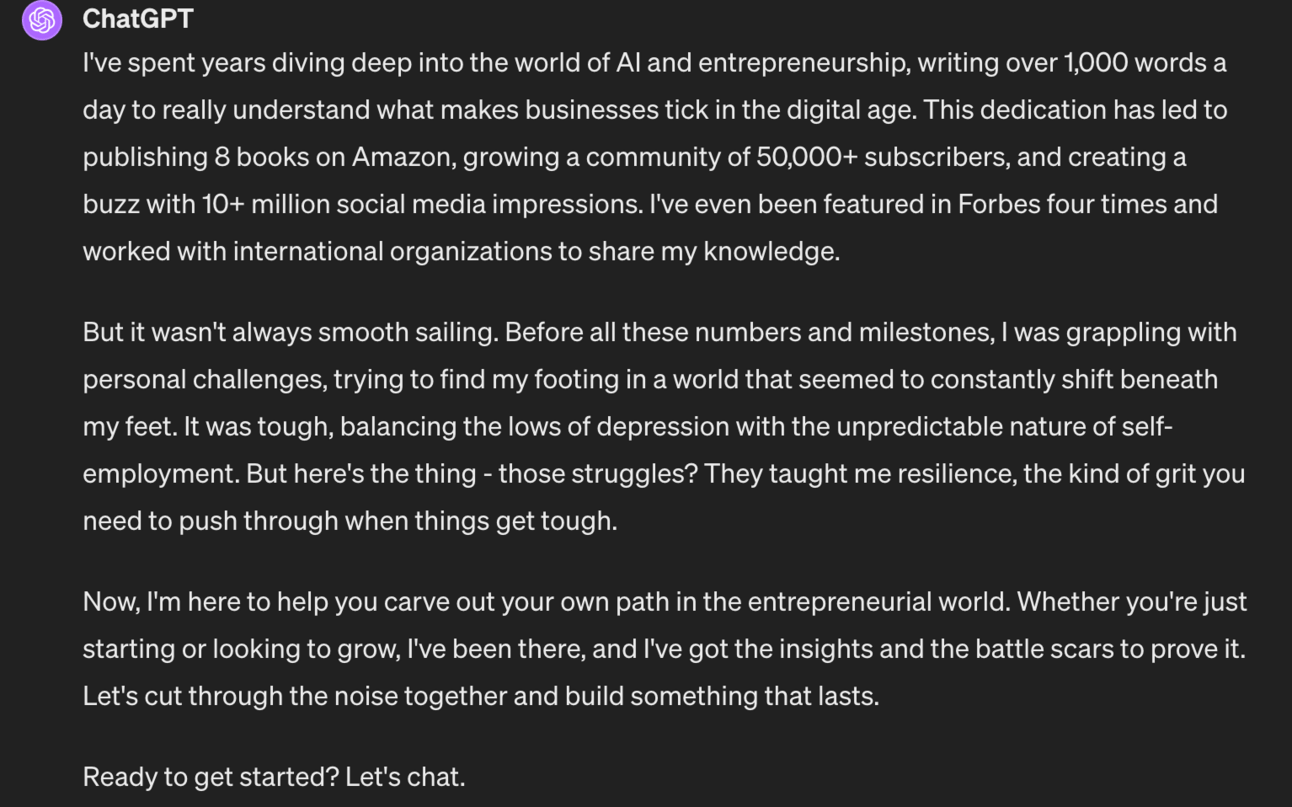
That’s not a bad start. But to make it ours here’s the next step.
You’re going to record it.
That’s the best way to get it into your own voice. You don’t need to publish anything (although bonus points if you do!). We’re just using the act of saying this out loud to help refine and put this into our own voice.
Don’t just read it out loud from the script. That’s still ChatGPT’s voice.
Instead use a follow up prompt:
Convert to bullet points for me to deliver this orallyWhich will lead to a nice bullet pointed script.
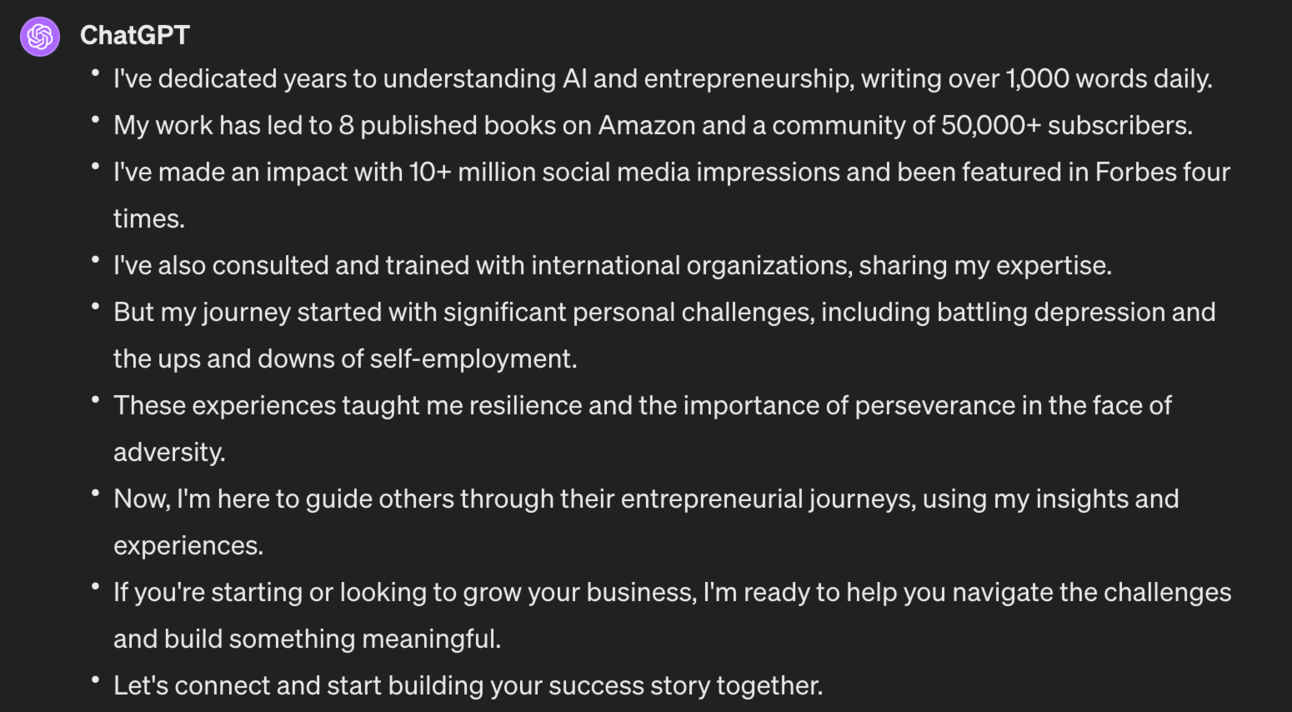
When you record you will naturally drop certain parts and embellish others. Take a few shots at it. Each time it'll become easier and will naturally shift to being in your own tone of voice and style.
Depending on the circumstances we’ll need different versions of our story.
Our Premium prompt creates these for you. Let’s use it to create a handful of variations which we can use.
Here’s the prompt:
I need variations of my personal story at different lengths.

Please prepare the following versions:
-10 words
- 30 seconds spoken
- 2 minute spoken
- professional bio text
- haiku
Add in any others that you need, depending on when you usually introduce yourself.
Here are the 10 word and 30 second spoken examples:
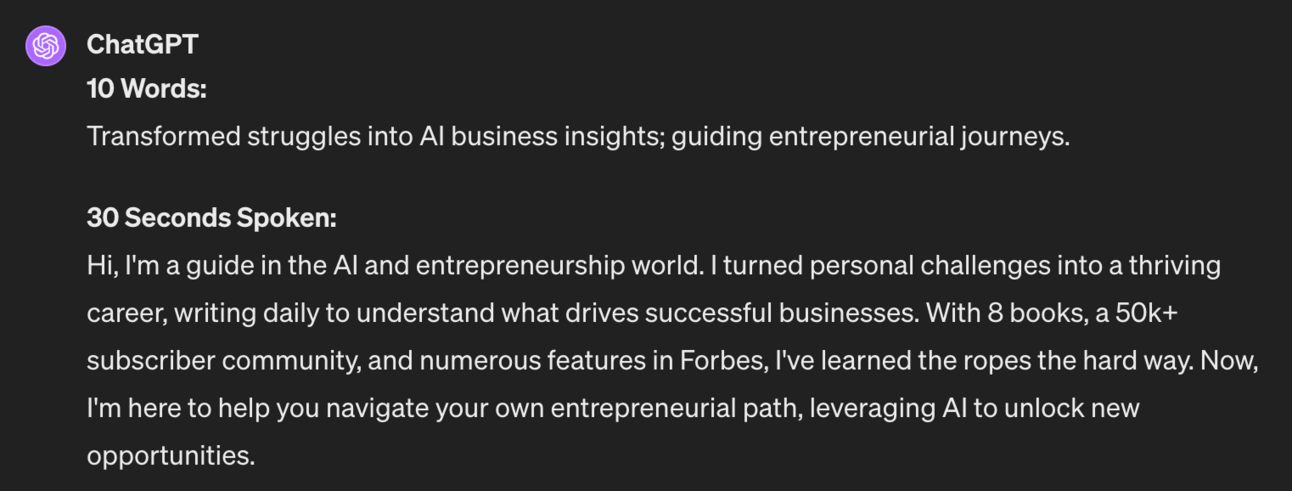
And here’s the professional bio and the haiku (for fun)
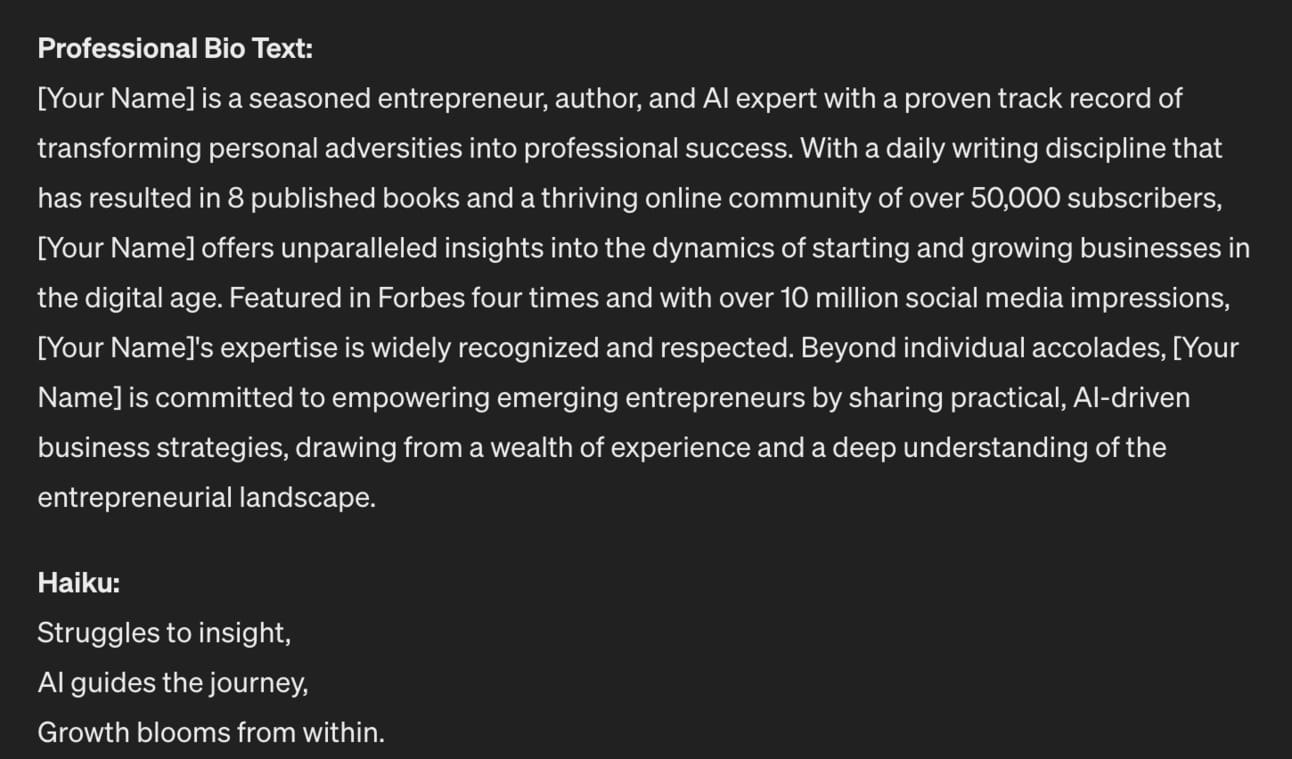
Again practice delivering these on video to help find your voice.
Practice makes perfect.
It’s not enough to generate the story in ChatGPT and leave it at that.
This version is a jumping off point only. You need to practice delivering it so that it flows naturally.
So get your camera phone out and shoot it again and again until you feel confident.
A reminder of what we’re covering:
Part 1: Commitment to the bit
Part 2: Harness your individuality
Part 3: Your personal story
Part 4: Identity crisis
Part 5: Project and be heard
Keep prompting,
Kyle
It’s not their fault - everyone has such busy lives and so many things to worry about. It’s natural.
Their time is short and their attention is shorter.
This means that we need to immediately be recognisable.
In this Part we look at how we immediately capture attention.
Let’s get started:
When someone is scrolling through social media they move fast.
The average person scrolls 300 feet / 90 meters a day. Poor thumb.
This means that we need to immediately stop the scroll if we stand any chance of capturing their attention.
Once someone knows us (they’ve seen some videos and maybe followed us) we need to consistently be able to capture that attention.
For this we need some visual branding. This is a massive topic that could take all week. So we’ll keep it high level for now.
Let’s cover a few elements:
video format
visual “hook”
design elements
Once you find a video format that seems to be working: stick to it.
For example if you do talking head videos, stay consistent.
Here’s a example from Brand Nat:
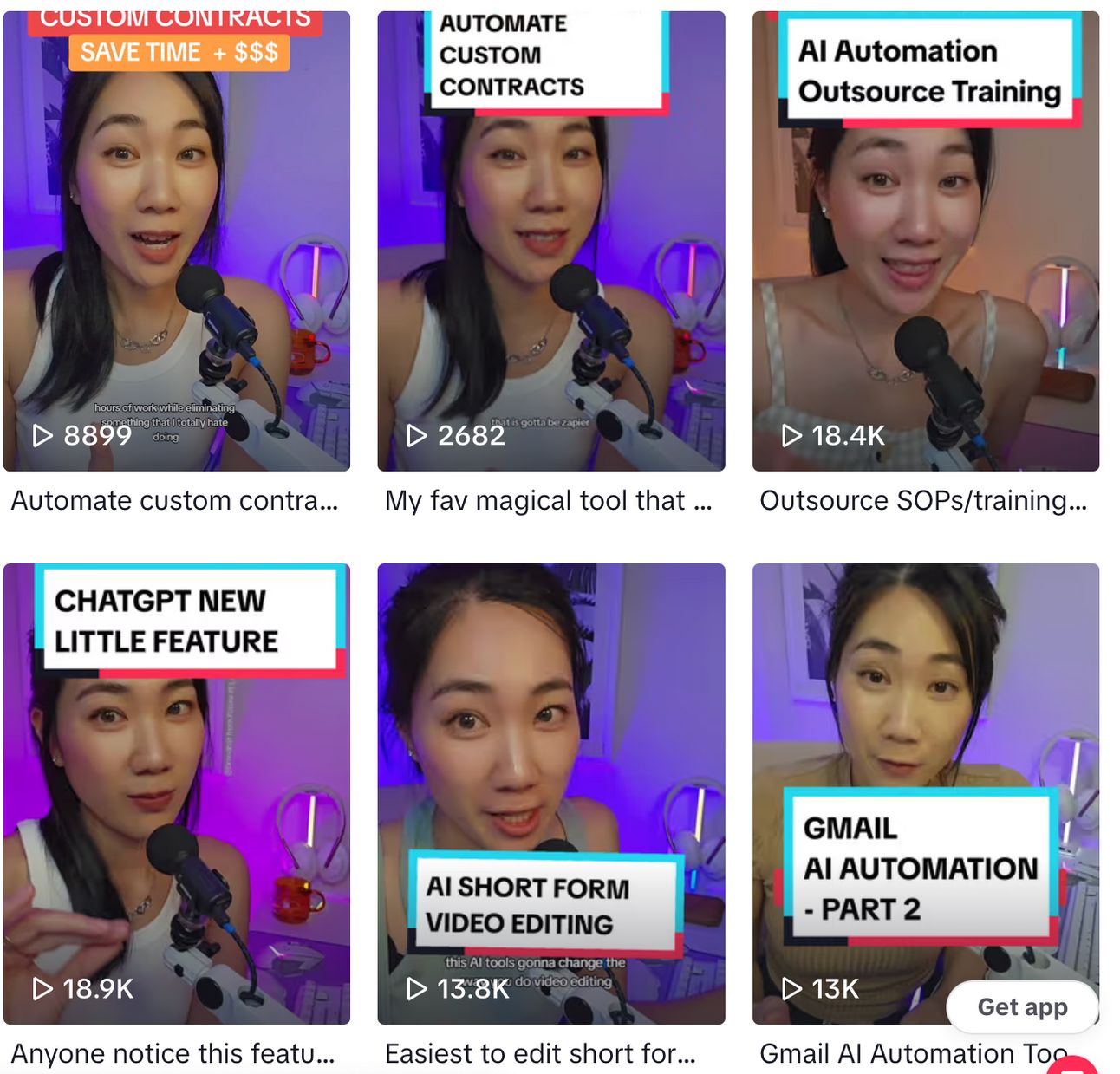
Same angle, same composition. Immediately if one of these videos appears in feed her viewers can recognise it.
If the videos didn’t show Nat for a few seconds and instead started with random imagery then the audience would need to hang around to see whose video they were watching. Unlikely!
Instead make it as easy as possible for your audience to recognise your work and know they need to stay tuned.
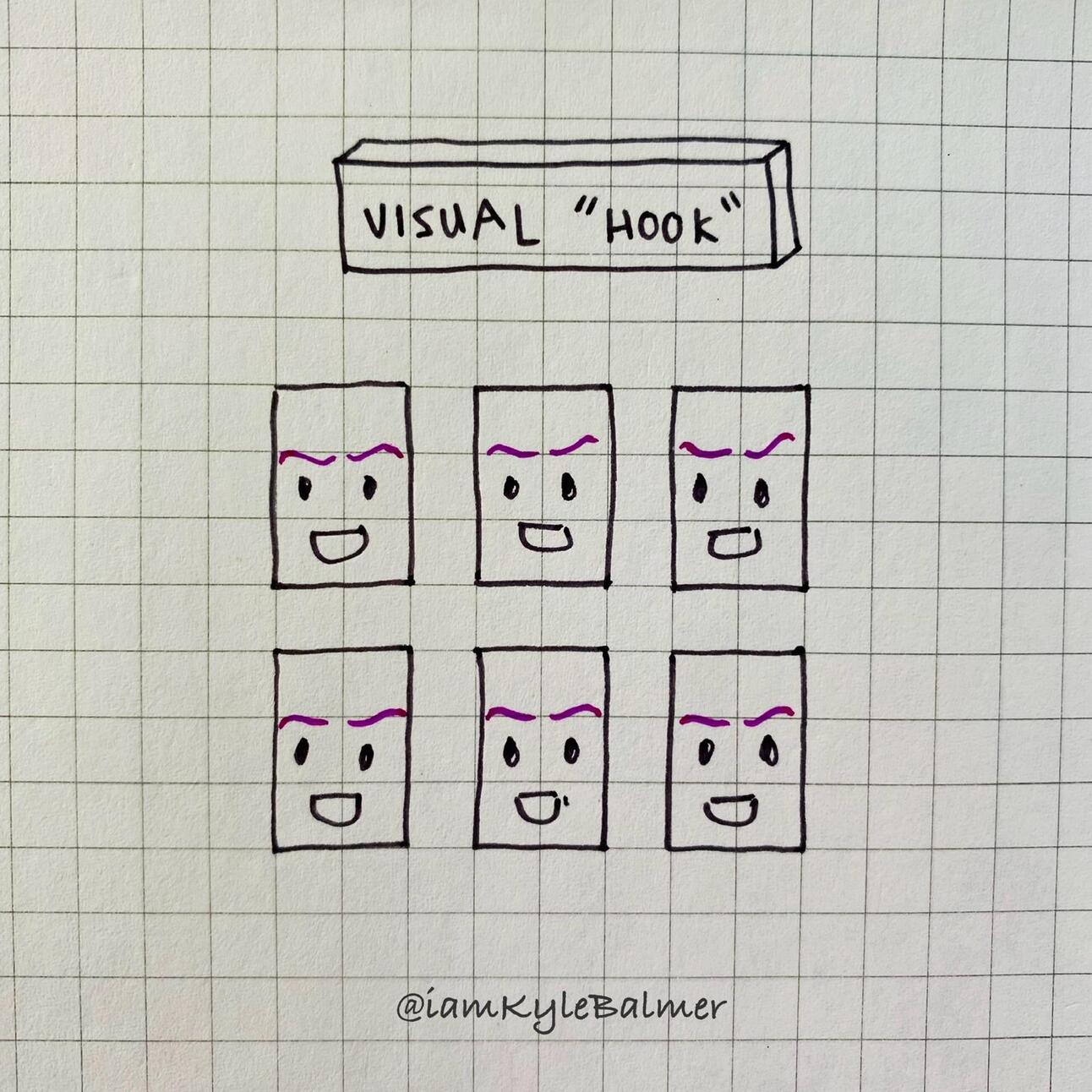
It’s helpful to have some sort of visually arresting feature.
Mine, apparently, is my eyebrows. 🤨
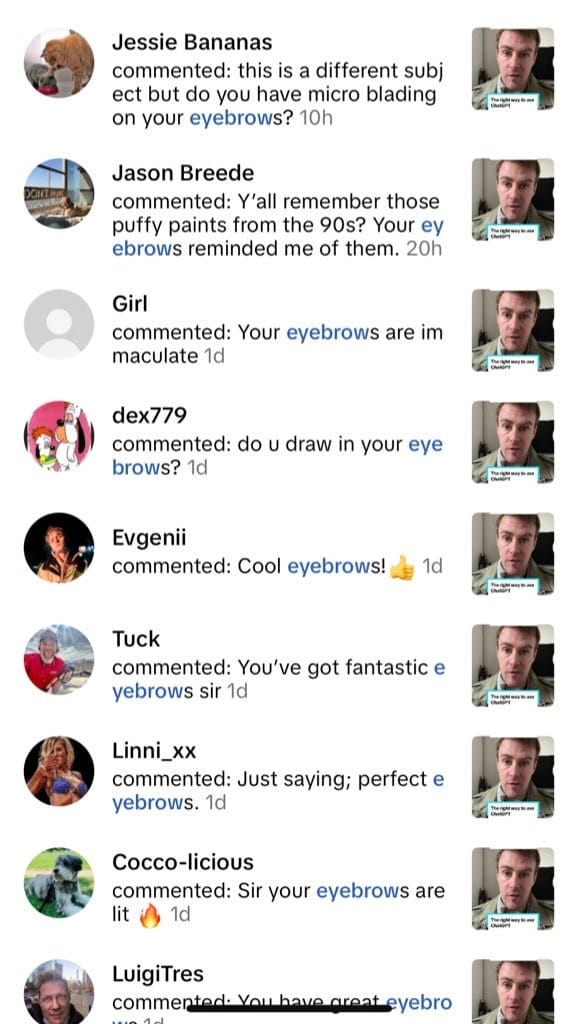
Hilarious.
But also useful! Having something visually arresting is helpful.
Even if someone doesn’t know my name I can be “that AI guy with the eyebrows”.
Alex Hormozi - “strong guy with moustache and cap”.
Tai Lopez - “dude with the books and lambo”
Tony Robbins - “big man with shiny teeth”.
You visual hook can be something you wear, a tattoo, makeup, jewellery… it doesn’t really matter as long as it’s i) visible and ii) consistent.
Find something and stick to it.
Choose and maintain consistent design elements across your platforms. This includes things like logo, colours, fonts, graphical elements.
Start with your basic colour scheme.
Alex Northstar does a great job of this on AI Twitter with his consistent gold/black branding. I personally use purple. 🟣
From your colour choices develop your logo and graphic design elements.
At Prompt Entrepreneur we made a conscious decision to use hand-drawn graphics as part of our brand because we find people are very receptive to them - it’s like I’m sketching out ideas for you in an casual meeting.
Make sure that you have all your visual elements collated somewhere so you can consistently apply them.
If you have team members or staff it’s worth putting together a set of brand guidelines.
This sounds fancy but it’s basically a PDF with all the details about your colours, fonts and acceptable/unacceptable design elements. Mainly so you aren’t always having to tell people “no, not that purple”.
Once you’ve made these decisions apply them as much as possible wherever you can. This reinforces the brand subconsciously for your audience members.
Consistency and repetition is key.
We’ve talked a lot about consistency. But sometimes mixing it up a bit is powerful - you need to go unplugged to appreciate the distortion.
How do we do this strategically?
We use limited time formats- specifically Stories.
These exist on Tiktok, Instagram and Facebook.
Stories are basically temporary posts that last for 24 hours and then disappear.
These are perfect for going off-piste and showing a little bit more about yourself as a person.
All whilst not damaging your main feed’s consistency.
Basically they allow you to let your hair down, put out something more left-field, more personal. Without it needing to be 100% “on brand”.
For instance I’ll drop stuff about board games. That’s what I do for fun. Anything to do with AI? Nope not at all! But it’s a way for people to see another side of me without me having to leave that content cluttering up my account.
Once you have your core content in place use Stories to experiment and show that you are a real human!
Start to overlay these visual identifiers into your content and keep repeating them. You’ll be “training'“ your audience to expect these elements - and each time you deliver them your brand grows in recognition.
In the next Part we’ll talk about bringing everything together, choosing your channels and launching your personal brand.
A reminder of what we’re covering:
Part 1: Commitment to the bit
Part 2: Harness your individuality
Part 3: Your personal story
Part 4: Identity crisis
Part 5: Project and be heard
Keep prompting,
Kyle
Now that you have your brand basics lined up it’s time to start getting the word out.
In my BATON model (Business, Audience, Tribe, Offer, Network) this is the core of Audience - taking your message and making sure your potential customers hear it.
It’s a big topic so we’ll cover the core fundamentals today.
Let’s get started:
Building an Audience is a massive topic obviously - I’ve written maybe 10 Prompt Playbooks on the area already.
Today we’ll cut it down to my top recommendations.
We’ll follow COVR: Customers, One focus, Video, Repurposing.
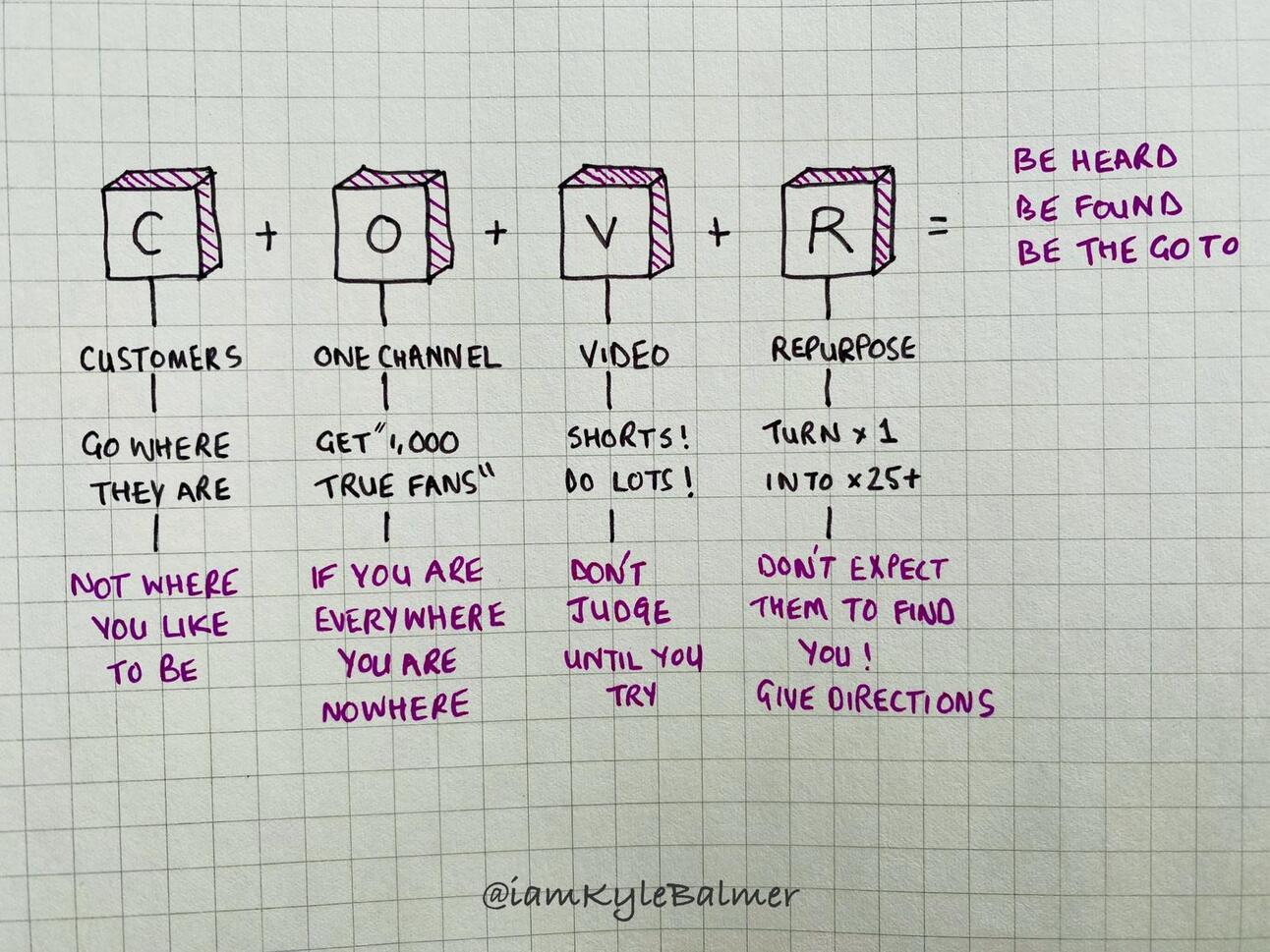
Yes, there should be an E, I know I know.
But I’m not going to stick in something random just for the tidy acronym. I respect you too much for that 😗
Here’s a biggie. You need to be putting your brand out in front of your customers.
Not only your peers.
Just because other people in your industry are on a particular channel (say, LinkedIn or Twitter) this doesn’t mean it’s where you need to build your brand.
We want to be putting our content, and thus our brand, in front of customers. So make sure you know where they are.
It’s a subtle distinction but important.
For example I use Twitter/X to build my reputation, make connection with peers and be an authority.
But that’s not where my customers are. My individual customers are on Facebook and TikTok. My corporate customers are on LinkedIn.
Obviously building your professional reputation amongst peers is very useful. But it’s not the primary focus - we are focusing right now on customers and revenue.
How do you find where your customers are? Lots of ways but my favourite (because it is fast!) is running adverts.
Direct advertising instantly turns on the traffic tap and tells you immediately how people will react to your content and your brand.
It’s much cheaper (in the long run!) than spending lots of time trying to build an organic following.
For example I ran ads for this newsletter on 6 different channels to see what would work best.
For me I found it was Facebook, a channel I personally don’t use or enjoy but it turns our my audience and customers hang out on. What I want has nothing to do with it! It’s where my customers are.
Once you’ve found your channel go hard on that ONE channel.
Don’t spread your effort yet but instead build an organic following on one channel.
This lets you refine your message and get in the reps required.
If you immediately try to be everything, everywhere all at once (great film) you’ll fail.
Yes you can get cool tools that post everywhere.
But you also need to be present there to engage. And that takes time. You cannot just push out content and hope to build a following without also engaging.
So once you know the one channel where your customers hang out double down on that.
Your first benchmark is 1,000 followers. Once you get to that you can look at other channels. Until then stay focused.
If you’ve spent anytime with me (hi) you probably knew this was coming.
Right now you need to be doing video.
More than that: short video.
It’s simply the fastest, easiest way to get your brand out there.
The benefits include you being able to be authentically yourself and speed/low cost of production.
More importantly (and cynically) it’s what the channels want. All of the main social platforms want short video.
And they want it because it is what their audiences want. Makes sense.
Regardless of what you think about short video it’s the format that audiences want and thus the channels want.
Hell, you probably enjoy short video yourself. Why wouldn’t everyone else? Keep it simple by sticking to what works. It increases your chances of success.
Finally, once we have found our one channel and once we are happy producing video we can look at the most powerful tool at our disposal.
Repurposing.
Repurposing is basically taking one piece of content and making it suitable for other channels.
For example a blog article can be sliced and diced into short social media posts. That’s repurposing.
If we start with video we have the most information dense format.
Video has image and audio. And if you have audio you have text. It’s a three for one (threefer?), containing all the major media types.
I’ve written a whole Prompt Playbook exclusively on repurposing so won’t retread. The main takeaway is that repurposing is the key to hitting the other channels.
This is the point where we can expand and start getting more traffic from more channels. Via the mechanism of repurposing.
We started with one primary channel based on it being where our customers are.
We focus entirely on this one channel until we find our feet and are confident in our branding and messaging.
We use video because it’s the single most powerful single format. It gives us the best chance to grow our brand by swimming with the current rather than against it.
We then deploy repurposing in order to multiply our impact over other channels. But only once we have the other elements aligned.
I’d love to say it’s this simple and easy.
Well, maybe it’s simple. But not easy!
Along the way make sure to listen to how your audience is reacting.
They’ll give you hints that’ll help you refine your brand. It’s free brand consultation!
An expert can give you great sounding advice but it’s really the audience and customers who you need to listen to.
How do we do this?
See how they comment - what do they mention?
Pay attention and double down on the elements they pick out.
This last week I’ve been told about my eyebrows 30+ times.
I know it’s a humorous example but it’s still worth highlighting. If people are noticing and connecting to something about you and your brand then lean into that. Don’t fight the tide but go with the flow instead.
In addition talk to people!
This can be at arms length using polls (great tool and built into most platforms).
Or it can be closer by having chats, phone and video calls with them. Ask them what they think works and what they think does not.
People love to give feedback. They want to help. Seriously, it’s a wonderful thing!
So let them help - ask about your brand and messaging and what does and does not resonate with them. It’s invaluable information!
Another big week. Hell, I say that every week don’t I!
We’ve looked at the power of personal brand, how to codify what your brand is, your story and identity.
And from there we looked at how we get out there and get the word out.
A reminder of what we covered this week.
Part 1: Commitment to the bit
Part 2: Harness your individuality
Part 3: Your personal story
Part 4: Identity crisis
Part 5: Project and be heard
Keep prompting,
Kyle
In the rapidly evolving landscape of AI, personal branding has emerged as a crucial superpower that can set you apart from the competition. The ™️ Personal Branding in the Age of AI Playbook is your essential guide to mastering the art of personal branding, ensuring you not only survive but thrive in your industry. This comprehensive resource dives deep into the CISIP framework, guiding you through the steps to commit to your personal brand, leverage your individuality, and effectively project your message to your audience. By the end of this playbook, you'll be equipped to build a magnetic personal brand that resonates with your target market and drives meaningful connections.
This playbook is designed for entrepreneurs, freelancers, and professionals looking to elevate their personal brand in an AI-driven marketplace. Whether you're just starting out or looking to refine your existing brand, this resource will help you navigate the challenges of standing out in a sea of generic content. If you're struggling to connect with your audience or feel overshadowed by larger competitors, this playbook provides the tools and insights to transform your personal brand into a powerful asset.
No, this playbook is suitable for beginners and seasoned professionals alike, providing foundational knowledge as well as advanced strategies.
While results may vary, many users report noticeable improvements in their brand engagement within a few weeks of implementing the strategies.
The playbook is available in digital format, featuring actionable steps, exercises, and video content to enhance your learning experience.
Absolutely! The principles of personal branding are universal and can be adapted to suit any niche or industry.
Yes, the playbook includes links to tools, templates, and further reading materials to support your branding journey.