
AI Knowledge
Welcome to the '💼 Legal Assistant' playbook, your essential guide to revolutionizing how you handle legal documentation in your business.
Start ReadingYour business can save thousand on legal fees with AI. I mean that literally - not in some wishy-washy "potential savings" way. I’ve saved tens of thousands on legals over the last year.
6 months ago I’m sat at my desk, staring at a legal quote with more zeros than my first year's salary. All I needed was a license agreement for my AI Workshop Kit. Simple enough, right?
Well, not quite. You see, we give exclusivity to each of our license holders for their territory and industry. It’s a relatively sophisticated contract that needed to flex to our (now) 100+ license holders.
The lawyers wanted tens of thousands for this work - for an idea that hadn't yet been proven to have legs. Revenue wasn’t coming in yet and a $10,000 bill to get started was looking … rough!
Steep but a that’s just a cost of business, right? Cough it up.
That's what I thought too... until I had "wait a second” moment.
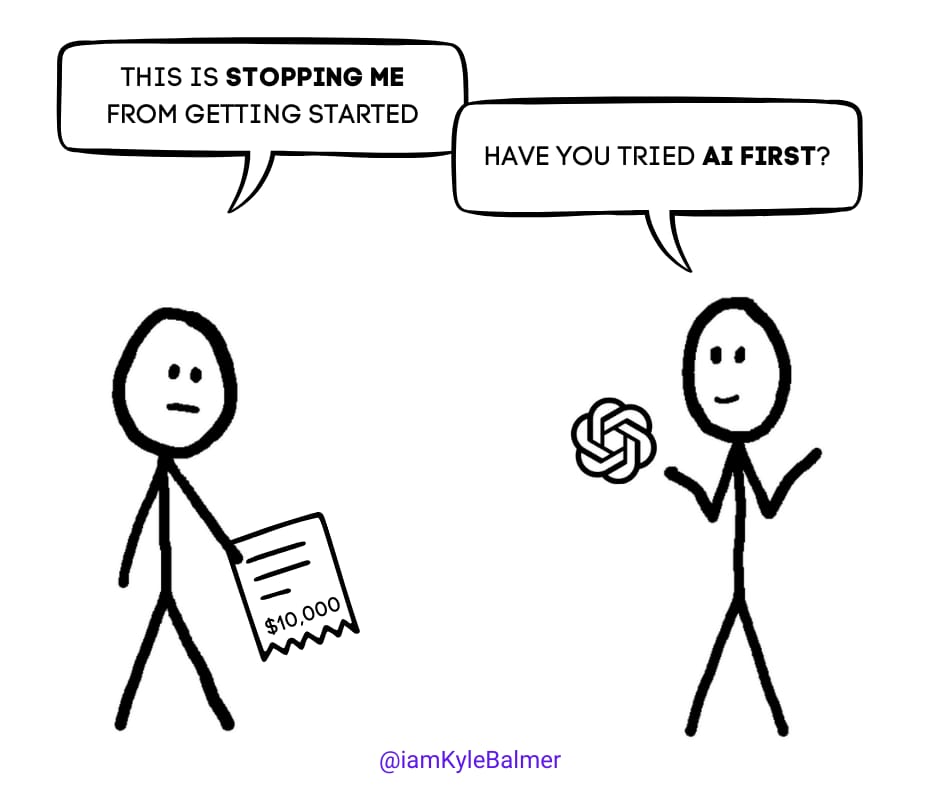
I used ChatGPT and Claude to prepare the agreements, refine, contest and finalise.
It still took hours of work over a whole week. I'm not going to pretend otherwise.
But here's the kicker: when I sent the final agreement to a solicitor, they came back with zero notes.
Not a single one.
And this isn't just about license agreements. We're talking NDAs, terms of service, contracts, contractor agreements - basically any legal document you can think of.
Used correctly we can use AI to slash and burn our company legal costs. Whilst remaining safe.
OK, before we get started, a quick word from our (very exciting, I love this company!) sponsor:
We are partnering with Notion to offer 3 months of Free Notion towards a Plus plan and Unlimited AI for startups in our ecosystem.
You should know Notion by now! I use it to publish my AI Business Playbooks every week. But if you don’t know Notion, thousands of startups use Notion to run a wiki, manage projects, share documents, and more.
Eligibility requirements
Must be a non-paying customer
Under 50 employees
Under $10M funding
Redemption Instructions
To redeem the Notion for Startups offer please follow these steps:
Submit an application using our custom link: https://ntn.so/aientrepreneurship and select AI Entrepreneurship on the partner list.
Include our partner key, STARTUP4110P38350.
Email startups-help@makenotion.com with any questions!
The Notion Startup Team will review your app and apply your offer within 1-2 business days and follow up with a confirmation email. Email startups-help@makenotion.com with any questions!
Let’s get started:
Lawyers hate this one trick…
Legal assistant in your pocket
The power of boilerplates + smart edits
Types of documents you can tackle
How to get started without getting into hot water
Here's something that might surprise you: most legal documents aren't the bespoke masterpieces lawyers would have you believe. They're actually more like Lego sets - standard blocks put together in slightly different ways.
Don't get me wrong - I'm not knocking lawyers. Not…too much. They're brilliant at what they do. But let's be honest about what most legal documents actually are: boilerplates with smart edits.
For example when you purchase a house they don’t write the contract from scratch every time. They have a specific template used thousands of times for every house sale. Adjusted for the specific deal each time.
That's exactly why AI is perfect for this kind of work. It excels at:
Understanding patterns in documents
Making systematic changes
Checking for consistency
Flagging potential issues
And the best bit? AI doesn't charge by the hour. 😂
Let me be crystal clear: i) I’m not a lawyer and ii) I'm not suggesting you fire your lawyers. There are times when you absolutely need professional legal advice. But there's a lot you can do to prepare the groundwork and save a tonne of cash in the process.
I've successfully used AI for:
NDAs and confidentiality agreements
Terms of service and privacy policies
Contractor and employment agreements
License agreements
Partnership contracts
Basic service agreements
Over this Playbook, I'll show you:
How to get AI to act as your legal assistant
The interview method for gathering all necessary info
How to review and refine documents
Using AI to spot potential problems
When to bring in the professionals
We’ll have a really smart paralegal who works 24/7 and costs us $20/month. Use it wisely, and it'll save you thousands.
At its core, our approach is simple:
Start with solid boilerplate documents
Have AI interview you about your specific needs
Get AI to craft the first draft
Use AIs (plural!) to review and punch holes in the document
Finally, have a lawyer review if needed
In Part 2, we'll start with the "boilerplate + interview" method. I'll show you exactly how to get AI to ask the right questions and build documents that fit your specific needs.
Keep Prompting,
Kyle
One of my first “proper” businesses was a TV station I co-founded in Vietnam.
Out the gate we hired fancy legal experts to help with everything - business setup, licensing, contracts, the works.
One day, I asked for a specific contract, and within minutes (literally minutes), I got an email back. It had a template attached and a list of basic questions to fill in.
In that moment, they'd accidentally shown their hand.
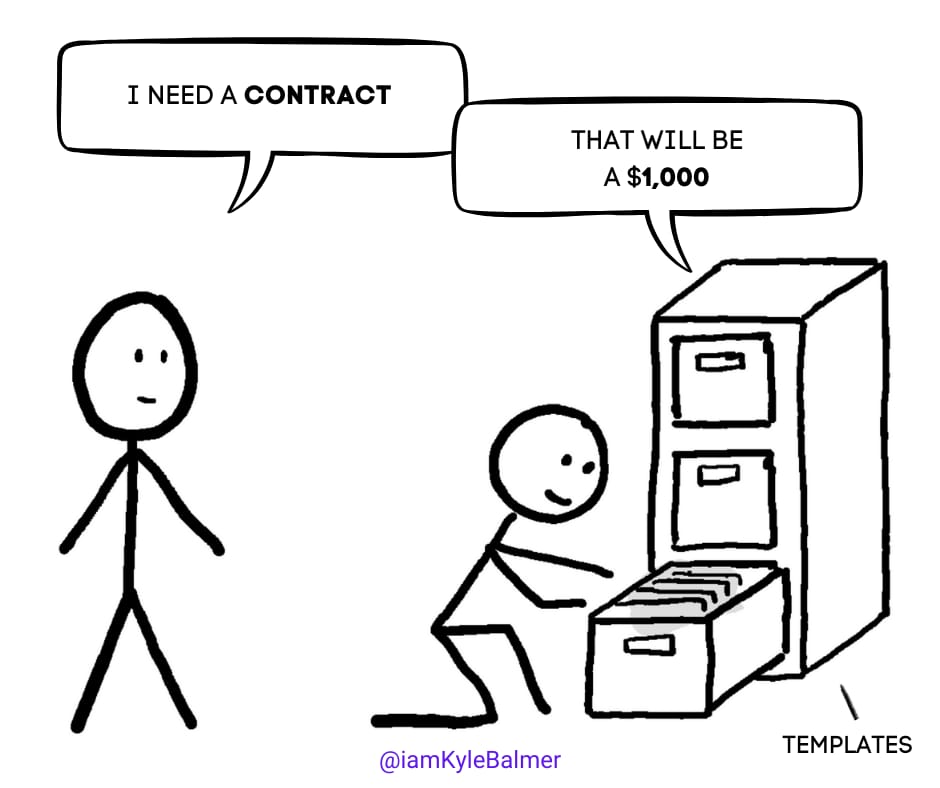
Their whole process was this: take a template, get some basic info from the client, plug it in, make it sound fancy with some legal language. Then charge hundreds per hour for the privilege.
Huh.
Here's the real kicker - I went online and found the exact same template. The one they were using? You could buy it for $50. It wasn’t even hard to find - it was sitting right at the top of Google. 😅
I'm not sharing this to knock lawyers. But here's the truth: the majority of business legal work follows this exact pattern. Lawyers have their boilerplate templates, they collect specific information from you, and make a handful of changes.
That used to be enough to justify the fees. Not anymore.
AI can do this faster and at a fraction of the cost.
Let’s get started:
Getting your base template from AI
The AI interview method
From answers to document
Quality check before moving on
First we need our boilerplate template.
There are two basic options.
Buy/find an existing template
Use AI to generate the template
Honestly the second option works well. AIs have been trained on thousands of legal documents already and can give a good base level boilerplate. It also means we can be sure it's not copied from anywhere. Bonus.
Let's use an NDA as an example, since it's something most businesses need. But this process works for any legal document - employment contracts, terms of service, you name it.
Here's our base prompt:
Create a standard template for [type of document]. This should be comprehensive and suitable for business use. Include all standard clauses typically found in this type of document.Simple as that. The AI will generate a solid base template. For our NDA example, we'd simply specify "Non-Disclosure Agreement" and get a template with all the usual confidentiality, term, and breach clauses.
But here's where most people go wrong - they just take this template and run with it. That's not what we're doing. This is just our starting point.
We’ll now use our AI as a lawyer to walk us through the customisation process. The basic method is we’ll ask the AI to devise a list of questions (based on the document type), we’ll provide answers and the AI will use them to customise.
Do this below your template. Here's the prompt:
You are a lawyer preparing a draft of [type of document]. Interview me to gather all necessary information. Ask one question at a time. Focus on understanding:

All parties involved
Key terms and conditions
Specific requirements or restrictions
Special circumstances or exceptions

Wait for my response before asking the next question.
This interview process is crucial. It's what separates amateur hour from professional-grade documents. The AI will systematically work through everything needed to customise the document properly.
Once you've gone through the interview process, you've got all the pieces needed. Now we combine everything:
Using the template provided and my answers to your questions, create a first draft document that reflects our specific requirements. Maintain professional legal language while incorporating all the specific details and requirements we discussed.The key here is that we're not just filling in blanks. We're creating a document that's properly tailored to the specific situation. As if a lawyer was compiling the document for us…just, a lot cheaper!
But we are not done. We’re going to refine and bulletproof our document.
In Part 3, we'll look at how to review and refine your document. I'll show you how to use AI to punch holes in your document, find weaknesses, and make it stronger through multiple iterations. We’ll use combative prompting to have it find flaws (that we’ll then fix).
Keep Prompting,
Kyle
Remember that AI Workshop Kit license agreement I mentioned in Part 1? Well, there's more to that story.
After I'd used AI to create the first draft, I was feeling pretty chuffed with myself. Ready to send it straight out to license holders and crack on with business.
Thank goodness I didn't.
Because here's the thing about legal documents - they're not for when everything's going great. They're for when shit hits the fan. And let me tell you, in business, that fan gets messy more often than you'd think.
It wasn't enough to have a document that worked when everyone played nice. I needed one that would protect all parties when things went sideways.
What if a license holder started teaching outside their territory? What if they modified the materials in a way that damaged our brand? What if they disappeared off the face of the earth mid-contract?
Good intentions aren't enough in business. And the whole purpose of contracts and legal documents is to prepare for when those good intentions go out the window.
Now, this isn't about being aggressive or pessimistic. It's about being thorough.It's about safety - for you AND the other party.
Because a solid legal document actually makes business relationships better. Everyone knows where they stand, what happens in different scenarios, and how issues will be resolved.
To do this properly, you need to look at the document from both sides of the table. Not just your own perspective.
Let’s get started:
Why reviewing from all angles matters
Using AI to stress test your document
Finding and fixing weak points
Building in proper protections
Making it fair and balanced
You know what's funny? After I posted about this AI legal document process on TikTok, a lawyer hopped into the comments:
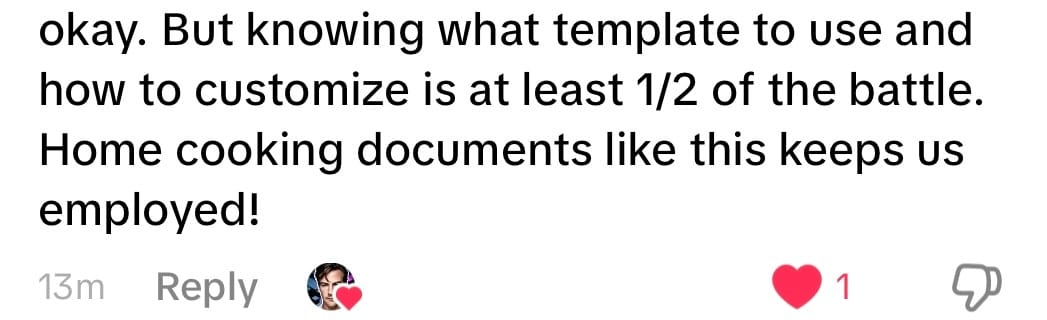
100% agree!
Having a well-drafted document is great, but it's just the starting point.
What really matters is making sure it holds up when things go wrong. And to do that we’re going to continue refining.
Think of this like a safety inspection. Just like you wouldn't drive a car without checking the brakes, you shouldn't use a legal document without thoroughly testing it. This first review helps us spot the obvious issues before they become real-world problems.
Here's how we do it:
Review this [type of document]. Analyse it for:

Missing clauses or gaps in coverage
Ambiguous language that could be interpreted multiple ways
Scenarios not properly addressed
Potential loopholes or weaknesses
Imbalanced or unfair provisions

Provide specific examples and suggestions for improvement.
This basic review prompt will give the document a review and spit out suggestions for improvement.
You can then select which improvements you want it to apply or simply ask it to apply all improvements.
You can repeat this process multiple times. Also, you can try using a different AI to run the analysis. Ie. if you had Claude prepare the document then have ChatGPT run a review. And vice-versa.
Most legal disputes don't arise from the obvious scenarios - they come from the unexpected. That's why we need to think about edge cases. It's like stress-testing a product - we're not just checking if it works in perfect conditions, we're throwing everything we can at it to see where it might break.
Because if we can break it in testing, someone else could break it in real life.
And if we can break it first then we can apply fixes.
Here's the prompt:
You are a legal analyst. Review this document and identify potential edge cases and scenarios that aren't adequately covered.

For each scenario identified, explain why it's important and suggest specific language to address it.
This will run a scenario analysis and come up with different events that could cause problems down the line.
After this run a prompt like:
Using the scenarios identified, help me strengthen this document. For each point:

Draft specific clause language to address the issue
Explain why this language works
Consider potential counterarguments
Suggest alternative approaches if needed
This will provide potential fixes for the edge case scenarios and you can apply those that make sense (or at least have them handy for if/when you go to a lawyer for finalisation).
Here's something counter-intuitive: the more one-sided your agreement is, the less likely it is to actually protect you. Why? Because heavily one-sided agreements either don't get signed in the first place, or they get fought tooth and nail if things go wrong.
We’ll talk more about negotiation in the next Part but for now let’s make sure that our draft is even-handed. Here’s a prompt:
Review this document from both parties' perspectives. For each major clause:

Analyze the balance of rights and obligations
Identify any unfair advantages
Suggest modifications to make it more equitable
In Part 4, we're going to take this even further with combative analysis. We'll get AI to actively try to break our document, looking at it from an opponent's perspective in a negotiation or dispute. This is where it gets really interesting!
We’ll also prepare you for negotiation by identifying potential issues the other party will raise as well as your responses.
Keep Prompting,
Kyle
I'm sat across the table from Discovery Channel's legal team in Singapore. They've just pushed across their standard licensing agreement for a show we want to air in Vietnam. It's the size of a small phone book.
Their lead gives me their usual speech: "This is our standard agreement, used worldwide..." But I'm already smiling, because I know something they don't.
I'd already licensed shows from every major player in the game - BBC, 20th Century Fox, Paramount, CBS, Telemundo, you name it.
And while they all start with "this is our standard agreement," I've never signed a truly "standard" contract. Not once.
Yeah. I’m a pain!
These supposedly rigid documents are actually starting points for discussion. That "non-negotiable" territory clause? We adjusted it. The "standard" tape storage requirements? Modified. The "fixed" licensing fee? Demolished.
You get the picture.
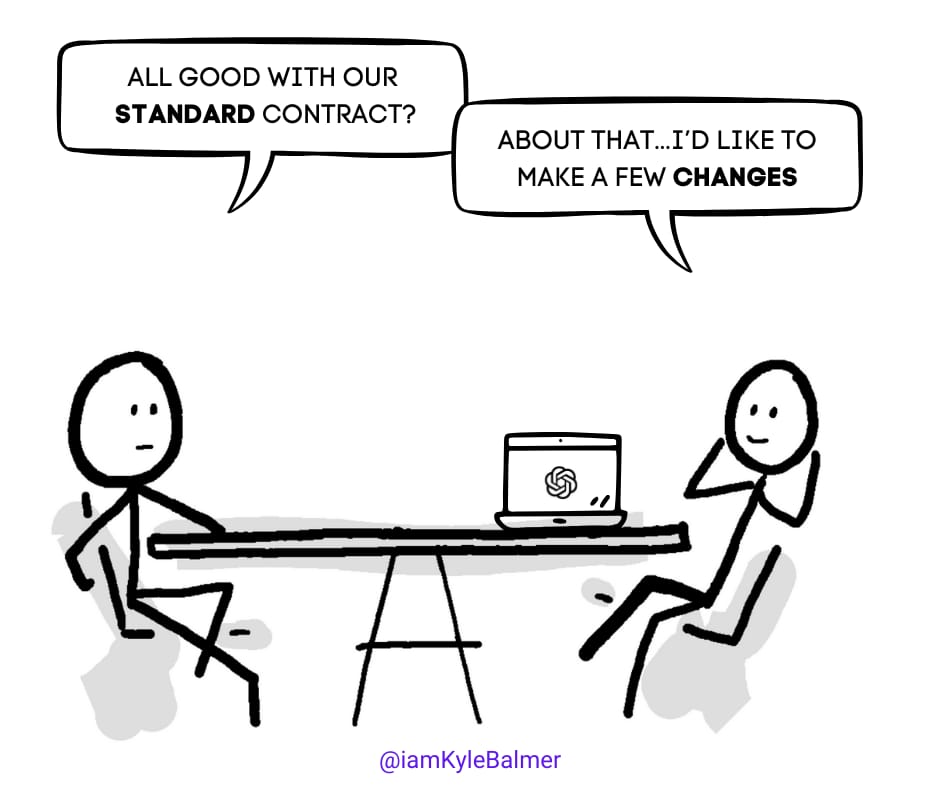
Before this came from prep. Lots of prep.
Now we can come to the negotiation prepped with the help of AI.
Before I even get to the negotiating table, I use AI to analyse contracts from every angle. It helps me spot potential sticking points, prepare different levels of compromise, and find creative solutions - all before the first meeting.
Let’s get started:
Fight Me
Analysing contracts from both perspectives
Identifying negotiation points and priorities
Preparing multiple compromise options
Finding win-win solutions
Building sustainable business relationships
People tend to think of contracts as rigid, set-in-stone documents. That's missing the point entirely.
Every contract - even the ones from massive corporations - is a starting point for discussion. A framework for finding common ground.
Hell, they might not expect you to ask for revisions but that doesn’t stop you from doing so!
Back in my TV days, I'd spend days prepping for these negotiations. Reading through agreements, marking things up in green pen (the best ink colour, come at me), consulting with colleagues, trying to anticipate every possible objection or sticking point.
Now, AI helps me do this prep work in hours instead of weeks.
I hardly even use my green pen now…
First, we need to look at our document through both sets of eyes. What looks perfectly reasonable to us might raise red flags for the other party. And generally we’re blind to that because we’re too focused on what we want from the negotiation.
Here's how we get AI to help:
Act as a contract negotiation specialist.

Review this document from both parties' perspectives.

Identify: what each party needs to protect, potential points of conflict, and possible areas of flexibility. Focus on understanding the 'why' behind each major clause.
This first pass analysis will help us step bak from our POV and see how the document looks for the other parties too.
What will they potentially find objectionable? And is it enough to sink the deal?
The real magic happens when we start exploring solutions. Often, the best answer isn't a simple compromise - it's finding a completely different approach that gives both parties what they need.
Negotiation is a massive topic - I did a whole 3 month module on it at NYU. We can use prompts to help get us pointed in the right direction:
For each identified point of potential conflict, provide three different solutions:

A straightforward compromise
A creative alternative that restructures the arrangement
A package deal that combines multiple points

For each solution, explain how it serves both parties' core interests.
Now comes the strategic part. We need to know our boundaries and possibilities:
Help me prepare negotiation positions for each major point:

Query me and help me formulate a position document

What's our ideal position?
What's our fall-back position?
What's our walk-away point?
What we could offer in exchange for each concession?
This will give us literally a document that flags up the potential hiccups in discussions as well as help us think through how we’ll deal with them.
The beauty of this approach is that it helps you walk into negotiations fully prepared. You've already:
Understood the other party's likely concerns
Prepared multiple solutions for each issue
Thought through the trade-offs and alternatives
Got a clear picture of your flexibility
This isn't about trying to "win" every point. It's about being ready to find solutions that work for everyone.
At the end of the day, a contract is just the beginning of a business relationship. Making it work for both parties is what leads to long-term success. Don’t try to “win”!!
Keep Prompting,
Kyle
When we launched the AI Workshop Kit licensing program, I thought we might get 50, maybe 100 applications. You know, a manageable number I could handle manually.
We got over 600.
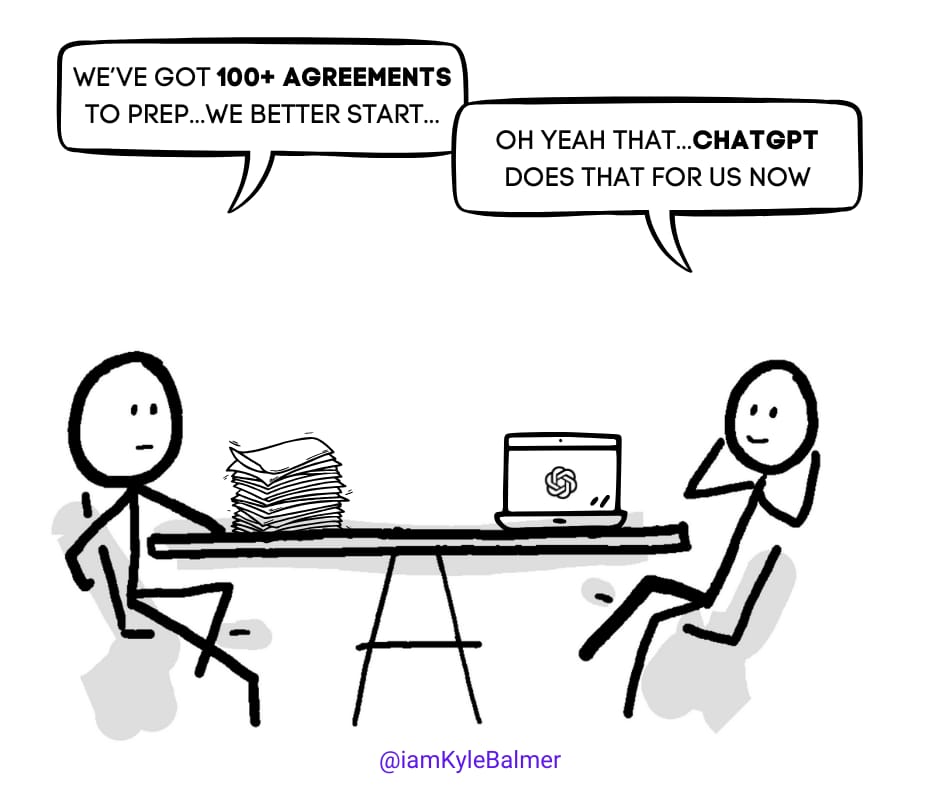
Suddenly, preparing individual license agreements wasn't just time-consuming - it was practically impossible.
Harminder, my business partner was suddenly a full-time license agreement preparer!
Each application needed to be reviewed, details extracted, and converted into proper legal language to be written up into agreements. Doing this manually would have killed the momentum of the launch completely. And maybe killed Harms too!
That's when we realised - when you're dealing with volume, automation isn't just nice to have. It's imperative.
Let’s get started:
Legals at scale
When to automate legal documents
Setting up your collection system
Processing inputs automatically
Creating clean, consistent outputs
Testing and quality control
This part is more advanced and only for if you have a recurring task. If you're creating a one-off contract or occasional documents, the processes we covered in the previous parts are plenty.
Don’t automate one-offs or even small batch tasks. It’s tempting but a waste of time. Just do the work. Boooo!
But if you're regularly creating similar legal documents - like service agreements for clients, NDAs for contractors, or licensing agreements for products - look into automating the process.
Specifically here’s what we're trying to solve: Your clients rarely give you information in a format that plugs straight into a legal document.
They might tell you what they want in everyday language on a call or via email. And converting that into proper legal terms takes time.
Do this once? No problem. Do it hundreds of times? That's a different story.
Think of it like this:
Input = Client details and requirements
Process = Your legal document template + AI processing
Output = Clean, properly formatted legal document
First, we need to know exactly what information we need to collect. Here's the prompt to help with that:
Review this legal document template and identify all information that needs to be collected from the second party. List:

Required personal/business details
Specific terms that need to be agreed upon
Options or variations that need to be selected
Any conditional elements that might apply

Format the response as a structured data collection plan.
Once you know what you need to collect, it's time to set up your form.
I use HeyForm but JotForm or TypeForm work too. The key is making sure it can connect to Zapier or Make.com so we can set up a workflow!
Create your form using the fields identified by the prompt above. Make it easy for clients to fill out, but thorough enough to get all the information you need. Then publish it with a public link. That’s input sorted.
This is where it gets interesting. In Zapier or Make.com, you'll create a flow that:
Captures form submissions
Sends the data to your AI of choice (Claude or ChatGPT)
The AI processes the response
Creates your document
For the AI processing, here's the crucial prompt:
Using the provided legal document template and the following form responses, create a properly formatted legal document. Maintain professional legal language while incorporating all specific details provided. Format all dates, numbers, and proper nouns according to legal document standards.

Template: [Your template]
Form Responses: [Form data]
This is a starting point. You’ll likely have to make adjustments based on what sort of document and inputs you are working with. Crucially we make adjustments based on doing dry run.
Test this ruthlessly before going live. Start with dummy data, then real test cases. Look for edge cases and weird inputs that might break your flow. I covered all of this in the Prompt Playbook on Blueprint Prompts. Hop into that course for more techniques on refining reusable prompts.
For output format, think about your needs:
Need to edit? Output as .doc
Ready to sign? Go straight to PDF
Want to streamline further? Connect directly to DocuSign or PandaDoc
This will depend on your human workflow once the basic draft is ready.
We've covered a lot of ground in this series:
Part 1: Why AI is perfect for legal document creation
Part 2: The boilerplate + interview method
Part 3: Review and refinement
Part 4: Combative analysis and negotiation prep
Part 5: Automation for scale
The key through all of this? AI isn't replacing legal expertise. We're using it to handle the grunt work, the repetitive tasks, the initial drafts. This frees up human expertise for what really matters: final review, complex negotiations, and relationship building.
And for the more important documents - run them past a lawyer at the end of the process!
Keep Prompting,
Kyle
Welcome to the '💼 Legal Assistant' playbook, your essential guide to revolutionizing how you handle legal documentation in your business. With the power of AI at your fingertips, you'll learn to cut down on legal fees significantly, allowing you to allocate resources more effectively. This playbook is not just about saving money; it's about empowering you to streamline your legal processes, making them faster and more efficient, ultimately leading to a more agile business operation.
This playbook is designed for small to medium-sized business owners, entrepreneurs, and startups who are looking to reduce costs associated with legal services while maintaining compliance and quality. If you've ever been overwhelmed by the prospect of legal fees or bogged down by the slow pace of legal processes, this playbook is your solution. It equips you with the knowledge and tools to navigate the legal landscape confidently and efficiently.
No, this playbook is designed for non-lawyers and offers step-by-step guidance to help you effectively use AI for legal documentation.
The techniques outlined in the playbook can be implemented gradually, with initial drafts taking a few hours to complete, depending on the complexity of the document.
You can create NDAs, terms of service, contractor agreements, license agreements, and much more using the methods described.
This playbook enhances your ability to draft and prepare documents but does not replace the need for professional legal advice when necessary.
You will need access to AI tools like ChatGPT or Claude, as well as a basic understanding of legal language and templates.