
AI playbook
Are you ready to take the plunge into the world of AI app development but unsure where to start?
Start ReadingEarlier this year, I spent THREE MONTHS planning what I thought would be my perfect product launch. Everything was meticulously prepared - the sales page was a work of art, the email sequence was crafted like fine poetry, and the product itself? Chef's kiss.
The result?
A whopping £3,000 in sales…
Now, that might not sound terrible. But spread over three months of prep? That's a grand total of £1,000 per month of work. I could have made more working at McDonald's. And probably got some free chips…
Fast forward to the next launch. Realised had to do it differently.
Different product, completely different approach. This time I started small, tested messaging with a tiny group, adjusted based on their feedback, and gradually built momentum.
The result this time?
£100,000.
Same person (me). Same market. Same target audience. The only difference? The launch approach.
What did I do next? I launched again. Another £100,000. And what do you think I’m doing next month? You guess it - another launch.
We’re going to spend this Playbook talking about this launch method.
And especially the wider of context of how we use launches to grow our audience and business over time rather than only for quick cash.
Let’s get started:
Why soft launches beat big bangs (almost) every time
The simple checklist you need for launch success
How to validate messaging and pricing without stress
Setting realistic launch goals and timelines
Using soft launches to build toward bigger wins
Here's a sobering experiment: hop onto any AI tool directory right now. Go ahead, I'll wait.
Notice anything? Most of these tools are digital tumbleweeds. Last updated: 6 months ago. Twitter account: dormant since launch. Product Hunt comments: crickets.
It's the great irony of 2024 - AI has made it easier than ever to build tools, but harder than ever to get them noticed. It’s a blessing and a curse. A double edged sword.
The ease of creation has led to a tsunami of new tools, and most are drowning in the noise. What’s great for building is also a nightmare for going to market!
Annoying! We want to AI to be working for us…but not necessarily everyone else. Ha!
I see it at every AI meetup I attend. Brilliant developers with mind-blowing tools, but no customers. Amazing solutions, but no one using them.
And you know what the worst part is? Many of these tools are genuinely useful! They're not failing because they're bad products. They're failing because of how they were launched. Because of DISTRIBUTION.
AI will teach everyone how to code.
Everyone will be able to create a product.
Time to get to master distribution.
Or you’ll still be at 0.
— Mike Strives (@mikestrives)
1:18 PM • Nov 25, 2024
This is why our approach through these Playbooks has been different. We've been methodically:
Validating our ideas before building (Playbook 1)
Building fast and lean (Playbook 2)
Testing thoroughly with real users (Playbook 3)
Now we're at the crucial moment - the launch. And we're going to do it differently than 99% of AI tools out there.
Pssst…we actually already set ourselves up for launch success back in Playbook 1 by, you know, working out what tool our customers actually wants rather than what we think they want. Smart huh?
Instead of spending months crafting the "perfect" launch strategy (spoiler: there isn't one), we're going to start small and smart. Here's what that looks like:
Phase 1: The Whisper Launch This isn't even really a launch. It's more like a quiet conversation with potential users. You're basically saying "Hey, I built this thing, it’s pretty cool, want to try it?"
What's beautiful about this phase is that there's no pressure. If something goes wrong (and it will), only a handful of people see it. If you’re a theatre kid this is the dress rehearsal.
Phase 2: The Momentum Builder Once we've got those first few users and have ironed out the obvious kinks, we start to turn up the volume - but just a little. This is where we start collecting those early wins, testimonials, and use cases that will fuel our bigger launch. We’re using the results of the first users to move to our next users.
Phase 3: The Rolling Thunder Now we're starting to make some noise, but in a controlled way. Instead of one big BANG, we're creating a series of smaller launches, each one bigger than the last. This is our medium to long term strategy.
Let's use this prompt to create your personalised launch timeline:
You are an AI launch strategist for AI tools and products. Create a 3 phrase graduated launch plan based on the following information:

My AI Tool:
[Brief description of your tool]
Current Status:
[Testing completed? Any beta users?]
Target Market:
[Who will use this?]
Existing Audience:
[Your current reach/following]

For each week, provide:
1. Specific goals (users, revenue, feedback)
2. Key activities and content needed
3. Success metrics to hit before advancing
4. Common pitfalls to avoid
5. Resources needed

Remember this is a graduated approach:
1: Whisper Launch (5-10 users)
2: Momentum Building (10+ users)
3: Rolling Thunder (100+ users)
Input your tool’s information - as always more detail is better. Alternatively use this under the work from the previous Playbooks.
This is a high level prompt - we’ll get into the details over the rest of the week. This prompt will give you a customised timeline based on your specific situation. But here's what it typically looks like:
Week 1: The Whisper Launch
Goal: 5-10 highly engaged users
Activities: Direct outreach, 1-1 demos, high-touch support
Success Metric: At least 3 users actively using the tool
Focus: Gathering deep feedback and fixing critical issues
Phase 3: Momentum Building
Goal: 50+ users
Activities: Larger announcements, case studies from early wins
Success Metric: 40+ active users, clear product-market fit
Focus: Building social proof and launch momentum
Phase 3: Rolling Thunder
Goal: 100+ users
Activities: Full launch campaigns (plural), leveraging all previous wins
Success Metric: Consistent daily sign-ups
Focus: Scaling what's proven to work. Do more of winning strategies.
Over the next parts of this Playbook, we'll dive deep into:
Part 2: The Audience Question How to launch successfully whether you have an audience or not (and how to build one along the way).
Part 3: Launch Content & Tactics Specific content types and templates for each phase of your launch.
Part 4: Momentum Building Turning early users into advocates and case studies that fuel your growth.
Part 5: Launch-Led Growth How to use launches as an ongoing growth engine for your AI business.
Remember: The goal isn't a perfect launch right out of the gate. Especially if this is your first launch it’s unlikely. No offence!
The goal instead is to start small, learn fast, and build momentum. That's how we avoid the AI tool graveyard and build something that actually grows.
Keep Prompting,
Kyle
LinkedIn: A dusty profile I hadn't touched in months
Twitter: Pretty much just liked other people's stuff
Fast forward to today:
60,000 email subscribers
120,000+ TikTok followers
Combined audience across all platforms: 250,000
I’ve built an audience. And an audience means distribution.
When I want to launch an AI tool I can tap into these quarter million people and (hopefully) sell a few units. And if I can’t then chances are the tool isn’t wanted!
But how? How did I build an audience? I built this entire audience through launching.
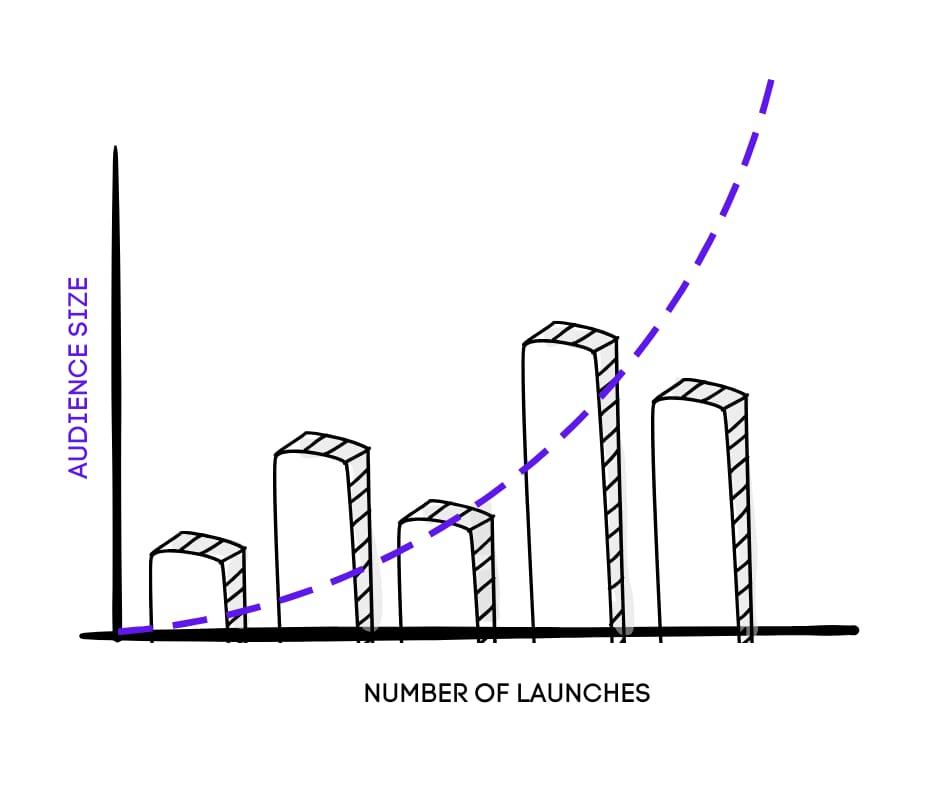
I’ve launched about 80 products this year.
Some are small. Like $3 Kindle eBook or $10 Playbooks.
Others are large, in the thousands of dollars.
Each launch grew my reach, which made the next launch bigger, which grew my reach more... you get the picture.
But here's the thing - I had to start at zero. Just like many of you reading this right now.
Starting at zero is absolutely fine. Everyone starts there. The question isn't where you start - it's how quickly you can build momentum..
Let’s get started:
The pure bootstrap approach (starting from zero)
Using partnerships to accelerate growth
Before we dive in, let's quickly recap our graduated launch approach from Part 1:
Whisper Launch: Close, personal outreach to your first users
Momentum Builder: Expanding through early wins and proof
Rolling Thunder: Scaling what works
Today we're going to look at two paths to execute these phases: the pure bootstrap approach (which everyone starts with) and the accelerated partnership approach (which you can add once you have some proof).
We’re also covering this to deal with the objection (read: excuse!) that you don’t have an audience yet! i) I didn’t have one a year ago and ii) you can launch via this method regardless. So…shh 😂
Love you really! Just, get out your own way sometimes OK? It’s hard enough with making new excuses for ourselves.
Let's be crystal clear about the Whisper Launch - it's literally just you sending DMs and emails to potential users. One by one. No scale, no automation, no fancy strategies.
This is what my first week looked like:
Finding people who matched my target user
Writing personally crafted messages
Having real conversations about their problems
Demonstrating my solution
Getting my first user!
Was it glamorous? Hell no. Was it effective? Absolutely.
The key is extreme personalisation. None of this "Hey {FIRSTNAME}" nonsense. I'm talking about messages like:
"Hey Sarah, saw your post about struggling with AI image generation for your design agency. I've built a tool that specifically helps with [exact problem she mentioned]. Would you be interested in taking a look?"
You can do this at any size. There’s nothing stopping you.
What size does grant you is legitimacy. There’s no way around that. If someone reaches out who has 50,000 followers they are going to be taken a lot more seriously than someone with 5. We humans are basic like that.
But this just means it’s going to be harder. Not impossible. You are going to have to find more people and reach out with more messages because your hit rate will be lower. It’s more work. That’s just you paying early dues.
It’s also a great reminder to build your audience using as many methods as possible. We’re using launches right now but you can also use content marketing and other strategies that I cover in (many!) other Playbooks.
Regardless, put in the work to find your first 5-10 users manually. You need these early birds to move to the momentum phase later - this cannot be skipped.
For your first users, you're looking for:
People who actually need your solution
Those willing to give honest feedback
Folks who'll share their experience
Users active in your target community
You don't need an audience for this. You need:
A clear idea of who needs your tool
The ability to find them on LinkedIn/Twitter/email
Enough charm to not sound like a spam bot(!)
The willingness to have real conversations as a real person
First people to reach out to? The same people you talked to back in our earlier Playbooks - the people we interviewed and had test our MVP. These are very likely your first customers.
I do not recommend deploying AI here. I know right‽ The problem is that everyone else will be using AI to shortcut this step. So do the hard alternative and actually talk to humans as a human. Later we can get automatic.
Once you've got those first few users and some proof your tool works, you can start layering in partnerships to accelerate growth. But remember - this is additional to, not instead of, your direct outreach. Don’t be lazy.
The idea with partners is to build relationships with people in your niche that have access to your audience. And to get into a position where they talk about your tool to their audience.
This could be them sending out a tweet talking about how cool your tool is, being invited onto their podcast, doing a TikTok live with them…there are many different form factors this will take. Depending really on what their channels are.
The partnership approach requires its own work:
Building genuine relationships with partners
Providing value upfront
Creating win-win scenarios
Managing partner expectations
This is why I suggest running both paths together:
Early Phase= Direct outreach for initial users, Start building partner relationships
Middle Phase= Continue direct outreach, First small partner launches
Now that I personally have an audience I get a lot of people reaching out to me saying “hey try my tool and tell your audience about it”.
Flip this around a moment. As an audience owner I’m being asked to:
go and create an account / login to the new tool (sometimes having to pay myself because they haven’t sent a code yet)
spend 30-60 minutes playing around with the tool
form my thoughts into a quick review
sit down to shoot a video or write something up for the newsletter
tell my audience about a tool that may or may not be good for a company that may or may not be trust worthy (jeopardises my reputation)
All of this stacks up.
And remember that I’m being sent 3-5 of these a day asking for a “quick shoutout”.
Nah. Ain’t happening.
And this will also be what the people you approach will be thinking. Not because they hate you and your tool. They are just busy and this requires their time for (generally) very little return.
You’ve got to make it make sense for them too! It’s got to be a win for them otherwise … why bother? You might think about offering:
Free lifetime access to my tool
Revenue share on referred sales
Cross-promotion of their products
What you offer people you chat to will depend entirely on what they want. Get into their shoes and think about this before reaching out!
Right let’s pull this all together and apply to your AI tools specifically:
You are an outreach strategist. Help me create outreach templates for both users and potential partners.

First, tell me about your tool:
1. What does your tool do?
2. What problem does it solve?
3. Who needs this solution most?
4. How are they solving this problem now?
5. What makes your solution unique?

Based on this, I'll create two sets of outreach approaches:

Direct User Outreach:
1. How to find proof they have the problem (past posts, comments, etc)
2. How to personalise initial message based on their situation
3. Follow-up templates if no response
4. Common objections and how to handle them
5. Ways to turn early users into case studies

Partner Outreach:
1. How to research potential partners (content, audience, style)
2. Initial relationship building approach (not asking for anything yet)
3. How to provide value before requesting help
4. Ways to structure win-win partnership proposals
5. Follow-up and nurture strategies

For each approach I'll provide:
- Message templates
- Do's and Don'ts
- Key points to include
- Red flags to watch for
- Success indicators

Remember: All messages should be heavily customised. These are frameworks, not copy-paste templates. Reinterate this!
This will take all your work before and help come up with outreach plans for both users and partners (accelerated approach).
It’ll also help form templates. These are just that: Templates! Don’t let me catch you sending them out directly! We’re working in small numbers right now - personalise and make each message count here. Don’t be lazy!
Keep Prompting,
Kyle
The most common launch mistake I see with AI tools is a simple one: "If we build a good tool, people will use it."
LOL Nope. Not happening. Sorry.
The AI tool graveyard is littered with incredible products that nobody ever heard about. Amazing solutions to real problems that died in silence because their creators thought quality was enough.
Look, I get it. We're builders. We love creating things. We want to believe that if we just make something good enough, the world will beat a path to our door.
Here's the reality: You need to be EVERYWHERE during launch. Social media, communities, newsletters, DMs - anywhere your potential users might be. You need to be telling people about your tool constantly.
Why? Because people are busy.
The launch might be everything for you. But not for everyone else.

As a builder though you probably don’t know what you should be talking about. How do you promote the launch?
That's exactly what we're covering today. I've got entire playbooks dedicated to each of these areas (social media strategy, content creation, community building). But right now, we're going to blast through the essentials you need for launch.
Think of this as your rapid-fire guide to making major noise about your AI tool.
Today issue brought to you by:
After developing and running AI workshops for businesses, that I charge $1,500-$4,000 for, I’m now making all the material, assets and support available so you can do the same.
Become the go-to AI Trainer for Businesses in your Sector with my AI Workshop Kit.
Profit from the high-demand climate where businesses are moving fast to bring their teams up to speed with the mind blowing power of AI.
Cohort 3 Starts on 13th January!
Places are already being secured.
Let’s get started:
Why silence kills great products
Content types that drive AI tool launches
Templates for each content type
Platform-specific adaptations
Engagement strategies that work
Here's a brutal truth: The AI tool graveyard is full of amazing products that nobody knows about.
Every week I see brilliant developers launch powerful tools into complete silence. They post once on Launch Day and then... nothing. Not even crickets. Hell, crickets would be great!
They're falling into the "quality = success" trap.
If you find yourself arguing that your company will win just because your product is better, you should staple this chart to your shirt.
— Kyle Harrison (@kwharrison13)
4:16 PM • Nov 2, 2024
Sure, quality matters. But in 2024, with new AI tools launching every single day, quality isn't enough. You need to be constantly telling people about your tool:
What it does
How it helps
Who it's for
Why it matters
And you need to be doing this everywhere, all the time. Exhausting? Yup. But increasingly necessary.
I’m going to absolutely blast through this. Again, refer to other Playbooks for detailed instructions as, honestly, each type could be its own mini-course.
Show don't tell. People need to see exactly how your tool helps in real situations. Their real situations specifically.
Structure:
Identify the problem with a strong hook ("90% of marketers waste 4 hours a day on this task...")
Current solution pain ("The old way? Writing everything by hand...")
Tool demonstration ("Watch how our AI handles this in 30 seconds...cool huh?")
Results showcase ("From 4 hours to 10 minutes - here's the proof...")
Clear next steps ("Want to try this yourself? Here's how...click link or whatever")
Turn early wins into compelling stories. Especially important after the Whisper launch as you start to get more testimonials and reviews. We use these to knock through skepticism using social proof.
Structure:
Initial situation ("Meet Sarah. She was spending $2000/month on copywriters...")
The skepticism ("'Another AI tool?' she said. I’m good thanks…")
The trial ("But here's what happened when she tested it...")
Specific results ("48 hours later, her ad copy costs dropped 90%...")
User quote ("'I honestly didn't believe it until …'")
Show the human side of your tool. Specifically your building and launch experiences. Put yourself in this content as much as possible. People care about people.
Structure:
Development insights (“had some trouble recently”)
Challenge overcome (“tried this, this and this. Nothing worked. And then…!”)
Feature evolution (“I’ll admit the last version sucked. But now…”)
User feedback impact (“so and so mentioned this, so I fixed it”)
Future vision (“looking to build on this in the future with xyz”)
Position your tool as the answer. Remember all the problems we identified that our tool addresses? Yup - those are the core of this content type. We’ll literally work through them one at a time.
Structure:
Problem statement ("Everyone's struggling with AI image generation...")
Market gap ("Current tools take like 20+ prompts to get it right...they’re crap")
Your solution ("We fixed this with one-click style matching...")
Validation ("I get it. No reason to believe it’s actually better. Don’t listen to me then. Here's what our users are saying...")
Call to action ("Want to stop wasting prompts? Try this...")
Make your tool accessible. These are quick videos that are technically for actual users. BUT non-users will see them and think “wait that’s cool…what tool is this?”
Structure:
Single valuable tip ("Most people don't know about the /fast command...")
Step-by-step guide ("1. Click here 2. Enter your text 3. Watch what happens...")
Visual demonstration ("Look what happens when I click this button...")
Time saved/value added ("This one trick saves our users 2 hours every time...")
Usage suggestion ("Try this next time you're stuck on image generation...")
Here's a prompt to help generate these different content types:
You are an AI content strategist for tool launches. Help create launch content based on:

Tool Details:
1. Tool name and purpose
2. Main problem it solves
3. Key features/benefits
4. Target user profile
5. Unique selling points

Generate specifically for the following channel: [Channel name]

Ask which of 5 content types I want and create 5 posts/scripts (accordingly for channel):

1. Use Case Breakdown
Show exactly how your tool helps in real situations. Include:
- Problem hook
- Current pain points
- Tool demonstration
- Results showcase
- Next steps

2. Success Story
Turn early wins into compelling stories that address skepticism:
- Initial situation
- User skepticism
- The trial
- Specific results
- User quote

3. Behind-the-Scenes
Show the human side of development:
- Development insights
- Challenges overcome
- Feature evolution
- User feedback impact
- Future vision

4. Problem-Solution Post
Position your tool as the solution:
- Problem statement
- Market gap
- Your solution
- Validation
- Call to action

5. Quick Tips & Tutorial
Make your tool accessible while attracting new users:
- Single valuable tip
- Step-by-step guide
- Visual demonstration
- Time/value benefit
- Usage suggestion

For each piece provide:
- Complete content outline
- Key messaging points
- Best platform(s) for this content
- How to adapt for different platforms
- Ways to engage and encourage sharing

Focus on authenticity and real value demonstration rather than marketing speak.
This prompt will run through a process of making 5 posts of the specific type. Small batch generation (a few posts at a time) will lead to much better results than getting the model to make 100 posts simultaneously.
You’ll notice there is also a parameter to enter your channel of choice. Be specific here - not just Twitter/X but Twitter Thread or Twitter Post. Not just TikTok but TikTok <60 second video or TikTok 2 minute video. Research what is working on the channel right now and follow that as a basic guide.
During launch week you should be everywhere:
Multiple pieces of content daily
Different angles each time
Various platforms (if feasible - use repurposing!)
Constant engagement
Don't worry about being "too much" during launch. You're building awareness. And only you can “see” all of it. For most people it’ll just be another post or video flashing past their awareness. If they even see it at all.
@garyvee Why there's no such thing as posting too much🧙🏻♂️ #garyvee #tiktok #truth #algorithm #advice #hearmeout #foryou
I’ve grown my audience to 250,000 through VOLUME. Massive amounts of writing. Massive amounts of video work. Sheer overwhelm.
“What about quality???” (I can hear you, all the way at the back there!). The thing about volume is that it forces you to also nail quality.
If you are posting 5 videos a day and they are all flopping guess what? The videos need to be better. And you know this because you’re seeing them eat dirt 5 times a day.
So you skill up. You get better. You have to.
And by putting out so much content you are also gifted the ability to do so - you’re putting your reps in.
Volume overcomes quality issues. Get posting.
Keep Prompting,
Kyle
For the first launch of the AI Workshop Kit - we were out there telling people they could make $1000-4000/hour delivering AI workshops. Just like I had been doing. Just like a handful of other early beta users had done.
But here's the thing - people had to take a lot on faith. Sure, I could prove I was doing it. A few others too. But was it repeatable? Would it work for everyone?
And why should they believe me? It’s a precarious position!
Those early first cohort students were brave souls. They trusted me, and thankfully, they succeeded.
Then came the second launch.
This time we came packing. We came ready.
We had stories like Joshua’s. Joshua gave his first workshop and landed a $2,000 client within 3 days of getting the AI Workshop kit.
Here’s an example of social proof used being in a Webinar:
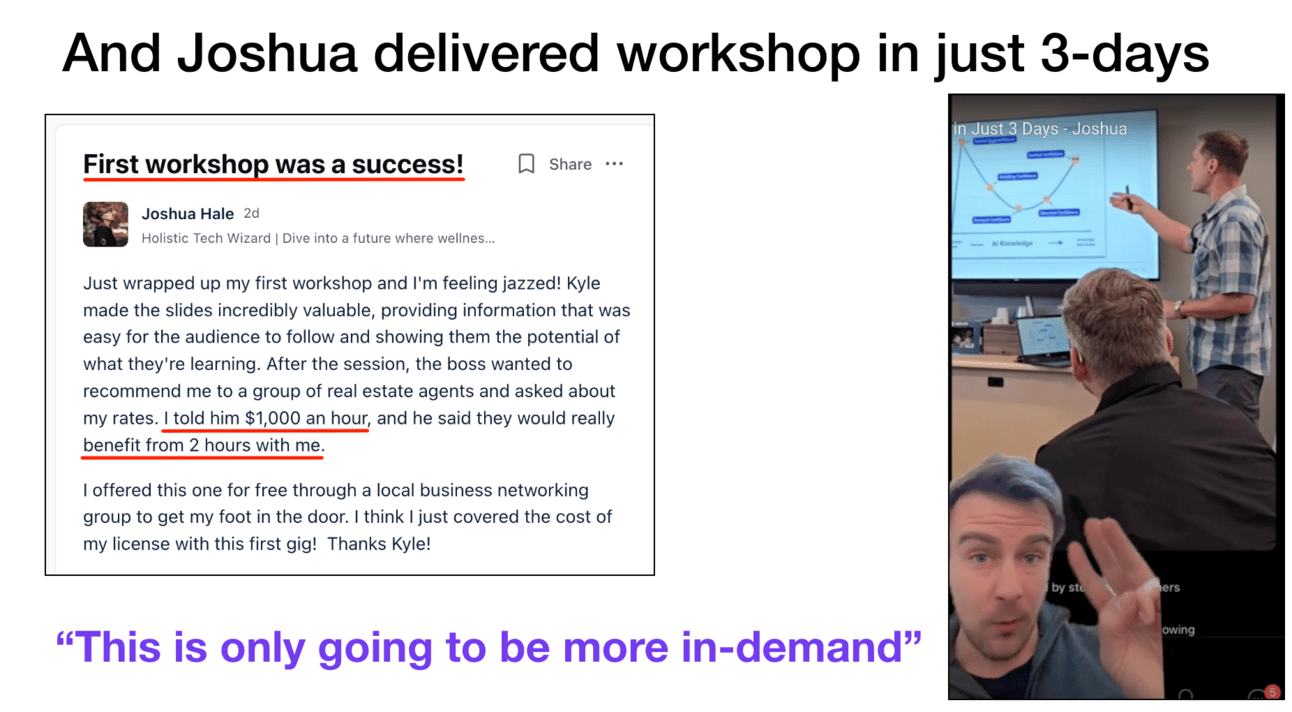
We had dozens more success stories just like it. Real people, real results, real proof.
The difference? External validation. Social proof. Instead of me saying "trust me bro this works" we had a chorus of successful real users saying "look what we did with this."
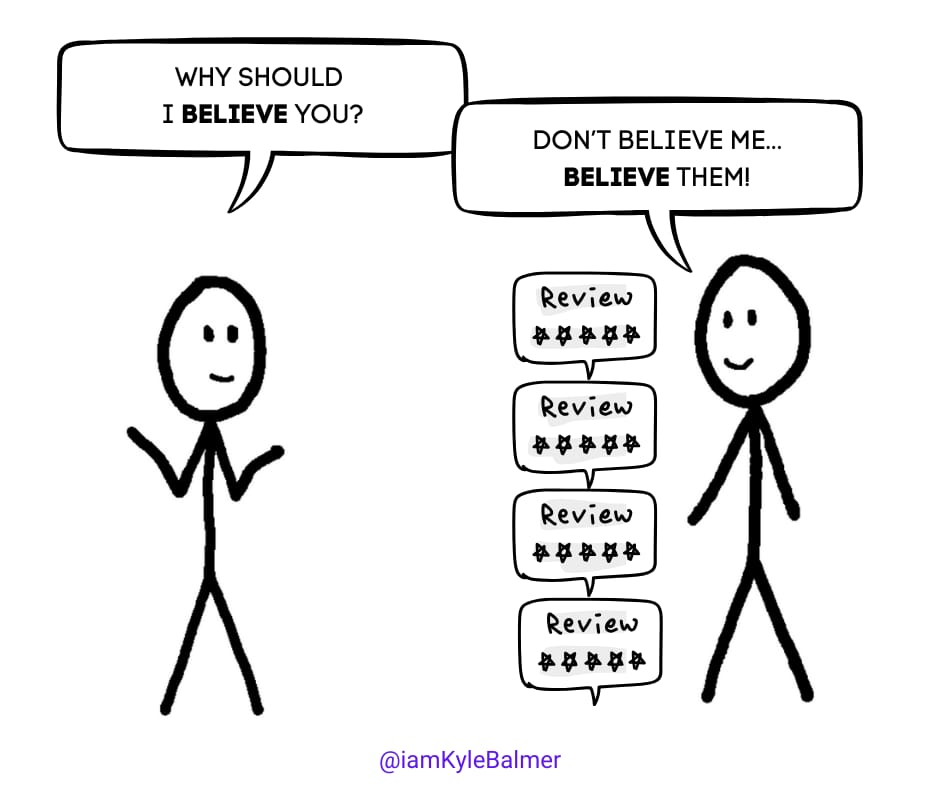
Do you think we deployed these stories? To their fullest extent?? You bet we did.
And you’ll be doing this too. Let’s build steam with a grain of salt.
Brought to you by:
After developing and running AI workshops for businesses, that I charge $1,500-$4,000 for, I’m now making all the material, assets and support available so you can do the same.
Become the go-to AI Trainer for Businesses in your Sector with my AI Workshop Kit.
Profit from the high-demand climate where businesses are moving fast to bring their teams up to speed with the mind blowing power of AI.
Cohort 3 Starts on 13th January!
Places are already being secured.
Let’s get started:
Why social proof changes everything
Organising testimonials for AI use
Matching proof to problems
Creating targeted social content
Building momentum through storytelling
Here's the secret about momentum: it's not about what you say - it's about what others say about you.
Remember our launch phases from Part 1? We're at that critical transition point between Whisper and Momentum. And social proof is our bridge.
Here's what most people get wrong about social proof: they only think about formal testimonials and case studies. Those are great sure. But there’s way more out there.
Some of the most powerful proof comes from casual, real-world feedback. The excited DM from a user who just got their first result. The screenshot of someone sharing their win in Discord. The quick "holy crap this actually works!" email response.
I keep everything. You should too:
Screenshots of DMs
Email response
Text messages
Discord/Slack messages
Social media mentions
Support ticket thank yous
Random feedback in comments
Video messages
Voice notes
You need to train yourself to be on the lookout for any and all social proof. And to immediately grab it.
That message you got last week where someone said "wow this saved me so much time"? That's proof. Screenshot it.
The person who posted about your tool in their Instagram story? Save it.
That excited voice note in your WhatsApp? Keep it.
These informal bits of proof often feel more authentic than polished case studies. They're raw. They're real. They show genuine excitement.
Of course, still collect the formal stuff:
Structured reviews
Video testimonials
Written case studies
Customer interviews
This is all still gold. It requires more effort and a strategy to collect them. Do both!
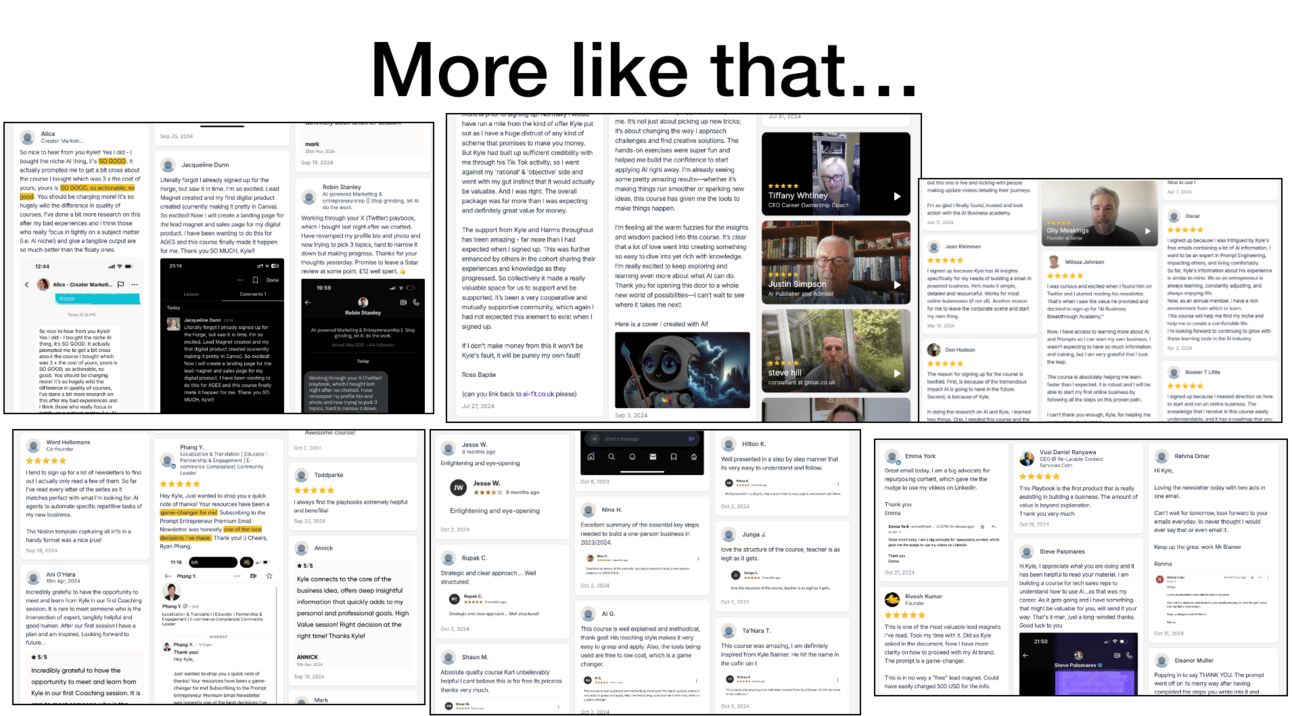
Basically don't wait for the perfect testimonial. Save everything. Each piece of proof, no matter how small, is ammunition for your launch. Be a hoarder, squirrelling away everything.
You want this sort of mess eventually:
First up, let's talk about collecting testimonials. Forget complex systems. Forget fancy databases. In the age of AI, we just need everything in one accessible place.
Create a simple document or webpage. Copy in every testimonial, every review, every piece of feedback you get.
I personally chuck the informal social proof in a Notion page. Nothing fancy. Just a document. And we use Senja for the more formal collection.
Don't worry too much about organising it - AI can parse through it all in seconds.
The key is making it easy to upload to ChatGPT, Claude, or whatever AI you're using. If you're fancy, connect it to an agent. But honestly? Copy/paste works just fine.
Remember all those customer problems we identified back in Playbook 1? The ones that drove us to build our tool in the first place? Pull those out.
We're going to match every piece of social proof to the specific problems it solves. Here's the prompt that does the heavy lifting:
You are helping match customer testimonials to specific problems and create social content.

First input:
1. Your list of identified customer problems
[Paste problems from earlier playbooks]

2. Your collected testimonials/reviews
[Attached]

For each customer problem, I will:
1. Find relevant testimonials that address this problem
2. Identify strongest proof points
3. Generate social content for your chosen platform:
   - Platform: [user specifies]
   - Format: [user specifies]
   - Style: [user specifies]

Remember to maintain authentic voice and real customer stories.
This prompt will go through your customer problems and match up killer social proof to address the problem. And then from here spit out social posts based on your requirements.
This is powerful because it connects real user success stories directly to the pain points your potential customers are feeling. It's not just proof - it's targeted proof. It let’s us get very purposeful with our social proof content.
Now for the fun part. Once you've matched testimonials to problems, you can generate targeted content for any platform. Want a Twitter thread about how your tool solves problem X? Feed the relevant testimonials into the prompt. Need a TikTok script about problem Y? Same process.
The key is that we're not making stuff up. We're taking real success stories and adapting them to the format that works best for each platform.
As you get more testimonials, keep adding them to your collection. The AI will have more and more success stories to draw from. Your content gets stronger. Your proof gets more targeted.
Each piece of content leads to more users, who provide more testimonials, which feed more content. It's a beautiful cycle. You just need to get the flywheel up and running and it’ll build its own momentum.
Keep Prompting,
Kyle
Want to know a crazy number? I've done over 80 launches this year.
Not a typo. Eighty plus launches. I tallied them up and was surprised myself.
Everything from $3 Kindle books to $100k+ launches.
Free playbooks, low-cost guides, medium-priced courses, subscriptions, lifetime deals, high-ticket offers... you name it, I've launched it.
And here's the beautiful part - each launch made the next one more successful.
And easier.
Why? Because launches aren't just about making sales. They're about building audience. And audience means your next launch starts from a stronger position.
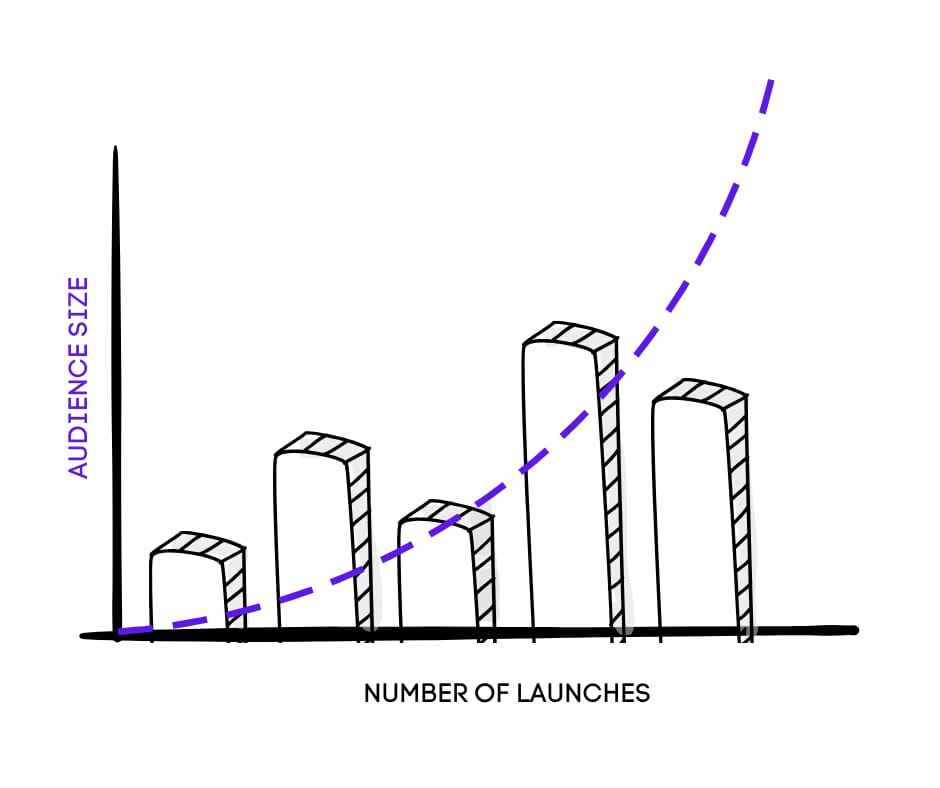
That $3 Kindle book reader? They might join your email list. That email subscriber might buy your $47 course. That course student might join your $2000 coaching program.
But more importantly - they're there for your next launch. And the one after that. And the one after that.
Today issue brought to you by:
After developing and running AI workshops for businesses, that I charge $1,500-$4,000 for, I’m now making all the material, assets and support available so you can do the same.
Become the go-to AI Trainer for Businesses in your Sector with my AI Workshop Kit.
Profit from the high-demand climate where businesses are moving fast to bring their teams up to speed with the mind blowing power of AI.
Cohort 3 Starts on 13th January!
Places are already being secured.
Let’s get started:
Using launches as your growth engine
How to build between launches
Creating launch ladders
Making each launch count
Building sustainable momentum
Here's what my first launch looked like: Zero audience, zero proof, zero momentum, a few hundred dollars in sales.
Not exactly going to retire on that!
But you know what? That launch gave me my first testimonials, my first pieces of content, my first email subscribers, my first social followers.
So the next launch started with a small but engaged audience, some social proof, some momentum. Result? A few thousand in sales.
And each launch after that? More audience. More proof. More momentum. Sometimes more sales - but not always! And that's okay.
The basic trajectory is always drifting upwards. And that’s what matters.
Here's what most people get wrong: they think each launch needs to be completely different. New product, new audience, new everything.
Wrong.
The smartest launches build on what's already working. They create an ecosystem around your core tool.
This took me a LONG time to realise. I have to be held back from new shiny objects - totally new projects. Instead now launches are interrelated and stacking.
Think about it: You've already validated a problem. You've already found an audience. You've already built trust. Why start from scratch? That’s making it much harder than it needs to be.
Instead, build outward from your core. Take your main tool and create a whole ecosystem around it.
Here's a prompt to help you plan this ecosystem:
You are a launch strategist helping plan an ecosystem of launches around a core AI tool.

First, tell me about your core tool:
1. What does it do?
2. Main customer problems it solves
3. Current target audience
4. Key features and benefits
5. Current price point

I will help you create:

1. Tool Variations:
- Stripped down essential version
- Premium/pro version
- Niche-specific versions
- Single-feature focused tools
- Bundle opportunities

2. Educational /supplemental Products:
- Quick-start guides
- In-depth courses
- Video tutorials
- Resource collections
- Templates/frameworks

3. Service Offerings:
- Implementation help
- Customisation services
- Training programs
- Consulting packages

4. Launch Sequence:
- Suggested order of launches
- Audience building opportunities
- Proof gathering points
- Price point progression
- Cross-sell opportunities

Focus on creating a cohesive ecosystem where each launch supports and strengthens the others.
Let's see this in action with a real example. It’s a little abstract otherwise.
Say you've built an AI tool that helps salespeople handle their DMs - it categorises leads, researches their background, and helps prioritise who to respond to first.
I want this for Twitter/X so I’m hoping someone will read this and run off and do it for me! Tell me if you do and let’s talk about distribution 😛.
The tool variations are obvious. You build a core product that you charge, say, $20/month for. That’s the centre, the linchpin.
You might then layer in a free version that just handles categorisation. Add a pro version with research and prioritisation. Build out a team version with collaboration features. Maybe split out the research component as a simple Chrome extension. Add Slack integration for teams.
You don’t do ALL of these things in one go. No. You strip them out and make each one a launch event. Simple change but suddenly you have multiple chances to go to the market and say “hey look what I’ve got for you!”.
This approach also allows you to test the specific parts. Launch of the Chrome extension flops? Fine - that tells you people don’t value that. That’s useful knowledge.
We can also add supplemental products. In this example it might be educational products; think about the whole sales process. A guide on qualifying leads. A playbook for DM sales. Templates for prospect research. Frameworks for responses. Scripts for cold outreach. Each one solving a specific part of the larger problem.
These are all tied to the original customer problem and give us more assets, more products, more launches. All tied back to our core tool.
Services flow naturally. Help with setup and integration. Custom research rule creation. Sales team training. Strategy consulting for larger clients.
The launch sequence might look like this:
Start with a free guide on DM sales to build audience.
Launch the Chrome extension as an easy entry point.
Release the basic categorisation tool.
Follow with the pro version.
Add team features.
Layer in services.
Here's the important part: Not every launch needs to be bigger than the last! It feels like they should be right? The Chrome extension might make less money than the guide. The basic tool might have lower revenue than the extension. That's fine.
What matters is that each launch reaches new people, solves real problems, builds your audience, adds to your proof, and strengthens your ecosystem. You are creating ties between each component - with each one supporting and boosting the others. Think of it like a mesh where you are layering in more strands.
And remember that money is just one metric. Sometimes a small, free launch that brings in 1,000 new email subscribers is worth more than a big launch that makes $10,000 but brings in no new audience.
The beauty of launch-led growth is that it's sustainable. You're not relying on ads or virality or luck.
You're building an audience one launch at a time. Growing your reach one customer at a time. Building momentum one success at a time.
The disadvantage (and there is one!) is that you are always in launch mode. It’s a lot of work - take it from someone who has launch 80+ items this year!
Your goal is to built sufficiently so that it all starts to feed into itself and becomes sustainable. Once you are hitting a good MRR/ARR you can pull back, systematise and set your products to evergreen. But that comes later!
We've covered a lot in this series:
Part 1: Launch Foundation and the power of starting small
Part 2: The Audience Question and borrowed reach
Part 3: Launch Content & Tactics for making noise
Part 4: Building Momentum through social proof
Part 5: Launch-Led Growth
Remember: Your first launch won't be huge. That's fine! Use it to build for the next one. And the next one. And the next one.
Keep building. Keep launching. Keep growing.
Oh and…keep Prompting!
Kyle
Are you ready to take the plunge into the world of AI app development but unsure where to start? The 'Launching Your AI App' playbook is your essential guide to transforming your innovative ideas into successful reality. Over the course of this playbook, you'll discover the nuances of effective launch strategies, focusing on soft launches that build momentum over time rather than relying on one-off big bang events. By leveraging proven techniques, you will not only maximize your launch's impact but also create a sustainable growth engine for your business. Whether you're a seasoned developer or just starting out, this playbook is designed to equip you with the knowledge and tools to navigate the crowded AI landscape. Dive deep into practical methodologies that will help you validate your ideas, engage your audience, and generate momentum that leads to not just sales, but lasting customer relationships.
This playbook is designed for entrepreneurs, product developers, and marketers who are eager to launch AI tools but feel overwhelmed by the competition and noise in the market. If you've ever found yourself pouring time and resources into a product launch only to see lackluster results, this playbook is perfect for you. With clear, actionable strategies, you'll learn how to navigate the complexities of launching an AI app in a way that not only brings in initial sales but also builds a loyal customer base for future success. Whether you're just starting out or looking to refine your existing approach, this playbook will empower you to make smarter, data-driven decisions that resonate with your target audience.
This playbook is suitable for all levels, from beginners to experienced developers. It provides foundational knowledge as well as advanced strategies.
While the time varies by individual project, many users find they can start seeing results within a few weeks after following the launch timeline.
While specific tools may enhance your experience, the playbook offers actionable strategies that can be implemented using basic resources.
Even seasoned launchers will find value in refining their approach and learning how to build on previous success for future launches.
Yes! The strategies focus on building an audience that continues to engage with your brand long after the initial launch.