
AI Authority
In today's digital landscape, building an audience is no longer optional; it's essential for launching a successful business.
Start ReadingIncreasingly I believe that having an Audience is the difference between a successful and a failed business launch.
The framework I use to teach entrepreneurship highlights this:
BATON = Business, Audience, Tribe, Offer, Network.
After coming up with a business idea and niche the name of the game is building an Audience.
This comes before capturing details, before making sales, before any automation and systems.
It’s all about just getting the word out and telling the world what you have to offer. If you can’t do this then the rest of the business is irrelevant.
So: this will be the focus of the week. How to get attention. How to show potential customers what you have. How to build an Audience.
This week we’ll cover:
Part 1: Audience first
Part 2: Personal brand
Part 3: Content funnel
Part 4: Platforming
Part 5: Stages of growth
Before we get into it a word from our sponsor (and friend):
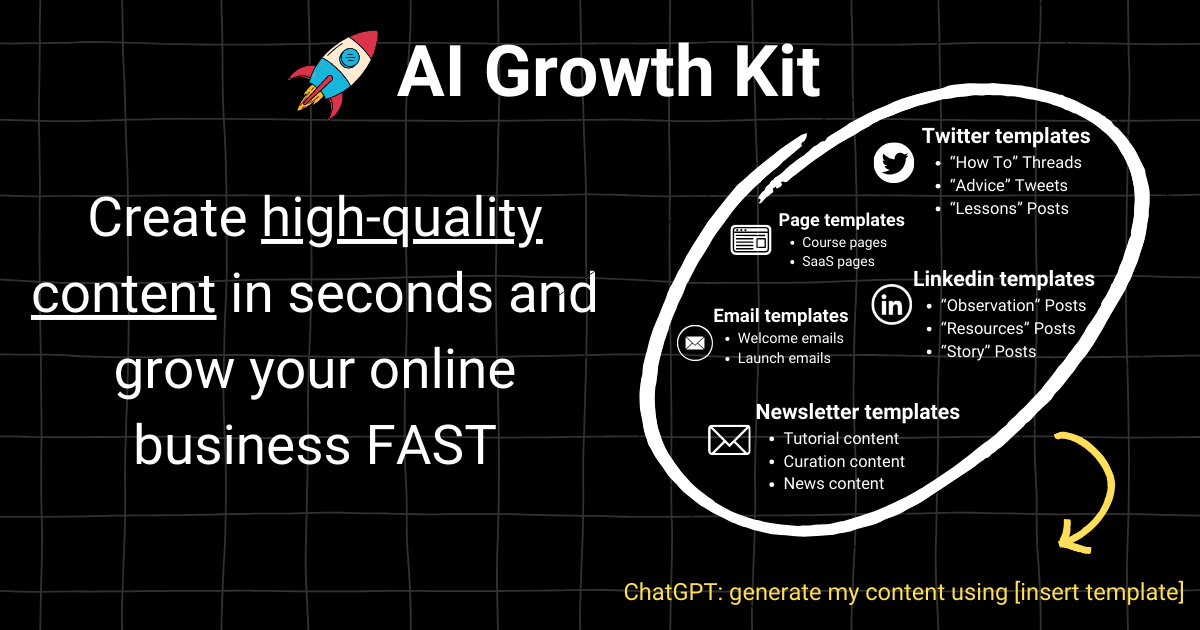
It’s the first ever library of plug-and-play AI templates to create Twitter, LinkedIn and newsletter posts with AI in seconds (without sounding like a robot).
It’ll help you:
→ Create high-quality content with 100+ AI templates in seconds, without sounding like a generic robot
→ Save you 20+ hours a week creating content that may or may not hit the mark
→ Grow your audience and business fast
>>Learn more here<<
Let’s get started:
Audience First
don’t make the same mistake as me
Audience is foundational to all business
audience allows testing, mini-launches, multiple launches
unlike advertising building an audience is free/low cost
I’ve previously helped other people and businesses build their audiences, including managing millions in advertising budget. But didn’t build an audience for myself.
I’ve also previously launched over 30 businesses, each time from scratch. Because I hadn’t built an audience for myself.
I knew that I should. I was helping other people with their audience building and marketing and saw the immense power of being able to get a product/service in front of a pre-existing audience.
I was seeing them do really well - hell, I was making it happen.
But as a natural introvert who didn’t want to be in the limelight I neglected building an audience. I was comfortable behind the scenes.
Until the last year. Screw comfort. Comfort is dangerous.
For the last 9 months I’ve been primarily focused on building an audience. In 9 months I’ve built up 100,000 social media followers and 50,000 newsletter subscribers and, from this audience, 1000s of customers for a now 6 figure business.
I’m genuinely annoyed I left it until now to build my own audience. And instead wasted all those years doing it for other people.
Which is why I want to encourage you to not make the same mistake as me!
By doing so I hope I can save you wasted years!
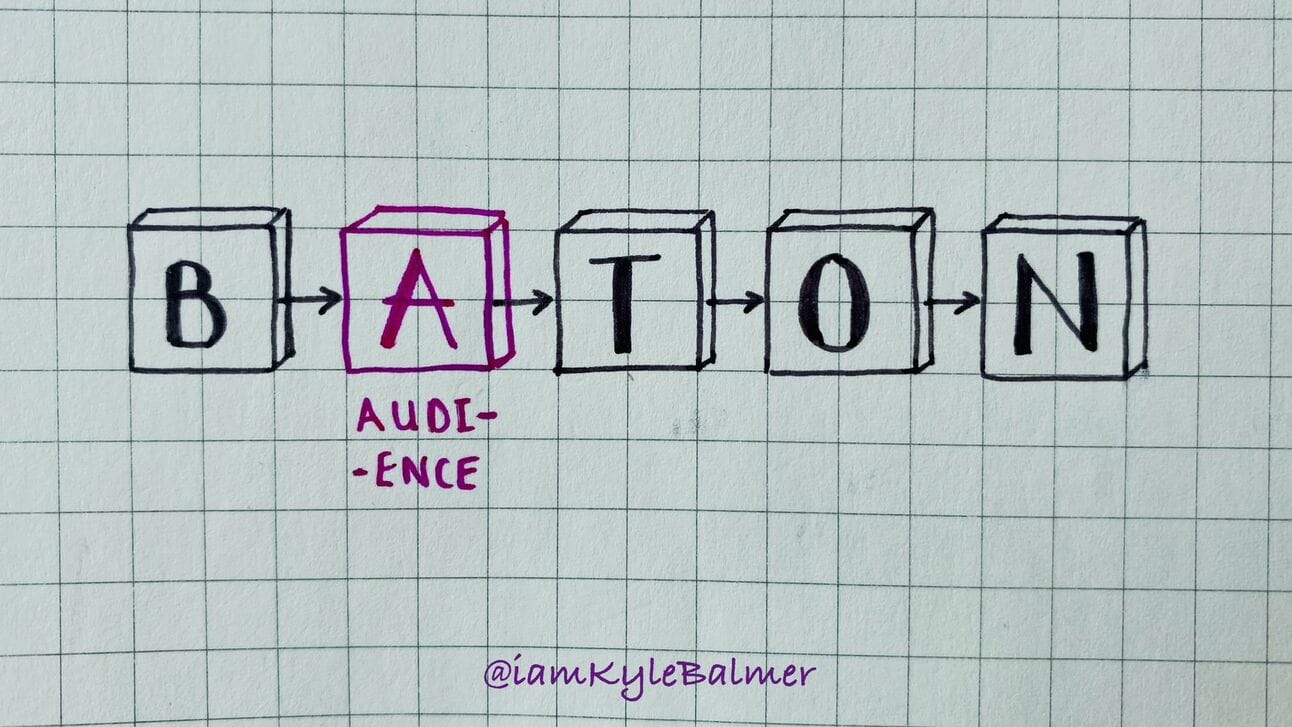
The business framework I teach is BATON:
Business - working out your niche and product-marketing, building something of value
Audience - letting the right people know about the value you have created
Tribe - capturing the details of those who are interested in what you have created and nurturing the relationship
Offer - making the sale
Network - scaling up once you’ve found what works
Building up an audience is the first step once you know your niche and what you are going to be offering.
You can have the best product or service in the world but if no-one knows about it your business won’t succeed.
Distribution, being able to get the word out, is far more important.
In fact, arguably, having and audience is more important than the actual quality of your product.
Because you can use your audience to shape your offer. This happens in a number of ways:
you can ask your audience what they want from you before creating your offer
you can launch stripped down versions of your offer -see what resonates and what doesn’t- and adapt accordingly
you can launch more even if one idea doesn’t work. You get more “at bats”
Let’s explore that last one.
If you follow successful solopreneurs and creators on a platform like Twitter you’ll have heard of Marc Louvion:
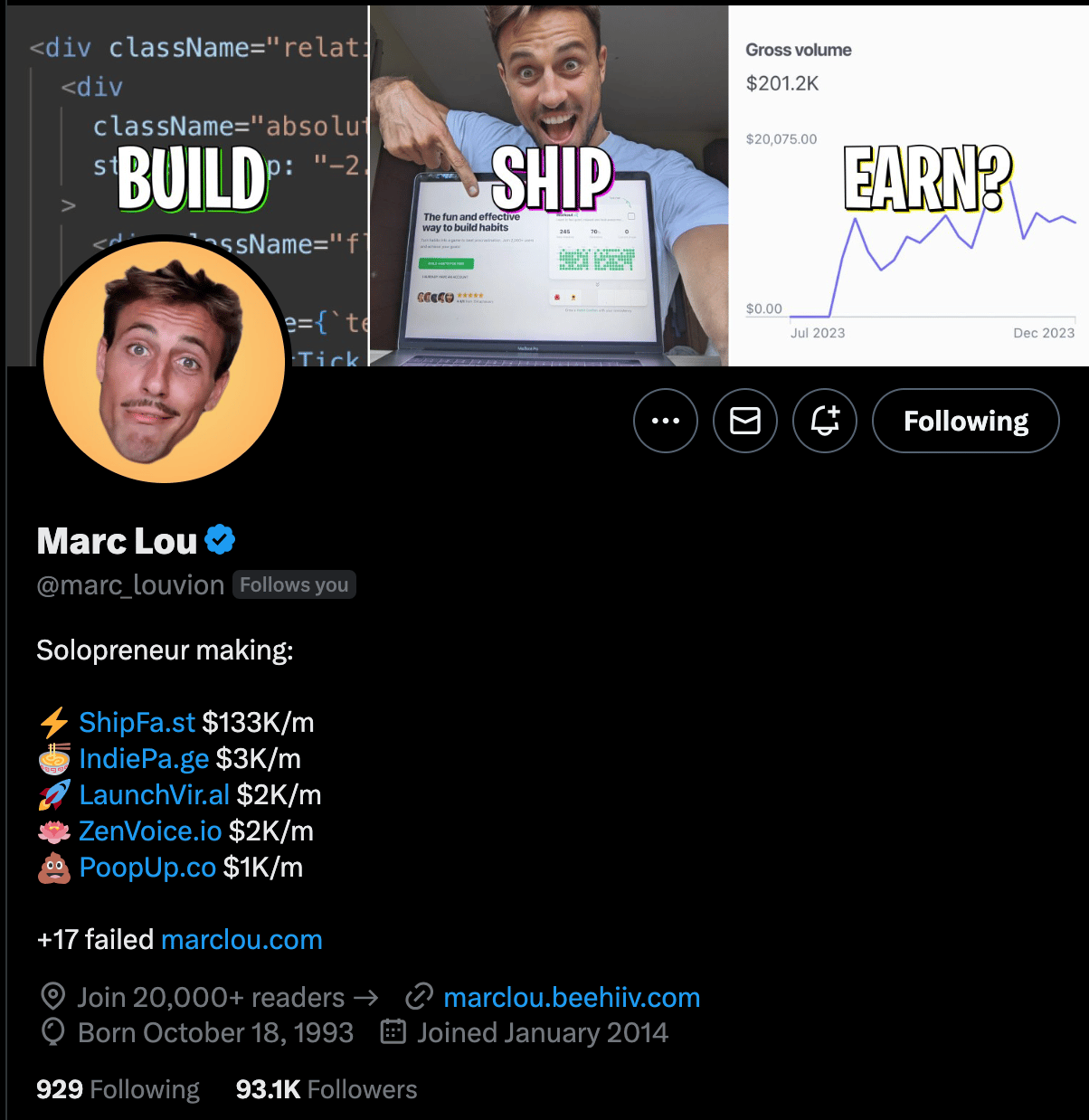
Marc ships a lot of projects. A lot!
Most fail. Some make a little cash. Others (like ShipFa.st) make him 6 figures per month.
A massive advantage Marc has is that he has an audience - 93,000 people on Twitter and another 20,000 in his newsletter.
That means that when Marc has a new business he automatically has distribution. He can use his audience to test whether people are interested, workshop his offer in public and then launch to thousands of people who are ready to buy from him.
The power of this is hard to underestimate. It’s a built in advantage that you lose if you start with audience building from scratch each time.
Of course not all business build audiences before selling.
Most actually jump straight to selling. And you can too!
But that generally requires advertising budget which requires capital.
If your business is funded and you can invest in adverting then building an audience becomes less important. You can buy one instead by using cash.
But because Prompt Entrepreneur focuses on helping people start and grow their first business I know that this isn’t always an option. You’ll more than likely not have the $100/day budget to drop into ads required to get proper results.
Building an audience is not only a lower cost alternative to advertising. It also, once up and running, keeps generating revenue. One issue with paid advertising is that as soon as you turn it off that’s the end of revenue too!
Instead what I’ll show you over the week is how in 9 months I built an audience of 150,000+ that now nets me 6 figures of income without having to put in advertising budget.
Specifically here’s some of what we’ll cover:
the specific type of branding I recommend
dealing with psychological blocks to creating an audience
the 3 levels of content
setting up your pillars
never running out of ideas
the best platforms to use right now
how to get started from 0
strategies for different stages of growth
what worked for me and how to adapt it to your niche.
If you are a premium subscriber you have all that to look forward to and I’ll see you tomorrow!
If not then there are details below on how to join us for the full guides each and every week.
Keep prompting,
Kyle
Building an audience is exponentially simpler if you use your personal brand.
But there’s a natural resistance to putting yourself out there. I totally get that - I too felt that resistance!
Overcoming this resistance and committing to connecting yourself to your audience growth will be the biggest lever you can pull.
The rest of this Playbook is entirely doable without attaching yourself to the project but will be much slower and (likely) expensive.
This Part will convince you of the necessity of leaning into your personal brand.
Let’s get started:
Personal Brand
People connect with people
Corporations wish they had a face
Your competitors feel this similar resistance - use that
You only need to know enough about the subject to provide value.
Raw, authentic production beats polish
Personal brand is the concept of attaching yourself, as an individual, to a company.
Instead of relying on the business’ brand you utilise yourself - your words, your image, your personality, your story, your journey. All to build an audience.
The core reason personal brand works is simple: people connect with people.
Ultimately we love to follow, interact with and (eventually) buy from actual people.
Wonder why podcast advertising is so popular? It’s because we listen to our favourite podcast hosts for hundreds or thousands of hours. Maybe we hear their voice more than our loved ones! So when that host does an ad read we’re pre-sold. We know, like and trust them and by extension their recommendations- even when we know it’s an ad!
Even huge corporations know this - hence the use of spokespersons, mascots and brand partners (like Michael Jordan). They attach individuals to their massive corporate structures to provide “a face”.
As normal (!) I’ve written a whole Playbook on just this subject. It’s available here: https://aiwithkyle.com/catalog/personal-branding-in-the-age-of-ai-playbook
As someone growing a business your personal brand becomes a comparative advantage.
You (likely) can’t outspend competitors with advertising. Not yet. So you need to lean into every advantage you have. And, as a solopreneur or small team, you can do this by being an actual human being.
And that resistance you are feeling? Your competitors are feeling that too.
It’s much easier to remain anonymous online. It’s also less effective.
Even in the busy AI space (where I operate) very few content creators are open with their personal brand. Or they take a half measure of being open in text and not video. Video is far more open and accessible which scares people.
This has allowed me personally to rapidly expand my audience on a platform like Tiktok (65,000 followers in 3 months) because I can count my direct competition on one hand.
That same resistance stopping you right now means that, if you break through it, you could be looking at a nice empty playing field.
A natural next question is wondering what you’d even talk about. And whether anyone would want to listen!
This is lack of confidence speaking.
I always recommend working in a niche that you know well - one that you have expertise in (or at least know more than your customer). Your expertise becomes your content, all wrapped up in your personal brand.
In the next Parts we’ll talk specifics of content marketing - what are you content pillars and how to deliver value.
What’s important now though is realising you do not need to be a world class expert to build an audience based on your brand.
You just need to be able to provide value to potential customers.
In fact, going too deep into your expertise may kill your business as it naturally limits your audience. There are always more people interested in or beginners in your topic than their are up at your current level.
In my world of AI entrepreneurship the wide content I put out (ie. to millions of viewers) is also the most basic. Anything complex and immediately I lose my audience. This is the case across niches.
You just need to know enough to be able to provide value to people below your knowledge level. And that comes not from having a PhD in the subject but instead in being able to empathise with your audience members and pitch your content at the right level.
Honestly, if anything, having a PhD would make that much harder for you!
We’ll discuss different levels of content later but for now just know that you need to know a little more than your customers to be able to provide value.
Personal branding works because it’s (ugh) authentic. This is a bit of marketing buzz word but there’s truth to it.
Audiences (and customers) don’t fall for glitzy sales tactics. They are too smart now.
Instead we buy from people we like and trust. Because of who they are.
That mean that our content doesn’t need to be highly scripted, professionally shot and perfectly edited. In fact that style content is doing worse and worse. Audiences don’t trust it.
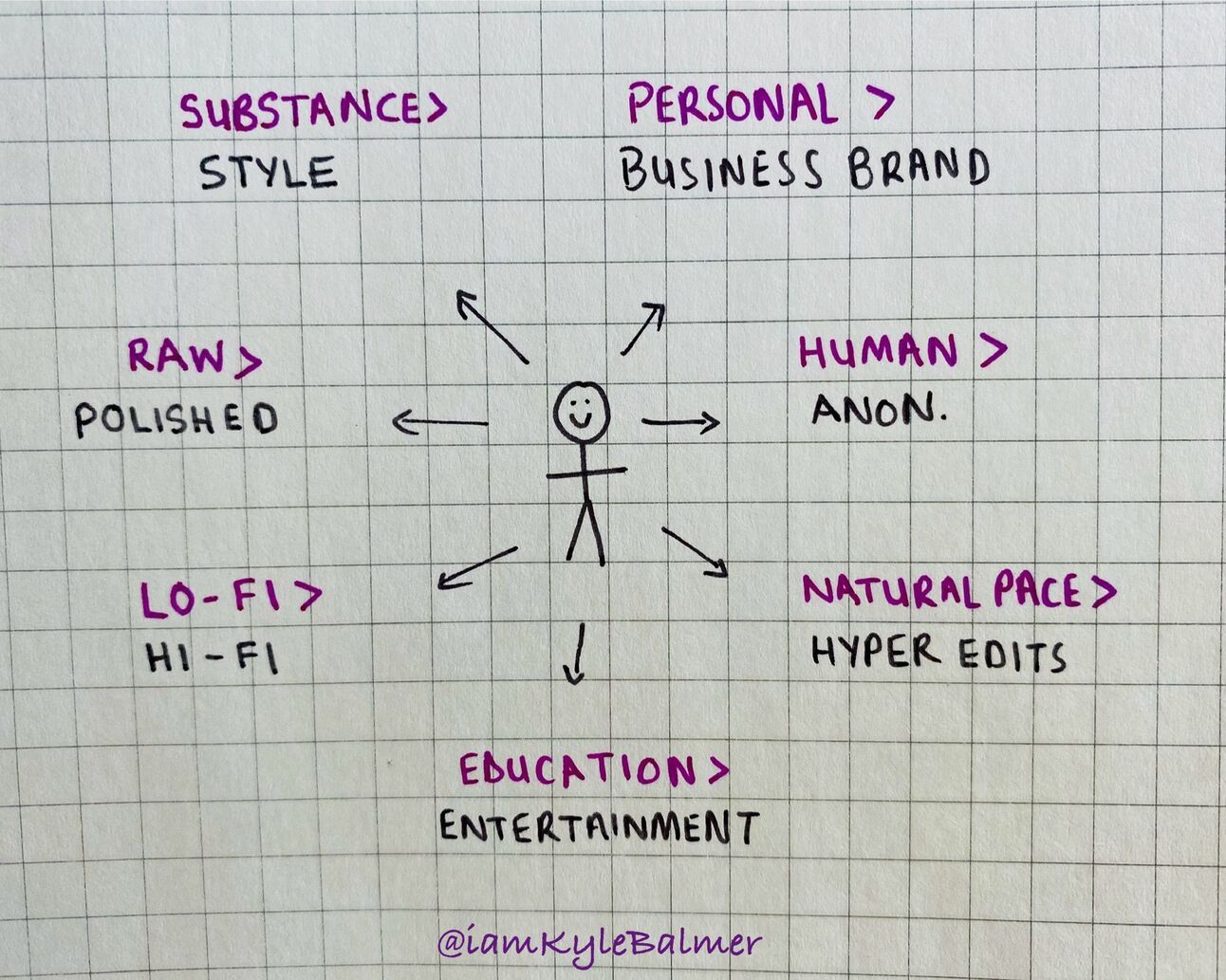
For you, just getting started with building an audience, the stars are aligned. What works now for marketing content is:
raw, authentic content from a real person
education over entertainment
substance over style
lo-fi production values
longer running rather than hyper edited videos
All great news for you, as a business owner, getting started as it means focusing on value value value - which we should already be doing.
You lose all of these advantages if you don’t want to put your personal brand on your content. It’s doable but is going to require a lot more polish, production and promotion.
Going raw also means that anyone with a phone can make and publish content. There aren’t any excuses.
Well, apart from psychological blocks!
Everyone has their own and it’s tricky to cover them all (that’ll take a week). However, I am running a 30 Day cohort soon that’ll blitz through your blocks to producing content, especially short video content.
Hopefully by now I’ve convinced you that personal brand is a powerful tool. If that’s all I convince you off in the Playbook I’m happy!
The rest of the Playbook will assume you are on board with this and are following using a personal rather than corporate brand. But it will still be doable if using a faceless corporate brand, just…more difficult!
Keep prompting,
Kyle
Today we dive into how you’re going to build your audience.
Using content marketing.
Let’s get started:
Content Funnel
what is value based content marketing
always solve problems
help for free to build trust
content continuity to offer
three levels of funnel: top, mid, bottom.
The primary method we’ll be using to grow our audience is value based content marketing.
This is basically creating pieces of content to attract the attention of our potential customers.
We’re not going to be doing this randomly. We’re running a business here and need repeatable, sustainable systems.
We’re also not relying on entertainment. If you are naturally entertaining and charismatic that’s amazing! That’ll be a really powerful bonus and will make this easier (I shan’t pretend it won’t!).
But as a business owner we need something that works regardless. And this is value based content marketing.
We are going to be creating content that is valuable for our audience and (latterly) customers.
A note on platforms and formats. We’ll cover all this in the next Part. Twitter vs. Tiktok. Text vs. video. It’s important stuff but first let’s work out how we best provide value to our customers via content and then we’ll decide on delivery mechanisms.
As a business we provide value to our customers by solving their problems and helping them overcome blocks and challenges.
That’s fundamental to what we do as a business: we provide value. If we don’t we’re running a scam not a business.
Our content marketing follows the same pattern of solving customer problems. Just at a different level.
I like to see content and sales as a continuum. I’ll use myself as an example.
My customer’s core problem could be that that they hate their job, they want more freedom, they want more fulfilling work or they want to make their fortune. Or a combination of the above.
The basic solution I provide is helping them start a business to take control of their financial future. And my particular spin is leveraging AI to do so.
All straight forward so far.
I help people with their problem regardless of whether they are a customer or not. This is the key to value based content marketing.
People take time to warm up to you and to trust that you can help them.
We’ll give away advice, inspiration, tips, hints, guides and counsel to prove that we know what the hell we’re talking about. We’ll give freely. We’ll educate. We’ll help without (yet) asking for anything in return.
We actively want to help people solve their problems and because we know we have a solution we’re obligated to do so!
5% of people will take the “free” content we give away and run with it - they’ll go and apply it and do well. Amazing.
Have we lost them as a customer? Sure! But they were never going to be our customer. This 5% are the self-sufficient lot who will work it out and get it done anyway.
The remaining 95% though?
They still need help.
They’ve watched your videos, read your guides, learned from you.
But they haven’t started. Or they’ve started and hit their next road block.
This is where your products and services come into play.
You’ve proven to this 95% that you know what you are talking about. You’ve given them massive value already. They trust you. They just can’t quite move to the next stage. And when that happens you are the first port of call for assistance.
Our free content thus feeds into our paid products and services as the natural “next steps”.
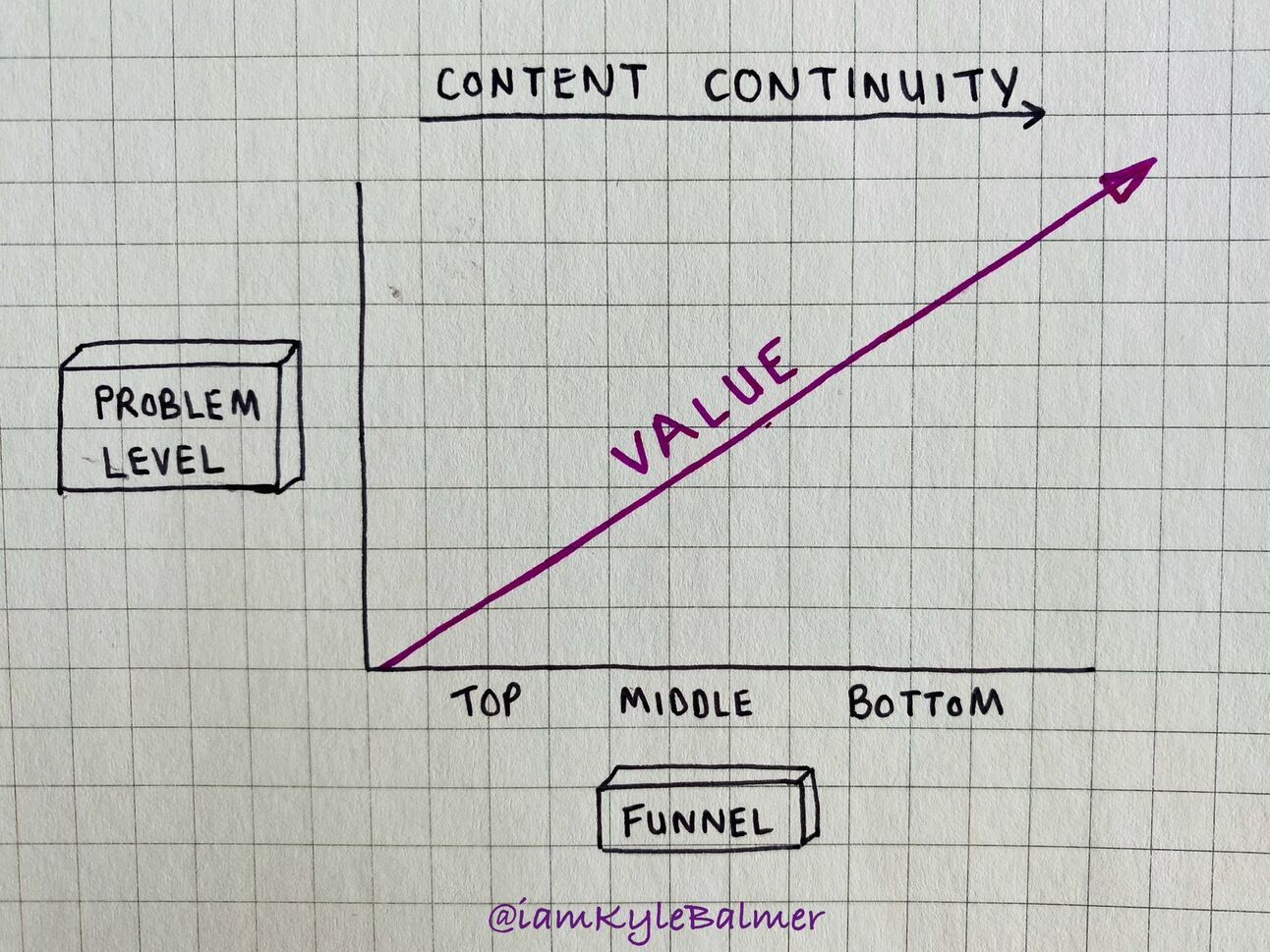
The key here is that there is a continuity from our free content to our paid products.
They both solve the same problem, just at different levels.
So: as long as you know what problems your products solve…you also now know what problems your content should focus on. Your content plan begins to come into focus all of a sudden. It’s the same stuff!
A nice side benefit? If you don’t know your customer’s core problem yet the building an audience will reveal this for you. If you put out videos about problems A, B and C and overwhelmingly people are interested in C then guess what? You’ve been intel on what your products should be.
Once up and running your audience growth and product development should be in lockstep. One informs the other and you can build knowing people are interested in your offer. Pretty cool!
How do we practically implement this?
Using a content funnel.
We want different levels of content for audience members at different stages in their journey.
At the top of the funnel we have wide, broad appeal content. This is high-level, not at all in depth content about your subject.
For example for me it might be a 30 second video 5 top reasons to use AI in your business. Not much detail, just broad strokes for a wide general audience.
The purpose is purely to get your name out there and build a following. This is where your “viral” content sits - content that gets shared and pops of to millions of views.
Next is content for people who already follow you.
By following you they’ve raised their hand and said “yes please I want more”. They’ve given you permission to talk to them more.
At this level we want to focus on showing we know what we are talking about. This level is about how-tos, guides and tips. Actionable advice that our followers can use and realise “huh. They’re the real deal”.
This is where your longer form written guides and videos sit. They will only be appreciated by someone who already has shown an interest.
At the base of the funnel is where we find those who are ready to buy.
They’ve consumed your free content, probably for a while! And now they need the next step.
This is where you talk about your products and services. Or potentially your waitlists.
This is where your call to actions are more obvious because you know the audience members here are receptive.
It’s worth repeating. Your content at each stage solves the same problem.
Just at different levels of depth. This becomes your guiding compass.
An example - when I teach how to choose a business niche I might have:
15 second video on the intersection between interest, skill and market
twitter thread on the intersection with hand-drawn graphic
3 minute video explaining how to apply the concept
full blog article giving step by step methodology
a Prompt Playbook on working out your niche
my Niche Navigator course
1:1 coaching
Same problem. Different levels of solution.
Here’s a prompt to help you start to think about the levels in your business.
Act as a marketing strategist.

One of my customer's core problems is [enter a core problem]

My content funnel consists of:
-top level, short, viral content around the topic to gain an audience, no cta, high level concepts, lack of detail
-mid level, mid length written and video content helping people with the problem, requires their time commitment but still free, more detail to help them solve problem themselves
-bottom level, CTA content to take people onto the next step, longer form videos and webinars to my offer

My first offer is [enter first paid offer]

Generate 10 topics. Each topic should exist in all three levels. Provide results in tabular format.
I’ve entered “building an audience to get their business known” as the problem.
Here are the first 6 recommendations:
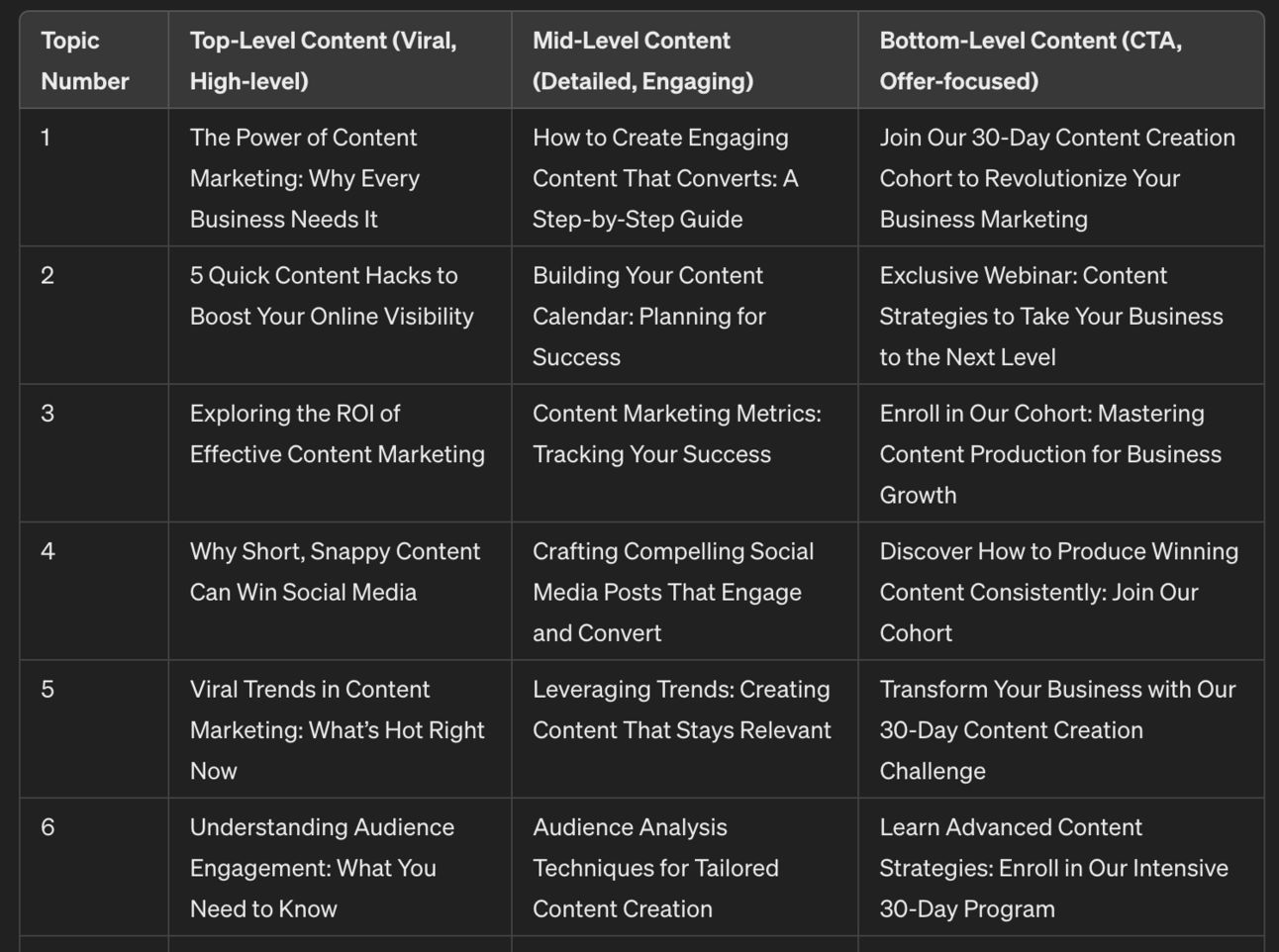
Run this with your customers’ main problems to get an idea of how content can be used to consistently solve at different levels.
And yes I used the example to plug my cohort!
Know why? Because as Premium readers (where this gets published) you are bottom of the funnel audience members. I use what I teach!
Today we looked at the what. In the next Part we’ll look at the how : what platforms and formats to use.
This will all be driven by the same (consistent!) force. Delivering massive value to your audience and customers by solving their problems. Do that and you can build an audience and a successful business.
Keep prompting,
Kyle
By now you’ve probably been thinking “should I be using Tiktok?” or “I’ve heard Instagram is the best place to start” and wondering why I haven’t mentioned platforms yet.
I’ve held off for a reason.
Because choosing platform first is arse-end backwards.
We need to focus on where we can provide the most value to our customers. Then worry about platforms and formats.
Let’s get started:
Platforming
go where your customers are
competitive accounts is a good sign
focus on ONE platform
match your format to the platform, don’t overcomplicate
align content funnel with formats for your updated content plan
First question is where are your customers?
This ultimately determines where you need to build your audience. Your preference isn’t actually important.
Remember that we are focusing on providing value to our audience and potential customers first.
In the same spirit we want to make it as easy as possible for them to access the value. If we’re intent on building on Facebook because we like Facebook (but they don’t!) then i) they won’t see it and/or ii) we’re forcing them to come to a place they don’t want to be to consume your content.
No bueno.
Therefore first step is to locate where they are.
Hopefully as someone who knows a fair amount about the topic you already know the main social media hang out spots.
If not then you’ll need to go research on all the major platforms.
You are looking specifically for other large creators in the space. Specifically those who sell products and services off the back of their audiences. We don’t want entertainers.
For example in the AI entrepreneurship most of the big names are on Twitter. They are not, conversely, on Facebook.
These people have built up audiences on Twitter because that’s where their audience hangs out. They haven’t build up audiences on Facebook because that’s not where the audience hangs out.
This is a simple but effective rule of thumb and when starting out its worth following. The converse is trying to break ground on a new platform. You may be the first and you’ll do exceptionally well. But chances are others have tried before and there just isn’t the audience density required to make it worthwhile.
To start you should focus on one platform. And ignore the rest.
The reason is focus. It takes time to grow on a single platform. And the more you spread yourself thing the longer it’ll take to “click” on any single platform.
If you genuinely don’t know where to start then here’s an alternative. At first post on all the major platforms for a month or two and see which one you begin to gain traction on. As soon as there’s a clear frontrunner focus purely on that one and drop the rest.
Either way you want to end up with one platform for growth.
The reason for this is that growing isn’t just about posting content. You also need to be present and engage. With other accounts as well as with people who comment on your content. You need engagement time.
This is because people follow people. And they want to know you are a person, not just someone reposting automatically. Equally the algorithms of the various platforms look to engagement when calculating how much to push your content.
Therefore we need to go all in on just one to start.
We’ve followed our customers to where they hang out. And we have decided to focus on that specific platform.
The question now is what format do we use?
Simple: whatever works best on that platform for the various levels of value based content marketing.
An example will help here. One of my primary platforms is Tiktok.
What works well on Tiktok is, surprise surprise, short video.
So my format will be: short video.
I’ll align that with my content funnel from the last Part like so:
top of funnel: short <60 second videos for high level audience build. Focus on volume, low production value, speed, talking head style.
middle of funnel: 2-3 minute videos going into more depth about a topic. More editing, more scripting. Less rushed delivery. Aim is to deepen relationship so I’ll give examples, ask questions, relate personal stories.
bottom of funnel: CTA content to bring people over to my newsletter or directly into sales. Aimed at people who have been consuming my content for some time and know who I am so I’m primarily reminding them that I have a next step.
All of this is done on one platform: Tiktok. Using one format: short video.
If you are find your audience on Twitter then you would use text as your primary format:
top of funnel: short single tweets, aiming for wide distribution
middle of funnel: in depth threads and long form posts
bottom of funnel: CTA tweets, social proof tweets, testimonials and case studies.
Your job is to match up your content funnel to your platform of choice.
Always remembering:
Where customers are → Platform of choice → Platform’s preferred format
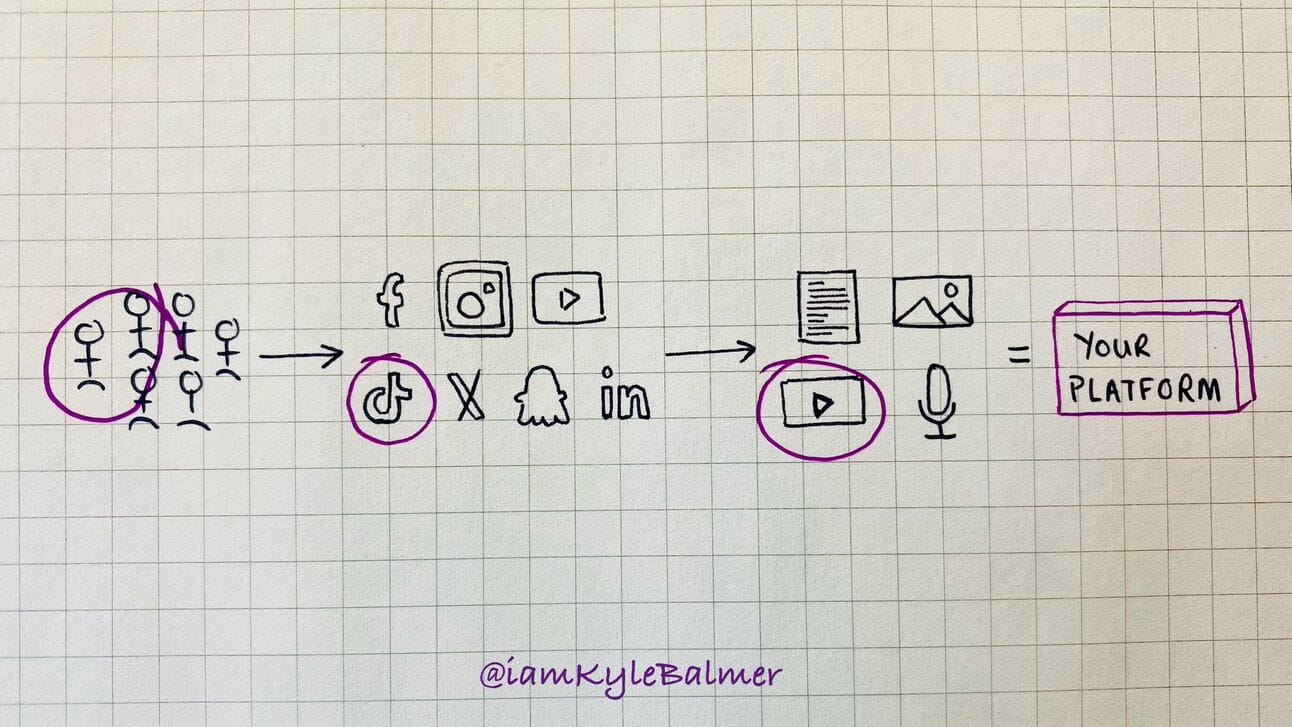
Once you know your platform we will very simply add a line to the prompt from the last Part:
Adjust this for [platform] as platform of choice.
Make suggestions on time/format based on this platform's best practices
This will edit your content funnel and match the ideas to your platform of choice.
Once you’ve begun to build an audience on one platform you can absolutely try out others.
The main thing you need to avoid (early days) is bouncing from one platform to the next.
Growing on any platform is going to take some time. And far too many people quit when they don’t see immediate results. That’s great for you if you are committed to building an audience (for your business) for the long term.
I’d recommend getting your first 1000 followers on a single platform before looking to expand. That should be sufficient for you to find your feet and learn what it is your audience wants to hear about.
Once you have this on lock you can take those same topics and same content to other platforms. And, if there is a similar audience there, they should be receptive.
When doing this I’d recommend starting by reposting and repurposing content. You don’t necessarily need to make fresh content for every platform. But instead you can:
repost - literally taking the same video, without a watermark, and posting to another platform
or repurpose - taking a piece of content and chopping and changing it for another platform
Because you’ll have a steady content pipeline for your first platform in place this becomes much simpler than starting fresh on each platform.
Keep prompting,
Kyle
As your audience grows your techniques will change.
What big boys do for growth isn’t relevant for you early days.
And what techniques are great for you early on will be inefficient later.
We need to modify our approach as we go from stage to stage. I’ll survey how to do this in this Part.
Let’s get started:
Stages of Growth
0-100 no pressure experimentation
1-1000 the slog
1000-10,000 building your community
10,000-100,000 ROI scaling
The path to 100,000+ followers will be different for everyone.
For some it’ll be years of carefully piecing together an audience. For others it might be one viral post.
It depends on your niche, your platform, your content and, let’s face it, luck.
Regardless of how long it takes to get there it’s worth it. With our audience we are building an asset - a group of people who are potential customers further down the line.
I’m not going to talk timelines. Me saying that you should hit 1000 followers in a month is counterproductive. We’re all different and will move at our own paces.
Instead let’s use audience count as rough benchmarks here. Again, this isn’t perfect - for instance 100 LinkedIn contacts could indeed be worth more than 1000 Tiktok followers (depending on your business) but it’s sufficient.
I‘ll also focus more on early stages because that’s more relevant to most people reading this guide!
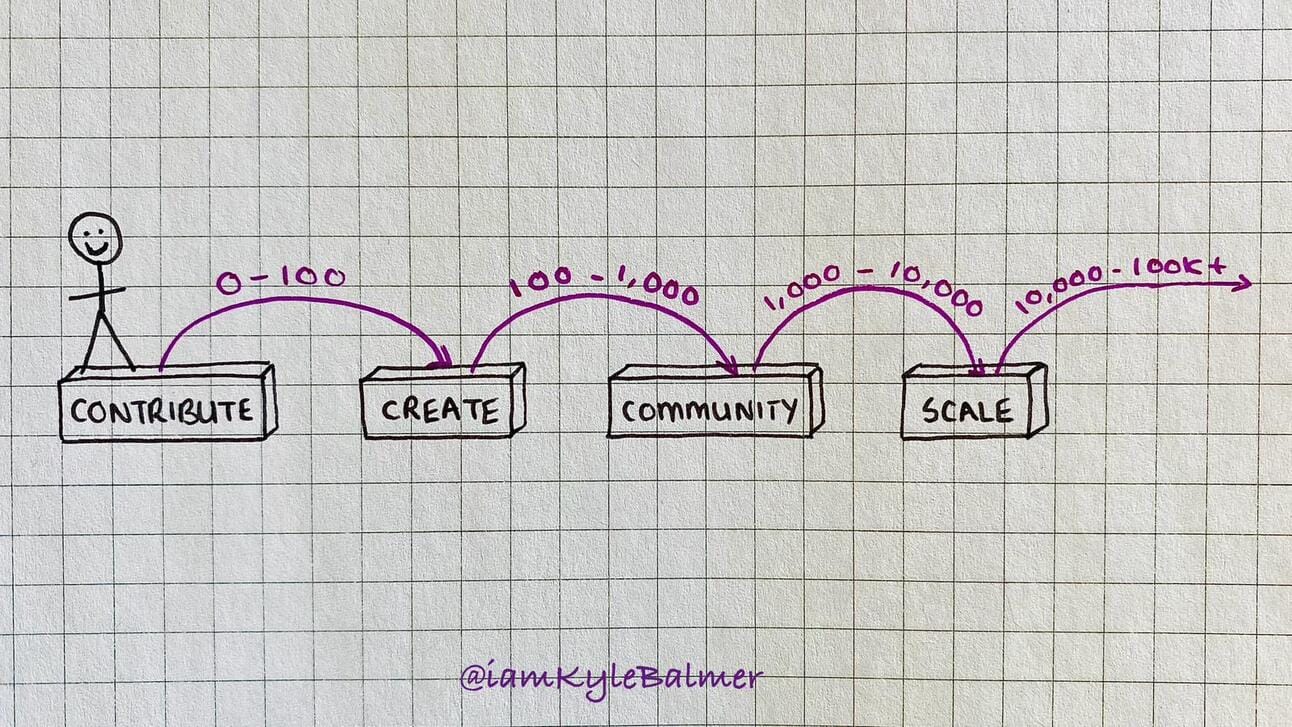
We all start in the same place. At 0.
It’s an awkward place to be I won’t lie. Who wants to follow an account with zero followers? No-one!
But everyone started here initially and had to deal with the first step. Well, maybe not Taylor Swift.
The great thing (!) about have hardly any followers is that you can experiment.
You can sing like nobody is watching because…they aren’t!
Treat a fresh social account as a blank palette and play around with the tools on offer. Test the functionality, see what’s what. If there are multiple formats (lnstagram has Reels, Posts and Stories for example) learn what they are and test them out. Find what appeals to you most.
And then start posting using the techniques we’ve covered. Initially don’t worry about quality too much. We literally just need our profile to look “lived in” at first.
I get of comments and DMs from people saying “please follow me!”. Every once in a while I’ll actually go and look and their profile. And I’ll find it has one video. More likely than not a blurry photo of their cat.
Why would I follow them? Same question goes for you.
If your profile is absolutely empty no-one will follow. So…start to consistently publish. Even if no-one is watching. Because when someone does come to your profile we need them to see it’s inhabited.
Feels weird yup. But it’s required!
OK then how are we getting people to come to our account then? Certainly not by DMing people and saying “follow me”!
Instead we’re going to start as we mean to go on. By offering value.
You’re going to engage with other accounts on the platform. And genuinely join conversations and be useful.
By doing so other people will see your profile and think “huh, who’s this?” and come to visit your profile.
You will also be building relationships (good ones) with people in your niche. Human relationships. Don’t just spam their feeds! Value first, always.
Sometimes you’ll even get a shoutout from a big account.
Here’s a recent example:
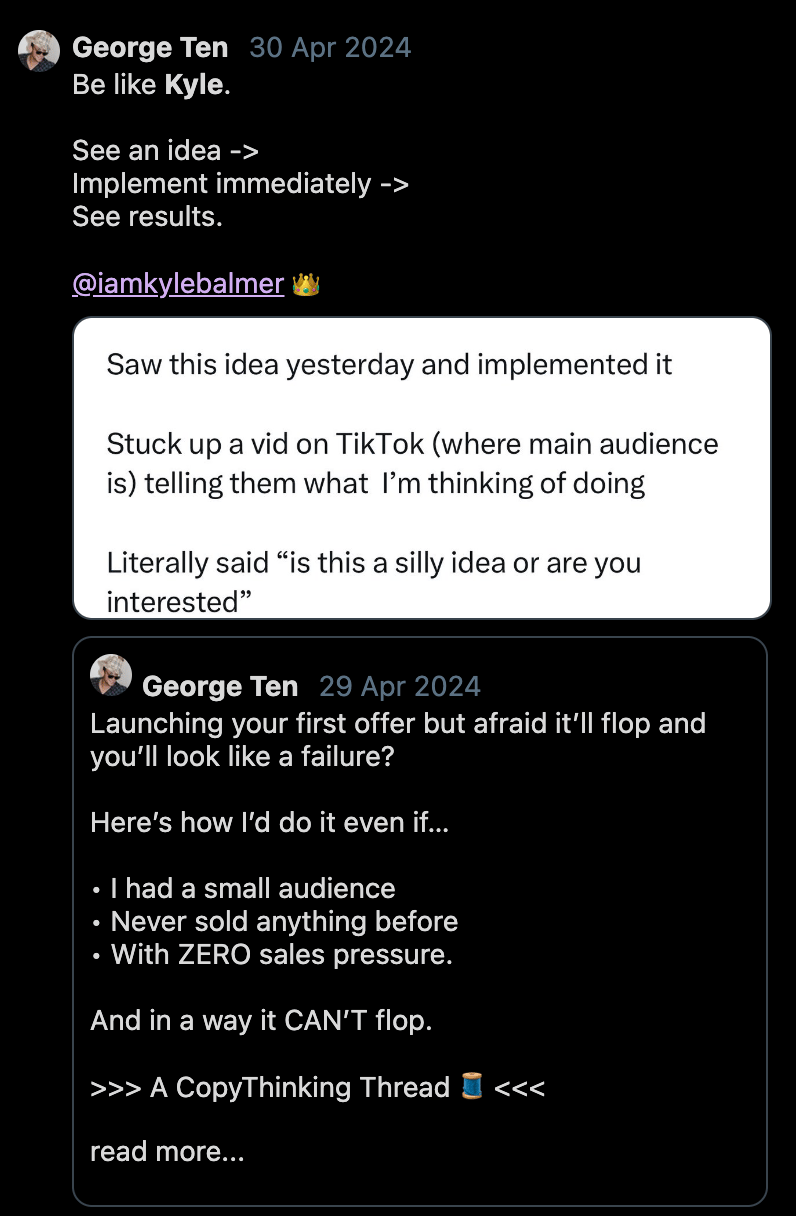
The bottom of the image is a tweet from George Ten. He has about 200,000 followers on Twitter.
I responded to his tweet saying that I’d used his advice and it worked. This was true. I did use the advice. And it did work!
George then screen-shotted my response and put out another tweet about the interaction.
I got a bump of followers (100+) from this interaction. Not bad for 30 second tweet.
Notice that I didn’t beg for followers. I didn’t spam George’s timeline. I didn’t do anything icky.
Instead we had a human interaction, just publicly on social media. Which led to some more followers on my account.
That’s the name of the game initially. Social media is…well, social!
Getting to your first 1000 followers is the real slog.
You’re in a weird space where you aren’t brand new. But your count is still too small to be taken seriously (sorry!).
This is where persistence comes into play. You just need to keep showing up. Keep posting. Keep engaging. And you will grow.
The key is to be sustainable. This means finding how to enjoy the process. It’s going to take time so it’s critical you find a way to take joy from the process.
Find the formats, content types and engagement that you enjoy as this will be sustainable. Then keep pushing.
This is the time when you’ll be tempted to take shortcuts. Don’t.
I’m talking about buying followers, paid bots, engagement groups etc.
These can be used to (immediately) plump follower counts. Hell, you can buy 100,000 followers right now if you want to. Don’t!
The reason not to take this shortcut is engagement. Nearly all the social media platforms use the % of your audience engaged as a metric for whether to share your content more.
If you have 100,000 bot followers then your engagement % will be low. And as a result your content will be seen as junk and not shown to anyone. You basically kneecap yourself. The account will strangle itself.
Instead use this time to lock in the type of content you’ll be doing. Watch for what your audience (at any size!) reacts to and do more of that. This feedback loop will cascade bit by bit and you’ll find the rate of growth starts to increase.
OK it’s go time.
Around 1,000+ things start to happen. There’s something about the 4 digit number that makes an account look “legit”. It’s stupid but it is what it is.
Continue to do the same activities (content creation and engagement) but also add in networking. Start to directly talk to others in your niche and build relationships.
Now that you have over 1000+ you will start to be seen as another creator rather than a consumer.
You will very likely also see an acceleration in audience acquisition at this point. Suddenly you’ll be adding more followers in a single day than you used to in a week.
It might take 6 months to hit 1,000 and then a single month to get to 2,000. It’s not linear but accelerates. My Tiktok, for example, took a month to add my first 1000 and now I add 1000-2000 every day.
The big get bigger, which feels entirely unfair when you are a smaller creator!
But…you’ll get the same treatment once you get here.
At this stage in your audience growth I also recommend layering in email capture. You’re now pulling enough traffic for it to be worthwhile to start lead generation. My suggestion is a newsletter, especially using beehiiv as your platform because you can get paid for each sign up.
Now it’s about ROI.
I suggest looking into advertising as a way to grow your audience at this point.
You’ve cracked the code and have content that your niche wants. You can now scale that organic content using advertising.
As we’re running a business we need ROI. So make sure you have your offer in place to monetise your audience via your sales funnel.
As a nice bonus (depending on your platform) you may be able to directly generate revenue if your platform of choice has a rev-sharing programme. Youtube, Tiktok, Instagram, Facebook and Twitter all pay their creators for putting out content. Treat this as bonus revenue - you are a business owner not an influencer!
Hopefully having this outline of growth stages helps.
I won’t lie. It takes time. And the first stages are the slowest!
But being forewarned is forearmed.
You know the challenge. And the work required to get there.
And know that the end result is well worth it.
Now it’s a matter of getting started and (most importantly!) sticking to it until you get what you want.
Keep prompting,
Kyle
In today's digital landscape, building an audience is no longer optional; it's essential for launching a successful business. The '🚀 How to Build an Audience | AI Business Playbook' equips aspiring entrepreneurs with the strategies and frameworks needed to attract and engage their target market. This playbook not only emphasizes the importance of audience creation but also provides a step-by-step guide to navigating the often complex world of social media, content creation, and personal branding. By the end of this journey, you'll transform your business idea into a thriving community of loyal followers and potential customers.
This playbook is designed for aspiring entrepreneurs, freelancers, and small business owners who recognize the critical role of audience building in their success. If you're feeling overwhelmed by the idea of launching your business without a following or struggling to connect with potential customers, this guide is perfect for you. It addresses the common challenges of starting from scratch, providing actionable insights to foster genuine relationships with your audience and turn them into loyal customers.
No prior experience is necessary. This playbook is designed for beginners and those who want to enhance their audience-building skills.
The time commitment varies, but dedicating at least a few hours a week to apply the strategies will yield significant results.
Absolutely! Even established entrepreneurs can find valuable insights to refine their audience engagement and growth strategies.
This playbook provides unique techniques to differentiate yourself and effectively reach your target audience, even in competitive niches.
Yes, the playbook includes templates, examples, and access to recommended AI tools to streamline your content creation process.