
AI Business
Unlock the secrets to a successful launch without the typical hurdles of lengthy product development and aggressive sales tactics.
Start ReadingThis week’s topic is about guaranteeing a successful launch.
Without spending months building a product/service. Without hard sales.
Huh - how can I guarantee that? Black magic!
This guide is inspired by this exchange with the excellent George Ten (who you should be following on Twitter if you aren’t already):
Be like Kyle.
See an idea ->
Implement immediately ->
See results.@iamkylebalmer 👑
— George Ten (@GrammarHippy)
9:18 AM • Apr 30, 2024
Here’s George’s brilliant guide in full. Go and read it on Twitter - copy/pasting it here in the newsletter makes zero sense:
Launching your first offer but afraid it’ll flop and you’ll look like a failure?
Here’s how I’d do it even if…
• I had a small audience
• Never sold anything before
• With ZERO sales pressure.And in a way it CAN’T flop.
>>> A CopyThinking Thread 🧵 <<<
— George Ten (@GrammarHippy)
11:58 AM • Apr 29, 2024
Make sure to go check it out for full context. Link here.
The basic idea is this:
Ask your audience if they would be interested in participating in a cohort or workshop with you.
Soft launch a small cohort or workshop to a targeted group, keeping the number of spots limited.
Be close to the participants, work with them closely, and build a product/course tailored to their needs and feedback.
Leverage the success stories, testimonials, and case studies from the first cohort to make selling the next one easier.
Increase the price for the second cohort, as you now have social proof and a refined offering.
Over the week I’m going to use George’s excellent guide (I claim no originality here!) and combine it with AI to make the process even more frictionless for you.
I’ll also go into more detail about each step based on my own experiences with the method.
Specifically, this week we’ll cover:
Part 1: Fail without Failing
Part 2: Soft launch
Part 3: Laying track in front of the train
Part 4: Building together
Part 5: Scaling and price bumps
Let’s get started:
Fail without Failing
basic starter idea based on solving a problem
immediately go fishing
no interest? months saved
positive reaction? next steps
First up we need a basic idea for our offer.
If you already have an audience fantastic. This simplifies things!
Straight up ask them (via polls, posts or interviews) what their biggest problems are right now.
First ask broadly to get a range of options. Then run polls and surveys to find out what the most pressing issues are.
If you don’t have an audience (or even if you do!) look at what other people and companies are doing in your niche.
If they have been successfully selling for any period of time then chances are they’ve hit upon the market’s problems, challenges and desires. It’s your task to reverse engineer what these are!
If you have zero idea find a competitor’s landing page and copy the text content.
Then use it with this prompt to divine the core offer:
Act as a marketing expert

Analysis the below sales page and extract:
-the defined audience
-the core offer
-the audience problems being solved by the offer

[copy/paste sales page copy]
If I run this on (for example) Dickie Bush’s Ship 30 for 30 programme I get the following insights:
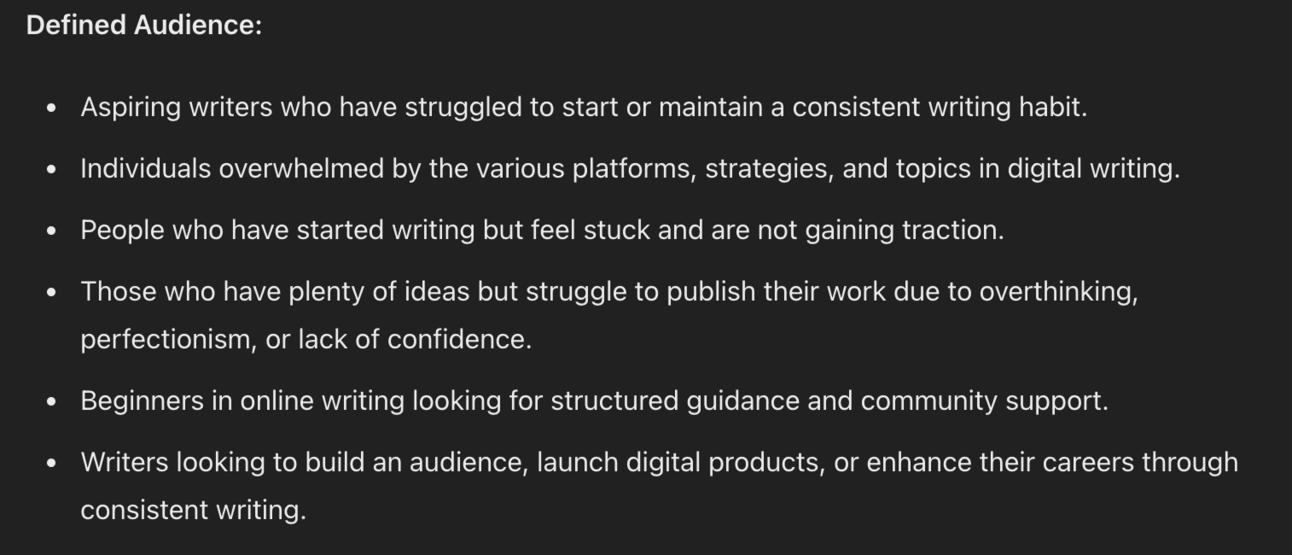
and for audience problems:
Use this along with your own knowledge and research about the market to decide what problem you want to solve (your offer) and for whom (your customers).
It doesn’t need to be perfect. Stop chasing perfection. This is the reason why many people fail to launch anything at all!
We’re now going to immediately test the idea out with the only people who matter : our audience.
Your idea by itself is worth nothing.
Only via implementation does it become valuable.
The problem most people have at this point is we tend to fall in love with our ideas. We think they are special little babies and that anyone who says anything against them is plain wrong.
We over-identify and tie our egos to our ideas. Bad idea.
Instead we’re going to circumvent all of that by immediately getting our idea out into the world. We won’t have time to get attached!
As soon as you have your basic idea you’re going to tell your audience.
We don’t announce we’re selling it. Because if we start bigging it up and no-one responds it feels like a flop. Our (fragile!) egos are damaged and we get disheartened by this whole entrepreneurship malarky.
Instead we go fishing. Low-stakes, just testing the waters.
Here’s the exact phrasing George Ten uses : “Have this idea of getting a small group together where I teach [topic]. Is that stupid?”
Adapt this as needed. Make it fit your normal style.
Here, for example, is me asking people about whether they’d be interested in licensing my teaching material to go and teach companies about AI for $1500-4000/hour:
@iamkylebalmer Gauging interest : would you be interested in teaching AI to businesses? I run workshops and give talks but don’t have capacity to meet d... See more
In this video I frame the idea and basically ask “is this something you’d be interested in or am I stupid?”. I then ask them to tell me if they’d be interested in something like this.
200+ people told me they wanted it in comments. Another 100+ DM’d or emailed me.
That tells me the idea is a goer. I’ll talk more in the next Part about how I quantify this and how I continue to verify but first it has to pass this initial hurdle.
The “is this stupid?” post should take you minutes to make.
No longer.
You have an idea for a product or service, you throw out a post and see who reacts. That’s it. Don’t belabour it.
Nobody responds? Great!
Genuinely.
You’ve learned something extremely valuable. People don’t want this.
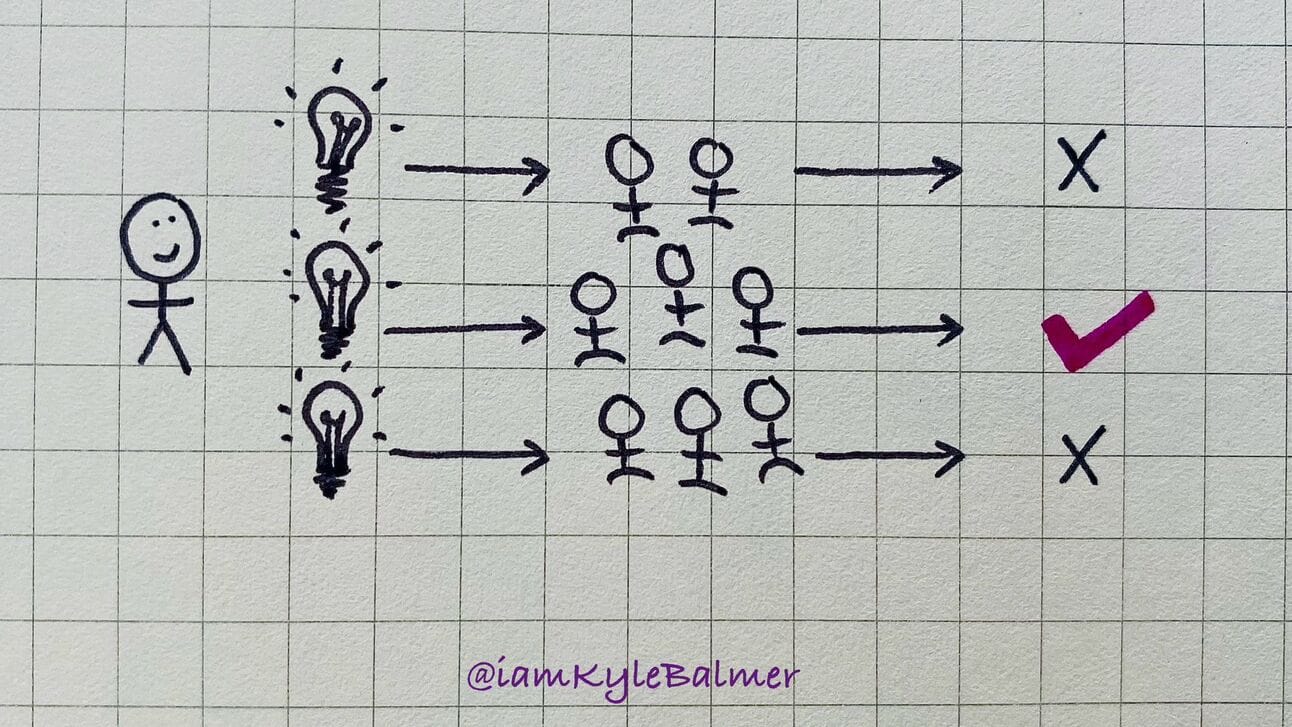
You do not need to produce the product or service. You’ve just saved yourself months of work! You can move on and in a few days post about another idea. And continue to do so until something clicks.
You didn’t “fail”. You’ve instead falsified a hypothesis. That’s all. And you are free to come up with more ideas, keep testing responses and only moving onto the next step once you’ve got the go ahead from your customers.
We’re going to continue in this manner over the rest of this Playbook. Following along will let you build without the normal massive risks of failure. Step by step, each time verifying and adapting.
Hopefully you already see the power of this method!
If you are a premium reader we’ll cover
Part 1: Fail without Failing
Part 2: Soft launch
Part 3: Laying track in front of the train
Part 4: Building together
Part 5: Scaling and price bumps
If you are non-Premium you buy get the whole thing next Saturday or join the Forge now to get access this week:
Keep prompting,
Kyle
Let’s continue to validate our offer idea with a soft launch.
The more time we spend here in pre-production confirming people want this the better. Believe me - I’ve cumulatively wasted YEARS building stuff people don’t want! Don’t fall into the trap.
Again this method is based on the excellent thread by George Ten I mentioned in the first Part. Link here. It’s well worth reviewing!
Let’s get started:
Soft Launch
what’s a “good” reaction?
example of a “mid” reaction
build in public content for continued clarity
soft launch with waitlist
define success before you start
In the last Part we went through a short loop:
Come up with an idea → Ask your audience if it’s stupid → Gauge reaction
I previously said that if the audience responded poorly kill the idea and try with something new in a few days. And if they respond well go ahead to the next step.
But what’s a good/bad response? And what do we do about "meh” results?
What you are looking for is for people to bite your hand off. You want the idea to be so exciting that people start hounding you for more information.
When I put out my video about licensing my AI teaching material I got:
200+ interested on the post itself
50+ DMs
50 or so emails
It’s been a week since the first “is this a stupid idea?” and people are now emailing for updates.
You want this level of impatience (in a good way❣️ ). It means you are onto something.
If it’s purely people saying “yeah sounds cool” that’s insufficient. We want to find something that people get a bit crazy about.
And guess what….we can! Because we are not yet building anything! We can keep asking about new ideas until we get a big reaction.
Here’s an example. I had the idea of doing a 30 day Audience Accelerator. Basically showing people how I built to 80k Tiktok followers in a few months.
Here’s the announcement video:
@iamkylebalmer Need some feedback! Is this a stupid idea? Or interested? If so please tell me in comments so i can gauge whether its worthwhile! #content... See more
Notice the “Is this a stupid idea?” language. Literally George Ten’s language from the last Part!
Now this video did…fine. And the response was pretty good. But go look at the language people use in the comments. It’s much less excited that with the idea about licensing my material.
There’s also just less interest - smaller numbers. And certainly no one tracking down my email and chasing me!
Is it a bad idea? No not really. It’s OK. Still 100+ interested. And I may still do it, with tweaks. But the reaction was not the OHMYGOSHYES that I needed to push ahead.
Same goes for you - don’t push out one idea, get a decent response and think “this is it! All in!”
Feel free to ask more, try more ideas, look for an extreme reaction.
There’s no ego at this point. Just you fishing. And experimenting here means finding an offer that is worth your time working on!
Better to spend a few weeks here than months creating something no-one really wants.
People biting your hand off at the first post? Great.
So you build it all right now as the next step? No! Hold on for a moment.
We’re now going to continue to verify that people want this. By continuing to post about it.
This allows us to:
confirm interest
drum up more interest
refine the idea
Here’s an example:
@iamkylebalmer Early draft of how to deliver AI workshops course and material. I got a LOT of interest over the weekend about this (300+ people) so we s... See more
In this video I quickly showed an outline of what the offer might look like and asked what other things people would want to see in the offer. It’s a follow up video with more detail.
You want to do similar posts, talking about what you are building and asking for feedback.
This is called “build in public” and is a smart way to tailor your product to your customer requirements (with audience feedback) as well as keep it in their minds.
If this goes well and it seems like your first popular “is this stupid?” post isn’t a fluke we’ll lock in and move to soft launch mode.
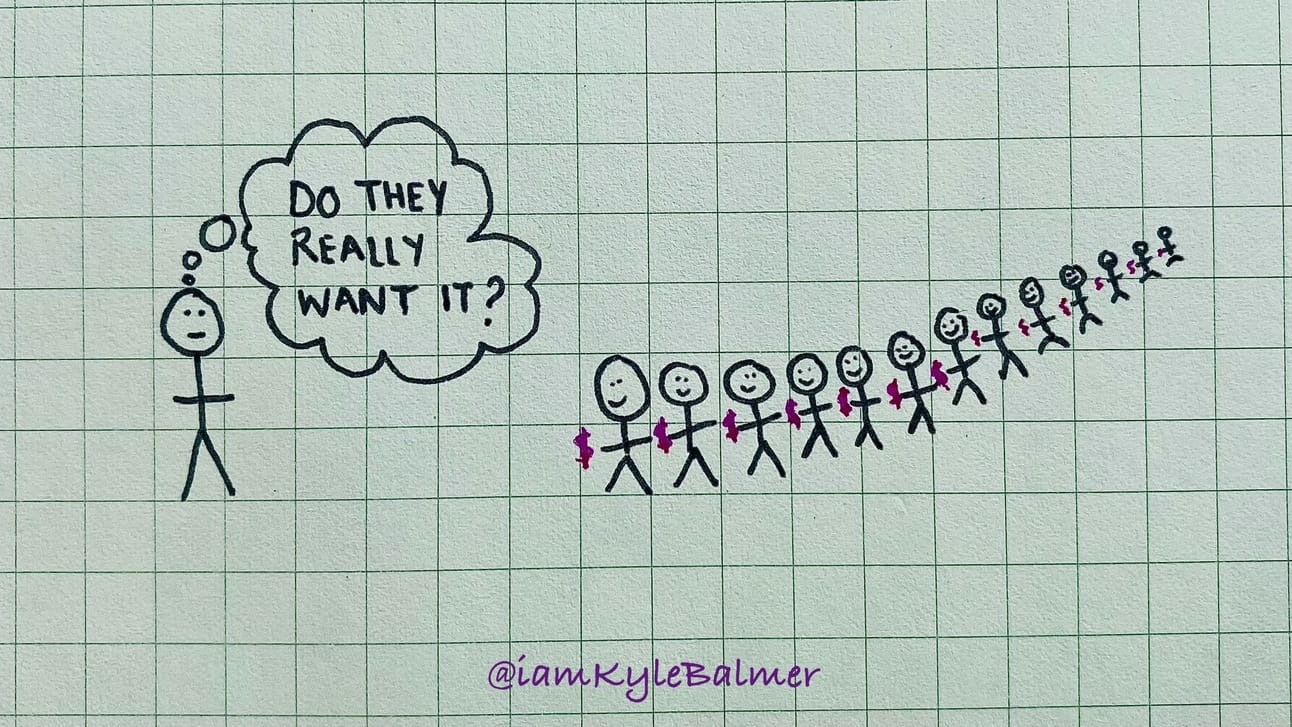
Our soft launch is getting people onto a waiting list.
We’re collecting their email to:
know the numbers who are interested
be able to contact them later
Importantly: we need to set a target before we start collecting emails.
If we hit the target we push ahead with launching the offer. If we do not hit the target we stop and come up with another idea.
Sounds brutal but we are using these checkpoints to make sure we don’t waste time and money later.
How we set this target depends on our audience size, past track record with launches, the price of the offer, your financial goals etc.
Work backwards from the result you want to the wait list size you need.
For example let’s say the launch is only worth while if you know you can sell $50,000 worth. Anything below just won’t be worth your time building and launching.
If the offer is $3000 we need to sell to 17 people to hit $50,000.
If we assume 25% of the people of our waiting list buy we need 68 people on the waiting list.
68 becomes your target wait list.
Here’s a quick and dirty prompt to do the calculation for you. Just plug your numbers in:
I am launching a waitlist for an upcoming sale. The purpose of the waitlist is to validate before launch. To validate I need to hit a certain number on the waitlist. Help me calculate this number.

This launch is only worth me doing if I can bank [revenue goal]
The price is [price of offer]
I expect to be able to close [x%] of the waitlist
Plug in your figures and you’ll get a worked result like this:
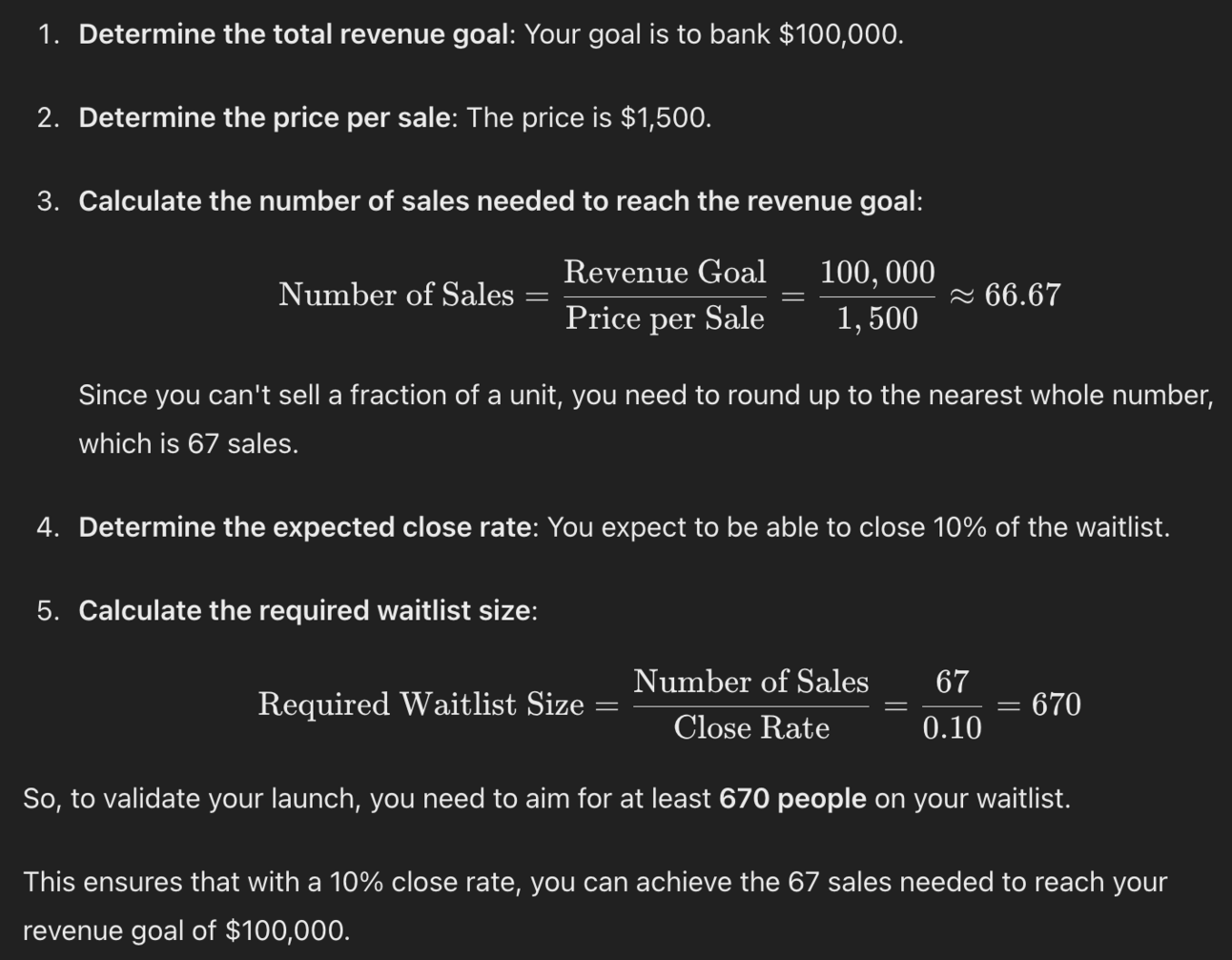
The exact accuracy of the calculation is not the important thing here. What’s important is having an objective target before you start collecting emails. Otherwise it’s too easy to engage in hand waving “oh yeah that’s enough” justifications later!
For the practicalities of the waitlist keep it simple. Use a simple Google Form asking for their email address and then plug it at the bottom of your posts talking about what you are working on. The offer idea should be sufficient to secure the waitlist signup without fancy sales pages and copywriting.
In the next Part we’ll get paid and start to build! In that order! We get paid before we build.
Keep prompting,
Kyle
You’ve secured interest in your offer and have a waiting list excited to buy from you.
Most businesses would now go offline and build a product or service. Go stealth and reappear in 6 months with a big reveal. Only to find out no-one cares.
We ain’t most businesses. Let’s do it sensibly.
Let’s get started:
Laying track in front of the train
what exactly do we build?
low volume, high price
sell first, build later
basic outline prompt
I purposely left what we’re building vague - you may have noticed!
I do not recommend building a full product, service or course. Because they take too long to launch.
Instead you want to launch something fast, taking advantage of the upswell of interest you are receiving. We want to ride the momentum and not lose it by spending 3+ months building out a product.
For this reason we’ll launch a cohort. A cohort is basically a live hands-on course.
Couple of reasons why we’ll use a cohort:
cohorts are developed “live” with customers meaning we don’t need it all ready upfront
cohorts have higher per person cost, meaning we need less customers
less customers means automatic scarcity
A cohort is usually $500-3,000. Get 10 or so people on board and it’s immediately a good pay day.
If you instead built a product or a course you’d:
have to spend months prepping it, risking losing interest
you can probably only charge a few hundred per customer meaning you need a much thicker lead pipeline
The real secret sauce here though is that you are going to co-author the cohort with the lucky sign ups.
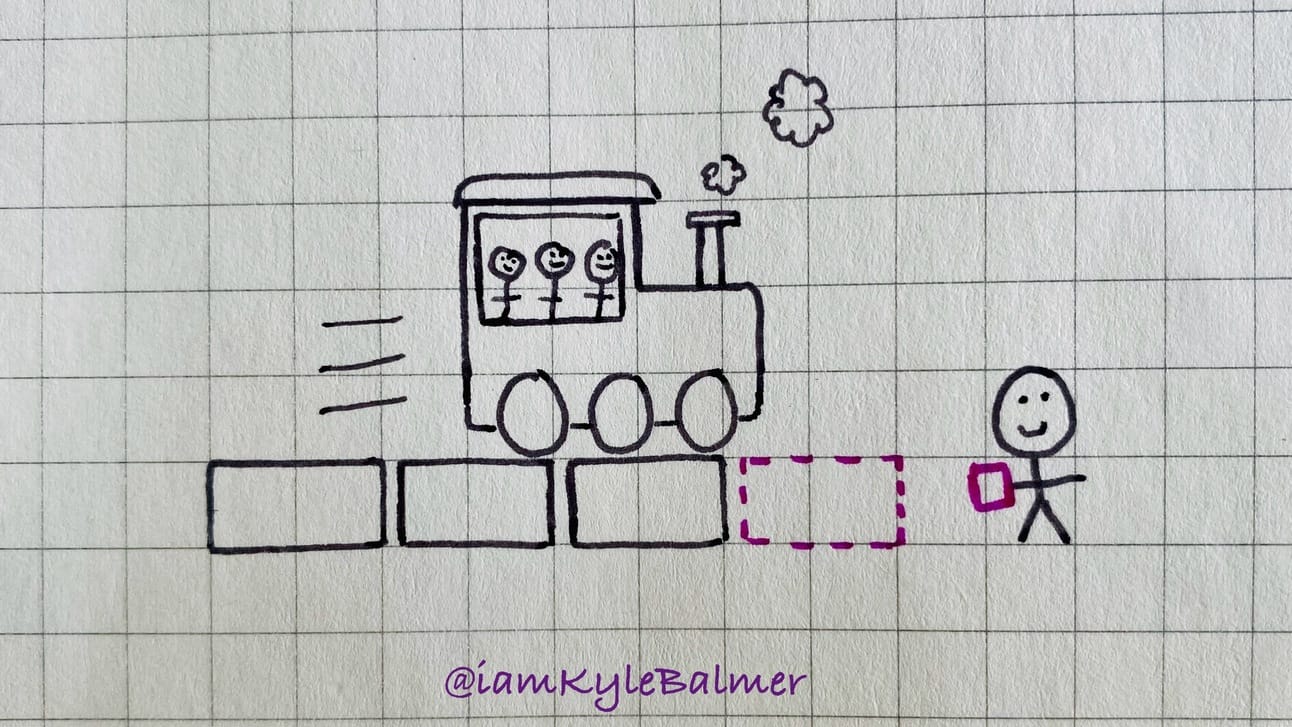
We don’t have a product yet. But we’re going to sell.
We’ll take the original idea we had. And we’ll use this to build a rough outline. Just rough.
Here’s a prompt to get started:
Act as a cohort designer
I'm running a 4 week programme to teach people [topic]
By the end of the programme they should be able to [goal]
My audience main problems are: [list 4-5 problems]
Give me a 4 week outline of the cohort
This will give you a very basic outline:
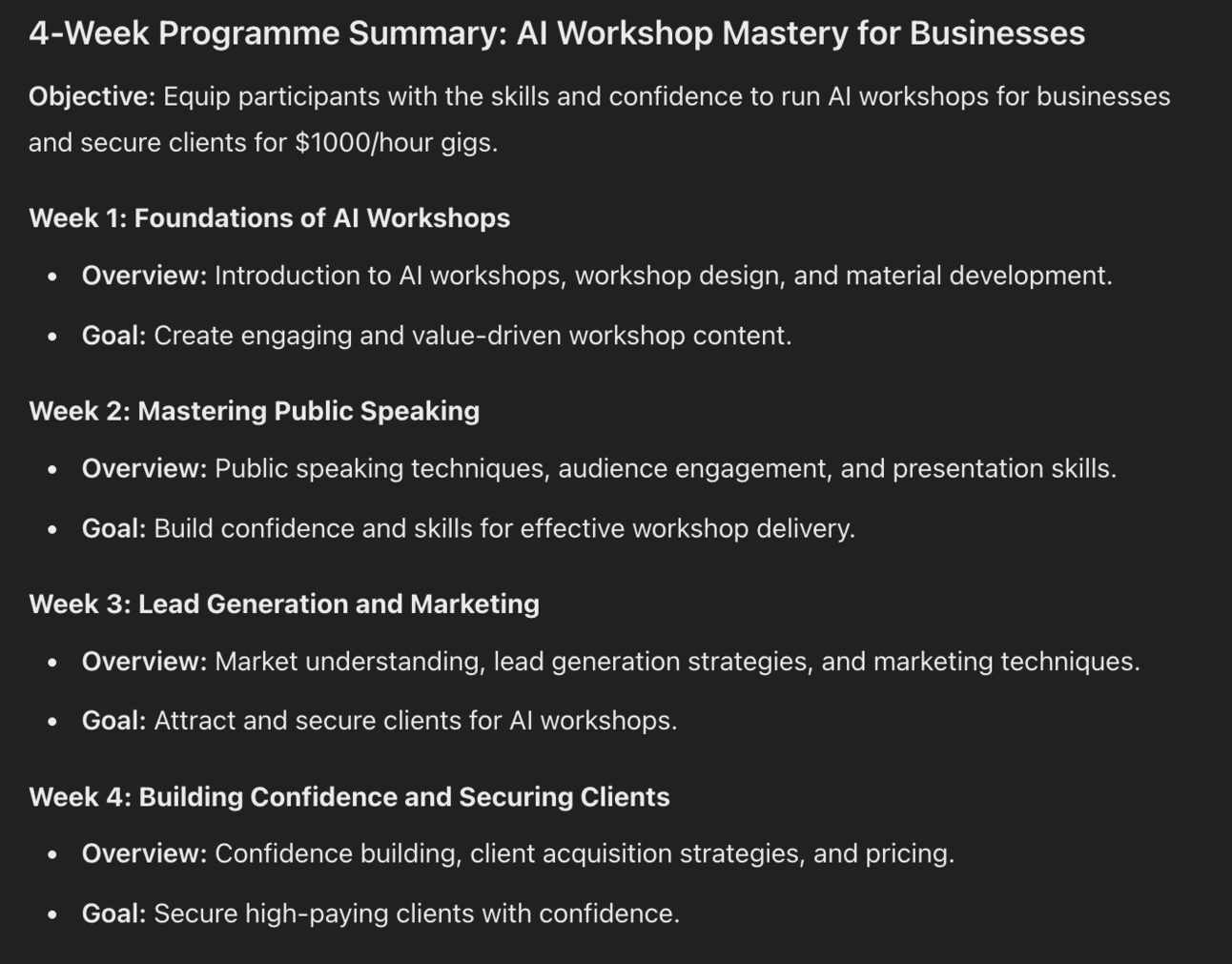
As a subject matter expert it’s your job to adjust this. Mix in the feedback from potential customers as much as possible. Match their language.
Don’t worry about having a perfect outline though.
You need to know roughly where you are going. And build the first session.
But that’s it.
Because we’re going to build as we go along.

We’ll talk about how exactly we do this in the next Part.
All you need to know right now is that you need an outline and the first session to start selling. Nothing more.
By releasing this as a cohort you get to launch immediately, get people enrolled and revenue in. But you’ll be building the rest as you go along with your customers.
This is actually amazing for your first cohort because they get white glove service! They get your full attention and customised assistance. You’ll be shaping and forming the curriculum around them and their needs.
You’ll also be working extra hard to make sure they get the results you’ve promised. Because (as we’ll discuss in a later Part) we’ll be using their successes as case studies and testimonials.
Later (when we scale) we’ll solidify the cohort into a static course or product. Based on what you’ve co-built with your first customers. Later customers won’t get the same level of hands-on care but that’s fine! Focus on nailing it for your first cohort as top priority!
The big bonus here is that we don’t waste time to building something that people won’t want.
We sell before we build. This means we build the cohort knowing there’s interest locked in - people have already paid!
This is the basic traffic light system we’ve been using in the previous Parts:
does this idea sound stupid?
do you want to join the waitlist?
do you want to buy at this price?
Most businesses do this backwards and build everything first. Then hope for the best when they launch. Oops.
Instead we are (at each stage) testing the waters, seeing how people react and only moving ahead when our customers are eager. It’s hard to overestimate how much time this saves.
What if no-one wants to buy? Great - that’s told us we need to adjust the offer for the cohort.
What if some people buy but not enough for you to justify running the cohort. Refund the cash. No harm done.
A quick note on the technicals of it all. It’s easy to get bogged down here. So, in the spirit of keeping everything lean and not requiring time/money to get started I’d recommend:
Notion to build a basic “landing page” explaining your cohort
Stripe or Lemonsqueezy link for direct payment
Google Meets or Zoom for running the sessions
I personally run cohorts through Circle but I wouldn’t recommend it for your first pass. Keep it simple first time - focus on the quality of the information you’ll be delivering and worry less about the technicalities.
In the next Part we’ll look at session #1 and where we go from there.
Keep prompting,
Kyle
We continue to build without guesswork. Starting this time by defining successful outcomes with the help of our customers.
Let’s get started:
Building together
get your customers to tell you the outcomes
session zero intel gathering
adapt the structure on the fly
leave no one behind
When we pitched the idea of our cohort to our audience members we used the phrase:
“Have this idea of getting a small group together where I teach [X]. Is that stupid?”
We are now teaching the topic, live in our first cohort. Let’s explore what exactly that looks like.
We need first to define what the outcomes will be for the people you are working with.
You could easily come up with a list of outcomes off the top of your head. Or indeed use ChatGPT.
But you don’t truly know if these are valuable outcomes for your actual customers. How do you find these out? Well…you ask!
Now that you have a live cohort you can build with them rather than for them. It’s a shift in dynamics that will let you serve them far better and (as we’ll see in the next Part) also create a killer evergreen product.
Your first live session should be (for you!) reconnaissance gathering.
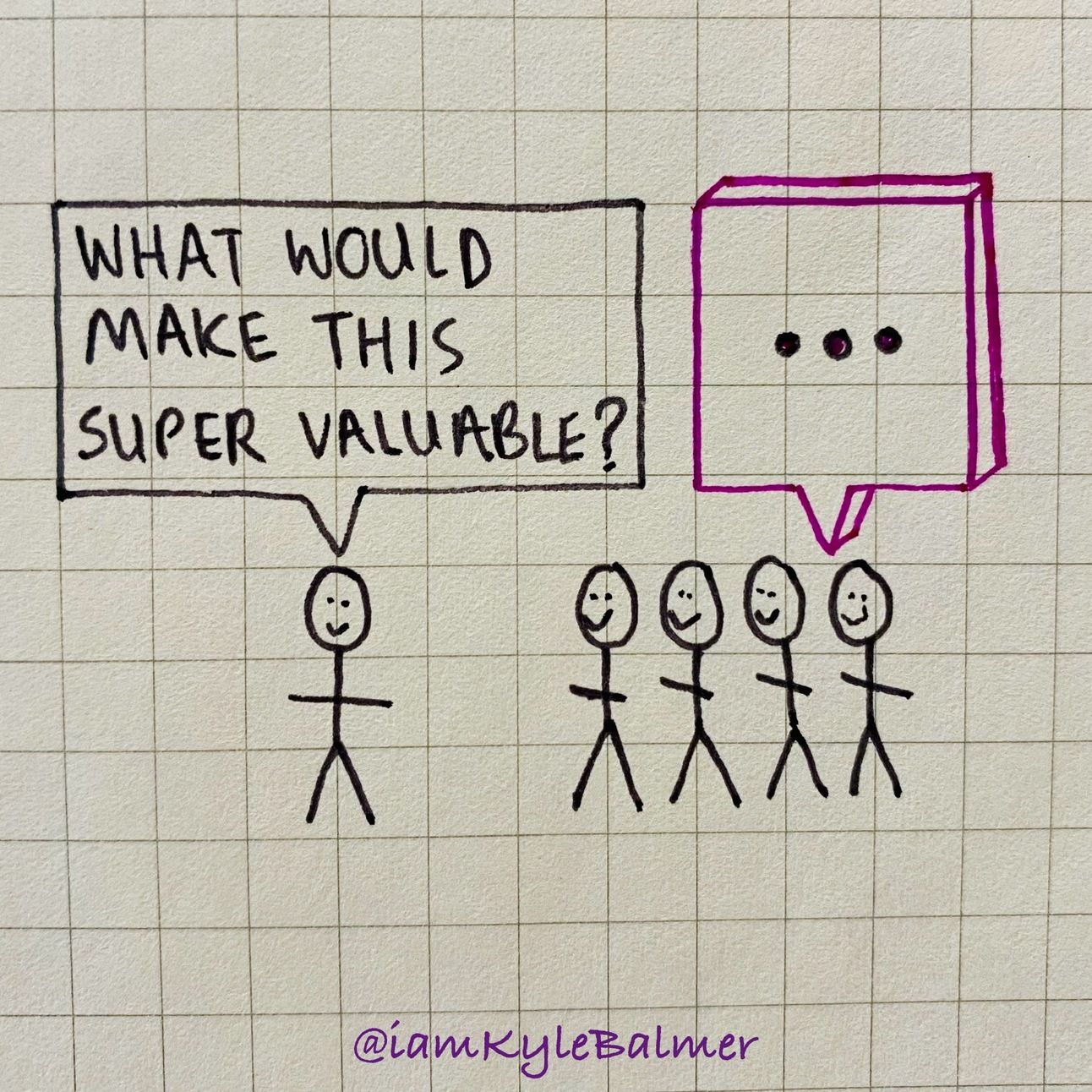
I like to run a short session zero as an introduction and information collection session. Then session one is where the core content comes into play.
Session zero should include thanking everyone for signing up and then a rapid fire structured roundtable.
Basically go around the participants and get them to tell the group:
name
their past experience with [your topic]
blocks they’ve previously hit
what they are hoping to learn this time that’ll make it different this time
what success would look like to them
Keep it rapid fire and structured so all participants know what to say and don’t get flustered. Don’t let anyone relate their entire life story either - keep it zippy.
During the session provide your thoughts but this is primarily about them. Session zero is about letting them talk, meet one another and see that they are not alone in their problems. So keep it casual but don’t go into hardcore teaching mode.
Instead focus on capturing everything they say and (if possible) the language they use to do so. Better yet record the call and transcribe/summarise with AI. Zoom has this built in otherwise upload the audio to a third party service.
You can also do this with a survey in Google Docs but you won’t capture as much information that way.
Either way we’re going to adapt the cohort structure we made by feeding in what we’ve learned.
Go back to your AI generated cohort structure and use this prompt:
Analyse the collected information from my students.
My objective is to solve these problems for my students and help them achieve their desired outcomes.
Intelligently adapt the current cohort structure to allow me to do so.
[Collected information copy/paste]
Here are some example notes from a student about running workshops
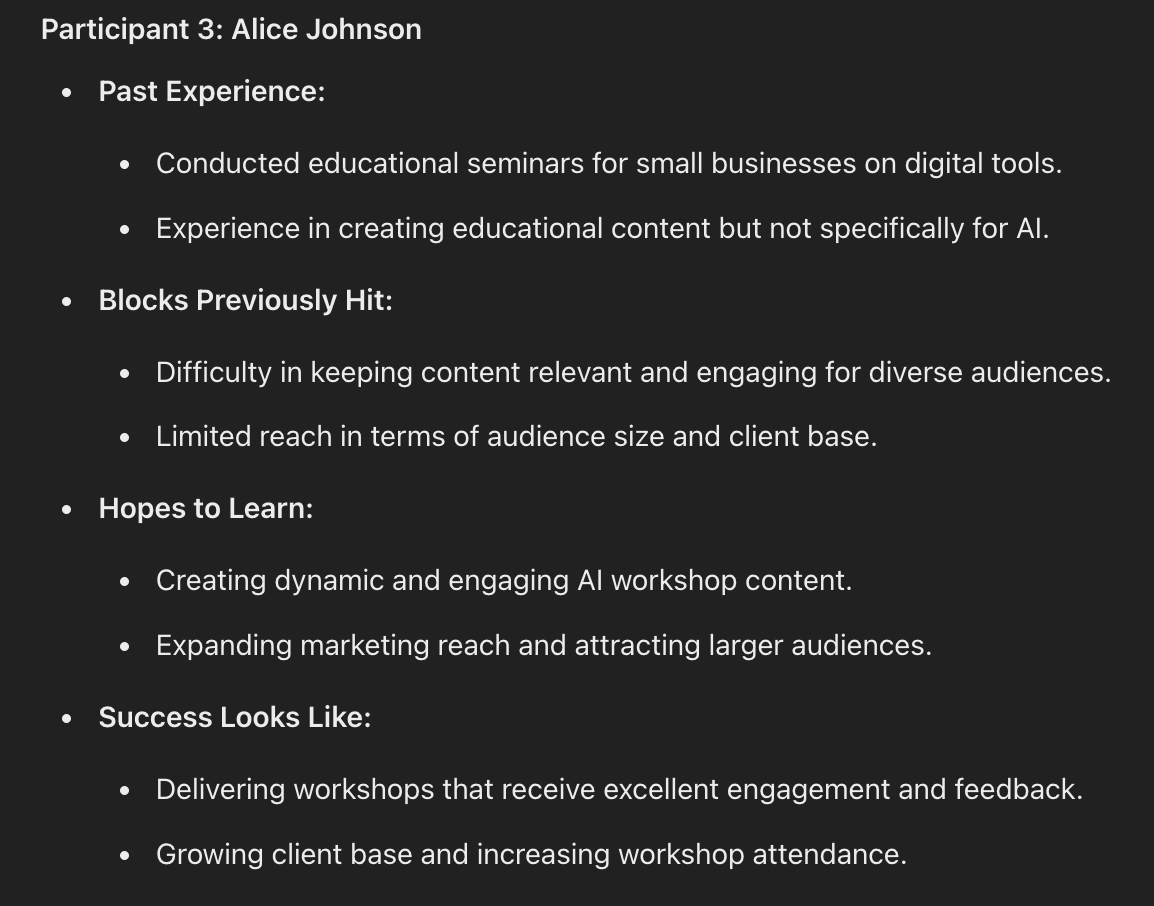
If I run this (and all the other student information) through the above prompt ChatGPT will adapt my initial cohort structure to better suit their needs:
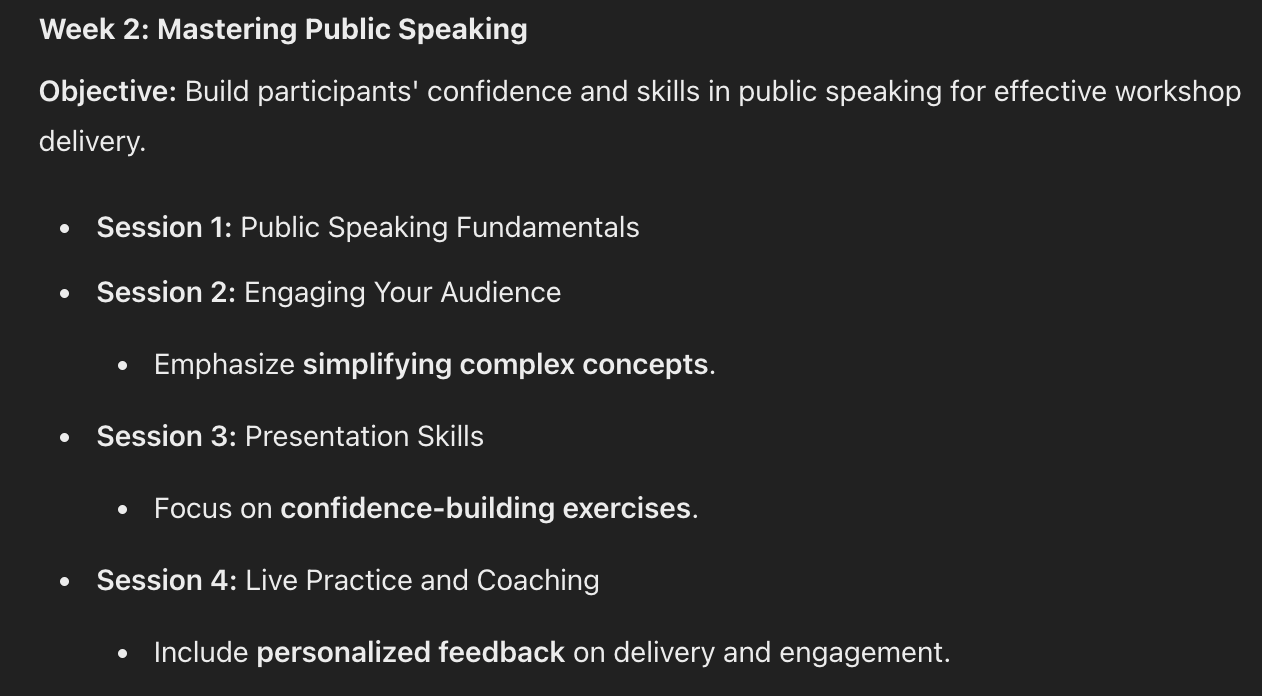
For example here ChatGPT has added in section on simplifying complex concept, building confidence and even personalised feedback on presentation skills. Those parts are bolded.
Basically we’re listening to what our students want and adapting the curriculum to them. We don’t assume we know best. We let them tell us.
You’ll now prepare Session one. No more.
We stay one step ahead, one week ahead.
This isn’t because we are lazy. Quite the opposite.
It’s so that at the end of each session we continue to tweak and adapt to better suit what our customers need.
After each session reuse the prompt from above with this basic adaptation:
Session [x] is completed. Ignore any sessions including and prior to this session.

Analyse this additional collected information from my students.

My objective is to solve these problems for my students and help them achieve their desired outcomes.

Intelligently adapt the current cohort structure to allow me to do so.
[Collected information copy/paste]
This will fold new information about your students into the curriculum. But only into upcoming lessons. This lets you adapt week to week - we never need to set in stone but instead continue to tailor to what our customers need.
For your first pass give it everything you’ve got. You need to get your students the result they expect.
If this hasn’t happened by the end of the cohort I’d genuinely recommend continuing with them until you have succeeded.
Will that take more of your time? Yes. But that extra distance will not only ensure fantastic reviews and testimonials but also help you work out what your product looks like moving forward.
In the next Part we’re going to “fix” our cohort into an evergreen course or product so it can be scaled. And to do that we have to nail this first cohort - even if it takes longer than we originally thought. It’s the right thing to do for your first cohort customers and for you as the business owner! Win-win.
Keep prompting,
Kyle
Once you’ve run your first cohort you’ve built your offer.
But you haven’t yet built a business. Let’s go ahead and scale up.
Let’s get started:
Scaling and pricing bumps
Gather testimonials
Build case studies
Run second cohort at double the cost
Convert to evergreen
Once the dust has settled from your first cohort make sure to celebrate a little.
Had fun? Ok good back to work!!
If the first cohort went well and you helped your customers achieve their goal (you did right??) then we can scale.
Didn’t manage this? Go again. Don’t scale something that doesn’t work.
We’re going to repeat the process but each time nudge up the pricing. We can do this because each time we run the cohort we’ll get more evidence than this works.
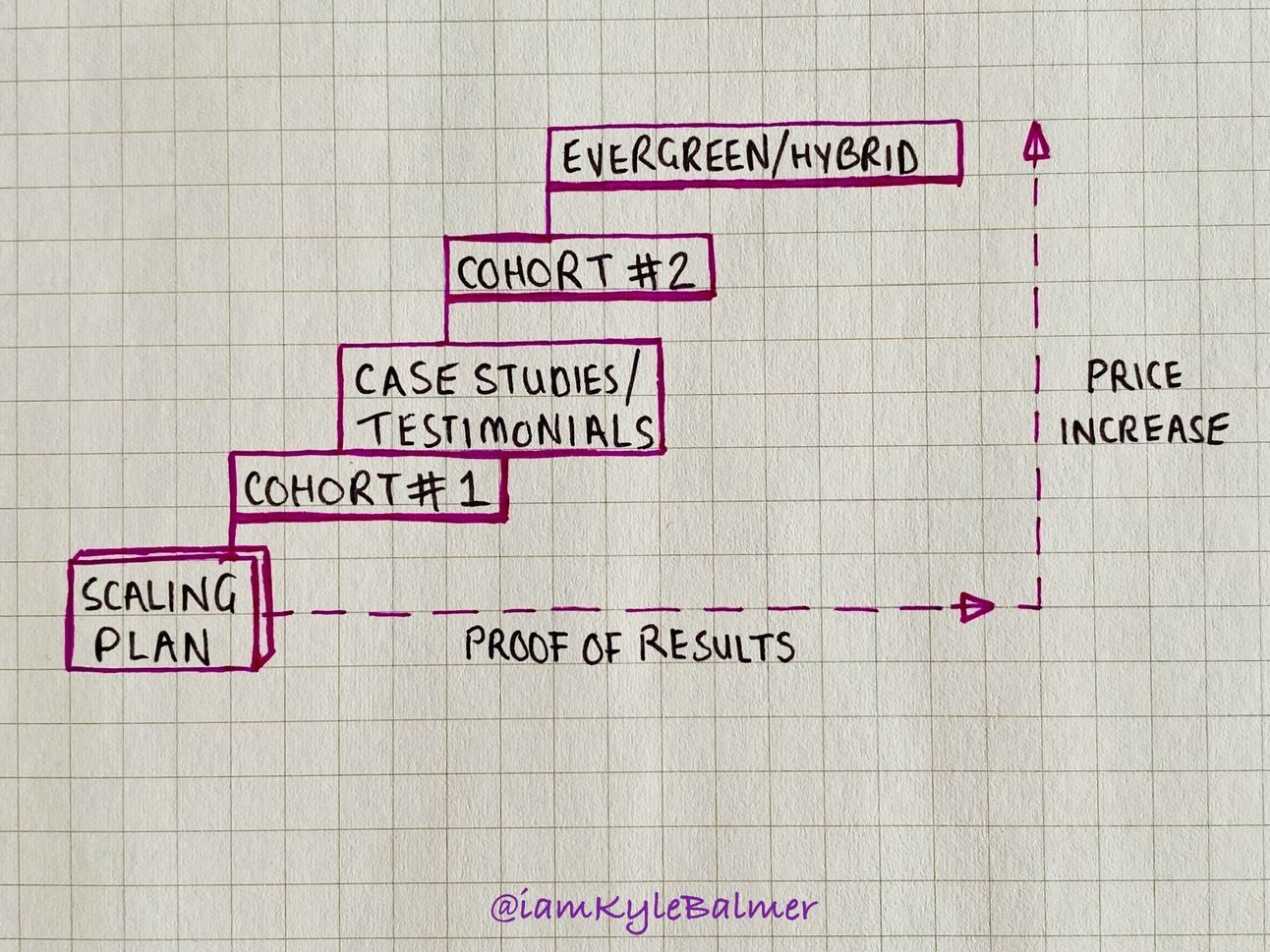
Let’s gather up that evidence!
First up and simplest.
We want to get testimonials from each and every member of our first cohort.
I personally use Senja (affiliate link) to collect testimonials because it makes it super simple for my customers. They can give a text or video testimonial. You want both.
If necessary incentivise the testimonial - “fill this in by this date and I’ll send you X”
Alternatively, and this one is powerful, offer a testimonial for them.
You’ve just taught them something powerful right? If you’ve done a good job (this the point of the cohort so you better have!) then give them a testimonial talking about their skills.
Just do a straight swap here - you give me a testimonial and I’ll do one for you.
Do whatever it takes to get the testimonial and the adorn your next sign up page with those bad boys!
A step up the social proof ladder is a full case study.
Choose a handful of your most successful customers and interview them for a case study.
Ideally hop on a video call and record it all or alternatively send them a survey.
To generate the questions use this prompt under your cohort structure:
Prepare a set of 10 questions I can ask a successful student after the cohort in order to generate a case study
The case study is for marketing purposes to help me acquire new customer
Base the questions on the structure, problems solve, outcomes
This will use the actual course content to come up with a set of questions to ask students:
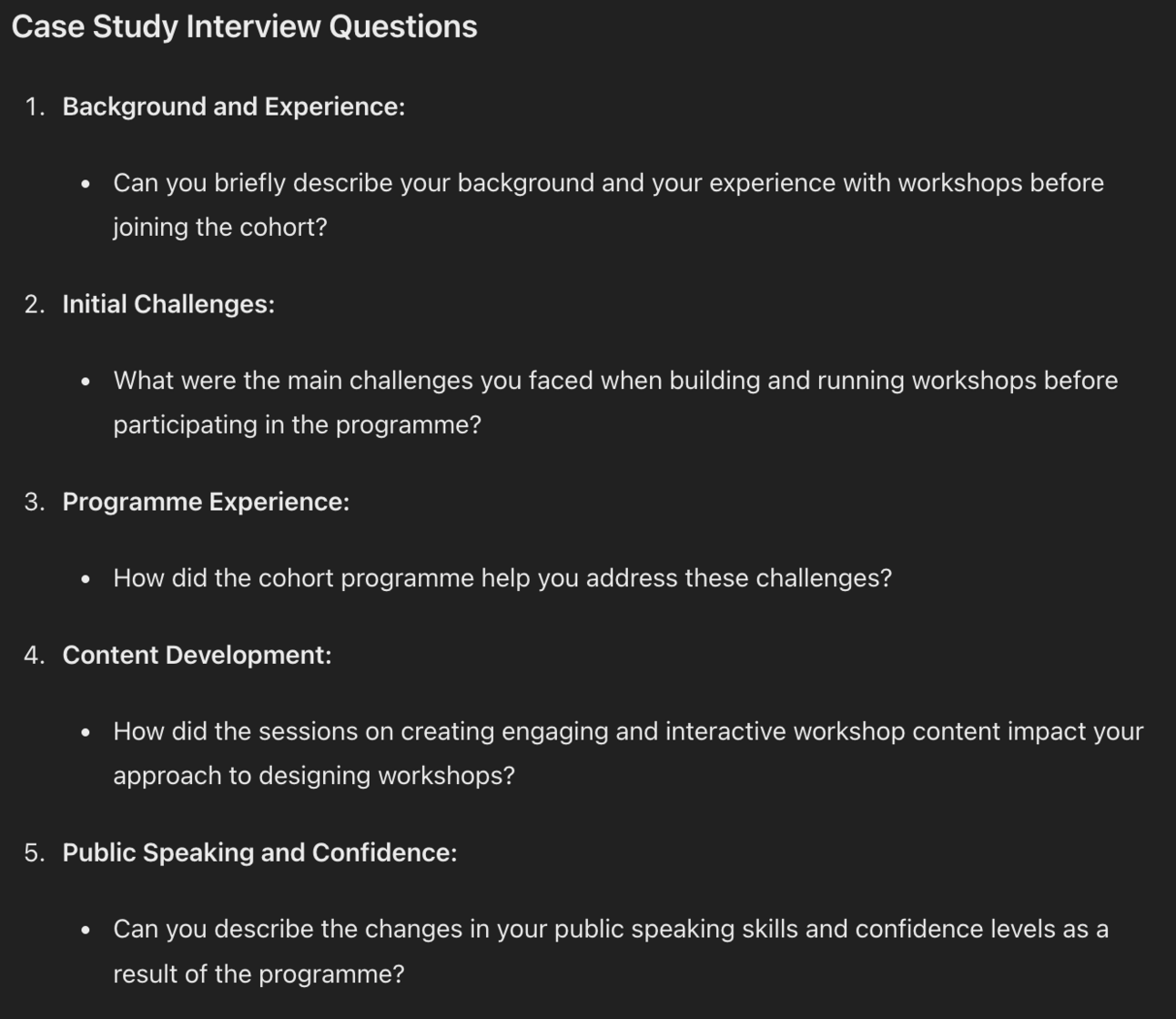
Collect up their answers via an interview or survey form. Then drop them back into ChatGPT to convert it all into a one page case study. You can straight up drop that on your website or shoot videos about it.
Want to get really fancy? Compile a handful into a small booklet and give them away as a lead magnet.
Once you’ve got social proof about the successes you just had it’s time to roll into the second cohort.
Good news; this will be easier AND more profitable. Great combination!
You’ve done the work now with your first cohort. That process helped you build the product. Running it the second time is much easier. You know the structure, you know the content, you know the blocks customers will hit.
Even though running it again is easier for you you are going to charge more.
If you charged $1500 first time then second time you are going to charge $3000.
We can do this because we now have proof. We have testimonials. We have case studies. This allows us to more confidently charge closer to the full value of the cohort.
This is aligned with the overall method. Always testing and pushing forward once we know the market will support us.
We started lower because we were building alongside our first cohort. We nailed their experience so we have proof. And then we start to increase the price each time we launch.
Once we’ve run the cohort enough times and find that the content is settling into a groove we can go ahead and solidify it into a product or course.
This is optional - but it allows you to scale outside of your time constraints. By converting into a product you can sell at anytime to any number of people. You aren’t in the cycle of launching and running cohorts.
It’s very appealing. But make sure to run enough cohorts to genuinely perfect the material! Don’t automate before it’s ready.
Because as soon as you solidify into a product the material becomes immutable. You lose the flexibility of creating live on the fly with your customers. So it had better be damn good before it’s made static.
One alternative is to sell both life cohorts and fixed product versions.
This is a best of both worlds. You can have (for example) quarterly cohorts set at a high price ($3k++ depending on niche) as well as an evergreen product version.
The main difference is access to you and your team. That comes in the live version with live calls, Q&As and other hands on help. Whilst the fixed product version is just the material.
Whether you decide to continue running high ticket cohorts or prefer to solidify into a lower cost product is up to you and your wider business plans.
Either way we’ve got to this point by steadily testing and verifying each step. At no point have we taken a leap of faith and just hoped there’s a market.
We’ve tested the offer idea, waitlist, first cohort sales and even each session’s content. Step by step building with our customers. Never assuming what they want but actually testing and building exactly that.
If you’ve been struggling to launch this is the perfect way to finally get your online business rocking and rolling.
Again, thank you to George Ten for the tweet that inspired this guide. Make sure to give him a follow over on Twitter!
Keep prompting,
Kyle
Unlock the secrets to a successful launch without the typical hurdles of lengthy product development and aggressive sales tactics. The 🧪 Cohort Momentum Method | AI Business Playbook is your essential guide to leveraging the power of cohort-based learning and real-time feedback to create a product that resonates with your audience. This playbook is designed to help you transform your ideas into viable offerings, ensuring that you not only launch successfully but also build a thriving business around your expertise.
This playbook is specifically designed for aspiring entrepreneurs and business professionals who are eager to launch their first product or service but feel overwhelmed by the traditional launch process. If you struggle with understanding your audience's needs, fear failure, or lack a clear strategy for monetization, this playbook is perfect for you. It empowers you to test your ideas quickly, learn from real customer feedback, and build a product that truly meets market demands.
No! This playbook provides strategies that work even if you're starting from scratch, guiding you on how to engage potential customers and validate your ideas.
The playbook emphasizes quick iterations and testing your ideas, so you can start seeing results in a matter of days, rather than months.
The playbook focuses on learning from failures. Each attempt provides valuable insights that will refine your approach and improve future launches.
Yes, while the methods are particularly effective for online courses and workshops, the principles can be applied to various product and service launches.
Absolutely! You'll learn how to gather testimonials and create case studies that will enhance your marketing efforts and attract more customers.