AI Knowledge
Dive into the essential questions surrounding Artificial Intelligence with our comprehensive playbook, '❔Big Questions in AI.' This resource is designed to empower you with the knowledge and confidence to tackle the most pressing inquiries that arise in discussions about AI.
Start ReadingEvery time I go an give workshops or talks about AI the same 4-5 questions from the audience pop up again and again. Again.
The first time they come up I have to think on my feet and hope for the best. But after answer the same question 10 times? Easy.
If you are venturing into the world of AI building or becoming an authority in your industry on the use of AI you will get these kind of questions. Whether its from clients or audiences doesn’t really matter- you need to have answers at your fingertips.
This is what separates the casual AI enthusiast from the genuine AI expert. When you position yourself as an authority on AI in your field, these big, thorny questions will come your way—often in public, high-pressure settings where your response can make or break your credibility.
In this Playbook we're tackling the five most common "curveball" questions you'll face as an AI expert.
Having fielded these questions countless times on stage, in workshops, and during consulting engagements, I'm sharing my approach to each—along with alternative perspectives you might consider.
I am not the be all and end all of this! Far from it! I’m probably very wrong ha!
BUT I want to i) surface the questions that get asked ii) give you my answers and iii) help you start to formulate your own.
So that when the question is asked (and it will be!) you’ll be ready to wow the asker.
Let’s get started:
Why "Will AI take our jobs?" is the #1 question you'll face
Three competing perspectives on AI and employment
Why job erosion rather than job replacement is the real concern
The generational impact: who will be affected and when
A concise, memorable position you can adapt to your own expertise
"Will AI take our jobs?" isn't just a common question—it's practically inevitable. In my experience, if this doesn't come up during a formal Q&A, it will emerge during breaks, in private conversations, or in follow-up emails. And it makes perfect sense: people's livelihoods and professional identities are at stake.
It won’t necessarily be asked in such a blunt way. Often there are layers - people will ask about automation, hiring practices or job progression. But the underlying root cause is the same: is my job safe??
Let's look at three distinct positions you might take:
The optimistic view holds that, like previous technological revolutions, AI will ultimately create more opportunities than it displaces. Proponents point to history: the industrial revolution, computerisation, and the internet all sparked initial fear but ultimately expanded the job market.
In this view, while certain roles will disappear, entirely new categories of jobs will emerge—AI trainers, AI ethics specialists, prompt engineers, and countless roles we can't yet imagine. The key is adaptation and re-skilling.
I personally don’t believe in this. AI is different because whereas other technologies augmented human skill and intelligence AI can (potentially) wholesale replace it. It can also self improve which no other technology is human history has been able to do.
It’s new territory so applying existing historical paradigms is…risky!
The flip side alarmist perspective suggests we're facing something fundamentally different from previous technological shifts. Because AI can potentially automate both physical AND cognitive tasks, it threatens a much broader swath of employment—even knowledge work that previously seemed immune to automation.
This view suggests massive displacement across industries, with only a small fraction of new AI-related jobs created to replace those lost. The result: widespread unemployment and profound economic disruption.
I think that this is closer to the long-term truth. We’ll need to find different ways to organise our economies. Remember that modern capitalism is only actually 400-500 years old. Seems like a long time absolutely but it’s a small blip in terms of human history and even in terms of civilisation.
In the West we assume it’s the primary way to organise societies economically (and indeed not all humans agree with this!) but this doesn’t preclude other forms. Something will have to shift - it’s just very difficult to predict what!
My position takes a more nuanced middle path. I’m focusing on the short and medium term where we can predict with a (little!) more accuracy. Trying to prognosticate out too far is a fool’s errand so instead let’s keep it focused.
I believe the primary impact won't be sudden job displacement but a gradual erosion of job creation, particularly at entry levels, which will ultimately transform organisational structures.
Less utopian, less apocalyptic. Let me outline my basic argument.
I used to repeat the common refrain: "AI won't take your job, but someone using AI will take your job." I've come to believe this is overly simplistic. That was 2024 - old school!
The reality is (I think!) more subtle and, in many ways, more concerning. Rather than directly eliminating existing positions, AI is more likely to slow or stop the creation of new jobs—particularly at the entry-level. This has profound implications for organisational structures and career pathways.
Consider fields like law, accounting, or business analytics. The most algorithmic, routine work tends to happen at the early career stages. It’s how new hires cut their teeth. They aren’t given responsibility right out of the gate but instead go through the basic grunt work first.
These roles—law clerks doing document review, junior accountants processing transactions, analysts creating standard reports—are precisely where AI excels. Ruh roh shaggy.
As these tools become more sophisticated, organisations will need fewer entry-level staff. We're already seeing the beginnings of this with hiring freezes and reduced head-counts in sectors with robust AI adoption.
If you're currently established in your career, especially at mid or senior levels, you're likely relatively safe in the short term. You’ve put in your years and secured your position. Your role probably involves complex judgment, interpersonal skills, and institutional knowledge that AI can't easily replicate. Yet.
But here's where the secondary effects become important—and these are harder for many to grasp.
Most organisations are structured like pyramids, with more people at the bottom than the top. If we reduce the base of that pyramid through AI automation, there are downstream consequences for the entire structure. With fewer junior staff to manage, organisations need fewer managers. With fewer managers, they need fewer directors and executives. You get the picture.
This is similar to what happens with an aging population in countries like Japan. You are probably more familiar with this particular Jenga tower:
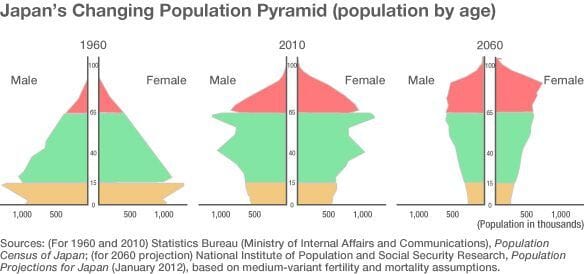
I think we’ll see something similar with AI’s effects on work. Over time—we're talking years or even decades—the combination of fewer entry-level positions and improved AI capabilities will likely transform many traditional career ladders and organisational structures entirely.
The timeline and impact vary significantly depending on your career stage:
If you're established in your career: The immediate effects will likely be minimal. Organisations and regulatory frameworks move slowly, and skills like judgment, creativity, and interpersonal dynamics remain challenging for AI to replicate. Is your industry unionised? Likely effects will be even slower. Your job may evolve to incorporate AI tools, but wholesale replacement is unlikely in the near term. If retirement is within sight, you can likely navigate to the finish line. Congrats you, dodging bullets like Neo.
If you aren’t entering the workforce for another ~10 years: If you are still at school then you are equally lucky. The world has time to adapt to this new technology. You'll be stepping into a transformed landscape. The advantage is that you'll enter knowing the new rules of the game, without having to unlearn old patterns.
If you're in the "messy middle" (finishing up university / early career): You are in your early 20s and (sorry!) facing the most challenging transition. You may graduate into an environment where traditional entry-level positions have significantly diminished. At the same time new roles haven’t yet opened up because older institutions are working out how to deal with this whole “AI thing”. This group will need to be particularly adaptive and entrepreneurial - you can’t wait for the world to sort itself out for you. You need to get on with taking control yourself.
For everyone, regardless of career stage, I believe developing alternative income streams and entrepreneurial skills is increasingly essential. This isn't just about financial safety nets—it's about developing the adaptability and self-direction that will be increasingly valuable in whatever economic reality we find ourselves in.
One of the most profound ironies of the AI revolution is that while it may reduce traditional employment opportunities, it simultaneously makes entrepreneurship more accessible than ever.
When I launched my first business, I had to handle everything myself: building products, writing marketing copy, designing websites, providing customer service—the full spectrum. While it was educational, it was extraordinarily difficult to build a sustainable income this way. It took a decade plus realistically to start making good money. That’s too long and I wouldn’t recommend it to my worst enemy!
That’s changing now.
asks that once required teams of specialists—coding, design, content creation, marketing, customer support—can now be accomplished or augmented through AI tools by individuals or small teams. The barriers to entry for starting a business have never been lower.
I’m writing this in a Vietnamese coffee shop right now whilst in another window Cursor chugs away building an SEO optimised website for me. As someone who started building businesses in the “before times” believe me : this is special.
Today's entrepreneurs (read: you) can leverage AI to handle or augment many startup tasks. In fact, this is precisely why I've focused my work on AI entrepreneurship—to help people harness these tools to create sustainable, independent income streams regardless of what happens to traditional employment models.
OK so here’s a quick roundup of the basic thrust. So that when asked a question about job security you have a framework to answer with:
If AI excels at automating routine, algorithmic tasks concentrated at entry-level positions,
Then job creation at these levels will gradually erode rather than existing jobs suddenly disappearing.
If entry-level positions diminish over time,
Then organisational structures will transform from the bottom up, like removing lower blocks from a tower.
If organisational structures fundamentally change,
Then the impact varies by career stage: minimal for established careers, challenging for early careers, transformative for new entrants.
However the same AI making traditional employment uncertain also makes entrepreneurship more accessible than ever.
Remember, this is just one perspective! And I’m not particularly smart!
With AI's rapid development, no one can predict the future with certainty. Anyone who says they can is B.S.ing. The purpose of this argument is to give you a nudge to prepare your own answer to this question.
In fact - if you have an answer shoot a video, post it to TikTok and tag me in and I’ll see it.
Next we’ll tackle a philosophical curveball: "Is AI really intelligent, or just mimicry?" This question tests your understanding of both technical capabilities and the nature of intelligence itself. It’s a doozy.
Keep Prompting,
Kyle
"My AI chatbot seems to understand me better than my spouse does," a client recently told me.
Half-joking I think…
"So is it actually... intelligent? Or is it just really good at faking it?"
As we interact with systems that can write poetry, solve complex problems, and engage in what feel like meaningful conversations, the line between simulation and genuine intelligence begins to blur. Increasingly so as the models get more sophisticated.
When Claude or ChatGPT responds with apparent empathy or insight, are we experiencing something truly comparable to human intelligence, or simply an elaborate illusion created by pattern matching?
Let’s get started:
AI intelligence vs. mimicry
Three distinct perspectives on machine intelligence
Why token prediction creates the appearance of understanding
The emergent properties of scale in large language models
How our definition of intelligence keeps shifting
A practical framework for discussing AI capabilities with clients
The question of whether AI is "truly intelligent" or merely mimicking intelligence has been debated since the very beginning of the field.
Turing sketched out the first “computer” (as we would understand it) to solve a mathematical problem and shortly afterwards speculated whether these machines could ever be intelligent.
Smart guy. Scary smart.
Whether AI is “intelligent” touches on fundamental questions about consciousness, understanding, and what it means to think—questions that have honestly occupied philosophers for millennia and remain (largely) unresolved.
When fielding this question, there are several distinct perspectives you could take:
Some argue that AI systems like large language models demonstrate genuine intelligence, just of a different kind than human intelligence. These systems can reason through complex problems, identify patterns humans might miss, and generate novel solutions.
In this view, we should broaden our concept of intelligence beyond human cognition. Stop being so anthropocentric - as we are wont to be! Intelligence should be defined functionally—by what a system can accomplish—rather than by how it accomplishes it or whether it has subjective experiences.
The opposing view holds that current AI systems are essentially sophisticated pattern-matching machines with no actual understanding of the content they process. In this perspective, what looks like intelligence is actually just statistical correlation at massive scale.
Which…kinda makes sense considering how LLMs work. They are mass probability engines.
Proponents of this view often cite the Chinese Room thought experiment proposed by philosopher John Searle: a person who doesn't understand Chinese follows instructions to manipulate Chinese symbols, producing appropriate responses without comprehension. The system as a whole appears to understand Chinese, but no actual “understanding” exists anywhere within it. The system is pure mimicry.
My position is more pragmatic. Surprise surprise!
The question itself might be less important than we think. Or even meaningless. Current AI systems are neither conscious minds nor simple mechanical calculators—they occupy a new and interesting space that challenges our existing categories.
At their core, large language models like GPT-4 or Claude are token prediction engines. When you input text, the model predicts what tokens (roughly, pieces of words) are most likely to follow based on patterns it observed in its training data.
This is fundamentally different from how humans think. These systems don't have intentions, beliefs, or desires. They don't "know" what words mean in the way we do—with connections to lived experience, emotions, and physical sensations. They're processing statistical patterns, not meaning as humans understand it.
However, this doesn't mean these systems are simple or unimpressive. The scale at which they operate leads to emergent properties that weren't explicitly programmed.
Just as complex behaviours can emerge in natural systems (like how individual ant behaviours create sophisticated colony structures or a flock of starlings forms a murmuration), complex capabilities emerge from these massive statistical models that weren't directly encoded.
Hell, life itself and evolution thereafter led to complex outcomes from simple mechanical processes. Given enough scale (be it geological time or immense data sets and compute) some pretty wild things emerge unbidden.
It's also important to recognise that LLMs represent just one approach to AI—albeit the dominant one at this moment. We’ve had many types before which is why knowing the history is helpful!
We’ll also have many types hereafter. The field continues to evolve, and future breakthroughs may come from entirely different architectures or approaches. Many experts believe that truly intelligent systems will ultimately require different approaches or hybrid methods that go beyond the statistical prediction paradigm. We’ll see!
From emergence come behaviour that seem very “intelligent”. And it keeps happening again and again in the world of AI.
But we humans keep shifting back the goal posts. We’ll declare something like “computers are great at calculations sure but they’ll never beat a grandmaster chess player”. We set arbitrary boundaries for what is human intelligence. Which then get demolished.
Consider this pattern:
1997: "Chess requires unique human intelligence"... until Deep Blue beat Kasparov.
2016: "OK has a finite move set so of course a computer could brute force it. But Go is too intuitive for computers"... until AlphaGo beat Lee Sedol.
2020: “OK but that’s just games in a controlled environment. AI can’t deal with real world tasks like driving which require real-world perception and split-second judgment”… until Waymo launched driverless taxis in Phoenix.
2023: “Driving is mainly mechanical. AI can’t handle complex reasoning or professional tasks”… until GPT-4 started passing bar exams, acing medical boards, and writing better code than junior devs.
This perfectly illustrates what comedian Louis C.K. observed in his famous bit about "Everything is amazing and nobody's happy." He describes being on a plane with Wi-Fi: "I'm watching YouTube clips. It's amazing. I'm on an airplane! And then it breaks down. And they apologise, the Internet's not working. And the guy next to me goes, 'This is bullshit!" His response captures our relationship with technology perfectly: "How quickly the world owes him something he knew existed only 10 seconds ago?"
This one sentence sums up humanity’s reaction to AI. How quick we feel we are owed these superpowers!
We've become so accustomed to technological advances that even the most extraordinary achievements—like passing the Turing test—are quickly taken for granted.
Whenever AI masters a skill previously thought to require human intelligence, we tend to say, "Well, that's not really intelligence." The goal posts for what constitutes "real intelligence" keep moving.
The REAL problem here is that we, as humans, don’t even have an agreed upon definition of “intelligence”.
We do not know fully what’s going on in that squishy mass of tissue inside our skulls. How is it possible of such wondrous things? How does a lumpy collection of cells firing electric signals create the Mona Lisa?
We don’t really know.
So how on earth could we have a definition of what the artificial version looks like?
Alan Turing anticipated this philosophical quagmire before AI actually existed.
Again, smart lad.
Rather than getting bogged down in definitions of "intelligence," he proposed the Imitation Game (now known as the Turing Test) in 1950 as a practical approach.
The test focuses on functionality rather than internal mechanisms: if a machine can consistently fool humans into thinking it's human through conversation, does it matter if its internal processes differ from human cognition?
Turing wasn't concerned with whether machines were "truly thinking" in the human sense. Because, duh, we don’t know what truly thinking is in a human.
Turing was instead interested in whether they could produce outputs indistinguishable from human outputs—a much more practical question.
Fun fact: in early 2025, researchers from UC San Diego conducted a proper Turing test with GPT-4.5. When prompted to adopt a humanlike persona, GPT-4.5 was judged to be human 73% of the time—significantly more often than the real human participants. After 75 years, the Turing test was finally passed.
And the public reaction? A collective shrug.
We moved the goalposts. Yet again!
So how should you respond when clients or audiences ask whether AI is "really intelligent"?
I find it most useful to reframe the question entirely.
Rather than diving into philosophical waters about the nature of consciousness or understanding, focus on what these systems can and cannot do, how they differ from human intelligence, and what that means for practical applications.
What matters isn't whether these systems "think" in the human sense, but how they can complement human thinking, what new capabilities they enable, and what risks or limitations we need to be aware of.
The history of technology shows that the most transformative tools aren't those that perfectly replicate human abilities, but those that extend them in new directions.
The calculator doesn't think like a mathematician, but it dramatically enhances our mathematical capabilities
Engines do not replicate our muscular movements but they make physical labour much easier.
Similarly, AI systems don't need to replicate human cognition to be revolutionary.
When addressing whether AI is truly intelligent or merely mimicking intelligence:
If intelligence is defined by observable capabilities and outputs rather than internal processes or consciousness,
Then the distinction between "real" intelligence and "simulated" intelligence becomes largely philosophical rather than practical.
If large language models are fundamentally prediction engines working with statistical patterns,
Then they lack human-like understanding but can still produce results that require intelligence when humans perform them.
If history shows we continually redefine intelligence once machines master previously "intelligent" tasks,
Then focusing on specific capabilities and limitations is more productive than debating whether AI is "really" intelligent.
Again, this is just one perspective—as AI continues to evolve, our understanding of intelligence itself may transform. It will be argued about by philosophers, cognitive scientists and AI researchers. Fantastic! Let them get to it.
But for the rest of us - the only practical answer here is functional. What can AI do and what can’t it do? How can we use this technology to improve our lives? Focusing here will be far more rewarding.
Tomorrow, we'll tackle another common challenge: "Is AI Overhyped or Truly Transformative?" This question tests your ability to navigate between techno-optimism and realistic assessment of AI's current capabilities and limitations. I'll share how to provide a balanced perspective that acknowledges both the revolutionary potential and the very real constraints of today's AI technologies.
Keep Prompting,
Kyle
I was recently in Beijing and my Mandarin reached its limits during a conversation with a local nainai (grandmother).
She was insistent about recommending her favourite dumpling shop, gesturing enthusiastically while I smiled and nodded, catching maybe every third word. The Beijing dialect is tricky sometimes! Legit sound like Pirates (love it).
Then she did something that stopped me in my tracks. She pulled out her phone typed something out in Chinese to DeepSeek, and within seconds, showed me her screen—her recommendation perfectly translated into English, complete with the shop's address and specialties.
This wasn't a tech enthusiast showing off the latest gadget. This was a Beijing grandmother in a local hutong using AI as naturally as she'd use WeChat to message her family.
This is different.
Let’s get started:
Why the AI hype vs. reality question reveals deeper truths about technological change
Three contrasting perspectives on AI's transformative potential
Comparing AI to previous tech bubbles and breakthroughs
The concept of "capability overhang" and general-purpose technologies
A framework for discussing AI's impact that avoids both cynicism and utopianism
"So, honest opinion—is AI actually transformative, or are we just in another hype cycle?"
This question comes in various forms, but the underlying concern is always the same: Are we witnessing a genuine technological revolution, or just the latest in a long line of overpromised tech trends?
In the business world in particular this is a pointed question. It boils down to “do we need to spend money on this or is this all junk hype?”
Your answer to this question can significantly impact how seriously people take your expertise. Too cynical, and you risk looking like you're missing the biggest technological shift of our generation. Too optimistic, and you might come across as just another hype merchant.
The cynical view sees AI as the latest in a series of overhyped technologies. It’s an easy argument to make if we point to recent history:
“Remember blockchain? The Internet of Things? Crypto? NFTs? The metaverse? Each was supposed to revolutionise everything, and where are they now? AI is just the newest shiny object for venture capitalists and tech companies desperate to pump their valuations.”
In this view, companies are slapping "AI" (and now "agentic" in 2025, lol) onto everything to attract investment, just as they added ".com" to their names in 1999 or "web3 blockchain" in 2017. The bubble will burst, leaving behind failed startups and wasted investments.
At the opposite extreme, the sci-fi utopian view declares that we're witnessing the dawn of a new era in human existence:
"The singularity isn't coming - it's here. Within years, AI will surpass human intelligence in every domain. We'll cure cancer, fix climate change, upload our consciousness to the cloud, merge with machines, and transcend our biological limitations. Every problem will be solved by super intelligent AI systems."
All hail our new AI overlords!
This perspective sees current AI capabilities as just the beginning of an exponential curve that will rapidly transform humanity beyond recognition.
My view occupies a more nuanced middle ground. Seeing a pattern here? Boring aren’t I?
I believe AI represents a genuinely transformative technology akin to the internet, but many current applications are indeed overhyped.
To understand AI's potential impact, I find it helpful to draw parallels with the internet revolution.
I recently completed a three-hour motorbike trip to My Son, the ancient Champa temples in Vietnam. The journey took me over rice fields, across no-car bridges, and through remote countryside. This trip would have been absolutely impossible without the internet—GPS navigation, translation apps, booking platforms, payment systems, weather updates, and the ability to research the destination beforehand.
The internet has become so pervasive that we barely notice how it underpins nearly every aspect of modern life. We don’t even think about it - unless it goes down! 😅
AI is heading down a similar path. It’s on par with the internet in terms of importance.
But transformative technologies can be both revolutionary and overhyped simultaneously. Huh?
Remember the dotcom boom of the late 1990s? Maybe not - probably younger than me!
Companies basically slapped ".com" to their names and watched their valuations soar. Pets.com became the poster child for excess—spending millions on Super Bowl ads and a Macy’s parade balloon to sell pet food online before spectacularly imploding.
The bubble burst in 2000, wiping out hundreds of companies and trillions in market value. Critics declared the internet overhyped.
Yet what emerged from the ashes? Google. Amazon. eBay. PayPal. The infrastructure and innovations of the dotcom era laid the foundation for companies that would fundamentally reshape commerce, information access, and communication.
From the debris rose the modern internet. Kinda a big deal.
We're seeing the same pattern with AI. Yes, there's tremendous hype. Yes, many current applications are gimmicky or poorly thought out. Yes, companies are adding "AI" to their pitch decks without meaningful integration.
There will probably be a correction. Maybe a violent one. It’ll be messy and people will decry AI as trash.
But underneath all that froth lies genuinely transformative technology.
I don’t (personally) believe the same can be said of Web3, blockchain, crypto, the metaverse, internet of things etc. They are solutions in search of a problem, fascinating technologies used mainly in SF and environs. Whereas modern AI immediately took hold across broad swathes of the public, young and old.
Ethan Mollick, a professor at Wharton, introduced a concept that perfectly captures our current moment: the "capability overhang."
Even if we stopped all AI development today - no new models, no improvements, no breakthroughs- it would take years for humanity to fully explore and implement all the capabilities that current AI systems already possess.
(God that sounds nice. I’d be able to relax and take a properly holiday too…)
Right now we're like someone who just got their first smartphone and is still using it primarily to make calls, unaware of the thousands of other capabilities waiting to be discovered.
This is because AI belongs to a rare category: general purpose technologies (confusingly the acronym for this is GPTs…). These are innovations that don't just solve specific problems but enable entirely new categories of solutions.
Historical examples include:
The steam engine
Electricity
The microchip
The computer
The internet
We could probably chuck in fire and the wheel too.
You may have heard of some of these…they are pretty important.
Each of these technologies took decades or even centuries to reach their full impact. They started with simple applications, went through periods of hype and disappointment, but ultimately transformed society in ways their inventors couldn't have imagined.
This is one of my favourite related images from the year 2000:

That internet? Bit rubbish! It’ll never catch on!
Modern AI shows all the hallmarks of a General Purpose Technology. It's not just a tool for specific tasks—it's a platform upon which countless other innovations can be built.
And right now we’re scratching the surface.
We're in the "digital sandbox" phase of AI—similar to the early days of the internet when people were building wild, experimental geocities websites with flashing text and auto-playing MIDI files and animated backgrounds.
(FYI the 1996 Space Jam (Come on and slam, and welcome to the jam) website is still up and available here https://www.spacejam.com/1996/)
Current AI applications often feel like toys. Chat interfaces, image generators, simple automations. We're playing, experimenting, figuring out what's possible.
A lot of the time they are pick up and play then quickly discarded. “Oh that was cool” followed by never using again.
In 20 years, we'll look back at ChatGPT the way we now view early Flash websites or the sound of a dial-up modem—charming artefacts from a more primitive time. We’ll probably smile at how simple we were back then - much as we would about playing Snake on a Nokia 3210.
But just as those early web experiments led to today's sophisticated digital ecosystem, our current AI "toys" are laying the groundwork for profound transformations in how we work, learn, create, and solve problems. It’s just we’re in the midst of it and it’s hard to see.
When addressing whether AI is overhyped or transformative:
If AI adoption patterns mirror the internet (with normal people using it for everyday tasks),
Then we're witnessing a genuinely transformative technology rather than a niche trend.
If previous tech bubbles (dotcom, crypto, metaverse) show that hype and transformation can coexist,
Then current AI hype doesn't negate its revolutionary potential.
If AI demonstrates characteristics of a general purpose technology,
Then its full impact will unfold over decades, not months.
If we're experiencing a "capability overhang" where current AI abilities exceed our implementation capacity,
Then focusing on practical applications rather than speculative futures provides the most value.
Therefore AI is both overhyped in specific applications AND genuinely transformative as an underlying technology—requiring a nuanced perspective that acknowledges both realities.
This is my perspective—adapt it to your industry and experiences as always! And disagree with me! The key though is helping people see beyond both the hype and the cynicism.
Tomorrow, we'll tackle a question that's becoming increasingly urgent: "What about AI's environmental impact?"
As AI capabilities grow, so do concerns about energy consumption, water usage, and carbon footprints. Big issues that need proper consideration.
Keep Prompting,
Kyle
The environmental impact question always comes up. And I mean always. Whether it's during a keynote, in client meetings, or casual conversations about AI, it never fails.
Once I'd barely finished my talk when a hand shot up: "But what about all the water AI uses? I read that each ChatGPT query guzzles a whole bottle of water!"
I had seen then shaking their head and squinting at me the whole talk so knew something was coming!
The room nodded knowingly. This tidbit had clearly made the rounds—another AI horror story to add to the collection. I took a deep breath, knowing I was about to burst a rather popular bubble.
"Actually," I said, "the water story is mostly a red herring. The real environmental challenge with AI is electricity, not water. And even that needs context."
The puzzled looks told me this was going to be one of those conversations. Perfect. This is exactly the kind of nuanced discussion we need to have about AI's environmental impact.
Let’s get started:
The "bottle of water per query" claim
The real issue: electricity consumption
How AI's energy use compares to other industries and everyday activities
Industry responses including nuclear power and efficiency improvements
Practical steps businesses can take to minimise their AI environmental footprint
When it comes to AI's environmental impact, I typically encounter three distinct perspectives:
The environmentally alarmed view sees AI as an ecological disaster in the making:
"Every ChatGPT query consumes a bottle of water! Data centres will soon use as much electricity as entire countries! We're facing a climate emergency—we can't afford this frivolous technology burning through resources just so people can generate cat memes and crappy poetry."
This perspective often cites dramatic statistics about water usage and exponential growth in energy consumption, painting AI as an unsustainable luxury we can't afford in a warming world.
At the opposite extreme, the techno-optimist view dismisses environmental worries entirely:
"AI efficiency improves faster than consumption grows. Besides, AI will solve far more environmental problems than it creates—from optimising power grids to accelerating renewable energy research. Market forces ensure efficiency improvements happen automatically."
This camp sees environmental concerns as either exaggerated or soon to be solved by the very technology being criticised.
Basically we’ll be able to outrun the problems we create using the very same AI. A very common human point of view! We’ll fix it later don’t worry!
My position occupies a more nuanced middle ground.
AI's environmental impact is real and growing, but it needs to be understood accurately and in context. We have to look at the actual facts and figures (gross!) rather than just our opinions and what we want to be true.
First let’s tackle that water bottle claim head-on. It gets in the way of actually discussing the issue. The idea that each ChatGPT query uses a bottle of water has become viral, but it fundamentally misunderstands how modern data centre cooling works.
When training models a lot of GPUs are used. And they get hot. Real hot.
To keep them running efficiently they need to be cooled down. Cold water is used to do so.
Yes, some older data centres use evaporative cooling, where water evaporates to remove heat. But the industry is rapidly shifting to closed-loop systems where water circulates without evaporation. It basically is cooled, run through the servers to cool off the GPUs and the warm/hot water returned to a reservoir to be cooled.
Microsoft for example announced that all new data centre designs from August 2024 will use zero-water evaporation cooling technology, eliminating cooling-related water consumption entirely.
The fixation on water consumption is understandable—it's easy to visualise "a bottle of water per query." It’s dramatic. And scary sounding. But it's increasingly outdated as cooling technology evolves. The real environmental challenge lies elsewhere.
While water concerns are a bit of a red herring, electricity consumption is AI's genuine environmental challenge.
Cooling that water requires, you guessed it, electricity.
As do all the other data centre operations during training and inference.
Electricity is the problem here. Not water.
I’m going to give you current figures but I highly recommend you research these all up yourself. Not hard with Deep Research modes! These figures are always changing so being current is important.
Here’s the high level summary without getting into the weeds!
As of 2024, data centres already draw about 415 TWh of electricity a year — roughly 1.5 % of all power generated worldwide.
The IEA’s new Energy & AI report says that demand will double to around 945 TWh by 2030, a load comparable to Japan’s entire grid.
Electricity used specifically for AI‑optimised servers is expected to more than quadruple over that same period, making AI the biggest single driver of the surge.
If those projections hold, data‑centre operations could soak up close to 3 % of global electricity within five years.
It’s a lot. And it’s growing. That is undeniable.
Yes, AI is energy-intensive. But how does it compare to other activities we take for granted? This is where it gets interesting.
The problem with decrying AI’s energy usage is that we need to be aware of the larger context.
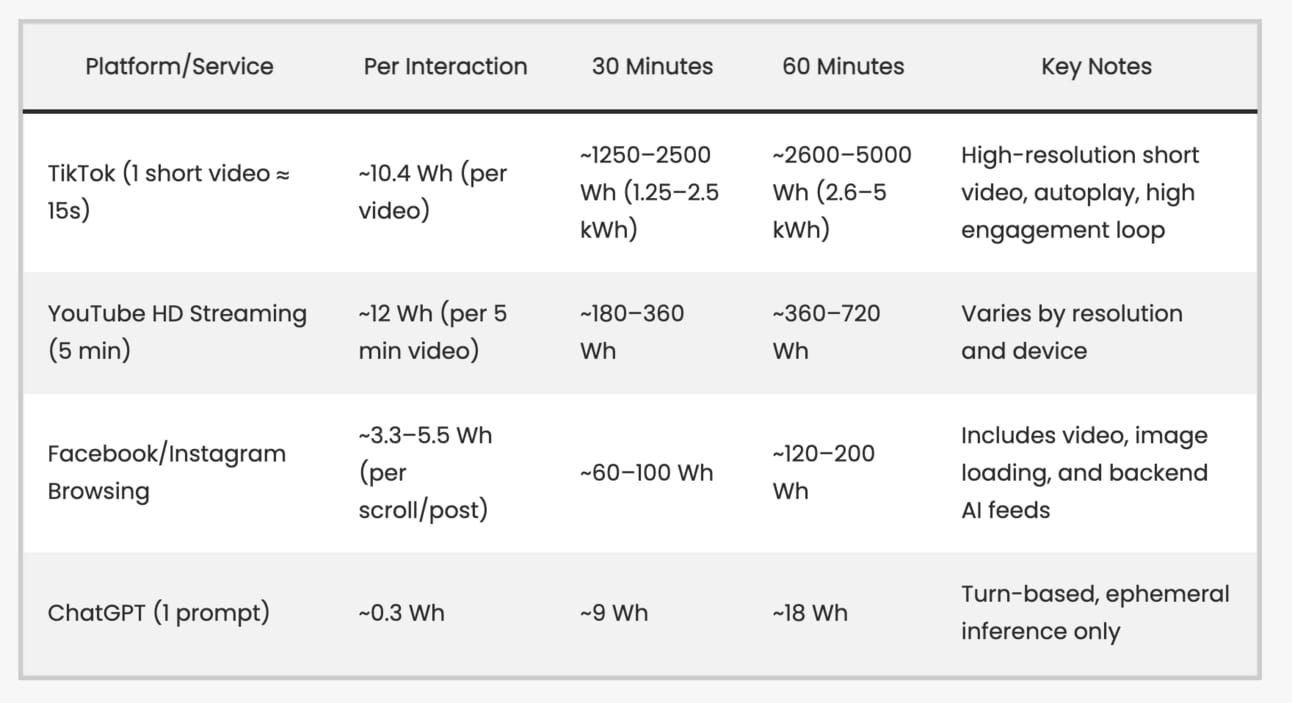
I always get comments on my TikToks and YouTube videos about AI’s energy usage so this is a good place to begin the comparison.
A single ChatGPT reply is about 0.3watt-hours.
Watching a 5 minute HD Youtube video? 12 watt-hours.
And if that video gets 10 million views? 120M watt-hours, or 400 million AI queries. Video streaming, unlike AI queries we send to ChatGPT, is massively scalable.
What about TikTok and other platforms?
My viral TikTok videos, watched by 10+ million people, have done incalculably more damage to the environment than any AI work I have done. Hell, more than the AI work I’ve inspired other people to do.
We have to be aware of all the other uses of energy. This is why when someone hyper-fixates on AI’s electricity impact it’s important to remind them of all the other uses of power they engage in everyday.
(Yes, training AI rather than inference also uses a lot of power - I’ve left this out for simplicity. But remember that producing TikTok videos, Netflix shows and the like also takes a massive amount of energy too!)
Also, here’s the biggie. Above I mentioned that data centres currently consume 1.5% of the world’s electricity, potentially doubling to 3% in 5 years?
Well…what’s that other 98.5% or 97%?
That’s manufacturing, transportation, construction, consumer electronics etc.
In fact household IT devices alone use double the electricity of data centres!
We don’t hear that much about this remaining 97% because, unlike AI, it’s not emotive.
The AI industry has also recognised electricity is a problems.
Companies like Microsoft have signed nuclear deals whilst Google is going for geothermal.
At the same time model efficiency is always improving. Basically newer models achieve better results with less energy requirements. Hardware improvements continue to reduce power per computation.
Don’t get me wrong - all of this isn’t out of the goodness of their hearts.
It’s about profit.
AI is power hungry as we have seen. So the company with the cheapest access to electricity (by, you know, building your own nuclear power stations) and the most efficient models will have the lowest costs.
Lower the electricity bill and the company profits more. These companies may wrap their initiatives up in environmental clothing but there is raw profit at the root of their decisions.
Which, for better or worse(!), is arguably is a much stronger force than their sense of responsibility. 😆
All this is well and good. But if you are discussing energy usage with an audience or client it’s even better to give them solid steps they can actually take.
Some practical steps:
1. Right-Size Your Models Don't use GPT-4o for tasks that GPT-3.5 can handle. Model selection significantly impacts energy use.
2. Optimise Token Usage Be concise with prompts and context. Every token processed consumes energy. As Sam Altman has told us - stop saying please and thank you!
3. Strategic Timing and Location
Run intensive tasks during off-peak hours when grids often have cleaner energy mix. Train models in regions with cleaner energy (France's nuclear grid is a popular choice in Europe.) Here’s a handy map to help here.
4. Choose Green Providers Select cloud providers committed to renewable energy and efficient operations.
5. Deploy Local Models When Appropriate For simple, repetitive tasks, local models can be more efficient than cloud APIs.
This is often the best way to deal with these questions at public talks - basically turn it around on them. Assume that AI is here to stay (it is) and that any company without it is in trouble (they are). And from here segue into helping them limit their impact. This brings the discussion from an emotive “AI is destroying the planet” to a productive “Here’s an actual plan”.
When addressing AI's environmental impact:
If water consumption fears are based on outdated understanding of cooling systems,
Then focusing on electricity usage provides a more accurate picture of AI's environmental impact.
If AI currently represents a tiny fraction of global energy consumption (1-3%),
Then environmental concern should be proportional, not panicked.
If AI companies have profit motives to improve efficiency (energy costs money),
Then market forces will naturally drive continued improvements in energy efficiency.
If we're concerned about AI's energy use,
Then we should apply similar scrutiny to all our digital activities—streaming, gaming, social media—not single out AI.
Therefore AI's environmental impact requires balanced attention: real concerns addressed through practical solutions, not dismissed or catastrophised.
This is my perspective— as always adapt it based on your industry context and local environmental priorities.
There are genuine concerns in play here. We just need to be sure to focus on the real issues rather than the headline de jour.
Next up we'll tackle our final curveball question: "Is AI development moving too fast?" This question touches on safety, regulation, and the tension between innovation and responsibility.
I'll share how to address concerns about AI's somewhat scary breakneck pace while acknowledging the competitive (and, gulp, geopolitical) realities driving rapid development.
Keep Prompting,
Kyle
Now, obviously, I’m a little biased. I am pro-AI as you can guess.
That said there are real concerns. We’ve covered a number in this Playbook. It’s inevitable for any technology of this import to not have negative side effects.
These very real problem areas lead some people to suggest we should slow down AI’s development.
Ultimately though, I’ll argue, this is a non-problem.
As Stephen Hawking said all the way back in 2017: “The genie is out of the bottle. We need to move forward on artificial‑intelligence development, but we also need to be mindful of its very real dangers.”
We’ve opened Pandora’s Box and there’s no way to close it now. So we had better get serious about living with the demons within.
Let’s get started:
Why "slowing down" AI is like trying to slow down the internet
The geopolitical reality: US vs China in the AI race
How competitive pressures cascade from nations to companies to individuals
The real risks: economic disruption, social deterioration, and wealth concentration
Why education and democratisation matter more than deceleration
AI is moving fast. REAL fast.
I cover it pretty much full time and I can’t keep up.
People rightfully ask me about whether this is a problem. Is the speed of change a risk?
I typically encounter three distinct viewpoints:
The safety-first view argues that we're racing toward potential catastrophe:
"We're building increasingly powerful systems we don't fully understand. Without proper safety measures and alignment research, we risk creating AI that could harm humanity—whether through accidents, misuse, or eventually systems that pursue goals misaligned with human values. We need international treaties, research moratoriums, and strict regulations before it's too late."
Sometimes this slips into the Terminator narrative. Which, with all the new robots being developed, isn’t terribly surprising.
Proponents point to nuclear weapons as a precedent—we developed international frameworks to prevent their spread. More or less…Why not do the same for potentially transformative AI?
The (Western) acceleration camp dismisses calls for caution:
"Slowing down is both impossible and counterproductive. China won't pause their AI development just because we're nervous. The benefits of AI—in medicine, science, education—are too important to delay. Plus, competition drives innovation. Artificial slowdowns would only ensure authoritarian regimes get to AGI first."
Basically full steam ahead and we’ll work it out as we go along. This view often emphasises that we can't predict risks accurately anyway, so we might as well capture the benefits while maintaining our competitive edge.
And if “we” don’t then someone else will!
In my opinion the question "Should we slow down AI development?" fundamentally misunderstands our current situation. The technological cat is already out of the bag. The knowledge exists, the papers are published, and multiple nations are racing ahead.
Debating slow down isn’t practical anymore.
Let me be blunt about something that might be unpopular: the debate about slowing down AI development is largely academic.
Various global bodies may spend the next few years discussing this stuff. And put out some very serious sounding papers at very serious conferences. Probably in Switzerland.
But…it doesn’t matter.
The fundamental technologies are already public. The research papers are published. Open-source models are freely available. The knowledge exists.
As the “Godfather of AI” Geoffrey Hinton said of open sourcing large models: “It’s too late now — the cat’s out of the bag, but it was a crazy move”. He also compared it to making nuclear material freely available. And this is one of the top AI researchers of all time!
Basically … it’s done. Fait accompli.
Asking if we should slow down AI development is like asking if we should slow down the internet in 1995. It's not that the question is wrong—it's that it misunderstands the nature of general-purpose technologies.
These technologies don't have a central off switch. Once you work out how electricity works (and tell other people) that’s it: humanity has electricity. These sort of technologies permeate everything, transform everything, and ultimately become part of everything.
You can't unring this bell. Sorry!
There are two players on the AI play board right now: the US and China.
Sorry Europe (especially Mistral!!). You’re outta here. Despite all the handwringing in EU the reality is that this has become a two-player game at the national level.
For context here I used to live in China, speak (passable!) Mandarin and studied Chinese history at Oxford. I have also lived in America for 6+ years, including getting my MBA in New York.
Oh and I’m British for those who didn’t know. Or, technically, Bri’ish, because I’m from South London…
I was in Beijing recently, browsing a local bookstore, and something struck me: the bestsellers weren't business books or self-help guides.
They were books about DeepSeek one of China's (very good!) homegrown AI systems. Not tucked away in the technology section, but prominently displayed as essential reading for everyone from students to business leaders.
These were the first books you saw when you came in. And the books at the counters. They are being pushed. HARD.
China isn't debating whether to slow down. They're accelerating AI adoption across education, business, and daily life with the intensity of a national mission. School kids are getting mandatory lessons on the use of AI.
This creates a prisoner's dilemma for the US. Even if the United States wanted to slow down AI development for safety reasons, doing so would simply cede technological leadership to China.
Any unilateral slowdown by one nation becomes a strategic advantage for the other.
That means at the top level there will not be slowdown. It’s out of the question.
This same dynamic repeats itself at every level of society:
At the Corporate Level: Imagine a bank decides to slow down its AI adoption for ethical reasons. Noble intention, I respect it. But while they're being cautious, their competitors are using AI to offer instant loan approvals, personalised financial advice, and fraud detection that actually works. Guess which bank loses market share?
Companies that hesitate don't just fall behind—they risk becoming irrelevant.
And that’s not even mentioning the new AI-first entrants who will come and eat the incumbents’ lunch.
At the Individual Level: The same pressure exists for professionals. I have colleagues who boast about not using AI tools, preferring to "do things the old-fashioned way."
That's sorta fine for now. But when their competitors are producing higher quality work in a fraction of the time, how long can that position last? Yeah…my guess is that they’ll quietly just start using AI (without the same fanfare as not using it!).
This isn't about replacing human creativity or judgment. It's about augmenting human capabilities. Those who refuse to adapt risk becoming the equivalent of accountants who insisted on using paper ledgers after spreadsheets were invented.
Or trying to do (checks notes) anything without the internet. Is it doable? Yes, absolutely! But it’s very hard to stay competitive by following such an artisanal route.
Now, am I saying we should proceed without caution? Absolutely not.
The risks are real and substantial:
Economic Disruption: We discussed earlier in this series how AI won't just take jobs—it will fundamentally restructure entire industries. We're looking at economic transformation on a scale not seen since the Industrial Revolution. Maybe more? We don’t know - this is new.
Wealth Concentration: AI development is currently controlled by a handful of massive corporations with government backing. We're watching the greatest consolidation of power and wealth in human history unfold in real time. The whole concern about the wealth gaps and 1% over the last decade may look quaint compared to what we’re about to see. Imagine what happens for the first company who hits AGI? That is what the AI companies are racing for right now. Because the power, control, wealth that will be generated from that point are unprecedented.
Social Deterioration: I've already seen concerning trends—people preferring AI companions to human relationships, skills atrophying as AI handles more cognitive tasks, attention spans shrinking as AI delivers instant answers to every question. I get several requests for sponsored posts each week from AI girlfriend companies - they have good budgets because (no surprise) people are paying for this. I politely decline.
Geopolitical Instability: AI-powered warfare could allow technologically advanced nations to project force with minimal human cost (on their side). This asymmetry could de-stabilize international relations in unprecedented ways. If I can send in drones and robots rather than my citizens (which gets me booted from office) then the calculus for warmongering changes dramatically. The barriers for entry of war decrease.
These are civilisation level challenges. Quite a few of them. All at once. We should absolutely be concerned!
But here's where my perspective might surprise you: the answer isn't to slow down. It's to speed up—but in a different direction.
Right now, AI development is concentrated among a few giant corporations and nation-states. Every breakthrough increases their power. Every advancement widens the gap between the AI-haves and AI-have-nots.
The antidote isn't deceleration—it's democratisation.
This is why I spend my time teaching entrepreneurs and small business owners how to leverage AI. Not because I think everyone needs to become a machine learning engineer, but because distributed knowledge is our best defence against concentrated power.
When millions of people understand AI, can build with AI, and can create value with AI, we create a counterbalance to corporate and state control.
Is this possible? I don’t know. It’s a big ask. But we need to at least try. We can’t just cede total control of these technologies to billionaires.
This is ultimately what I tell clients and audience members who have these concerns. Basically, it’s too late I’m afraid. So all we can do is carve out our own space in this new world.
OK! We covered some big topic in this Playbook.
Let's recap the journey we've taken:
Part 1: "Will AI Take Our Jobs?" - We explored how AI will transform employment through gradual erosion rather than sudden replacement, particularly affecting entry-level positions.
Part 2: "Is AI Really Intelligent or Just Mimicry?" - We tackled the philosophical debate about machine consciousness, concluding that the practical capabilities matter more than abstract definitions of intelligence.
Part 3: "Is AI Overhyped or Truly Transformative?" - We examined how AI can be both overhyped in specific applications and genuinely transformative as a general-purpose technology, much like the internet revolution.
Part 4: "What About AI's Environmental Impact?" - We addressed environmental concerns, finding that while energy consumption is real, it needs context alongside other digital activities and ongoing efficiency improvements.
Part 5: "Should We Slow Down AI Development?" - Today we've confronted the governance challenge, recognising that the path forward lies in democratisation and education rather than futile attempts at deceleration.
As AI experts, consultants, and educators, our role isn't just to understand these issues but to help others navigate them thoughtfully.
This is (I hope) what I’ve been able to do for you with this Playbook.
You of course don’t need to agree with me. In fact I’d be surprised if you did! Instead the purpose of this series was to give you starting off points to think about these topics and articulate your own arguments. If they are completely counter to mine then all the better!
Keep Prompting,
Kyle
Dive into the essential questions surrounding Artificial Intelligence with our comprehensive playbook, '❔Big Questions in AI.' This resource is designed to empower you with the knowledge and confidence to tackle the most pressing inquiries that arise in discussions about AI. Whether you're leading workshops, consulting clients, or simply seeking to deepen your understanding, this playbook offers insights and strategies that will help you position yourself as a credible authority in the rapidly evolving AI landscape. By engaging with the content, you'll not only prepare for challenging conversations about AI but also enhance your ability to influence and educate others effectively.
This playbook is tailored for professionals, educators, and entrepreneurs who are navigating the complex world of AI. If you find yourself frequently bombarded with questions about AI's implications for jobs, ethics, and the economy, this resource is perfect for you. It addresses the challenges faced by those looking to share informed insights while fostering discussions that matter. By engaging with this playbook, you'll gain the tools necessary to transform those daunting questions into opportunities for meaningful dialogue and understanding.
No prior knowledge of AI is required, but a basic understanding of technology concepts will enhance your experience.
The playbook is designed to be digestible in segments, with an estimated completion time of 5-7 hours, depending on your pace.
Absolutely! The insights provided are practical and applicable, equipping you with the skills to handle real-world discussions and challenges surrounding AI.
Yes! The content is structured to help you confidently convey key messages and engage your audience effectively.
That's encouraged! The playbook aims to stimulate critical thinking and discussion, allowing you to form and express your own viewpoints.