
AI Business
Welcome to the '💚 Authentic Selling | AI Business Playbook', your ultimate guide to transforming your relationship with sales.
Start ReadingThis week I’m covering the idea of authentic selling.
This has been the fix to my own fear of selling.
Which has just allowed us to have a 6 figure launch last week.
I’ll walk through the essential psychological ground work required for this to happen.
We’ll cover:
Part 1: Fear of selling
Part 2: Bulletproof Offer
Part 3: Overcoming our own blocks
Part 4: Planned surprises
Part 5: They win, we win
Let’s get started:
Fear of Selling
disconnect of value and offer
creative entrepreneurs must sell
sell your own value, not someone else’s
overcoming blocks to open the floodgates
I used to hate selling.
I would avoid it as much as humanly possible.
And when forced to actually sell I’d often end up vastly undercharging.
This stemmed from a sense of embarrassment or even guilt that I was “inconveniencing” the other person by daring to ask for money.
Part of this is probably my Britishness. We tend to be squeamish around money.
But the biggest factor was that I didn’t fully believe in what I was selling.
I didn’t believe in its value. I didn’t believe that it would make the customers’ lives better.
As you can imagine this made running a business a lot harder than it already was!
Does this sound familiar to you?
Have you ever dreaded telling someone about your offer for the fear of seeming pushy?
It happens to a lot of us entrepreneurs - especially creatives who want to focus on building rather than the sales aspect.
Many many entrepreneurs hate sales. Which is why it’s often a role that is outsourced or hired for early.
But you, as the creative core of the business, need to also be its greatest advocate.
Are you out there telling 10 people a day about what you do and how you can help? 100? 1000?
Or, like many businesses, are you waiting for people just to stumble across you?
A lot of hesitancy here comes from the fact that you may not be 110% certain of the value of what you offer.
When you have this level of certainty you actively want to go out and make sure everyone knows about your offer. Because you know it will make their life better. More than simply not being embarrassed to sell you embrace it.

Lots of people start their first business by selling someone else’s stuff.
I’m talking:
affiliate marketing
dropshipping
fulfilled by Amazon
TikTok shop
multi-level marketing
and so on…
The problem with these sort of businesses is that often you as the seller don’t really believe that the core product is valuable.
You don’t have any control of the product itself - it’s not yours. You are distribution, not the creator. You don’t control its value (beyond choosing what products to promote).
You’re selling it for purely financial reasons, not with the intention of helping your customer and making their life better.
No shade. If you are happy with this all power to you!
But I’d ask you to imagine being able to fully control the value of the offer. And how it would feel to bring the same energy you bring to selling other people’s products to your own offer - an offer you have carefully constructed to ensure it’s hyper-valuable for customers.
Hint: it feels damn good.
In the last year I’ve built up Prompt Entrepreneur from zero. We’re about to have our first birthday actually.
For the first time I’m truly proud of what I produce.
I know my social content is valuable. I know the newsletter is valuable. I know the courses are valuable. I know everything we put out is genuinely helping people. Because I see it in use and hear stories from those we help.
This is a massive shift from the past, the situation described above when I wasn’t 110% certain in the value of what I did.
Last week we had our largest launch ever - we hit 6 figures.
And I’m delighted about that because I know the value we are going to deliver to the customers will vastly outstrip what they’ve paid.
This is a gamechanger because of the simplicity and ease it adds to the sales process. When you are confident in the massive value you’ll provide it’s easy to makes sales. It unlocks the “salesperson” in you.
Over this coming week I’m covering how to get to this position.
Where your faith in the offer is so ironclad that any sales hesitation you might have evaporates.
I’ll be showing you:
how to craft an offer that truly changes your customers’ lives
how we shift from “always be closing” to “always be helping”
how to prove to yourself the massive value of the offer
fixing our psychological blocks to money
planning in over-delivery and “wows” to surprise customers
using results based selling to grow
This has been a journey for me over the last decade.
One that I’m hoping to make shorter and less painful than mine has been!
If you are subscribed to the Premium newsletter I’ll see you tomorrow.
Keep prompting,
Kyle
It goes without saying that first and foremost your offer need to be amazing.
But me just telling you that isn’t enough. What is an amazing offer? How do we make sure we’re not just kidding ourselves? Is there a right way to build the offer?
Let’s look at how we ensure our offer is killer.
Let’s get started:
Bullet Proof Offer
what makes an offer valuable?
what you think doesn’t matter
content → lead magnet → offer
cohort and services ftw
first pass will not be good therefore iterate
First we start with value creation.
Most of my Playbooks and teaching work starts at this level - creating a valuable offer first and foremost.
The BATON teaching framework I use is:
Business
Audience
Tribe
Offer
Network
The offer and value to the market is the first thing to be locked down - in the Business step.
Here’s the skinny:
A business exists to provide value to its customers
Value comes from solving their problems
Your products and services are solutions. The more valuable your solution to customers the higher the price you can command.
The key is thus knowing what your customers’ problems are and then building amazing solutions (packaged as your products and services).
As Zig Ziglar says: “You can have everything in life you want, if you will just help other people get what they want."
We start with helping them out. The rest deals with itself.
Notice I’ve made no reference to your business ideas.
Your ideas have very little to do with the value you end up providing.
Because ultimately what you think your customers’ problems are doesn’t matter.
Only your customers can tell you their problems. But so many entrepreneurs and business owners believe they know best.
We tend to over inflate the importance of our ideas and how much they’ll change our customers’ lives…
…and then we get annoyed when our customers don’t “get it”.
…when they don’t understand how amazing what we’ve built is. They must be stupid right?
No. Generally when this happens it’s because we didn’t actually build our product with any reference to what our customers actually want.
Basically: what we think doesn’t matter. We know nothing.
Only how our customers—the market—reacts is important.
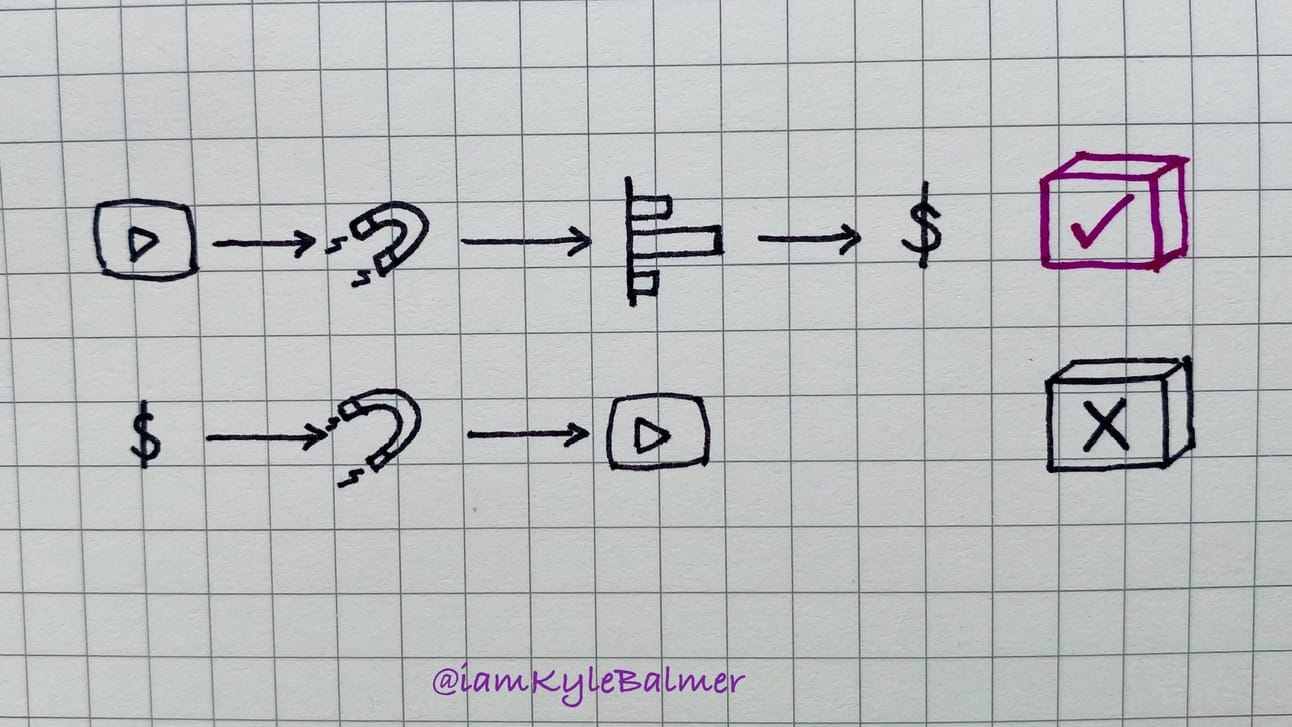
Here are a few techniques, in order, to ensure we start building based on what our customers actually want.
Produce content about our topic area. What content resonates most with your audience? If people aren’t interested in your free content they sure as heck aren’t going to be interested in paid versions. When you find content that resonates follow that thread. Create more along the same theme and then…
…create a lead magnet based on your top content. Use this to test whether people will give you their contact information based on the value of the information you provide. This is the next step up from consuming your free content but still doesn’t require a monetary exchange.
Based on the most successful content and lead magnets build a shortlist of related problems that you could solve for your audiences. Then poll your audience about which is the most of interest to them - get them to actively vote and collect as much information as possible.
Create a basic offer that addresses their top problem.
For your first offer I strongly recommend against building a product right off the bat.
Yes, products are amazing for scaling. You build them once and can basically set and forget. The dream!
But they are terrible for learning. And that’s what we need to do right now. We’re in learning mode remember. We’re not assuming we know what our customers need.
For this reason I’d recommend the following formats in order of preference:
cohort, group coaching or some similar “build alongside customers” format
a service
finally, a product
Running some sort of group live coaching session or cohort gives you the best opportunity to listen and learn. I’ve written a Playbook about the exact method here: Cohort launch.
Providing a service also gives you this opportunity just at lower scale than a group. You’ll be working closer with customers and so will get more in-depth information but you’ll be able to work alongside less people which will limit the scope. Ideally you want to be talking to lots of individuals.
Your goal at this point is to solve the customers problems. Do whatever it takes. For however long it takes. This is the learning phase and you need to master providing value to your customers.
Worry less about your bottom line and more about learning at this point. In fact if you are new to the niche and don’t yet have a track record you could even offer this first group cohort for free or a nominal cost. This is an amazing way to start to build up a name in a niche.
Here’s a prompt to pull all this together:
Act as a business strategist.

Your goal is to develop a lead magnet and a potential cohort-based program or service offer that directly addresses a problem your audience is facing. Follow these steps:

1. Ask me for details about my audience and specific problem or pain point that my target audience is struggling with.
2. Suggest related lead magnets that could be used to collect contact information of potential customers.
3. Brainstorm potential cohort-based programs or service offers that could directly solve the problem.

Outline the key components, structure, and potential pricing for your cohort or service offer, keeping in mind the value you'll provide by solving my audience's problem
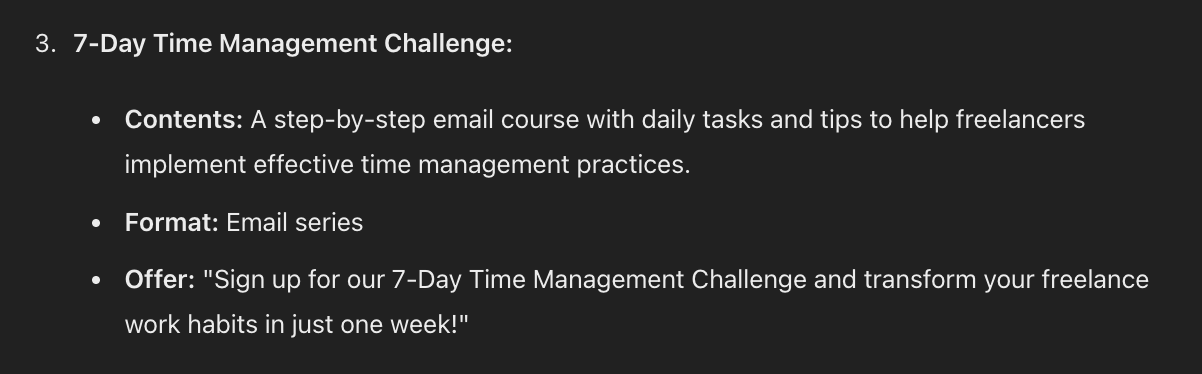
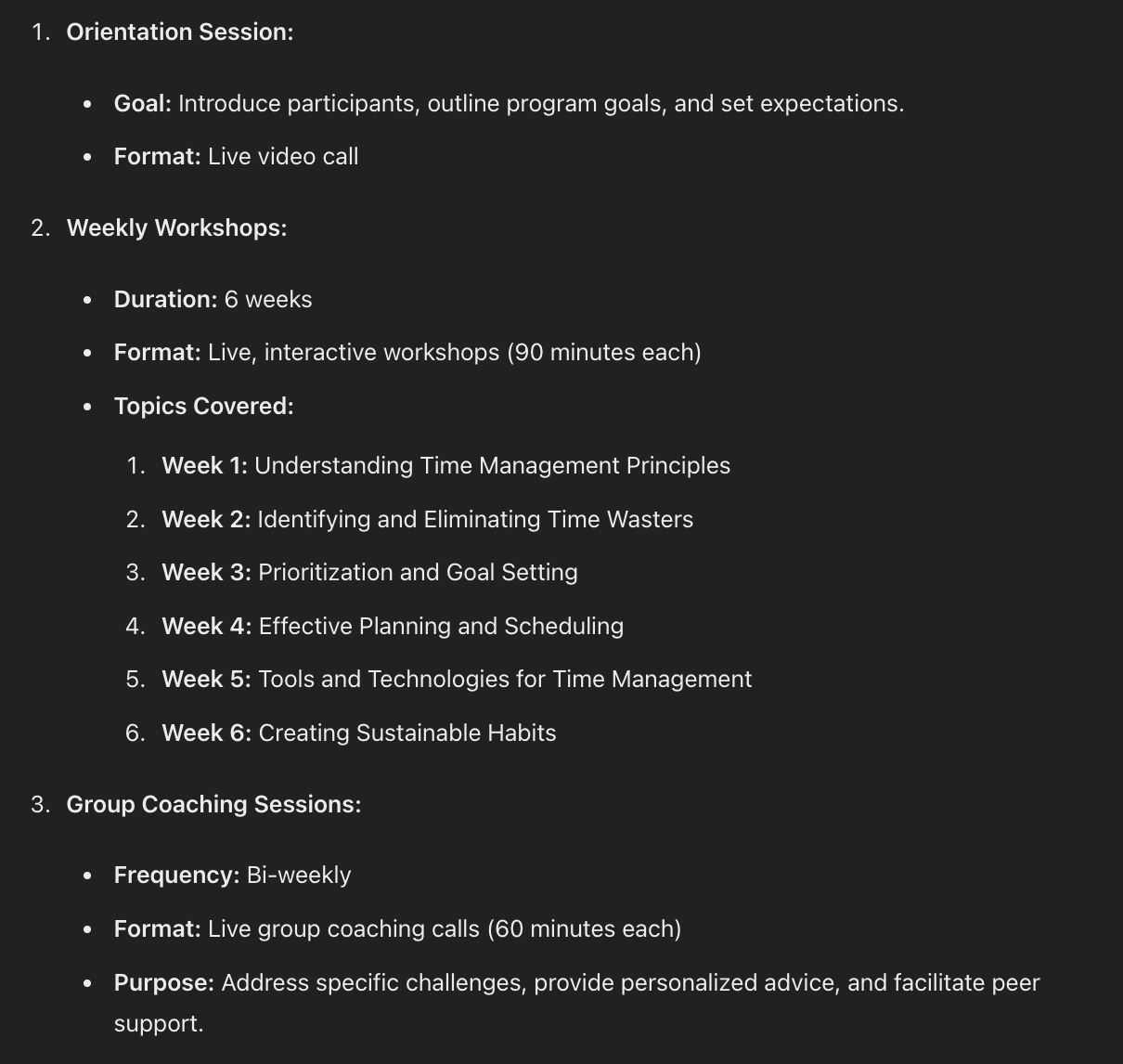
When I plug in “freelancers struggling to manage time” as my audience and their core problem I get a list of lead magnet and first offer results, all aligned along the stated problem.
For example a 7 day Time Management email course as a lead magnet:
Which rolls into a 6 week cohort including:
Use the prompt to start thinking about how you too can build to validate your customer problems.
Often your first idea will be rubbish. Nothing against you personally! That’s just the way these things shake out.
This means not getting attached to ONE idea and trying fruitlessly to make it work for years. I see far too many people fall int this trap.
If it’s not working you need to pivot the idea or scrap it and start fresh. Don’t be afraid to kill your darlings.
Here’s the good news - each time you go back to the market with your new idea or iteration you know a little bit more than last time. Chances are you also have a bigger audience to talk to as well.
Yes it can feel a bit like Groundhog Day…but remember that after enough repetitions Bill Murray basically became godlike.
Each loop means learning and growth. Your job is to i) have as many loops as possible and ii) make sure you learn each time!
Your “failures” will do better each and every time. Your personal criteria for what a success is will increase.
Importantly you’ll get better and better at solving customer problems. Because you’ve been practicing! You’ll be honing in on what exactly you bring to the market that customers will bite your hand off for.
Keep prompting,
Kyle
Psychological blocks come in all shapes and sizes.
The brain is, after all, complex!
I’ve personally had to deal with a whole bunch of mental blocks over the years. Honestly though I think it’s part and parcel of being an entrepreneur. When you work for yourself you have to deal with yourself on a daily basis!
I’m in no way a qualified psychologist or therapist (that would be quite the twist eh?) but I can at least speak to my own experiences and offer some thoughts to assist anyone who recognises similar blocks.
Let’s get started:
Overcoming our own blocks
your money blocks
don’t compare to where others are now
confidence from coherence
collect positive proof
First up, dealing with beliefs about money is a foundational layer.
Personally, I grew up in a middle-class single-mum home. Certainly not the poorest (thanks to mum being a superstar) but certainly not the wealthiest.
I went to state (ie. free) school in London - private education wasn’t on the table. But then I went on to Oxford University because one teacher at my school happened to have gone there and encouraged a few of us to apply.
At Oxford I was suddenly surrounded by rich people. Very rich people. In fact I married one - my ex-wife is a billionaire. That’s a story for another time though!
Basically though I’ve always had whiplash when it comes to money. Being dragged back and forth from not much to a lot and back again. It does a number on you let me tell you.
From this I know I have certain beliefs around money: tendencies towards resentment, ascetic tastes, rejection of materialism, inability to buy stuff for myself etc.
I’m not going to unpack them all because this isn’t my personal diary! But I’ve sat down and worked them out and actively worked (and work!) on them.
All of us have pre-conceived beliefs and bias around money. Even you saying “I don’t have any beliefs around money” is a belief I’m afraid!
I’m not here to judge. But it is important to at least know what your beliefs are and if there are any that you might want to modify.
A great place to start is the book Psychology of Money by Morgan Housel. It’s basically a set of stories outlining different beliefs and bias, presented in a way so that you can recognise yourself in the stories.
I’ve also built you a coaching prompt to help you kick off the exploration process:
Help me to uncover any potential psychological blocks I have around money. Ask me 10 questions, one at a time, awaiting my response for each before asking the next.

At the end give me an assessment of areas where I may be experiencing blocks. Name them if they are known phenomenon. Point me in the direction of resources, actions and exercises that could assist with breaking the blocks
Like all coaching prompts the more information you give the better the results you’ll receive. It’s a guided process to help make the unconscious conscious.
Even if you have your personal money beliefs on lock, being an entrepreneur can be challenging.
We have the tendency to always be comparing ourselves with others in business. And lo and behold wouldn’t you know everyone else is doing so much better! Always the way isn’t?
Learning from people who are ahead of us is a super powerful method - this is why I love X/Twitter. I can see people building their businesses in real time, sharing what works and what did not. That’s hyper-valuable.
To guard against comparison (or even envy) it’s important to realise that a lot of these creators and builders have been doing this for a long time.
The “overnight successes” you see on social media have been years in the making.
A really useful exercise is to go and look at the first things these people posted. At the beginning of their grind. Don’t look at where they are now. Look at where they started.
Gary Vee is always great for this. He dominates social media in the marketing space. And his videos nowadays are high quality and high volume.
But go back and look at his first videos. They look like they were recorded on a potato. They are overlong and circuitous. If they popped up on your feed now you’d likely swipe away immediately. Sorry Gary!
But then Gary Vee spent the next decade plus plugging away. Always improving, always refining. That’s what you are seeing when you watch a video now - a decade plus of improvement.
This is a far healthier comparison point. Seeing early work and thinking “huh, I can do that". Not looking at the end result now and thinking “I’ll never catch up”.
Also, be sure to follow business owners who are honest! Ones who talk about failures and struggles as well as wins. Off the top of my head Marc Lou, Tibo and Nico are great examples here. Stop following hyped up “$10,000/month on autopilot” trash. Regulate your information diet!
I’ve found that the quickest way to deal with confidence issues is to be yourself.
Confidence issues occur when there’s a disconnect between how you portray yourself externally and how you perceive yourself internally.
When these images mismatch we have a crisis of confidence.
So - if your public persona matches your private persona confidence becomes a lot easier. You don’t need to “pretend” anything.
For instance in these newsletters I’m not pretending for a moment I’m the expert of everything. God forbid. I’m not smart enough for that! That would be exhausting!
What I am is a good researcher, experimenter and documenter. I’m always learning, testing and applying new strategies.
And when one works I write about it. Not as a master but instead because it worked for me and because I’m able to break it down in a way that makes it more universal for others.
One great method to work on this is by building in public. Going onto social and documenting every step of your journey.
You don’t pretend to be what you’re not. You simply document each step of the journey as you grow.
Build in Public is a great community because you get i) mutual support from others whilst ii) not trying to be something you are not. You can gain supporters and fans for your work regardless of where you are in your journey.
The final level here is uncertainty about the value of your offer.
This is what we’re working on all week. But I want to give an additional micro-tactic here.
As the good reviews, testimonials and emails come in…print them out. You know, using that old defunct printer hiding under your desk.
Stick them on a wall or in a binder where you can quickly access them.
Failing that take photos and chuck them in a screenshot folder. Whatever works.
On a regular basis review them all. Read through them. See what people are saying about you positively.
Eventually the sheer volume will overwhelm you.
If you think your offer sucks but 1000 people have gone out of their way to tell you it rocks then…maybe they are right and you are wrong? Maybe…and this sounds wild…maybe it’s actually good?
Use overwhelming positive proof to overwhelm any hangups you have by sheer force.
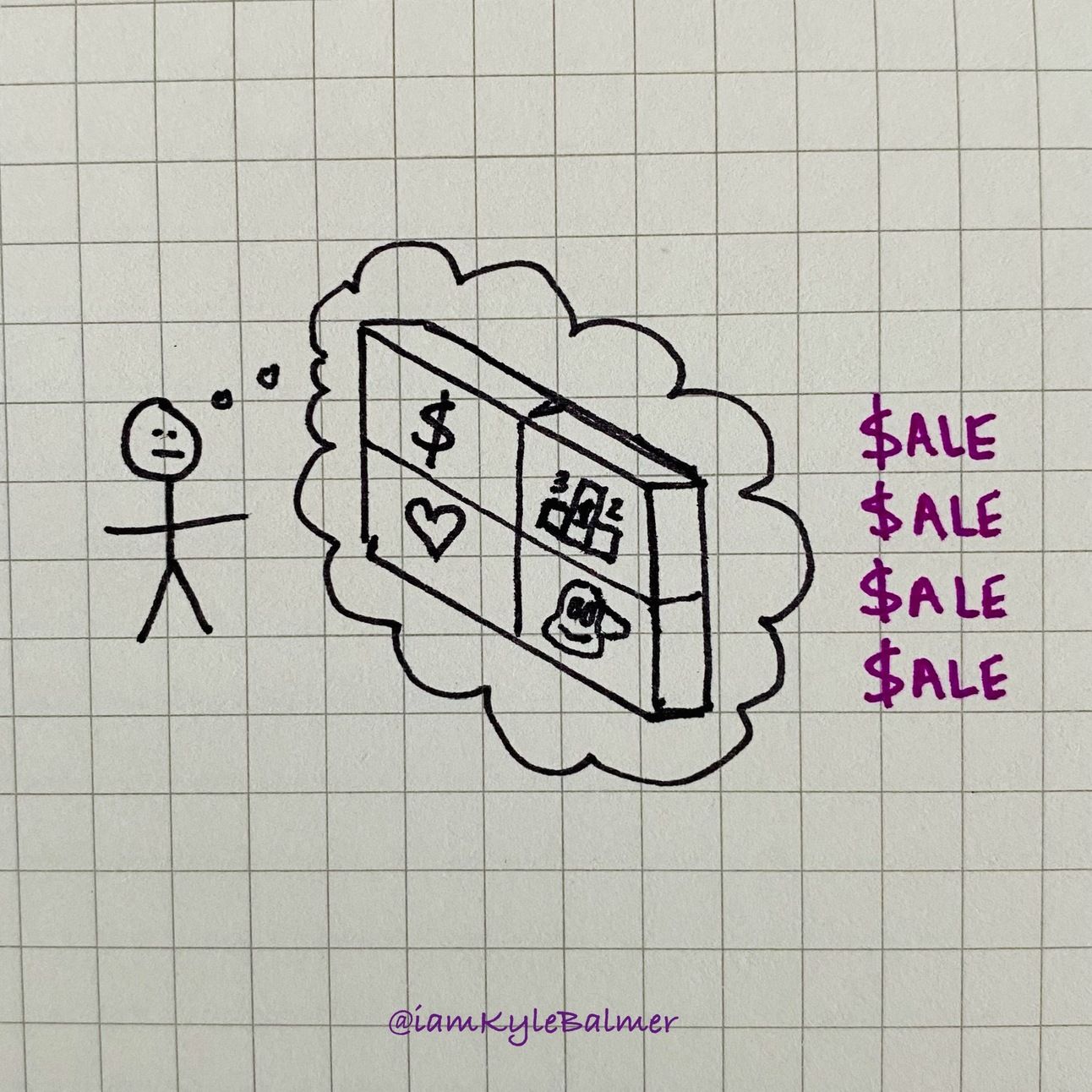
Don’t expect to read this and immediately overcome your:
money biases
business confidence issues
uncertainty about value of offer
This will be a process. Proper deep internal work.
But use what we’ve covered in this Part to at least recognise these tendencies in yourself so you can direct the work.
Keep prompting,
Kyle
You’ve decided your offer. You’ve got your first customers in.
Job done? Nope- now you over-deliver!
Let’s get started:
Planned Surprises
what is over-delivery
don’t just add more
planned over-delivery
unplanned over-delivery
Christmas or Hannukah
When you make a sale your customer will have expectations of the value they will receive.
These expectations will be set by your offer descriptions, sales pages and marketing copy. You’ve told them what they are buying and they made their purchase expecting what you’ve promised.
First up: deliver what you promised!
Sounds simple but it’s crucial. Keep a checklist of everything promised and damn well make sure it’s delivered! Don’t leave out anything.
But we don’t stop there. That’s the bare minimum. But we want our customers to not only be happy with their purchase. We want them to be ecstatic.
We do this by overdelivering. We aim to surprise and delight.
Your surprises should not just be more.
I’ve been guilty of this many times. When in doubt I just add MORE.
More newsletter, more videos, more courses.
The problem here is that by adding more you are asking more of your customer.
Just chucking in a free eBook isn’t necessarily a good surprise. That’s extra work for your customers- “you sold me a video course and now you want me to read this extra 200 page book?? Ugggh”
Instead surprises should make your customers’ life easier.
They’ve purchased your offer because they want a certain outcome. It’s a solution to a problem they have. For the over-delivery to be valuable it should either make the outcome:
more achievable
cheaper
faster
We don’t do that by giving people more homework!
Let’s now look at two types of surprises - planned and unplanned.
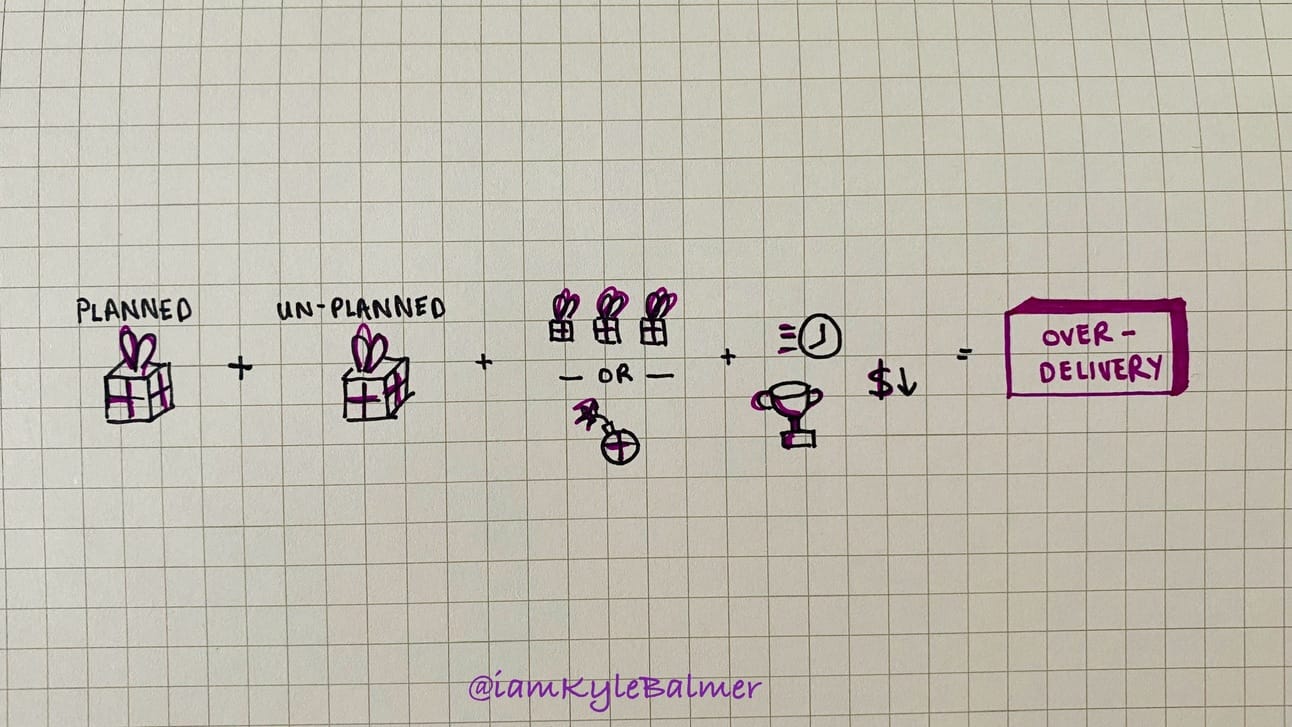
These are surprises for our customers. But not for us. We’re going to plan them in upfront.
One way to do this is in pre-production when first putting your offer together.
As you construct the offer you could choose to hold a few elements back. You just don’t mention them in your marketing. But when customers receive the product - boom! - they get the extra bonuses.
You are providing exactly the same thing as before. You just didn’t mention one element and now deliver it by surprise. No additional work needed. Easy-peasy.
Second is to add to your existing offer. Look at at your offer and think of additional bonuses to release after purchase.
Here’s a prompt to get thinking:
Act as an offer strategist.
My offer is a [product/service/productised service/course etc.]
It contains [list offer details]

Help me brainstorm additional overdelivery items for my offer.

These items should
-compliment the existing offer by making it easier/faster/cheaper/more likely to achieve the desired outcome
- not require additional work/time from the customer
If I run my Forge offer through this prompt I get suggestions. Here are the first:
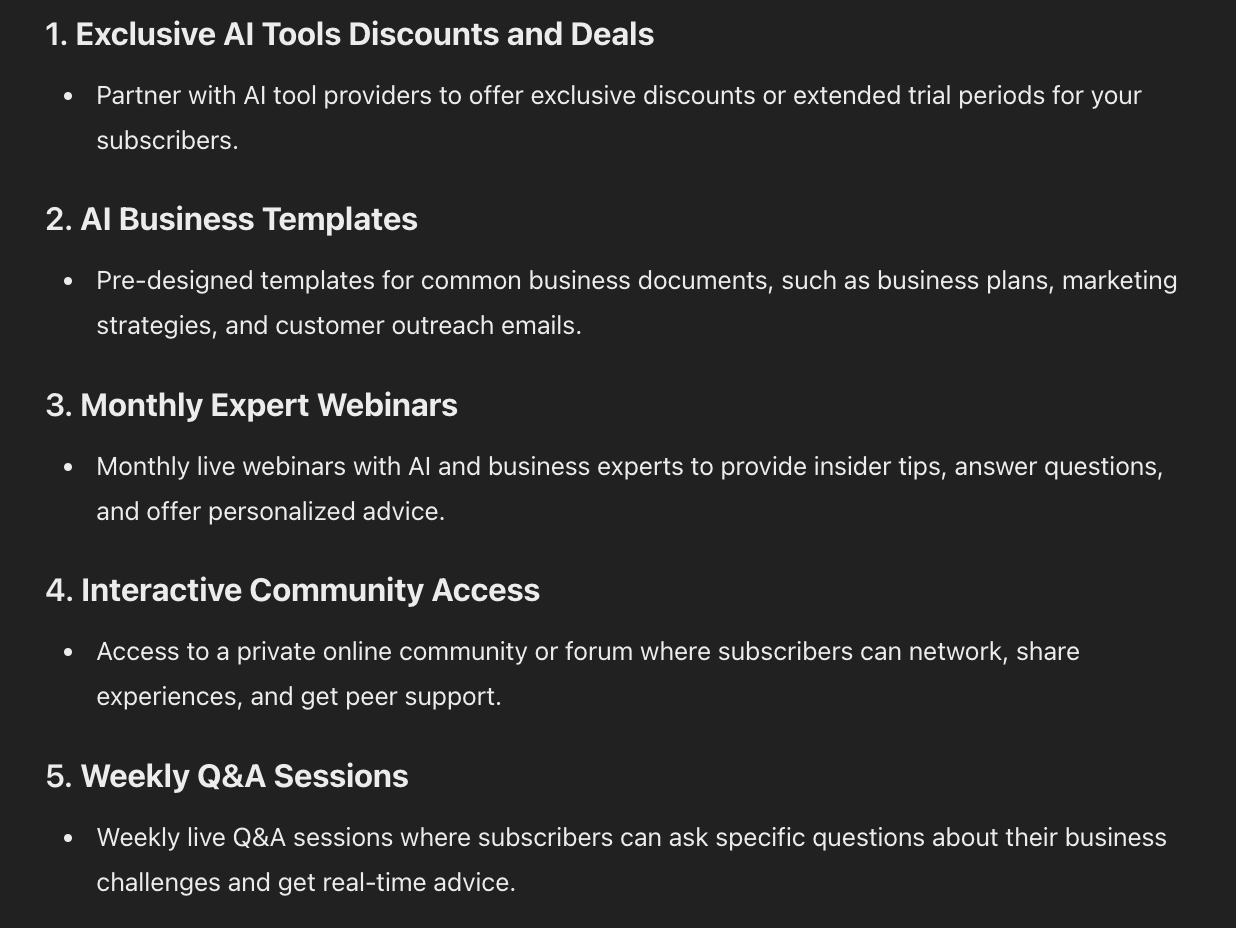
Use this to come up with potentials to add to your offer a ways to massively overdeliver.
As well as planned surprises you can also listen to customers. This can lead to unplanned surprises. Stuff you didn’t know would be valuable but later add in
This is why group teaching and cohorts is a great way to initially launch. Because you get real time feedback.
Sometimes they’ll straight up ask you if you can add something or if there’s an existing resource. If there isn’t - make it!
Other times you’ll need to listen and read between the lines. Pay attention to what they are saying. For example if someone mention they love the resource database you gave them but wish it was in Google Sheets not Excel…easy. Spin up a Google Sheet version. Job done.
If you are running an early version of your offer keep adding whatever your customer say would be useful.
It seems like a lot of work now. And it is. But anything you add now is inside your offer from this point onwards, either as part of the core offer or as a bonus surprise.
Two options here - Christmas or Hannukah.
If we follow the Christmas model we overdeliver all at once in a frenzy of giving. We slam them with over-delivery, aiming for shock and awe.
This might be an email after their purchase with “by the way you also get all this”. Or maybe as soon as they access their purchase they see all the presents.
This works well if you aren’t expecting them to continuously be interacting with your offer. Hit them with everything fast.
It doesn’t work so well if you have huge amounts of presents. The individual value of each will be lost in the sheer volume.
The other model is Hannukah. We spread the present giving out over a period of time.
Each day or every couple of days we drop some new bomb of value.
This works great on cohorts, group coaching and any form of continuity offer.
It’s also better if you have a lot of over-delivery items. You can space it out and constantly be surprising and delighting.
Finally, it works best with unplanned surprises because it lets you drop them when ready.
Overall this is my preferred play but consider your offer individually to decide what fits better.
In the next Part we’ll look at securing customer wins. Not just for them (which we should!) but for our plans too.
Keep prompting,
Kyle
Let’s wrap up by talking about how we ensure our customers get their outcomes and how we leverage that to build our business even more.
We’ll win together.
Let’s get started:
They win, we win
work with them until it’s done
gather overwhelming evidence
their wins are your wins
scale with proven value
For the first launch of your offer you want to make sure everyone gets their desired outcome.
It doesn’t matter how much you need to drag them, kicking and screaming, to the outcome. You do the work to get it done.
We do this by continuing to overdeliver, continuing to mould our offer, adding what’s required until we get them to their end result.
Outcome is weight loss via your nutritional plans? Stick with them until that last pound is gone.
Outcome is setting up an online business? Be with them until they are cash-flowing.
Is this more work for you? Absolutely.
But it’s all learning for you. And you’ll build all the extra work into your offer.
Then when you launch again it’s all built in. It’s already done. You cement all that “extra” work into the product/service and learn how to best get them the outcome.
It’s insufficient for us to know we can provide an outcome. We need proof.
Once you’ve got your first customers to their desired outcome we collect evidence.
Evidence comes in the form of case studies, reviews and testimonials.
I’ve written a whole Playbook about this, available here.
Generally though use a tool like Senja (this is what we use) to make collection frictionless.
And time your asks just after big wins for your customers. They just hit their goal? Celebrate with them and ask if they’d shoot a quick video for you on their win.
All of this evidence becomes integral as you scale your offer.
Fortunately for me (!) just hours before writing this I got a wonderful live example of this in action. I was going to pull some older examples but this one is fresh! Let’s work through it as it’s instructive.
I launched my AI Workshop Kit on Monday. On Monday my students/customers received the material to go and teach workshops around the world.
On Wednesday, just two days later, one student gave his first workshop and landed his first $2000 client:
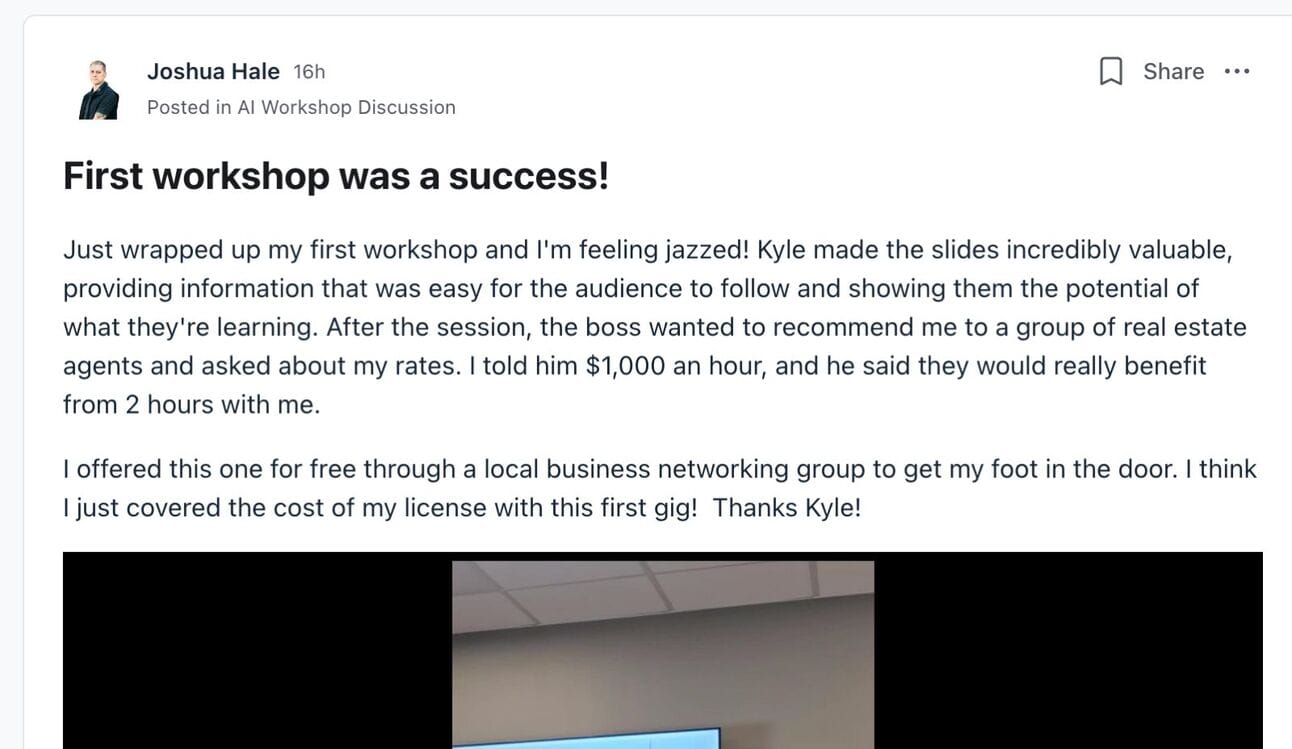
Absolutely amazing result from someone who just went for it and achieved the outcome in short order.
From that workshop he’s also been introduced to other businesses owners and I wouldn’t be surprised if this ends up netting him many more thousands in the next couple of weeks.
As soon as we saw this message we asked Joshua if we could talk about his win. And then spun up social posts like this one:
@iamkylebalmer Massive shout out to Joshua who in 3 days secured first paying client. Crazy action taking. On Monday in launched a cohort where i licens... See more
This is a post celebrating Joshua’s win. Easy to do because I’m genuinely ecstatic.
This has a couple of effect.
First up it gets the word out about what Joshua is doing. You can tag in your customers and their wins on social to give them a shout out. When your customers win you win.
At the same time it’s social proof for my business. Immediately there are comments like this:
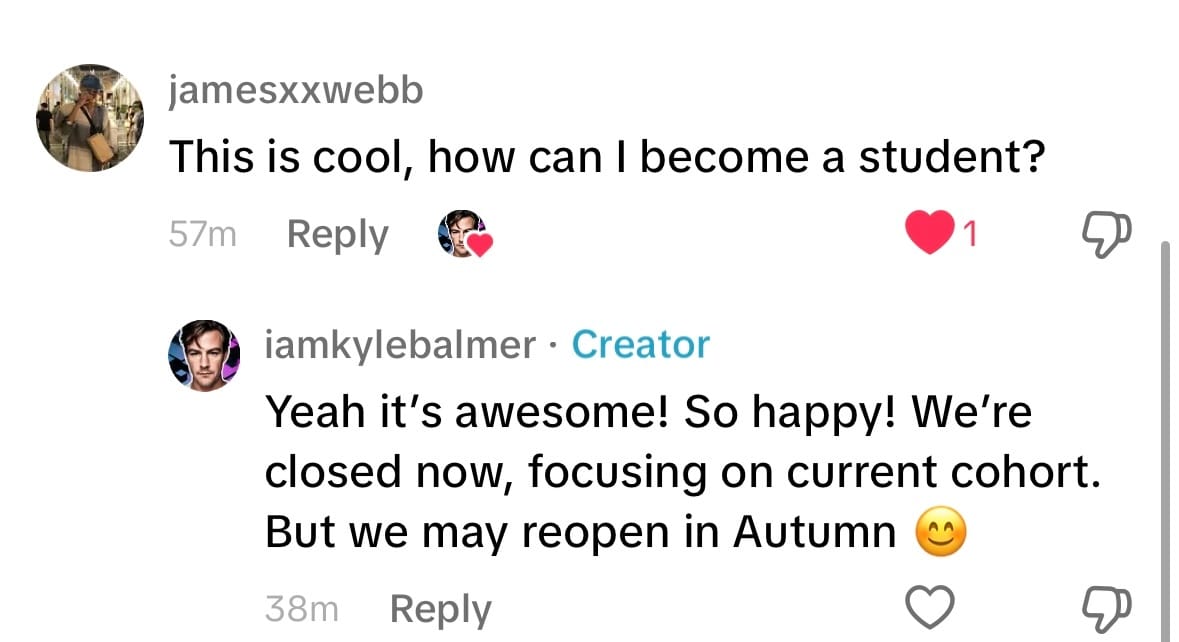
As well as a handful of DMs asking the same thing.
Sharing customer wins triggers FOMO in others. They want to be involved. It’s a totally natural human reaction! Any hesitations they may have had before start to disintegrate in the face of evidence of others who are achieving their outcomes.
These people become future customers.
If I had a live offer I’d immediately have sent him a link. Otherwise get people on your email list ready for when there is an active offer in play.
To recap quickly. We first go above and beyond to secure the promised outcome for our customers.
If it takes you longer than you initially thought: tough. You should have aligned your marketing message better!
But don’t worry it’s the first pass. We’re using this first push to refine our offer remember. So you absolutely kill it with the first customers.
Then when (not if!) they achieve their outcome you’re going to publicly celebrate them. You’re going to share their stories. You’re going to big them up.
Because i) they deserve it for getting it done! and ii) their wins are your wins.
Doing so will help you prove to prospects that your offer does what it says on the tin.
We’ll now relaunch.
This time it’s a finessed and refined offer, polished with customer feedback.
This time we build in the over-delivery. We include what’s needed to get them the outcome.
We redo the marketing materials to include these changes. We add lots of social proof like testimonials, case studies and reviews from our first customers. We give evidence.
And then, importantly, we put the price up.
We now have an objectively better offer.
It has additional value from customer feedback. Additional value from over-delivery. Additional value from proven results.
All of this additional value get reflected in the price.
First round was $200? Now it’s $500.
First round was $2000. Now it’s $5000.
This rewards the people who came with you on the journey initially. Whilst also pricing fairly for subsequent customers because of the additional value that’s been added in.
And we repeat this process. Each launch adding more value. Each launch increasing the price to reflect that additional value.
And throughout you know, with absolute certainty, that what you are selling is valuable. That what you are selling is authentic and will genuinely improve the lives of your customers. Because you are delivering, again and again, the outcome you’ve promised.
It’s a great feeling. Go get it.
Keep prompting,
Kyle
Welcome to the '💚 Authentic Selling | AI Business Playbook', your ultimate guide to transforming your relationship with sales. This playbook dives deep into the world of authentic selling, uncovering the psychological barriers that hold many creative entrepreneurs back from confidently sharing their value. By leveraging AI insights and proven strategies, you'll learn how to embrace selling as a means of helping others rather than viewing it as an inconvenience. Get ready to elevate your business with a mindset shift that turns fear into excitement and uncertainty into unwavering confidence. Throughout this journey, we’ll explore five pivotal parts: overcoming the fear of selling, crafting a bulletproof offer, breaking through personal blocks, planning delightful surprises for your customers, and creating a win-win scenario for both you and your clients. By the end of this playbook, you’ll not only understand the essence of authentic selling but will be equipped with actionable strategies to ensure your offers resonate with your audience and deliver outstanding results.
This playbook is designed for creative entrepreneurs, freelancers, and small business owners who struggle with the sales aspect of their ventures. If you've ever felt overwhelmed by the thought of selling or have hesitated to promote your offerings due to fear of rejection, this playbook is perfect for you. You'll discover how to shift your mindset from viewing sales as a chore to embracing it as an opportunity to genuinely help others. Whether you're just starting your business journey or looking to refine your existing sales strategies, the insights shared in this playbook will empower you to confidently advocate for your products and services. By learning to sell authentically, you can create meaningful connections with your audience while achieving your financial goals.
No prior sales experience is required. This playbook is designed to help you overcome your fears and build confidence in selling, regardless of your background.
Results vary based on individual commitment, but many readers report noticeable shifts in their mindset and sales approach within weeks of applying the strategies.
This playbook provides insights that can be applied with or without AI tools. You'll learn foundational strategies that enhance your selling skills regardless of technology.
Yes, the principles of authentic selling are applicable across various industries, making it a versatile resource for any business owner.
The playbook is divided into five parts, each focusing on a key aspect of authentic selling, providing actionable insights and practical exercises.