
AI Authority
Welcome to the 🧲 Audience Fundamentals | AI Business Playbook, your ultimate guide to unlocking the true potential of your business by understanding and engaging your audience.
Start ReadingThis week we're diving deep into the 'A' of BATON - Audience.
How to actually get your great new business out there into the world so people can see it and (in turn) become customers.
We are still following my BATON framework (Business, Audience, Tribe, Offer, Network):
Business: what value are we going to provide and to who?
Audience: how will we let them know about the value we have?
Tribe: how do we get permission to offer our value to prospects?
Offer: how do we package up our value and sell it to customers?
Network: how do we scale what works into a business?
In the last Playbook we covered Business. We’re now building on that all this week.
Let’s get started:
Content Pillars
value comes from solving problems
content marketing by answering questions
generating content pillars from questions
Let's start by looping back to our fundamental truth: businesses exist to provide value.
Think about it this way: Your customers are at point A, and they want to get to point B.
Your business? It's the bridge that helps them make that journey. We solve problems to provide value to our customers.
But here's the kicker: To succeed in business, we need people to KNOW about the value we can provide for them. You can have the best damn product in the world but if no-one knows about it our business will fail.
This is what kills so many entrepreneurial dreams. Great product, zero marketing.
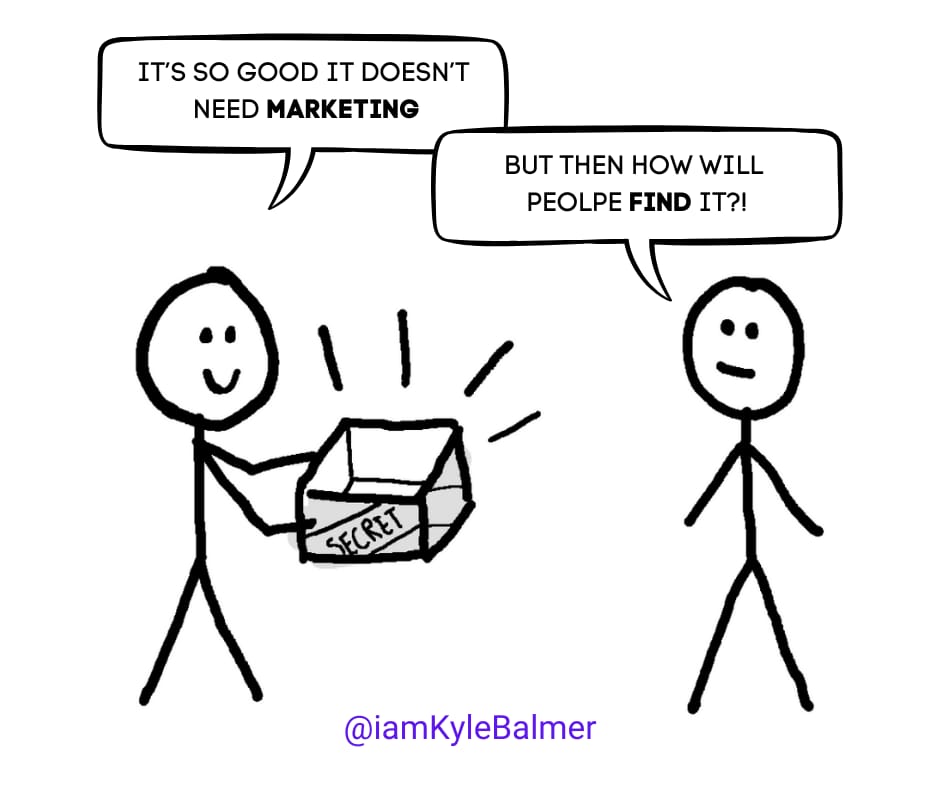
That's where the Audience element of BATON comes in.
Now, you might be thinking, "Kyle, do I need to start doing TikTok dances or cool trick shots to build an audience?"
Yes! Buckle up cowboy.
Ha. No! Imagine if that’s where I went with this.
Instead, we're going to start as we mean to go on: by solving problems and providing value. For free. Yes, you heard that right.
Think about all those social media posts, blog articles, and videos that businesses make. It's all FREE content. And it helps people solve problems. This, my friends, is content marketing. They aren’t pushing all that content out of the goodness of their hearts.
It's how we build out an audience, prove our worth, build trust, and let the world know what we have to offer. Only then do we move them towards the sale.
(Quick note: Yes, there are alternatives to content marketing. In particular advertising. I’ll cover advertising in the Network (N) stage of BATON. Advertising is an accelerant. For now, we're focusing on organic growth. And that means content.)
So, how do we get started? We're going to answer questions. We're going to show our expertise, prove our knowledge, and become known in our sphere as the go-to expert.
This idea comes from the excellent book "They Ask, You Answer” by Marcus Sheriden. It’s also just what I’ve done in content marketing for years (myself and for clients) and I know it works.
Enough chat. Let's get practical.
Head over to https://answerthepublic.com and plug in a keyword connected to your business. For me, it might be "AI", "AI education", or "ChatGPT". The free version is enough to get started with.
You'll get an image that looks something like this:
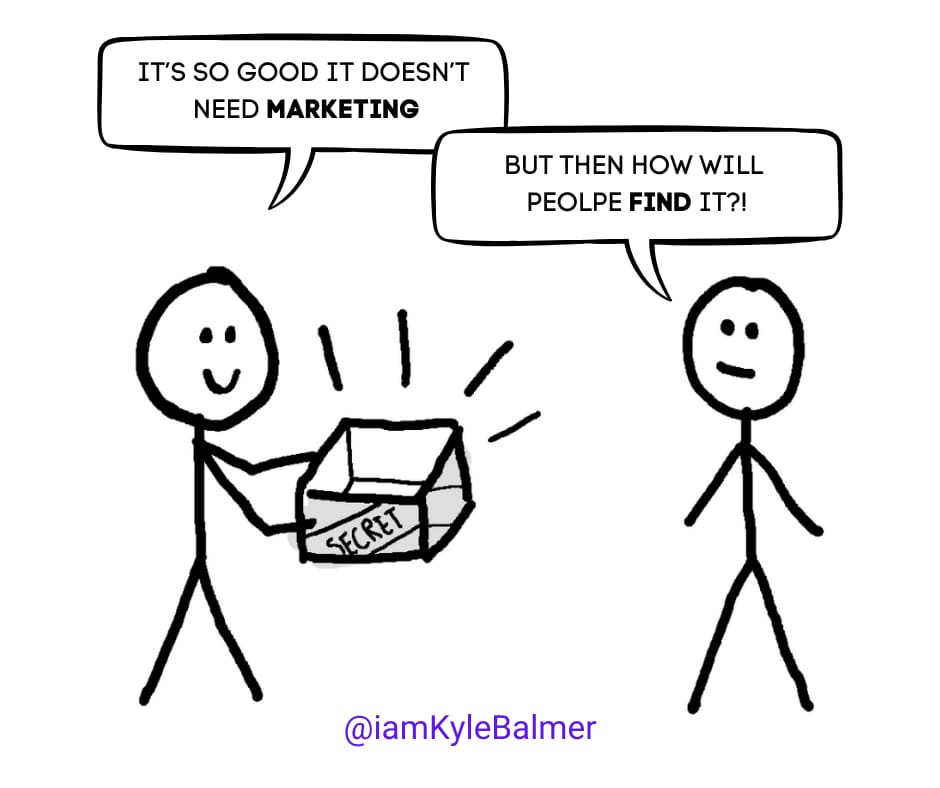
Beautiful! It show us lots of questions that people ask about “chatgpt”.
It’s also quite impractical. We want the List, not the pretty image. This gives us a list of questions that people actually ask.
With a free account you can export data. Or copy/paste it off the page and use AI to strip out the questions (removing formatting) like so:
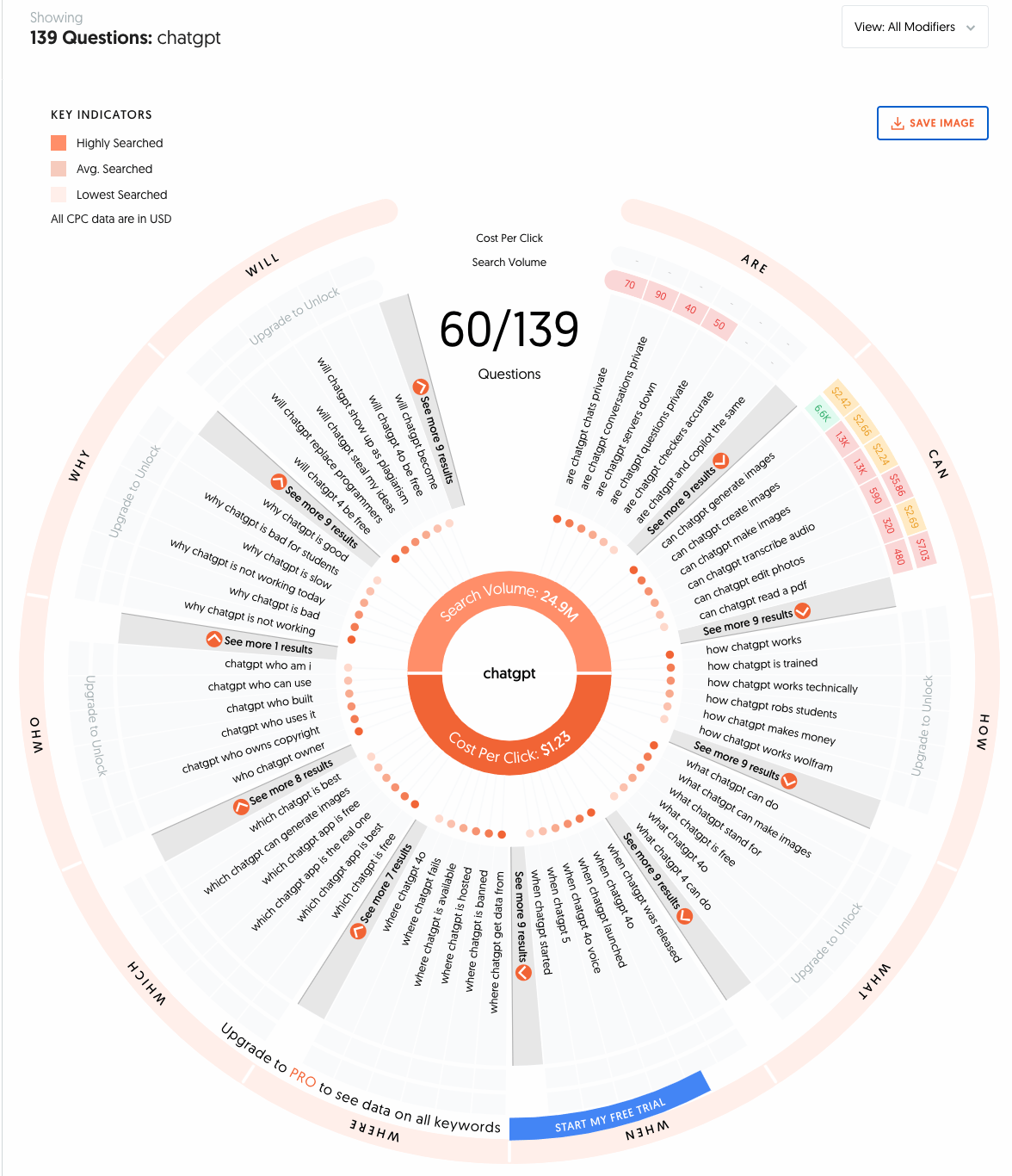
Now, let's combine our list of question topics with this prompt:
You are an expert content strategist specialising in creating comprehensive content plans for businesses. Your task is to analyse a list of questions and generate 10 potential content pillars based on these questions.

I have a list of questions from Answer The Public related to my business area. Please analyze these questions and generate 10 potential content pillars based on them. For each content pillar, provide:

1. A name for the pillar
2. A brief description (1-2 sentences) explaining what this pillar covers and why it's important
3. 3-5 example topics or questions that could be addressed under this pillar, based on the provided questions

Here's the list of questions:

[INSERT QUESTIONS HERE]

Please format your response as follows:

Content Pillar 1: [Name]
Description: [Brief description]
Example Topics:
- [Topic 1]
- [Topic 2]
- [Topic 3]

Content Pillar 2: [Name]
...

Repeat this format for all 10 content pillars. After providing the 10 pillars, please give a brief summary (2-3 sentences) of how these pillars cover the main themes from the questions and how they can be used to create a comprehensive content strategy.
This prompt will convert the list of commonly asked questions into broad content pillars. Here are content pillars 3 and 4 from my example for instance:
These content pillars are basically the buckets of content we’ll be testing out.
We will not end up doing them all - we’ll instead be testing them and seeing which resonate best with our audiences (and customers). More of this as we progress with the strategy!
Speaking of…
Here's what we'll be covering this week:
We kicked things off by getting inside your customers' heads. What problems keep them up at night? What questions are they frantically Googling at 2 AM? We’ve turned those queries into solid gold content pillars which we’ll be using as the core of our strategy.
Next up, we're playing matchmaker. We'll figure out where your dream customers are hanging out online and how to slide into their feeds (in a totally non-creepy way…promise). Spoiler alert: We're talking short-form video and snappy tweets. It's like speed dating, but for your content.
Ever heard of content inception? In this part, we're going deep. I'll show you how to take one killer content idea and turn it into multiple pieces that speak to your audience at different levels. We’ll have a casual chat, a deep discussion, and a TED talk all from one concept.
This is only going to drive your business if you do the work. We’re going to make it as frictionless as possible with a 30-day content plan. By the end, you'll have a month's worth of content locked and loaded. We don’t want to be thinking “what am I doing today” ever.
Last but not least, we're putting on our data scientist hats. Well, the AI will be wearing the hat don’t worry. I'll show you how to analyse what's working, what's flopping, and how to pivot. We'll turn those insights into action, doubling down on the winners and quietly ushering the losers off stage (to shoot them in the back of the head).
By the end of this week, you'll have a solid plan to start building your audience by providing real value. No trick shots required (but still encouraged, for my entertainment).
Premium subs, see you in the next Part. If you're not a premium sub yet, what are you waiting for? Don't miss out on the full audience-building blueprint!
Keep prompting,
Kyle
Welcome back to our Audience Mastery series! Today, we're diving into a crucial topic: choosing the correct channel for your audience growth.
Let’s get started:
Choosing our Channel
choice of channel is important, but how to know
start with a primary but experiment first month
first month done, double down on winner
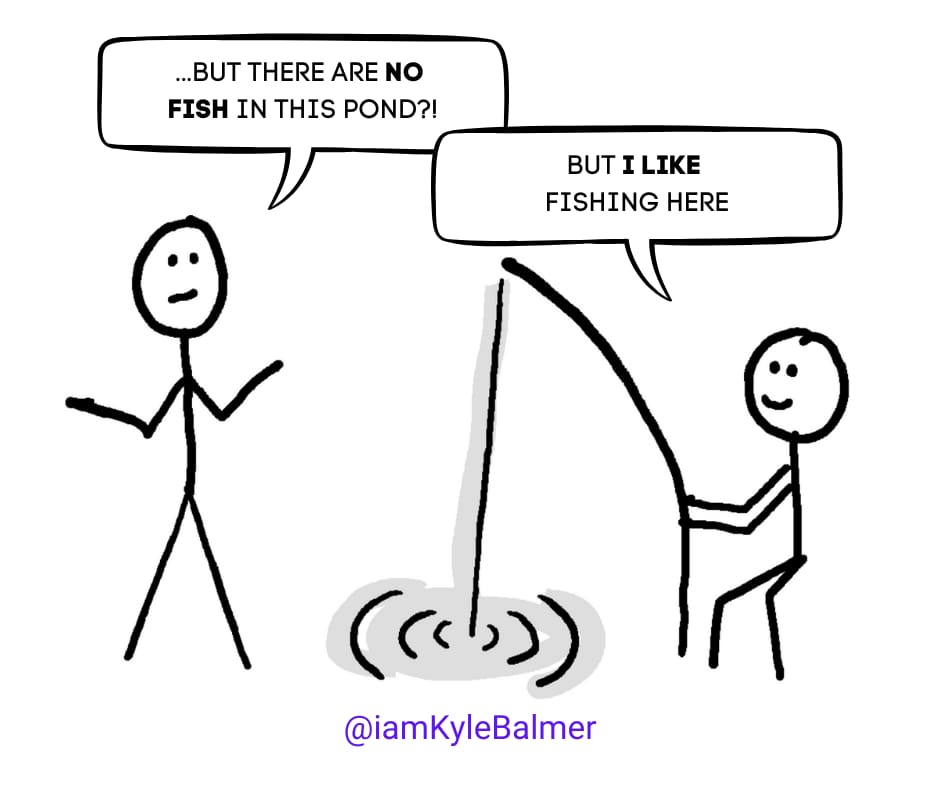
So, here's the deal: end of the month I'm about to go fishing for the first time ever. (I know, I know, try to contain your excitement.)
But here's the thing - choosing where to fish is turning out to be more complicated than I thought.
Some spots have trout, others have carp, and some even boast salmon. Fancy.
If I want any chance of success beyond just sitting with friends and some beers (which, let's be honest, sounds like a win in my book), I need to choose the right spot.
Just like choosing the right fishing spot, picking the right social media platform is crucial for your success.
See what I did there? Quite proud of myself. And I am actually going fishing so didn’t just have to make up some BS.
Here's the golden rule:
Go where your audience ALREADY is, not where you personally prefer to hang out.
It doesn't matter if you're an Instagram junkie or a Twitter addict. If your audience is on LinkedIn, that's where you need to be. End of story. It's the number one criteria for success in this game.
Sure you could carve out a space for your niche on an untapped platform. But that’s an advanced play. Right now we’re getting started.
Now, how do we figure out where our audience is already hanging out? Time for a little reconnaissance mission.
Take one of your key questions (remember our prompt from the last Part) and plug it into different social media platforms.
Let's say your question is "How to get started with ChatGPT."
Check out:
TikTok
YouTube
Here’s what the results look like on TikTok:
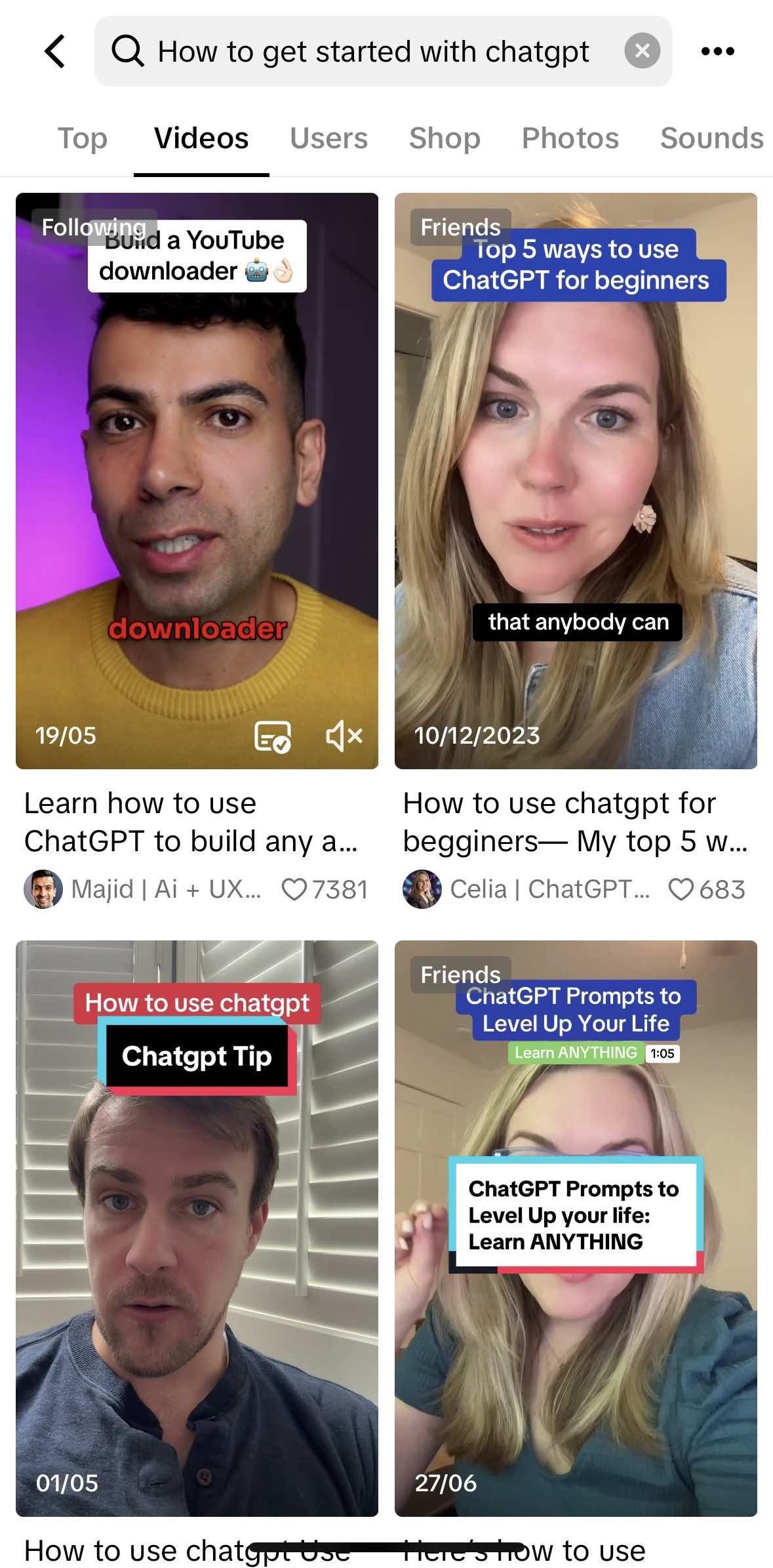
Look at the top videos or posts for your question. But here's the catch - ignore the MASSIVE creators in your space. They're outliers. Instead, focus on small and medium accounts. What kind of views and engagement are they getting?
Basically go through the top posts and note down the basics. Do they have 100s of views, 100s of thousands or millions? If no views are available use Likes or other engagement metrics as a rule of thumb.
We do this on each of the platforms to get a rough idea of the popularity of a particular topic.
This isn't rocket science. We're just trying to get a rough gauge of where people with your problem (and question) are hanging out.
Ideally create a ranked list of most interest to least interest. But we are mainly interested in the top platform.
Alright, based on your reconnaissance, it's time to choose ONE platform as your primary battleground. For me, it's TikTok (more on that in a bit).
Here's the game plan:
Create content on your primary platform
Repurpose it to others for the first month
See where it gets picked up and becomes popular
Starting in this way gives us exposure on all the main platforms which, in turn, gives us more chances for the content to suddenly be picked up and the account to grow.
We initially use multiple platforms because we still don’t know which will be the best. We can make an educated guess (based on our manual check above) but we want to use this first month to be certain we aren’t missing a trick.
Chances are, it'll perform best on your primary platform. Why? Because platforms love native content and reward you for using their specific tools. Plus, you're likely to be most active there, which the algorithms adore.
But by hitting all the main platforms (at least initially) we are belt and braces just in case we were wrong. Shiny? Cool.
Now, if you're still scratching your head wondering which platform to choose, here's my secret sauce: TikTok as primary, LinkedIn as secondary.
Use this as a solid fall back if your manual checks really revealed nothing. About the market.
Why TikTok? It treats each video individually and doesn't care about account size. This is gold for new accounts. It allowed me to reach 100K followers in just 6 months. Not too shabby, right?
And LinkedIn? It's where the "serious" prospects go to check if you're legit after seeing you on TikTok. I've had contacts from IBM, Google, eMed, and other HUGE companies this way. It's a great 1-2 punch!
If you are building an audience for business this 1-2 combo should work for you too as it gives you exposure to both volume/b2c and quality/b2b.
OK - when the first month is up you’ll have a winning channel. It’s probably the primary you researched manually and then used to create content but it may not be. Main thing is we’ve tested.
After a month or so, you have two options: a) Put repurposing on autopilot (I personally use repurpose.io) or b) Kill non-primary channels for now and focus all your energy on your primary platform.
Which you do will depend on capacity. I can hear some of you now: "But Kyle, shouldn't we be everywhere?"
Look, I get it. But here's the truth: focusing on one platform gives you the greatest chance of success. It's like fishing - you'll catch more fish if you focus on one spot rather than constantly moving around the lake.
We spend the first month testing out different spots. And then we plonk our arses down and get serious.
Once you get traction on ONE platform, double down. We can use that success to drive growth on others later.
In our next part, we'll dive into the nitty-gritty of content creation and the levels of content you need. Specifically how to create in one format in a way that gives us multiple content pieces for all the channels.
But for now, your mission is clear: choose your primary platform using the manual check method explained above. That’s all.
Keep prompting,
Kyle
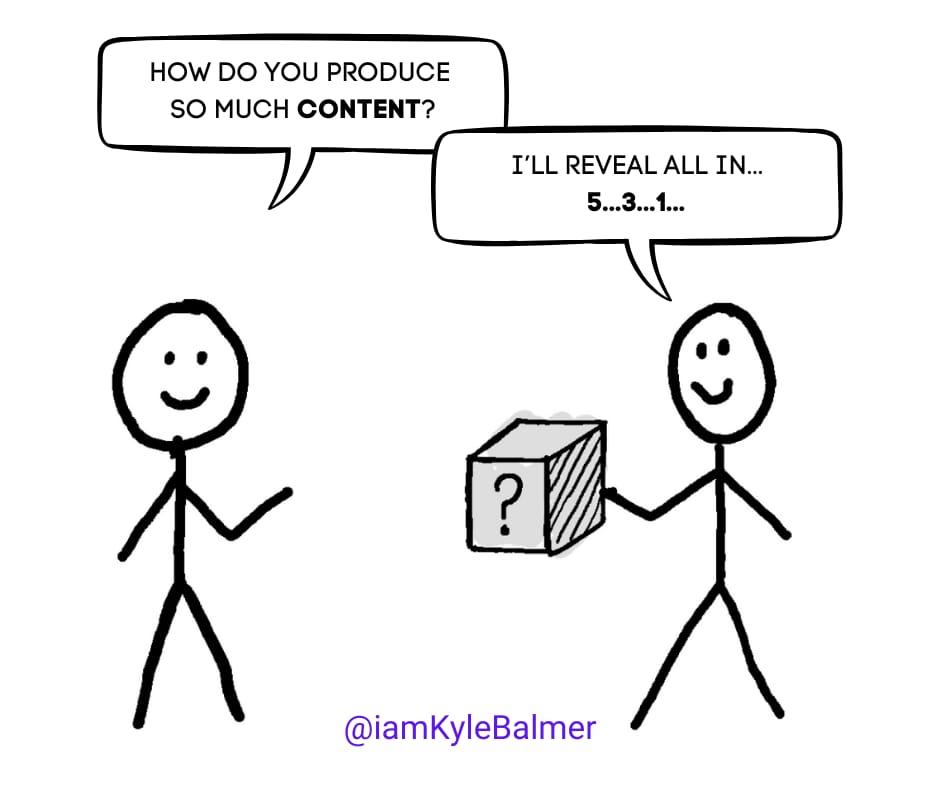
I often get asked how I come up with so many content ideas. I try to post 3-5 videos every day so I understand why this question comes up!
In this Part I’ll show you one of my secrets!
Let’s get started:
5-3-1 Method
5 short, 3 medium, 1 long
invisible content funnel
5-3-1 examples and prompt
Remember those questions we dug up that your customers are asking back in Part 1?
Well, we're about to turn each of those into a content goldmine. Enter the 5-3-1 Method.
Here's the breakdown:
5 short pieces of content
3 medium pieces of content
1 long piece of content
All from one single idea.
And remember that the tool we used dug out 1000s of questions or us…
Yeah…you aren’t going to have to worry about what content to create anymore!
These are your content appetisers. We're talking:
Single tweets or other short text post
60-second (or less) videos
The goal? Stop the scroll. Make people pause and think, "Huh, that's interesting." Or, in my case, who’s this plummy but scruffy Brit talking about ChatGPT.
These are for the people who don't know you (yet). You're not asking for much of their time - just a moment of attention and maybe, if you're really charming, a follow.
This stage is about volume. Just…showing up. Again and again. Addressing topics that are relevant to them.
Now we're getting into the main course. Think:
Twitter threads or LinkedIn Posts
1-3 minute videos
These are for your followers, the people who know who you are and are willing to spend a bit more time with your content. They're intrigued and want to go a little deeper.
Hell, with enough exposure they’ll even start to like you. This is where we can move people to Tribe, the next stage of BATON - generally onto our email list.
This is your content feast. We're talking:
Full blog articles
5+ minute videos
This is for your super fans, the people who are really bought into what you're saying. They're willing to spend legit time with your content.
These audience members are often close to making a purchase - they want detail, they want information, and they trust you enough to give you their precious time. They are close to tipping into the Offer stage and buying from us.
Now, here's where it gets really interesting. And a bit sneaky.
We're creating a funnel, but not the kind you're thinking of. It’s not (yet) a sale funnel. This isn't about money (yet) - it's about time.
We're escalating people from spending a few seconds with us to potentially spending several minutes. Which, online, is a lifetime…
It's like dating - you don't propose on the first date, you gradually spend more time together. (Or if you are a little odd like me you fly to Cyprus for your first date followed by Indonesia for your second date…)
But here's the kicker: To your audience, this funnel is invisible. They don't see the structure we're using behind the scenes. They just see short, medium, and longer pieces around topics they're interested in.
No one is watching all this content in order. Only you know about the existence of all of it.
They might start with a long piece and then check out some of your tweets. Or they might follow you for your short videos and then dive into a blog post. The order doesn't matter - what matters is that we have content for every level of engagement.
We’re meeting them where they are right now with different levels of content. We have tasty amuse-bouches through to a three course chef’s tasting menu for them. We’re covering all the bases for all appetite levels.
Let's say one of your customer questions is "How do I get started with AI in my business?"
Here's how you might apply the 5-3-1 method:
5 Short Pieces:
Tweet: "AI isn't just for tech giants. Here's how small businesses can start: [link]"
30-sec video: "3 simple ways to implement AI in your business today"
3 Medium Pieces:
Twitter thread: "5 myths about AI in business, debunked"
2-min video: "AI for beginners: What it is and isn't"
1 Long Piece:
Blog post: "The Complete Guide to Implementing AI in Your Small Business"
5-min video: "From Chatbots to Predictive Analytics: A Tour of AI Applications for Business"
Boom! Nine pieces of content, all from one idea.
Each a little more in depth, a little more commitment required from them to consume.
Let’s use a prompt to run this process for us:
You are an expert content creator specializing in producing engaging, conversation-starting content using the 5-3-1 method. Your task is to take a single question and generate full content for 5 short pieces, 3 medium pieces, and 1 long piece of content. Focus on creating engaging, thought-provoking content that encourages audience interaction.

I need a complete 5-3-1 content plan with full, engaging content based on the following question or topic:

[INSERT YOUR QUESTION HERE]

Please create the following content:

5 Short Pieces (60 seconds or less):
- 3 tweets (280 characters or less each). Each tweet should either ask a thought-provoking question or make a slightly controversial statement related to the topic.
- 2 short-form video scripts (60 seconds or less each). Include an attention-grabbing opening and end with a question that encourages audience response.

3 Medium Pieces (1-3 minutes):
- 1 tweet thread (5 tweets). Each tweet should build on the previous one, presenting a unique perspective or challenging a common belief about the topic.
- 2 medium-form video scripts (1-3 minutes each). Include moments where you directly address the audience and ask for their thoughts or experiences.

1 Long Piece:
- 1 full blog post (800-1000 words). Present a nuanced view of the topic, including potential counterarguments. End with open-ended questions for the readers.
- 1 long-form video script (5-7 minutes). Structure it as a narrative that challenges conventional wisdom on the topic, encouraging viewers to reconsider their stance.

For each piece of content:
1. Provide a clear, attention-grabbing title or opening line
2. Include full text or script
3. For videos, include brief directions for tone, expression, or actions where appropriate
4. End with a provocative question or statement that encourages audience interaction

Do not use hashtags or include links in any of the content. Instead, focus on creating self-contained pieces that spark curiosity and debate.

After providing all the content, please give a brief strategy note (2-3 sentences) on how these pieces work together to create ongoing engagement and discussion around the topic.
Ideally use this prompt with Claud or a model that is particularly good at writing.
Here are the short form tweets and video scripts:
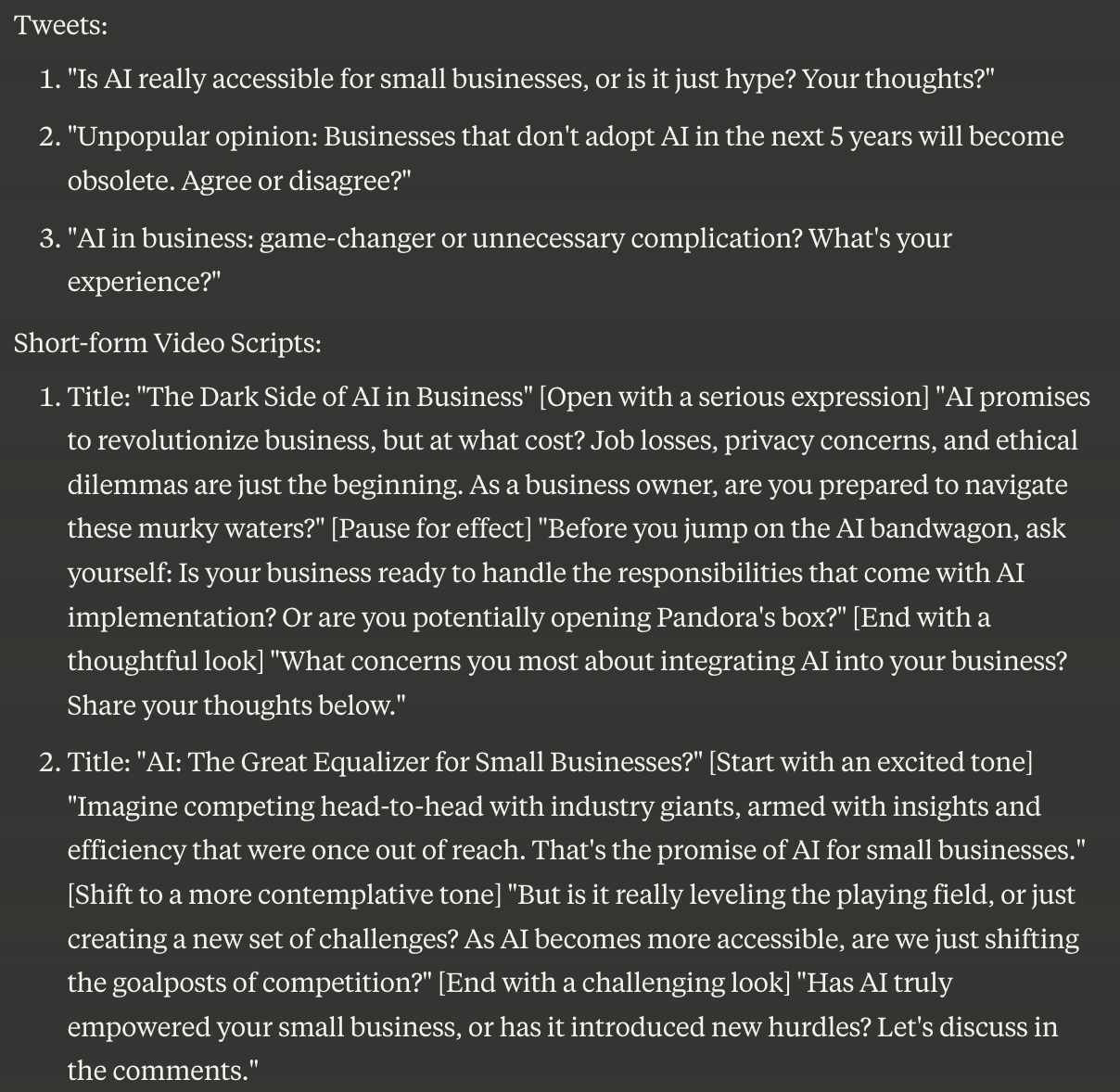
And the beginning of the blog article (it’s 1000+ words!):
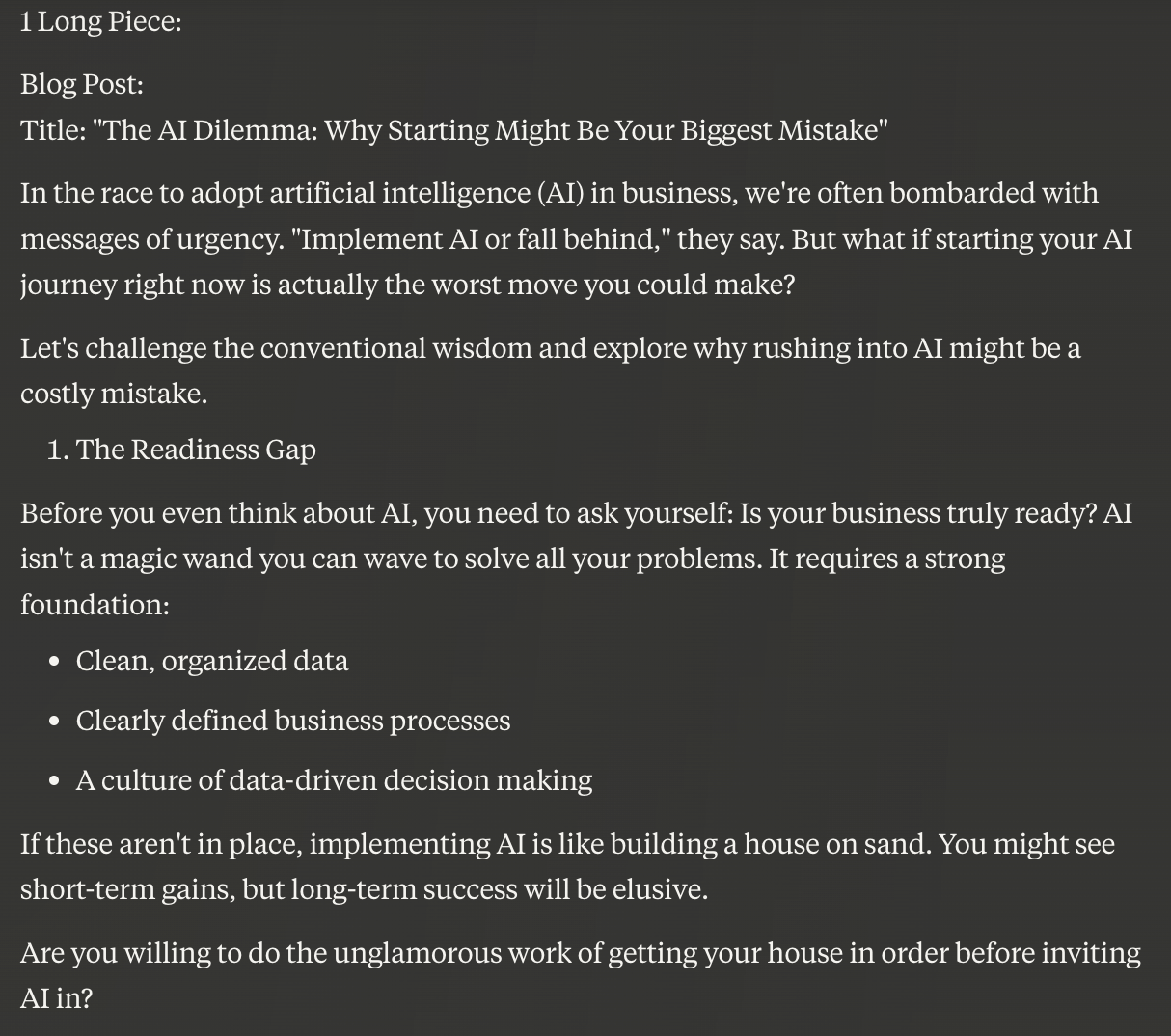
All good?
Time to start creating. Take one of your key customer questions and apply the 5-3-1 method. Outline what each piece of content could be or produce full scripts. Adapt and improve as required - you should inject your own opinions and personality as possible. The AI output is a jumping off point.
Next time, we'll talk about how to turn this into a consistent content strategy.
But for now, start thinking in 5-3-1!
Keep prompting,
Kyle
Welcome to Part 4 of our Audience Fundamentals series.
In this Part we're talking about something that might make you squirm a little. We're talking about work. Hard work. Consistent work. The kind of work that separates the wheat from the chaff in the world of content creation.
Eww right??
Let’s get started:
Volume beats all
never stare at a blank page again
volume outweighs all disadvantages
investment of time, not money
Picture this: It's 9 AM. You've had your coffee (or three), and you sit down at your desk. Or walk at if you are me…
Suddenly, it hits you: "Oh god, I need to do some social media for my business today.”
If you've ever felt that pit in your stomach, you ain’t alone. This is the daily battle many entrepreneurs face - and i't’s why most people just…stop.
But here's the truth bomb: This is only going to drive your business if you do the work.
The good news though. All those people dropping off? That’s less competition for you. Because we are going to be smart and give ourselves the best chance of success.
Creating content is work. Period. Or full-stop as I should as a Brit…but it sounds weird.
It being hard work is especially true if you're doing video (you should) and don't yet feel comfortable on camera (you won’t).
We need to make this process as streamlined as possible. That's why I recommend having 30 days of content planned out upfront.
Now, don't panic. You don't need to CREATE all the content upfront. You just need to have the ideas and topics ready for you to work on, without much extra thought.
Think of it like Einstein and Steve Jobs with their "uniforms." They wore the same thing every day to reduce mental overhead. That's exactly what we're doing with our content plan.
We can’t have that extra choice of “what to create today?” because it moves us closer to creating nothing at all.
Now, let's talk about your real task: consistency and volume. This is what sets you apart from the crowd.
I grew to my first 100,000 followers on TikTok by straight up outproducing everyone.
The first videos were rubbish. Hell, some of them are as well now. Doesn’t matter - volume overcomes all else.
Most businesses will post a handful of times, get lacklustre (or zero!) results, and stop. They'll throw their hands up and declare that social media "doesn't work." Or that it’s only for the young and beautiful or whatnot.
Nonsense.
Here's the “secret” they're missing: You need to post consistently for some time for things to kick off in your favour.
I’ve got “secret” in scare quotes because honestly we all know this. But knowing something and acting on it are different things.
You also need to be creating LOTS of content. Why? Two reasons:
It's a skill. The more you do it, the better you'll get. Duh.
You need data. Lots of it.
If I put out one video and no one likes it, what have I learned? Not much. Maybe that one specific video didn't resonate. But why? Was it the topic? The format? The time I posted? Who knows. Anyone who says they know is lying.
I need to put out 10, 50, 100 videos to start seeing patterns in what people like and don't like specifically. And to do this, I need consistency and volume.
There's no shortcut!
Remember this: Social media is an investment. With advertising, we can just spend money and have an audience on tap. Powerful stuff. And something I 100% recommend once you have your funnel worked out.
With organic social media, we pay for attention by putting in the work.
What did you want? Easy, free, unlimited traffic for your business?
Yeah. Me too. And that’s the problem - everyone is competing for attention.
Know also that it’s very top-heavy work. The first 100 followers are much harder to get than the next 1,000. And going from 1,000 to 10,000 is easier still. It gains momentum, but it takes time.
That's why having a 30-day plan helps. You remove the friction of deciding what to make and just get on with the creation.
So, here's your mission, should you choose to accept it (and you should, but I’m biased!):
Create your 30-day content plan.
Commit to consistency. Decide how often you'll post and stick to it.
Focus on volume. Don't worry about perfection. Done is better than perfect.
Analyse and adapt. After 30 days, look at what worked and what didn't. That’s in the next Part.
Solid?
Here’s the prompt:
You are an expert content strategist tasked with creating a 30-day content plan based on customer questions and the 5-3-1 method. Your goal is to generate a diverse, engaging content calendar that maintains consistency while addressing various aspects of the main topic.

I need a 30-day content plan based on my customer questions and content pillars, using the 5-3-1 method. Please follow these steps:

1. I will provide you with a list of customer questions and content pillars. Please confirm when you're ready for me to share this information.

2. Once you have the information, create a 30-day content plan in table format with the following columns:
   - Day
   - Content Type (Short, Medium, or Long)
   - Topic/Question
   - Content Idea
   - Engagement Hook (a question or statement to encourage interaction)

3. For each day, assign a content type based on the 5-3-1 method:
   - 20 days should be Short content (quick tips, facts, or questions)
   - 9 days should be Medium content (brief explanations or mini-tutorials)
   - 1 day should be Long content (in-depth exploration of a topic)

4. Distribute the content types evenly throughout the month.

5. For each day's content:
   - Choose a topic or question from the provided list
   - Create a brief content idea that addresses the topic/question
   - Add an engagement hook to encourage audience interaction

6. Ensure that all content pillars are covered throughout the month.

7. Avoid repetition of exact topics, but feel free to approach similar themes from different angles.

8. After the table, provide 3-5 tips on how to efficiently create this content, focusing on batching, repurposing, and maintaining consistency.

Please generate the 30-day content plan table and tips based on these instructions.
Use this after your previous work if the context window allows for it (ie. in Claude). Otherwise copy/paste in outputs from previous Parts so that this prompt has the right information.
If I run this using my previous audience questions and content pillars here are the first 15 days:
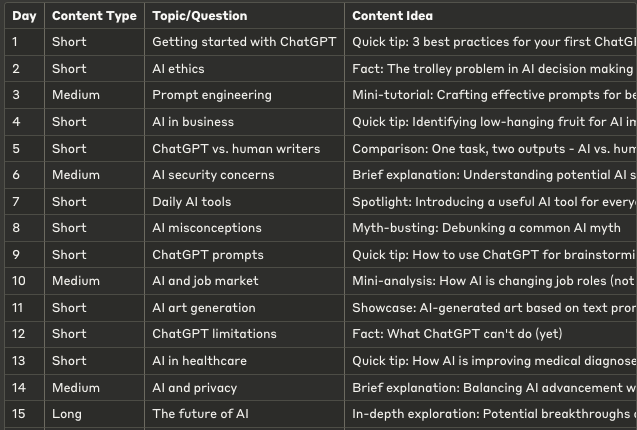
This is splitting out one piece of content per day (from the 5-3-1 system) and giving me a nice balance of short, medium and long. Feel free to tweak the prompt or add a follow up request to:
suggest multiple content pieces per day
adjust short, medium, long balance
tailor to your specific platform of choice if required
Let's be real for a moment. This isn't going to be easy. There will be days when you don't feel like creating content. Days when you wonder if anyone is even listening.
Tough.
Remember this: Every successful content creator you admire went through this phase. They had days of doubt, days of low engagement, days when they wondered if it was all worth it.
Go and look at some of your favourite creator’s early vids. Hopefully they haven’t deleted them out of embarrassment! They are often instructive - they remind us we all start at the bottom.
The difference? They kept going. They showed up, day after day, creating content, engaging with their audience, and refining their craft.
So, here's my challenge to you: Commit to your 30-day plan. Create it, follow it, and see it through to the end. No excuses, no days off.
Got something coming up? Yup - we all do. Do the content the days before as extra work.
At the end of those 30 days, you'll have:
A body of work you can be proud of
Valuable data on what your audience actually responds to
Improved your content creation skills
Built momentum that will carry you forward
Let's get to work, Prompt Entrepreneurs. Your audience is waiting for you just at the end of these 30 days. Do the damn work - sorry, only way!
Keep prompting,
Kyle
Now the final Part of our Audience Fundamentals series!
Today, we're putting on our data scientist hats. Well, the AI will be wearing the hat - don't worry, I won't make you do any complex calculations. It’s not like I could…
Let’s get started:
Do what works
do more of what works, less of what doesn’t
repeat successful content
data analysis prompt
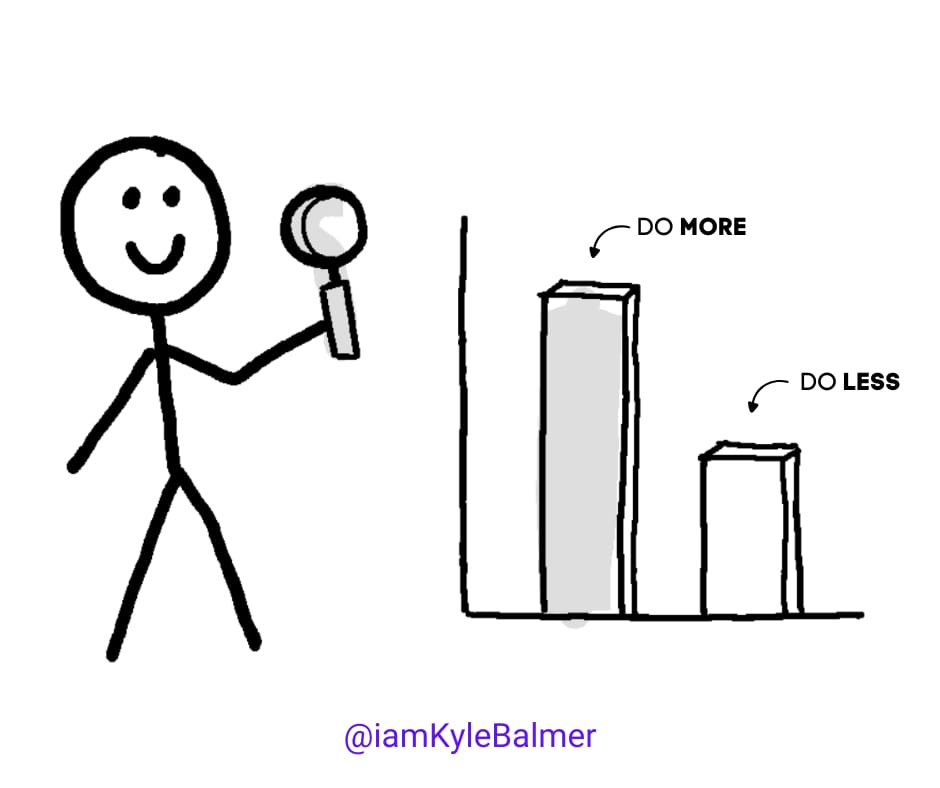
Here's the basic idea: Do more of what works and less of what doesn't.
OK we’re done here right? Probably not…
Sounds simple, right? Yet you'd be surprised how many people don't follow this golden rule. They either:
Have a success and leave it at that (one-hit wonders)
Have flops and just... keep going! (Definition of insanity)
Remember when we talked about the power of volume? This is where it really pays off. All that content you've been pumping out?
It's not just content - it's data - and used properly it’ll help us avoid these mistakes.
First up, your winners.
When you hit a winner, here's what I want you to do: Do it again.
No, I don't mean posting the identical post or video. That’s duplicate content and will get you dinged. But rewrite or rerecord it. And post it again.
"But Kyle," I hear you cry, "won't people get bored seeing the same content?"
We don’t care. Because there are three situations here. None of them matter:
If they've seen it before, they'll move on. No harm done - it's one of 1000 posts they'll see today. They’ll live.
If they've seen it before and are happy for a repeat - great! They get to review, refresh, or see it with new eyes.
or most likely scenario: It's a new person. Horray.
Let me show you what I mean. Check out this screenshot from my TikTok:
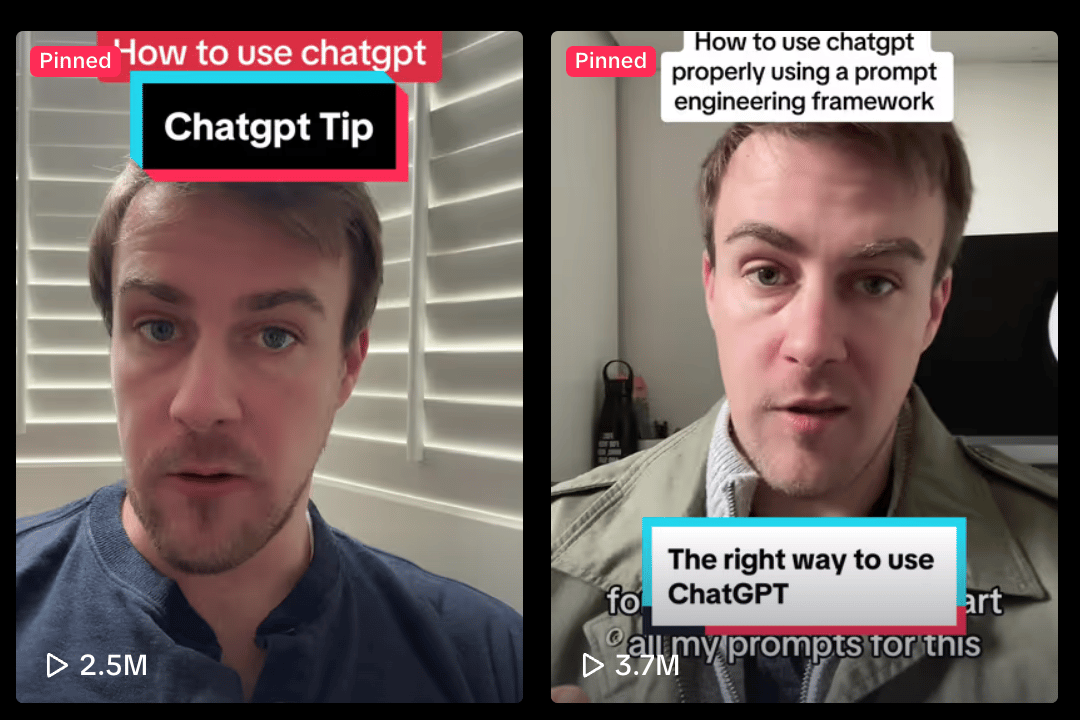
See these two top videos? Literally the same concept. 5M+ views.
That reminds me, I need to do the same video again…
Most of the time, you're reaching new people.
Those 5M views? 99% were new viewers of my content. They hadn't seen the first video. They don't know or care that the second is similar.
So, repeat your winners. Add graphics, change the lighting, wear a silly hat. Doesn't matter - add a little variation and do it again. And keep doing it (and similar content) as long as it works.
Now, for the not-so-fun part: failing posts. If something isn't working, you need to make a change. I know right…ugh.
The question is: When do you know if something is working or not? This is why I personally think TikTok is great - each post has its own chance to shine. It'll be shown to 200 people, and if it's engaging, it'll be shown to more. If not, it'll stall in "200 view jail". Very clear cut! You know what’s crap and what isn’t!
On other platforms, you have to judge win/loss compared to your other content. Does one spring ahead of the average? That's a winner. Does one underperform? It's a loser.
Assess this weekly to work out what’s not helping you…and then: do less of the losers. It's that simple. Really.
If you follow this basic plan, your content will get better - it can't not. You're using feedback to follow what people want. It's like evolution, but for your content strategy.
Once you have sufficient data, we can add another layer of feedback. We'll use a prompt to review your social media account performance and give you insights.
But before we can do that, we need the data. Where you get the data depends on the platform - Google how to download your data for the respective platform. Or ChatGPT the info!
Generally the data comes in a CSV file. Get as long a period as possible.
Once you have your data, feed it into this prompt:
You are an expert social media analyst with a deep understanding of content performance metrics across various platforms. Your task is to analyze the provided social media data and offer insights to improve the user's content strategy.

I have a CSV file containing my social media performance data. Please analyze this data and provide insights to help me improve my content strategy. Follow these steps:

1. First, tell me you're ready for me to upload or paste the CSV data.

2. Once I've provided the data, perform the following analyses:

Quantitative Analysis:
a) Identify the top 10% performing posts based on engagement rate (likes, comments, shares, etc.).
b) Calculate the average performance metrics for all posts.
c) Determine the best and worst times for posting based on engagement.
d) If hashtags are used, identify the top 5 most effective hashtags.
e) Analyze the correlation between post length and engagement.

Qualitative Analysis:
a) Identify common themes or topics in the top-performing posts.
b) Analyze the tone and style of the most engaging content.
c) Determine what type of content (e.g., questions, how-tos, personal stories) performs best.
d) Identify any patterns in the use of media (images, videos, text-only) in successful posts.

3. Based on your analysis, provide the following insights:

a) Top 3 content topics or themes that resonate most with the audience.
b) 3 specific characteristics of high-performing posts.
c) 3 common elements in underperforming posts to avoid.
d) Recommendations for optimal posting times and frequency.
e) Suggestions for hashtag usage (if applicable).
f) Advice on content length and media use.

4. Offer 5 actionable recommendations to improve overall content strategy, based on what's working well.

5. Suggest 3 new content ideas that align with the successful patterns you've identified.

6. Provide a brief summary (3-4 sentences) of the overall content performance and the most critical area for improvement.

Please present your analysis in a clear, organized manner, using bullet points where appropriate. Avoid technical jargon and focus on providing actionable insights.
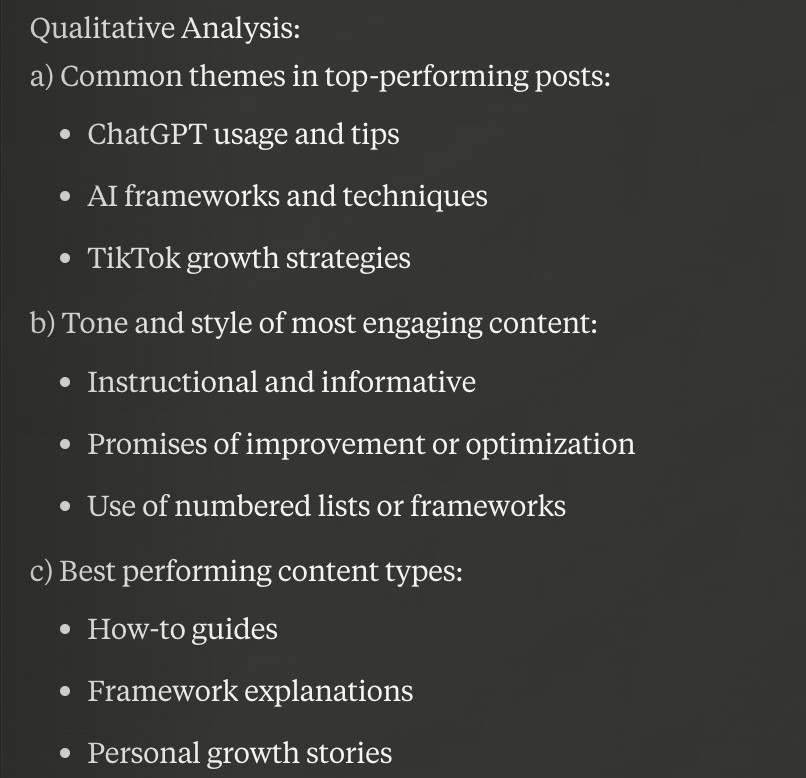
This prompt (plus your data) will come out with a whole load of info for you. For example a qualitative analysis:
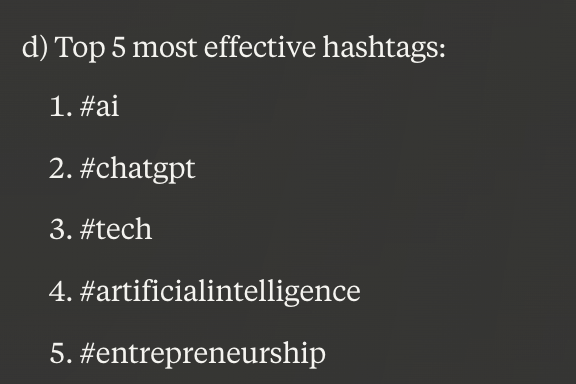
It also identified my best hashtags:
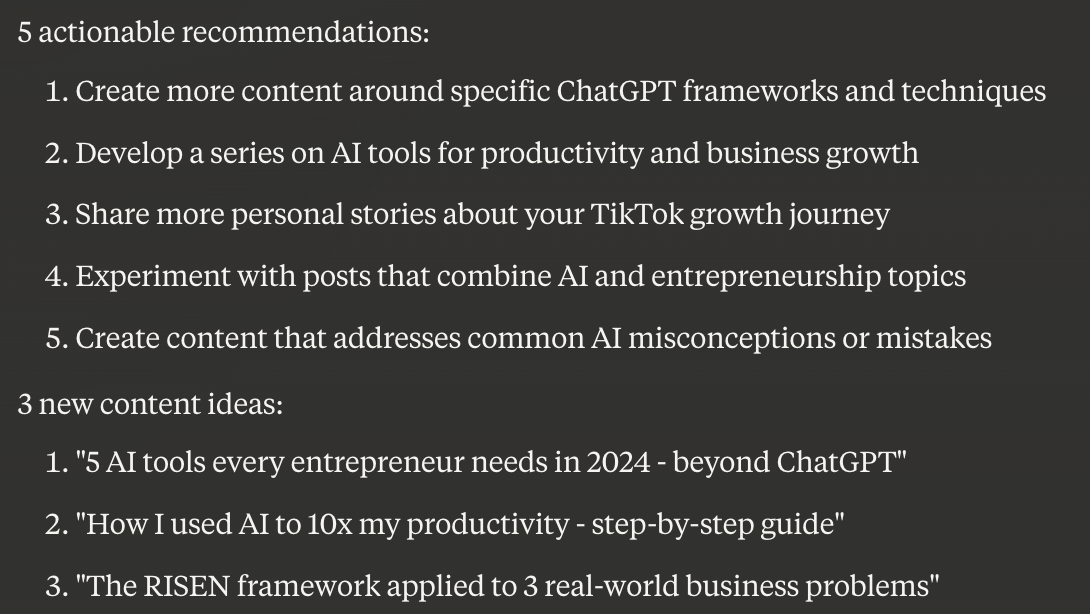
And ends with general recommendations:
You're not just creating content anymore - you're running experiments.
Think of each post as a hypothesis about what your audience wants. Some will fail, some will succeed, but each one teaches you something valuable.
That means that your “failed” posts are actually really useful. They give you more intel.
Hopefully that helps release you from the curse of making only “perfect” content. Because that’s impossible - and only leads to paralysis.
Alright, Prompt Entrepreneurs, we've been on quite the journey together! Let's take a moment to recap.
We kicked things off by diving deep into the questions your audience is actually asking, using the "They Ask, You Answer" approach to build rock-solid content pillars.
Then, we got strategic about choosing the right social media channels, focusing our efforts where our audience truly hangs out.
We leveled up our content game with the 5-3-1 method, creating a diverse content ecosystem that caters to every stage of audience engagement.
To keep the momentum going, we mapped out a 30-day content strategy, eliminating the daily "what should I post?" dilemma.
And finally, we put on our data scientist hats (well, the AI did…) to analyse what's working, what's not, and how to pivot faster than a cat on a hot tin roof.
This isn't just a series of tactics – it's a comprehensive system for building, engaging, and growing your audience.
Remember, consistency is key, but so is adaptation. Consistent effort, adaptation of output. Off you go now - go create!
Keep prompting,
Kyle
Welcome to the 🧲 Audience Fundamentals | AI Business Playbook, your ultimate guide to unlocking the true potential of your business by understanding and engaging your audience. In this playbook, we dive into the 'A' of the BATON framework, focusing on how to effectively reach your customers and showcase the value your business provides. With actionable insights and proven strategies, you'll learn to build a loyal audience that not only recognizes your brand but actively seeks out your offerings. Transform your marketing approach and watch your business thrive as you connect with the right people, at the right time, with the right message.
This playbook is designed for entrepreneurs, marketers, and business owners who are passionate about connecting with their audience but struggle with effective outreach. Whether you're just starting or looking to refine your existing strategies, this guide will address your challenges by providing clear, actionable steps to engage your target market. If you've ever felt overwhelmed by the noise of digital marketing or unsure of how to showcase your value, this playbook is the perfect resource for you.
No prior experience is required; this playbook is suitable for beginners and seasoned marketers alike.
You can work through the content at your own pace; however, dedicating a few hours each week will yield the best results.
Absolutely! The principles discussed can be tailored to fit virtually any industry or niche.
This playbook will help you refine your understanding of their needs and enhance your engagement strategies.
Yes, the playbook includes actionable templates and prompts to help you implement the strategies discussed.