
AI Knowledge
Unlock the future of learning with the '🤓 AI Tutor Personalised Learning' playbook, designed to revolutionize your educational journey through the power of artificial intelligence.
Start ReadingI’m in a Whatsapp group with a number of successful UK-based entrepreneurs.
The common questions for the past 6 months have all been AI related.
How do I use AI? How can I learn about this stuff? How can I keep up?
I was chatting to one entrepreneur last week and he was telling me: "I've got 15 newsletters in my inbox, a Slack channel full of updates, and my LinkedIn feed is nothing but AI announcements. I'm drowning in information but I don't feel like I'm actually learning anything useful."
This captures perfectly the bizarre paradox we're all living through: we have more access to information than any humans in history, yet genuine learning often feels harder than ever.
But here's where it gets interesting. While helping him set up a systematic approach to learning with AI, I realised something profound had changed - not just in how much information is available, but in our entire relationship with knowledge itself.
This week we’re covering this new paradigm and learning how to learn.
Let's get started:
The shift from information scarcity to synthesis challenges
Why traditional learning approaches are collapsing
How AI redefines knowledge acquisition
Knowledge as fuel for action, not an end goal
For most of human history, information was scarce and precious. Books were rare, education was limited, and expertise was locked behind years of dedicated study. The industrial age began to change this with mass printing and public education, but the internet truly shattered the scarcity model.
I was extremely fortunate to be able to study my degree from this (rather lovely) room:

But even then this model of memorising and consuming information seemed sort of…weird. Why did we need a special fancy building for this knowledge? Why was access restricted? Why was information not free?
The internet has changed this over the last couple of decades. It’s hard to overestimate its impact.
What followed was the era of information overload - where Google became our external brain. Need to know something? Just search for it! The problem shifted from "How do I find information?" to "How do I filter through all this noise?"
Increasingly the only reason to retain minutiae is for pub quizzes… there’s very little other reason to know all the FA Cup Winners of the past 50 years.
But now, we're entering a third era - the age of AI. The challenge isn't just finding or filtering information anymore. It's having machines that can analyse, combine, and transform raw information into personalised knowledge.
We have access to another brain. One that is (arguably) superior to our own.
This is fundamentally different from what came before:
In the scarcity era, we memorised because information access was limited
In the overload era, we focused on search skills and critical evaluation
In the AI era, we need to master the art of collaboration with AI systems that can process and connect information in ways we simply cannot
This evolution has rendered many traditional learning approaches obsolete. Consider:
Rote memorisation of facts is increasingly pointless when AI can instantly recall any fact. This was possible with Google Search but even that pales.
Simply collecting and cataloguing information (like saving articles to read later) adds little value when AI can summarise and synthesise on demand
Even "knowing where to look" has less value when AI can search, filter, and organise information automatically
But if these traditional approaches to learning are dying, what replaces them?
The answer is learning how to direct the synthesis process, ask the right questions, and apply the resulting knowledge to real-world situations. In other words, we're moving from being knowledge collectors to knowledge conductors.
HOW to work alongside AI is the skill moving forward.
This shift means that your relationship with learning is fundamentally changing. Here's what the new paradigm looks like:
From passive consumption to active direction: Instead of just absorbing information, you need to actively direct the AI synthesis process.
From memory to connectivity: The valuable skill isn't memorising isolated facts but understanding how concepts connect across domains.
From solo learning to collaborative learning: You and AI form a learning partnership, each with different strengths.
From "just in case" to "just in time": The focus shifts from accumulating knowledge that might be useful someday to acquiring specific knowledge when you need it.
From information hoarding to action orientation: Knowledge becomes valuable primarily as fuel for action, not as something to possess.
This stuff is exciting. And scary. It’s one hell of a shift!
The exciting part of this new paradigm is that it can dramatically accelerate the learning process. When used effectively, AI can help you:
Identify the most relevant information in any domain
Customise explanations to your specific background and learning style
Make connections between concepts that might otherwise remain hidden
Test your understanding through dynamic questioning
Adapt to your pace and fill gaps in your knowledge as they appear
This isn't just marginally faster learning - it's the possibility of an order of magnitude improvement in how quickly you can gain useful knowledge in any domain.
This will be the plan in this Playbook - building our a personalised AI tutor for you to learn any subject. A tutor that understands where you are, what you want to learn and how to get you there.
This shift in how we relate to knowledge requires a new systematic approach to learning - one that leverages AI as a partner rather than just a tool. Over this week, we'll build a complete methodology for AI-assisted learning:
Part 1: The New Learning Paradigm - Today we've explored how AI fundamentally changes our relationship with knowledge acquisition and why we need new approaches to learning.
Part 2: Setting Up Your Personal AI Tutor - Tomorrow we'll create a specific prompt template for configuring an AI to serve as your personal tutor, customised to your learning style and goals.
Part 3: Structured Learning Sessions - We'll dive into the optimal structure for learning sessions, including active engagement strategies to maximise retention.
Part 4: Active Recall & Reinforcement - You'll learn strategies for ensuring knowledge sticks, including spaced repetition and project-based knowledge management.
Part 5: Cement Learning Through Teaching & Application - Finally, we'll explore how teaching concepts back (including on camera, you know me!) and applying knowledge through time-boxed projects solidifies learning.
By the end of this series, you'll have a complete system for using AI to learn any subject more effectively than traditional methods could ever achieve.
Keep Prompting,
Kyle
I remember the first time I tried to learn about machine learning back in 2018. I signed up for three different online courses, bought two technical books, and subscribed to several YouTube channels.
Three months later, I had completed exactly zero courses, read half of one book, and my YouTube recommendations were a mess of tutorials I never watched.
The traditional learning approach had failed me completely.
Fast forward to this year when I needed to understand the intricacies of RAG systems. Instead of going down the same rabbit hole, I created a structured AI tutoring system. In about 3 focused sessions I had a handle on the subject.
The difference? A systematic approach to AI-assisted learning rather than random, sporadic interactions.
Today, I'm going to show you exactly how to set up your own personal AI tutor - one that will dramatically accelerate your learning in any domain.
Let's get started:
Why a dedicated AI tutor beats random AI interactions
The complete setup process for your personal AI tutor
Crafting the perfect initialisation prompt (with template)
Most people use AI assistants in a fragmented way - asking one-off questions whenever they need information. While this is certainly useful, it's like the difference between occasionally asking a knowledgeable friend for advice versus hiring a dedicated tutor who understands your goals and builds a progressive curriculum.
A properly configured AI tutor offers several critical advantages:
Continuity: It maintains awareness of what you've already covered
Progression: It can build concepts in a logical sequence
Personalization: It adapts to your specific learning style and pace
Accountability: It provides structure and tracks your progress
Efficiency: It optimizes the learning path based on your goals
Instead of spending time repeatedly explaining your background and goals with each new interaction, a properly configured tutor picks up exactly where you left off, maintaining the thread of your learning journey.
Setting up your AI tutor involves five key steps:
Selecting the right AI model for your needs
Creating a detailed initialization prompt
Establishing clear knowledge boundaries and learning goals
Setting up your learning environment
Creating a system for session continuity
Let's walk through each of these steps in detail.
For most learning purposes, a model with strong reasoning capabilities and a large context window is ideal. I recommend trying both ChatGPT and Claude, as each has distinct advantages:
ChatGPT: Offers excellent multi-modal capabilities through advanced voice mode, which is perfect for learning while walking or exercising. It can also generate images to help visualize complex concepts, which is invaluable for visual learners.
Claude: Excels at nuanced explanations and often provides more detailed, thoughtful responses for complex topics.
Both platforms offer "Projects" functionality, which is crucial for our learning methodology. Projects allow your conversations to stack and build upon each other, creating a continuous learning journey rather than disjointed sessions.
What matters most isn't which specific model you use but rather how you configure it and maintain the continuity of your learning sessions. Try both to see which better suits your learning style and subject matter.
Where and how you interact with your AI tutor matters. Here are some recommendations:
Use a dedicated project: This is absolutely crucial. Both ChatGPT and Claude offer Projects functionality that keeps all your learning sessions in one organized space. Each new chat session becomes part of your learning journey, with previous conversations accessible to both you and the AI. This creates a continuous learning experience where each session builds on prior knowledge.
Scheduled time: Block regular time in your calendar for learning sessions
Distraction-free environment: Treat these as focused learning sessions
Voice mode opportunities: ChatGPT's advanced voice mode is excellent for learning while walking or exercising. You can literally have a conversation with your tutor while on the move, making use of otherwise "dead" time.
Multi-modal learning: Take advantage of the ability to generate images when learning visual concepts or requesting diagrams to illustrate complex ideas.
Remember that each chat within your project becomes part of your learning record. The AI can refer back to specific explanations, examples, or exercises from previous sessions, creating a more coherent and progressive learning experience.
The initialisation prompt is the foundation of your AI tutor's effectiveness. It establishes the tutor's role, your goals, preferred teaching styles, and the structure of your learning sessions.
Use this prompt as the Instructions file. Or simply start your first chat in a Project with this prompt and then save the resulting chat as an artefact.
Here's a comprehensive template you can adapt:
You are now my dedicated AI tutor for [SUBJECT]. Your primary goal is to help me develop a deep, practical understanding of this subject through structured, progressive learning sessions.

About me:
- Current knowledge level: [BEGINNER/INTERMEDIATE/ADVANCED]
- Background in: [RELEVANT BACKGROUND]
- Learning goal: [SPECIFIC GOAL]
- Preferred learning style: [VISUAL/TEXTUAL/ANALOGIES/PRACTICAL EXAMPLES/ETC]
- Time commitment: [TIME PER SESSION] sessions [FREQUENCY]

Teaching approach:
1. Structure each session with: recap of previous material, confirmation of understanding, introduction of new concepts, practical application, and preview of next session.
2. Explain concepts using [PREFERRED APPROACHES - e.g., real-world examples, analogies to subjects I know, visual descriptions].
3. Regularly check my understanding through questions and have me explain concepts back to you (Feynman Technique).
4. If I'm struggling with a concept, try explaining it from different angles until it clicks.
5. Challenge me appropriately - push my understanding without overwhelming me.
6. Connect new information to previously covered material to build a cohesive knowledge framework.
7. Focus on practical applications over theoretical knowledge when possible.

Session format:
- Begin each session by briefly recapping what we've covered so far
- Confirm my understanding of previous material before introducing new concepts
- Present new material in manageable chunks
- Include practical exercises or thought experiments to apply the new knowledge
- Conclude with a summary and preview of the next session's topic
- Ask me to explain key concepts back to you before ending

For our first session, please:
1. Establish a baseline understanding of my current knowledge
2. Propose a curriculum outline based on my goals
3. Begin with the most foundational concept I need to understand
4. Include one practical application or exercise
You can (and should!!) customise this template based on your specific needs and learning preferences. The more detailed you make it, the better your AI tutor will be able to assist you.
This part is where you spend your time/effort.
Once you’ve initialised your tutor using this template you can begin working with it. It’ll start your initial session.
BUT, we don’t want to start from scratch each time. That wouldn’t be very helpful. So one final step.
With a Project-based approach, maintaining continuity becomes much simpler. Your AI tutor can access previous conversations within the same project, building a progressive learning journey.
Basically at the end of each session ask the AI to summarise the session. In ChatGPT it’ll saved as Memories. Or for a more robust approach copy/paste the summary into a document and then upload the document into the project memory as a file.
In Claude the summary will be an Artefact - save it to the Project memory using “Copy to Project”.
Either way this allows your Project to have a running memory of your sessions.
The beauty of the Project structure is that your entire learning journey becomes a searchable, interconnected knowledge repository. Your AI tutor can reference specific explanations or examples from session #2 while you're in session #7.
Much like a real tutor!
Now that you have your AI tutor set up, in Part 3 we'll focus on how to structure your actual learning sessions for maximum effectiveness. We'll explore the optimal session format, strategies for overcoming learning blocks, and how to use voice mode for learning on the go.
Keep Prompting,
Kyle
I've developed a routine that's completely transformed how I learn new subjects. Every morning, I put on my trainers, pop my AirPods in, and head to the local park.
But instead of music or podcasts, I'm having a conversation with my AI tutor through ChatGPT's voice mode.
Last month, I wanted to understand the fundamentals of machine learning. I know, exciting right? 😁
Rather than sitting at my desk reading articles or watching videos, I decided to learn while walking.
For 30 minutes each morning, I'd stroll through the park while my AI tutor explained concepts, answered my questions, and challenged me to think deeper about what I was learning.
By the end of three weeks, not only did I have a solid grasp of the fundamentals, but I'd also walked over 60,000+ steps and enjoyed fresh air every day. The combination of physical movement and focused learning created a rhythm that made complex concepts stick in a way that desk-bound study never had.
What made this approach so effective wasn't just the multitasking efficiency. It was the structured, conversational nature of the learning—the back-and-forth dialogue that kept me actively engaged rather than passively consuming information.
Today, I'm going to show you how to structure your learning sessions with AI—whether you're walking in the park, sitting at your desk, or anywhere in between—to maximise comprehension and retention.
Let's get started:
The anatomy of an effective learning session
Active learning strategies to maximize retention
Overcoming learning blocks and plateaus
Voice mode learning for mobility and multitasking
When it comes to learning with AI, consistency trumps intensity every time.
Remember school or university and how each year you'd say that you’d revise little and often instead of all at the end? But … it was always at the very end? Yeah - we’re not doing that again! We’re being smart.
The ideal cadence is simply the one you can actually sustain. Regular, focused sessions will always outperform sporadic marathon cramming, regardless of the subject matter.
Don't overthink this part. Whether it's daily 15-minute sessions, three weekly 30-minute sessions, or whatever fits your life - the best schedule is the one you'll actually stick with. Start with something achievable and adjust as needed.
If you're using ChatGPT, its voice mode offers a powerful way to maintain consistency even during busy days. You can literally have learning sessions while:
Walking or commuting
Doing light exercise
Completing household chores
Waiting in line or for appointments
This transforms otherwise "dead" time into productive learning opportunities. The conversation feels natural and allows you to engage with complex ideas without being tied to a screen.
Simply start a voice session within your learning project and say something like: "Let's continue our learning about [subject]. Can we pick up where we left off with [concept]?" Your AI tutor will have access to your previous sessions and can continue your learning journey seamlessly.
Voice sessions work best when they follow a clear structure:
Begin with context: Start by explicitly referencing your previous session and asking for a recap. This is why we use Projects, so we have a record.
Focus on discussion over dense information: Voice is better for exploratory discussions, examples, and application scenarios than for complex technical details.
Use explicit verbal commands: Be clear when you want to move to a new topic or revisit something confusing. The AI won’t know unless you tell it explicitly.
Request session summaries: At the end of a voice session, ask your AI tutor to summarise key points, which you can review later in text form. Also those summaries can be added to project memory.
These voice sessions can be interspersed with more intensive text-based sessions where you tackle more complex material or complete specific exercises. Use both!
Here are some more general tips to layer in. Don’t try to do ALL of these at once. They are suggestions! Just try them out and see how they feel.
This is all about you learning the skill of co-learning with your AI partner - it’s still directed by you so it’s on you to learn these methods.
After learning a concept, pretend you're teaching it to someone else. This forces you to organise your thoughts and identify gaps in your understanding. Your AI tutor makes the perfect audience because it can identify misconceptions in your explanation.
This technique is extremely powerful and central to our methodology—so much so that we'll dedicate Part 5 to exploring it in depth.
Ask your AI tutor: "How does this concept connect to [something you already know]?" For example, if you're learning about blockchain, you might ask how it relates to banking systems you're already familiar with.
Finding these connections creates a web of knowledge rather than isolated information points, making recall much easier.
Develop the habit of asking deeper questions beyond just "What is X?" Good questions include:
"Why does X work this way?"
"What problems does X solve?"
"What are the limitations of X?"
"How has X evolved over time?"
"What alternatives to X exist?"
Your AI tutor can both answer these questions and help you develop better questioning skills, which is itself a valuable meta skill. Especially in an AI world.
Every learner eventually hits roadblocks—concepts that just don't click or plateaus where progress seems to stall. Here are some ways to blast through.
If you're struggling with a particular concept, try these approaches with your AI tutor:
Request multiple explanation styles: "I'm not getting this. Can you explain it using a different analogy?"
Break it down further: "This concept is still confusing. Can you break it down into smaller steps?"
Work backwards from examples: "Instead of explaining the theory, can you show me several examples and help me identify the pattern?"
Change modalities: If you're using a multimodal AI, request a visual explanation: "Can you create an image or diagram that illustrates this concept?"
Relate to existing knowledge: "How does this relate to [concept you already understand]?"
The beauty of a well-configured AI tutor is that it never gets impatient or frustrated when you need multiple explanations. Use this to your advantage!
Learning plateaus are normal but can be discouraging. Here's how to work through them:
Review your foundations: Sometimes plateaus occur because fundamental concepts aren't fully solidified. Ask your tutor to review basics you might have rushed through.
Change your approach: If you've been focusing on theory, switch to practical applications. If you've been doing lots of exercises, step back and review theoretical foundations.
Implement spaced repetition: Revisit concepts from earlier sessions to strengthen connections.
Set micro-goals: Break down your learning into smaller, more achievable objectives to restore a sense of progress.
Connect to your "why": Remind yourself why you're learning this material and how it connects to your larger goals.
Simpler: if stuck just ask the AI to make the concept simpler. “Explain it to me like I’m 5!”. Keep simplifying until you get it.
Now that you understand how to structure effective learning sessions, in Part 4 we'll focus on strategies for systematic review and reinforcement. You'll learn how to implement spaced repetition, create knowledge maps, and build systems to ensure your learning sticks for the long term. Yea, we’re getting fancy.
The structured sessions we've outlined here form the core of your daily learning practice, while the review systems we'll cover next will ensure that knowledge becomes permanently accessible.
Keep Prompting,
Kyle
We've all been there. The night before an exam, frantically cramming information into our brains, desperately trying to memorise facts, formulas, and concepts.
Then, after the exam? Poof. It all vanishes, like it was never there.
Despite "learning" enough to pass an exam, we don’t truly learn at all.
Exposure to information isn't the same as learning it. Without the right approaches to reinforce knowledge, even the most brilliantly explained concepts fade quickly from memory.
The challenge is particularly relevant in our AI age. When information is instantly accessible through AI assistants, it's tempting to think, "Why bother committing anything to memory?"
But this creates a dangerous dependency that hampers your ability to think critically and creatively about complex problems. In this Part, we'll focus on how to ensure the knowledge you gain from your AI tutor actually sticks, becoming a permanent part of your intellectual toolkit rather than temporary cramming.
Let's get started:
Why passive review fails to create lasting knowledge
Using your AI learning project as a knowledge repository
Active recall: The gold standard for building true understanding
Question-based learning strategies with your AI tutor
As we discussed in Part 2, using a dedicated Project for your learning creates a valuable knowledge repository. Each learning session becomes part of this growing body of knowledge, with previous explanations, examples, and exercises all searchable and accessible.
Here's how to maximise the value of this repository:
At the end of each learning session, ask your AI tutor to create a clear tag or label summarising what was covered. For example:
"Session 4: Functions in Python - Parameters, Return Values, and Scope"
This makes it easier to locate specific content when you need to revisit it. We already mentioned finishing each session by asking for a summary. This is why.
Periodically ask your AI tutor to create a concept map or outline of everything you've covered so far. This helps visualise how different concepts connect and identify any gaps in your knowledge. For example:
"Could you create a structured outline of all the marketing concepts we've covered so far, showing how they relate to each other?"
Your AI can go ahead and create cool knowledge graphs and flowcharts for you. Notebook LM is particularly good for this. Get a data dump of your knowledge file and pass it to Notebook for awesome flowcharts:
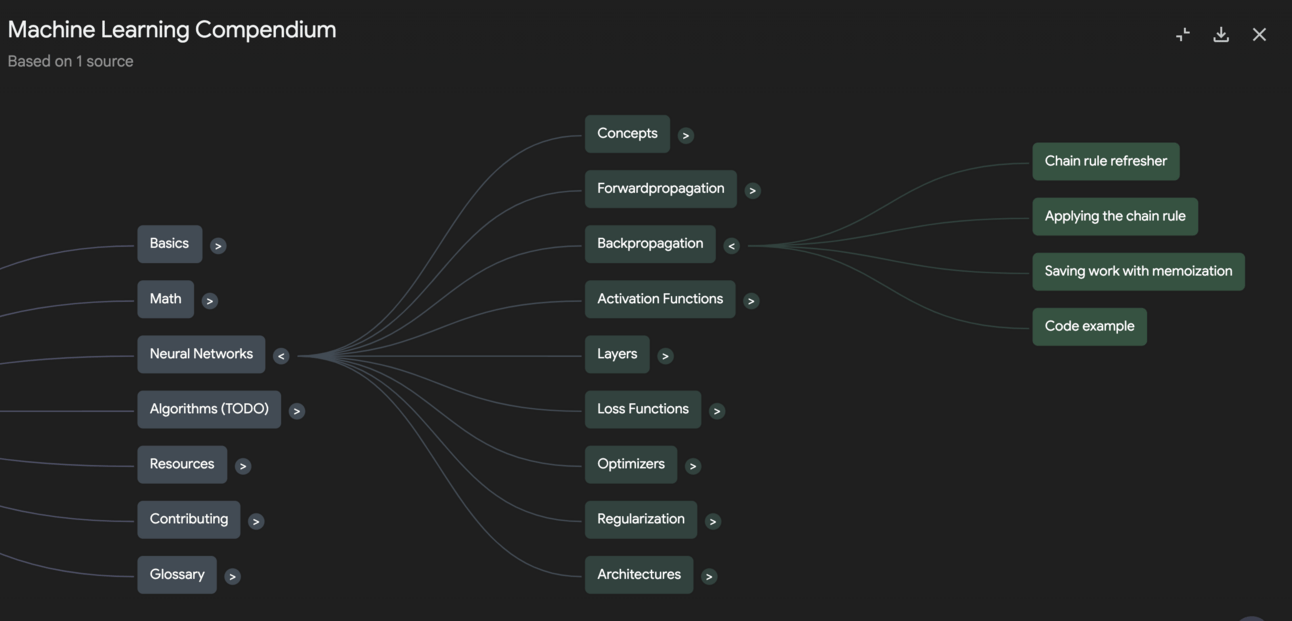
As your project grows, you can ask your AI tutor to synthesise information across multiple sessions:
"We've discussed customer acquisition strategies across several sessions. Could you create a comprehensive summary of all the approaches we've covered, with the key advantages and limitations of each?"
These summaries become valuable reference points within your knowledge repository.
Active recall—retrieving information from memory rather than simply reviewing it—is consistently shown to be one of the most effective learning techniques. Your AI tutor is the perfect partner for implementing this approach because it’s infinitely patient.
Begin each session with retrieval practice rather than passive review:
Try: "Before we start, can you ask me to explain the three economic indicators we discussed last session and how they relate to each other?"
This small change makes a profound difference in retention. The act of struggling to retrieve information strengthens the neural pathways associated with that knowledge, making future retrieval easier.
Have your AI tutor create a bank of questions covering the material you've learned. These questions should:
Focus on application rather than mere definition
Require connecting multiple concepts
Include "why" and "how" questions, not just "what" questions
Range from basic recall to complex problem-solving
At the beginning of each session, have your tutor select a few questions from this bank, including some from recent material and some from earlier sessions.
Regularly challenge yourself to explain complex concepts without referencing your notes or previous sessions. Your AI tutor can listen to and assess your explainations:
"Test my ability to explain [topic]. What could I explain better? What’s not clear?”
This approach combines active recall with the Feynman Technique we'll explore more in Part 5.
In Part 5, our final Part in this series, we'll explore the ultimate retention technique: teaching what you've learned.
We'll dive deep into the Feynman Technique and show you how to cement your knowledge by explaining it to others—even if that "other" is your AI tutor or a camera.
Keep Prompting,
Kyle
Someone who jumps out to me who exudes expertise is Nate B Jones on TikTok.
What immediately strikes me about Nate wasn't just his knowledge of AI—it was his absolute fluency in explaining complex concepts. He doesn't stumble or resort to vague generalisations. Instead, he speaks with clarity and confidence, breaking down complex topics into digestible explanations.
That is the kind of mastery we're all aiming for.
And we’re going to apply a final step to reach that level of fluency. We’ll leverage the Feynman technique - teaching is one of the most powerful learning tools available to us.
When you have to explain something to someone else, you cannot hide behind vague understanding or fuzzy concepts. You must clarify your own thinking, organise your knowledge, and identify gaps in your understanding. Otherwise you cannot explain to others.
Let's get started:
The Feynman Technique: The ultimate test of understanding
Teaching to your AI tutor: Private rehearsal for public fluency
Teaching-to-camera method: Building confidence and clarity
Connecting learning sessions to real-world outcomes
Named after Nobel Prize-winning physicist Richard Feynman, this technique is based on a simple premise: If you can't explain something in simple terms, you don't really understand it.
The traditional Feynman Technique involves four steps:
Choose a concept
Explain it to a 12-year-old
Identify gaps and go back to the source material
Simplify and use analogies
Your AI tutor makes an ideal partner for practicing this technique. Unlike a real person who might nod politely even when your explanation is confusing, your AI tutor can provide specific feedback on unclear elements and prompt you to refine your understanding.
Here's how to use your AI tutor to apply the Feynman Technique:
Select a key concept from your recent learning sessions. Choose something substantial enough to be challenging but defined enough to explain in a few minutes.
Ask your AI tutor to play the role of someone unfamiliar with the topic. For example: "I'd like to practice explaining machine learning algorithms. Could you pretend to be someone with no technical background, and I'll try to explain how they work in simple terms? Listen until I tell you I am done. Then provide feedback on the clarity of my explanation"
Deliver your explanation without referencing your notes or previous conversations in your project. Preferably use voice mode to deliver verbally.
Request targeted feedback on your explanation: "How clear was my explanation? Were there parts that seemed confusing or overly complex? Did I rely too much on jargon?"
Identify gaps in your understanding based on the feedback.
Refine and retry until you can explain the concept clearly and confidently.
This process forces you to transform passive knowledge into active understanding. The AI's feedback helps identify exactly where your explanation falls short, allowing you to focus your review efforts precisely where needed.
For bonus points and to deepen your understanding, practice explaining the same concept to different imagined audiences:
To a complete beginner: Forces you to avoid jargon and focus on fundamentals
To a peer with basic knowledge: Allows more technical language but requires clarity
To an expert in an adjacent field: Challenges you to make relevant connections
To a skeptic: Prepares you to address common misconceptions and objections
Adapt this depending on who you think you’ll end up talking to about these concepts. Your AI tutor can role-play these different audiences, asking appropriate questions from each perspective.
Taking your teaching practice to the next level involves recording yourself explaining concepts—a technique used by many top educators like Nate B Jones.
Recording yourself creates several powerful benefits:
Increases accountability (you can't gloss over concepts you don't fully understand, it’s right there on camera!)
Builds presentation confidence
Creates a record of your learning journey
Develops communication skills valuable in professional contexts
Forces additional clarity and conciseness
Here's a simple process to implement this approach:
Concept selection: Choose a single concept you've learned recently.
Outline preparation: Work with your AI tutor to create a simple outline covering:
What the concept is (definition)
Why it matters (relevance)
How it works (explanation)
When/where it applies (application)
Recording: Use your phone or computer to record a 2-3 minute explanation of the concept without referring to notes.
Publish: we need this to be real. Publish your work to TikTok, Instagram, Youtube Shorts and/or LinkedIn.
You don't need to share these recordings publicly (though this will certainly sharpen your practice!). The act of recording itself dramatically improves clarity of thought and expression.
If you do want to share your learnings publicly (in particular if you’re learning about AI) check out the AI Authority Accelerator.
One final piece! Action.
The ultimate test of learning is not what you know but what you can do with what you know. While teaching forces conceptual clarity, application projects ensure practical understanding. We introduced these briefly in Part 4, but let's explore how to design them specifically to cement learning.
We do this through focused mini projects.
Your AI tutor can help design custom projects tailored to your learning goals. Here's a template prompt:
I'd like to create a time-boxed project to apply what I've learned about [concept].
Could you design a 30-minute exercise that:

1. Focuses specifically on applying [specific aspect or technique]
2. Produces a tangible result I can evaluate
3. Relates to my goal of [your broader learning objective]
4. Can be completed with the tools and resources I have available
5. Includes clear evaluation criteria so I know if I've understood correctly

Please make this practical rather than theoretical, and ensure it's genuinely completable within the time limit.
For example if you are learning Python this prompt might gives projects like:
Build a specific function to solve a defined problem (30 min)
Debug a provided code sample with intentional errors (20 min)
Implement a particular algorithm from scratch (45 min)
Use these sort of projects (customised to what you’ve been focusing on!) to completely cement your learning. As a bonus : maintain a collection of your completed mini-projects, teaching videos, and real-world applications. This creates a tangible record of your growing expertise. Very neat.
We've covered a lot of ground in this series! Let's bring it all together into a sustainable system you can maintain long-term.
Setup: Configure your AI tutor with clear goals and methodologies (Part 2)
Acquisition: Conduct structured learning sessions with active engagement (Part 3)
Reinforcement: Implement spaced repetition and active recall (Part 4)
Cementation: Teach concepts and apply knowledge through projects (Part 5)
Here's what a sustainable weekly schedule might look like:
Day
Activity
Monday
30-min learning session with AI tutor on new concept
Tuesday
15-min review + 30-min application project
Wednesday
30-min learning session continuing the topic
Thursday
20-min teaching practice (explain to AI tutor or camera)
Friday
30-min learning session wrapping up the week's topic
Weekend
15-min outcome log and planning for next week
This represents about 2.5 hours per week—a modest time investment that produces substantial results when approached systematically. And because it’s all highly tailored to you it’s like having a 1:1 tutor on call.
Over this five-part series, we've built a comprehensive methodology for accelerated learning in the AI age:
In Part 1, we explored how AI fundamentally changes our relationship with knowledge, shifting from information scarcity to synthesis challenges.
In Part 2, we created a systematic approach to setting up your personal AI tutor, with a powerful prompt template that establishes the foundation for effective learning.
In Part 3, we designed structured learning sessions for engagement and retention through active participation rather than passive consumption.
In Part 4, we implemented retention strategies like spaced repetition and active recall to ensure knowledge becomes permanent rather than temporary.
And in this final part, we've explored how teaching and application cement learning through practical usage and clear articulation.
The world is changing rapidly, and our ability to learn effectively will determine our success more than any specific knowledge we currently possess.
Thankfully, you can develop a sustainable competitive advantage using AI: the ability to learn anything, faster and more thoroughly than ever before.
Keep Prompting,
Kyle
Unlock the future of learning with the '🤓 AI Tutor Personalised Learning' playbook, designed to revolutionize your educational journey through the power of artificial intelligence. This comprehensive guide empowers you to transform overwhelming information into actionable, personalized knowledge that accelerates your understanding and mastery of any subject. By collaborating with AI, you will not only learn faster but also retain and apply knowledge more effectively, setting you on a path to becoming a true expert in your field. Dive into this playbook to explore a new era of learning where traditional methods fall short. With five insightful parts, you'll discover how to set up your very own AI tutor, apply cutting-edge learning techniques, and ultimately harness the full potential of AI in your educational pursuits. Whether you're an entrepreneur, a professional seeking to upskill, or a curious learner, this playbook is your key to mastering the art of personalized learning.
This playbook is crafted for ambitious learners, entrepreneurs, and professionals who find themselves overwhelmed by the sheer volume of information available on AI and technology. If you've ever felt lost in a sea of online courses, newsletters, and tutorials without making meaningful progress, this playbook is designed specifically for you. Whether you're looking to keep up with the latest advancements in AI, enhance your skill set for career growth, or simply satisfy your curiosity, '🤓 AI Tutor Personalised Learning' will provide the structured approach and practical tools you need to turn information into actionable knowledge, helping you achieve your learning objectives efficiently.
No prior knowledge of AI is required. This playbook is designed to guide you from the basics to advanced concepts.
Each part of the playbook can be completed in a few hours, but the practical applications and projects can be spread out over weeks for deeper learning.
You will need access to an AI tool of your choice, such as ChatGPT, and a device for learning and project execution.
By mastering AI-assisted learning, you'll enhance your ability to acquire and apply knowledge quickly, making you more competitive in your field.
Absolutely! The methodologies taught can be applied to any subject or skill you wish to learn or improve.