
AI Business
Unlock the power of visual storytelling with our playbook, 'AI Explainer Comics for Business'.
Start ReadingLast week I spent three hours with the new ChatGPT model, experimenting with something that's been buzzing in my head for months: AI-generated comics for business.
The results? Bloody brilliant, frankly.
Kinda shocked by the new ChatGPT image tool
I’ve been using it this morning to make explainer comics for socials
VERY cool
— Kyle Balmer (@iamkylebalmer)
1:27 PM • Mar 26, 2025
I created a 12-panel comic explaining how large language models work—a complex technical concept—in a delightfully approachable way. Then I posted it on Twitter. Within 24 hours, it racked up over 10k views. Not too shabby.
I also flipped it into:
LinkedIn Carousel
Instagram carousel
TikTok slideshow and Tiktok video
Here's the thing: I love comics. Sorry, “graphic novels”.
But I'm no artist. Before this, my drawing skills peaked at slightly misshapen stick figures. Now I'm publishing educational comics that people actually want to read and share. That's the game-changer for our business we're exploring this week.
Let's get started:
Why comics are powerful tools for technical communication
The transformation AI brings to comic creation for business
Real-world examples that prove the concept works
Comics aren't just for superheroes and Sunday funnies. They're secretly one of the most powerful communication tools humans have ever created. They combine visual storytelling with text in a way that makes complex ideas digestible and memorable.
Jeremy Nguyen captured this perfectly when he shared a comic he made using ChatGPT's image generation:
The best way to remember what matters?
Make it visual. Keep it simple.
I'm using ChatGPT's brand new image gen to illustrate principles I don't want to forget:
— Jeremy Nguyen ✍🏼 🚢 (@JeremyNguyenPhD)
10:16 AM • Mar 29, 2025
"The best way to remember what matters? Make it visual. Keep it simple."
The Japanese have actually been using manga to explain everything from quantum physics to cooking techniques for decades. Medical textbooks in graphic novel format help students retain information better than traditional texts.

Why? Because our brains are wired to process visual narratives. Comics create mental models that stick. They turn abstract concepts into concrete visuals. They give personality to dry information.
Most importantly, they get read. In an age of shrinking attention spans, that's no small victory.
The AI backlash will be bigger than anything we've seen in tech. When both a truck driver and a painter realize they're just training data for machines, this stops being a tech issue and becomes a human one.
— GREG ISENBERG (@gregisenberg)
12:51 PM • Mar 30, 2025
Some of you will even be flicking through this Playbook and looking at only the comics.
That should probably tell you something!
Until now, there's been one massive barrier to entry: artistic skill. Creating good comics required either learning to draw (years of practice) or hiring an illustrator (expensive and time-consuming).
AI art generation has completely smashed that barrier. Now you can go from idea to shareable comic in hours, not weeks or months. The implications for business communication are enormous:
Technical explainers that people actually want to read
Product tutorials that don't bore customers to tears
Brand stories that create emotional connection
Complex value propositions made instantly understandable
Social content that stops the scroll and drives engagement
Let me show you what's possible with some examples:
My LLM Explainer Comics: I created a series explaining how large language models work, breaking down complex concepts like token prediction and context windows into friendly visual metaphors. The engagement was 4x my normal posts.
I’ll be rolling out this concept more broadly soon to explain how AI actually works. Watch this space.
Medical Education: Dr. Derya Unutmaz (an immunologist) created a comic series explaining T-cells and immune response for children using the same ChatGPT image generation tool. His tweet about it went viral, with other medical professionals asking how they could create similar resources.
These are some of my favorite images created with @OpenAI’s 4o image generation 😍
I made a comic series for children explaining the life of immune cells (T cells), which I had studied most of my life. It’s unbelievably good! The comic series will continue. 🥰
— Derya Unutmaz, MD (@DeryaTR_)
7:01 PM • Mar 25, 2025
What's particularly powerful is how these comics can be repurposed across different channels—from social carousels to email newsletters to printed materials. Create once, deploy everywhere. We’ll cover that in a later Part.
The business case for AI-generated comics is compelling:
Cost: A professional illustrator might charge £500-1,500 for a custom comic. With AI tools, you can create them for pennies.
Time: Custom illustration work often takes weeks. AI comics can be ready in hours.
Flexibility: Need to make changes? No problem. With traditional comics, revisions are expensive and time-consuming.
Engagement: Comics typically drive 2-5x more engagement than text-only posts on social media.
Versatility: The same comic can be adapted for different channels—social, email, presentations, or print materials.
But perhaps most important is the accessibility factor. You don't need to be an artist. You don't need a massive budget. You just need ideas and the right prompting techniques.
Over the next four parts of this newsletter series, I'll be walking you through the entire process of creating effective AI comics for your business:
Part 2: Developing Your Comic Identity - We'll explore how to create consistent characters and visual styles that align with your brand.
Part 3: Crafting Complete Comic Stories - I'll show you how to break down complex concepts into engaging narrative sequences and create eye-catching cover images for social media.
Part 4: Perfecting Individual Panels - We'll dive into the nitty-gritty of prompting for better panels, addressing common limitations, and improving visual consistency.
Part 5: Distribution, Repurposing, and ROI - Finally, we'll cover how to get your comics in front of your audience and measure their impact.
By the end of this series, you'll have everything you need to start creating your own AI-generated comics that explain, engage, and convert.
Keep Prompting,
Kyle
When it comes to creating AI-generated comics for your business, the biggest challenge I hear from people is simply not knowing where to start.
"I'm not a designer or artist, and I have no experience with comics”. Makes sense! Most people don’t!
There's also the very real concern that without proper guidance, you'll end up with something that looks like a generic knockoff rather than something distinctively yours.
Thankfully you don't need artistic talent or extensive comic knowledge to create effective, original comics for your business. BUT what you do need is a systematic approach to making smart choices about characters, settings, and visual style.
That's exactly what we're going to work through today: a methodical process for developing your comic identity from the ground up.
Let's get started:
Building your comic identity step-by-step
Character development through guided prompts
World-building with practical examples
Defining your visual style with AI assistance
Creating your master prompt document
Creating a comic identity might seem overwhelming if you're not a designer or illustrator. We’re going to break it down with a handful of prompts that will:
Ask you the right questions
Generate examples based on your answers
Help you refine your preferences
Build your master prompt document
By the end of this process, you'll have a clear visual direction and a master prompt that ensures consistency across all your future comics.
We’ll then use this master prompt as a style guide to create all our comics moving forward.
Characters are the heart and soul of your comics. They guide readers through concepts, embody abstract ideas, and create emotional connection. Whether you opt for a cartoon version of yourself, a brand mascot, or characters that personify concepts in your field, they need to be instantly recognisable and consistent.
When I created characters for my AI explainer comics, I knew I needed a way to represent neural networks, the language model itself, and the input/output process. After some experimentation, I settled on a friendly brain character (depicting human intelligence) with arms and legs and a blue robot with a cube-shaped head (depicting artificial intelligence).
Let's develop your characters using this guided prompt:
You are a comic character development expert helping me create characters for business-focused AI-generated comics. Please interview me to develop characters that will represent key concepts in my business.

Ask me these questions one at a time, waiting for my response to each:

1. What industry or topic will your comics primarily explain? (e.g., AI, marketing, finance, health)

2. Who is your target audience for these comics?

3. Would you prefer to:
   a) Appear as yourself in the comics
   b) Create a mascot character that represents your brand
   c) Use characters that personify concepts in your field
   d) Feature avatars representing your customers/users

4. Based on my choice, ask relevant follow-up questions:
   - For self-insert: Ask about my appearance, style preferences, and how I want to be portrayed
   - For mascot: Ask what animal/object/character would represent my brand well
   - For concept characters: Ask what 2-3 key concepts need representation
   - For customer avatars: Ask about my typical customer demographics

5. For each character we decide on, ask:
   - What is this character's role in explaining your topics?
   - What personality traits should they have?
   - What distinctive visual features would make them instantly recognizable?
   - How do they typically interact with other characters or concepts?

After gathering my responses, provide a detailed summary of each character with name, role, visual description, and personality
Go ahead and run this prompt, answering each question thoughtfully. This guided interview will help you clarify your character needs before we even start generating images.
Now continue in the same Chat with the next step.
Your characters need a world to inhabit. This doesn't have to be elaborate—even a minimal background provides context for your concepts. The main thing is we explicitly define the world so that when generating comics the AI doesn’t just choose willy-nilly.
For my AI comics, I wanted a clean, abstract environment that wouldn't distract from the explanations. I settled on simple gradient backgrounds with occasional digital elements. I created visual metaphors like building blocks for tokens, stacks of paper for context windows, and magnifying glasses for attention mechanisms.
Your world should complement your topic area. Financial comics might use money gardens or budget containers as metaphors. Marketing comics might visualise customer journeys as actual paths. The key is consistency—your audience should recognise your comic world instantly.
Let's develop your comic world using this guided prompt:
You are a comic world-building expert helping me create settings and environments for my business-focused comics. Based on the characters I've developed, please help me define my comic world.

Ask me these questions one at a time, waiting for my response to each:

1. Would you prefer your comic settings to be:
   a) Realistic environments (offices, homes, etc.)
   b) Abstract conceptual spaces
   c) Metaphorical landscapes
   d) Minimalist backgrounds

2. Based on my industry, what specific environments would be relevant to show? (Ask follow-ups based on my industry)

3. Are there any specific props or objects that would help explain concepts in your field?

4. What visual metaphors might help represent abstract concepts in your field?

5. Would you like your backgrounds to be:
   a) Detailed and immersive
   b) Simple with just enough context
   c) Very minimal to focus attention on characters

After gathering my responses, provide a detailed summary of my comic world with key settings, props, and visual metaphors
Run this prompt and work through the questions. This will give your comics a consistent sense of place and visual vocabulary.
Again, keep this and continue your work in the same chat for the next step.
Visual style might be the most challenging aspect to articulate, especially if you're not a designer.
This includes elements like art style (cartoon, manga, comic book), line weight, colour palette, and text treatment. This is where specialist language and terminology comes into play and if you don’t know it then you might feel overwhelmed.
When I was developing my comics, I experimented with several approaches before landing on a clean, simple cartoon style with medium-weight lines and flat colours. This style was both visually appealing and - crucially - consistent when generated by AI.
Your visual style should align with your brand and resonate with your audience. A financial advisor might want a more professional, clean approach, while a creative agency might prefer something more expressive and vibrant.
Don't worry if you don't have the design vocabulary to express exactly what you want. The following guided prompt will help you explore options through examples:
You are a comic style consultant helping me define the visual approach for my business comics. Based on my characters and world, help me determine the most appropriate visual style.

Ask me these questions one at a time, waiting for my response to each:

1. Which of these comic art styles appeals to you most:
   a) Clean, simple cartoon (like xkcd or Dilbert)
   b) Manga-inspired with more expressive features
   c) Classic comic book style with more detail
   d) Modern minimalist with geometric shapes
   e) Hand-drawn, sketchy appearance

2. How would you describe your brand's visual personality?
   (e.g., professional, playful, cutting-edge, traditional)

3. Is there an existing comic, illustration style, or artist whose work you admire?

4. What colour palette aligns with your brand or topic?
   a) Your existing brand colours
   b) Industry-standard colours
   c) Conceptual colours (e.g., green for money, blue for technology)
   d) Limited palette (2-3 colours only)

5. How would you like text to appear in your comics?
   a) Traditional speech bubbles
   b) Modern text boxes with borders
   c) Integrated into the scene
   d) Minimalist text without containers

After gathering my responses, provide a detailed summary of my chosen visual style with art style, colour approach, and text treatment
OK as before keep in the same chat. You now have the character, world and style guidelines in place.
Let’s have a look and SEE what this looks like.
Seeing is believing when it comes to visual styles. It's one thing to describe what you want, but you'll only know if it works when you see it.
To start let’s very simply use this prompt in ChatGPT:
Generate a comic panel introducing [concept from your field] using the above character, world and style descriptions.This will spit out a first draft of your style. It may be amazing off the bat. But we want to go a little further.
When I was developing my style, I tested subtle variations on my chosen approach. I found that small adjustments to line weight, colour saturation, or character proportions could make a significant difference in both visual appeal and clarity.
Here's a prompt you can use to generate a grid of style variations based on your choices so far:
Create a 2x2 grid showing four variations of the same comic panel.

Create four variations that maintain my basic preferences but explore different style possibilities.

Label each variation clearly and include a brief description of what makes each one distinct. This will help me refine my final style choice.
Here is an example output:
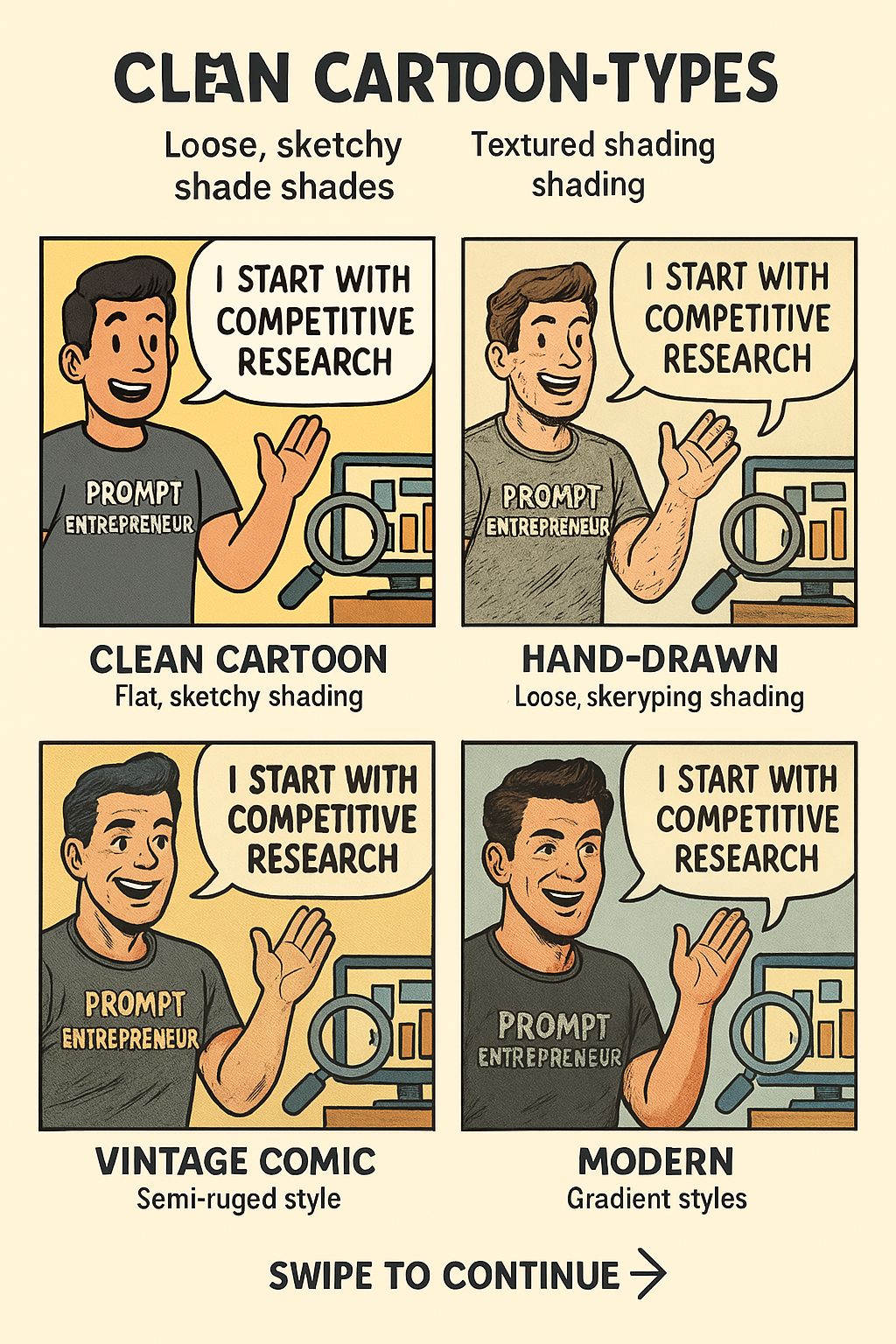
Importantly you don’t need the language to explain what exactly you like or don’t like. You can see the variations and simply decide.
We are then going to feed that decision back to ChatGPT and ask it to revise our style guidelines accordingly. I could say “I like the modern gradient style here, can you give more variations along those lines” and continue like this until we settle on something great.
Don't rush this stage—the style you choose will define the look and feel of all your future comics. Take time to analyse the variations and determine which elements work best for your specific needs.
OK. Lots of groundwork but it’ll be worth it.
We’re going to pull everything together in one place: a master prompt.
Your master prompt is essentially a comprehensive creative brief for all your future comics. It's the document that ensures consistency across every panel you create, no matter when or what topic you're explaining.
Think of your master prompt as a set of brand guidelines specifically for your comics. Just as companies have strict rules about logo usage, colours, and typography, your master prompt defines the rules for your comic universe.
I keep my master prompt document in Notion for easy access. Whenever I create a new comic, I start with this document and then add the specific content for that panel or sequence. This approach saves enormous time and maintains consistent quality. This is why all this prep work is worthwhile!
After you've worked through the character, world, and style prompts, and you're happy with the visual examples generated, use this final prompt in the same chat to create your master document:
Based on all my previous selections for characters, world, and visual style, please create a comprehensive and exhaustive master prompt that I can use for all future comic panel generation. The master prompt should:

1. Include detailed descriptions of each character with their roles and visual features
2. Define the world settings and visual metaphors
3. Specify the chosen art style, colour approach, and text treatment
4. Include any special instructions for maintaining consistency
5. Be structured in a way that I can easily modify for different comic panels while maintaining the core elements

Format this as a complete prompt template with clearly labeled sections that I can copy and use directly with AI image generation tools.
The resulting master prompt becomes your comic creation blueprint. Any time you want to create a new comic panel or sequence, you'll start with this document and add the specific content for that panel.
OK that’s a lot of prep work! Fun part starts in the next Part I promise!
In Part 3, we'll take your newly developed master prompt and use it to create your first complete comic sequence.
Keep Prompting,
Kyle
Do we go for a single-panel cartoon like The New Yorker? Or a full-blown comic book?
Single panels are HARD. Requires clever writing and composition to pull off. Doable but making it harder on yourself.
Full comic books, meanwhile, are too resource-intensive and exceed most social media limitations.
The goldilocks zone is short-form comics of 8-10 panels. They're perfect for social media carousels, easily digestible by readers, and ideal for explaining concepts without overwhelming your creation process.
And today we’re going to start printing!
Let's get started:
The narrative structure of effective explanation comics
Crafting an 8-10 panel sequence for social media carousels
Generating panels sequentially with consistency checks
Creating eye-catching cover images (and why we save this for last)
What to watch for in your first complete comic
Let’s cover the basic workflow - we’ll take it step by step. Don’t worry: once you’ve done this once or twice it’s not complex!
The first step is to establish a clear narrative structure for your comic. This gives you a roadmap to follow as you create individual panels.
Let's look at this structure in action with a prompt that helps you plan your comic's narrative flow:
Help me structure an explanation comic about [your topic]. I want to create an 8-panel sequence that educates my audience while telling a compelling story.

My topic: [Describe what you want to explain]
Target audience: [Who will be reading this comic]
Main character(s): [From your comic identity]
The concept to explain: [Specific aspect you're focusing on]

Please outline an 8-panel narrative structure that includes:

1. A hook panel that presents a relatable problem or question
2. A setup panel that introduces the characters and concept
3. 1-2 panels that identify the specific challenge or confusion
4. 2-3 panels that walk through the solution/explanation step by step
5. A payoff panel showing the benefit of understanding this concept
6. A call to action panel guiding readers on next steps

For each panel, provide:
- Brief description of the visual scene (what's happening, who's present)
- Suggested dialogue or caption text (keep text minimal - around 15-25 words max)
- Key visual elements to include
- Panel composition (close-up, medium shot, etc.) for visual variety
This prompt will generate a comprehensive outline for your comic sequence, but it's crucial that you review and refine it before proceeding. This is your chance to:
Adjust any panel descriptions that don't align with your vision
Refine dialogue to match your brand voice
Add specific visual elements you want to include
Ensure the narrative flow makes sense for your concept
Do this before we rush into generation. The effort will pay off as you’ll spend less time fussing with the images. Make any edits or adjustments to the outline before moving on. You can ask the AI to revise specific panels or aspects of the outline until you're satisfied.
Oh and you might be wondering why 8-10 panels? Basically: social media.
Instagram carousels are 10 images. So if we come in at <10 we get the most bang for our buck by being able to deploy on multiple platforms.
Only when you're completely happy with your outline should you move to Step 2: creating the individual panels.
Once you have a refined outline, it's time to create each panel based on that outline. Rather than filling in details manually for each panel, we'll use a prompt that automatically pulls from your outline.
Remain in the same chat and use this prompt:
Now that I have my comic outline, please create Panel [number] based on my outline details.

Format the panel as a square (1:1 ratio) optimised for social media viewing, with text large and clear enough to read on mobile.

Use my master prompt elements for visual consistency:
[Include key elements from your master prompt: characters, style, etc.]

For this specific panel, use these details from my outline:
Scene description, Dialogue/Caption, Visual elements, Panel composition

Ensure consistency with any previously generated panels in terms of character appearance, style, and background elements where applicable.
The beauty of this approach is that after your first panel is created, you can simply respond with "Next panel" or "Create panel 2" and the AI will automatically progress through your outline, creating each panel in sequence.
After each panel is generated, take a moment to review it:
Does it match your outline's vision?
Does it maintain consistency with previous panels?
Is the text readable and properly positioned?
If any panel needs adjustments, you can provide specific feedback before moving to the next one: "This looks good, but please make the character slightly larger and adjust the text placement so it doesn't cover the visual elements."
We’ll cover detailed feedback in Part 4.
Continue this process, generating each panel in order, until you've completed your whole sequence.
Your cover image is the gateway to your comic. On social media, it determines whether someone will swipe to see more. It’s like a video or tweet hook. If people don’t get past this then the rest is pretty much irrelevant!
You might wonder why we're not starting with the cover image. There's a method to this apparent madness:
The cover should represent the actual content: By creating your panels first, you ensure your cover accurately reflects what's inside your comic.
You'll discover the most compelling visual: Often the most powerful visual metaphor or character moment emerges during the panel creation process—something you wouldn't have thought of initially.
You'll know your comic's true focus: The message or concept that actually became central to your comic might shift slightly during creation.
You can repurpose successful elements: You can incorporate the most visually striking elements from your panels into your cover image.
Here's a prompt for creating engaging cover images. Use this below all your previous work so it can pull in the details.
Create a comic book style cover image for my explanation comic.

Refer to the style guidelines and instructions above.

Key elements:
- Title: "[Your Comic Title]" in large, bold text
- Featuring: [Your main character(s)]
- Style: [Match your established style]
- Main visual: [Central concept or scene that represents your comic]
- Format: Square (1:1 ratio) optimised for social media

The cover should:
- Clearly communicate the topic
- Feature my established character(s) in an engaging pose
- Include visual elements that hint at the content
- Have a clean, bold title treatment
- Include a visible arrow and "Swipe to continue" text
- Include "A Comic by [Your Name/Brand]" at the bottom

IMPORTANT CONSISTENCY REQUIREMENTS:
- Character appearance must match the panels I've already created
- Visual style must maintain perfect consistency with my comic panels
- Colour palette should remain consistent
Because this is arguably the most important image feel free to generate a bunch of variations and choose between them.
For my LLM explainer comic cover, I positioned my three main characters (brain, robot, and input/output figure) centrally with the title "UNDERSTANDING LLMs" in bold text. I included small corner panels showing snippets from the comic itself, which created visual interest and hinted at the content inside.
Importantly make sure you cover has an arrow element to tell people to move to the next panel. Super important on social media in particular where only your first image is shown. We need to instruct our viewers to move to the next panel by swiping.
In Part 4, we'll dive deeper into perfecting individual panels. We'll explore advanced techniques for creating more dynamic, visually interesting comic panels, addressing common limitations in AI-generated comics, and elevating the overall quality of your comics.
This stuff is honestly more optional. But good to know if you want to go further.
We'll also look at how to troubleshoot specific issues, including:
Regenerating problematic panels
Editing specific elements within panels
Creating more dynamic compositions
Improving text placement and readability
Remember, your first comic doesn't need to be perfect—it needs to exist. Each comic you create will be better than the last as you refine your process and master your style. So just build and publish - we’ll refine as we go!
Keep Prompting,
Kyle
I came across a tweet last week that perfectly captured the frustration many feel about AI-generated comics. A professional illustrator pointed out how AI comics often look stilted and uncreative – characters essentially in the same pose in every panel, always shot from the same camera angle, with blank, nebulous backgrounds and no variety in composition.
And you know what? They're not wrong! AI generated comics can be pretty middling!
The basic techniques we've covered so far will get you functional comics that explain your concepts effectively. But there's a significant gap between "functional" and "visually compelling."
Let's get started:
Elevating your comics from functional to fantastic (entirely optional!)
Creating character sheets for consistent characters
Basic fixes for common AI comic problems
Advanced techniques for visual storytelling
Resources for learning the language of comics
First, let me emphasise: everything in this issue is entirely optional. If you're happy with the comics you've created using Parts 1-3, that's fantastic! The primary goal is effective communication, not winning illustration awards.
This issue is necessarily more of a grab bag – a collection of techniques you can apply based on your specific style, goals, and the particular challenges you're facing. Not every tip will be relevant to your situation, and that's perfectly fine.
For those who want to dive deeper into comic storytelling principles, I highly recommend Scott McCloud's books, particularly "Understanding Comics" and "Making Comics." These are masterworks on the visual language of comics and will give you a deeper appreciation of the medium.
Now, let's look at how we can address some of the most common limitations of AI-generated comics.
One of the biggest challenges with AI comics is maintaining character consistency across panels. The solution? A character sheet – something professional comic artists have used for decades.
A character sheet is essentially a visual reference guide for your characters, showing them from different angles, with various expressions, and in different poses. It serves as a consistency bible for your comics.
Here's how to create one:
Create a comprehensive character sheet for [character name] that I can use as a reference for my comics.

Include:
1. Front-facing full body view in neutral pose
2. Side profile view
3. 3/4 angle view
4. Close-up of face with neutral expression
5. Five key facial expressions: [list relevant expressions like happy, confused, excited, etc.]
6. Three characteristic poses that show: [list poses relevant to your character]
7. Colour guide with specific colours for:
   - Clothing/body
   - Hair/distinctive features
   - Any accessories or tools

Add labels and notes about distinctive features that must remain consistent, such as:
- Proportions (exact head-to-body ratio)
- Unique identifying elements
- Specific style details

Format this as a single reference image I can keep alongside my master prompt for all future comics.
Moving forward, you can add this character sheet to your master prompt from Part 2, creating a more complete visual guidebook for your comics. Simply refer to the character sheet in your panel generation prompts.
Let's address some of the most frequent issues with AI-generated comics:
The most common problem is panels filled with static characters just standing and talking:
Regenerate this panel with the same content but make the character poses more dynamic and engaging.

Current panel shows: [Brief description of your current panel]

Instead of having [character] simply standing and talking, show them:
- Actively demonstrating the concept (e.g., pointing, manipulating objects)
- Using expressive body language that reinforces the message
- Interacting with visual elements rather than just talking about them

Keep all dialogue and the core message exactly the same, but make the visual presentation more engaging.Another common issue is using the same straight-on, medium-shot perspective for every panel:
Regenerate this panel using a different camera angle for visual interest.

Current panel uses a straight-on medium shot. Replace it with a [choose one]:
- Low angle view (looking up at the character/scene)
- High angle view (looking down at the character/scene)
- Close-up (focusing on facial expression or important detail)
- Wide shot (showing more of the environment)
- Over-the-shoulder view (looking from behind one character toward another)

The new angle should emphasise [key aspect of the message] while maintaining all the essential content.Generic or missing backgrounds make comics feel disconnected and ungrounded:
Enhance only the background in this panel while keeping characters and text identical.

Current panel has a [plain/generic/missing] background.

Improve the background to:
- Establish a clear setting related to [topic]
- Include contextual elements that reinforce the message
- Add depth and dimension to the scene
- Complement rather than compete with the foreground elements

The background should provide context without distracting from the main focus.Sometimes you don't need to regenerate an entire panel – you just need to fix a specific aspect.
Importantly ChatGPT lets you highlight certain areas you want to change. It’ll then only apply changes there and (theoretically) leave the rest alone. That’s not to say we don’t need to prompt it.
Sometimes you don't need to regenerate an entire panel – you just need to fix a specific aspect:
Fix this specific character inconsistency issue in my panel.

Current panel shows [character name] with these inconsistencies compared to previous panels:
- [List specific differences: facial features, proportions, clothing details, etc.]

Please modify ONLY this character to match their appearance in previous panels while keeping everything else in the panel exactly the same.

Reference for correct appearance: [Description from previous successful panel]Adjust only the colours and art style in this panel to match the rest of my comic.
Current panel has [different colour palette/art style/line weight] compared to previous panels.
Modify ONLY the visual style to:
- Match the exact colour palette established in previous panels
- Maintain consistent line weight and detail level
- Use the same shading/lighting approach
- Keep the same overall art style
Do not change any content, composition, or elements in the scene.Once you've addressed the basic issues, these advanced techniques can take your comics to the next level:
Create a stronger visual metaphor for explaining [abstract concept].

Current approach: [Describe how you're currently representing this]

Develop a more intuitive visual metaphor that:
- Makes the abstract concept immediately understandable visually
- Allows characters to physically interact with it
- Can be consistently represented across multiple panels
- Simplifies understanding for someone unfamiliar with the topic

For example, instead of just talking about "data processing," show data as physical objects moving through a visible system.
I personally like to sit with an AI and come up with lots of potential metaphors for concepts I want to talk about - these are super helpful not just for the comics but also generally when communicating about our niche.
Modify this panel to direct visual focus more effectively to the key element.

The most important element that should have visual focus is: [Specify key element]

Enhance visual focus by:
- Creating stronger contrast around the key element
- Using directional cues (lines, character gazes) pointing toward it
- Slightly de-emphasising less important elements
- Using colour or lighting to naturally draw attention to the focal point

These changes should guide the viewer's eye to the most important part of the panel.Apply a cinematic technique to this panel to increase its visual impact.
Apply this specific technique: [Choose one]
- Dramatic lighting (strong contrast between light and shadow)
- Dutch angle (slight tilt to create tension or energy)
- Parallax effect (multiple depth layers with foreground and background elements)
- Forced perspective (manipulating scale to emphasise relationships)
- Silhouette effect (using bold shapes against contrasting backgrounds)
The technique should enhance the message while maintaining clarity.With ALL of the approaches above you need to just test them out on your comics and see what happens. These are about opening up possibilities rather than a set process.
That said, I always like to give a clear checklist of actions so let’s have a shot!
When looking to improve your existing comics, follow this process:
Evaluate your comic panel by panel, asking:
Is this panel visually interesting?
Does it clearly communicate its message?
Is it consistent with surrounding panels?
Does it offer visual variety compared to adjacent panels?
Identify your weakest panels - these will benefit most from improvement
Apply targeted fixes - start with basic issues first:
Character consistency problems
"Talking heads" syndrome
Generic backgrounds
Add visual interest once the basics are addressed:
Vary camera angles
Improve character posing and interaction
Enhance visual metaphors
Apply emotional atmosphere techniques
Remember: You don't need to apply every technique to every panel! This is more of a grab bag of techniques to try out yourself.
In our final instalment, Part 5, we'll cover distribution.
We'll explore how to optimise your comics for different platforms, create series that build on each other and beyond.
Keep Prompting,
Kyle
Over the past four parts of this series, we've been focused on creation – developing our comic identity, crafting complete narratives, and perfecting individual panels. Now it's time to talk about what happens after creation.
The comics you've created aren't just one-off content pieces; they're valuable business assets. Unlike many forms of content that have a short shelf life, well-crafted explanation comics can continue delivering value for months or even years after creation.
Think of each comic not as a disposable piece of content but as an investment in your business's intellectual property portfolio. These are assets you can repost, repurpose, and boost to maximise your return on creation time.
Let's get started:
Comics as valuable, long-term business assets
Repost: Platform-specific optimization for maximum engagement
Repurpose: Transforming comics into different media formats
Boost: Amplifying successful comics with paid advertising
Building a library of visual assets over time
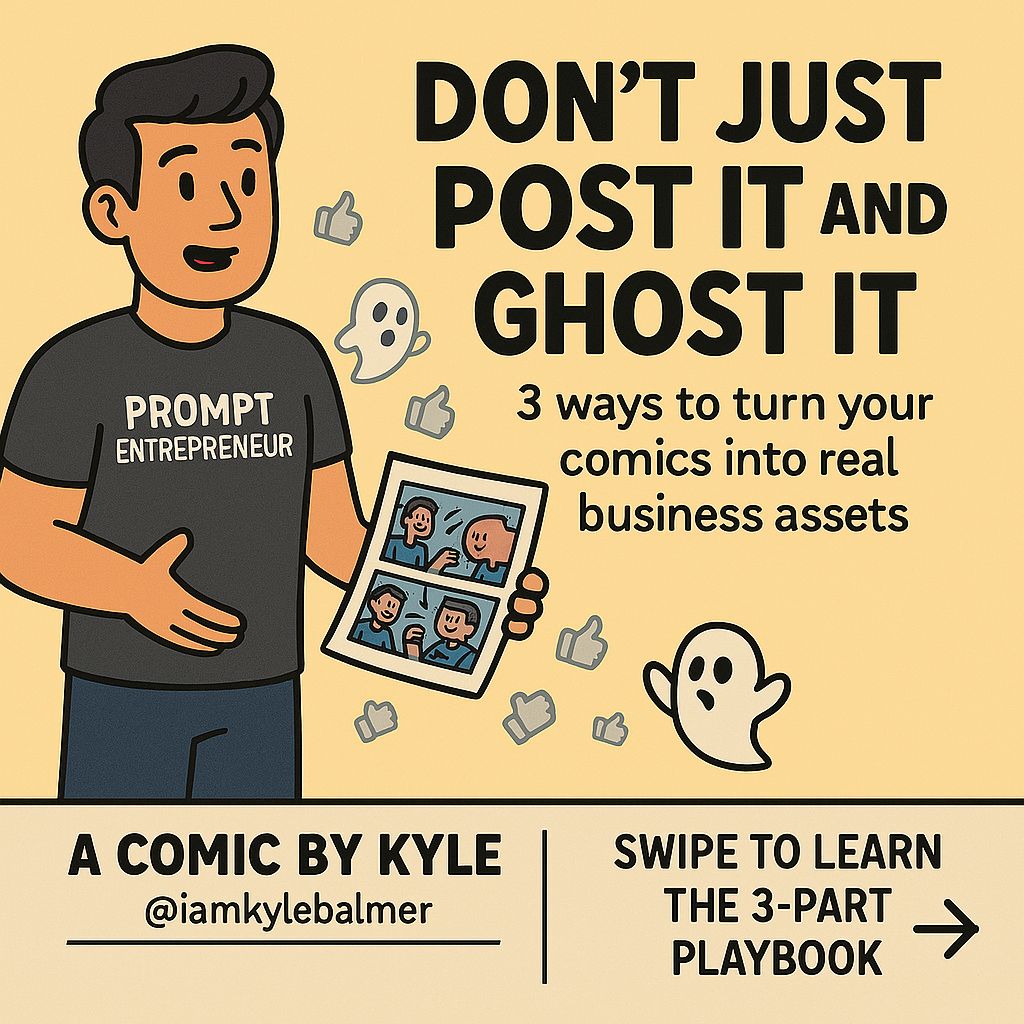
How to convert your comics into legit business assets
Every comic you create becomes a valuable business asset in your content library. These aren't one-and-done content pieces that expire after posting – they're versatile tools that can:
Explain complex concepts consistently across multiple platforms
Serve as educational resources for customers at various stages
Establish your visual brand identity over time
Generate engagement across different platforms
Become the foundation for paid advertising campaigns
Specifically in this Part we’re talking about Reposting, Repurposing and Boosting.
Unlike written content that can quickly become dated or videos that require substantial production resources, comics strike an ideal balance between impact and creation efficiency. They communicate visually (which increases retention) while being relatively quick to produce once you've established your process.
Most importantly, they're incredibly versatile – which brings us to our first strategy.

Repost the same images with minor tweaks to different platforms.
Each platform has its own preferences, dimensions, and audience expectations. The good news is that you don't need to create entirely new comics for each platform – you just need to optimise your existing comics to fit each environment.
Here's how to adapt your comics for maximum performance across the major platforms:
Instagram is all about visuals and works exceptionally well for comics with its carousel feature that allows up to 10 images.
Optimisation Approach:
Use square (1:1) format for consistency across the carousel. (We previously optimised for this anyway as it’s the most versatile format)
Create a strong cover image with an attention-grabbing visual and clear title
Add context in your caption that explains the value of the comic
Use strategic hashtags to reach new audiences (#ExplainerComics #YourIndustry #VisualLearning)
Consider adding a call to action in the final panel
Instagram audiences respond especially well to visually striking, easy-to-understand sequences. The platform's swipe-through format makes it perfect for educational comics that build from one panel to the next.
LinkedIn is more professionally focused but increasingly receptive to creative content formats – especially when they communicate business value.
Optimisation Approach:
Use the document/carousel feature with square or slightly wider panels - make a PDF of your panels and upload as a document to unlock the carousel format
ALTERNATIVELY just upload the images sequentially for a multi-image post
Frame your comic in terms of business applications and professional relevance
Use more formal language in your post caption.
LinkedIn audiences appreciate content that helps them solve professional challenges or understand complex business concepts. Frame your comics as professional insights rather than just entertaining content.
Twitter moves fast and requires immediate impact. Single powerful panels or very short sequences work best.
Optimisation Approach:
Lead with your strongest, most impactful panel as a standalone image
Use thread format for sequences, with one panel per tweet - this increases engagement time and bumps the algo
Note: If using a thread for a full comic sequence, make sure each panel can stand relatively well on its own. Tricky but helps individual panels be shared.
Convert the comic format from image to video/text.
Your comics can extend well beyond their original format. The same valuable content can be transformed into multiple media types, each reaching people who prefer to consume content differently.
Those panel sequences you've created can be transformed into engaging video content with minimal additional effort:
Transformation Approach:
TikTok, Instagram and Capcut have tools for automatically converting photos/static images into videos
Alternatively send to an editor to give the full treatment - even to the extent of converting to animations
Keep videos short (30-60 seconds for social, 2-3 minutes for YouTube)
Video versions can reach audiences who prefer watching to reading and can work particularly well on platforms like TikTok, Instagram Reels, and YouTube Shorts.
Those same comics can be expanded into comprehensive blog content:
Transformation Approach:
Use the comic as a visual centrepiece for your post
Expand on each panel with additional context and examples
Add data, research, or case studies that support the comic's message
Include practical application steps for readers
Incorporate relevant keywords for SEO
Blog versions allow you to go much deeper than the comic alone, reaching audiences who want comprehensive information and prefer reading detailed content. You basically use the comics itself as a jumping off point and flesh out with written content. Notice that this particular guide incorporates a comic and text guide! I’m doing it right now.
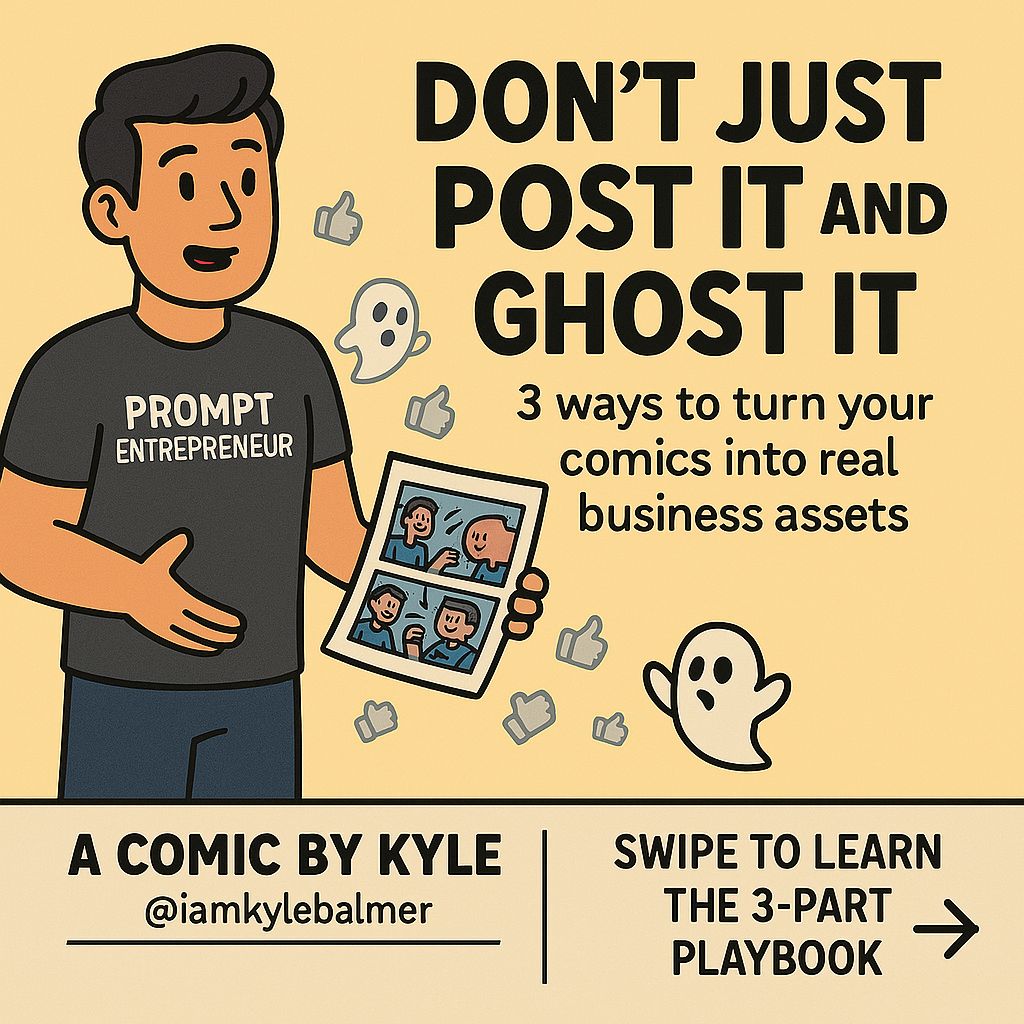
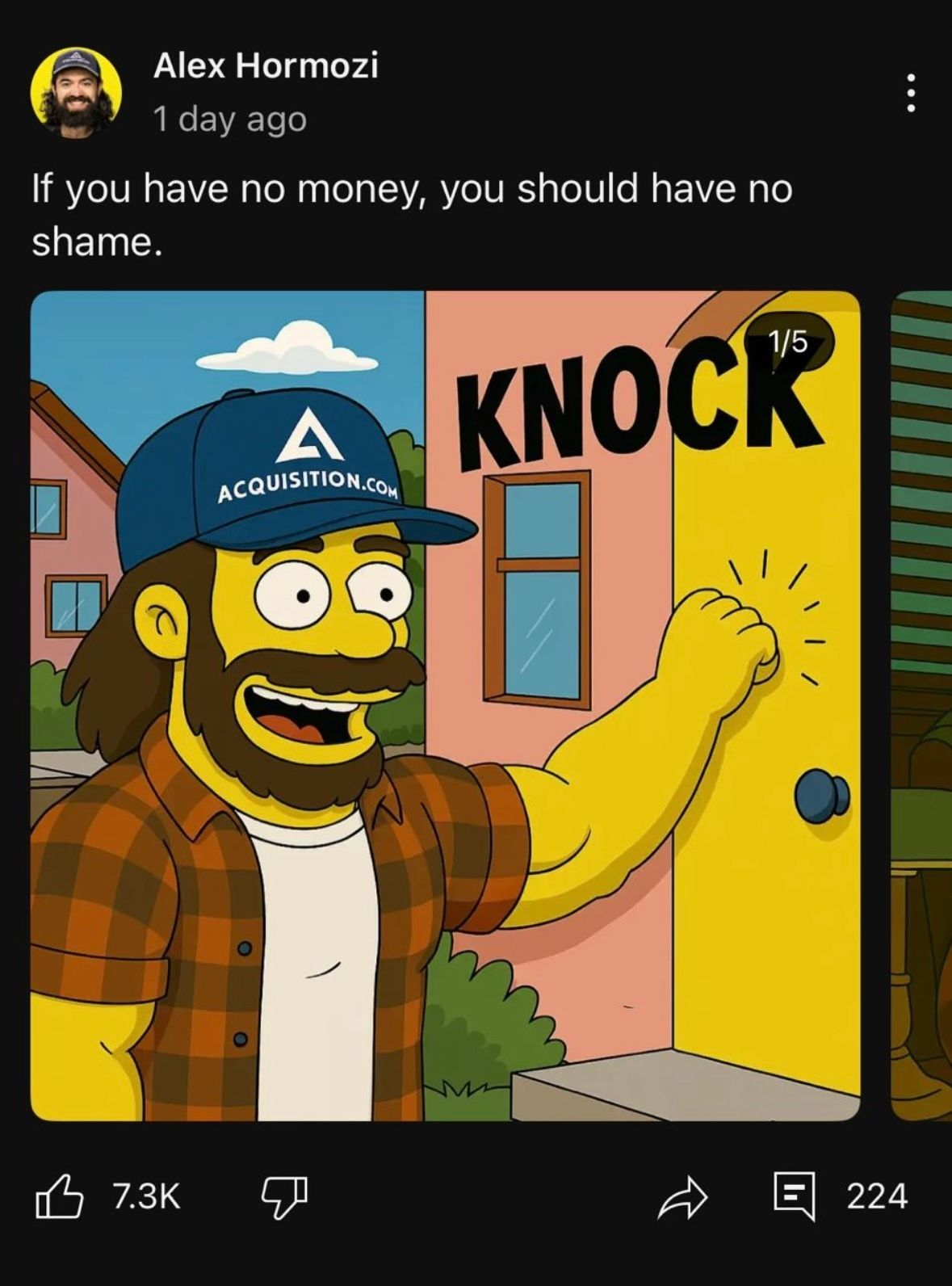
As Gary Vee has discussed many times, the smartest approach to advertising isn't guessing what will work – it's amplifying what you already know works. This applied to any organic content, including comics.
When a comic performs exceptionally well organically, that's market validation that it resonates with your audience. So….add a little budget and boost it.
Case in point from Alex Hormozi:
The Amplification Process:
Create and post your comics organically across platforms
Identify which comics generate the most engagement and shares
Create a paid campaign featuring your top-performing comics
Test different headlines and calls to action with the same comic
Scale budget on the variations that perform best
This approach dramatically reduces the risk of your ad spend because you're not guessing – you're amplifying content that has already proven effective with your audience.
As you create more comics, you're building a valuable library of visual assets that appreciate in value over time. Here's how to manage this growing collection:
Organise by Topic: Categorise your comics by subject matter for easy reference and repurposing
Track Performance: Note which comics perform best on which platforms for future optimisation
Create Series: Develop themed series that build on each other and can be compiled into larger assets
Refresh Periodically: Update older comics with new information or improved visuals as your skills develop
Build Connections: Cross-reference related comics to create a web of educational content
I do all of this in Airtable personally as it makes it easy to attach full resolution images. But you could equally set up a series of Google Drive folders or similar structure.
Over time, this library becomes an increasingly valuable business asset that differentiates you from competitors and serves as a foundation for multiple marketing initiatives.
We've covered a lot of ground in this five-part series on AI-generated comics for business:
Part 1: Comics as Business Superpowers We explored why comics are such powerful communication tools and how AI has democratised comic creation for business owners with no artistic background.
Part 2: Developing Your Comic Identity We walked step-by-step through creating a distinctive comic identity with consistent characters, settings, and visual style using a master prompt.
Part 3: Crafting Complete Comic Stories We learned how to structure narrative arcs that explain complex concepts clearly and create complete comic sequences optimised for social media.
Part 4: Perfecting Individual Panels We tackled common issues in AI-generated comics and developed techniques for creating more dynamic, visually interesting panels.
Part 5: Distribution and Repurposing We've seen how comics become valuable business assets that can be optimised across platforms, transformed into different formats, and amplified through paid advertising.
The power of what we've built together goes far beyond pretty pictures. We've developed a system for creating distinctive, educational visual content that builds your authority, simplifies complex ideas, and drives real business results.
Keep Prompting,
Kyle
Unlock the power of visual storytelling with our playbook, 'AI Explainer Comics for Business'. This comprehensive guide takes you on a transformative journey, showing you how to leverage AI-generated comics to communicate complex ideas in a digestible and engaging format. Whether you're a marketer, educator, or business owner, you'll discover how to create compelling narratives that capture attention and drive engagement across various platforms. Say goodbye to boring text-heavy communication and hello to a new era of creativity and connection.
This playbook is designed for business professionals, marketers, and educators who struggle to convey complex information in an engaging way. If you're tired of traditional communication methods that fail to capture your audience's attention and want an innovative solution to stand out in a crowded marketplace, this playbook is perfect for you. Embrace the new era of visual communication and transform how you connect with your audience.
No! This playbook empowers you to create impactful comics without any drawing skills. AI tools handle the artistic aspect, allowing you to focus on storytelling.
Once you understand the process, you can create comics in a matter of hours, significantly reducing the time compared to traditional methods.
You'll primarily need access to AI image generation tools, which are easy to use and require no prior experience.
Absolutely! The comics are versatile and can be repurposed for social media, email newsletters, blog posts, and more.
Yes! This playbook is designed to guide beginners step-by-step, making it accessible for anyone interested in using comics for business communication.