AI Authority
Build your first audience with practical AI workflows.
Start ReadingPieter Levels (aka Levelsio) had just launched a browser-based 3D flight simulator. Nothing unusual there – except he built the entire thing in just three hours using AI tools like Cursor.
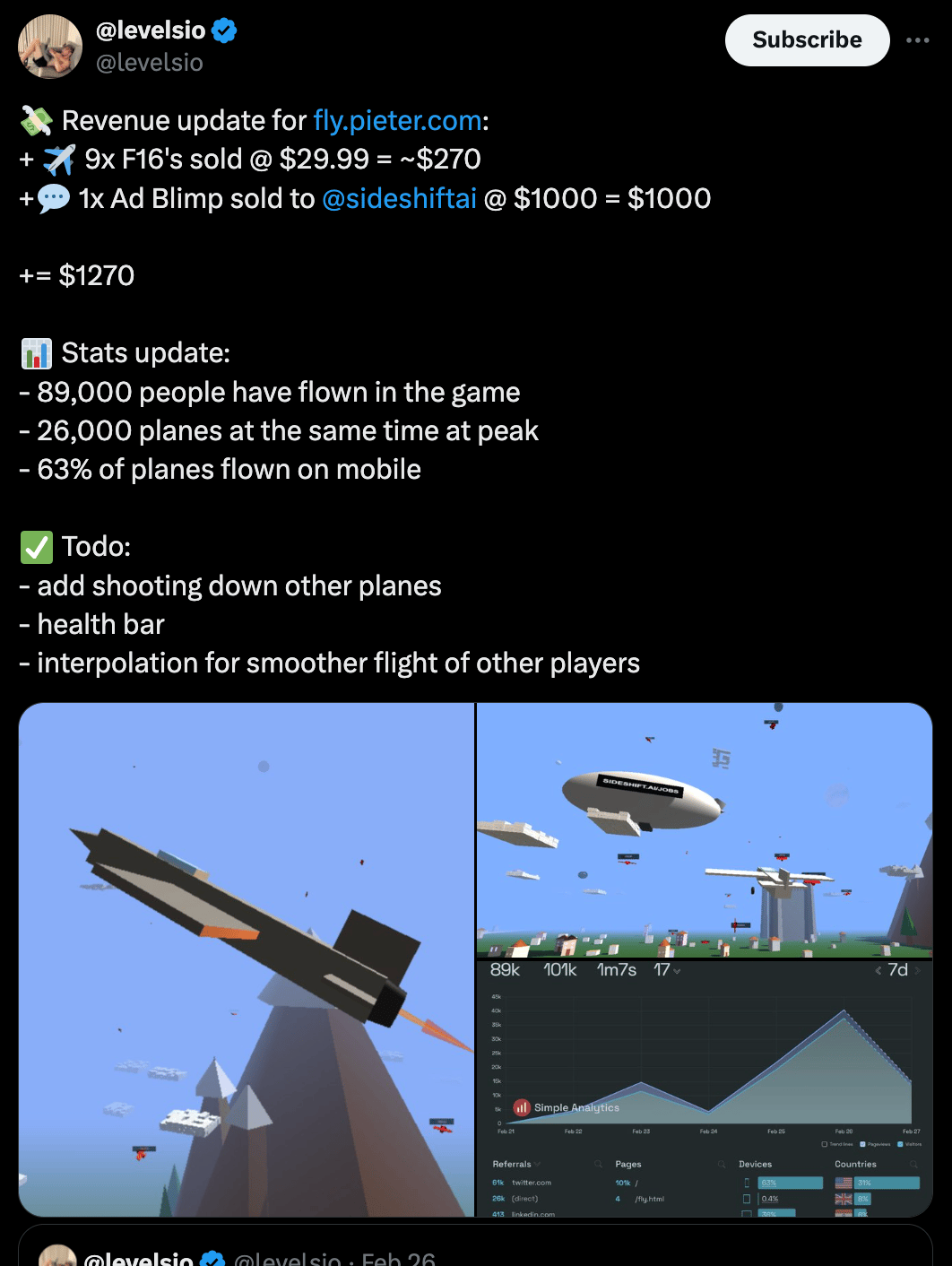
Within days, this little "toy project" had 89,000 players, with 26,000 people playing simultaneously at its peak.
This quickly cobbled together game made $1,270 in just a few days. He sold nine F-16 planes as cosmetic upgrades at $29.99 each (about $270) and a $1,000 ad blimp. This number is still going up as Levels continues to build.
Now, was this a get-rich-quick scheme? Hardly. I’m not telling you we’re building flight simulators in this Playbook! Imagine!
The money isn't even the point here. What's fascinating is HOW this happened.
Levels didn't need to run ads. Didn't need to beg influencers for shares. Didn't need to hire a PR agency. He simply built something interesting that he thought was cool, shared it with his audience, and they showed up in droves – bringing their wallets with them.
That's the power of having an audience. When you build publicly over the years and genuinely connect with people, even your "fun" side projects can take off. An audience changes everything.
Let's get started:
Why an audience is your most valuable business asset
The difference between building an audience and being an "influencer"
How to identify what you should be known for
Realistic timeline expectations for audience building
Building a business without an audience is playing the game on hard mode. Unnecessarily hard.
I should know. It’s the way I’ve been doing business for a decade plus. And it’s been much harder than it had to be!
Think about the traditional business approach: You create a product or service, then spend enormous amounts of time, energy, and money trying to find customers. It's like throwing a party and then desperately trying to convince strangers to attend. It’s kinda arse-end backwards (that’s the technical term I learned during my MBA…).
Now flip that around. When you have an audience first, it's like having a group of friends who are just waiting to see what you'll do next. They're already interested in you and what you have to say. When you eventually offer something for sale, you're not selling to cold prospects – you're offering something valuable to people who already know, like, and trust you.
It’s a bunch of people waiting eagerly for that party invite. Hell, maybe you don’t even have enough invites to go around!
This fundamentally changes the dynamics of business:
Your customer acquisition costs (CAC) plummet. When someone from your audience becomes a customer, you've already done the (very!) expensive part of marketing – building awareness and trust.
You get instant feedback. Launch something new, and your audience will tell you – often within hours – if it's hitting the mark.
You develop genuine relationships. This isn't about manipulating people; it's about building real connections that benefit both sides. You actually get to know your customers which is such a cool feeling.
You create an appreciating asset. Unlike ad spend that stops working the moment you stop paying, an audience continues to grow in value over time. The audience is the asset - and a very powerful one.
But wait, I'm not an influencer, you might be thinking. Good news: you don't need to be. No dancing on TikTok required!
This is crucial to understand. Building an audience isn't about becoming an influencer or a celebrity. It's about becoming known for something specific and valuable.
An influencer sells their audience's attention to brands. That's their business model. The product is attention.
When you build an audience for business purposes your product is not attention. Instead you drive that attention to your products and services - which can be anything.
It’s a subtle but very important difference. Being an influencer is a very particular business model - and not one we are talking about.
Instead we’re becoming expert authorities. Known voices.
Many of the most successful entrepreneurs with audiences aren't household names. They're not doing dance challenges on TikTok or posting glamorous lifestyle photos. They're sharing valuable insights, solving problems, and building trust with the specific group of people they can best serve.
Very different to being an influencer.
This brings us to the million-dollar question: What should you be known for?
The answer lies at the intersection of three things:
What you're knowledgeable about (your expertise)
What you're interested in (your passion)
What a significant group of people need help with (market demand)
Too many people make the mistake of being too broad ("I help businesses grow") or too narrow ("I help left-handed golfers improve their putting in rainy conditions in Scotland").
The sweet spot is specific enough that people can immediately understand what you do, but broad enough that there's a substantial audience who needs your help.
For example, "I help e-commerce store owners automate their customer service using AI" is specific, valuable, and addresses a real problem for a sizeable market.
Here's an prompt to help you find your focus area:
You are an expert in market positioning and audience building. Your task is to help me identify the optimal focus area for building my authority and audience online.

I'll share some information about myself, and I want you to analyse it to suggest 3-5 potential positioning angles that would be specific enough to stand out but broad enough to attract a significant audience.

My background and expertise:
[List your professional experience, skills, and knowledge areas]

My interests and passions:
[Share what you genuinely enjoy doing/talking about]

Markets or audiences I'm familiar with:
[Describe groups of people you understand well]

For each suggested positioning angle, please provide:
1. A clear statement of what I would be "known for"
2. The specific audience who would value this expertise
3. The core problems I would help them solve
4. Why this positioning could work better than alternatives
5. Early content themes I could explore to establish this positioning

Be brutally honest and precise - I need positioning that's genuinely distinctive, not generic "social media expert" type suggestions.
Either fill in your details before submitting the prompt or submit the prompt and the AI will ask for the missing details. Either works.
Take the suggestions and refine them until you have a positioning statement that feels right – specific enough to be distinctive, but broad enough to support a business.
Be aware though that this will always be a work in progress. You’ll adjust what exactly your pitch is as you start to build your audience. And that’s fine. We just need a starting point for now so we don’t get hung up.
Once you've identified your focus area, you need to consistently demonstrate your expertise in that space. This isn't about claiming to be an expert – it's about showing that you are one through the value you provide. Very different!
And it’s all about education. And giving giving giving.
The formula is simple but requires commitment:
Create content that solves problems or provides insights related to your focus area.
Do this consistently over time (we'll talk more about consistency in Part 4).
Engage with others in your space, both audience members and peers.
Refine based on feedback and performance.
What's critical here is aligning everything you do with how you want to be perceived. If you want to be known as the go-to expert on AI productivity tools for freelancers, then your content, conversations, and interactions should consistently reinforce that positioning. We’ll talk about exactly how to do this in this Playbook.
Now, let me be transparent about something: building an audience takes time. There's no way around it.
It’s taken me a year to build an audience of 250,000. And the first 6 months or so basically nothing happened. You need to be prepared this. You'll likely be publishing content for 6-12 months before seeing significant traction. It's the classic "overnight success that took years to build" scenario.
The early days are particularly challenging because you'll feel like you're shouting into a void. I mean - you kinda are! At least initially.
You might get a few likes, maybe a comment here and there, but it won't feel like you're making an impact. It’s frustrating.
This is where most people quit. They post consistently for a few weeks, don't see immediate results, and decide it's not working. We’re not going to do that. Are we?
Audience building is a compound game. It's not linear growth – it's exponential. That means it starts slowly and then accelerates. Basically your benchmarks are the first 1,000 and then the first 10,000 and then 100,000.
Your first 1,000 followers are the hardest to get. But they're also the most valuable because during that time you’re going to your message and build momentum. Basically it’s a practice period to work out what the hell you’re going to talk about.
That first 1,000 is the focus of this week.
Now that you understand why building an audience is so crucial for your business and have started thinking about what you want to be known for, we need to figure out where and how to reach these people. The nitty gritty HOW.
Here's what we'll be covering in this series:
Part 1: Why Building an Audience Changes Everything - The fundamentals of audience-building and finding your focus area
Part 2: Platform Choice & Content Format Strategy - Where to find your audience, the Dream 100 approach, and why short-form video is king
Part 3: The Content Funnel - Wide, Middle, Deep - Creating authority-based content that attracts and engages your audience
Part 4: Consistency Wins - Building habits, maintaining volume, and simplifying production to stay consistent
Part 5: Off to the Races - Engagement & Refinement - Boosting algorithm performance and refining your approach based on data
Keep Prompting,
Kyle
Some of my biggest business deals have come through TikTok.
I know, I know. TikTok? That app where teenagers dance and people lip-sync? That's where serious B2B clients are hanging out?
When introducing myself at entrepreneurial and AI events I often have to embarrassedly say “oh yes and I’m a TikToker too”.
I’ve managed to stop appending “for my sins” to that intro at least!
But it's true. TikTok absolutely slaps for business. I've landed speaking gigs at conferences, consulting contracts, and enterprise-level clients—all from content I've posted on TikTok. One 2-3 minute long video on the RISEN framework has led to around ~$100,000 of revenue alone. Mad.
The lesson here is crystal clear: don't make assumptions about where your audience is hanging out. Your potential customers are real people with varied interests. That buttoned-up CEO you're targeting? They might be scrolling TikTok while waiting for their coffee, just like everyone else.
This brings us to a crucial point in our "First 1,000 Followers" journey. Today, we're answering the vital questions: Where should you build your audience? What format should your content take? And how can you leverage existing networks to accelerate your growth?
Let's get started:
Where your audience is actually spending time (not where you think they should be)
Why short-form video crushes every other content format right now
The best platforms to start with for production ease
How to repurpose content strategically (especially to LinkedIn)
The Dream 100 approach to jumpstart your visibility
The first rule of audience building: go to where your people already are. Don't expect them to come to you.
Ain’t no Field of Dreams here. Sorry Kevin.
This seems kinda obvious, but I've seen countless entrepreneurs launch newsletters or blogs, then wonder why nobody's reading them. They're building on digital ghost towns while their audience is elsewhere.
Basically - I don’t care if you prefer to be on a certain platform. If your audience isn’t also there it’s a waste of your time. We’re doing this to grow a business and the number one with a bullet fix is to be where your customers are.
Here's a quick rundown of where different audiences tend to gather in 2025:
LinkedIn: Professionals across industries, particularly in B2B, consulting, HR, finance, and enterprise tech. More senior roles tend to be active here.
TikTok: Surprisingly broad demographics now, from teenagers to C-suite executives. Particularly strong for reaching 25-45 year olds across diverse industries. Yes, for real - it’s older than you’d expect.
Instagram: Wide demographic reach with strength in creative industries, eCommerce, coaching, lifestyle businesses, and consumer products.
Twitter/X: Tech, media, politics, finance, and industry commentators. Great for peer connections.
YouTube: Excellent for educational content and in-depth expertise across virtually all industries. Skews slightly more technical. Huge long term audience potential.
How do you know where YOUR specific audience hangs out? Here are three practical research methods:
Go straight to the source: Survey your existing customers or colleagues in your target industry about which platforms they use most frequently. Don't ask where they "professionally network"—ask where they actually spend their time.
Search platform-specific: Look for relevant hashtags or keywords on each platform. The volume and engagement of content in your niche is a good indicator of audience presence. For me for example I’ll check the hashtag or topic #AI and check the relative volume.
Competitor analysis: Where are other experts in your field building audiences? Where are they getting the most engagement? If they are all on a certain platform that suggests there are audiences there.
The platform with the highest concentration of your ideal audience is where you should focus first. But—and this is crucial—don't overthink this decision. Because of reasons we'll discuss shortly, it's more important to start creating than to spend weeks agonising over the perfect platform.
Momentum and speed beats all.
OK here’s the next biggie: format.
For speed: if you're starting to build an audience in 2025, short-form video should be your primary content format.
Simple as.
I've experimented with every content format under the sun—long-form articles, Twitter threads, LinkedIn posts, podcasts, YouTube videos, you name it. Nothing—and I mean nothing—has given me the reach, engagement, and conversion that short-form video has.
This isn’t just me either - it’s the industry leading format.
There are several reasons for this dominance:
Algorithm favour: The major platforms are all pushing video content heavily in their algorithms. Audience members spend more time watching shorts which means more time on platform which means more advertising revenue.
Attention advantage: Video engages multiple senses simultaneously (visual and auditory), making it more attention-grabbing. It’s literally “multimedia”.
Connection factor: Seeing your face and hearing your voice creates a stronger para-social relationship than text alone ever could. People feel like they know you. I’ve had multiple people come up to me to me (including once whilst I was getting a haircut!) and ask if I’m “that AI guy from TikTok”.
Barrier to entry: Fewer people are comfortable on camera, meaning less competition in the video space.
"But Kyle," I hear you saying, "I hate being on camera! Can't I just write articles instead?"
Look, I get it. I wasn't exactly thrilled about putting my mug on camera either when I started. But here's the tough love you need: if you want the fastest path to 1,000 followers, video is it. Full stop.
In fact in my AI Authority Accelerator it’s a requirement. I’ll be helping people get over camera fear but it’s still required! Waitlist here btw.
Now that we’ve started to work out WHERE your audience is and WHAT format to use, let's talk about the practical starting point.
For most people building an audience from scratch, I recommend starting with either TikTok or Instagram Reels. Here's why:
TikTok advantages:
Most forgiving algorithm for beginners: TikTok evaluates each video independently, giving every upload a chance to go viral regardless of follower count.
Superior in-app editing tools: TikTok's native video editor is remarkably powerful for a mobile app.
Discovery-focused: The For You Page is designed to surface new creators, unlike platforms that prioritise accounts you already follow.
Instagram Reels advantages:
Integrated with Facebook ecosystem: Content can reach both platforms.
Business features: More robust business profile options and analytics.
Slightly older demographic: If your audience skews older, this might be a better fit.
This part is super important. And hard to grok unless you try the tools!
Both TikTok and Instagram have start/stop recording features. You hold to record, release to stop. And then you can either keep the clip or discard it. All the clips you keep and spliced together into the final video.
Why is this important? You can record sentence by sentence. No need to memorise a script. No need to get everything in one take. No need for complex editing after recording. You can instead capture everything you want to say straight to camera in a series of small clips.
It’s really a game changer and the main reason I recommend TikTok and Instagram as starting platforms.
Your starting platform matters less than you think. Why? Because eventually, you'll be repurposing your content to multiple platforms anyway.
Here's a secret that most successful content creators know: you don't need to create original content for every platform. Instead, create once, then repurpose strategically.
This is particularly relevant for LinkedIn, which is an incredible platform for business connections but lacks robust native video creation tools.
LinkedIn are pushing short form video (like all platforms) but didn’t bother to add a video recording tool. I’d expect nothing less!
A basic repurposing workflow looks like this :
Create and post original video on TikTok or Instagram (because they have great video recorders)
Download the video without the watermark (use a tool like SnapTik)
Upload natively to LinkedIn with a text intro that contextualises it for the business audience
Repeat for other platforms as relevant (Twitter, YouTube Shorts, etc.)
You can also use Repurpose.io to do this all automatically.
This approach gives you maximum reach with minimum effort. And it's particularly powerful for reaching those first 1,000 followers because you're casting a wider net.
One important note: While the core content remains the same, I do recommend slight modifications for different platforms:
LinkedIn: Add more business context and professional framing in the text
Twitter: Keep accompanying text short and punchy
YouTube: Consider grouping short videos into themed compilations
But the key is to start somewhere, then expand. Don't try to be everywhere at once—that's a recipe for burnout and inconsistency. Layer in repurposing as and when you are ready. The main thing is just starting.
OK here’s the concrete first step - the Dream 100. I’m borrowing here from Russell Brunson and his Audience Secrets book.
The concept is simple but powerful: identify the 100 most influential creators/accounts in your niche, then systematically build relationships with them and their audiences.
This approach gives you three massive advantages:
Market Research: You'll learn what content resonates in your niche by studying successful creators. You can then emulate (cough, steal and adapt, cough) their best performing content, knowing that it resonates with your market.
Audience Overlap: By engaging with their content, you'll become visible to their audience (who are also your target audience).
Potential Collaborations: Over time, these relationships can evolve into partnerships, shoutouts, or collaborations with the creator.
Here's how to implement the Dream 100 approach:
Step 1: Identification Create a list of the top creators in your space. Use platform search, hashtags, and tools like Creator Marketplace to find them. They don't all need to be mega-influencers—include a mix of account sizes.
Step 2: Systematic Engagement
Follow all 100 accounts
Turn on notifications for their new content
Consistently engage with meaningful comments (not just "Great post!" and please don’t use AI here!!!)
Reference their ideas in your own content (with credit)
Step 3: Relationship Building
Share their content with your own insights added
Chat with the creator in their comments
Move conversations to DMs when appropriate
Look for genuine ways to provide value to them, collaboration focused
This isn't about spamming or fake engagement—it's about becoming a valued member of your niche community. These relationships need to be authentic. Spamming will just get you blocked and that relationship is forever cut off. Don’t do it!
Here's an AI prompt to help you start to identify and track your Dream 100:
You are an expert in social media strategy and audience building. Help me develop my "Dream 100" list for my niche.

My niche/focus area: [Your niche]
My target audience: [Your audience description]
Primary platform I'm building on: [TikTok/Instagram/etc.]

First, provide me with:
1. 10 search terms/hashtags I should use to find relevant creators in my space
2. 5 different types of creators I should include in my Dream 100 (e.g., educators, entertainers, news sources, etc. in my niche)

Then, create a Dream 100 tracker template with the following columns:
- Creator name
- Platform(s)
- Follower count
- Relationship status (stranger, mutual follower, DM connection, collaborator)
- Notes (content types that perform well, engagement patterns)
Running this prompt using Grok (X’s AI) works really well because it has up to date data on all the creators on X specifically. A lot of those creators will also be on other platforms. So this is a solid extra step if you have access to Grok.
The end goal here is to be able to leverage the audiences of other creator’s who are already big. That could be a share of your content to their audience. It could be going on their podcast. It could be a joint video. Lots of possibilities! All that help sky rocket your account.
Speaking of…I’m building this directly into my AI Authority Accelerator. Anyone who completes all 30 days of content creation gets featured on my account, exposing them to my 130,000+ TikTok followers. Normally a sponsored post costs $1500+ for reference. Nice way to get an immediate bump! Waitlist here.
Now that you know where to build your audience and which format to focus on, the next step is creating content that actually resonates and builds authority.
In Part 3, we'll dive into the Content Funnel approach—Wide, Middle, and Deep content that works together to attract and convert followers. You'll learn how to create a mix of content that both expands your reach and establishes your expertise.
Remember, we're focused on getting you to that first 1,000 followers—the hardest milestone in audience building, but also the most educational. Once you hit 1,000, you'll have learned so much about your audience and your content style that the next milestones will come more easily. I promise - it does get easier!
Keep Prompting,
Kyle
Turns out what I want isn’t necessarily what others want. I had to adjust. I had to serve.
When I first started creating content about AI, I jumped straight into the more technical topics that fascinated me—prompt engineering techniques, model architecture explanations, complex implementation guides.
Oh and things like the history of AI and people like Alan Turing.
The stuff that got my gears turning.
You know what happened? No one cared.
The occasional technical person would engage, but I was completely missing the broader audience I needed to reach first.
By creating only in-depth content, I was essentially saying, "If you're not already knowledgeable about this topic, this content isn't for you." Which isn’t very inviting. Especially when trying to talk to entrepreneurs and business owners.
I was setting up a massive barrier to entry. And then wondering why my audience wasn't growing.
My breakthrough came when I asked "Where is my audience now, and what content do they need?"
Let's get started:
Why different types of content serve different audience-building purposes
Wide content: Using trends and news to attract new viewers
Middle content: Building connection through perspectives and opinions
Deep content: Demonstrating expertise with guides and tutorials
Not all content serves the same purpose.
Some content is great for discovery but terrible for conversion. Other content is fantastic for demonstrating expertise but won't help you reach new people. Some content builds emotional connection but doesn't showcase your knowledge depth.
So…what do we do? Where do we focus?
This is where content funnels come in.
The content funnel is a simple three-layer approach to content creation:
Wide Content = Trend-based, news-oriented, easy to understand, broad appeal
Middle Content = Opinion-based, perspective-oriented, moderately specific
Deep Content = Guide-based, expertise-oriented, very specific, detailed
Each layer serves a specific purpose in your audience-building strategy:
Wide content attracts new people to your content (discovery)
Middle content builds connection and trust (engagement)
Deep content demonstrates your expertise (conversion)
Think of it like a real funnel—wide at the top, narrow at the bottom. Many people will see your wide content, fewer will engage with your middle content, and fewer still will consume your deep content. But that's exactly how it should work.
Let's break down each layer in detail.
Wide content is all about discovery. Its job is to get in front of as many relevant people as possible.
The key characteristics of effective wide content are:
Trend-based (tied to current events, news, popular topics)
Easy to understand (no specialised knowledge required)
Broad appeal (relevant to many people in your general space)
Quick to consume (short, punchy, gets to the point quickly)
Examples of wide content include:
Reactions to breaking news in your industry
Quick takes on viral trends
"Did you know?" informational snippets
Myth-busting or fact-checking popular beliefs
Simple explanations of complex topics
For my AI content, some of my best-performing wide content has been:
Reactions to new AI tool releases (“Grok 3 just came out and here’s what I think of it”)
Quick demos of viral AI capabilities ("Check out ChatGPT’s advanced voice mdoe")
Simple explanations ("How to use ChatGPT")
The beautiful thing about wide content is that it's relatively easy to create. You're tapping into existing conversations and trends, giving your take or explaining something in an accessible way.
It should be quick and dirty. Not highly produced and complex. Short, fast videos about what is hot right now.
Here's an AI prompt to help generate wide content ideas:
You are a content strategy expert focused on creating discoverable "wide" content for audience building. Based on my niche, help me identify trending topics and news I can leverage for wide-appeal content.

My niche: [Your specific focus area]
My platform: [TikTok/Instagram/LinkedIn/etc.]

Please provide:
1. 5 recent news stories or trends in my niche that would make good wide content
2. For each trend/news item, suggest:
   - A hook or attention-grabbing opening
   - The core insight I should share
   - A simple way to present this (visual idea, explanation approach, etc.)

Focus on ideas that require minimal background knowledge to understand and could appeal to people just discovering my niche.
Remember, with wide content, you're meeting people where they are—at the beginning of their journey. Don't overwhelm them with jargon or complexity. Your goal is to make them think, "Hey, this is interesting and I can actually understand it!"
Middle content is where you start to build deeper connections with your audience. People who enjoyed your wide content may have followed you and will stick around for this. So it's your chance to share more of your perspective and personality.
The key characteristics of effective middle content are:
Opinion-based (your perspectives and insights)
Moderately specific (assumes some basic knowledge)
Value-oriented (helps solve common problems)
Personal (shows your thinking process and experiences)
Examples of middle content include:
Your take on industry developments
Comparison videos ("X vs Y: Here's what I think")
Process insights ("How I approach this common challenge")
Practical tips and techniques
Behind-the-scenes of your work
Some of my best-performing middle content has been:
"Apple need to pull their finger out re: AI"
"What you are doing wrong with AI"
"AI Experts I recommend you follow"
Middle content is where you start to differentiate yourself from the general, wide viral content. While your wide content might cover similar topics to other creators, your middle content should showcase your unique perspective and approach.
Here's a prompt to help generate middle content ideas:
You are a content strategy expert focused on creating "middle" content that builds connection and showcases perspective. Based on my niche, help me develop content ideas that share my viewpoint and build deeper audience relationships.

My niche: [Your specific focus area]
My unique angle/perspective: [What makes your approach different]
Common problems my audience faces: [List 2-3 key challenges]

Please provide:
1. 5 opinion-based content ideas where I can share my perspective on industry topics
2. 3 comparison ideas (X vs Y) relevant to my niche
3. 4 "how I approach this" topics where I can share my personal process
4. 3 ideas for sharing lessons learned from my experiences
5. For each idea, suggest:
   - A promising hook or opening
   - The core value/insight to deliver
   - How to make it personal while keeping it valuable

These ideas should assume basic familiarity with my field but not require deep expertise to understand.
With middle content, you're meeting people who already have some interest in your topic. They are probably already followers and they are more likely to give you the time of day.
Deep content is where you fully showcase your expertise. It's detailed, comprehensive, and demonstrates the depth of your knowledge.
The key characteristics of effective deep content are:
Guide-based (teaches a specific skill or concept thoroughly)
Very specific (focuses on a particular aspect of your field)
Process-oriented (shows step-by-step approaches)
Comprehensive (covers the topic in depth)
Examples of deep content include:
Detailed tutorials
Step-by-step guides
Case studies
In-depth explanations of complex concepts
Comprehensive walkthroughsCreating a Balanced Content Mix
Generally (but not always!) these will be longer videos. You may find yourself shifting towards Youtube rather than TikTok and Instagram with these sort of videos, just because it’s a more natural place for people to consume longer form guides.
These are a much more involved content type, harder to encapsulate in a prompt so we’ll cover it in another Playbook.
So how do you balance these three types of content? While there's no one-size-fits-all formula, here's a ratio that's worked well for me:
50% Wide / 30% Middle / 20% Deep
You always want more of the wider content because that’s what gets your funnel started.
A typical week of content for me might look like:
10-15 pieces of wide content (news reactions, trend commentary, simple explanations)
5 pieces of middle content (my perspectives, approaches, comparisons)
1 piece of deep content (detailed tutorial or guide)
I don’t recommend starting with this much though! Work up to it. And start with the wide content first and foremost to gain momentum.
Now that you understand the content funnel approach and have tools to generate ideas for each layer, the next critical factor in reaching your first 1,000 followers is consistency.
In Part 4, we'll dive into the practical aspects of consistent content creation. I'll share how to build a sustainable content habit, maintain high volume without burning out, and use simple production techniques that let you focus on value rather than perfection.
Keep Prompting,
Kyle
I started creating AI content around the same time as dozens of other creators. Some had bigger followings from the start. Some were getting better numbers than me early on.
I was jealous.
But you know what happened to most of them?
They just... disappeared.
One day they were posting regularly, building momentum. The next, their accounts went silent. Videos stopped. Growth stalled. And eventually, they joined the vast graveyard of abandoned creator accounts that litter every platform.
And…I was still there. Still growing.
It wasn't because they lacked talent or knowledge. It wasn't because they didn't have good ideas or the right equipment.
It was because they couldn't maintain consistency. Simple as.
Building an audience is, at its core, a grind. There's simply no way around that uncomfortable truth. Sorry!
It requires showing up day after day, week after week, month after month—even when you don't feel like it, even when the numbers aren't impressive, even when it seems like nobody's listening.
And just when you are about to pack it all in? Something hits. You’re off to the races.
This is precisely why consistency is the ultimate differentiator in your journey to 1,000 followers. Not talent. Not equipment. Not even content quality!!! Just pure, stubborn consistency.
Let's get started:
Why consistency trumps everything else in audience building
The power of volume in accelerating your learning curve
Keeping production simple to maintain momentum
Building a sustainable content creation habit
Content pillars for topic sustainability
When I analyse who makes it in the creator economy and who doesn't, two factors stand out above all others: consistency and volume.
The maths is brutally simple. If you post daily for a year, that's 365 pieces of content. If someone else posts weekly, that's just 52. You've created seven times more opportunities to be discovered, to learn what works, to improve your craft, and to demonstrate your expertise.
But here's the thing: staying consistent is bloody hard. It's probably the biggest challenge you'll face in your journey to 1,000 followers.
So how do you solve this problem? By making content creation as frictionless as possible.
In the early days of my content creation journey, I was cranking out 3 videos a day. Now I'm more reasonable at 1-2 per day. But just yesterday, I recorded 8 videos in a single session. Become the machine!
How? By embracing what I call Minimum Viable Production.
The MVP approach is simple: strip your content creation process down to the absolute essentials. Make it so easy that you can't talk yourself out of doing it.
For most creators, this means embracing the basic "talking head" format—just you, facing the camera, delivering value through your words and expressions. No fancy transitions, no elaborate b-roll, no complex editing. All that adds time which, in turn, adds friction! Which means it won’t get done.
In my niche some of the top content creators are talking heads. Nate, Sabrina and Cat. Notice the trend? All just talk to camera. Very little fancy editing. Very little on screen distraction. Just them talking!
I know an Italian creator (won't name names) who went from producing highly edited videos with fancy graphics to simple talking head videos. The result? Absolutely no change in engagement or growth—but she was able to create content 5x faster.
The videos do just as well but don’t take HOURS of editing!
People simply don't care about fancy production values as much as you think they do. We hide behind the editing - thinking it’ll save our videos. Audiences are there for the value, the information, the personality—not the slick transitions or perfect lighting.
By embracing MVP content production, you accomplish two crucial things:
You remove the friction that prevents consistent creation
You ensure you can stay in the game long-term without burning out
This doesn't mean your content should look awful. Aim for decent lighting, clear audio, and a non-distracting background. But beyond those basics (which are super easy to do), your energy is better spent on scripting, delivery and pure VOLUME of content.
Volume isn't just about more chances to be discovered—though that's certainly a benefit! The real power of volume is in accelerated learning.
Let's compare two creators:
Creator A makes one video per month, creating 12 videos over a year. Creator B makes 12 videos per week, creating 624 videos over a year.
Which creator do you think will improve faster? Which one will discover what their audience truly wants sooner? Which one will develop their on-camera presence more quickly?
The answer is obvious when put like this. Creator B has 624 learning opportunities compared to Creator A's 12. That's 624 chances to:
Test different topics
Try different formats
Analyse what gets engagement
Practice delivery
Build confidence
Gather feedback
Course-correct
When you're starting out, volume creates velocity. Every piece of content is a data point, a learning opportunity, a chance to refine your approach.
Will they all be good? Not at all! Doesn’t matter as each video lets you improve.
This is why I'm such a strong advocate for high-volume creation in the early stages of audience building. It's not about quantity over quality—it's about using quantity to build quality through rapid iteration. Subtle but important difference!
Consistency requires turning content creation from a sporadic activity into a consistent habit. And like any habit, it requires structure and routine. Boring but important. Sorry!
Some days will suck. Some weeks will be uninspiring. You'll have moments where you feel like you're talking to nobody. This is normal and happens to everyone—including me, still, to this day. I’ve had days and weeks when I didn’t really want to put anything out. Views were low. I didn’t feel like it. What’s the point?
Tough. I just got it done.
In fact one of my most popular videos (3.5M+ and counting views) you’ll notice I’m wearing an outdoor jacket. Why? I was on the way out the door and thought “ugh fine I’ll just sit down a shoot a damn video”. That was my first viral video and (without hyperbole) changed my life.
The key is making your production process simple and painless enough that you still do the work even on those bad days.
Think of professional writers. Stephen King famously writes 2,000 words every single day—including holidays, birthdays, and yes, even the days when he doesn't feel particularly inspired (and/or was coming off a cocaine and booze bender). It's not about waiting for inspiration; it's about showing up and doing the work regardless. The Muse will only show up if you put in the work.
Content creation is no different. It's a craft that improves with repetition and deliberate practice.
The biggest threat to consistency is friction—anything that makes it harder to create content. Your job is to systematically identify and eliminate these friction points.
Common roadblocks and how to solve them:
"I don't know what to talk about" : Maintain a running list of content ideas. Use the AI prompts from Part 3 to generate batches of ideas in advance. I keep a Note on my phone that I add to whenever inspiration strikes. Personally I use Raindrops to quickly capture inspiration from any source.
"My setup takes too long to prepare" Create a permanent or semi-permanent recording space where you can sit down and start recording immediately. For me, it's a corner of my office with decent natural light from a window and a simple backdrop. Phone front camera, phone mic. Done. That’s sufficient!
"I get stuck trying to make it perfect" Set a time limit for each step of the process. For example, "I have 15 minutes to plan, 5 minutes to record, and 15 minutes to edit. Whatever I have at the end of that time is what gets published." You’ll get better over time. But for now just get it done.
"I don't feel motivated" Don't rely on motivation. Rely on systems and habits instead. The motivation will often come after you start, not before. Just start and it gets easier.
In my AI Authority Accelerator, I focus heavily on removing these roadblocks. We provide daily scripts and prompts so you never have to wonder what to talk about. We introduce technical aspects gradually to avoid overwhelm. And we build accountability systems to keep you on track. Waitlist is here.
The goal is to make consistency as easy as possible because consistency is what gets you to 1,000 followers.
In Part 5, we'll explore how to boost your algorithmic performance through strategic engagement, analyse what's working and what isn't, and refine your approach based on data. All important stuff BUT not as important as just getting consistent!
We'll also discuss the importance of that first 1,000 followers milestone and how to use it as a launchpad for further growth.
Keep Prompting,
Kyle
When I started on TikTok, I made a classic rookie mistake: I'd post a video, then immediately close the app and go about my day.
I’ll be honest. I didn’t want to see my videos bomb. Out of sight, out of mind!
I couldn't figure out why some of my videos would take off while others—which I thought were better—would barely get any views. It felt completely random, like playing the lottery.
Then I noticed something. On days when I (for whatever reason) stuck around after posting, responding to comments and engaging with other creators' content, my videos performed significantly better. I'm not talking about a small difference—I'm talking 3-5x the views.
That's when I realised I'd been missing half the equation. Creating content is only 50% of the battle. The other 50% is engagement—both generating it and participating in it.
The trick is to do this efficiently so you aren’t pulled into consuming social media. Icky.
Before we get started:
Here’s the opportunity:
The opportunity to become the go-to AI expert for your industry is available today (but it won’t be available forever)
The best way to position yourself as the trusted AI authority is to produce content
The best (and fastest) content to produce is short form video
The challenge? Most people won’t do it. There’s too many blocks — terrified of camera, don’t know what to say, not sure who to target, think they need expensive equipment, overwhelmed by the number of social platforms…
In the 30-Day AI Authority Accelerator I’ll be showing you the same systems and protocols I use on a daily basis that help me overcome all these blocks and more — so I can hit record, post and start generating AI related business opportunities..
Want to become the AI Voice in your industry?
Only 100 spots available (40 places left).
Deadline: Monday 10th.
P.S - For 10+ years I hated social media. I hid behind the scenes. After building an audience of 250k and generating $300k I kick myself for not starting earlier.
Let's get started:
Why engagement matters as much as content creation
How to jumpstart the algorithm with strategic engagement
Analysing your content to do more of what works
The inflection point at 1,000 followers
If anyone says they know for sure how social media algorithms works run for the hills. It’s black magic. Chances are they are seeing patterns that don’t exist.
That said… every social platform algorithm factors engagement heavily into their distribution decisions.
When you post a piece of content, the platforms initially show it to a small test audience. How that test audience engages with your content determines whether the algorithm will show it to more people.
High engagement = wider distribution
Low engagement = limited reach
We don’t know exactly how the algo works. But we don’t need to. We just need to understand that people watching, liking, sharing, bookmarking and commenting all positively affects our reach.
And the critical insight: you can actively influence that initial engagement. You don't have to passively wait and hope like I used to.
The first 30-60 minutes after posting are crucial. This is your window to convince the algorithm that your content deserves wider distribution.
Here are the strategies I use to jumpstart engagement on every post:
Post When Your Audience Is Active Timing does matter. As you post more your platform’s analytics will tell you when your audience are most active. Initially you are in the dark - but keep posting and that data will fill in. On TikTok, I've found that posting between 7-9pm UK time gives me the best initial engagement. But what works for me has zero bearing on what will work for you and your audience!
Ask a Question in Your First Comment Immediately after posting, be the first to comment with a thoughtful question related to your content. It could be as simple as “what do you think?” This gives viewers an easy way to engage—they just have to answer your question rather than coming up with something to say. Also, often no-one wants to be the first to comment. So you need to kick it off.
Respond to Every Comment (Initially!) In the early stage of building your audience, respond to every single comment you receive. This doubles your comment count instantly and (more importantly) encourages further conversation. People are much more likely to comment when they see the creator actively responding. It’s time consuming initially but well worth the investment. LATER commenters will chat amongst themselves - but you need to kickstart that early days.
Use Video Replies Many platforms now allow you to respond to comments with video. This is gold for two reasons i ) It creates a new piece of content ii) It drives the commenter back to your profile, likely resulting in a follow. On TikTok, some of my video replies have outperformed the original content! It shows you actually are listening and give a damn.
Engage with Similar Content Right after posting, spend 10-15 minutes engaging with content similar to yours. Comment thoughtfully on 5-10 posts in your niche. Don’t just comment “nice” or dumb emojis. Properly engage. This puts you in the algorithm's "conversation" around your topic and can drive relevant viewers to your profile. I recommend having a “watchlist” of genuinely useful accounts and using this time to also build relationships with those creators.
This is a bit of a smorgasbord but that’s because there’s no silver bullet. You need to spread your effort and work on being visible. These will get you started and you can adjust your approach as you see what works with your audience specifically.
As your content starts to gain traction, something magical happens: your comments section becomes a community unto itself.
At first, it's just you and individual commenters. But eventually, commenters start responding to each other, having full conversations in your comments section. This is algorithm gold.
For better or worse this works best with controversial topics.
Case in point my first viral Instagram post:
Because it was about the rivalry between Elon Musk and Sam Altman people had “Opinions”. Capital O “Opinions”. And they continued to argue in the comments for weeks.
This does absolute wonders for the algorithm as you can imagine. But it also has the added benefit of allowing you to disengage. Remember, you are an entrepreneur not an influencer! We aren’t going to spend our lives in the comment sections on social!
While you're creating content consistently and driving engagement, you also need to be constantly analysing what's working—and doing more of it.
This sounds obvious, but it's surprising how many creators ignore their own data and continue creating content that their audience has shown little interest in.
Most tools have basic Analytics. That’s sufficient for a basic analysis. Basically look for which posts are doing well and … do more of them! I’m not joking - it’s that simple.
IDEALLY though you can get a data dump of your posts. Then we can run a proper data driven analysis.
Most social platforms support this. You can also scrape your own profile data using Apify if the platform doesn’t support direct data download. Particularly powerful as it can grab your subtitles (ie. what you said in each video!).
Here for example is the TikTok scraper.
Here's an AI prompt to help analyse your content performance:
You are an expert content strategist and data analyst. Help me analyse my recent content performance to identify patterns and optimise my strategy.

For these recent posts, help me identify patterns in my top vs. bottom performers:

TOP PERFORMING CONTENT:
[List 3-5 of your best posts with brief descriptions and metrics]

BOTTOM PERFORMING CONTENT:
[List 3-5 of your worst posts with brief descriptions and metrics]

Please analyse:
1. Topic patterns (what subjects performed best/worst)
2. Format patterns (how I structured the content)
3. Hook patterns (how I opened the content)
4. Length patterns
5. Time/day patterns if available

Then provide:
1. 3 specific recommendations for content themes/topics to double down on
2. 2 content types I should reduce or stop creating
3. A suggested testing plan for my next 5-10 posts to verify these patterns
4. Ideas for how to repurpose my top-performing content into new formats

Be brutally honest in your assessment - I need clear direction on what's working and what's not.
This data-driven approach ensures you're not just creating content in the dark. You're systematically learning what your specific audience responds to, and optimising accordingly. Do this religiously.
There's something magical about reaching 1,000 followers. It's not just a psychological milestone—though that's certainly part of it! It's an actual inflection point in your growth journey.
At 1,000 followers, several things happen:
Algorithm Trust: Platforms start to trust your content more, giving you better initial distribution
Social Proof: New viewers see your follower count and perceive you as established
Engagement Compounding: With more followers, you get more initial engagement, creating a virtuous cycle
Collaboration Opportunities: Other creators become more open to collaborating
Voice Clarity: After creating enough content to reach 1,000 followers, you've found your voice .
That last point is particularly important. By the time you reach 1,000 followers, you'll have published enough content to develop a clear style, tone, and approach. You’ve got the groundwork done. You'll know what topics you enjoy covering and which ones your audience responds to.
The journey to 1,000 followers is as much about discovering yourself as a creator as it is about building an audience.
Also it’s a pretty cool number - not going to lie!
From there everything speeds up. 1,000 to 10,000 will (likely) take about the same time as 0 to 1,000. And 10,000 to 100,000 the same again. It begins to compound, faster and faster. And feels great!
But first…get that first 1,000 in the bag!
We've covered a lot of ground in this "First 1,000 Followers" playbook. Here's a quick recap:
Part 1: Why Building an Audience Changes Everything An audience is your most valuable business asset, different from being an influencer. Find your specific focus area and set realistic expectations.
Part 2: Platform Choice & Content Format Strategy Go where your audience already is. Short-form video dominates. Start with TikTok or Instagram, then repurpose strategically. Use the Dream 100 approach.
Part 3: The Content Funnel - Wide, Middle, Deep Create wide content to attract new people, middle content to build connection, and deep content to demonstrate expertise.
Part 4: Consistency Wins Consistency separates successful creators from everyone else. Keep production simple, embrace volume, build a content habit, and use content pillars.
Part 5: Off to the Races - Engagement & Refinement Drive engagement to boost algorithm performance. Analyze data to refine your approach. Reaching 1,000 followers is a significant inflection point where growth often accelerates.
The path to 1,000 followers isn't complicated, but it does require commitment. Those first 1,000 are the hardest to get, but they teach you everything you need to know to reach 10,000, 100,000, and beyond.
Building an audience is one of the most powerful things you can do for your business and personal brand. It’s an INSANE asset that legit creates opportunities you can't even imagine right now. Trust the process, put in the work, and those first 1,000 followers will come.
Keep Prompting,
Kyle
Welcome to '1️⃣0️⃣0️⃣0️⃣ Getting your first 1,000 Followers', your comprehensive guide to transforming your approach to audience building. This playbook delves into the strategies and insights that will help you cultivate a dedicated audience, leveraging the power of AI tools and personal branding. By the end of this journey, you will not only understand the value of an engaged audience but also how to create one that eagerly supports your projects, just like the 89,000 players who flocked to Pieter Levels' flight simulator. Get ready to unlock the secrets of meaningful engagement and sustainable growth in the digital space.
This playbook is designed for entrepreneurs, content creators, and anyone looking to establish a strong online presence. If you've struggled to gain traction on social media or feel overwhelmed by the constant need for engagement, this guide is perfect for you. With actionable insights tailored to your challenges, you'll learn how to turn followers into a supportive community that propels your projects forward.
No, you don't need to be an influencer. This playbook focuses on becoming an expert authority in your niche, which is different from being a social media personality.
While results vary, dedicating consistent time each week to engage with your audience and create content will accelerate your growth.
This playbook will guide you in identifying your unique focus area, even if you're unsure at the start.
Absolutely! Whether you're just starting or looking to refine your existing strategy, this playbook provides valuable insights for all levels.
Yes! By building a loyal audience, you'll create opportunities for monetization through your products and services.