📜 The Four Rules of Co-Intelligence
TL;DR
- •Incorporate AI into your processes to learn its strengths.
- •Always check AI outputs; human oversight is essential.
- •AI is improving rapidly; stay adaptable.
As artificial intelligence continues to evolve, understanding how to effectively integrate AI into daily operations is more critical than ever. With rapid advancements, entrepreneurs need to adapt to these changes to maintain a competitive edge. The four rules of co-intelligence present a framework for leveraging AI effectively while ensuring human oversight and collaboration.
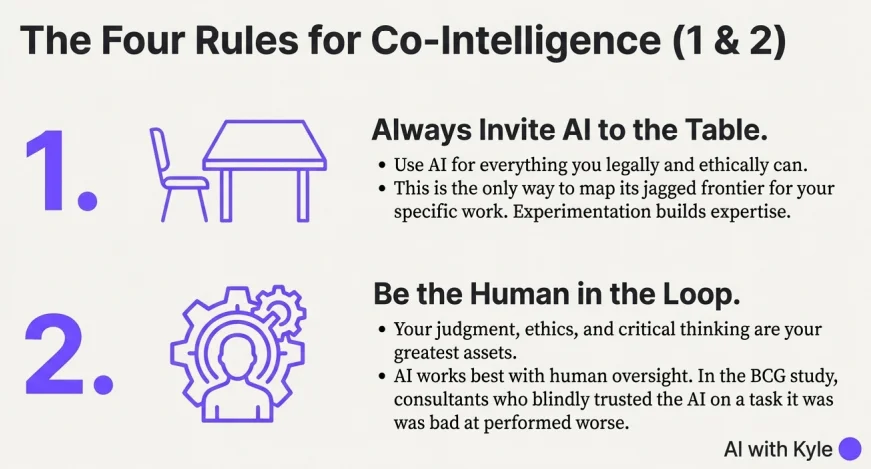
The Four Rules of Co-Intelligence
Ethan Molik's book, "Co-Intelligence: Living and Working with Artificial Intelligence," outlines four essential rules that can help entrepreneurs navigate the complex landscape of AI. These rules are designed to foster a productive partnership between humans and AI, maximizing the benefits of both.
1. Always Invite AI to the Table
The first rule emphasizes the importance of actively integrating AI into your workflow. Rather than viewing it as an afterthought, entrepreneurs should consider AI as a first option when tackling tasks. This experimentation allows you to discover where AI excels and where it may not meet your expectations.
For example, if you're drafting marketing copy, try using AI to generate ideas or even full drafts. This can enhance creativity and efficiency. Over time, as you experiment with AI, you'll build a nuanced understanding of its capabilities, which is vital for making informed decisions about when and how to use it.
2. Be the Human in the Loop
While AI can automate various tasks, the human element remains crucial. This rule reminds us that oversight is necessary. There are instances where AI can produce outputs that are misleading or incorrect, as seen in the case of Deloitte's AI-generated reports that included fabricated citations.
To prevent similar mishaps, always review AI outputs. Use your judgment to assess the quality of the work. Ensuring that a human checks AI-generated content helps maintain accuracy and credibility, which is essential in any business context.
3. Treat AI Like a Person (But Tell It What Kind)
When interacting with AI, it's beneficial to assign it a specific role. By framing your prompts to specify the function you want AI to fulfill—such as "You are an expert copywriter"—you can enhance the quality of the responses. This approach limits the AI's scope, guiding it to provide more relevant and context-specific outputs.
Rather than treating it like a generic search engine, giving it a defined role allows you to harness its strengths more effectively. This can lead to better results in areas such as content creation, data analysis, and strategic planning.
4. Assume This Is the Worst AI You'll Ever Use
The final rule encourages a forward-thinking mindset. AI technology is advancing rapidly, and what may seem limited or ineffective today will likely improve significantly in the near future. Entrepreneurs should approach AI with optimism and patience, recognizing that current limitations are not permanent.
As you continue to explore AI's potential, keep in mind that many models are in a constant state of improvement. This mindset will help you remain adaptable and open to new possibilities, ensuring you are ready to leverage the latest advancements as they become available.
Expert Insights from the Livestream Discussion
During a recent livestream, Kyle Balmer discussed the concept of the "jagged frontier" in AI capabilities. This idea illustrates that AI can be incredibly powerful in certain tasks while lacking in others. For example, AI models may excel at generating creative content but struggle with specific, detail-oriented tasks like counting.
Understanding this jagged frontier can prevent frustration when AI doesn't perform as expected in areas that are not well-suited to its design. It’s crucial for entrepreneurs to align their expectations with AI’s current capabilities and to be aware that the landscape is continually shifting.
Additionally, Balmer highlighted the importance of adapting your approach to using AI. Whether you choose to operate as a "centaur," where tasks are divided between human and AI, or as a cyborg, where AI is deeply integrated into your processes, the key is to remain flexible and responsive to changes in technology.
What's Next
As AI continues to permeate various industries, entrepreneurs must remain proactive in their learning and adaptation. By embracing the four rules of co-intelligence, you can foster a productive relationship with AI that enhances your business operations. Experiment, maintain oversight, set clear roles for AI, and adopt a forward-looking mindset to ensure you stay ahead in the rapidly evolving landscape of artificial intelligence.
The journey with AI is just beginning. As you explore its capabilities, remember to stay curious, experiment boldly, and always be prepared for what comes next.
Key Terms Explained
Co-Intelligence
A framework for collaborating with AI by integrating it into business processes effectively.
Jagged Frontier
The idea that AI performs excellently in some tasks while underperforming in others due to its design limitations.
Cyborg
A model where AI is fully integrated into human processes, allowing for collaboration rather than separation.
Centaur
A model that divides tasks between humans and AI, clarifying roles and responsibilities in workflow.
Generative AI
AI systems that can create content, such as text, images, or music, based on learned patterns from data.
Prompt Engineering
The practice of designing inputs to optimize AI output, often by giving the AI specific roles and instructions.
Deloitte
What This Means For You
Embrace Experimentation
For entrepreneurs, the message is clear: don’t hesitate to experiment with AI in your daily operations. Always reach for AI first when tackling new challenges. This approach will help you discover where AI can enhance your productivity and creativity.
Maintain Human Oversight
Despite AI's capabilities, human judgment is irreplaceable. Always ensure that you review AI outputs to guarantee quality and avoid potential pitfalls. This will not only safeguard your work but also enhance your skills in evaluating AI results.
Stay Adaptable
The landscape of AI is ever-changing. Stay informed about advancements and be ready to adapt your strategies as new capabilities emerge. By viewing AI as a continuously evolving tool, you can leverage its growing strengths to benefit your business.
Frequently Asked Questions
What are the four rules of co-intelligence?
The four rules are: 1) Always invite AI to the table, 2) Be the human in the loop, 3) Treat AI like a person, and 4) Assume this is the worst AI you'll ever use.
How can I effectively integrate AI into my business?
Start by incorporating AI into your processes for tasks like content generation and data analysis, while maintaining human oversight.
Why is human oversight important when using AI?
Human oversight ensures the quality and accuracy of AI outputs, preventing errors and maintaining credibility.
What is the jagged frontier in AI?
The jagged frontier refers to the uneven performance of AI, excelling in some tasks while struggling in others.
What does treating AI like a person mean?
It means assigning AI a specific role to improve its output quality, rather than using it generically.
Sources & References
Love AI with Kyle?
Make us a Preferred Source on Google and catch more of our coverage in your feeds.