
Claude Opus just fell to third place.
Once Fable leaves normal subscriptions, my practical order is Sol, Kimi, Opus, Grok.
That is my order for the sort of coding work I do. Change the job, benchmark or harness and the order changes too. Please don't turn it into the Ten Commandments and shout at me on Twitter (!!). We have enough of that already.
Kimi K-3 is the newest Chinese model, it is already extremely good and it costs far less than the Western premium models.
This is not a future threat. It is here right now.
Kimi doesn't need to beat Fable
Moonshot's new Kimi K3 is a 2.8-trillion-parameter model with native vision and a one-million-token context window. It is built for long coding jobs, knowledge work and agents.
Is it the best? Nope!
But it’s VERY good.
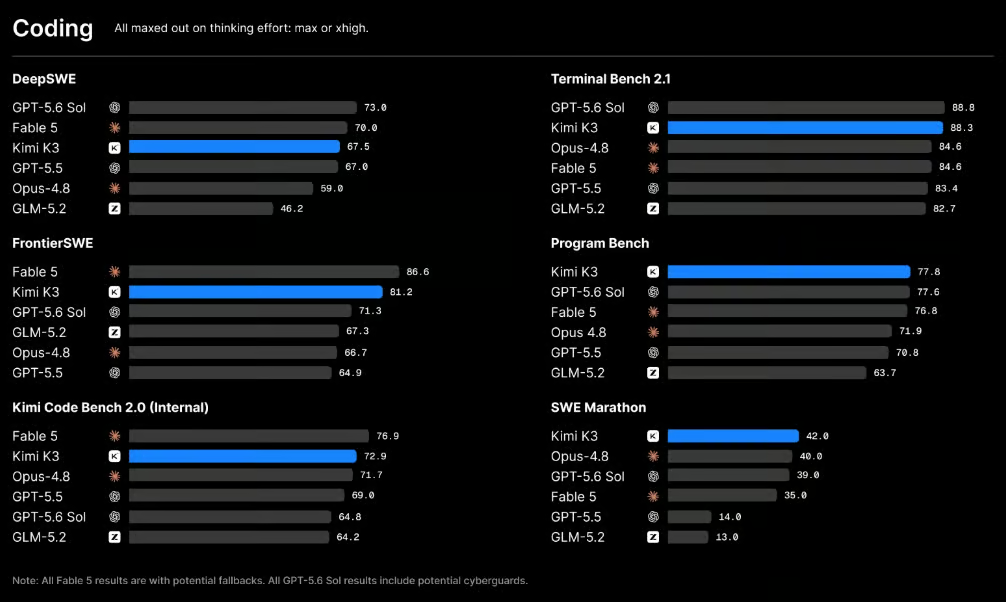
Moonshot's (the makers of Kimi) own numbers still put it behind Fable and ChatGPT Sol overall. Reasonable!
Kimi does not need to win every benchmark. Once Fable disappears from normal subscription access, it only needs to be good enough to push Claude Opus down the list on work people actually care about.
And it is close enough to do that.
AND the open weights are meant to arrive by 27 July.
We will be able to download the whole model.
They are not available yet and K3 is NOT something you can download and casually run on your MacBook. Even when the weights arrive, the model is enormous. At four-bit quantisation, the weights alone would be roughly 1.4TB before overhead. That ain’t fitting on a MacBook!
But it does underline China’s commitment to low cost and open weight models.
Chinese AI isn't just DeepSeek
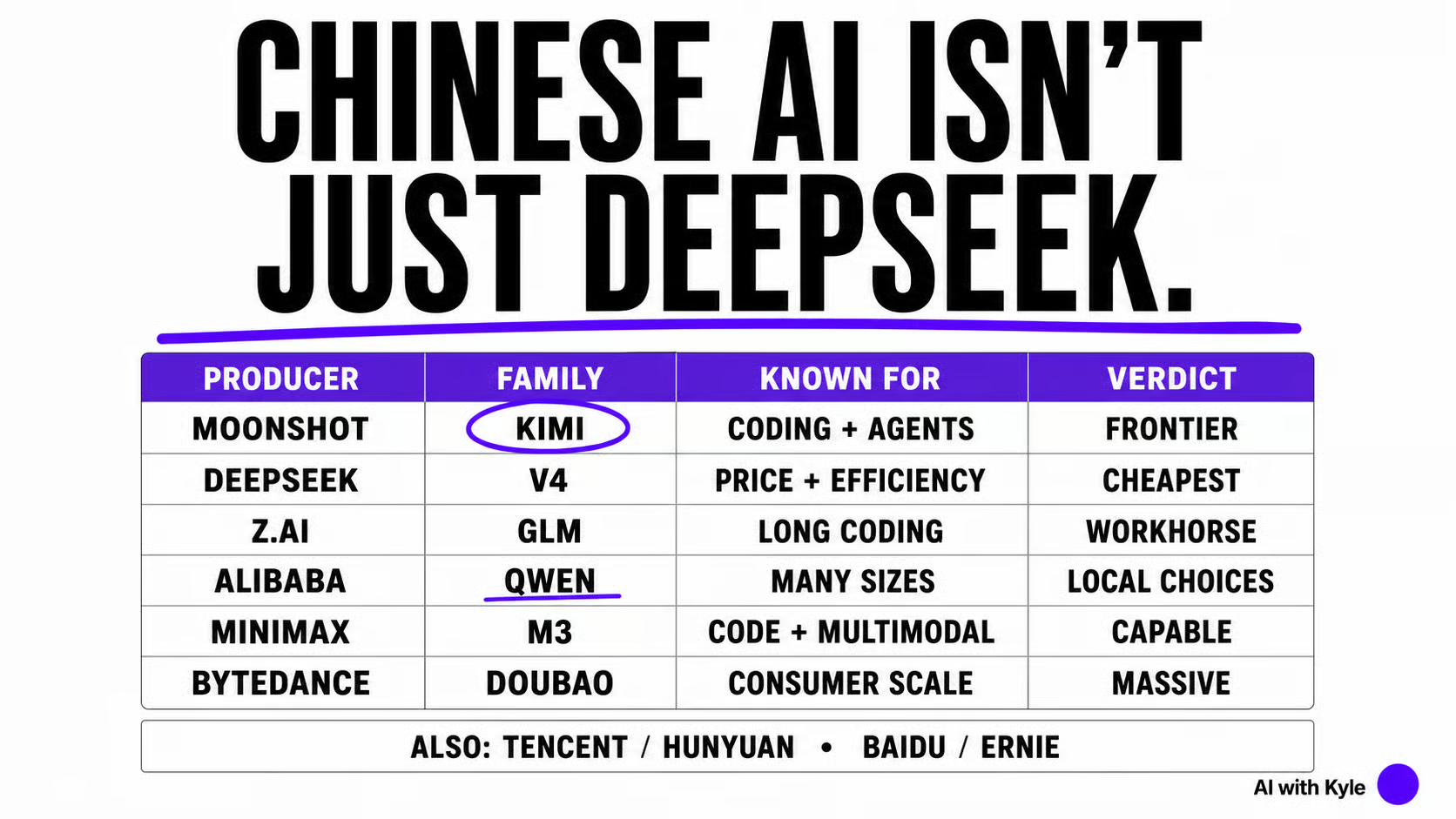
Useful moment in time to recap the Chinese AI ecosystem.
Moonshot makes Kimi. DeepSeek is the price-and-efficiency wrecking ball - cheap as chips. Z.ai makes GLM. Alibaba makes Qwen, including the smaller models I use locally. MiniMax makes the M family. ByteDance makes Doubao and already has absurd consumer distribution through TikTok's Chinese sister app Douyin (the OG TikTok)
You do not need to memorise every version number. They will all change by Tuesday anyway. Same as with the Western labs!
The important bit to remember is that there is now a whole parallel AI market producing serious models for coding, reasoning, translation, agents and boring high-volume business work. A year or two ago Chinese releases tended to sit six to nine months behind the American frontier. Kimi has closed that gap to roughly a month or two.
Cheap is the attack vector
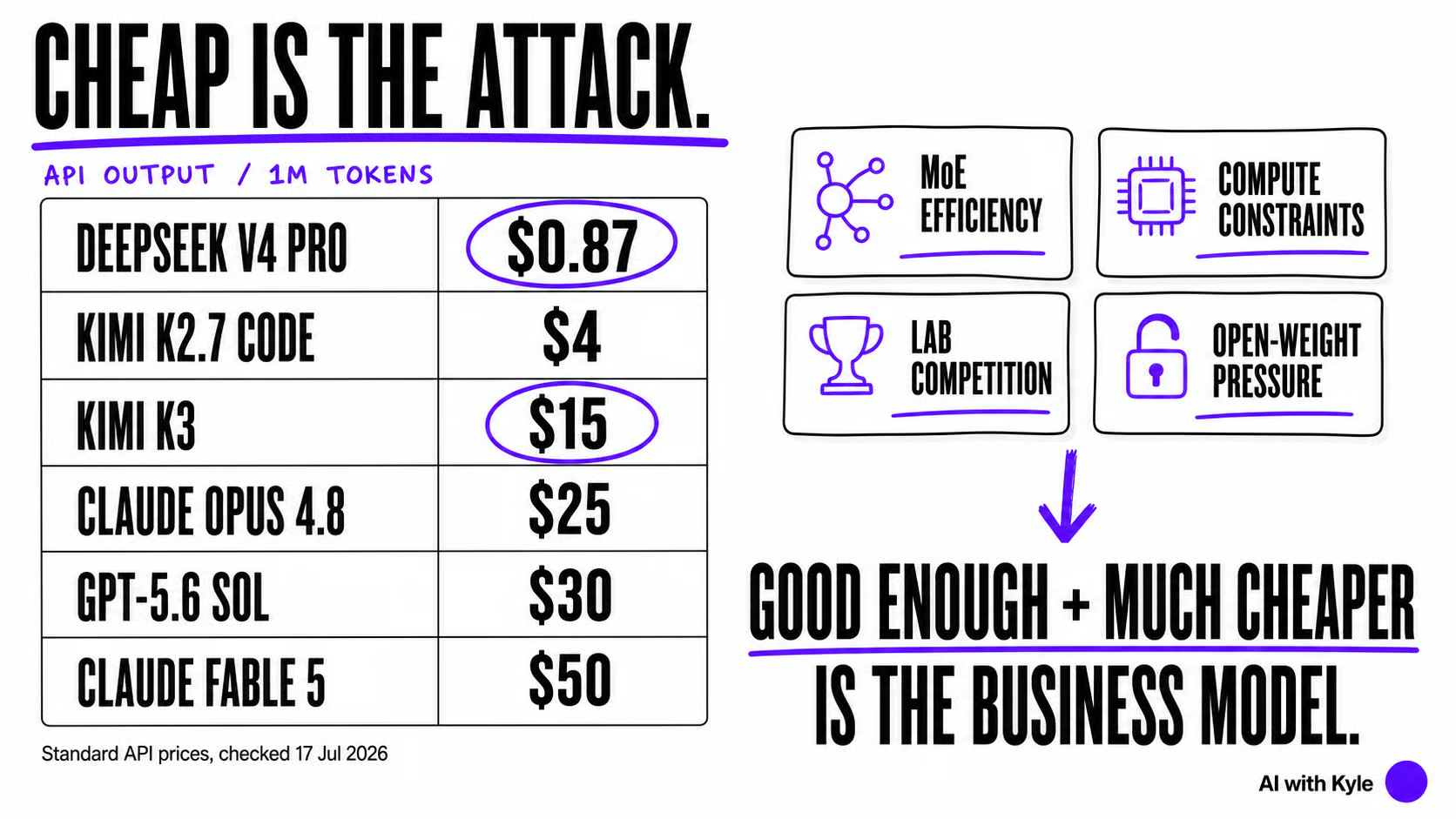
The main threat the Chinese labs pose is cost.
Per million output tokens, the standard API prices I checked were $0.87 for DeepSeek V4 Pro, $15 for Kimi K3, $25 for Claude Opus 4.8, $30 for GPT-5.6 Sol and $50 for Claude Fable 5.
Here’s Artificial Analysis’ cost per Intelligence Index.
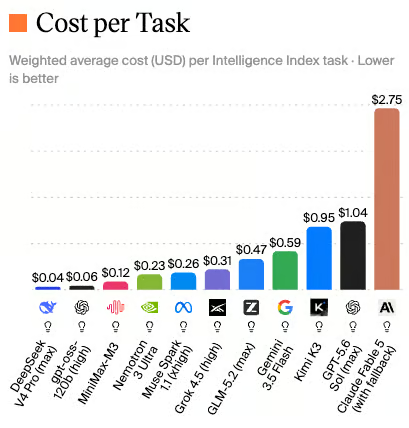
DeepSeek continuing to be obscenely cheap
Those are API output prices, not subscriptions and not the total cost of every job. Input, caching, tools and long context all change the bill. But the direction is kinda obvious…
If a Chinese model gives you 80% or 90% of the quality for a fraction of the cost, you can use more tokens, add checking steps and still spend vastly less.
That is the business model: good enough, much cheaper and available everywhere.
And even that “good enough” is increasingly not far behind Claude and ChatGPT. It used to be 60%-70% as good. Now it’s nipping their heels at 90% as good.
This is a BIG problem if your trillion-dollar IPO valuation relies on selling premium tokens.
I wrote about the wider mechanism in the open-source AI price war. Open-weight alternatives put a ceiling on what closed providers can charge, even when the open model is not quite as good.
Six different things get mixed up
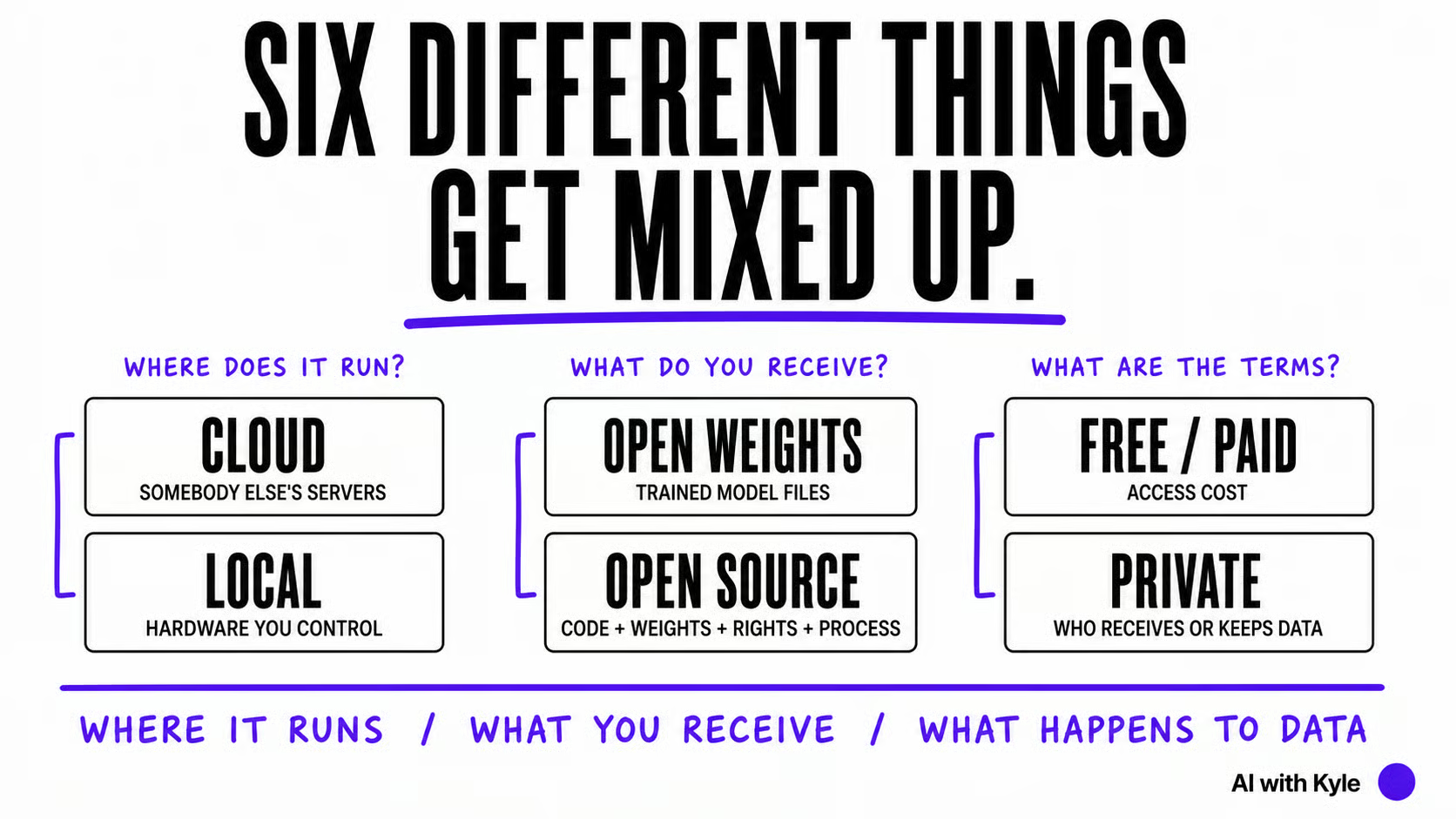
People chuck around open source, local, free and private as if they all mean the same thing.
They do not.
I literally had someone in my comments saying that all the Chinese models are free so the US is in trouble…
Well…not quite. It’s important to be clear on all of this.
Cloud or local tells you where the model runs. Cloud means somebody else's server. Local means hardware you control. Generally when something is cloud based you are paying. When it is local you are not paying (except electricity).
Open or closed tells you what you receive. Open weights means you can download the trained model files under a licence. It does not automatically give you the training data, code, process or unlimited rights. True open source is a much higher bar.
Most American models are strict closed-source. You do not know what’s inside. And the companies releasing this information would tank their valuations.
Free or paid is slippery.
Generally cloud models are paid for with a subscription or API fees. This is what we are used to with ChatGPT and Claude. You pay your monthly fee and get access.
Technically though a closed-source model could be free. For instance OpenAI has some of their older models sitting in the Playground that you can mess around with for free. But that’s a weird edge case.
Open weights models can be paid or free. Which is confusing initially! How can they charge for something that they also give away for free??
Compute is the answer.
You can download Kimi K3 (or at least next week when they release the weights you can). You can then run it locally, fine tune it, do what you want with it. And not pay Moonshot a single penny.
BUT to do so you are going to need a beast of a computer. More likely a server rack. Or several. You can’t just install this on a laptop - you will need several hundred thousand dollars of equipment. At least.
As a result even open-weight model providers (like the Chinese labs) offer cloud versions. Versions you can sign up to on subscriptions and via the API - much like the closed source labs. You are paying for the convenience of, well, not building a data centre in your garage!
If you want the gentle beginner version of local vs. cloud and want to explore setting up local models, my local LLM guide walks through LM Studio, hardware and running your first model without touching the terminal.
China is ahead in usage
One other factor people miss is that China (and indeed most of Asia) is adoption AI extremely quickly.
China had 602 million generative-AI users by the end of 2025. That is 42.8% national adoption with 141.7% growth in a year. The Stanford 2026 AI Index also found workplace AI usage above 80% in China and several other emerging economies.
That matches what I felt when I was there. Beijing bookshops had DeepSeek and AI books piled at the front, not hidden in the computer-science corner. And when I spoke to a woman from Hangzhou, where DeepSeek is based, she was proud of it.
The mood was much closer to "how quickly can we use this?" than "how quickly can we ban it?" The West has spent a lot of time arguing whilst China got on with deploying.
How I'd actually use Chinese AI
Brass tacks! I would not move everything to Kimi tomorrow. Nah.
For hard, valuable or high-risk work, use the best frontier model you can access and check the result. For most work that’s still ChatGPT and Claude. If you are comfortable using them they are still the best. For now!
But definitely experiment around the edges with Chinese models. Mostly to know what’s available and see how they stack up.
For routine coding and high-volume business work, test a cheaper hosted Chinese model. This is where the price gap becomes real. For sensitive, repetitive work, try a smaller local Qwen or DeepSeek model if it clears your quality bar and the app genuinely stays offline.
For anything important, test on your own jobs. As always! There isn’t an objective “best” most of the time. Give three models the same ten tasks. Keep the cheapest one that reliably clears the bar without creating stupid risk.
I have been banging on about this for a while, but do not marry the model. The order changed today. It will change again. Shit, probably next week when Opus 5 drops and/or they keep Fable on the subscription. (I’m writing this Friday evening and the issue comes out Monday morning - let’s see how this holds up!)
Have a poke around. Just check where your data is going first eh?
To the Task,
Kyle
Get the full daily digest in your inbox. Browse recent issues →